
How to Improve Heat Engine Power Density
OCT 9, 20269 MIN READ
Generate Your Research Report Instantly with AI Agent
Patsnap Eureka helps you evaluate technical feasibility & market potential.
Heat Engine Evolution and Power Density Goals
Heat engines have undergone remarkable transformation since their inception in the early 18th century, driven by the perpetual quest to extract maximum mechanical work from thermal energy within increasingly compact configurations. The evolution began with Thomas Newcomen's atmospheric engine in 1712, which exhibited power densities below 1 kW/m³, primarily limited by low operating pressures and inefficient heat transfer mechanisms. James Watt's subsequent improvements in the 1760s introduced separate condensers and higher steam pressures, effectively doubling power output per unit volume.
The industrial revolution catalyzed rapid advancement in heat engine architecture. The transition from reciprocating steam engines to steam turbines in the late 19th century marked a pivotal milestone, as turbines achieved power densities exceeding 100 kW/m³ through higher rotational speeds and improved thermodynamic cycles. Internal combustion engines emerged as game-changers, with Otto and Diesel cycles enabling power densities surpassing 500 kW/m³ by the early 20th century through direct fuel combustion and elevated compression ratios.
Modern aerospace applications have pushed boundaries further, with contemporary gas turbines achieving power densities beyond 10 MW/m³ through advanced materials capable of withstanding temperatures exceeding 1500°C, sophisticated cooling systems, and multi-stage compression. Automotive engines have similarly evolved, with turbocharged gasoline engines now delivering 150-200 kW/liter through direct injection, variable valve timing, and downsizing strategies.
Current technological objectives center on achieving power densities of 15-20 MW/m³ for aviation turbines while maintaining thermal efficiencies above 60% through combined cycle configurations. For automotive applications, targets include 250 kW/liter with reduced emissions through hybridization and advanced combustion control. Emerging technologies such as supercritical CO₂ cycles and rotating detonation engines promise power densities potentially exceeding 50 MW/m³, representing the next frontier in heat engine development. These goals are fundamentally driven by demands for reduced weight in transportation, miniaturization in distributed power generation, and enhanced fuel economy across all sectors.
The industrial revolution catalyzed rapid advancement in heat engine architecture. The transition from reciprocating steam engines to steam turbines in the late 19th century marked a pivotal milestone, as turbines achieved power densities exceeding 100 kW/m³ through higher rotational speeds and improved thermodynamic cycles. Internal combustion engines emerged as game-changers, with Otto and Diesel cycles enabling power densities surpassing 500 kW/m³ by the early 20th century through direct fuel combustion and elevated compression ratios.
Modern aerospace applications have pushed boundaries further, with contemporary gas turbines achieving power densities beyond 10 MW/m³ through advanced materials capable of withstanding temperatures exceeding 1500°C, sophisticated cooling systems, and multi-stage compression. Automotive engines have similarly evolved, with turbocharged gasoline engines now delivering 150-200 kW/liter through direct injection, variable valve timing, and downsizing strategies.
Current technological objectives center on achieving power densities of 15-20 MW/m³ for aviation turbines while maintaining thermal efficiencies above 60% through combined cycle configurations. For automotive applications, targets include 250 kW/liter with reduced emissions through hybridization and advanced combustion control. Emerging technologies such as supercritical CO₂ cycles and rotating detonation engines promise power densities potentially exceeding 50 MW/m³, representing the next frontier in heat engine development. These goals are fundamentally driven by demands for reduced weight in transportation, miniaturization in distributed power generation, and enhanced fuel economy across all sectors.
Market Demand for High Power Density Engines
The global demand for high power density heat engines is experiencing robust growth across multiple sectors, driven by the dual imperatives of performance enhancement and spatial optimization. In transportation applications, the automotive industry faces mounting pressure to develop compact powertrains that deliver superior performance while accommodating increasingly complex vehicle architectures integrating electrification components and advanced safety systems. Aerospace manufacturers similarly require engines with exceptional power-to-weight ratios to improve fuel efficiency and payload capacity, particularly as unmanned aerial vehicles and urban air mobility solutions proliferate.
The marine sector presents substantial opportunities, where vessel operators seek propulsion systems that maximize cargo space while meeting stringent emissions regulations. Commercial shipping companies are particularly interested in engines that can deliver higher output from smaller installations, enabling retrofitting of existing vessels without major structural modifications. Military applications continue to demand compact, high-output engines for tactical vehicles, naval vessels, and portable power generation units operating in space-constrained environments.
Industrial and stationary power generation markets are witnessing growing interest in high power density solutions as urbanization intensifies land-use constraints. Combined heat and power systems for distributed generation require compact footprints to integrate into urban infrastructure, while backup power systems for data centers and critical facilities must maximize output within limited mechanical room allocations. The renewable energy sector also drives demand, as hybrid systems combining heat engines with solar or wind installations require space-efficient thermal backup solutions.
Emerging applications in robotics, autonomous systems, and portable power equipment further expand market potential. Construction and agricultural machinery manufacturers seek downsized engines that maintain performance while improving maneuverability and reducing overall equipment weight. The convergence of electrification trends with traditional combustion technology creates additional demand for range-extending engines in hybrid configurations, where compact dimensions are essential for system integration.
Regulatory frameworks worldwide increasingly favor technologies that reduce material consumption and improve resource efficiency, indirectly promoting power density improvements. Market analysts observe that industries willing to invest in advanced heat engine technologies view power density enhancement not merely as a technical specification but as a strategic differentiator enabling new product categories and competitive advantages in space-sensitive applications.
The marine sector presents substantial opportunities, where vessel operators seek propulsion systems that maximize cargo space while meeting stringent emissions regulations. Commercial shipping companies are particularly interested in engines that can deliver higher output from smaller installations, enabling retrofitting of existing vessels without major structural modifications. Military applications continue to demand compact, high-output engines for tactical vehicles, naval vessels, and portable power generation units operating in space-constrained environments.
Industrial and stationary power generation markets are witnessing growing interest in high power density solutions as urbanization intensifies land-use constraints. Combined heat and power systems for distributed generation require compact footprints to integrate into urban infrastructure, while backup power systems for data centers and critical facilities must maximize output within limited mechanical room allocations. The renewable energy sector also drives demand, as hybrid systems combining heat engines with solar or wind installations require space-efficient thermal backup solutions.
Emerging applications in robotics, autonomous systems, and portable power equipment further expand market potential. Construction and agricultural machinery manufacturers seek downsized engines that maintain performance while improving maneuverability and reducing overall equipment weight. The convergence of electrification trends with traditional combustion technology creates additional demand for range-extending engines in hybrid configurations, where compact dimensions are essential for system integration.
Regulatory frameworks worldwide increasingly favor technologies that reduce material consumption and improve resource efficiency, indirectly promoting power density improvements. Market analysts observe that industries willing to invest in advanced heat engine technologies view power density enhancement not merely as a technical specification but as a strategic differentiator enabling new product categories and competitive advantages in space-sensitive applications.
Current Power Density Limitations and Technical Barriers
Heat engine power density, defined as power output per unit volume or mass, faces fundamental thermodynamic and engineering constraints that limit performance across all engine architectures. The primary barrier stems from the Carnot efficiency ceiling, which restricts maximum theoretical efficiency based on operating temperature differentials. Real-world engines operate far below this limit due to irreversible losses including friction, heat transfer inefficiencies, and incomplete combustion processes. These thermodynamic losses directly constrain how much useful work can be extracted from a given fuel mass within a compact engine volume.
Material limitations present critical technical barriers to power density enhancement. High-temperature components such as turbine blades, cylinder heads, and combustion chambers must withstand extreme thermal and mechanical stresses while maintaining structural integrity. Current superalloys and ceramic materials impose upper temperature limits typically between 1200-1600°C for continuous operation. Exceeding these thresholds leads to creep deformation, thermal fatigue, and oxidation degradation. This temperature ceiling directly limits compression ratios and peak cycle temperatures, thereby constraining achievable power density improvements.
Heat rejection systems constitute another significant bottleneck. As power density increases, waste heat generation intensifies proportionally, requiring more effective cooling mechanisms. Conventional air and liquid cooling systems add substantial weight and volume, creating a paradoxical situation where attempts to increase power density are offset by enlarged thermal management infrastructure. The challenge intensifies in compact applications where space constraints prevent adequate heat exchanger sizing, forcing operation at reduced power levels to avoid thermal damage.
Mechanical stress limitations further restrict power density advancement. Higher power output demands increased rotational speeds, combustion pressures, and mechanical loads on engine components. Bearings, crankshafts, connecting rods, and valve trains face escalating fatigue stresses that reduce operational lifespan and reliability. The trade-off between peak performance and durability becomes increasingly unfavorable as power density targets rise, particularly in applications requiring extended service intervals.
Combustion efficiency barriers also impede progress. Achieving complete fuel oxidation within increasingly compact combustion chambers and shortened residence times proves challenging. Incomplete combustion results in unburned hydrocarbons, reduced thermal efficiency, and increased emissions. Advanced fuel injection strategies and combustion chamber geometries can partially address these issues but introduce additional complexity and cost while still facing fundamental mixing and reaction kinetics limitations in confined spaces.
Material limitations present critical technical barriers to power density enhancement. High-temperature components such as turbine blades, cylinder heads, and combustion chambers must withstand extreme thermal and mechanical stresses while maintaining structural integrity. Current superalloys and ceramic materials impose upper temperature limits typically between 1200-1600°C for continuous operation. Exceeding these thresholds leads to creep deformation, thermal fatigue, and oxidation degradation. This temperature ceiling directly limits compression ratios and peak cycle temperatures, thereby constraining achievable power density improvements.
Heat rejection systems constitute another significant bottleneck. As power density increases, waste heat generation intensifies proportionally, requiring more effective cooling mechanisms. Conventional air and liquid cooling systems add substantial weight and volume, creating a paradoxical situation where attempts to increase power density are offset by enlarged thermal management infrastructure. The challenge intensifies in compact applications where space constraints prevent adequate heat exchanger sizing, forcing operation at reduced power levels to avoid thermal damage.
Mechanical stress limitations further restrict power density advancement. Higher power output demands increased rotational speeds, combustion pressures, and mechanical loads on engine components. Bearings, crankshafts, connecting rods, and valve trains face escalating fatigue stresses that reduce operational lifespan and reliability. The trade-off between peak performance and durability becomes increasingly unfavorable as power density targets rise, particularly in applications requiring extended service intervals.
Combustion efficiency barriers also impede progress. Achieving complete fuel oxidation within increasingly compact combustion chambers and shortened residence times proves challenging. Incomplete combustion results in unburned hydrocarbons, reduced thermal efficiency, and increased emissions. Advanced fuel injection strategies and combustion chamber geometries can partially address these issues but introduce additional complexity and cost while still facing fundamental mixing and reaction kinetics limitations in confined spaces.
Mainstream Power Density Enhancement Solutions
01 Geared turbofan and gas turbine engines with specified power density ranges
Technological advancements in gas turbine and geared turbofan engines focus on defining and optimizing power density ranges. These design configurations improve engine thrust-to-weight ratios and overall operational efficiency through targeted architectural and gear ratio enhancements.- Geared turbofan and gas turbine engines with specified power density ranges: Technological advancements in aviation power plants focus on optimizing gas turbine and geared turbofan engines to achieve high power density ranges. These configurations utilize specialized gearboxes and structural arrangements to maximize performance and power output while maintaining compact dimensions.
- Heat exchanger capacity and thermal management for high power density engine gearboxes: Thermal management systems enhance heat exchanger capacity specifically tailored for turbofan engine gearboxes, including power and accessory gearboxes. Effective cooling and heat dissipation prevent overheating in high power density components, thereby ensuring structural integrity and operating efficiency.
- Waste heat recovery and power generation from engine thermal energy: Methods and systems capture waste heat from internal combustion engines, ship cylinder liner cooling water, or industrial boilers to drive secondary heat engines or power generators. Utilizing shape memory alloys or waste heat power cycles increases overall energy efficiency and system sustainability.
- Internal combustion engine optimization for increased power density: Piston engines, six-stroke configurations, and split-cycle engines are optimized through specific power density matching, firing density transition management, and performance criteria. These developments improve engine power output, control combustion efficiency, and reduce operational costs without adding excessive maintenance.
- Direct cooling of high power density devices using fluids and heat pipes: Advanced cooling apparatuses and devices utilize electrically conducting fluids, increased heat dissipation surfaces, and liquid immersion to cool high power density modules and high heat flux equipment. These technologies effectively prevent component failure and short circuits caused by poor thermal dissipation.
02 Heat management and cooling systems for high power density engines and components
Methods and apparatuses for thermal management involve heat exchangers, fluid-based cooling, and heat dissipation techniques. These solutions address critical heat loads in high power density engines, power gearboxes, and related electrical or high-heat components to maintain efficiency and prevent failure.Expand Specific Solutions03 Energy harvesting and power generation utilizing waste heat from engines
Systems and methods capture waste heat from heat engine exhausts, cooling loops, or industrial processes to generate supplemental power. Utilizing devices like heat pumps, linear generators, shape-memory drives, or specialized boiler controls converts thermal losses into useful electrical or mechanical energy.Expand Specific Solutions04 Optimizing internal combustion engine operation and power density matching
Engine operational methods enhance performance through split-cycle configurations, multi-stroke power density matching, optimized firing/pumping density transitions, and dual-fuel efficiency criteria. These techniques maximize power output while reducing mechanical losses and operational costs.Expand Specific Solutions05 Specialized heat engine configurations and thermodynamic cycles
Novel structural designs and control strategies for heat engines incorporate variable density media, ambient-temperature systems, shape-memory alloy mechanisms, and electronic continuously variable transmissions to regulate power output and improve overall energy conversion efficiency.Expand Specific Solutions
Leading Manufacturers in Advanced Heat Engine Systems
The heat engine power density improvement landscape represents a mature yet evolving technological domain, characterized by intensifying competition across traditional and emerging energy sectors. The market spans construction machinery, automotive powertrains, and energy systems, with significant growth driven by electrification and efficiency demands. Technology maturity varies considerably among key players: established manufacturers like Weichai Power, FAW Jiefang Automotive, Yanmar, and Siemens Energy demonstrate advanced capabilities in conventional engine optimization and hybrid systems, while research institutions including North China Electric Power University and China Northern Engine Research Institute drive fundamental innovations. Emerging specialists such as Moore Power (Beijing) Technology and Modern Hydrogen pursue breakthrough approaches in low-entropy engines and alternative energy conversion. Companies like LG Electronics and DeepBlue Automotive represent the convergence with electric powertrains, while Eaton Intelligent Power and Mechanology focus on component-level innovations in compressors and power electronics, collectively indicating a transitional phase toward higher power density through both incremental refinements and disruptive technologies.
Yanmar Co., Ltd.
Technical Solution: Yanmar specializes in compact, high power density diesel engines for marine, agricultural, and construction applications. Their technical approach emphasizes advanced combustion optimization through precise fuel injection timing and spray pattern control, achieving higher peak cylinder pressures and improved thermal efficiency. Yanmar implements compact turbocharging systems specifically designed for small-displacement engines, including variable geometry turbochargers that maintain boost pressure across wide operating ranges. The company utilizes advanced engine architecture with optimized bore-to-stroke ratios and compact packaging designs that maximize displacement within minimal envelope dimensions. Their engines incorporate lightweight materials and integrated component designs that reduce parasitic mass while maintaining durability, achieving specific power outputs exceeding 60 kW/L in some applications.
Strengths: Specialized expertise in compact engine design, strong reputation for reliability in demanding applications, efficient production systems for small to medium volume manufacturing. Weaknesses: Limited presence in large-scale industrial or automotive markets, smaller R&D budget compared to major automotive manufacturers.
Eaton Intelligent Power Ltd.
Technical Solution: Eaton focuses on improving heat engine power density through advanced power management and hybrid system integration technologies. Their solutions include variable valve actuation systems that optimize engine breathing across operating ranges, cylinder deactivation technologies for improved efficiency, and integrated hybrid systems combining internal combustion engines with electric motors. Eaton's approach emphasizes waste heat recovery systems using organic Rankine cycle technology to convert exhaust thermal energy into additional mechanical power. They also develop advanced transmission systems with optimized gear ratios and reduced parasitic losses, enabling engines to operate at peak efficiency points more frequently, thus improving effective power density in real-world applications.
Strengths: Comprehensive system integration expertise, strong position in hybrid powertrain components, global market presence and customer base. Weaknesses: Dependent on OEM partnerships for implementation, solutions require significant system-level integration complexity.
Key Patents in Compact Heat Engine Design
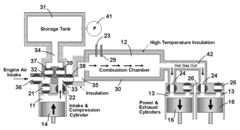
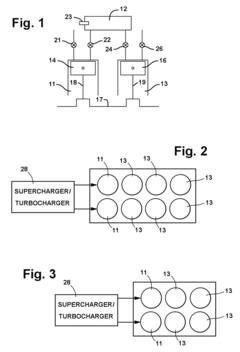
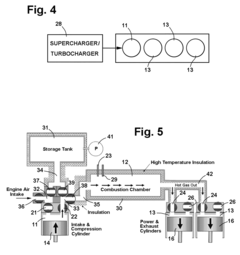
Split cycle engine and method with increased power density
PatentInactiveUS9074526B2
Innovation
- A split cycle engine design where air is compressed and stored, then used to drive an expansion chamber, allowing for increased power output by varying air intake and using a blower or pneumatic storage to recapture energy, thereby maintaining efficiency and reducing costs.
Method of generating power and an osmotic heat engine
PatentInactiveIL198579A
Innovation
- A closed-loop osmotic heat engine utilizing a semi-permeable membrane with a deionized water working fluid and an ammonia-carbon dioxide draw solution, which is highly soluble, completely removable, and generates high osmotic pressure gradients, minimizing internal concentration polarization and environmental impact.


Material Science Breakthroughs for Engine Miniaturization
Material science innovations have emerged as critical enablers for achieving substantial reductions in heat engine physical dimensions while maintaining or enhancing power output capabilities. Advanced ceramic matrix composites, particularly silicon carbide reinforced materials, now demonstrate operational stability at temperatures exceeding 1400°C, enabling combustion chamber volume reductions of up to 40% compared to conventional metallic designs. These materials exhibit thermal conductivity coefficients below 15 W/m·K while maintaining structural integrity under cyclic thermal loading, directly supporting miniaturization objectives without compromising thermodynamic efficiency.
Recent developments in single-crystal superalloys incorporating rhenium and ruthenium additions have pushed creep resistance boundaries to new thresholds. Third-generation superalloys now sustain stress levels above 450 MPa at 1100°C for extended operational periods, permitting thinner wall sections in turbine components and reducing overall engine mass by 25-30%. The grain boundary strengthening mechanisms in these alloys enable designers to specify smaller safety margins, translating directly into compact geometries.
Thermal barrier coating systems have undergone transformative improvements through the integration of rare-earth oxides and multilayer architectures. Current generation coatings achieve thermal gradient capabilities exceeding 200°C across sub-millimeter thicknesses, allowing substrate materials to operate closer to their performance limits. This thermal management advancement permits higher specific power outputs from reduced displacement volumes, as combustion intensities can increase without proportional increases in cooling requirements.
Additive manufacturing techniques have unlocked unprecedented design freedoms in material deployment. Selective laser melting processes now produce functionally graded materials with spatially optimized properties, enabling component consolidation that eliminates traditional assembly interfaces. Lattice structures with controlled porosity provide targeted cooling pathways while minimizing material usage, achieving strength-to-weight ratios previously unattainable through conventional manufacturing. These fabrication capabilities directly facilitate the realization of miniaturized engine architectures that were theoretically possible but practically unachievable with traditional production methods.
Recent developments in single-crystal superalloys incorporating rhenium and ruthenium additions have pushed creep resistance boundaries to new thresholds. Third-generation superalloys now sustain stress levels above 450 MPa at 1100°C for extended operational periods, permitting thinner wall sections in turbine components and reducing overall engine mass by 25-30%. The grain boundary strengthening mechanisms in these alloys enable designers to specify smaller safety margins, translating directly into compact geometries.
Thermal barrier coating systems have undergone transformative improvements through the integration of rare-earth oxides and multilayer architectures. Current generation coatings achieve thermal gradient capabilities exceeding 200°C across sub-millimeter thicknesses, allowing substrate materials to operate closer to their performance limits. This thermal management advancement permits higher specific power outputs from reduced displacement volumes, as combustion intensities can increase without proportional increases in cooling requirements.
Additive manufacturing techniques have unlocked unprecedented design freedoms in material deployment. Selective laser melting processes now produce functionally graded materials with spatially optimized properties, enabling component consolidation that eliminates traditional assembly interfaces. Lattice structures with controlled porosity provide targeted cooling pathways while minimizing material usage, achieving strength-to-weight ratios previously unattainable through conventional manufacturing. These fabrication capabilities directly facilitate the realization of miniaturized engine architectures that were theoretically possible but practically unachievable with traditional production methods.
Environmental Regulations Impact on Engine Design
Environmental regulations have emerged as a critical driving force reshaping heat engine design philosophies, fundamentally altering the traditional approach to maximizing power density. Stringent emission standards, particularly those targeting nitrogen oxides, particulate matter, and carbon dioxide, have compelled engineers to integrate complex after-treatment systems and adopt cleaner combustion strategies. These regulatory requirements often introduce design constraints that directly conflict with conventional power density optimization methods, creating a challenging balance between performance enhancement and environmental compliance.
The implementation of emission control technologies such as selective catalytic reduction systems, diesel particulate filters, and exhaust gas recirculation mechanisms adds significant weight and volume to engine packages. This additional hardware directly reduces the effective power-to-weight ratio, counteracting efforts to improve power density through core engine optimization. Furthermore, these systems impose thermal management challenges and parasitic power losses that must be carefully managed to maintain overall efficiency targets while meeting regulatory thresholds.
Fuel quality regulations and carbon intensity standards are driving a fundamental shift in combustion system design. The transition toward lower carbon fuels, including biofuels, synthetic fuels, and hydrogen blends, requires substantial modifications to fuel injection systems, combustion chamber geometries, and control strategies. These adaptations often necessitate conservative calibration approaches that prioritize emissions compliance over peak power output, thereby limiting the achievable power density within regulatory boundaries.
Noise and vibration regulations further constrain design freedom, particularly in urban and residential applications. Acoustic insulation requirements and operational restrictions during specific hours demand additional sound-dampening materials and modified operating profiles, both of which impact the power density equation. The cumulative effect of these environmental mandates necessitates innovative engineering solutions that can simultaneously achieve high power density while satisfying increasingly stringent regulatory frameworks, pushing the boundaries of materials science, combustion technology, and system integration capabilities.
The implementation of emission control technologies such as selective catalytic reduction systems, diesel particulate filters, and exhaust gas recirculation mechanisms adds significant weight and volume to engine packages. This additional hardware directly reduces the effective power-to-weight ratio, counteracting efforts to improve power density through core engine optimization. Furthermore, these systems impose thermal management challenges and parasitic power losses that must be carefully managed to maintain overall efficiency targets while meeting regulatory thresholds.
Fuel quality regulations and carbon intensity standards are driving a fundamental shift in combustion system design. The transition toward lower carbon fuels, including biofuels, synthetic fuels, and hydrogen blends, requires substantial modifications to fuel injection systems, combustion chamber geometries, and control strategies. These adaptations often necessitate conservative calibration approaches that prioritize emissions compliance over peak power output, thereby limiting the achievable power density within regulatory boundaries.
Noise and vibration regulations further constrain design freedom, particularly in urban and residential applications. Acoustic insulation requirements and operational restrictions during specific hours demand additional sound-dampening materials and modified operating profiles, both of which impact the power density equation. The cumulative effect of these environmental mandates necessitates innovative engineering solutions that can simultaneously achieve high power density while satisfying increasingly stringent regulatory frameworks, pushing the boundaries of materials science, combustion technology, and system integration capabilities.
Unlock deeper insights with Patsnap Eureka Quick Research — get a full tech report to explore trends and direct your research. Try now!
Generate Your Research Report Instantly with AI Agent
Supercharge your innovation with Patsnap Eureka AI Agent Platform!