
How to Increase Adaptive Capacity with Control Engineering
MAR 27, 20269 MIN READ
Generate Your Research Report Instantly with AI Agent
Patsnap Eureka helps you evaluate technical feasibility & market potential.
Adaptive Control Engineering Background and Objectives
Adaptive control engineering has emerged as a critical discipline within the broader field of control systems, addressing the fundamental challenge of maintaining optimal performance in dynamic and uncertain environments. The field originated from the recognition that traditional fixed-parameter controllers often fail to deliver satisfactory performance when system parameters change or when operating conditions deviate from design specifications. This limitation became particularly evident in aerospace applications during the 1950s, where aircraft dynamics varied significantly across different flight conditions.
The evolution of adaptive control can be traced through several key phases, beginning with early model reference adaptive control (MRAC) systems and self-tuning regulators in the 1960s. These pioneering approaches laid the groundwork for more sophisticated methodologies that emerged in subsequent decades. The development progressed through robust adaptive control in the 1980s, nonlinear adaptive control in the 1990s, and more recently, machine learning-enhanced adaptive systems that leverage artificial intelligence to improve adaptation mechanisms.
Contemporary adaptive control systems face increasingly complex challenges as modern industrial processes become more sophisticated and interconnected. The integration of cyber-physical systems, Internet of Things devices, and distributed control architectures has created new demands for adaptive capacity. These systems must now handle not only parameter variations and disturbances but also network delays, communication failures, and cybersecurity threats while maintaining real-time performance requirements.
The primary objective of increasing adaptive capacity in control engineering centers on developing systems that can automatically adjust their behavior to maintain desired performance levels despite uncertainties and changes in the operating environment. This involves creating controllers that can identify system parameters in real-time, adapt control laws accordingly, and ensure stability throughout the adaptation process. Key technical goals include reducing adaptation time, improving transient performance during adaptation phases, and enhancing robustness against modeling errors and external disturbances.
Modern research directions focus on integrating advanced computational techniques such as neural networks, fuzzy logic, and reinforcement learning to enhance adaptive capabilities. The objective extends beyond traditional parameter adaptation to include structural adaptation, where the control architecture itself can be modified based on changing requirements. This represents a paradigm shift toward truly intelligent control systems capable of autonomous decision-making and continuous improvement through experience.
The evolution of adaptive control can be traced through several key phases, beginning with early model reference adaptive control (MRAC) systems and self-tuning regulators in the 1960s. These pioneering approaches laid the groundwork for more sophisticated methodologies that emerged in subsequent decades. The development progressed through robust adaptive control in the 1980s, nonlinear adaptive control in the 1990s, and more recently, machine learning-enhanced adaptive systems that leverage artificial intelligence to improve adaptation mechanisms.
Contemporary adaptive control systems face increasingly complex challenges as modern industrial processes become more sophisticated and interconnected. The integration of cyber-physical systems, Internet of Things devices, and distributed control architectures has created new demands for adaptive capacity. These systems must now handle not only parameter variations and disturbances but also network delays, communication failures, and cybersecurity threats while maintaining real-time performance requirements.
The primary objective of increasing adaptive capacity in control engineering centers on developing systems that can automatically adjust their behavior to maintain desired performance levels despite uncertainties and changes in the operating environment. This involves creating controllers that can identify system parameters in real-time, adapt control laws accordingly, and ensure stability throughout the adaptation process. Key technical goals include reducing adaptation time, improving transient performance during adaptation phases, and enhancing robustness against modeling errors and external disturbances.
Modern research directions focus on integrating advanced computational techniques such as neural networks, fuzzy logic, and reinforcement learning to enhance adaptive capabilities. The objective extends beyond traditional parameter adaptation to include structural adaptation, where the control architecture itself can be modified based on changing requirements. This represents a paradigm shift toward truly intelligent control systems capable of autonomous decision-making and continuous improvement through experience.
Market Demand for Adaptive Control Systems
The global market for adaptive control systems is experiencing unprecedented growth driven by increasing complexity in industrial processes and the demand for autonomous operation capabilities. Manufacturing industries, particularly automotive, aerospace, and chemical processing sectors, are actively seeking control solutions that can automatically adjust to changing operational conditions without human intervention. This demand stems from the need to maintain optimal performance while reducing operational costs and minimizing downtime.
Aerospace and defense applications represent one of the most significant market segments for adaptive control technologies. Modern aircraft systems require control mechanisms that can compensate for varying flight conditions, payload changes, and component degradation over time. Similarly, unmanned aerial vehicles and autonomous spacecraft missions demand robust adaptive control capabilities to handle unpredictable environmental conditions and system uncertainties.
The automotive industry is driving substantial demand through the development of autonomous vehicles and advanced driver assistance systems. These applications require control systems that can adapt to diverse driving conditions, vehicle dynamics changes, and sensor uncertainties. Electric vehicle manufacturers are particularly interested in adaptive battery management and motor control systems that can optimize performance across varying operating conditions.
Industrial automation and robotics sectors are increasingly adopting adaptive control solutions to handle manufacturing variability and product customization demands. Smart manufacturing initiatives require control systems capable of adapting to different product specifications, material properties, and production schedules without extensive reprogramming or manual intervention.
Energy sector applications, including renewable energy systems and smart grid technologies, present growing market opportunities. Wind turbine control systems must adapt to varying wind conditions, while solar tracking systems require adaptive algorithms to maximize energy capture throughout different weather patterns and seasonal changes.
The healthcare and medical device industry is emerging as a significant market driver, particularly for adaptive control in surgical robotics, prosthetics, and patient monitoring systems. These applications demand precise control adaptation to individual patient characteristics and real-time physiological changes.
Market growth is further accelerated by the integration of artificial intelligence and machine learning technologies with traditional control engineering approaches. This convergence enables more sophisticated adaptive capabilities and opens new application domains across various industries seeking intelligent automation solutions.
Aerospace and defense applications represent one of the most significant market segments for adaptive control technologies. Modern aircraft systems require control mechanisms that can compensate for varying flight conditions, payload changes, and component degradation over time. Similarly, unmanned aerial vehicles and autonomous spacecraft missions demand robust adaptive control capabilities to handle unpredictable environmental conditions and system uncertainties.
The automotive industry is driving substantial demand through the development of autonomous vehicles and advanced driver assistance systems. These applications require control systems that can adapt to diverse driving conditions, vehicle dynamics changes, and sensor uncertainties. Electric vehicle manufacturers are particularly interested in adaptive battery management and motor control systems that can optimize performance across varying operating conditions.
Industrial automation and robotics sectors are increasingly adopting adaptive control solutions to handle manufacturing variability and product customization demands. Smart manufacturing initiatives require control systems capable of adapting to different product specifications, material properties, and production schedules without extensive reprogramming or manual intervention.
Energy sector applications, including renewable energy systems and smart grid technologies, present growing market opportunities. Wind turbine control systems must adapt to varying wind conditions, while solar tracking systems require adaptive algorithms to maximize energy capture throughout different weather patterns and seasonal changes.
The healthcare and medical device industry is emerging as a significant market driver, particularly for adaptive control in surgical robotics, prosthetics, and patient monitoring systems. These applications demand precise control adaptation to individual patient characteristics and real-time physiological changes.
Market growth is further accelerated by the integration of artificial intelligence and machine learning technologies with traditional control engineering approaches. This convergence enables more sophisticated adaptive capabilities and opens new application domains across various industries seeking intelligent automation solutions.
Current State and Challenges in Adaptive Control
Adaptive control systems have evolved significantly over the past decades, yet several fundamental challenges continue to impede their widespread implementation across industrial applications. The current landscape reveals a complex interplay between theoretical advances and practical limitations that define the boundaries of what is achievable with existing adaptive control methodologies.
Modern adaptive control architectures primarily rely on model reference adaptive control (MRAC), self-tuning regulators (STR), and dual control approaches. These systems demonstrate remarkable capabilities in handling parametric uncertainties and slowly varying system dynamics. However, their performance degrades substantially when confronted with unmodeled dynamics, measurement noise, and rapid environmental changes that exceed the adaptation bandwidth.
The computational burden associated with real-time parameter estimation and control law updates presents a significant obstacle, particularly in high-frequency control applications. Current adaptive algorithms often struggle to maintain stability guarantees while achieving satisfactory transient performance, creating a fundamental trade-off that limits their practical deployment in safety-critical systems.
Robustness remains a critical concern, as traditional adaptive controllers can exhibit poor performance or even instability when faced with unstructured uncertainties, actuator saturation, and sensor failures. The lack of guaranteed finite-time convergence in many adaptive schemes further complicates their application in time-sensitive operations where rapid adaptation is essential.
Parameter drift and bursting phenomena continue to plague adaptive systems, especially in the presence of persistent disturbances or when the reference signals lack sufficient richness for proper excitation. These issues are particularly pronounced in aerospace, automotive, and process control applications where environmental conditions can change rapidly and unpredictably.
The integration of adaptive control with modern digital communication networks introduces additional challenges related to time delays, packet losses, and bandwidth limitations. These networked control scenarios demand new theoretical frameworks that can accommodate the stochastic nature of communication channels while maintaining adaptive performance.
Current research efforts focus on developing more robust adaptive algorithms that can handle broader classes of uncertainties while providing stronger stability and performance guarantees. Machine learning integration, particularly reinforcement learning approaches, shows promise but introduces new complexities related to data requirements, training stability, and interpretability in safety-critical applications.
Modern adaptive control architectures primarily rely on model reference adaptive control (MRAC), self-tuning regulators (STR), and dual control approaches. These systems demonstrate remarkable capabilities in handling parametric uncertainties and slowly varying system dynamics. However, their performance degrades substantially when confronted with unmodeled dynamics, measurement noise, and rapid environmental changes that exceed the adaptation bandwidth.
The computational burden associated with real-time parameter estimation and control law updates presents a significant obstacle, particularly in high-frequency control applications. Current adaptive algorithms often struggle to maintain stability guarantees while achieving satisfactory transient performance, creating a fundamental trade-off that limits their practical deployment in safety-critical systems.
Robustness remains a critical concern, as traditional adaptive controllers can exhibit poor performance or even instability when faced with unstructured uncertainties, actuator saturation, and sensor failures. The lack of guaranteed finite-time convergence in many adaptive schemes further complicates their application in time-sensitive operations where rapid adaptation is essential.
Parameter drift and bursting phenomena continue to plague adaptive systems, especially in the presence of persistent disturbances or when the reference signals lack sufficient richness for proper excitation. These issues are particularly pronounced in aerospace, automotive, and process control applications where environmental conditions can change rapidly and unpredictably.
The integration of adaptive control with modern digital communication networks introduces additional challenges related to time delays, packet losses, and bandwidth limitations. These networked control scenarios demand new theoretical frameworks that can accommodate the stochastic nature of communication channels while maintaining adaptive performance.
Current research efforts focus on developing more robust adaptive algorithms that can handle broader classes of uncertainties while providing stronger stability and performance guarantees. Machine learning integration, particularly reinforcement learning approaches, shows promise but introduces new complexities related to data requirements, training stability, and interpretability in safety-critical applications.
Existing Adaptive Control Solutions
01 Adaptive control systems with real-time parameter adjustment
Adaptive control systems that can automatically adjust parameters in real-time based on changing operating conditions or system dynamics. These systems utilize feedback mechanisms and algorithms to continuously monitor system performance and modify control parameters to maintain optimal operation. The adaptive capacity enables the control system to handle variations in process characteristics, disturbances, and uncertainties without manual intervention.- Adaptive control systems with real-time parameter adjustment: Adaptive control systems that can automatically adjust parameters in real-time based on changing operating conditions or system dynamics. These systems utilize feedback mechanisms and algorithms to continuously monitor system performance and modify control parameters to maintain optimal operation. The adaptive capacity enables the control system to handle variations in process characteristics, disturbances, and uncertainties without manual intervention.
- Machine learning and artificial intelligence based adaptive control: Integration of machine learning algorithms and artificial intelligence techniques to enhance the adaptive capacity of control systems. These approaches enable the system to learn from historical data, recognize patterns, and predict future system behavior. The control system can automatically optimize its performance by training on operational data and adapting its control strategies based on learned models and intelligent decision-making processes.
- Multi-variable adaptive control with dynamic optimization: Advanced control engineering systems capable of handling multiple variables simultaneously while maintaining adaptive capacity. These systems employ dynamic optimization techniques to balance competing objectives and constraints across different control parameters. The adaptive mechanisms allow for coordinated adjustment of multiple control variables to achieve overall system optimization under varying operational conditions.
- Robust adaptive control with uncertainty compensation: Control systems designed with robust adaptive capabilities to handle uncertainties, noise, and external disturbances. These systems incorporate compensation mechanisms that can identify and counteract unknown or time-varying system parameters. The adaptive capacity includes fault tolerance and the ability to maintain stable operation even when facing significant model uncertainties or unexpected changes in system dynamics.
- Distributed and networked adaptive control architectures: Adaptive control systems implemented in distributed or networked environments where multiple control nodes work cooperatively. These architectures enable scalable adaptive capacity across complex systems by allowing individual control units to adapt locally while maintaining coordination with other units. The distributed approach enhances system flexibility, reliability, and the ability to handle large-scale control problems with varying communication constraints.
02 Machine learning and artificial intelligence based adaptive control
Integration of machine learning algorithms and artificial intelligence techniques to enhance the adaptive capacity of control systems. These approaches enable the system to learn from historical data, recognize patterns, and predict future behavior. The control system can automatically optimize its performance by training on operational data and adapting its control strategies based on learned models, improving efficiency and robustness over time.Expand Specific Solutions03 Multi-variable adaptive control with constraint handling
Advanced adaptive control methods that can handle multiple input and output variables simultaneously while respecting system constraints. These systems incorporate optimization algorithms that adapt control actions based on multiple objectives and operational limits. The adaptive capacity allows for coordinated control of complex processes with interdependent variables, ensuring safe and efficient operation within specified boundaries.Expand Specific Solutions04 Robust adaptive control with uncertainty compensation
Control engineering approaches that provide adaptive capacity while maintaining robustness against model uncertainties and external disturbances. These methods incorporate uncertainty estimation and compensation mechanisms that allow the control system to adapt to unknown or varying system parameters. The adaptive algorithms ensure stability and performance even when the system model is imperfect or when facing unexpected operating conditions.Expand Specific Solutions05 Distributed and networked adaptive control systems
Adaptive control architectures designed for distributed systems and networked environments. These systems feature decentralized or hierarchical control structures where multiple control agents can adapt their behavior based on local information and coordination with other agents. The adaptive capacity extends to handling communication delays, network topology changes, and coordination among multiple subsystems to achieve global objectives.Expand Specific Solutions
Key Players in Adaptive Control Industry
The adaptive capacity enhancement through control engineering represents a rapidly evolving technological domain currently in its growth phase, driven by increasing demands for resilient and self-adjusting systems across industries. The market demonstrates substantial expansion potential, particularly in manufacturing, automotive, and aerospace sectors, with estimated valuations reaching billions globally. Technology maturity varies significantly among key players, with established industrial giants like Mitsubishi Electric Corp., Hitachi Ltd., and Panasonic Holdings Corp. leading in mature control system implementations, while companies such as AISing Ltd. and Brain Corp. pioneer cutting-edge AI-integrated adaptive solutions. Academic institutions including Carnegie Mellon University and Georgia Tech Research Corp. contribute foundational research, bridging theoretical advances with practical applications. The competitive landscape shows convergence between traditional control system manufacturers and emerging AI-focused companies, indicating a transitional period where conventional control engineering integrates with machine learning and artificial intelligence to achieve superior adaptive capabilities.
Fisher-Rosemount Systems, Inc.
Technical Solution: Fisher-Rosemount develops advanced process control systems that enhance adaptive capacity through predictive control algorithms and real-time optimization. Their DeltaV distributed control system incorporates adaptive model predictive control (MPC) that continuously adjusts control parameters based on process variations and disturbances. The system utilizes machine learning algorithms to identify process changes and automatically reconfigure control strategies, enabling plants to maintain optimal performance under varying operating conditions. Their adaptive control framework includes self-tuning PID controllers, constraint handling capabilities, and robust optimization techniques that can handle model uncertainties and process nonlinearities effectively.
Strengths: Industry-leading process control expertise, proven adaptive MPC implementations, comprehensive integration capabilities. Weaknesses: High implementation costs, complex system configuration requirements, limited applicability outside process industries.
Mitsubishi Electric Corp.
Technical Solution: Mitsubishi Electric implements adaptive capacity enhancement through their MELSEC series programmable logic controllers and CC-Link IE field networks that support real-time adaptive control. Their approach combines edge computing with cloud-based analytics to create self-adjusting control systems that can modify their behavior based on environmental changes and system performance metrics. The company's adaptive control solutions include dynamic parameter tuning, fault-tolerant control architectures, and predictive maintenance algorithms that enhance system resilience. Their FA integrated platform enables seamless integration of adaptive control strategies across manufacturing processes, utilizing AI-driven optimization to continuously improve system performance and energy efficiency.
Strengths: Strong industrial automation background, comprehensive hardware-software integration, proven reliability in manufacturing environments. Weaknesses: Limited advanced AI capabilities compared to specialized software companies, primarily focused on discrete manufacturing applications.
Core Innovations in Adaptive Control Methods
Systems and methods for adaptive capacity constraint management
PatentActiveUS9612601B2
Innovation
- An adaptive capacity constraint management system that uses measured thermodynamic properties to calculate a gain factor, updating the design capacity limits to determine actual capacity limits, and optimizing the selection of HVAC devices to satisfy thermal energy loads efficiently.


Adaptive critic apparatus and methods
PatentActiveUS20130073080A1
Innovation
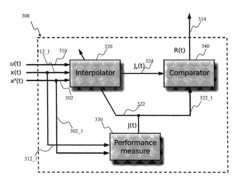
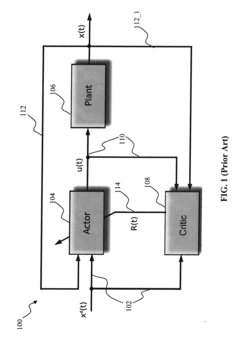
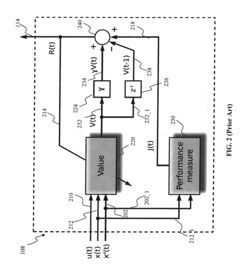
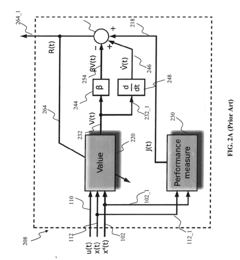
- The proposed solution involves a computerized control apparatus with a critic block that uses an interpolator to estimate past performance based on present and past values of the plant state and target state, generating a reinforcement signal to optimize control parameters, focusing on observed present and past control system performance rather than future predictions.
Safety Standards for Adaptive Control Systems
Safety standards for adaptive control systems represent a critical framework ensuring that enhanced adaptive capacity does not compromise operational safety or system reliability. The development of these standards addresses the inherent challenges posed by systems that modify their behavior in real-time, requiring comprehensive safety protocols that can accommodate dynamic operational parameters while maintaining predictable safety margins.
Current safety standards for adaptive control systems are primarily governed by international frameworks including IEC 61508 for functional safety, ISO 26262 for automotive applications, and DO-178C for aerospace systems. These standards establish fundamental principles for safety-critical adaptive systems, emphasizing the need for rigorous verification and validation processes that account for the system's ability to modify its control parameters autonomously. The standards mandate comprehensive hazard analysis, risk assessment, and the implementation of safety integrity levels that correspond to the potential consequences of system failures.
The verification and validation requirements for adaptive control systems present unique challenges compared to traditional fixed-parameter controllers. Safety standards require extensive testing scenarios that encompass the full range of adaptive behaviors, including boundary conditions where the system operates at the limits of its adaptive capacity. This includes stress testing under extreme environmental conditions, component failures, and unexpected input variations that could trigger inappropriate adaptive responses.
Certification processes for adaptive control systems must demonstrate that the adaptive mechanisms themselves do not introduce additional failure modes or compromise existing safety functions. Standards require the implementation of monitoring systems that can detect when adaptive algorithms are operating outside acceptable parameters and trigger appropriate fail-safe responses. These monitoring systems must be independent of the adaptive control algorithms to prevent common-mode failures.
The integration of machine learning and artificial intelligence components in adaptive control systems has prompted the development of new safety standard provisions. These emerging requirements address the challenges of validating systems whose behavior cannot be fully predetermined, necessitating probabilistic safety arguments and continuous monitoring approaches. Standards now emphasize the importance of explainable adaptive behaviors and the ability to audit decision-making processes in safety-critical applications.
Future developments in safety standards are focusing on establishing frameworks for real-time safety assessment and dynamic safety margins that can adapt alongside the control system while maintaining overall system safety integrity.
Current safety standards for adaptive control systems are primarily governed by international frameworks including IEC 61508 for functional safety, ISO 26262 for automotive applications, and DO-178C for aerospace systems. These standards establish fundamental principles for safety-critical adaptive systems, emphasizing the need for rigorous verification and validation processes that account for the system's ability to modify its control parameters autonomously. The standards mandate comprehensive hazard analysis, risk assessment, and the implementation of safety integrity levels that correspond to the potential consequences of system failures.
The verification and validation requirements for adaptive control systems present unique challenges compared to traditional fixed-parameter controllers. Safety standards require extensive testing scenarios that encompass the full range of adaptive behaviors, including boundary conditions where the system operates at the limits of its adaptive capacity. This includes stress testing under extreme environmental conditions, component failures, and unexpected input variations that could trigger inappropriate adaptive responses.
Certification processes for adaptive control systems must demonstrate that the adaptive mechanisms themselves do not introduce additional failure modes or compromise existing safety functions. Standards require the implementation of monitoring systems that can detect when adaptive algorithms are operating outside acceptable parameters and trigger appropriate fail-safe responses. These monitoring systems must be independent of the adaptive control algorithms to prevent common-mode failures.
The integration of machine learning and artificial intelligence components in adaptive control systems has prompted the development of new safety standard provisions. These emerging requirements address the challenges of validating systems whose behavior cannot be fully predetermined, necessitating probabilistic safety arguments and continuous monitoring approaches. Standards now emphasize the importance of explainable adaptive behaviors and the ability to audit decision-making processes in safety-critical applications.
Future developments in safety standards are focusing on establishing frameworks for real-time safety assessment and dynamic safety margins that can adapt alongside the control system while maintaining overall system safety integrity.
AI Integration in Adaptive Control Engineering
The integration of artificial intelligence into adaptive control engineering represents a paradigm shift that fundamentally transforms how control systems respond to dynamic environments and uncertainties. Traditional adaptive control methods, while effective in specific scenarios, often struggle with complex nonlinear systems and rapidly changing operational conditions. AI technologies, particularly machine learning algorithms and neural networks, offer unprecedented capabilities to enhance adaptive capacity through intelligent pattern recognition, predictive modeling, and real-time decision-making processes.
Machine learning algorithms serve as the cornerstone of AI-enhanced adaptive control systems, enabling controllers to learn from historical data and operational experiences. Reinforcement learning techniques allow control systems to optimize their performance through trial-and-error interactions with the environment, continuously improving their adaptive responses. Deep neural networks provide sophisticated function approximation capabilities, enabling controllers to handle high-dimensional state spaces and complex system dynamics that would be computationally prohibitive for conventional adaptive methods.
The implementation of AI in adaptive control engineering leverages several key technological approaches. Model-free reinforcement learning algorithms, such as Q-learning and policy gradient methods, enable controllers to adapt without requiring explicit mathematical models of the controlled system. Recurrent neural networks and long short-term memory architectures facilitate the processing of temporal sequences, allowing controllers to incorporate historical information into their adaptive strategies. Additionally, ensemble learning methods combine multiple AI models to improve robustness and reliability in uncertain environments.
Real-time processing capabilities represent a critical advancement in AI-integrated adaptive control systems. Edge computing technologies and specialized hardware accelerators enable the deployment of complex AI algorithms directly within control loops, reducing latency and improving responsiveness. Federated learning approaches allow distributed control systems to share knowledge while maintaining data privacy and reducing communication overhead.
The synergy between AI and adaptive control engineering creates emergent capabilities that exceed the sum of their individual contributions. Predictive adaptation becomes possible through AI's ability to forecast system behavior and environmental changes, enabling proactive rather than reactive control strategies. Multi-objective optimization through AI algorithms allows simultaneous consideration of multiple performance criteria, leading to more balanced and robust adaptive responses across diverse operational scenarios.
Machine learning algorithms serve as the cornerstone of AI-enhanced adaptive control systems, enabling controllers to learn from historical data and operational experiences. Reinforcement learning techniques allow control systems to optimize their performance through trial-and-error interactions with the environment, continuously improving their adaptive responses. Deep neural networks provide sophisticated function approximation capabilities, enabling controllers to handle high-dimensional state spaces and complex system dynamics that would be computationally prohibitive for conventional adaptive methods.
The implementation of AI in adaptive control engineering leverages several key technological approaches. Model-free reinforcement learning algorithms, such as Q-learning and policy gradient methods, enable controllers to adapt without requiring explicit mathematical models of the controlled system. Recurrent neural networks and long short-term memory architectures facilitate the processing of temporal sequences, allowing controllers to incorporate historical information into their adaptive strategies. Additionally, ensemble learning methods combine multiple AI models to improve robustness and reliability in uncertain environments.
Real-time processing capabilities represent a critical advancement in AI-integrated adaptive control systems. Edge computing technologies and specialized hardware accelerators enable the deployment of complex AI algorithms directly within control loops, reducing latency and improving responsiveness. Federated learning approaches allow distributed control systems to share knowledge while maintaining data privacy and reducing communication overhead.
The synergy between AI and adaptive control engineering creates emergent capabilities that exceed the sum of their individual contributions. Predictive adaptation becomes possible through AI's ability to forecast system behavior and environmental changes, enabling proactive rather than reactive control strategies. Multi-objective optimization through AI algorithms allows simultaneous consideration of multiple performance criteria, leading to more balanced and robust adaptive responses across diverse operational scenarios.
Unlock deeper insights with Patsnap Eureka Quick Research — get a full tech report to explore trends and direct your research. Try now!
Generate Your Research Report Instantly with AI Agent
Supercharge your innovation with Patsnap Eureka AI Agent Platform!