

How to Leverage Electromagnetic Waves for Enhanced Data Storage?
JUL 11, 20259 MIN READ
Generate Your Research Report Instantly with AI Agent
PatSnap Eureka helps you evaluate technical feasibility & market potential.
EM Wave Data Storage Background and Objectives
Electromagnetic wave-based data storage represents a revolutionary approach to addressing the ever-increasing demand for high-capacity, high-speed data storage solutions. This technology leverages the properties of electromagnetic waves to store and retrieve information, potentially offering significant advantages over traditional magnetic and optical storage methods.
The field of electromagnetic wave data storage has its roots in the early 20th century with the discovery of electromagnetic waves and their properties. However, it wasn't until recent decades that technological advancements have made it possible to explore this concept for practical data storage applications. The evolution of this technology has been driven by the exponential growth in data generation and the need for more efficient storage solutions.
The primary objective of electromagnetic wave data storage research is to develop a storage medium that can harness the properties of electromagnetic waves to achieve higher data densities, faster read/write speeds, and improved energy efficiency compared to existing technologies. This involves exploring various materials and structures that can interact with electromagnetic waves in ways that allow for precise data encoding and retrieval.
One of the key areas of focus is the development of metamaterials – artificially engineered materials with properties not found in nature. These materials can manipulate electromagnetic waves in unique ways, potentially allowing for the creation of storage devices with unprecedented capabilities. Researchers are also investigating the use of plasmonics, which involves the interaction between electromagnetic waves and free electrons in metals, to create ultra-compact storage devices.
The goals of electromagnetic wave data storage research extend beyond merely increasing storage capacity. Scientists and engineers are working towards creating storage solutions that are more durable, consume less power, and can operate at higher temperatures than current technologies. Additionally, there is a strong emphasis on developing storage systems that can integrate seamlessly with emerging technologies such as quantum computing and artificial intelligence.
As the field progresses, researchers are exploring various frequency ranges of the electromagnetic spectrum, from radio waves to terahertz radiation, to identify the most promising approaches for different storage applications. This includes investigating both far-field and near-field electromagnetic interactions to optimize data storage and retrieval processes.
The development of electromagnetic wave data storage technology is not without its challenges. Researchers must overcome issues related to signal interference, data stability over time, and the miniaturization of components. However, the potential benefits of this technology, including its ability to potentially store vast amounts of data in a small physical space and access it at the speed of light, make it a compelling area of research for the future of data storage.
The field of electromagnetic wave data storage has its roots in the early 20th century with the discovery of electromagnetic waves and their properties. However, it wasn't until recent decades that technological advancements have made it possible to explore this concept for practical data storage applications. The evolution of this technology has been driven by the exponential growth in data generation and the need for more efficient storage solutions.
The primary objective of electromagnetic wave data storage research is to develop a storage medium that can harness the properties of electromagnetic waves to achieve higher data densities, faster read/write speeds, and improved energy efficiency compared to existing technologies. This involves exploring various materials and structures that can interact with electromagnetic waves in ways that allow for precise data encoding and retrieval.
One of the key areas of focus is the development of metamaterials – artificially engineered materials with properties not found in nature. These materials can manipulate electromagnetic waves in unique ways, potentially allowing for the creation of storage devices with unprecedented capabilities. Researchers are also investigating the use of plasmonics, which involves the interaction between electromagnetic waves and free electrons in metals, to create ultra-compact storage devices.
The goals of electromagnetic wave data storage research extend beyond merely increasing storage capacity. Scientists and engineers are working towards creating storage solutions that are more durable, consume less power, and can operate at higher temperatures than current technologies. Additionally, there is a strong emphasis on developing storage systems that can integrate seamlessly with emerging technologies such as quantum computing and artificial intelligence.
As the field progresses, researchers are exploring various frequency ranges of the electromagnetic spectrum, from radio waves to terahertz radiation, to identify the most promising approaches for different storage applications. This includes investigating both far-field and near-field electromagnetic interactions to optimize data storage and retrieval processes.
The development of electromagnetic wave data storage technology is not without its challenges. Researchers must overcome issues related to signal interference, data stability over time, and the miniaturization of components. However, the potential benefits of this technology, including its ability to potentially store vast amounts of data in a small physical space and access it at the speed of light, make it a compelling area of research for the future of data storage.
Market Analysis for Advanced Data Storage Solutions
The market for advanced data storage solutions is experiencing significant growth, driven by the exponential increase in data generation across various sectors. As businesses and individuals continue to produce and consume vast amounts of digital information, the demand for more efficient, high-capacity storage technologies is escalating. The global data storage market is projected to reach substantial value in the coming years, with a compound annual growth rate outpacing many other technology sectors.
Electromagnetic wave-based data storage solutions represent a promising frontier in this expanding market. These technologies offer the potential for higher storage densities, faster read/write speeds, and improved energy efficiency compared to traditional magnetic or optical storage methods. The market for such advanced storage solutions is particularly robust in sectors dealing with large-scale data operations, including cloud computing providers, research institutions, and data-intensive industries like healthcare and finance.
A key driver of market demand is the need for storage solutions that can keep pace with the rapid advancements in data processing capabilities. As artificial intelligence, machine learning, and big data analytics become more prevalent, there is a growing requirement for storage systems that can handle massive datasets with minimal latency. Electromagnetic wave-based storage technologies are well-positioned to address these needs, potentially offering quantum leaps in storage capacity and access speeds.
The market is also being shaped by the increasing emphasis on energy efficiency and sustainability in data centers. As organizations strive to reduce their carbon footprint, there is a growing interest in storage solutions that can offer high performance with lower power consumption. Electromagnetic wave-based storage technologies, with their potential for reduced energy requirements, align well with this trend and are likely to see increased adoption in environmentally conscious markets.
Geographically, the market for advanced data storage solutions is seeing strong growth in regions with high concentrations of technology companies and data centers. North America and Asia-Pacific are currently leading in terms of market share and adoption rates, with Europe following closely. Emerging markets in South America and Africa are also showing increasing interest in these technologies as they rapidly expand their digital infrastructure.
The competitive landscape in this market is characterized by a mix of established technology giants and innovative startups. Major players in the data storage industry are investing heavily in research and development of electromagnetic wave-based storage technologies, recognizing their potential to disrupt the current market dynamics. At the same time, numerous startups are emerging with novel approaches and patented technologies, creating a vibrant ecosystem of innovation in this space.
Electromagnetic wave-based data storage solutions represent a promising frontier in this expanding market. These technologies offer the potential for higher storage densities, faster read/write speeds, and improved energy efficiency compared to traditional magnetic or optical storage methods. The market for such advanced storage solutions is particularly robust in sectors dealing with large-scale data operations, including cloud computing providers, research institutions, and data-intensive industries like healthcare and finance.
A key driver of market demand is the need for storage solutions that can keep pace with the rapid advancements in data processing capabilities. As artificial intelligence, machine learning, and big data analytics become more prevalent, there is a growing requirement for storage systems that can handle massive datasets with minimal latency. Electromagnetic wave-based storage technologies are well-positioned to address these needs, potentially offering quantum leaps in storage capacity and access speeds.
The market is also being shaped by the increasing emphasis on energy efficiency and sustainability in data centers. As organizations strive to reduce their carbon footprint, there is a growing interest in storage solutions that can offer high performance with lower power consumption. Electromagnetic wave-based storage technologies, with their potential for reduced energy requirements, align well with this trend and are likely to see increased adoption in environmentally conscious markets.
Geographically, the market for advanced data storage solutions is seeing strong growth in regions with high concentrations of technology companies and data centers. North America and Asia-Pacific are currently leading in terms of market share and adoption rates, with Europe following closely. Emerging markets in South America and Africa are also showing increasing interest in these technologies as they rapidly expand their digital infrastructure.
The competitive landscape in this market is characterized by a mix of established technology giants and innovative startups. Major players in the data storage industry are investing heavily in research and development of electromagnetic wave-based storage technologies, recognizing their potential to disrupt the current market dynamics. At the same time, numerous startups are emerging with novel approaches and patented technologies, creating a vibrant ecosystem of innovation in this space.
Current EM Wave Data Storage Technologies and Challenges
Electromagnetic wave-based data storage technologies have made significant strides in recent years, offering promising solutions for high-density and high-speed data storage. However, these technologies also face several challenges that need to be addressed for widespread adoption.
One of the primary current technologies in this field is holographic data storage. This method uses laser beams to create three-dimensional holograms within photosensitive materials, allowing for high-density data storage. The advantage of holographic storage lies in its ability to store multiple data pages in the same volume, potentially achieving terabyte-level capacities in relatively small devices. However, challenges persist in developing stable and long-lasting photosensitive materials that can maintain data integrity over extended periods.
Another emerging technology is spin wave-based data storage. This approach leverages the magnetic properties of materials to store and process information using spin waves, which are oscillations in the magnetic ordering of a material. Spin wave devices offer the potential for low-power, high-speed data processing and storage. However, the technology is still in its early stages, and significant work is needed to improve the efficiency of spin wave generation and detection, as well as to develop materials with suitable magnetic properties.
Microwave-assisted magnetic recording (MAMR) is a more recent development in hard disk drive technology. MAMR uses microwaves to temporarily lower the coercivity of the recording medium, allowing for smaller, more stable magnetic domains to be written. This technology promises to increase storage densities in traditional hard drives significantly. However, challenges remain in optimizing the microwave generation and delivery to the recording head, as well as in developing recording media that can take full advantage of this technique.
One of the most significant challenges across all electromagnetic wave-based storage technologies is the need for precise control and manipulation of electromagnetic fields at increasingly smaller scales. As storage densities increase, the ability to accurately read and write data becomes more difficult due to interference and noise. This challenge requires advancements in both materials science and nanoscale engineering to develop more sensitive detectors and more precise field generators.
Energy efficiency is another critical challenge facing these technologies. While electromagnetic wave-based storage offers the potential for high-speed operations, it often requires significant energy input for data writing and reading processes. Developing more energy-efficient methods for generating and detecting electromagnetic waves is crucial for the practical implementation of these technologies, especially in portable devices and large-scale data centers.
Lastly, the integration of these novel storage technologies with existing computing architectures presents a significant challenge. Many of these technologies require specialized hardware and software interfaces, which can be a barrier to widespread adoption. Developing standardized interfaces and ensuring compatibility with current systems will be essential for the successful commercialization of electromagnetic wave-based data storage solutions.
One of the primary current technologies in this field is holographic data storage. This method uses laser beams to create three-dimensional holograms within photosensitive materials, allowing for high-density data storage. The advantage of holographic storage lies in its ability to store multiple data pages in the same volume, potentially achieving terabyte-level capacities in relatively small devices. However, challenges persist in developing stable and long-lasting photosensitive materials that can maintain data integrity over extended periods.
Another emerging technology is spin wave-based data storage. This approach leverages the magnetic properties of materials to store and process information using spin waves, which are oscillations in the magnetic ordering of a material. Spin wave devices offer the potential for low-power, high-speed data processing and storage. However, the technology is still in its early stages, and significant work is needed to improve the efficiency of spin wave generation and detection, as well as to develop materials with suitable magnetic properties.
Microwave-assisted magnetic recording (MAMR) is a more recent development in hard disk drive technology. MAMR uses microwaves to temporarily lower the coercivity of the recording medium, allowing for smaller, more stable magnetic domains to be written. This technology promises to increase storage densities in traditional hard drives significantly. However, challenges remain in optimizing the microwave generation and delivery to the recording head, as well as in developing recording media that can take full advantage of this technique.
One of the most significant challenges across all electromagnetic wave-based storage technologies is the need for precise control and manipulation of electromagnetic fields at increasingly smaller scales. As storage densities increase, the ability to accurately read and write data becomes more difficult due to interference and noise. This challenge requires advancements in both materials science and nanoscale engineering to develop more sensitive detectors and more precise field generators.
Energy efficiency is another critical challenge facing these technologies. While electromagnetic wave-based storage offers the potential for high-speed operations, it often requires significant energy input for data writing and reading processes. Developing more energy-efficient methods for generating and detecting electromagnetic waves is crucial for the practical implementation of these technologies, especially in portable devices and large-scale data centers.
Lastly, the integration of these novel storage technologies with existing computing architectures presents a significant challenge. Many of these technologies require specialized hardware and software interfaces, which can be a barrier to widespread adoption. Developing standardized interfaces and ensuring compatibility with current systems will be essential for the successful commercialization of electromagnetic wave-based data storage solutions.
Existing EM Wave Data Storage Solutions
01 Electromagnetic wave-based data storage systems
These systems utilize electromagnetic waves to store and retrieve data, potentially increasing storage capacity and access speeds. The technology involves using various frequencies of electromagnetic waves to encode and decode information, allowing for higher data density compared to traditional storage methods.- Electromagnetic wave-based data storage systems: This technology utilizes electromagnetic waves for storing and retrieving data. It involves the use of specialized materials and structures that can interact with electromagnetic waves to encode and decode information, potentially offering high-density storage capabilities.
- Enhancing data storage capacity using electromagnetic wave properties: Techniques for increasing data storage capacity by exploiting various properties of electromagnetic waves, such as frequency, phase, and polarization. These methods allow for more efficient use of the electromagnetic spectrum, potentially leading to higher data storage densities.
- Electromagnetic wave-based memory devices: Development of memory devices that use electromagnetic waves for data storage and retrieval. These devices may incorporate novel materials or structures that can maintain stable electromagnetic states, allowing for non-volatile storage of information.
- Data encoding and decoding methods using electromagnetic waves: Advanced techniques for encoding and decoding data using electromagnetic waves, potentially allowing for increased data density and improved error correction. These methods may involve complex modulation schemes or novel signal processing algorithms.
- Electromagnetic wave-based data transmission and storage integration: Systems that integrate data transmission and storage using electromagnetic waves, potentially allowing for seamless transfer between storage and communication systems. This approach may lead to more efficient and flexible data management in various applications.
02 Quantum-based data storage techniques
Quantum-based storage methods leverage the principles of quantum mechanics to store and process information. These techniques can potentially achieve significantly higher data storage capacities and faster processing speeds compared to classical storage systems, by utilizing quantum states of particles or systems.Expand Specific Solutions03 Holographic data storage
Holographic storage uses laser beams to store data in three-dimensional patterns within a medium. This method can potentially store vast amounts of data in a compact space, offering high storage density and fast data access times. The technology relies on interference patterns of light waves to encode and retrieve information.Expand Specific Solutions04 Electromagnetic wave-based data transmission and networking
This technology focuses on using electromagnetic waves for high-capacity data transmission and networking. It involves developing advanced modulation techniques, efficient antenna designs, and novel network architectures to maximize data transfer rates and storage capacities in communication systems.Expand Specific Solutions05 Electromagnetic wave sensors for data storage management
These sensors utilize electromagnetic waves to monitor and manage data storage systems. They can detect and analyze various parameters such as temperature, humidity, and electromagnetic interference, helping to optimize storage conditions and prevent data loss or corruption in high-capacity storage environments.Expand Specific Solutions
Key Players in EM Wave Data Storage Industry
The electromagnetic wave-based data storage technology is in an early development stage, with significant potential for growth. The market size is expected to expand rapidly as the demand for high-capacity, fast-access storage solutions increases. While the technology is still maturing, several key players are actively researching and developing solutions. Companies like IBM, Western Digital, and Samsung are leveraging their expertise in data storage to explore electromagnetic wave-based technologies. Hitachi and Huawei are also investing in this area, focusing on integrating it with their existing product lines. As the technology advances, we can expect increased competition and innovation from both established players and emerging startups in the coming years.
International Business Machines Corp.
Technical Solution: IBM has developed a groundbreaking approach to leverage electromagnetic waves for enhanced data storage through their Racetrack Memory technology. This innovative system uses spin-polarized electric current to move magnetic domains along nanowires, allowing for high-density, non-volatile storage[1]. The technology exploits the interaction between electron spin and magnetic moments to manipulate data, potentially offering storage densities up to 100 times greater than current hard drives[2]. IBM's research has also explored using electromagnetic waves to control skyrmions, nanoscale magnetic vortices that can be used to store data, promising even higher storage densities and lower power consumption[3].
Strengths: Extremely high storage density, non-volatile storage, and potential for low power consumption. Weaknesses: Complex manufacturing process and challenges in scaling up production.
Hitachi Ltd.
Technical Solution: Hitachi has been exploring the use of electromagnetic waves in their bit-patterned media (BPM) technology for next-generation hard disk drives. Their approach involves using electromagnetic assistance to write data on highly stable magnetic nanostructures[4]. By employing microwave-assisted magnetic recording (MAMR), Hitachi aims to overcome the superparamagnetic limit in conventional magnetic recording. This technique uses localized electromagnetic waves to temporarily reduce the coercivity of the recording medium, allowing for smaller, more stable magnetic domains to be written[5]. Hitachi's research also extends to heat-assisted magnetic recording (HAMR), which uses laser-generated electromagnetic waves to heat the recording medium momentarily during writing[6].
Strengths: Potential for significantly higher areal density in hard drives, compatibility with existing manufacturing processes. Weaknesses: Challenges in precise control of localized heating and potential for media degradation over time.
Core Innovations in EM Wave Data Storage
Device for generating electromagnetic waves, method for operating a device of this type and method for modulating the electromagnetic waves to be generated using a device of this type in accordance with data to be transmitted
PatentInactiveUS7064312B2
Innovation
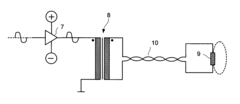
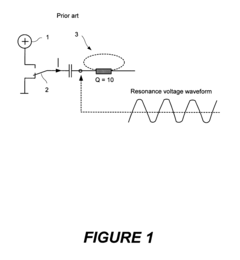
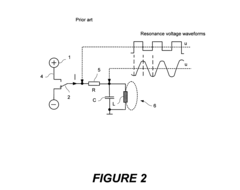
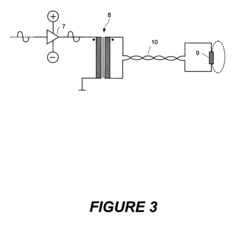
- A device comprising an energy supply with a choke coil and oscillating circuit, where the energy supply includes a DC voltage source, a converter coil, and push-pull switches, operating the choke coil in saturation during transient conditions to enhance output power and efficiency, and using a transformer for efficient energy transfer.
Environmental Impact of EM Wave Data Storage
The environmental impact of electromagnetic (EM) wave data storage is a crucial consideration as this technology advances. While EM wave data storage offers potential benefits in terms of increased capacity and faster data access, it also raises concerns about energy consumption and electromagnetic radiation.
Energy consumption is a primary environmental concern. EM wave data storage systems require continuous power to maintain data integrity and facilitate read/write operations. This constant energy demand could lead to increased electricity consumption, potentially contributing to higher carbon emissions if the power source is not renewable. However, the energy efficiency of EM wave storage compared to traditional magnetic or solid-state storage needs further investigation to determine its overall environmental footprint.
Electromagnetic radiation emitted by EM wave data storage systems is another environmental consideration. While the radiation levels are generally low and within safety limits, the cumulative effect of large-scale deployment could potentially impact local ecosystems. Studies on the long-term effects of low-level EM radiation on flora and fauna are ongoing, and more research is needed to fully understand the ecological implications.
The manufacturing process of EM wave data storage devices also has environmental implications. The production of specialized components may involve rare earth elements or other materials with complex extraction and processing requirements. This could lead to increased mining activities and associated environmental degradation if not managed sustainably.
On the positive side, EM wave data storage could potentially reduce the physical footprint of data centers. By enabling higher storage densities, this technology might decrease the land area required for data storage facilities, potentially preserving natural habitats and reducing urban sprawl.
The disposal and recycling of EM wave storage devices at the end of their lifecycle present another environmental challenge. Proper recycling protocols must be developed to recover valuable materials and prevent electronic waste from accumulating in landfills.
As the technology evolves, it is crucial to conduct comprehensive life cycle assessments to fully understand and mitigate the environmental impacts of EM wave data storage. This should include evaluating energy consumption, material use, manufacturing processes, operational emissions, and end-of-life disposal. By proactively addressing these environmental concerns, the technology can be developed and implemented in a more sustainable manner, aligning with global efforts to reduce the environmental footprint of digital infrastructure.
Energy consumption is a primary environmental concern. EM wave data storage systems require continuous power to maintain data integrity and facilitate read/write operations. This constant energy demand could lead to increased electricity consumption, potentially contributing to higher carbon emissions if the power source is not renewable. However, the energy efficiency of EM wave storage compared to traditional magnetic or solid-state storage needs further investigation to determine its overall environmental footprint.
Electromagnetic radiation emitted by EM wave data storage systems is another environmental consideration. While the radiation levels are generally low and within safety limits, the cumulative effect of large-scale deployment could potentially impact local ecosystems. Studies on the long-term effects of low-level EM radiation on flora and fauna are ongoing, and more research is needed to fully understand the ecological implications.
The manufacturing process of EM wave data storage devices also has environmental implications. The production of specialized components may involve rare earth elements or other materials with complex extraction and processing requirements. This could lead to increased mining activities and associated environmental degradation if not managed sustainably.
On the positive side, EM wave data storage could potentially reduce the physical footprint of data centers. By enabling higher storage densities, this technology might decrease the land area required for data storage facilities, potentially preserving natural habitats and reducing urban sprawl.
The disposal and recycling of EM wave storage devices at the end of their lifecycle present another environmental challenge. Proper recycling protocols must be developed to recover valuable materials and prevent electronic waste from accumulating in landfills.
As the technology evolves, it is crucial to conduct comprehensive life cycle assessments to fully understand and mitigate the environmental impacts of EM wave data storage. This should include evaluating energy consumption, material use, manufacturing processes, operational emissions, and end-of-life disposal. By proactively addressing these environmental concerns, the technology can be developed and implemented in a more sustainable manner, aligning with global efforts to reduce the environmental footprint of digital infrastructure.
Quantum Effects in EM Wave Data Storage
Quantum effects play a crucial role in leveraging electromagnetic waves for enhanced data storage. At the quantum level, electromagnetic waves interact with matter in unique ways, opening up new possibilities for data manipulation and storage. One of the most promising quantum effects is the use of spin states in electrons and nuclei to encode information.
Spin-based quantum storage utilizes the intrinsic angular momentum of particles to represent binary data. This approach allows for significantly higher storage densities compared to traditional magnetic storage methods. By manipulating the spin states of individual atoms or electrons, researchers can create quantum bits, or qubits, which can exist in multiple states simultaneously due to superposition.
The quantum Hall effect is another phenomenon that shows potential for data storage applications. This effect occurs in two-dimensional electron systems subjected to strong magnetic fields, resulting in the quantization of electrical conductance. By exploiting the quantum Hall effect, researchers can create topologically protected states that are resistant to environmental disturbances, potentially leading to more stable and long-lasting data storage.
Quantum entanglement, a phenomenon where particles become correlated in such a way that the quantum state of each particle cannot be described independently, also offers intriguing possibilities for data storage. Entangled photons can be used to create quantum memories, where information is stored in the quantum states of light particles. This approach could lead to the development of quantum repeaters, essential components for long-distance quantum communication networks.
The use of quantum dots in electromagnetic wave data storage is another area of active research. Quantum dots are nanoscale semiconductor structures that exhibit quantum confinement effects. By controlling the size and composition of quantum dots, researchers can tune their optical and electronic properties, potentially enabling high-density optical data storage with enhanced read and write speeds.
Quantum error correction is a critical aspect of quantum-based data storage systems. As quantum states are inherently fragile and susceptible to decoherence, robust error correction schemes are necessary to maintain data integrity. Techniques such as surface codes and topological quantum error correction show promise in protecting quantum information from environmental noise and operational errors.
The integration of quantum effects with electromagnetic wave data storage presents both opportunities and challenges. While quantum-based storage systems offer the potential for unprecedented storage densities and novel functionalities, they also require precise control over quantum states and protection from decoherence. As research in this field progresses, we can expect to see the development of hybrid systems that combine classical and quantum storage techniques, leveraging the strengths of both approaches to create more efficient and capable data storage solutions.
Spin-based quantum storage utilizes the intrinsic angular momentum of particles to represent binary data. This approach allows for significantly higher storage densities compared to traditional magnetic storage methods. By manipulating the spin states of individual atoms or electrons, researchers can create quantum bits, or qubits, which can exist in multiple states simultaneously due to superposition.
The quantum Hall effect is another phenomenon that shows potential for data storage applications. This effect occurs in two-dimensional electron systems subjected to strong magnetic fields, resulting in the quantization of electrical conductance. By exploiting the quantum Hall effect, researchers can create topologically protected states that are resistant to environmental disturbances, potentially leading to more stable and long-lasting data storage.
Quantum entanglement, a phenomenon where particles become correlated in such a way that the quantum state of each particle cannot be described independently, also offers intriguing possibilities for data storage. Entangled photons can be used to create quantum memories, where information is stored in the quantum states of light particles. This approach could lead to the development of quantum repeaters, essential components for long-distance quantum communication networks.
The use of quantum dots in electromagnetic wave data storage is another area of active research. Quantum dots are nanoscale semiconductor structures that exhibit quantum confinement effects. By controlling the size and composition of quantum dots, researchers can tune their optical and electronic properties, potentially enabling high-density optical data storage with enhanced read and write speeds.
Quantum error correction is a critical aspect of quantum-based data storage systems. As quantum states are inherently fragile and susceptible to decoherence, robust error correction schemes are necessary to maintain data integrity. Techniques such as surface codes and topological quantum error correction show promise in protecting quantum information from environmental noise and operational errors.
The integration of quantum effects with electromagnetic wave data storage presents both opportunities and challenges. While quantum-based storage systems offer the potential for unprecedented storage densities and novel functionalities, they also require precise control over quantum states and protection from decoherence. As research in this field progresses, we can expect to see the development of hybrid systems that combine classical and quantum storage techniques, leveraging the strengths of both approaches to create more efficient and capable data storage solutions.
Unlock deeper insights with PatSnap Eureka Quick Research — get a full tech report to explore trends and direct your research. Try now!
Generate Your Research Report Instantly with AI Agent
Supercharge your innovation with PatSnap Eureka AI Agent Platform!