

How to Optimize Blue Lasers for Enhanced Energy Efficiency
MAY 21, 20269 MIN READ
Generate Your Research Report Instantly with AI Agent
PatSnap Eureka helps you evaluate technical feasibility & market potential.
Blue Laser Technology Background and Efficiency Goals
Blue laser technology emerged in the late 20th century as the final piece of the RGB laser spectrum puzzle, following the successful development of red and infrared lasers in the 1960s and green lasers in subsequent decades. The breakthrough came with the development of gallium nitride (GaN) based semiconductor materials in the 1990s, which enabled the creation of efficient blue light-emitting devices. This technological advancement was revolutionary, as it completed the visible light spectrum for laser applications and opened new possibilities in high-density optical storage, display technologies, and precision manufacturing.
The evolution of blue laser technology has been marked by continuous improvements in material science and device engineering. Early blue lasers suffered from significant efficiency limitations, with wall-plug efficiencies often below 20%. The primary challenges stemmed from the inherent properties of wide-bandgap semiconductors required for blue light emission, including high defect densities, poor current injection efficiency, and thermal management issues. These limitations resulted in substantial energy losses through non-radiative recombination processes and resistive heating.
Current efficiency goals for blue laser optimization center around achieving wall-plug efficiencies exceeding 50% while maintaining stable output power and beam quality. The semiconductor industry has established benchmarks targeting power conversion efficiencies of 60-70% for next-generation blue laser diodes, particularly for applications in laser projection, materials processing, and underwater communications where energy efficiency directly impacts system performance and operational costs.
The technological roadmap for enhanced blue laser efficiency focuses on several critical areas: improving crystal quality of GaN-based materials, optimizing quantum well structures for better carrier confinement, developing advanced thermal management solutions, and implementing novel device architectures such as photonic crystal structures. These improvements aim to reduce threshold current density, minimize series resistance, and enhance light extraction efficiency.
Modern applications driving efficiency optimization include automotive lighting systems, where energy consumption directly affects vehicle range in electric vehicles, and industrial laser processing, where operational costs are significantly impacted by power consumption. Additionally, the growing demand for portable laser-based devices and battery-powered systems has intensified the focus on developing ultra-efficient blue laser sources that can operate effectively under power-constrained conditions while maintaining performance specifications.
The evolution of blue laser technology has been marked by continuous improvements in material science and device engineering. Early blue lasers suffered from significant efficiency limitations, with wall-plug efficiencies often below 20%. The primary challenges stemmed from the inherent properties of wide-bandgap semiconductors required for blue light emission, including high defect densities, poor current injection efficiency, and thermal management issues. These limitations resulted in substantial energy losses through non-radiative recombination processes and resistive heating.
Current efficiency goals for blue laser optimization center around achieving wall-plug efficiencies exceeding 50% while maintaining stable output power and beam quality. The semiconductor industry has established benchmarks targeting power conversion efficiencies of 60-70% for next-generation blue laser diodes, particularly for applications in laser projection, materials processing, and underwater communications where energy efficiency directly impacts system performance and operational costs.
The technological roadmap for enhanced blue laser efficiency focuses on several critical areas: improving crystal quality of GaN-based materials, optimizing quantum well structures for better carrier confinement, developing advanced thermal management solutions, and implementing novel device architectures such as photonic crystal structures. These improvements aim to reduce threshold current density, minimize series resistance, and enhance light extraction efficiency.
Modern applications driving efficiency optimization include automotive lighting systems, where energy consumption directly affects vehicle range in electric vehicles, and industrial laser processing, where operational costs are significantly impacted by power consumption. Additionally, the growing demand for portable laser-based devices and battery-powered systems has intensified the focus on developing ultra-efficient blue laser sources that can operate effectively under power-constrained conditions while maintaining performance specifications.
Market Demand for High-Efficiency Blue Laser Applications
The global market for high-efficiency blue laser applications is experiencing unprecedented growth driven by multiple converging technological trends and industry demands. Blue lasers, operating primarily in the 405-450 nanometer wavelength range, have become indispensable components across diverse sectors including consumer electronics, automotive, industrial manufacturing, and emerging display technologies.
Consumer electronics represents the largest market segment, with blue laser diodes serving as critical components in Blu-ray disc players, high-definition projectors, and next-generation display systems. The proliferation of 4K and 8K display technologies has intensified demand for more efficient blue laser sources that can deliver superior color reproduction while minimizing power consumption and heat generation.
The automotive industry has emerged as a rapidly expanding market for high-efficiency blue lasers, particularly in advanced lighting systems and LiDAR applications for autonomous vehicles. Automotive manufacturers increasingly require laser solutions that combine exceptional brightness with extended operational lifespans and reduced energy consumption to meet stringent efficiency standards and battery life requirements in electric vehicles.
Industrial manufacturing applications continue to drive substantial demand for optimized blue laser systems, especially in precision materials processing, 3D printing, and semiconductor manufacturing. These applications require laser sources capable of maintaining consistent performance while operating at higher efficiency levels to reduce operational costs and improve process reliability.
The emerging market for laser-based displays and projection systems presents significant growth opportunities. Next-generation cinema projectors, large-scale architectural displays, and augmented reality devices demand blue laser sources with enhanced energy efficiency to enable portable applications and reduce cooling requirements in high-brightness installations.
Medical and scientific instrumentation sectors are increasingly adopting high-efficiency blue lasers for fluorescence microscopy, flow cytometry, and therapeutic applications. These markets prioritize laser systems that deliver stable output with minimal power consumption to enable portable diagnostic equipment and reduce operational costs in clinical settings.
Market dynamics indicate strong preference for blue laser solutions that achieve efficiency improvements while maintaining cost competitiveness. End-users across all sectors are actively seeking laser technologies that can deliver enhanced performance per watt, reduced thermal management requirements, and extended operational lifespans to optimize total cost of ownership.
Consumer electronics represents the largest market segment, with blue laser diodes serving as critical components in Blu-ray disc players, high-definition projectors, and next-generation display systems. The proliferation of 4K and 8K display technologies has intensified demand for more efficient blue laser sources that can deliver superior color reproduction while minimizing power consumption and heat generation.
The automotive industry has emerged as a rapidly expanding market for high-efficiency blue lasers, particularly in advanced lighting systems and LiDAR applications for autonomous vehicles. Automotive manufacturers increasingly require laser solutions that combine exceptional brightness with extended operational lifespans and reduced energy consumption to meet stringent efficiency standards and battery life requirements in electric vehicles.
Industrial manufacturing applications continue to drive substantial demand for optimized blue laser systems, especially in precision materials processing, 3D printing, and semiconductor manufacturing. These applications require laser sources capable of maintaining consistent performance while operating at higher efficiency levels to reduce operational costs and improve process reliability.
The emerging market for laser-based displays and projection systems presents significant growth opportunities. Next-generation cinema projectors, large-scale architectural displays, and augmented reality devices demand blue laser sources with enhanced energy efficiency to enable portable applications and reduce cooling requirements in high-brightness installations.
Medical and scientific instrumentation sectors are increasingly adopting high-efficiency blue lasers for fluorescence microscopy, flow cytometry, and therapeutic applications. These markets prioritize laser systems that deliver stable output with minimal power consumption to enable portable diagnostic equipment and reduce operational costs in clinical settings.
Market dynamics indicate strong preference for blue laser solutions that achieve efficiency improvements while maintaining cost competitiveness. End-users across all sectors are actively seeking laser technologies that can deliver enhanced performance per watt, reduced thermal management requirements, and extended operational lifespans to optimize total cost of ownership.
Current Blue Laser Efficiency Limitations and Challenges
Blue laser technology faces several fundamental efficiency limitations that significantly impact their widespread adoption across various applications. The primary challenge stems from the inherent properties of gallium nitride (GaN) based semiconductor materials, which form the foundation of most blue laser diodes. These materials exhibit relatively high electrical resistance compared to their red and infrared counterparts, resulting in substantial power losses through heat generation during operation.
Thermal management represents one of the most critical obstacles in blue laser efficiency optimization. The quantum efficiency of GaN-based active regions decreases dramatically as operating temperatures rise, creating a cascading effect where increased electrical input leads to higher temperatures, which in turn reduces optical output and further increases heat generation. This thermal droop phenomenon becomes particularly pronounced at high current densities required for achieving substantial optical power outputs.
The crystalline structure quality of GaN substrates presents another significant constraint. Threading dislocations and point defects within the crystal lattice act as non-radiative recombination centers, converting electrical energy into heat rather than coherent light. Current manufacturing processes struggle to achieve the ultra-low defect densities necessary for optimal efficiency, with typical commercial devices exhibiting defect concentrations several orders of magnitude higher than theoretical requirements.
Carrier injection efficiency poses additional challenges specific to blue laser architectures. The large bandgap energy of GaN materials necessitates higher operating voltages, while electron-hole recombination processes compete with various loss mechanisms including Auger recombination and carrier leakage. These phenomena become increasingly problematic as drive currents increase, limiting the practical efficiency ceiling for high-power applications.
Optical cavity design constraints further compound efficiency limitations. Blue wavelengths require precise control of layer thicknesses and refractive indices to achieve optimal confinement and feedback. Manufacturing tolerances that are acceptable for longer wavelength devices can significantly degrade performance in blue systems, leading to increased threshold currents and reduced slope efficiency.
Current blue laser devices typically achieve wall-plug efficiencies ranging from 20-40%, substantially lower than the 60-70% efficiencies demonstrated by mature red laser technologies. This efficiency gap represents both a significant technical challenge and a substantial opportunity for improvement through advanced materials engineering, thermal management solutions, and novel device architectures.
Thermal management represents one of the most critical obstacles in blue laser efficiency optimization. The quantum efficiency of GaN-based active regions decreases dramatically as operating temperatures rise, creating a cascading effect where increased electrical input leads to higher temperatures, which in turn reduces optical output and further increases heat generation. This thermal droop phenomenon becomes particularly pronounced at high current densities required for achieving substantial optical power outputs.
The crystalline structure quality of GaN substrates presents another significant constraint. Threading dislocations and point defects within the crystal lattice act as non-radiative recombination centers, converting electrical energy into heat rather than coherent light. Current manufacturing processes struggle to achieve the ultra-low defect densities necessary for optimal efficiency, with typical commercial devices exhibiting defect concentrations several orders of magnitude higher than theoretical requirements.
Carrier injection efficiency poses additional challenges specific to blue laser architectures. The large bandgap energy of GaN materials necessitates higher operating voltages, while electron-hole recombination processes compete with various loss mechanisms including Auger recombination and carrier leakage. These phenomena become increasingly problematic as drive currents increase, limiting the practical efficiency ceiling for high-power applications.
Optical cavity design constraints further compound efficiency limitations. Blue wavelengths require precise control of layer thicknesses and refractive indices to achieve optimal confinement and feedback. Manufacturing tolerances that are acceptable for longer wavelength devices can significantly degrade performance in blue systems, leading to increased threshold currents and reduced slope efficiency.
Current blue laser devices typically achieve wall-plug efficiencies ranging from 20-40%, substantially lower than the 60-70% efficiencies demonstrated by mature red laser technologies. This efficiency gap represents both a significant technical challenge and a substantial opportunity for improvement through advanced materials engineering, thermal management solutions, and novel device architectures.
Existing Blue Laser Energy Efficiency Solutions
01 Laser diode structure optimization for blue laser efficiency
Optimization of laser diode structures including quantum well designs, barrier layers, and active region configurations to improve the efficiency of blue laser emission. These structural modifications focus on enhancing carrier confinement, reducing threshold current, and improving optical gain characteristics in blue wavelength ranges.- Laser diode structure optimization for improved efficiency: Optimization of laser diode structures through advanced semiconductor materials and quantum well designs to enhance the conversion efficiency of electrical energy to optical energy in blue laser systems. These improvements focus on reducing threshold current and increasing slope efficiency through better carrier confinement and reduced non-radiative recombination.
- Thermal management and heat dissipation techniques: Implementation of advanced thermal management systems to maintain optimal operating temperatures and prevent efficiency degradation in blue laser devices. These techniques include improved heat sink designs, thermal interface materials, and active cooling systems that help maintain consistent performance and extend device lifetime.
- Power supply and driver circuit optimization: Development of efficient power supply circuits and driver systems specifically designed for blue laser applications. These systems focus on reducing power consumption, minimizing electrical losses, and providing stable current control to maximize overall system efficiency while maintaining precise laser output characteristics.
- Optical coupling and beam shaping efficiency improvements: Enhancement of optical coupling efficiency and beam quality through advanced lens systems, waveguides, and beam shaping optics. These improvements reduce optical losses and improve the overall system efficiency by better directing and focusing the blue laser output for specific applications.
- Wavelength stabilization and spectral efficiency control: Implementation of wavelength stabilization techniques and spectral control methods to maintain optimal blue laser performance across varying operating conditions. These approaches help maintain consistent efficiency by preventing wavelength drift and ensuring stable optical output characteristics through feedback control systems.
02 Thermal management and heat dissipation techniques
Implementation of advanced thermal management systems and heat dissipation methods to maintain optimal operating temperatures for blue lasers. These techniques include improved heat sink designs, thermal interface materials, and cooling mechanisms that prevent efficiency degradation due to thermal effects and ensure stable performance.Expand Specific Solutions03 Power conversion and electrical efficiency improvements
Development of enhanced power conversion circuits and electrical systems to maximize the electrical-to-optical conversion efficiency in blue laser systems. These improvements involve optimized driver circuits, power management units, and electrical control systems that reduce power losses and improve overall system efficiency.Expand Specific Solutions04 Optical cavity and resonator design enhancements
Advanced optical cavity designs and resonator configurations specifically tailored for blue laser applications to improve lasing efficiency. These enhancements include optimized mirror coatings, cavity geometries, and mode control techniques that maximize optical feedback and reduce losses in the blue wavelength spectrum.Expand Specific Solutions05 Material composition and semiconductor engineering
Development of advanced semiconductor materials and compositions optimized for blue laser applications, focusing on improving quantum efficiency and reducing defect-related losses. These innovations include novel alloy compositions, doping strategies, and crystal growth techniques that enhance the fundamental efficiency of blue light generation.Expand Specific Solutions
Key Players in Blue Laser and Semiconductor Industry
The blue laser optimization market represents a rapidly evolving technological landscape characterized by significant growth potential and diverse competitive dynamics. The industry is transitioning from early adoption to mainstream commercialization, driven by expanding applications in materials processing, display technologies, and automotive manufacturing. Market participants range from established semiconductor giants like Texas Instruments and Sharp Corp. to specialized laser technology companies such as IPG Photonics and NUBURU, alongside academic institutions like Huazhong University of Science & Technology contributing fundamental research. Technology maturity varies significantly across applications, with companies like KYOCERA SLD Laser and Cymer demonstrating advanced capabilities in industrial processing, while firms such as LG Display and Canon integrate blue laser solutions into consumer electronics. The competitive landscape reflects a mix of vertical integration strategies and specialized niche players, indicating a market still consolidating around optimal efficiency solutions.
KYOCERA SLD Laser, Inc.
Technical Solution: KYOCERA SLD Laser specializes in gallium nitride (GaN) based blue laser diodes with advanced semiconductor crystal growth technology. Their approach focuses on optimizing the active layer structure and reducing defect density in GaN substrates to enhance wall-plug efficiency. The company employs proprietary epitaxial growth techniques and thermal management solutions to minimize heat generation during operation. Their blue laser systems incorporate advanced driver circuits with pulse width modulation and current control algorithms to optimize power consumption while maintaining stable output power and beam quality.
Strengths: Leading GaN substrate technology, high-quality crystal growth expertise, strong thermal management capabilities. Weaknesses: Higher manufacturing costs compared to traditional approaches, limited scalability for mass production applications.
Nuburu Subsidiary, Inc.
Technical Solution: Nuburu focuses on high-power blue laser technology for industrial applications, utilizing advanced beam combining techniques and optimized cavity designs. Their energy efficiency optimization approach centers on wavelength stabilization systems and adaptive power control mechanisms that adjust output based on material absorption characteristics. The company develops proprietary cooling systems and beam shaping optics to reduce energy losses during transmission. Their blue laser systems feature intelligent feedback control loops that monitor thermal conditions and automatically adjust operating parameters to maintain optimal efficiency throughout extended operation cycles.
Strengths: High-power output capabilities, advanced beam combining technology, robust industrial-grade systems. Weaknesses: Complex system architecture increases maintenance requirements, higher initial investment costs for deployment.
Core Innovations in Blue Laser Efficiency Enhancement
Blue laser beam oscillating method and system
PatentInactiveUS20060120415A1
Innovation
- The use of a slab optical waveguide made of a non-linear optical crystal with a broad area semiconductor laser of Fabry-Perot type as a fundamental wave, allowing for increased slab width and reduced power density, enabling higher output power and improved conversion efficiency.


Phosphate photonic crystal fiber and converter for efficient blue generation
PatentInactiveUS20160099539A1
Innovation
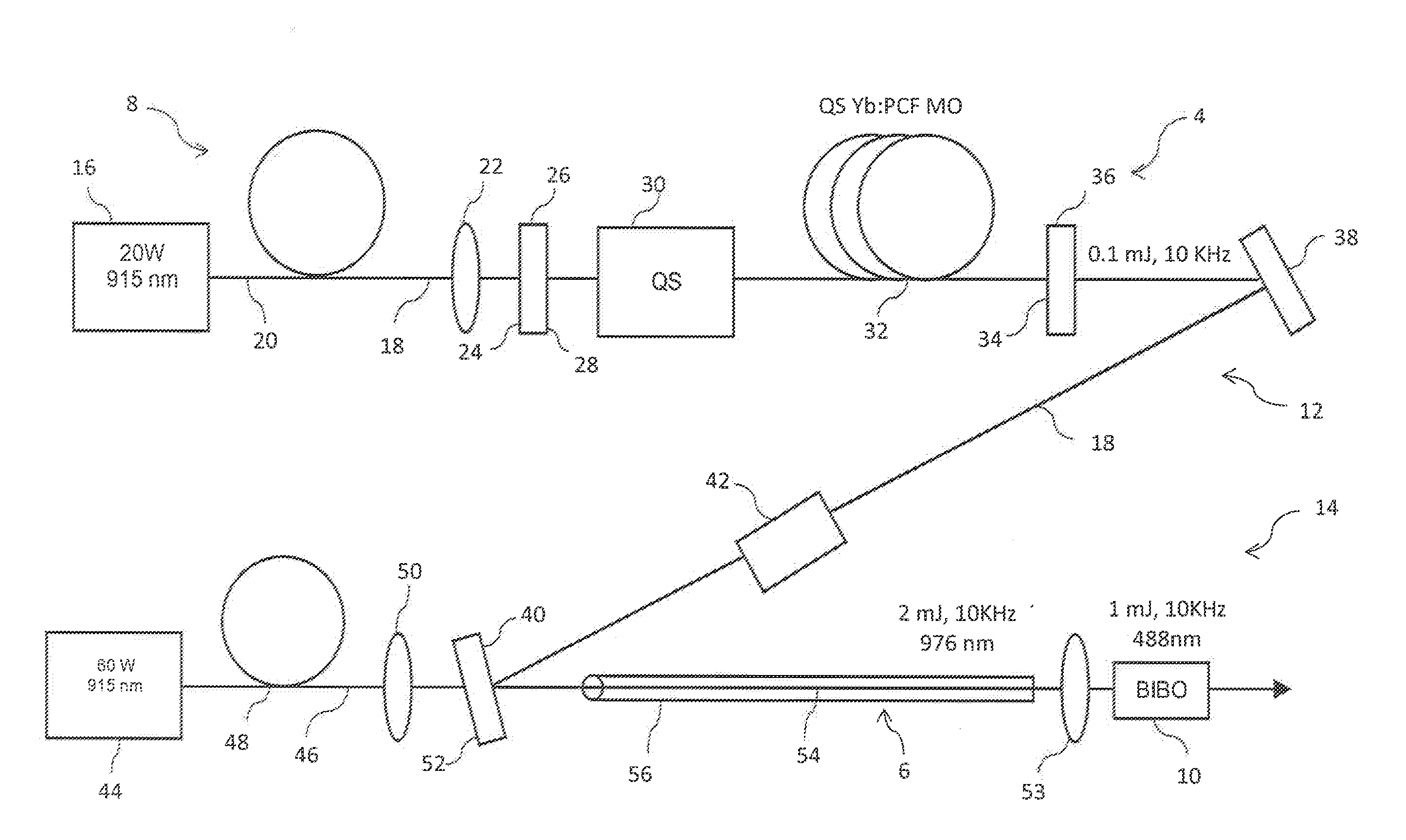
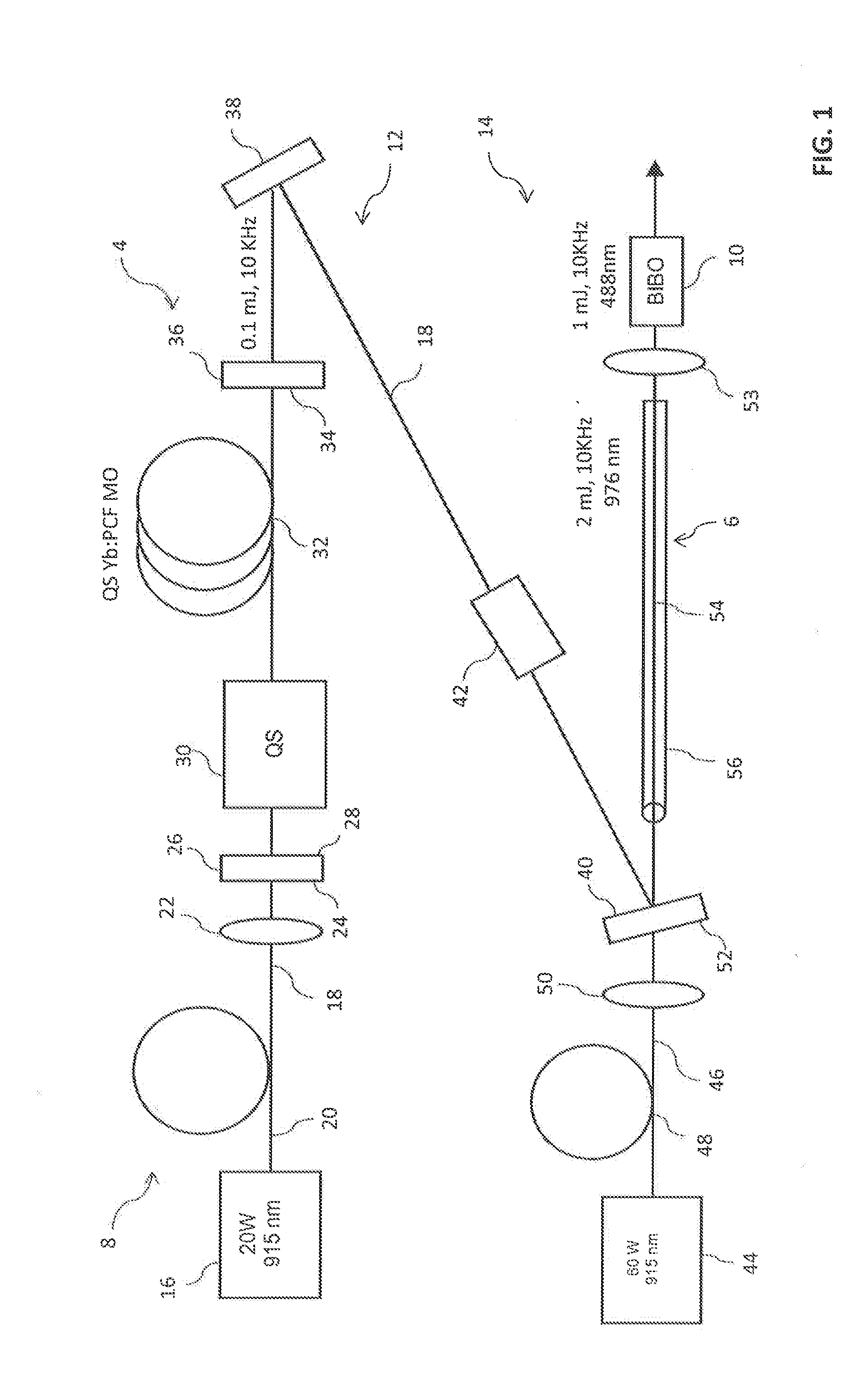
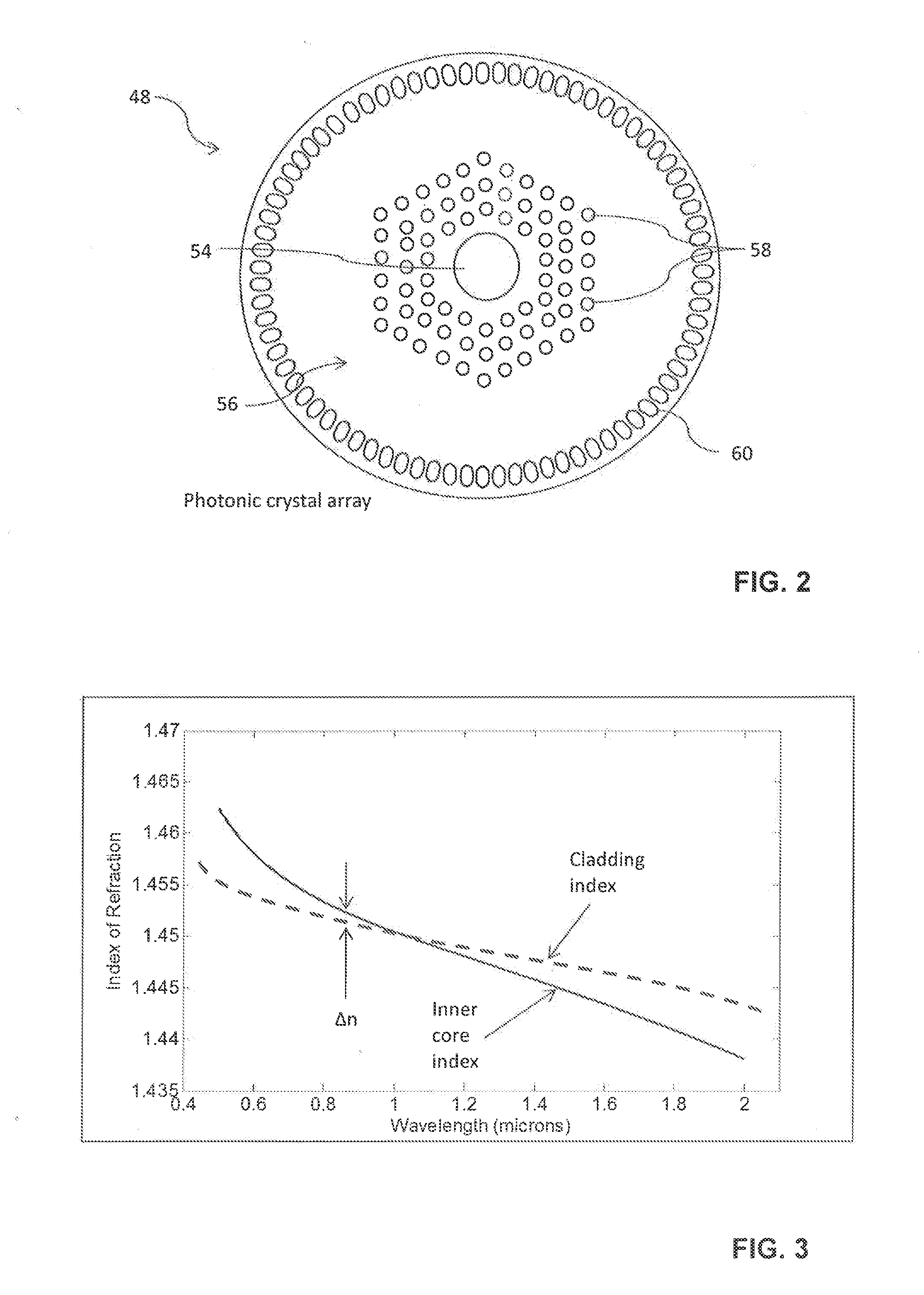
- The use of a photonic crystal fiber (PCF) structure with a large mode area and phosphate glass as the host material, which acts as a wavelength filter to suppress gain at longer wavelengths, allowing for efficient propagation of 975 nm light while leaking 1030 nm light into the cladding, and employing a single second harmonic generator for blue output, enhancing gain at short wavelengths and reducing parasitic losses.

Environmental Impact and Sustainability Considerations
The optimization of blue lasers for enhanced energy efficiency carries significant environmental implications that extend beyond immediate performance metrics. Blue laser technology, particularly in applications such as solid-state lighting, display systems, and industrial processing, presents both environmental challenges and opportunities that must be carefully evaluated within the broader context of sustainable technology development.
Energy consumption represents the most direct environmental impact of blue laser systems. Current blue laser diodes typically exhibit lower wall-plug efficiency compared to their red and infrared counterparts, often operating at 20-40% efficiency levels. This efficiency gap translates to substantial energy waste in the form of heat generation, requiring additional cooling systems that further increase overall power consumption. The cumulative effect across millions of deployed devices creates a significant carbon footprint, particularly in consumer electronics and automotive lighting applications where blue lasers are increasingly prevalent.
Manufacturing processes for blue laser optimization introduce additional environmental considerations. The production of gallium nitride (GaN) based blue laser structures requires high-temperature epitaxial growth processes and specialized substrates, often involving energy-intensive fabrication steps. Advanced optimization techniques, such as quantum well engineering and novel heterostructure designs, may necessitate more complex manufacturing processes with increased material consumption and waste generation. The use of rare earth elements and specialized compounds in some optimization approaches raises concerns about resource depletion and mining-related environmental impacts.
However, the environmental benefits of optimized blue laser technology present compelling sustainability arguments. Enhanced energy efficiency directly reduces operational carbon emissions throughout the device lifecycle. In solid-state lighting applications, optimized blue lasers enable more efficient white light generation through phosphor conversion, potentially reducing global lighting energy consumption by significant percentages. The longevity advantages of optimized blue laser systems, often exceeding 50,000 hours of operation, substantially reduce electronic waste generation compared to traditional lighting technologies.
The circular economy implications of blue laser optimization extend to material recovery and recycling considerations. Improved efficiency reduces thermal stress on semiconductor materials, potentially extending device lifespans and reducing replacement frequency. Advanced packaging techniques developed for thermal management in optimized blue lasers may incorporate recyclable materials and design-for-disassembly principles, facilitating end-of-life material recovery.
Regulatory frameworks increasingly emphasize energy efficiency standards and environmental impact assessments for photonic devices. The European Union's Ecodesign Directive and similar regulations worldwide are beginning to address laser efficiency requirements, creating market incentives for sustainable optimization approaches. These regulatory trends suggest that environmental considerations will become increasingly central to blue laser optimization strategies, driving innovation toward solutions that balance performance enhancement with ecological responsibility.
Energy consumption represents the most direct environmental impact of blue laser systems. Current blue laser diodes typically exhibit lower wall-plug efficiency compared to their red and infrared counterparts, often operating at 20-40% efficiency levels. This efficiency gap translates to substantial energy waste in the form of heat generation, requiring additional cooling systems that further increase overall power consumption. The cumulative effect across millions of deployed devices creates a significant carbon footprint, particularly in consumer electronics and automotive lighting applications where blue lasers are increasingly prevalent.
Manufacturing processes for blue laser optimization introduce additional environmental considerations. The production of gallium nitride (GaN) based blue laser structures requires high-temperature epitaxial growth processes and specialized substrates, often involving energy-intensive fabrication steps. Advanced optimization techniques, such as quantum well engineering and novel heterostructure designs, may necessitate more complex manufacturing processes with increased material consumption and waste generation. The use of rare earth elements and specialized compounds in some optimization approaches raises concerns about resource depletion and mining-related environmental impacts.
However, the environmental benefits of optimized blue laser technology present compelling sustainability arguments. Enhanced energy efficiency directly reduces operational carbon emissions throughout the device lifecycle. In solid-state lighting applications, optimized blue lasers enable more efficient white light generation through phosphor conversion, potentially reducing global lighting energy consumption by significant percentages. The longevity advantages of optimized blue laser systems, often exceeding 50,000 hours of operation, substantially reduce electronic waste generation compared to traditional lighting technologies.
The circular economy implications of blue laser optimization extend to material recovery and recycling considerations. Improved efficiency reduces thermal stress on semiconductor materials, potentially extending device lifespans and reducing replacement frequency. Advanced packaging techniques developed for thermal management in optimized blue lasers may incorporate recyclable materials and design-for-disassembly principles, facilitating end-of-life material recovery.
Regulatory frameworks increasingly emphasize energy efficiency standards and environmental impact assessments for photonic devices. The European Union's Ecodesign Directive and similar regulations worldwide are beginning to address laser efficiency requirements, creating market incentives for sustainable optimization approaches. These regulatory trends suggest that environmental considerations will become increasingly central to blue laser optimization strategies, driving innovation toward solutions that balance performance enhancement with ecological responsibility.
Thermal Management Strategies for Blue Laser Systems
Thermal management represents one of the most critical challenges in optimizing blue laser systems for enhanced energy efficiency. Blue lasers, operating at wavelengths between 400-500 nm, generate substantial heat due to their inherently lower wall-plug efficiency compared to infrared counterparts. This thermal burden directly impacts device performance, lifetime, and overall energy conversion efficiency, making sophisticated thermal management strategies essential for practical applications.
The primary heat generation mechanisms in blue laser systems stem from non-radiative recombination processes, electrical resistance losses, and optical absorption within the active region. GaN-based blue laser diodes typically exhibit wall-plug efficiencies of 30-50%, meaning significant portions of input electrical energy convert to waste heat. This thermal load concentrates in the active region, creating localized hot spots that can reach temperatures exceeding 100°C during continuous operation.
Active cooling strategies form the foundation of modern blue laser thermal management. Thermoelectric coolers (TECs) provide precise temperature control by creating temperature differentials across semiconductor junctions. Advanced TEC configurations utilize multi-stage designs to achieve temperature reductions of 60-80°C below ambient conditions. However, TECs consume additional electrical power, creating trade-offs between thermal control and overall system efficiency that require careful optimization.
Passive thermal management approaches focus on enhancing heat dissipation through improved thermal interface materials and heat sink designs. Copper and aluminum heat sinks with optimized fin geometries maximize surface area for convective heat transfer. Diamond heat spreaders, despite higher costs, offer exceptional thermal conductivity exceeding 1000 W/mK, enabling rapid heat extraction from laser junction regions. Thermal interface materials with low thermal resistance ensure efficient heat transfer between laser packages and cooling systems.
Microchannel cooling represents an emerging approach for high-power blue laser arrays. These systems circulate coolant through microscale channels positioned near laser active regions, achieving heat flux removal rates exceeding 1000 W/cm². Liquid cooling systems using deionized water or specialized coolants can maintain junction temperatures within optimal operating ranges while minimizing parasitic power consumption compared to TEC-based solutions.
Package-level thermal design optimization involves strategic material selection and geometric configurations. Copper tungsten submounts provide matched thermal expansion coefficients while maintaining high thermal conductivity. Advanced packaging techniques incorporate thermal vias and heat spreading layers to distribute thermal loads across larger areas, reducing peak temperatures and thermal gradients that can degrade laser performance and reliability.
The primary heat generation mechanisms in blue laser systems stem from non-radiative recombination processes, electrical resistance losses, and optical absorption within the active region. GaN-based blue laser diodes typically exhibit wall-plug efficiencies of 30-50%, meaning significant portions of input electrical energy convert to waste heat. This thermal load concentrates in the active region, creating localized hot spots that can reach temperatures exceeding 100°C during continuous operation.
Active cooling strategies form the foundation of modern blue laser thermal management. Thermoelectric coolers (TECs) provide precise temperature control by creating temperature differentials across semiconductor junctions. Advanced TEC configurations utilize multi-stage designs to achieve temperature reductions of 60-80°C below ambient conditions. However, TECs consume additional electrical power, creating trade-offs between thermal control and overall system efficiency that require careful optimization.
Passive thermal management approaches focus on enhancing heat dissipation through improved thermal interface materials and heat sink designs. Copper and aluminum heat sinks with optimized fin geometries maximize surface area for convective heat transfer. Diamond heat spreaders, despite higher costs, offer exceptional thermal conductivity exceeding 1000 W/mK, enabling rapid heat extraction from laser junction regions. Thermal interface materials with low thermal resistance ensure efficient heat transfer between laser packages and cooling systems.
Microchannel cooling represents an emerging approach for high-power blue laser arrays. These systems circulate coolant through microscale channels positioned near laser active regions, achieving heat flux removal rates exceeding 1000 W/cm². Liquid cooling systems using deionized water or specialized coolants can maintain junction temperatures within optimal operating ranges while minimizing parasitic power consumption compared to TEC-based solutions.
Package-level thermal design optimization involves strategic material selection and geometric configurations. Copper tungsten submounts provide matched thermal expansion coefficients while maintaining high thermal conductivity. Advanced packaging techniques incorporate thermal vias and heat spreading layers to distribute thermal loads across larger areas, reducing peak temperatures and thermal gradients that can degrade laser performance and reliability.
Unlock deeper insights with PatSnap Eureka Quick Research — get a full tech report to explore trends and direct your research. Try now!
Generate Your Research Report Instantly with AI Agent
Supercharge your innovation with PatSnap Eureka AI Agent Platform!