

How to Optimize Cyclone Separator for Dust Collection Efficiency
FEB 24, 20269 MIN READ
Generate Your Research Report Instantly with AI Agent
PatSnap Eureka helps you evaluate technical feasibility & market potential.
Cyclone Separator Technology Background and Efficiency Goals
Cyclone separators have served as fundamental dust collection devices in industrial applications since their invention in the late 19th century. The technology emerged from the need to separate particulate matter from gas streams in industries such as mining, cement production, and grain processing. Early designs were relatively simple, relying on centrifugal force to drive particles toward the cyclone wall where they could be collected. Over the decades, the technology has evolved significantly, incorporating refined geometrical configurations and operational parameters to enhance separation performance.
The evolution of cyclone separator technology has been driven by increasingly stringent environmental regulations and industrial efficiency demands. Modern cyclone designs have progressed from conventional reverse-flow configurations to advanced variants including multi-cyclone systems, high-efficiency cyclones, and hybrid separators that integrate cyclonic action with other separation mechanisms. Research has focused on optimizing key design parameters such as inlet geometry, cylinder-to-cone ratio, vortex finder dimensions, and overall body proportions to maximize particle capture while minimizing pressure drop.
Current efficiency goals for cyclone separators are multifaceted and application-specific. For general industrial dust collection, achieving separation efficiency above 90% for particles larger than 5 micrometers remains a primary objective. In more demanding applications such as pharmaceutical manufacturing or fine chemical processing, the target extends to capturing submicron particles with efficiency exceeding 95%. Simultaneously, minimizing energy consumption through reduced pressure drop has become equally critical, with modern designs targeting pressure drops below 1000 Pa while maintaining high collection efficiency.
The technical objectives also encompass operational reliability and maintenance reduction. Enhanced designs aim to prevent particle re-entrainment, minimize erosion of cyclone walls, and reduce blockage risks at the dust discharge outlet. Furthermore, adaptability to varying inlet conditions, including fluctuating dust loads and particle size distributions, represents an important performance criterion. These comprehensive efficiency goals reflect the maturation of cyclone separator technology and the ongoing pursuit of optimized solutions that balance collection performance, energy efficiency, and operational robustness across diverse industrial contexts.
The evolution of cyclone separator technology has been driven by increasingly stringent environmental regulations and industrial efficiency demands. Modern cyclone designs have progressed from conventional reverse-flow configurations to advanced variants including multi-cyclone systems, high-efficiency cyclones, and hybrid separators that integrate cyclonic action with other separation mechanisms. Research has focused on optimizing key design parameters such as inlet geometry, cylinder-to-cone ratio, vortex finder dimensions, and overall body proportions to maximize particle capture while minimizing pressure drop.
Current efficiency goals for cyclone separators are multifaceted and application-specific. For general industrial dust collection, achieving separation efficiency above 90% for particles larger than 5 micrometers remains a primary objective. In more demanding applications such as pharmaceutical manufacturing or fine chemical processing, the target extends to capturing submicron particles with efficiency exceeding 95%. Simultaneously, minimizing energy consumption through reduced pressure drop has become equally critical, with modern designs targeting pressure drops below 1000 Pa while maintaining high collection efficiency.
The technical objectives also encompass operational reliability and maintenance reduction. Enhanced designs aim to prevent particle re-entrainment, minimize erosion of cyclone walls, and reduce blockage risks at the dust discharge outlet. Furthermore, adaptability to varying inlet conditions, including fluctuating dust loads and particle size distributions, represents an important performance criterion. These comprehensive efficiency goals reflect the maturation of cyclone separator technology and the ongoing pursuit of optimized solutions that balance collection performance, energy efficiency, and operational robustness across diverse industrial contexts.
Market Demand for Industrial Dust Collection Systems
The global industrial dust collection systems market has experienced substantial growth driven by increasingly stringent environmental regulations and heightened workplace safety standards across manufacturing sectors. Regulatory frameworks such as the U.S. EPA's National Emission Standards for Hazardous Air Pollutants and the European Union's Industrial Emissions Directive have mandated stricter particulate matter control, compelling industries to invest in advanced dust collection technologies. Cyclone separators, valued for their mechanical simplicity and cost-effectiveness, remain a critical component in multi-stage filtration systems across cement, mining, metalworking, pharmaceutical, and food processing industries.
Market demand is particularly robust in emerging economies undergoing rapid industrialization, where expanding manufacturing capacities coincide with evolving environmental compliance requirements. Industries generating high volumes of coarse to medium particulate matter prioritize cyclone separators as primary separation stages before secondary filtration. The cement and construction materials sector represents a significant demand driver, as does the metalworking industry where grinding, cutting, and welding operations produce substantial dust emissions.
Growing awareness of occupational health hazards associated with prolonged dust exposure has intensified demand for efficient dust collection solutions. Respiratory diseases linked to industrial dust exposure have prompted stricter occupational safety regulations, pushing manufacturers to upgrade existing systems or implement new installations. This trend is especially pronounced in sectors handling silica dust, wood dust, and metallic particulates, where health risks are well-documented.
Technological advancements in cyclone separator design have expanded their application scope, with industries seeking optimized solutions that balance collection efficiency, pressure drop, and operational costs. The push toward energy-efficient operations has created demand for cyclone separators that minimize energy consumption while maintaining high separation performance. Additionally, industries are increasingly seeking compact, modular designs that integrate seamlessly into existing production lines with minimal spatial footprint.
The market also reflects growing interest in hybrid systems combining cyclone separators with baghouse filters or electrostatic precipitators, addressing the need for comprehensive particulate control across varying particle size distributions. This trend underscores the importance of optimizing cyclone separator efficiency as a foundational element in achieving overall system performance and regulatory compliance.
Market demand is particularly robust in emerging economies undergoing rapid industrialization, where expanding manufacturing capacities coincide with evolving environmental compliance requirements. Industries generating high volumes of coarse to medium particulate matter prioritize cyclone separators as primary separation stages before secondary filtration. The cement and construction materials sector represents a significant demand driver, as does the metalworking industry where grinding, cutting, and welding operations produce substantial dust emissions.
Growing awareness of occupational health hazards associated with prolonged dust exposure has intensified demand for efficient dust collection solutions. Respiratory diseases linked to industrial dust exposure have prompted stricter occupational safety regulations, pushing manufacturers to upgrade existing systems or implement new installations. This trend is especially pronounced in sectors handling silica dust, wood dust, and metallic particulates, where health risks are well-documented.
Technological advancements in cyclone separator design have expanded their application scope, with industries seeking optimized solutions that balance collection efficiency, pressure drop, and operational costs. The push toward energy-efficient operations has created demand for cyclone separators that minimize energy consumption while maintaining high separation performance. Additionally, industries are increasingly seeking compact, modular designs that integrate seamlessly into existing production lines with minimal spatial footprint.
The market also reflects growing interest in hybrid systems combining cyclone separators with baghouse filters or electrostatic precipitators, addressing the need for comprehensive particulate control across varying particle size distributions. This trend underscores the importance of optimizing cyclone separator efficiency as a foundational element in achieving overall system performance and regulatory compliance.
Current Cyclone Separator Performance and Technical Challenges
Cyclone separators have been widely adopted in industrial dust collection systems due to their simple structure, low maintenance requirements, and ability to operate without moving parts. However, current performance metrics reveal significant limitations that constrain their effectiveness in modern applications. Conventional cyclone separators typically achieve collection efficiencies ranging from 80% to 95% for particles larger than 10 micrometers, but their performance deteriorates sharply for fine particles below 5 micrometers, where efficiency often drops below 50%. This limitation becomes increasingly problematic as environmental regulations tighten and industries demand higher air quality standards.
The pressure drop across cyclone separators represents another critical challenge, typically ranging from 500 to 2000 Pascal depending on design and operating conditions. Higher pressure drops translate directly into increased energy consumption for fan operation, significantly impacting operational costs over the equipment's lifetime. The trade-off between collection efficiency and pressure drop remains a fundamental design constraint, as modifications to improve particle capture often result in elevated energy penalties.
Particle re-entrainment poses a persistent technical obstacle in cyclone separator operation. Once particles reach the collection hopper, turbulent flow patterns and vortex instabilities can cause previously captured dust to become re-suspended and exit with the clean air stream. This phenomenon is particularly pronounced during high loading conditions or when handling low-density particles, reducing overall system effectiveness by 5% to 15% in severe cases.
Flow field uniformity and stability present additional challenges. The complex three-dimensional swirling flow within cyclones creates regions of uneven velocity distribution, leading to short-circuiting where some particles bypass the separation zone entirely. Computational fluid dynamics studies have revealed that vortex core precession and asymmetric flow patterns contribute to unpredictable performance variations, making it difficult to maintain consistent separation efficiency across different operating conditions.
Material abrasion and wear constitute significant operational concerns, especially when processing abrasive dust particles at high velocities. The cyclone wall and inlet regions experience accelerated degradation, requiring periodic maintenance and replacement. This issue becomes more severe in applications involving hard minerals or metallic particles, where equipment lifespan can be reduced by 30% to 50% compared to non-abrasive applications.
Current cyclone designs also struggle with scalability challenges. While small-scale units may perform adequately, maintaining efficiency in large industrial installations requires multiple parallel cyclones or multi-stage configurations, increasing system complexity and capital costs. The geometric scaling relationships do not translate linearly, necessitating careful optimization for each specific application and flow rate requirement.
The pressure drop across cyclone separators represents another critical challenge, typically ranging from 500 to 2000 Pascal depending on design and operating conditions. Higher pressure drops translate directly into increased energy consumption for fan operation, significantly impacting operational costs over the equipment's lifetime. The trade-off between collection efficiency and pressure drop remains a fundamental design constraint, as modifications to improve particle capture often result in elevated energy penalties.
Particle re-entrainment poses a persistent technical obstacle in cyclone separator operation. Once particles reach the collection hopper, turbulent flow patterns and vortex instabilities can cause previously captured dust to become re-suspended and exit with the clean air stream. This phenomenon is particularly pronounced during high loading conditions or when handling low-density particles, reducing overall system effectiveness by 5% to 15% in severe cases.
Flow field uniformity and stability present additional challenges. The complex three-dimensional swirling flow within cyclones creates regions of uneven velocity distribution, leading to short-circuiting where some particles bypass the separation zone entirely. Computational fluid dynamics studies have revealed that vortex core precession and asymmetric flow patterns contribute to unpredictable performance variations, making it difficult to maintain consistent separation efficiency across different operating conditions.
Material abrasion and wear constitute significant operational concerns, especially when processing abrasive dust particles at high velocities. The cyclone wall and inlet regions experience accelerated degradation, requiring periodic maintenance and replacement. This issue becomes more severe in applications involving hard minerals or metallic particles, where equipment lifespan can be reduced by 30% to 50% compared to non-abrasive applications.
Current cyclone designs also struggle with scalability challenges. While small-scale units may perform adequately, maintaining efficiency in large industrial installations requires multiple parallel cyclones or multi-stage configurations, increasing system complexity and capital costs. The geometric scaling relationships do not translate linearly, necessitating careful optimization for each specific application and flow rate requirement.
Existing Cyclone Design Optimization Solutions
01 Optimization of cyclone separator geometric structure
The dust collection efficiency of cyclone separators can be significantly improved by optimizing the geometric structure, including the diameter, height, cone angle, and inlet/outlet dimensions. Proper design of the cylindrical body and conical section ensures optimal airflow patterns and particle separation. The ratio between different structural components affects the centrifugal force applied to dust particles and the residence time within the separator, thereby enhancing collection efficiency.- Optimization of cyclone separator geometric structure: The dust collection efficiency of cyclone separators can be significantly improved by optimizing the geometric structure, including the diameter, height, cone angle, and inlet/outlet dimensions. Proper design of the cylindrical body and conical section ensures optimal airflow patterns and particle separation. The ratio between different structural components affects the centrifugal force applied to dust particles and the residence time within the separator, thereby enhancing collection efficiency.
- Multi-stage cyclone separation systems: Implementing multi-stage or series-connected cyclone separators can substantially increase overall dust collection efficiency. This approach involves using multiple cyclone units in sequence, where each stage captures progressively finer particles. The first stage removes larger particles while subsequent stages handle smaller particles that escaped initial separation. This configuration is particularly effective for applications requiring high efficiency across a wide range of particle sizes.
- Inlet design and flow distribution optimization: The design of the inlet configuration plays a crucial role in dust collection efficiency by controlling the initial velocity and flow distribution of the particle-laden air stream. Tangential inlet designs, spiral inlet structures, and optimized inlet dimensions help create stable vortex flow patterns that maximize centrifugal separation forces. Proper inlet design minimizes turbulence and short-circuiting, ensuring particles are effectively directed toward the separator walls for collection.
- Dust collection chamber and discharge mechanism improvements: Enhancing the dust collection chamber design and discharge mechanism prevents re-entrainment of collected particles and improves overall separation efficiency. Features such as optimized hopper angles, sealed discharge systems, and anti-backflow devices ensure that separated particles remain in the collection chamber. The design of the dust outlet and the method of dust removal significantly affect the ability to maintain high collection efficiency during continuous operation.
- Vortex finder and outlet tube configuration: The configuration of the vortex finder and outlet tube directly impacts the internal flow field and particle separation performance. Optimizing parameters such as the insertion depth, diameter, and shape of the vortex finder helps minimize particle escape through the clean air outlet. Advanced designs may include extended outlet tubes, tapered configurations, or special geometries that reduce the upward spiral flow velocity near the outlet, thereby preventing fine particles from being carried out with the cleaned air stream.
02 Multi-stage cyclone separation systems
Implementing multi-stage or series-connected cyclone separators can substantially increase overall dust collection efficiency. This approach involves using multiple cyclone units in sequence, where each stage captures progressively finer particles. The first stage removes larger particles while subsequent stages handle smaller particles that escaped initial separation. This configuration allows for higher total efficiency compared to single-stage systems.Expand Specific Solutions03 Inlet design and flow distribution optimization
The design of the inlet configuration plays a crucial role in dust collection efficiency by controlling the initial velocity and flow distribution of particle-laden air. Tangential inlet designs, spiral inlet structures, and optimized inlet dimensions help create stable vortex flow patterns. Proper inlet design minimizes turbulence and ensures uniform particle distribution along the cyclone wall, improving separation performance for various particle sizes.Expand Specific Solutions04 Dust discharge and collection mechanisms
Efficient dust discharge and collection mechanisms at the bottom of cyclone separators prevent re-entrainment of collected particles and maintain consistent separation efficiency. This includes optimized hopper designs, sealed discharge systems, and automatic dust removal devices. Proper dust collection chamber design ensures that separated particles are effectively removed from the system without being drawn back into the airflow.Expand Specific Solutions05 Vortex finder and outlet configuration
The vortex finder design and outlet configuration significantly affect the internal flow field and particle separation efficiency. Optimizing the vortex finder length, diameter, and insertion depth helps minimize short-circuit flow and reduces particle escape through the outlet. Advanced designs include extended vortex finders, anti-wear materials, and specialized outlet geometries that enhance the separation of fine particles while maintaining low pressure drop.Expand Specific Solutions
Key Players in Cyclone Separator Manufacturing Industry
The cyclone separator dust collection optimization field demonstrates a mature technology landscape with diverse market participation spanning industrial equipment manufacturers, consumer appliance companies, and research institutions. The market exhibits significant scale driven by both industrial applications and consumer cleaning products, with established players like Mitsubishi Electric, Samsung Electronics, LG Electronics, Panasonic, and Sharp leveraging their extensive R&D capabilities in air filtration and particle separation technologies. Specialized manufacturers including KingClean Electric, Ecovacs Robotics, Dyson Technology, Makita, and Miele focus on advanced cyclone designs for vacuum cleaners and dust collectors. The competitive landscape also features steel and industrial equipment providers like JFE Steel and Koki Holdings applying cyclone technology in manufacturing processes, while academic institutions such as Lanzhou University, Korea Institute of Energy Research, and Forschungszentrum Jülich contribute fundamental research on fluid dynamics and separation efficiency optimization, indicating ongoing technological refinement across industrial and consumer segments.
KingClean Electric Co., Ltd.
Technical Solution: KingClean focuses on cost-effective cyclone optimization through streamlined single-stage or dual-stage designs tailored for Asian markets. Their approach emphasizes simplified manufacturing with injection-molded ABS cyclone bodies featuring optimized inlet tangential angles (12-15 degrees) and cylindrical-to-conical transition ratios of 1:1.5 to balance separation efficiency with production costs. The company implements vortex finder extensions and adjustable outlet diameters to fine-tune cut-point particle sizes between 5-10 microns. Recent innovations include transparent cyclone chambers for visual dust monitoring and quick-release mechanisms for tool-free maintenance. KingClean's designs typically achieve 85-92% separation efficiency for particles above 5 microns while maintaining competitive pricing through design standardization and high-volume manufacturing.
Strengths: Cost-effective solutions, simplified maintenance design, good performance for typical household dust. Weaknesses: Lower fine particle separation compared to premium brands, less advanced materials and construction.
Samsung Electronics Co., Ltd.
Technical Solution: Samsung develops cyclone separators with dual-cyclone architecture combining outer macro-cyclone for large debris and inner micro-cyclone array for fine dust separation. Their Jet series implements a 9-cyclone system with variable pitch helical vanes that optimize airflow distribution and reduce pressure drop by approximately 15% compared to conventional designs. The technology utilizes precision-molded polycarbonate construction with smooth internal surfaces (Ra<0.8μm) to minimize particle adhesion and maintain consistent separation efficiency. Samsung integrates IoT sensors to monitor pressure differential and dust loading in real-time, enabling predictive maintenance alerts. The cyclone chamber features a conical bottom with 60-degree angle for efficient dust discharge into a compression chamber that compacts collected material to maximize bin capacity.
Strengths: Smart monitoring capabilities, efficient dual-stage separation, good balance between performance and cost. Weaknesses: Moderate fine particle efficiency compared to premium competitors, requires periodic cleaning of cyclone walls.
Core Patents in High-Efficiency Cyclone Separator Design
Dust separator for cyclone type cleaner
PatentInactiveUS20060059874A1
Innovation
- A dual-stage dust separation system where dust is first separated by centrifugal force in a hopper and then further separated by a second centrifugal force after passing through an impeller in a cylindrical dust separating container, with electric discharge poles to enhance dust separation.


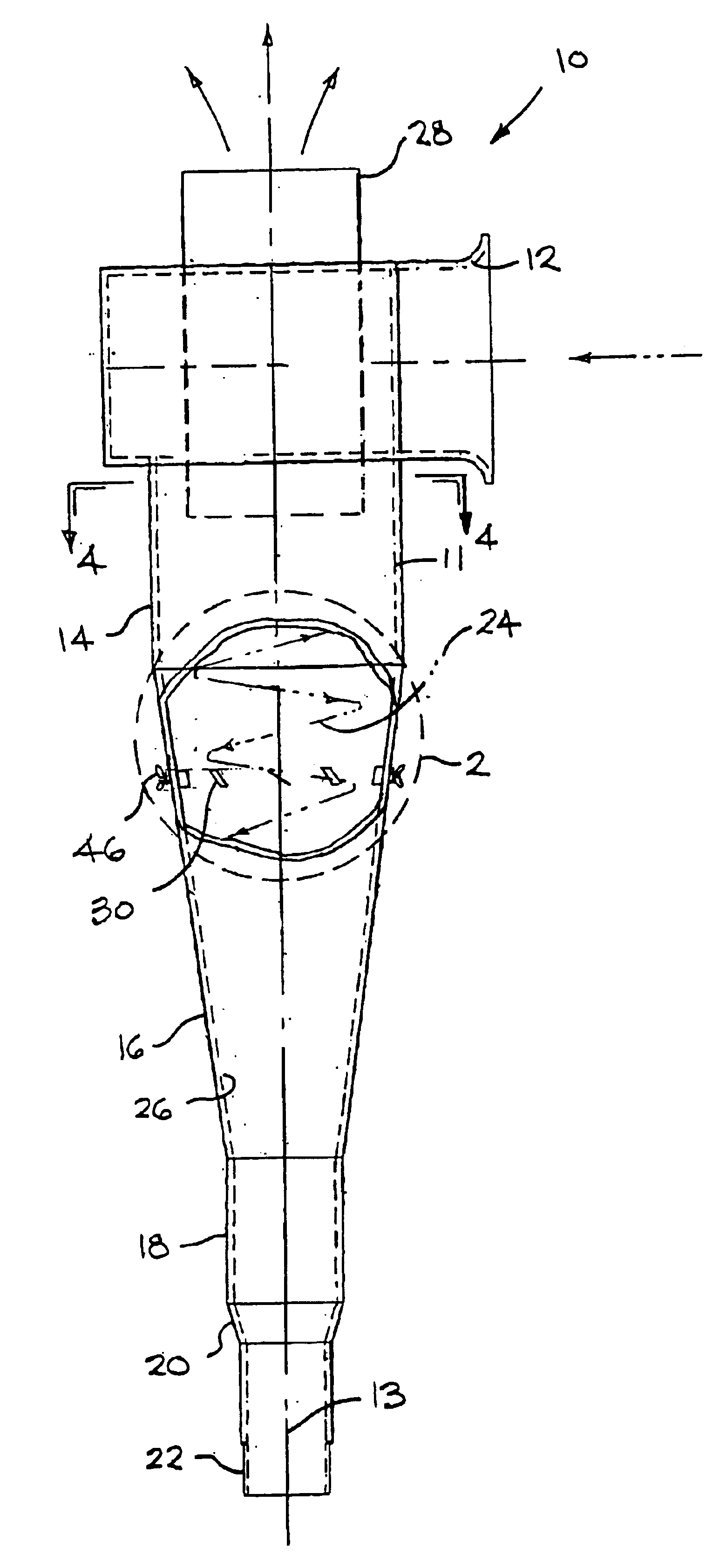
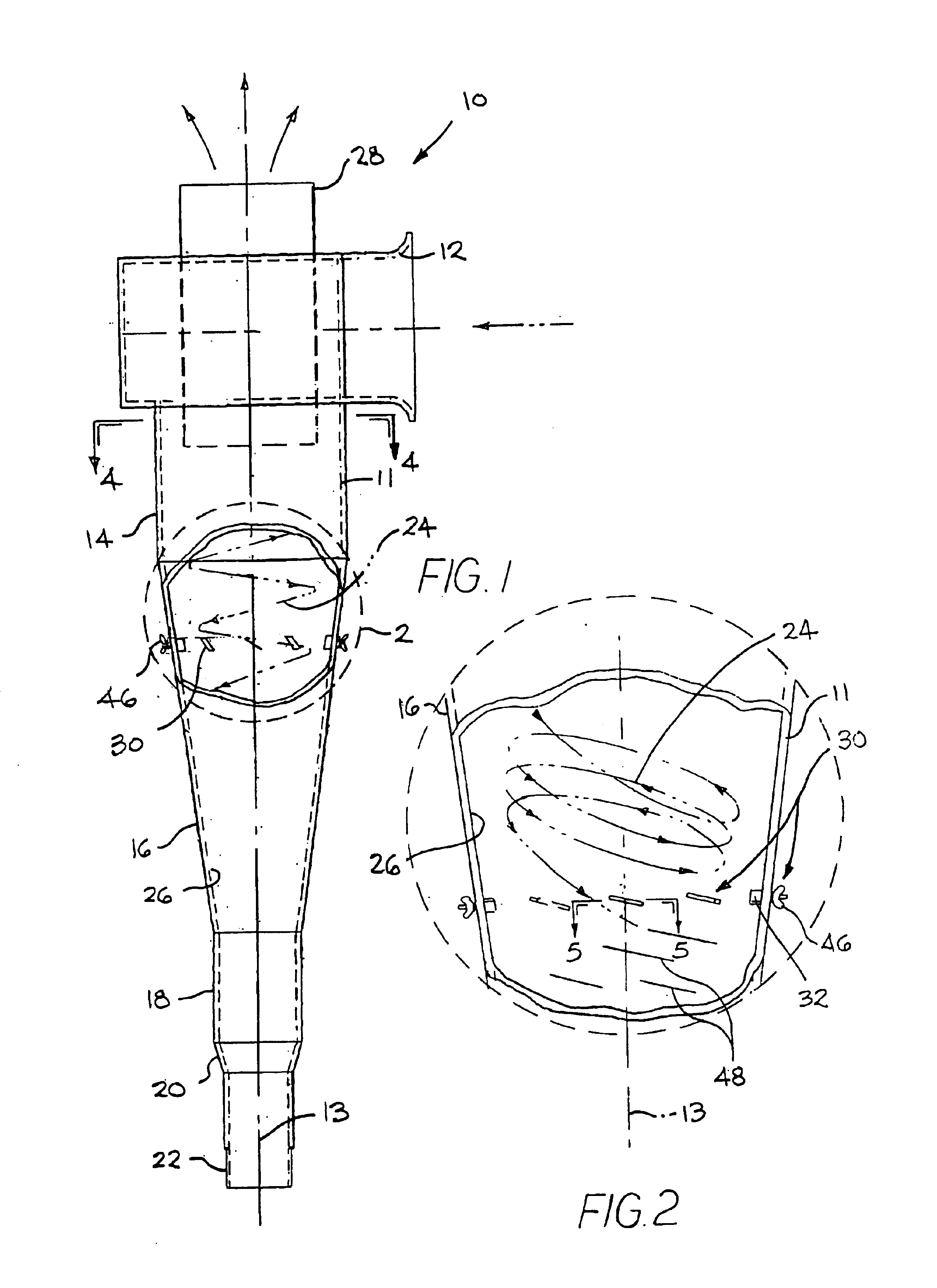
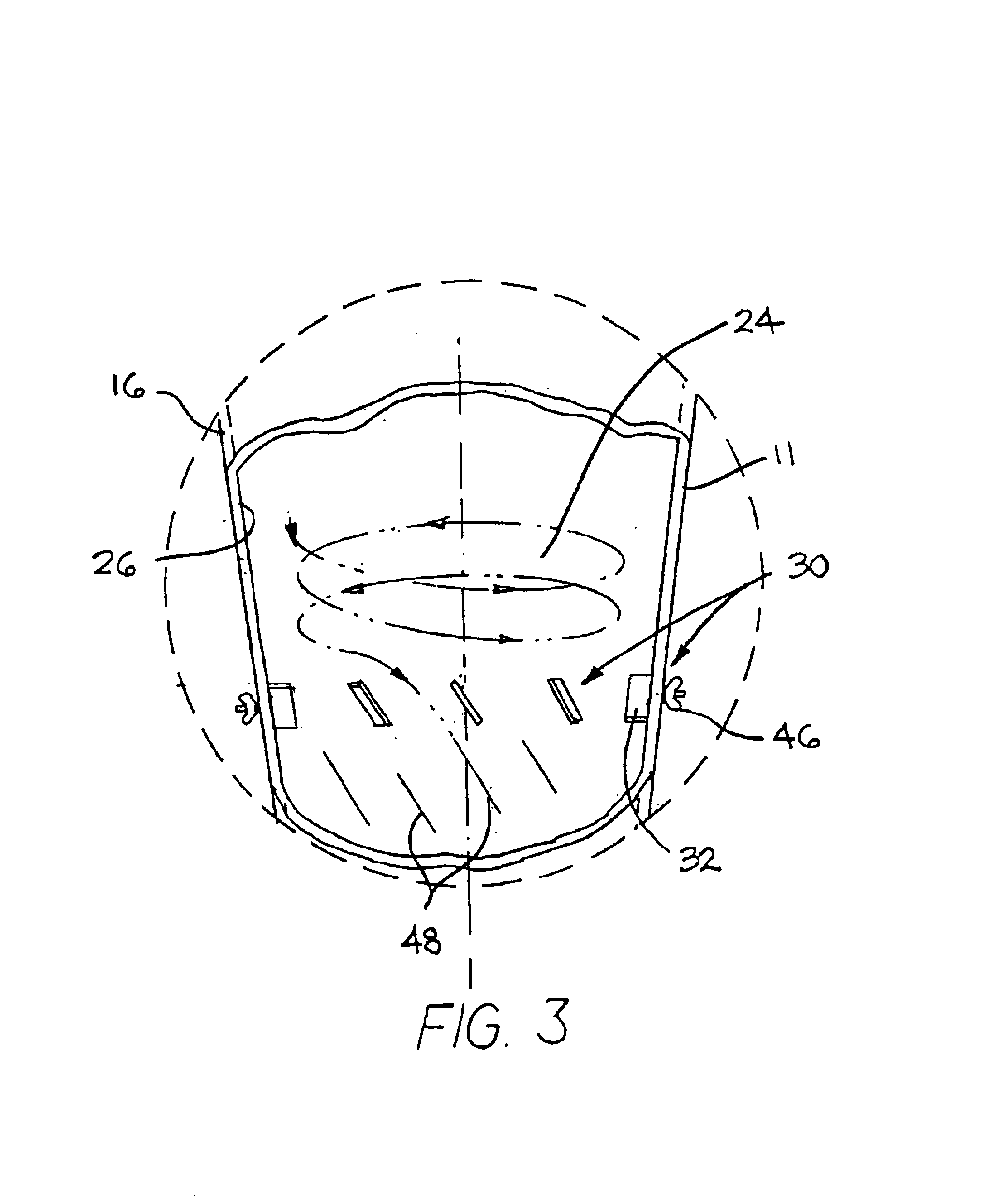
Cyclone separator with surface vanes
PatentInactiveUS6837912B1
Innovation
- Incorporating adjustable vanes on the inside surface of the cyclone cone to control axial velocity, allowing for empirical optimization of gas flow direction and velocity by adjusting the angle of the vanes based on specific gas flow rates, particulate loading, and particle size distribution.

Environmental Regulations for Industrial Dust Emission Control
Environmental regulations governing industrial dust emissions have become increasingly stringent worldwide, directly impacting the design and operational requirements of cyclone separators in manufacturing facilities. These regulatory frameworks establish mandatory emission limits, monitoring protocols, and compliance standards that industries must meet to minimize particulate matter release into the atmosphere. Understanding these regulations is essential for optimizing cyclone separator performance, as compliance drives both technical specifications and operational strategies.
In the United States, the Environmental Protection Agency enforces the National Ambient Air Quality Standards under the Clean Air Act, which sets specific limits for particulate matter including PM10 and PM2.5 concentrations. Industrial facilities utilizing cyclone separators must demonstrate compliance through continuous emission monitoring systems and periodic performance testing. The Maximum Achievable Control Technology standards further require industries to implement best available control technologies, pushing cyclone separator efficiency requirements beyond conventional benchmarks.
The European Union implements the Industrial Emissions Directive, which mandates Best Available Techniques for dust control across member states. This directive establishes emission limit values ranging from 5 to 20 mg/m³ depending on industry sector and process type. Cyclone separators serving as primary or secondary dust collectors must achieve these thresholds, often necessitating multi-stage configurations or hybrid systems combining cyclonic separation with filtration technologies.
China's Air Pollution Prevention and Control Law has introduced progressively tighter emission standards, with recent amendments requiring particulate emissions below 10 mg/m³ for many industrial processes. Regional variations exist, with heavily industrialized provinces implementing even stricter local standards. These regulations have accelerated adoption of high-efficiency cyclone designs and real-time monitoring systems to ensure continuous compliance.
Regulatory frameworks also address fugitive dust emissions, workplace air quality standards under occupational health regulations, and waste disposal requirements for collected particulate matter. Non-compliance penalties include operational shutdowns, substantial fines, and mandatory equipment upgrades, making regulatory adherence a critical driver for cyclone separator optimization initiatives. Industries must balance capital investment in advanced separation technology against ongoing compliance costs and potential liability exposure.
In the United States, the Environmental Protection Agency enforces the National Ambient Air Quality Standards under the Clean Air Act, which sets specific limits for particulate matter including PM10 and PM2.5 concentrations. Industrial facilities utilizing cyclone separators must demonstrate compliance through continuous emission monitoring systems and periodic performance testing. The Maximum Achievable Control Technology standards further require industries to implement best available control technologies, pushing cyclone separator efficiency requirements beyond conventional benchmarks.
The European Union implements the Industrial Emissions Directive, which mandates Best Available Techniques for dust control across member states. This directive establishes emission limit values ranging from 5 to 20 mg/m³ depending on industry sector and process type. Cyclone separators serving as primary or secondary dust collectors must achieve these thresholds, often necessitating multi-stage configurations or hybrid systems combining cyclonic separation with filtration technologies.
China's Air Pollution Prevention and Control Law has introduced progressively tighter emission standards, with recent amendments requiring particulate emissions below 10 mg/m³ for many industrial processes. Regional variations exist, with heavily industrialized provinces implementing even stricter local standards. These regulations have accelerated adoption of high-efficiency cyclone designs and real-time monitoring systems to ensure continuous compliance.
Regulatory frameworks also address fugitive dust emissions, workplace air quality standards under occupational health regulations, and waste disposal requirements for collected particulate matter. Non-compliance penalties include operational shutdowns, substantial fines, and mandatory equipment upgrades, making regulatory adherence a critical driver for cyclone separator optimization initiatives. Industries must balance capital investment in advanced separation technology against ongoing compliance costs and potential liability exposure.
Computational Fluid Dynamics Applications in Cyclone Design
Computational Fluid Dynamics has emerged as an indispensable tool in modern cyclone separator design, revolutionizing the approach to optimizing dust collection efficiency. CFD simulations enable engineers to visualize and quantify complex flow patterns, particle trajectories, and pressure distributions within cyclone geometries without the need for extensive physical prototyping. By solving the Navier-Stokes equations coupled with particle tracking algorithms, CFD provides detailed insights into the interaction between gas flow and particulate matter, allowing for precise prediction of separation efficiency across different particle size ranges.
The application of CFD in cyclone design typically employs turbulence models such as Reynolds Stress Model, Large Eddy Simulation, or k-epsilon variants to accurately capture the highly swirling flow characteristics. These models help identify critical flow phenomena including vortex core precession, short-circuiting flows, and boundary layer separation that significantly impact collection performance. Advanced multiphase flow simulations using Eulerian-Lagrangian or Eulerian-Eulerian approaches enable tracking of millions of particles simultaneously, providing statistical data on particle residence time, collision frequencies, and escape mechanisms through the vortex finder.
Parametric studies conducted through CFD allow systematic investigation of geometric variables such as inlet dimensions, cone angle, vortex finder diameter, and cylinder height. This computational approach dramatically reduces development time and costs compared to traditional trial-and-error methods. Engineers can rapidly evaluate hundreds of design variations, identifying optimal configurations that maximize separation efficiency while minimizing pressure drop. Sensitivity analysis through CFD reveals which parameters exert the greatest influence on performance, guiding focused optimization efforts.
Modern CFD platforms integrate optimization algorithms that automatically iterate through design spaces to identify Pareto-optimal solutions balancing multiple objectives. Machine learning techniques are increasingly coupled with CFD databases to develop surrogate models that predict cyclone performance instantaneously, enabling real-time design optimization. Validation against experimental data remains crucial, with CFD results typically requiring calibration through carefully designed physical tests to ensure predictive accuracy across operating conditions.
The application of CFD in cyclone design typically employs turbulence models such as Reynolds Stress Model, Large Eddy Simulation, or k-epsilon variants to accurately capture the highly swirling flow characteristics. These models help identify critical flow phenomena including vortex core precession, short-circuiting flows, and boundary layer separation that significantly impact collection performance. Advanced multiphase flow simulations using Eulerian-Lagrangian or Eulerian-Eulerian approaches enable tracking of millions of particles simultaneously, providing statistical data on particle residence time, collision frequencies, and escape mechanisms through the vortex finder.
Parametric studies conducted through CFD allow systematic investigation of geometric variables such as inlet dimensions, cone angle, vortex finder diameter, and cylinder height. This computational approach dramatically reduces development time and costs compared to traditional trial-and-error methods. Engineers can rapidly evaluate hundreds of design variations, identifying optimal configurations that maximize separation efficiency while minimizing pressure drop. Sensitivity analysis through CFD reveals which parameters exert the greatest influence on performance, guiding focused optimization efforts.
Modern CFD platforms integrate optimization algorithms that automatically iterate through design spaces to identify Pareto-optimal solutions balancing multiple objectives. Machine learning techniques are increasingly coupled with CFD databases to develop surrogate models that predict cyclone performance instantaneously, enabling real-time design optimization. Validation against experimental data remains crucial, with CFD results typically requiring calibration through carefully designed physical tests to ensure predictive accuracy across operating conditions.
Unlock deeper insights with PatSnap Eureka Quick Research — get a full tech report to explore trends and direct your research. Try now!
Generate Your Research Report Instantly with AI Agent
Supercharge your innovation with PatSnap Eureka AI Agent Platform!