How to Optimize Cyclone Separator for High-Density Materials
FEB 11, 20269 MIN READ
Generate Your Research Report Instantly with AI Agent
Patsnap Eureka helps you evaluate technical feasibility & market potential.
High-Density Material Separation Background and Objectives
Cyclone separators have been fundamental equipment in industrial particle separation processes since their introduction in the late 19th century. Originally designed for gas-solid separation in mining and agricultural applications, these devices have evolved significantly to address increasingly complex separation challenges. The technology operates on centrifugal force principles, where rotational motion creates differential forces that separate particles based on density and size characteristics. Over the past century, cyclone separators have found widespread applications across industries including mineral processing, chemical manufacturing, cement production, and waste management.
The separation of high-density materials presents unique technical challenges that distinguish it from conventional cyclone applications. High-density materials, typically characterized by specific gravities exceeding 2.5 g/cm³, include metallic ores, heavy minerals, industrial catalysts, and certain chemical compounds. These materials exhibit different flow behaviors and particle dynamics compared to lighter substances, necessitating specialized design considerations. Traditional cyclone configurations often demonstrate reduced separation efficiency, increased wear rates, and operational instability when processing high-density feedstocks.
Current industrial demands are driving the need for optimized cyclone separator designs capable of handling high-density materials more effectively. The mining sector requires improved recovery rates for valuable heavy minerals while minimizing energy consumption. Chemical and pharmaceutical industries seek enhanced separation precision to meet stringent product purity standards. Environmental regulations mandate better dust control and emission reduction, particularly for heavy metal-containing particles. These converging pressures create compelling economic and technical incentives for cyclone optimization research.
The primary objective of this technical investigation is to identify and evaluate optimization strategies that enhance cyclone separator performance specifically for high-density material applications. Key performance targets include maximizing separation efficiency above 95%, reducing pressure drop by 15-25%, extending equipment service life through wear mitigation, and improving operational stability across varying feed conditions. Secondary objectives encompass developing scalable design principles applicable across different capacity ranges and establishing predictive models for performance optimization. Achieving these objectives would enable industries to process high-density materials more economically while meeting increasingly stringent operational and environmental requirements.
The separation of high-density materials presents unique technical challenges that distinguish it from conventional cyclone applications. High-density materials, typically characterized by specific gravities exceeding 2.5 g/cm³, include metallic ores, heavy minerals, industrial catalysts, and certain chemical compounds. These materials exhibit different flow behaviors and particle dynamics compared to lighter substances, necessitating specialized design considerations. Traditional cyclone configurations often demonstrate reduced separation efficiency, increased wear rates, and operational instability when processing high-density feedstocks.
Current industrial demands are driving the need for optimized cyclone separator designs capable of handling high-density materials more effectively. The mining sector requires improved recovery rates for valuable heavy minerals while minimizing energy consumption. Chemical and pharmaceutical industries seek enhanced separation precision to meet stringent product purity standards. Environmental regulations mandate better dust control and emission reduction, particularly for heavy metal-containing particles. These converging pressures create compelling economic and technical incentives for cyclone optimization research.
The primary objective of this technical investigation is to identify and evaluate optimization strategies that enhance cyclone separator performance specifically for high-density material applications. Key performance targets include maximizing separation efficiency above 95%, reducing pressure drop by 15-25%, extending equipment service life through wear mitigation, and improving operational stability across varying feed conditions. Secondary objectives encompass developing scalable design principles applicable across different capacity ranges and establishing predictive models for performance optimization. Achieving these objectives would enable industries to process high-density materials more economically while meeting increasingly stringent operational and environmental requirements.
Market Demand for Efficient Cyclone Separators
The global demand for efficient cyclone separators optimized for high-density materials has experienced substantial growth across multiple industrial sectors. Mining and mineral processing industries represent the largest consumer segment, driven by the continuous need to separate valuable heavy minerals from gangue materials with maximum recovery rates and minimal energy consumption. The increasing complexity of ore bodies and declining ore grades worldwide have intensified the requirement for separation equipment capable of handling materials with significant density differentials while maintaining operational efficiency.
Manufacturing sectors processing ceramic materials, metal powders, and abrasive compounds have emerged as significant demand drivers. These industries require cyclone separators that can effectively classify high-density particles without excessive wear or performance degradation. The powder metallurgy sector particularly demands precise separation of metallic particles across narrow size ranges, where conventional cyclones often demonstrate suboptimal performance due to the challenging flow dynamics associated with dense materials.
Environmental regulations and sustainability initiatives have created additional market pressure for optimized cyclone technology. Industries generating high-density particulate emissions, including cement production, coal processing, and steel manufacturing, face increasingly stringent air quality standards. This regulatory environment has accelerated investment in advanced cyclone systems capable of capturing fine high-density particles that traditional designs allow to escape, thereby reducing environmental impact while recovering valuable materials.
The chemical processing industry presents growing demand for specialized cyclone separators handling catalyst particles, pigments, and other high-density chemical intermediates. Process intensification trends and the shift toward continuous manufacturing have heightened requirements for compact, high-efficiency separation equipment that maintains performance across varying feed conditions and particle characteristics.
Emerging markets in developing economies are experiencing rapid industrialization, particularly in mineral extraction and heavy manufacturing sectors. This geographic expansion has broadened the market base for cyclone separator technology, with specific emphasis on cost-effective solutions that deliver reliable performance when processing challenging high-density materials under demanding operational conditions.
Manufacturing sectors processing ceramic materials, metal powders, and abrasive compounds have emerged as significant demand drivers. These industries require cyclone separators that can effectively classify high-density particles without excessive wear or performance degradation. The powder metallurgy sector particularly demands precise separation of metallic particles across narrow size ranges, where conventional cyclones often demonstrate suboptimal performance due to the challenging flow dynamics associated with dense materials.
Environmental regulations and sustainability initiatives have created additional market pressure for optimized cyclone technology. Industries generating high-density particulate emissions, including cement production, coal processing, and steel manufacturing, face increasingly stringent air quality standards. This regulatory environment has accelerated investment in advanced cyclone systems capable of capturing fine high-density particles that traditional designs allow to escape, thereby reducing environmental impact while recovering valuable materials.
The chemical processing industry presents growing demand for specialized cyclone separators handling catalyst particles, pigments, and other high-density chemical intermediates. Process intensification trends and the shift toward continuous manufacturing have heightened requirements for compact, high-efficiency separation equipment that maintains performance across varying feed conditions and particle characteristics.
Emerging markets in developing economies are experiencing rapid industrialization, particularly in mineral extraction and heavy manufacturing sectors. This geographic expansion has broadened the market base for cyclone separator technology, with specific emphasis on cost-effective solutions that deliver reliable performance when processing challenging high-density materials under demanding operational conditions.
Current Cyclone Performance Limitations for Dense Materials
Cyclone separators face significant performance degradation when processing high-density materials, primarily due to fundamental design assumptions that favor lighter particulate matter. Traditional cyclones are optimized for particles with densities ranging from 1000 to 2500 kg/m³, but high-density materials exceeding 4000 kg/m³ present unique operational challenges that compromise separation efficiency and system reliability.
The most critical limitation stems from excessive particle momentum in high-density applications. Dense particles entering the cyclone body possess substantially higher kinetic energy, causing them to penetrate deeper into the vortex core rather than following the intended spiral trajectory toward the wall. This phenomenon reduces collection efficiency by 15-30% compared to standard density materials, as particles bypass the separation zone and exit through the overflow outlet.
Wall erosion represents another severe constraint, particularly at the cyclone inlet and conical section. High-density particles traveling at velocities of 15-25 m/s generate impact forces three to five times greater than conventional materials, accelerating wear rates exponentially. Industrial data indicates that cyclone lifespan can decrease from 18-24 months to merely 6-9 months when handling dense materials without design modifications, significantly increasing maintenance costs and operational downtime.
Pressure drop characteristics also deviate substantially from theoretical predictions. The increased particle loading and altered flow patterns in dense material applications generate pressure drops 40-60% higher than calculated values based on standard correlations. This excessive energy consumption not only reduces overall system efficiency but also necessitates oversized blowers or fans, increasing capital and operational expenditures.
Flow instability issues become pronounced with high-density feeds, manifesting as irregular vortex patterns and fluctuating separation performance. The heavy particle concentration disrupts the stable air-core formation essential for effective cyclone operation, leading to periodic efficiency variations of 10-20% and unpredictable product quality. Additionally, the risk of rope discharge and blockage in the dust outlet increases significantly, requiring frequent intervention and process interruptions that compromise continuous operation requirements in modern industrial settings.
The most critical limitation stems from excessive particle momentum in high-density applications. Dense particles entering the cyclone body possess substantially higher kinetic energy, causing them to penetrate deeper into the vortex core rather than following the intended spiral trajectory toward the wall. This phenomenon reduces collection efficiency by 15-30% compared to standard density materials, as particles bypass the separation zone and exit through the overflow outlet.
Wall erosion represents another severe constraint, particularly at the cyclone inlet and conical section. High-density particles traveling at velocities of 15-25 m/s generate impact forces three to five times greater than conventional materials, accelerating wear rates exponentially. Industrial data indicates that cyclone lifespan can decrease from 18-24 months to merely 6-9 months when handling dense materials without design modifications, significantly increasing maintenance costs and operational downtime.
Pressure drop characteristics also deviate substantially from theoretical predictions. The increased particle loading and altered flow patterns in dense material applications generate pressure drops 40-60% higher than calculated values based on standard correlations. This excessive energy consumption not only reduces overall system efficiency but also necessitates oversized blowers or fans, increasing capital and operational expenditures.
Flow instability issues become pronounced with high-density feeds, manifesting as irregular vortex patterns and fluctuating separation performance. The heavy particle concentration disrupts the stable air-core formation essential for effective cyclone operation, leading to periodic efficiency variations of 10-20% and unpredictable product quality. Additionally, the risk of rope discharge and blockage in the dust outlet increases significantly, requiring frequent intervention and process interruptions that compromise continuous operation requirements in modern industrial settings.
Existing Cyclone Optimization Solutions
01 Structural optimization of cyclone separator inlet and outlet
Optimization of the inlet and outlet configurations of cyclone separators can significantly improve separation efficiency. This includes modifications to the inlet duct geometry, such as tangential or volute inlet designs, and outlet pipe dimensions to reduce pressure drop and enhance particle collection. Adjusting the inlet velocity distribution and outlet tube length can minimize short-circuit flow and improve overall performance.- Structural design optimization of cyclone separator body: Optimization of the cyclone separator's main body structure, including modifications to the cylindrical section, conical section, and overall geometric configuration to improve separation efficiency. This involves adjusting dimensions, angles, and proportions of different sections to enhance the centrifugal force and particle separation performance. Structural improvements may include optimized cone angles, cylinder-to-cone ratios, and overall height-to-diameter ratios.
- Inlet and outlet configuration improvements: Enhancement of the inlet and outlet designs to optimize flow patterns and reduce turbulence. This includes modifications to inlet geometry, positioning, and flow direction to maximize tangential velocity and minimize energy losses. Outlet designs are optimized to reduce short-circuiting and improve particle collection efficiency. Various inlet types such as tangential, axial, or spiral configurations are employed to achieve better separation performance.
- Internal flow field optimization and vortex finder design: Optimization of internal flow dynamics through computational fluid dynamics analysis and vortex finder modifications. This involves adjusting the vortex finder diameter, insertion depth, and configuration to minimize pressure drop while maximizing separation efficiency. Flow field optimization reduces internal turbulence and secondary flows that can negatively impact separation performance.
- Multi-stage and combined cyclone separator systems: Development of multi-stage cyclone arrangements and combined separator systems to achieve higher separation efficiency for particles of varying sizes. This approach utilizes multiple cyclones in series or parallel configurations, with each stage optimized for specific particle size ranges. Combined systems may integrate different separation technologies to enhance overall performance and handle diverse operating conditions.
- Material selection and wear resistance enhancement: Optimization through selection of appropriate materials and surface treatments to improve wear resistance and extend service life. This includes the use of wear-resistant coatings, linings, and materials that can withstand abrasive particles and harsh operating conditions. Material optimization also considers factors such as corrosion resistance, temperature tolerance, and maintenance requirements to ensure long-term operational reliability.
02 Internal flow field optimization through vortex finder design
The vortex finder plays a critical role in cyclone separator performance by controlling the internal flow pattern and preventing re-entrainment of separated particles. Optimization involves adjusting the vortex finder diameter, insertion depth, and shape to enhance the stability of the inner vortex and reduce turbulence. Advanced designs may incorporate special geometries or extensions to improve separation efficiency and reduce pressure loss.Expand Specific Solutions03 Cone section geometry and dimensional optimization
The conical section of a cyclone separator significantly affects particle separation and collection efficiency. Optimization focuses on the cone angle, length, and diameter ratios to enhance centrifugal force and particle settling. Modifications to the cone geometry can reduce wall wear, minimize particle re-entrainment, and improve dust collection at the bottom discharge. Some designs incorporate multi-stage or variable-angle cones for enhanced performance.Expand Specific Solutions04 Multi-cyclone and parallel arrangement optimization
Multi-cyclone systems utilize multiple smaller cyclone units arranged in parallel to increase overall processing capacity while maintaining high separation efficiency. Optimization involves designing uniform flow distribution among individual cyclones, optimizing spacing and arrangement patterns, and ensuring balanced pressure drops. This configuration is particularly effective for handling large gas volumes with consistent particle removal efficiency.Expand Specific Solutions05 Integration of auxiliary separation enhancement devices
Auxiliary devices can be integrated into cyclone separators to further enhance separation performance. These include guide vanes, swirl generators, secondary air injection systems, and internal baffles that optimize flow patterns and increase particle capture. Such enhancements help reduce energy consumption, improve fine particle collection, and extend the operational range of the cyclone separator under varying load conditions.Expand Specific Solutions
Key Players in Cyclone Separator Industry
The cyclone separator optimization for high-density materials represents a mature technology sector experiencing steady evolution driven by industrial efficiency demands. The market spans multiple industries including cement production, petrochemicals, mining, and environmental engineering, with significant growth potential in emerging markets and sustainable processing applications. Technology maturity varies across players, with established industrial equipment manufacturers like Polysius AG, MANN+HUMMEL GmbH, and Andritz AG demonstrating advanced separation technologies, while specialized firms such as Shanghai Zhuozhuan Chemical Technology and Suzhou Xiran Industrial Equipment focus on niche applications. Research institutions including China Petroleum University Beijing, Donghua University, and Karlsruhe Institute of Technology contribute fundamental innovations in fluid dynamics and material science. The competitive landscape features both diversified conglomerates like Baker Hughes and MAHLE International alongside dedicated separation technology providers, indicating a mature but continuously innovating market with opportunities in efficiency enhancement, energy reduction, and adaptation to increasingly challenging material characteristics.
Polysius AG
Technical Solution: Polysius AG has developed advanced cyclone separator systems specifically optimized for cement and mineral processing industries handling high-density materials. Their technology incorporates multi-stage cyclone configurations with optimized vortex finder designs and inlet geometries to enhance separation efficiency for particles with high specific gravity. The system features adjustable cone angles and specialized wear-resistant linings to handle abrasive high-density materials while maintaining consistent separation performance. Their cyclones integrate computational fluid dynamics (CFD) optimization to reduce pressure drop while maximizing collection efficiency for dense particle streams, achieving separation efficiencies exceeding 95% for particles above 5 microns in high-density applications.
Strengths: Extensive experience in cement industry applications with proven track record in handling abrasive high-density materials; advanced wear-resistant designs extending equipment lifespan. Weaknesses: Solutions primarily focused on large-scale industrial applications; higher initial capital investment requirements.
MANN+HUMMEL GmbH
Technical Solution: MANN+HUMMEL has developed specialized cyclone separator technology for high-density particulate filtration in automotive and industrial applications. Their approach utilizes optimized cyclonic flow patterns combined with tangential inlet designs that create enhanced centrifugal forces suitable for separating high-density particles. The technology incorporates variable geometry cyclone bodies with adjustable pressure drop characteristics, allowing adaptation to different material densities and flow rates. Their systems feature integrated pre-separation stages that remove larger high-density particles before fine filtration, reducing overall system load. The design emphasizes compact footprint while maintaining high separation efficiency through precisely engineered spiral flow paths and optimized exit configurations.
Strengths: Strong expertise in filtration systems with proven automotive and industrial applications; compact and modular designs suitable for space-constrained installations. Weaknesses: Primary focus on smaller-scale applications compared to heavy industrial cyclones; limited experience with extremely high-density bulk material processing.
Core Patents in High-Density Cyclone Design
Cyclone separator
PatentInactiveAU1988013983A1
Innovation
- A cyclone separator of the de-watering type is designed with specific geometrical modifications, including a reduced cross-sectional dimension at the downstream end of the feed inlet section and a vortex finder to prevent re-entrainment of droplets, allowing for efficient separation of denser and less dense components.
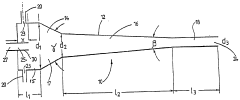
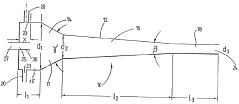
Separator and Method of Separation
PatentInactiveUS20100064893A1
Innovation
- A method and system that introduces a multiphase fluid into a separation region with a rotational movement, creating an outer annular region for high-density components and a core region for low-density components, allowing for effective separation of solid particles from fluids at wellhead pressures and across a wide range of flowrates and pressures.


Energy Efficiency and Environmental Regulations
Energy efficiency has emerged as a critical consideration in cyclone separator optimization for high-density materials, driven by escalating operational costs and stringent environmental regulations worldwide. Modern industrial facilities processing heavy particulates face mounting pressure to reduce energy consumption while maintaining separation performance. The energy demands of cyclone systems primarily stem from pressure drop across the unit, which directly correlates with fan power requirements and operational expenses. For high-density material applications, this challenge intensifies as increased particle loading and higher inlet velocities necessitate greater energy input to achieve effective separation.
Regulatory frameworks governing particulate emissions have become increasingly stringent across major industrial regions. The European Union's Industrial Emissions Directive and the United States Environmental Protection Agency's National Emission Standards for Hazardous Air Pollutants impose strict limits on particulate matter discharge, compelling industries to enhance cyclone separator efficiency. These regulations mandate not only higher collection efficiencies but also continuous monitoring and reporting of emission levels, adding compliance costs to operational budgets. High-density material processing industries, including mining, cement production, and metal refining, face particular scrutiny due to their substantial particulate generation rates.
The intersection of energy efficiency and environmental compliance creates a complex optimization landscape. Traditional high-efficiency cyclone designs often achieve superior separation through increased pressure drop, resulting in elevated energy consumption. This trade-off becomes economically unsustainable as energy prices rise and carbon taxation schemes expand globally. Consequently, next-generation cyclone designs must simultaneously address both imperatives through innovative approaches such as computational fluid dynamics optimization, advanced inlet configurations, and hybrid separation technologies that minimize energy penalties while meeting emission standards.
Furthermore, emerging regulations targeting carbon footprint reduction and circular economy principles are reshaping cyclone separator development priorities. Industries must now consider lifecycle energy consumption, material recyclability, and integration with waste heat recovery systems. These evolving requirements are driving research toward intelligent cyclone systems incorporating real-time performance monitoring, adaptive flow control, and predictive maintenance capabilities that optimize energy usage while ensuring continuous regulatory compliance throughout the equipment's operational lifespan.
Regulatory frameworks governing particulate emissions have become increasingly stringent across major industrial regions. The European Union's Industrial Emissions Directive and the United States Environmental Protection Agency's National Emission Standards for Hazardous Air Pollutants impose strict limits on particulate matter discharge, compelling industries to enhance cyclone separator efficiency. These regulations mandate not only higher collection efficiencies but also continuous monitoring and reporting of emission levels, adding compliance costs to operational budgets. High-density material processing industries, including mining, cement production, and metal refining, face particular scrutiny due to their substantial particulate generation rates.
The intersection of energy efficiency and environmental compliance creates a complex optimization landscape. Traditional high-efficiency cyclone designs often achieve superior separation through increased pressure drop, resulting in elevated energy consumption. This trade-off becomes economically unsustainable as energy prices rise and carbon taxation schemes expand globally. Consequently, next-generation cyclone designs must simultaneously address both imperatives through innovative approaches such as computational fluid dynamics optimization, advanced inlet configurations, and hybrid separation technologies that minimize energy penalties while meeting emission standards.
Furthermore, emerging regulations targeting carbon footprint reduction and circular economy principles are reshaping cyclone separator development priorities. Industries must now consider lifecycle energy consumption, material recyclability, and integration with waste heat recovery systems. These evolving requirements are driving research toward intelligent cyclone systems incorporating real-time performance monitoring, adaptive flow control, and predictive maintenance capabilities that optimize energy usage while ensuring continuous regulatory compliance throughout the equipment's operational lifespan.
Cost-Benefit Analysis of Optimization Approaches
Evaluating the cost-benefit dynamics of cyclone separator optimization for high-density materials requires a comprehensive assessment of investment requirements against anticipated performance gains. Initial capital expenditures vary significantly across different optimization approaches, ranging from relatively low-cost geometric modifications to substantial investments in advanced materials and control systems. Computational fluid dynamics simulations, while requiring upfront software licensing and expertise, offer cost-effective design validation that can prevent expensive physical prototyping iterations. The implementation of wear-resistant materials and coatings represents a moderate investment that delivers substantial long-term benefits through extended equipment lifespan and reduced maintenance frequency.
Operational cost considerations play a crucial role in determining the overall economic viability of optimization strategies. Energy consumption reductions achieved through aerodynamic improvements and optimized inlet configurations can generate significant savings over the equipment lifecycle, particularly in continuous operation scenarios. Enhanced separation efficiency directly translates to reduced material losses and improved product quality, creating measurable value in downstream processing operations. The quantification of these benefits must account for specific material characteristics, throughput requirements, and operational parameters unique to each application context.
The payback period for different optimization approaches varies considerably based on operational intensity and material value. Simple geometric modifications such as vortex finder adjustments or inlet redesigns typically demonstrate payback periods of six to eighteen months in high-throughput applications. More substantial investments in advanced monitoring systems and automated control mechanisms may require two to four years to achieve full return, though they provide additional benefits in process stability and predictive maintenance capabilities. The integration of multiple optimization strategies often yields synergistic effects that accelerate overall return on investment.
Risk mitigation represents an often-overlooked benefit component in optimization cost-benefit analysis. Enhanced separation performance reduces the likelihood of downstream equipment damage from oversized particles, while improved wear resistance minimizes unexpected downtime and emergency repair costs. The implementation of condition monitoring systems enables proactive maintenance scheduling, preventing catastrophic failures and associated production losses. These risk-adjusted benefits frequently justify higher initial investments in comprehensive optimization approaches, particularly in critical production environments where equipment failure carries substantial operational and financial consequences.
Operational cost considerations play a crucial role in determining the overall economic viability of optimization strategies. Energy consumption reductions achieved through aerodynamic improvements and optimized inlet configurations can generate significant savings over the equipment lifecycle, particularly in continuous operation scenarios. Enhanced separation efficiency directly translates to reduced material losses and improved product quality, creating measurable value in downstream processing operations. The quantification of these benefits must account for specific material characteristics, throughput requirements, and operational parameters unique to each application context.
The payback period for different optimization approaches varies considerably based on operational intensity and material value. Simple geometric modifications such as vortex finder adjustments or inlet redesigns typically demonstrate payback periods of six to eighteen months in high-throughput applications. More substantial investments in advanced monitoring systems and automated control mechanisms may require two to four years to achieve full return, though they provide additional benefits in process stability and predictive maintenance capabilities. The integration of multiple optimization strategies often yields synergistic effects that accelerate overall return on investment.
Risk mitigation represents an often-overlooked benefit component in optimization cost-benefit analysis. Enhanced separation performance reduces the likelihood of downstream equipment damage from oversized particles, while improved wear resistance minimizes unexpected downtime and emergency repair costs. The implementation of condition monitoring systems enables proactive maintenance scheduling, preventing catastrophic failures and associated production losses. These risk-adjusted benefits frequently justify higher initial investments in comprehensive optimization approaches, particularly in critical production environments where equipment failure carries substantial operational and financial consequences.
Unlock deeper insights with Patsnap Eureka Quick Research — get a full tech report to explore trends and direct your research. Try now!
Generate Your Research Report Instantly with AI Agent
Supercharge your innovation with Patsnap Eureka AI Agent Platform!