How to Predict Actuation Cycles Based on Hydrogel Failure Modes
MAY 12, 20269 MIN READ
Generate Your Research Report Instantly with AI Agent
PatSnap Eureka helps you evaluate technical feasibility & market potential.
Hydrogel Actuator Background and Cycle Prediction Goals
Hydrogel actuators represent a revolutionary class of soft robotic devices that leverage the unique properties of hydrogel materials to achieve controlled mechanical motion. These materials consist of three-dimensional polymer networks capable of absorbing and retaining substantial amounts of water while maintaining their structural integrity. The fundamental actuation mechanism relies on the hydrogel's ability to undergo reversible volume changes in response to external stimuli such as temperature, pH, electric fields, or chemical gradients.
The evolution of hydrogel actuators has progressed through several distinct phases since their initial discovery in the 1950s. Early research focused primarily on understanding the basic swelling and deswelling behaviors of synthetic polymers in aqueous environments. The 1980s marked a significant breakthrough with the development of temperature-responsive poly(N-isopropylacrylamide) hydrogels, which demonstrated rapid and reversible phase transitions. Subsequently, researchers expanded the stimulus-response repertoire to include pH-sensitive, electrically-responsive, and multi-responsive hydrogel systems.
Contemporary hydrogel actuator technology has achieved remarkable sophistication, enabling applications ranging from microfluidic valves and drug delivery systems to biomimetic robots and artificial muscles. The integration of advanced synthesis techniques, including interpenetrating networks, nanocomposite reinforcement, and gradient structures, has significantly enhanced actuator performance characteristics such as response speed, mechanical strength, and durability.
However, a critical limitation constraining the widespread adoption of hydrogel actuators is the unpredictable nature of their operational lifespan. Unlike conventional mechanical actuators with well-established fatigue models, hydrogel systems exhibit complex failure mechanisms that are influenced by multiple interdependent factors including polymer chain degradation, network heterogeneity, osmotic stress accumulation, and environmental conditions.
The primary objective of cycle prediction research is to develop robust predictive models that can accurately forecast the operational lifespan of hydrogel actuators based on their specific failure modes. This capability would enable engineers to design more reliable systems, optimize maintenance schedules, and establish performance guarantees for commercial applications. The ultimate goal encompasses creating standardized testing protocols, establishing failure mode classification systems, and developing real-time monitoring techniques that can predict remaining useful life during operation.
The evolution of hydrogel actuators has progressed through several distinct phases since their initial discovery in the 1950s. Early research focused primarily on understanding the basic swelling and deswelling behaviors of synthetic polymers in aqueous environments. The 1980s marked a significant breakthrough with the development of temperature-responsive poly(N-isopropylacrylamide) hydrogels, which demonstrated rapid and reversible phase transitions. Subsequently, researchers expanded the stimulus-response repertoire to include pH-sensitive, electrically-responsive, and multi-responsive hydrogel systems.
Contemporary hydrogel actuator technology has achieved remarkable sophistication, enabling applications ranging from microfluidic valves and drug delivery systems to biomimetic robots and artificial muscles. The integration of advanced synthesis techniques, including interpenetrating networks, nanocomposite reinforcement, and gradient structures, has significantly enhanced actuator performance characteristics such as response speed, mechanical strength, and durability.
However, a critical limitation constraining the widespread adoption of hydrogel actuators is the unpredictable nature of their operational lifespan. Unlike conventional mechanical actuators with well-established fatigue models, hydrogel systems exhibit complex failure mechanisms that are influenced by multiple interdependent factors including polymer chain degradation, network heterogeneity, osmotic stress accumulation, and environmental conditions.
The primary objective of cycle prediction research is to develop robust predictive models that can accurately forecast the operational lifespan of hydrogel actuators based on their specific failure modes. This capability would enable engineers to design more reliable systems, optimize maintenance schedules, and establish performance guarantees for commercial applications. The ultimate goal encompasses creating standardized testing protocols, establishing failure mode classification systems, and developing real-time monitoring techniques that can predict remaining useful life during operation.
Market Demand for Reliable Hydrogel Actuator Systems
The global hydrogel actuator market is experiencing unprecedented growth driven by the convergence of multiple technological sectors requiring precise, biocompatible, and responsive actuation systems. Healthcare applications represent the largest demand segment, where hydrogel actuators are increasingly sought for drug delivery systems, artificial muscles, and minimally invasive surgical devices. The ability to predict actuation cycles based on failure modes has become critical for ensuring patient safety and regulatory compliance in medical applications.
Industrial automation sectors are demonstrating substantial interest in hydrogel-based actuators for soft robotics applications, particularly in food processing, pharmaceutical manufacturing, and delicate material handling. These industries require actuators that can operate in sterile environments while maintaining predictable performance over extended operational periods. The demand for failure mode prediction capabilities stems from the need to minimize unplanned downtime and ensure consistent product quality.
The consumer electronics market is emerging as a significant demand driver, with applications in haptic feedback systems, flexible displays, and wearable devices. Manufacturers in this sector prioritize actuator reliability and longevity, making cycle prediction technology essential for product warranty considerations and user experience optimization. The miniaturization trend in electronics further amplifies the need for precise failure prediction models.
Aerospace and defense applications represent a high-value niche market where hydrogel actuators are being evaluated for morphing wing technologies, adaptive camouflage systems, and space-based applications. These sectors demand extremely high reliability standards and comprehensive failure analysis capabilities, driving premium pricing for advanced prediction technologies.
The automotive industry is exploring hydrogel actuators for adaptive seating systems, climate control interfaces, and autonomous vehicle sensors. The automotive sector's emphasis on safety and durability creates strong demand for actuators with predictable failure patterns and well-characterized operational limits.
Research institutions and academic organizations constitute a growing market segment, requiring sophisticated prediction tools for fundamental research and technology development. This segment drives demand for customizable prediction models and detailed failure analysis capabilities that can support scientific publication and patent development activities.
Industrial automation sectors are demonstrating substantial interest in hydrogel-based actuators for soft robotics applications, particularly in food processing, pharmaceutical manufacturing, and delicate material handling. These industries require actuators that can operate in sterile environments while maintaining predictable performance over extended operational periods. The demand for failure mode prediction capabilities stems from the need to minimize unplanned downtime and ensure consistent product quality.
The consumer electronics market is emerging as a significant demand driver, with applications in haptic feedback systems, flexible displays, and wearable devices. Manufacturers in this sector prioritize actuator reliability and longevity, making cycle prediction technology essential for product warranty considerations and user experience optimization. The miniaturization trend in electronics further amplifies the need for precise failure prediction models.
Aerospace and defense applications represent a high-value niche market where hydrogel actuators are being evaluated for morphing wing technologies, adaptive camouflage systems, and space-based applications. These sectors demand extremely high reliability standards and comprehensive failure analysis capabilities, driving premium pricing for advanced prediction technologies.
The automotive industry is exploring hydrogel actuators for adaptive seating systems, climate control interfaces, and autonomous vehicle sensors. The automotive sector's emphasis on safety and durability creates strong demand for actuators with predictable failure patterns and well-characterized operational limits.
Research institutions and academic organizations constitute a growing market segment, requiring sophisticated prediction tools for fundamental research and technology development. This segment drives demand for customizable prediction models and detailed failure analysis capabilities that can support scientific publication and patent development activities.
Current Hydrogel Failure Analysis and Prediction Challenges
Hydrogel actuators face significant challenges in failure analysis and prediction due to their complex multi-physics behavior and time-dependent material properties. Current analytical approaches struggle to accurately capture the intricate relationships between mechanical stress, swelling dynamics, and environmental factors that contribute to actuator degradation. The heterogeneous nature of hydrogel networks creates localized stress concentrations that are difficult to predict using conventional continuum mechanics models.
Existing failure prediction methodologies primarily rely on empirical testing and statistical analysis of cyclic performance data. However, these approaches often lack the fundamental understanding of failure initiation mechanisms at the molecular level. The transition from reversible deformation to irreversible damage involves complex polymer chain scission, crosslink degradation, and network reorganization processes that current models inadequately represent.
Computational challenges arise from the need to simulate multi-scale phenomena spanning from molecular dynamics to macroscopic actuator behavior. Traditional finite element methods face convergence issues when modeling large deformation cycles combined with chemical degradation processes. The coupling between mechanical loading, mass transport, and chemical reactions requires sophisticated numerical frameworks that are computationally intensive and often unstable.
Experimental characterization presents additional obstacles due to the difficulty in real-time monitoring of internal damage evolution. Standard mechanical testing protocols developed for conventional materials may not capture the unique failure modes specific to hydrogel actuators, such as fatigue-induced crosslink density reduction or osmotic pressure-driven crack propagation.
The lack of standardized failure criteria specifically designed for hydrogel actuators further complicates prediction efforts. Current approaches often adapt failure theories from other material systems, which may not accurately reflect the dominant failure mechanisms in hydrogel-based devices. This limitation significantly impacts the reliability of cycle life predictions and hinders the development of robust design guidelines for practical applications.
Existing failure prediction methodologies primarily rely on empirical testing and statistical analysis of cyclic performance data. However, these approaches often lack the fundamental understanding of failure initiation mechanisms at the molecular level. The transition from reversible deformation to irreversible damage involves complex polymer chain scission, crosslink degradation, and network reorganization processes that current models inadequately represent.
Computational challenges arise from the need to simulate multi-scale phenomena spanning from molecular dynamics to macroscopic actuator behavior. Traditional finite element methods face convergence issues when modeling large deformation cycles combined with chemical degradation processes. The coupling between mechanical loading, mass transport, and chemical reactions requires sophisticated numerical frameworks that are computationally intensive and often unstable.
Experimental characterization presents additional obstacles due to the difficulty in real-time monitoring of internal damage evolution. Standard mechanical testing protocols developed for conventional materials may not capture the unique failure modes specific to hydrogel actuators, such as fatigue-induced crosslink density reduction or osmotic pressure-driven crack propagation.
The lack of standardized failure criteria specifically designed for hydrogel actuators further complicates prediction efforts. Current approaches often adapt failure theories from other material systems, which may not accurately reflect the dominant failure mechanisms in hydrogel-based devices. This limitation significantly impacts the reliability of cycle life predictions and hinders the development of robust design guidelines for practical applications.
Existing Failure Mode Analysis Solutions for Hydrogels
01 Stimuli-responsive hydrogel actuation mechanisms
Hydrogels can be designed to respond to various external stimuli such as temperature, pH, electric fields, or chemical gradients to achieve controlled actuation. These responsive mechanisms enable the hydrogel to undergo reversible volume changes, shape deformation, or directional movement through cyclic stimulation. The actuation is typically achieved through polymer chain reorganization and water uptake or release in response to environmental changes.- Stimuli-responsive hydrogel actuation mechanisms: Hydrogels can be designed to respond to various external stimuli such as temperature, pH, electric fields, or chemical gradients to achieve controlled actuation. These responsive mechanisms enable the hydrogel to undergo reversible volume changes, shape deformation, or directional movement through cyclic stimulation. The actuation is typically achieved through polymer chain reorganization and water uptake or release within the hydrogel matrix.
- Cyclic swelling and deswelling behavior: The fundamental actuation cycle involves the reversible swelling and deswelling of hydrogel materials in response to environmental changes. This process is characterized by the absorption and expulsion of water or other solvents, leading to significant volume changes that can be harnessed for mechanical work. The cycling behavior can be optimized through polymer composition and crosslinking density to achieve desired actuation performance.
- Electrochemical actuation systems: Electrochemically driven hydrogel actuators utilize electrical stimulation to induce ion migration and subsequent volume changes in the hydrogel matrix. These systems can provide precise control over actuation timing and magnitude through applied voltage or current modulation. The electrochemical processes enable rapid response times and reversible actuation cycles suitable for various applications.
- Thermally activated hydrogel actuators: Temperature-sensitive hydrogels exhibit phase transitions at specific thermal thresholds, enabling thermally controlled actuation cycles. These materials can undergo rapid and reversible changes in mechanical properties and dimensions when heated or cooled through their transition temperature. The thermal actuation mechanism provides a reliable method for creating cyclical motion in response to temperature variations.
- Multi-cycle durability and performance optimization: Long-term performance of hydrogel actuators requires optimization of material properties to maintain consistent actuation behavior over multiple cycles. Factors such as fatigue resistance, mechanical stability, and retention of responsive properties are critical for practical applications. Advanced formulations and processing techniques are employed to enhance the durability and reliability of cyclic actuation performance.
02 Cyclic swelling and deswelling behavior
The fundamental actuation cycle involves the reversible swelling and deswelling of hydrogel materials through controlled hydration and dehydration processes. This cyclic behavior allows for repeated mechanical work output and is essential for applications requiring sustained actuation performance. The cycle duration and amplitude can be controlled through material composition and environmental conditions.Expand Specific Solutions03 Electrochemical actuation systems
Electrochemically driven hydrogel actuators utilize electrical stimulation to induce ion migration and subsequent volume changes in the hydrogel matrix. These systems can provide precise control over actuation timing and magnitude through applied voltage or current modulation. The electrochemical processes enable rapid response times and high force generation capabilities in compact actuator designs.Expand Specific Solutions04 Multi-cycle durability and performance optimization
Long-term performance of hydrogel actuators requires optimization of material properties to withstand repeated actuation cycles without degradation. Factors such as crosslink density, polymer composition, and operating conditions affect the durability and consistency of actuation performance over extended use. Advanced formulations focus on maintaining mechanical integrity and response characteristics throughout thousands of operational cycles.Expand Specific Solutions05 Biomimetic and soft robotics applications
Hydrogel actuators are increasingly used in biomimetic systems and soft robotics where natural-like movement patterns are required. These applications leverage the inherent flexibility and biocompatibility of hydrogels to create actuators that can mimic biological muscle function or provide gentle manipulation capabilities. The actuation cycles are designed to replicate natural motion patterns for enhanced performance in biological environments.Expand Specific Solutions
Key Players in Hydrogel Actuator and Smart Material Industry
The hydrogel actuation cycle prediction field represents an emerging technology domain currently in its early development stage, characterized by significant research activity but limited commercial maturity. The market remains nascent with substantial growth potential as applications expand across biomedical devices, soft robotics, and smart materials sectors. Technology maturity varies considerably across different approaches, with academic institutions like Tsinghua University, Xi'an Jiaotong University, and Northwestern Polytechnical University leading fundamental research into failure mode characterization and predictive modeling. Industrial players including Eaton Corp., Schlumberger Technologies, and Commonwealth Scientific & Industrial Research Organisation are exploring practical applications, while specialized companies like Medytox Inc. focus on biomedical implementations. The competitive landscape shows a clear divide between research-intensive academic institutions advancing theoretical understanding and industrial entities working toward commercial viability, indicating the technology is transitioning from laboratory research to early-stage industrial development.
Xi'an Jiaotong University
Technical Solution: Xi'an Jiaotong University has developed statistical models for predicting hydrogel actuator failure based on accelerated aging studies and probabilistic analysis. Their research methodology involves systematic investigation of various failure modes including mechanical fatigue, chemical degradation, and environmental stress effects. The university has established standardized testing protocols that correlate laboratory-scale degradation studies with real-world performance predictions. Their approach integrates Weibull analysis and other reliability engineering techniques to forecast actuation cycle limits under different operational scenarios and environmental conditions.
Strengths: Robust statistical modeling expertise and comprehensive testing facilities for reliability assessment. Weaknesses: Limited focus on novel hydrogel chemistries and potential gaps in emerging application areas.
Tsinghua University
Technical Solution: Tsinghua University has developed comprehensive predictive models for hydrogel actuation cycles by integrating mechanical stress analysis with failure mode characterization. Their approach combines finite element modeling with experimental validation to predict fatigue-induced degradation patterns in hydrogel actuators. The research focuses on correlating swelling-deswelling cycles with material property changes, establishing mathematical relationships between cyclic loading parameters and hydrogel structural integrity. Their methodology incorporates multi-physics simulations that account for water diffusion, mechanical deformation, and chemical degradation processes occurring simultaneously during actuation cycles.
Strengths: Strong theoretical foundation with advanced computational modeling capabilities and extensive research infrastructure. Weaknesses: Limited industrial application experience and potential scalability challenges for commercial implementation.
Core Innovations in Hydrogel Lifecycle Prediction Technologies
Use of partial component failure data for integrated failure mode separation and failure prediction
PatentInactiveUS20150066431A1
Innovation
- A computer-implemented method and system that processes sensor and operational data to update failure models, using both known and unknown failure modes, and probabilistic assignments to refine failure mode predictions in real-time, even with incomplete data.


Method for predicting the in vivo degradation time of hyaluronic acid hydrogel
PatentActiveKR1020220117021A
Innovation
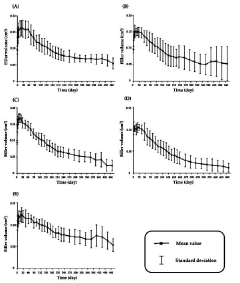
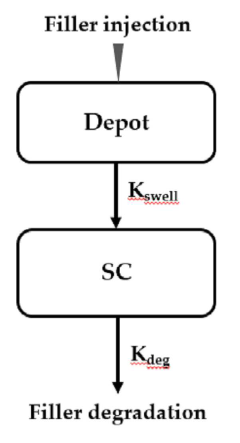
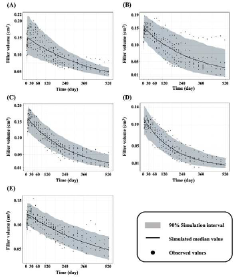
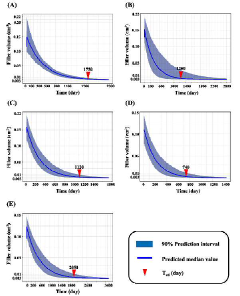
- A mathematical model using Equations 1 and 2 to determine the edema and degradation rates (K swell and K deg) of hyaluronic acid hydrogels, allowing for the prediction of complete decomposition time (T cd ) through a two-compartment model.
Biocompatibility Standards for Hydrogel Actuator Applications
Biocompatibility represents a fundamental requirement for hydrogel actuators intended for medical and biological applications, particularly when these devices operate in direct contact with living tissues or biological fluids. The establishment of comprehensive biocompatibility standards becomes increasingly critical as hydrogel actuators transition from laboratory prototypes to clinical implementations, where patient safety and regulatory compliance are paramount.
Current biocompatibility assessment frameworks for hydrogel actuators primarily follow ISO 10993 series standards, which provide systematic evaluation protocols for biological responses to medical devices. These standards encompass cytotoxicity testing, sensitization assessment, irritation evaluation, and systemic toxicity analysis. However, traditional biocompatibility testing protocols require adaptation to address the unique characteristics of hydrogel actuators, including their dynamic mechanical behavior, controlled swelling properties, and potential for cyclic material degradation during operation.
The dynamic nature of hydrogel actuators introduces additional complexity to biocompatibility evaluation, as mechanical actuation cycles can alter surface properties, release degradation products, and modify the material's interaction with biological systems over time. Standard static biocompatibility tests may not adequately capture these time-dependent changes, necessitating the development of specialized testing protocols that simulate actual operating conditions and cyclic loading scenarios.
Regulatory agencies, including the FDA and European Medicines Agency, are developing specific guidance documents for smart materials and responsive biomaterials used in medical devices. These emerging regulatory frameworks emphasize the importance of characterizing biocompatibility under dynamic conditions, including assessment of degradation products released during actuation cycles and evaluation of long-term tissue responses to repeated mechanical stimulation.
Contemporary biocompatibility standards for hydrogel actuators also address sterilization compatibility, shelf-life stability, and packaging requirements. The selection of appropriate sterilization methods becomes particularly challenging for hydrogel materials, as traditional sterilization techniques may alter polymer crosslinking density, affect swelling behavior, or compromise actuation performance. Gamma irradiation, electron beam sterilization, and ethylene oxide treatment each present distinct advantages and limitations for hydrogel actuator applications.
Future biocompatibility standards development focuses on establishing standardized testing protocols for dynamic biocompatibility assessment, including real-time monitoring of cellular responses during actuation cycles and development of accelerated aging tests that correlate with long-term clinical performance. These evolving standards will provide essential frameworks for ensuring patient safety while enabling innovation in hydrogel actuator technology for medical applications.
Current biocompatibility assessment frameworks for hydrogel actuators primarily follow ISO 10993 series standards, which provide systematic evaluation protocols for biological responses to medical devices. These standards encompass cytotoxicity testing, sensitization assessment, irritation evaluation, and systemic toxicity analysis. However, traditional biocompatibility testing protocols require adaptation to address the unique characteristics of hydrogel actuators, including their dynamic mechanical behavior, controlled swelling properties, and potential for cyclic material degradation during operation.
The dynamic nature of hydrogel actuators introduces additional complexity to biocompatibility evaluation, as mechanical actuation cycles can alter surface properties, release degradation products, and modify the material's interaction with biological systems over time. Standard static biocompatibility tests may not adequately capture these time-dependent changes, necessitating the development of specialized testing protocols that simulate actual operating conditions and cyclic loading scenarios.
Regulatory agencies, including the FDA and European Medicines Agency, are developing specific guidance documents for smart materials and responsive biomaterials used in medical devices. These emerging regulatory frameworks emphasize the importance of characterizing biocompatibility under dynamic conditions, including assessment of degradation products released during actuation cycles and evaluation of long-term tissue responses to repeated mechanical stimulation.
Contemporary biocompatibility standards for hydrogel actuators also address sterilization compatibility, shelf-life stability, and packaging requirements. The selection of appropriate sterilization methods becomes particularly challenging for hydrogel materials, as traditional sterilization techniques may alter polymer crosslinking density, affect swelling behavior, or compromise actuation performance. Gamma irradiation, electron beam sterilization, and ethylene oxide treatment each present distinct advantages and limitations for hydrogel actuator applications.
Future biocompatibility standards development focuses on establishing standardized testing protocols for dynamic biocompatibility assessment, including real-time monitoring of cellular responses during actuation cycles and development of accelerated aging tests that correlate with long-term clinical performance. These evolving standards will provide essential frameworks for ensuring patient safety while enabling innovation in hydrogel actuator technology for medical applications.
Machine Learning Integration in Hydrogel Failure Prediction
The integration of machine learning algorithms into hydrogel failure prediction represents a transformative approach to understanding and forecasting actuation cycle performance. Traditional empirical methods for predicting hydrogel degradation have proven insufficient for capturing the complex, nonlinear relationships between material properties, environmental conditions, and failure mechanisms. Machine learning offers sophisticated pattern recognition capabilities that can identify subtle correlations within multidimensional datasets, enabling more accurate predictions of when and how hydrogel actuators will fail.
Deep learning architectures, particularly convolutional neural networks and recurrent neural networks, have demonstrated exceptional promise in processing time-series data from hydrogel monitoring systems. These algorithms can analyze continuous streams of mechanical stress, swelling ratios, temperature fluctuations, and chemical composition changes to identify precursor signals that indicate impending failure. The temporal dependencies inherent in hydrogel degradation processes make recurrent networks especially valuable, as they can maintain memory of previous states while processing current sensor inputs.
Feature engineering plays a critical role in optimizing machine learning models for hydrogel applications. Key input parameters include crosslink density variations, polymer chain mobility metrics, water content fluctuations, and mechanical loading histories. Advanced preprocessing techniques such as principal component analysis and wavelet transforms help extract meaningful patterns from raw sensor data, while data augmentation methods address the challenge of limited experimental datasets common in materials research.
Ensemble learning methods combining multiple algorithms have shown superior performance compared to single-model approaches. Random forests and gradient boosting machines excel at handling the heterogeneous nature of hydrogel data, while support vector machines provide robust classification of different failure modes. The integration of physics-informed neural networks represents a particularly promising direction, as these models incorporate fundamental thermodynamic and mechanical principles directly into the learning process.
Real-time prediction capabilities require careful optimization of computational efficiency and model complexity. Edge computing implementations enable on-device processing of sensor data, reducing latency and improving system responsiveness. Transfer learning techniques allow models trained on one hydrogel formulation to be rapidly adapted for new materials, significantly reducing the data requirements for deployment in novel applications.
Deep learning architectures, particularly convolutional neural networks and recurrent neural networks, have demonstrated exceptional promise in processing time-series data from hydrogel monitoring systems. These algorithms can analyze continuous streams of mechanical stress, swelling ratios, temperature fluctuations, and chemical composition changes to identify precursor signals that indicate impending failure. The temporal dependencies inherent in hydrogel degradation processes make recurrent networks especially valuable, as they can maintain memory of previous states while processing current sensor inputs.
Feature engineering plays a critical role in optimizing machine learning models for hydrogel applications. Key input parameters include crosslink density variations, polymer chain mobility metrics, water content fluctuations, and mechanical loading histories. Advanced preprocessing techniques such as principal component analysis and wavelet transforms help extract meaningful patterns from raw sensor data, while data augmentation methods address the challenge of limited experimental datasets common in materials research.
Ensemble learning methods combining multiple algorithms have shown superior performance compared to single-model approaches. Random forests and gradient boosting machines excel at handling the heterogeneous nature of hydrogel data, while support vector machines provide robust classification of different failure modes. The integration of physics-informed neural networks represents a particularly promising direction, as these models incorporate fundamental thermodynamic and mechanical principles directly into the learning process.
Real-time prediction capabilities require careful optimization of computational efficiency and model complexity. Edge computing implementations enable on-device processing of sensor data, reducing latency and improving system responsiveness. Transfer learning techniques allow models trained on one hydrogel formulation to be rapidly adapted for new materials, significantly reducing the data requirements for deployment in novel applications.
Unlock deeper insights with PatSnap Eureka Quick Research — get a full tech report to explore trends and direct your research. Try now!
Generate Your Research Report Instantly with AI Agent
Supercharge your innovation with PatSnap Eureka AI Agent Platform!