

Interfacial Contact Optimization for Solid State Lithium Anodes
OCT 21, 20259 MIN READ
Generate Your Research Report Instantly with AI Agent
PatSnap Eureka helps you evaluate technical feasibility & market potential.
Solid-State Li Anode Interface Background & Objectives
Solid-state lithium batteries represent a significant advancement in energy storage technology, promising higher energy density, improved safety, and longer cycle life compared to conventional lithium-ion batteries with liquid electrolytes. The interfacial contact between lithium metal anodes and solid electrolytes has emerged as a critical challenge that has hindered the commercialization of these promising energy storage devices.
The development of solid-state batteries dates back to the 1950s, but recent advancements in materials science and nanotechnology have accelerated progress in this field. The evolution of this technology has been driven by increasing demands for safer, higher-capacity energy storage solutions for applications ranging from portable electronics to electric vehicles and grid-scale storage.
Lithium metal is considered the ultimate anode material due to its exceptionally high theoretical capacity (3860 mAh/g) and lowest electrochemical potential (-3.04V vs. standard hydrogen electrode). However, the interface between lithium metal and solid electrolytes presents numerous challenges, including poor physical contact, chemical instability, and mechanical stress during cycling.
The primary technical objectives for interfacial contact optimization include: achieving uniform and stable physical contact between the lithium anode and solid electrolyte; minimizing interfacial resistance to facilitate efficient lithium ion transport; preventing dendrite formation that can lead to short circuits; accommodating volume changes during cycling; and ensuring long-term chemical and electrochemical stability of the interface.
Current research trends focus on several approaches to address these challenges, including the development of interlayers and buffer layers, surface modification of solid electrolytes, pressure-application techniques, and novel cell designs. Additionally, there is growing interest in understanding the fundamental mechanisms of interfacial phenomena through advanced characterization techniques and computational modeling.
The technological trajectory indicates a shift from empirical approaches toward more systematic and fundamental understanding of interfacial chemistry and physics. This evolution is supported by advancements in in-situ and operando characterization techniques that allow researchers to observe interfacial processes in real-time during battery operation.
The ultimate goal of this technological development is to enable commercial-scale production of solid-state batteries with lithium metal anodes that can deliver energy densities exceeding 500 Wh/kg at the cell level, with cycle life comparable to or better than current lithium-ion technologies, while maintaining superior safety characteristics and operating across a wide temperature range.
The development of solid-state batteries dates back to the 1950s, but recent advancements in materials science and nanotechnology have accelerated progress in this field. The evolution of this technology has been driven by increasing demands for safer, higher-capacity energy storage solutions for applications ranging from portable electronics to electric vehicles and grid-scale storage.
Lithium metal is considered the ultimate anode material due to its exceptionally high theoretical capacity (3860 mAh/g) and lowest electrochemical potential (-3.04V vs. standard hydrogen electrode). However, the interface between lithium metal and solid electrolytes presents numerous challenges, including poor physical contact, chemical instability, and mechanical stress during cycling.
The primary technical objectives for interfacial contact optimization include: achieving uniform and stable physical contact between the lithium anode and solid electrolyte; minimizing interfacial resistance to facilitate efficient lithium ion transport; preventing dendrite formation that can lead to short circuits; accommodating volume changes during cycling; and ensuring long-term chemical and electrochemical stability of the interface.
Current research trends focus on several approaches to address these challenges, including the development of interlayers and buffer layers, surface modification of solid electrolytes, pressure-application techniques, and novel cell designs. Additionally, there is growing interest in understanding the fundamental mechanisms of interfacial phenomena through advanced characterization techniques and computational modeling.
The technological trajectory indicates a shift from empirical approaches toward more systematic and fundamental understanding of interfacial chemistry and physics. This evolution is supported by advancements in in-situ and operando characterization techniques that allow researchers to observe interfacial processes in real-time during battery operation.
The ultimate goal of this technological development is to enable commercial-scale production of solid-state batteries with lithium metal anodes that can deliver energy densities exceeding 500 Wh/kg at the cell level, with cycle life comparable to or better than current lithium-ion technologies, while maintaining superior safety characteristics and operating across a wide temperature range.
Market Analysis for Solid-State Battery Technologies
The global solid-state battery market is experiencing significant growth, driven by increasing demand for safer, higher energy density batteries across multiple sectors. Current market valuations estimate the solid-state battery market at approximately $500 million in 2023, with projections indicating potential growth to reach $8-10 billion by 2030, representing a compound annual growth rate (CAGR) of over 35%.
Electric vehicles constitute the primary market driver, with major automotive manufacturers investing heavily in solid-state technology to overcome range anxiety and safety concerns associated with conventional lithium-ion batteries. Companies like Toyota, Volkswagen, and BMW have announced strategic partnerships and investments exceeding $13.6 billion collectively in solid-state battery development over the next decade.
Consumer electronics represents the second largest market segment, with demand for longer-lasting, faster-charging, and safer batteries in smartphones, laptops, and wearable devices. This segment is expected to grow at 28% CAGR through 2028, creating substantial opportunities for solid-state battery technologies with optimized lithium anode interfaces.
Regional analysis reveals Asia-Pacific as the dominant market, accounting for approximately 45% of global solid-state battery development activities, with Japan and South Korea leading in patent filings specifically related to interfacial contact optimization for solid-state lithium anodes. North America follows at 30% market share, with significant research contributions from national laboratories and university consortia.
Market barriers include high manufacturing costs, currently estimated at 8-10 times that of conventional lithium-ion batteries, primarily due to complex interface engineering requirements and specialized materials. Production scalability remains challenging, with most manufacturers limited to small-scale prototype production below 5 MWh annually.
Customer adoption analysis indicates willingness to pay a premium of 20-30% for solid-state batteries offering double the energy density and significantly improved safety profiles compared to conventional alternatives. However, this premium tolerance decreases sharply beyond this threshold, creating a clear commercialization target for manufacturers.
Market forecasts suggest that breakthroughs in interfacial contact optimization for solid-state lithium anodes could accelerate market penetration by 3-5 years compared to current projections, potentially unlocking an additional $3-4 billion in market value by 2028 through enabling higher performance metrics and reduced manufacturing complexity.
Electric vehicles constitute the primary market driver, with major automotive manufacturers investing heavily in solid-state technology to overcome range anxiety and safety concerns associated with conventional lithium-ion batteries. Companies like Toyota, Volkswagen, and BMW have announced strategic partnerships and investments exceeding $13.6 billion collectively in solid-state battery development over the next decade.
Consumer electronics represents the second largest market segment, with demand for longer-lasting, faster-charging, and safer batteries in smartphones, laptops, and wearable devices. This segment is expected to grow at 28% CAGR through 2028, creating substantial opportunities for solid-state battery technologies with optimized lithium anode interfaces.
Regional analysis reveals Asia-Pacific as the dominant market, accounting for approximately 45% of global solid-state battery development activities, with Japan and South Korea leading in patent filings specifically related to interfacial contact optimization for solid-state lithium anodes. North America follows at 30% market share, with significant research contributions from national laboratories and university consortia.
Market barriers include high manufacturing costs, currently estimated at 8-10 times that of conventional lithium-ion batteries, primarily due to complex interface engineering requirements and specialized materials. Production scalability remains challenging, with most manufacturers limited to small-scale prototype production below 5 MWh annually.
Customer adoption analysis indicates willingness to pay a premium of 20-30% for solid-state batteries offering double the energy density and significantly improved safety profiles compared to conventional alternatives. However, this premium tolerance decreases sharply beyond this threshold, creating a clear commercialization target for manufacturers.
Market forecasts suggest that breakthroughs in interfacial contact optimization for solid-state lithium anodes could accelerate market penetration by 3-5 years compared to current projections, potentially unlocking an additional $3-4 billion in market value by 2028 through enabling higher performance metrics and reduced manufacturing complexity.
Interfacial Challenges in Solid-State Lithium Batteries
The solid-state lithium battery represents a promising next-generation energy storage technology, offering potential advantages in energy density, safety, and lifespan compared to conventional lithium-ion batteries. However, a critical challenge hindering their commercial viability lies at the interfaces between solid electrolytes and lithium metal anodes. These interfacial challenges manifest in several forms that significantly impact battery performance and longevity.
The primary interfacial issue stems from the inherent chemical instability between lithium metal and most solid electrolytes. Many solid electrolytes, particularly sulfide-based ones, undergo reduction reactions when in contact with lithium, forming interphases that increase interfacial resistance. This chemical degradation creates impedance growth during cycling, resulting in capacity fade and shortened battery life.
Physical contact problems represent another major challenge. Unlike liquid electrolytes that maintain consistent contact with electrodes, solid electrolytes struggle to maintain intimate contact with lithium anodes during cycling. The volume changes during lithium plating and stripping create voids at the interface, increasing resistance and creating "dead lithium" zones that reduce coulombic efficiency and capacity.
Mechanical stress at interfaces further exacerbates these issues. Lithium metal's softness contrasts with the rigid nature of most solid electrolytes, creating mechanical mismatch during cycling. This mismatch leads to stress concentration that can cause electrolyte fracture, creating pathways for lithium dendrite growth—precisely what solid-state batteries aim to prevent.
The lithium dendrite penetration problem remains particularly concerning. Even with solid electrolytes, lithium can still form dendrites along grain boundaries or through micro-cracks, eventually causing internal short circuits. This phenomenon is more pronounced at high current densities, limiting the fast-charging capabilities of solid-state batteries.
Interface engineering approaches have emerged to address these challenges, including the development of artificial interlayers, pressure-application techniques, and surface modification of solid electrolytes. Researchers are exploring thin-film buffer layers made of materials like LiPON or Li3N that are both ionically conductive and chemically stable against lithium metal.
Recent advances in computational modeling have enhanced understanding of these interfacial phenomena at atomic and molecular levels. Density functional theory calculations and molecular dynamics simulations now provide insights into interfacial reactions and ion transport mechanisms, guiding experimental design of improved interfaces.
The resolution of these interfacial challenges represents the most critical hurdle for solid-state battery commercialization. Addressing the chemical, physical, and mechanical aspects of the lithium-solid electrolyte interface will determine whether solid-state batteries can fulfill their promise as the next breakthrough in energy storage technology.
The primary interfacial issue stems from the inherent chemical instability between lithium metal and most solid electrolytes. Many solid electrolytes, particularly sulfide-based ones, undergo reduction reactions when in contact with lithium, forming interphases that increase interfacial resistance. This chemical degradation creates impedance growth during cycling, resulting in capacity fade and shortened battery life.
Physical contact problems represent another major challenge. Unlike liquid electrolytes that maintain consistent contact with electrodes, solid electrolytes struggle to maintain intimate contact with lithium anodes during cycling. The volume changes during lithium plating and stripping create voids at the interface, increasing resistance and creating "dead lithium" zones that reduce coulombic efficiency and capacity.
Mechanical stress at interfaces further exacerbates these issues. Lithium metal's softness contrasts with the rigid nature of most solid electrolytes, creating mechanical mismatch during cycling. This mismatch leads to stress concentration that can cause electrolyte fracture, creating pathways for lithium dendrite growth—precisely what solid-state batteries aim to prevent.
The lithium dendrite penetration problem remains particularly concerning. Even with solid electrolytes, lithium can still form dendrites along grain boundaries or through micro-cracks, eventually causing internal short circuits. This phenomenon is more pronounced at high current densities, limiting the fast-charging capabilities of solid-state batteries.
Interface engineering approaches have emerged to address these challenges, including the development of artificial interlayers, pressure-application techniques, and surface modification of solid electrolytes. Researchers are exploring thin-film buffer layers made of materials like LiPON or Li3N that are both ionically conductive and chemically stable against lithium metal.
Recent advances in computational modeling have enhanced understanding of these interfacial phenomena at atomic and molecular levels. Density functional theory calculations and molecular dynamics simulations now provide insights into interfacial reactions and ion transport mechanisms, guiding experimental design of improved interfaces.
The resolution of these interfacial challenges represents the most critical hurdle for solid-state battery commercialization. Addressing the chemical, physical, and mechanical aspects of the lithium-solid electrolyte interface will determine whether solid-state batteries can fulfill their promise as the next breakthrough in energy storage technology.
Current Interfacial Contact Optimization Approaches
01 Interfacial layer engineering for solid-state lithium anodes
Engineering interfacial layers between lithium metal anodes and solid electrolytes is crucial for improving contact and reducing interfacial resistance in solid-state batteries. These engineered interfaces can help mitigate issues such as poor wetting, mechanical stress, and chemical instability that typically occur at the lithium/solid electrolyte interface. Various materials including polymers, ceramics, and composite interlayers can be used to enhance the interfacial contact and stability, leading to improved battery performance and cycle life.- Protective coatings for solid-state lithium anodes: Various protective coatings can be applied to lithium metal anodes to improve interfacial contact in solid-state batteries. These coatings help prevent dendrite formation, reduce interfacial resistance, and enhance electrochemical stability. Materials such as polymers, ceramics, and composite layers can be used to create a stable interface between the lithium anode and solid electrolyte, improving cycle life and battery performance.
- Artificial SEI layers for improved interfacial stability: Artificial solid electrolyte interphase (SEI) layers can be engineered to enhance the contact between lithium anodes and solid electrolytes. These layers are designed to be ionically conductive while electronically insulating, preventing continuous electrolyte decomposition. By controlling the composition and structure of these artificial interfaces, researchers can mitigate volume changes during cycling and improve the mechanical integrity of the anode-electrolyte interface.
- Interface engineering with interlayers and buffer materials: Specialized interlayers and buffer materials can be introduced between the lithium anode and solid electrolyte to improve interfacial contact. These materials are designed to accommodate volume changes, reduce mechanical stress, and facilitate lithium ion transport across the interface. Various approaches include gradient interfaces, soft polymer buffers, and composite interlayers that combine the advantages of different materials to create a more stable and efficient interface.
- Surface modification techniques for lithium anodes: Surface modification of lithium metal anodes can significantly improve interfacial contact in solid-state batteries. Techniques include chemical treatments, plasma processing, and physical texturing to create more favorable surface properties. These modifications can increase the wettability of the lithium surface toward solid electrolytes, reduce interfacial impedance, and create more uniform lithium deposition during cycling, leading to improved battery performance and safety.
- Pressure-assisted interfacial contact enhancement: Applying controlled pressure during battery assembly and operation can significantly improve the interfacial contact between lithium anodes and solid electrolytes. Pressure-assisted techniques help maintain intimate contact despite volume changes during cycling, reduce void formation, and enhance the effective contact area. Various stack pressure designs, elastic components, and mechanical frameworks have been developed to optimize the pressure distribution and maintain consistent interfacial contact throughout battery operation.
02 Pressure-assisted interfacial contact enhancement
Applying controlled pressure during battery assembly or operation can significantly improve the interfacial contact between solid-state lithium anodes and electrolytes. This approach helps to maintain intimate physical contact at the interface, reducing void formation and interfacial resistance. Pressure-assisted techniques can compensate for volume changes during cycling and help overcome the challenges of poor wetting between lithium metal and solid electrolytes, resulting in more stable electrochemical performance and extended battery life.Expand Specific Solutions03 Composite anode structures for improved interfacial stability
Composite anode structures combining lithium metal with other materials can enhance interfacial contact in solid-state batteries. These composites may incorporate carbon-based materials, alloys, or framework structures that help maintain stable interfaces during cycling. The composite approach can accommodate volume changes, improve lithium ion transport across interfaces, and prevent dendrite formation, addressing key challenges in solid-state lithium metal batteries while maintaining high energy density.Expand Specific Solutions04 Surface modification of lithium anodes for enhanced wetting
Chemical or physical modification of lithium metal surfaces can significantly improve wetting and adhesion with solid electrolytes. These modifications may include controlled oxidation, plasma treatment, or application of thin functional coatings that enhance the chemical compatibility between lithium and the electrolyte. Improved wetting reduces interfacial resistance and helps maintain consistent contact during battery cycling, leading to more stable performance and reduced degradation at the critical anode-electrolyte interface.Expand Specific Solutions05 Artificial SEI formation for interfacial protection
Creating artificial solid electrolyte interphase (SEI) layers on lithium anodes before battery assembly can protect the interface and improve contact with solid electrolytes. These engineered SEI layers can be designed to be ionically conductive while electronically insulating, preventing continuous electrolyte decomposition while facilitating lithium ion transport. Various materials including inorganic salts, polymers, and composite formulations can be used to create stable artificial SEI layers that enhance the long-term stability of the lithium-solid electrolyte interface.Expand Specific Solutions
Leading Companies in Solid-State Battery Development
The solid-state lithium anode technology market is in an early growth phase, characterized by significant R&D investments but limited commercial deployment. The global market is projected to expand rapidly as electric vehicle adoption accelerates, with estimates suggesting a multi-billion dollar opportunity by 2030. Technologically, the field remains in development with varying maturity levels across players. Leading automotive companies (GM, Hyundai, Kia, Nissan, BMW) are actively pursuing solutions alongside specialized battery manufacturers (LG Energy Solution, Sion Power, PolyPlus). Academic-industry partnerships are prevalent, with research institutions like Chinese Academy of Sciences, University of California, and Chongqing University collaborating with industry. Asian companies, particularly from South Korea, Japan, and China, demonstrate advanced capabilities in addressing interfacial contact challenges, while Western companies focus on novel material approaches.
GM Global Technology Operations LLC
Technical Solution: GM has developed an innovative pressure-modulated interface optimization system for solid-state lithium anodes. Their technology employs a dynamic pressure regulation mechanism within the battery cell that maintains optimal interfacial contact throughout the battery's operational life. The system utilizes specialized elastic interlayers with precisely engineered mechanical properties that distribute pressure evenly across the lithium-solid electrolyte interface. GM's approach also incorporates a gradient-structured composite interface where multiple functional layers provide a smooth transition between the soft lithium metal and rigid solid electrolyte. Their manufacturing process includes a proprietary thermal bonding step that creates chemical bonds at the interface, significantly reducing contact resistance while maintaining mechanical integrity during cycling.
Strengths: Excellent performance under automotive duty cycles with varying temperature and load conditions; superior mechanical stability during long-term cycling; good manufacturability with existing production equipment. Weaknesses: Added complexity in cell design increases production costs; requires precise pressure control systems; potential reliability challenges in extreme environmental conditions.
LG Energy Solution Ltd.
Technical Solution: LG Energy Solution has developed a multi-layered interface engineering approach for solid-state lithium anodes. Their technology employs a composite interlayer system consisting of a polymer-ceramic hybrid electrolyte that creates a stable interface between the lithium metal anode and solid electrolyte. The company utilizes a gradient concentration design where the ceramic content gradually changes across the interface to minimize mechanical stress and improve contact. Additionally, they've implemented a thin artificial SEI (Solid Electrolyte Interphase) layer composed of lithium-conducting materials like Li3N and LiF to protect the lithium metal surface and prevent dendrite formation. Their manufacturing process includes a controlled pressure application during cell assembly to ensure optimal interfacial contact without damaging the brittle solid electrolyte components.
Strengths: Superior interfacial stability with reduced impedance growth during cycling; excellent dendrite suppression capabilities; scalable manufacturing techniques compatible with existing production lines. Weaknesses: Higher production costs compared to conventional lithium-ion batteries; challenges with maintaining interface quality during thermal expansion/contraction cycles.
Key Patents in Solid-State Lithium Anode Interfaces
Interlayer for solid-state battery having a lithium electrode
PatentPendingUS20250266506A1
Innovation
- A magnesium-containing multilayer composite interlayer is introduced, comprising a magnesium layer adjacent to the anode and at least one metal layer between the magnesium layer and the solid electrolyte, which improves interfacial contact and stability by promoting lithium diffusion and reducing resistance.


Method of improving electrode-to-solid-electrolyte interface contact in solid-state batteries
PatentPendingUS20230361266A1
Innovation
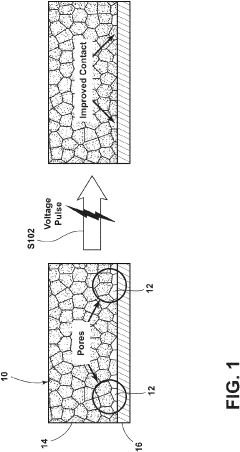
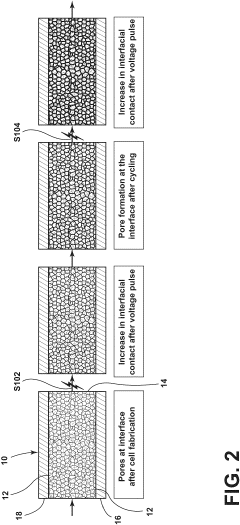
- Applying a voltage pulse at high current density for a short duration to electrochemically improve interfacial contact by causing electrode material to diffuse into pores in the solid electrolyte, thereby healing the interface and eliminating space charge effects, which can be repeated in-operando to maintain contact and prevent failure.
Safety and Performance Metrics for Solid-State Batteries
Safety and performance metrics for solid-state batteries represent critical evaluation parameters that determine their commercial viability and technological advancement. When examining interfacial contact optimization for solid-state lithium anodes, these metrics become particularly significant as they directly influence battery reliability and market acceptance.
The safety advantages of solid-state batteries primarily stem from their non-flammable solid electrolytes, which eliminate the thermal runaway risks associated with conventional liquid electrolytes. Quantitative safety metrics include thermal stability (measured through differential scanning calorimetry), mechanical integrity under physical stress, and dendrite resistance capabilities. Current data indicates that optimized interfaces between lithium anodes and solid electrolytes can withstand temperature fluctuations between -20°C to 80°C without significant safety degradation.
Performance metrics for solid-state batteries with optimized lithium anode interfaces encompass energy density, power capability, cycle life, and rate performance. Energy density metrics for advanced solid-state systems with optimized interfaces currently range from 350-500 Wh/kg, significantly exceeding conventional lithium-ion batteries. Coulombic efficiency, a critical performance indicator reflecting interfacial stability, must exceed 99.9% for commercial viability.
Cycle life testing protocols for solid-state batteries require standardization, with current metrics suggesting 1,000+ cycles at 80% capacity retention as the benchmark for automotive applications. The interfacial resistance between lithium anodes and solid electrolytes remains a key performance limitation, with target values below 10 Ω·cm² at room temperature necessary for high-power applications.
Rate capability metrics are particularly challenging for solid-state systems due to interfacial limitations. Current optimization techniques have demonstrated charging rates of 1-3C, though commercial targets of 5C require further interfacial engineering. Temperature performance metrics indicate that optimized interfaces maintain 80% of room temperature capacity at -20°C, compared to 50% for non-optimized interfaces.
Standardized testing protocols for these metrics remain under development by organizations including the International Electrotechnical Commission (IEC) and ASTM International. The establishment of universally accepted performance benchmarks will accelerate commercialization efforts and enable meaningful comparison between different interfacial optimization approaches for solid-state lithium anodes.
The safety advantages of solid-state batteries primarily stem from their non-flammable solid electrolytes, which eliminate the thermal runaway risks associated with conventional liquid electrolytes. Quantitative safety metrics include thermal stability (measured through differential scanning calorimetry), mechanical integrity under physical stress, and dendrite resistance capabilities. Current data indicates that optimized interfaces between lithium anodes and solid electrolytes can withstand temperature fluctuations between -20°C to 80°C without significant safety degradation.
Performance metrics for solid-state batteries with optimized lithium anode interfaces encompass energy density, power capability, cycle life, and rate performance. Energy density metrics for advanced solid-state systems with optimized interfaces currently range from 350-500 Wh/kg, significantly exceeding conventional lithium-ion batteries. Coulombic efficiency, a critical performance indicator reflecting interfacial stability, must exceed 99.9% for commercial viability.
Cycle life testing protocols for solid-state batteries require standardization, with current metrics suggesting 1,000+ cycles at 80% capacity retention as the benchmark for automotive applications. The interfacial resistance between lithium anodes and solid electrolytes remains a key performance limitation, with target values below 10 Ω·cm² at room temperature necessary for high-power applications.
Rate capability metrics are particularly challenging for solid-state systems due to interfacial limitations. Current optimization techniques have demonstrated charging rates of 1-3C, though commercial targets of 5C require further interfacial engineering. Temperature performance metrics indicate that optimized interfaces maintain 80% of room temperature capacity at -20°C, compared to 50% for non-optimized interfaces.
Standardized testing protocols for these metrics remain under development by organizations including the International Electrotechnical Commission (IEC) and ASTM International. The establishment of universally accepted performance benchmarks will accelerate commercialization efforts and enable meaningful comparison between different interfacial optimization approaches for solid-state lithium anodes.
Manufacturing Scalability Considerations
The scalability of manufacturing processes for optimized interfacial contacts in solid-state lithium anodes represents a critical challenge for commercialization. Current laboratory-scale techniques for creating ideal interfaces between lithium metal and solid electrolytes often involve highly controlled environments and specialized equipment that cannot be directly translated to mass production. Vacuum deposition methods, while effective for creating clean interfaces, face significant throughput limitations and cost barriers when considered for gigawatt-scale battery production.
Physical vapor deposition (PVD) and chemical vapor deposition (CVD) techniques currently used for interface engineering would require substantial redesign for roll-to-roll processing compatibility. The high vacuum requirements and batch processing nature of these methods create bottlenecks that limit production rates and increase capital expenditure. Additionally, the precise temperature control needed for optimal lithium wetting on solid electrolyte surfaces presents challenges for maintaining consistent quality across large-area substrates.
Material handling considerations further complicate manufacturing scale-up. Lithium metal's high reactivity with atmospheric components necessitates inert gas environments throughout the production line, significantly increasing facility costs and operational complexity. The mechanical fragility of thin lithium foils and many solid electrolyte materials also presents challenges for high-speed handling equipment, potentially leading to microcracks that compromise interfacial contact quality.
Cost modeling indicates that current interfacial optimization techniques could contribute 15-25% to the overall cell manufacturing cost, primarily due to slow processing speeds and specialized equipment requirements. This cost premium must be balanced against performance benefits to ensure commercial viability. Emerging approaches utilizing solution-processable interlayers show promise for cost reduction but require further development to match the performance of vacuum-deposited interfaces.
Equipment suppliers are beginning to address these challenges through the development of specialized roll-to-roll compatible systems for interface engineering. These include atmospheric pressure plasma treatment units, controlled-atmosphere coating systems, and rapid thermal processing equipment designed specifically for lithium metal handling. However, these solutions remain in early development stages and have not yet demonstrated the reliability needed for automotive-grade battery production.
Quality control and process monitoring represent additional challenges for scaled manufacturing. Real-time characterization of interfacial properties during high-volume production remains technically difficult, potentially necessitating statistical process control approaches rather than 100% inspection. The development of inline, non-destructive testing methods for interfacial contact quality will be essential for ensuring consistent performance in mass-produced solid-state batteries.
Physical vapor deposition (PVD) and chemical vapor deposition (CVD) techniques currently used for interface engineering would require substantial redesign for roll-to-roll processing compatibility. The high vacuum requirements and batch processing nature of these methods create bottlenecks that limit production rates and increase capital expenditure. Additionally, the precise temperature control needed for optimal lithium wetting on solid electrolyte surfaces presents challenges for maintaining consistent quality across large-area substrates.
Material handling considerations further complicate manufacturing scale-up. Lithium metal's high reactivity with atmospheric components necessitates inert gas environments throughout the production line, significantly increasing facility costs and operational complexity. The mechanical fragility of thin lithium foils and many solid electrolyte materials also presents challenges for high-speed handling equipment, potentially leading to microcracks that compromise interfacial contact quality.
Cost modeling indicates that current interfacial optimization techniques could contribute 15-25% to the overall cell manufacturing cost, primarily due to slow processing speeds and specialized equipment requirements. This cost premium must be balanced against performance benefits to ensure commercial viability. Emerging approaches utilizing solution-processable interlayers show promise for cost reduction but require further development to match the performance of vacuum-deposited interfaces.
Equipment suppliers are beginning to address these challenges through the development of specialized roll-to-roll compatible systems for interface engineering. These include atmospheric pressure plasma treatment units, controlled-atmosphere coating systems, and rapid thermal processing equipment designed specifically for lithium metal handling. However, these solutions remain in early development stages and have not yet demonstrated the reliability needed for automotive-grade battery production.
Quality control and process monitoring represent additional challenges for scaled manufacturing. Real-time characterization of interfacial properties during high-volume production remains technically difficult, potentially necessitating statistical process control approaches rather than 100% inspection. The development of inline, non-destructive testing methods for interfacial contact quality will be essential for ensuring consistent performance in mass-produced solid-state batteries.
Unlock deeper insights with PatSnap Eureka Quick Research — get a full tech report to explore trends and direct your research. Try now!
Generate Your Research Report Instantly with AI Agent
Supercharge your innovation with PatSnap Eureka AI Agent Platform!