

Maximizing Polyethylene Naphthalate for OLED Applications
MAR 9, 20269 MIN READ
Generate Your Research Report Instantly with AI Agent
PatSnap Eureka helps you evaluate technical feasibility & market potential.
PEN-OLED Technology Background and Development Goals
Polyethylene naphthalate (PEN) has emerged as a critical substrate material in the evolution of flexible organic light-emitting diode (OLED) technology. This high-performance polymer, first commercialized in the 1990s, represents a significant advancement over traditional polyethylene terephthalate (PET) substrates due to its superior thermal stability, dimensional stability, and optical properties. The material's unique molecular structure, featuring naphthalene rings instead of benzene rings, provides enhanced rigidity and thermal resistance that are essential for OLED manufacturing processes.
The historical development of PEN for OLED applications traces back to the early 2000s when the display industry began seeking alternatives to glass substrates for flexible electronics. Initial research focused on addressing the fundamental challenges of polymer substrates, including thermal expansion mismatch, moisture permeability, and surface roughness. PEN's glass transition temperature of approximately 120°C, significantly higher than PET's 80°C, positioned it as a promising candidate for processes requiring elevated temperatures during thin-film deposition and device fabrication.
The primary technical objectives driving PEN optimization for OLED applications center on achieving maximum performance across multiple critical parameters. Surface smoothness represents a fundamental requirement, with target roughness values below 1 nanometer RMS to ensure uniform thin-film deposition and prevent electrical shorts in OLED devices. Thermal dimensional stability must be maintained at processing temperatures up to 200°C, with coefficient of thermal expansion closely matched to deposited inorganic layers to minimize stress-induced defects.
Barrier properties constitute another crucial development goal, as OLED devices are extremely sensitive to moisture and oxygen ingress. Enhanced PEN formulations target water vapor transmission rates below 10^-6 g/m²/day and oxygen transmission rates below 10^-5 cc/m²/day. These stringent requirements necessitate either intrinsic material improvements or integration with additional barrier coating systems.
Optical performance objectives include maintaining high transparency across the visible spectrum, with transmission rates exceeding 90% and minimal haze formation. Color neutrality and UV stability are essential for maintaining display quality over extended operational lifetimes. Additionally, the material must exhibit excellent adhesion properties with various functional coatings, including transparent conductive oxides, organic transport layers, and encapsulation materials.
The overarching goal encompasses developing PEN substrates that enable large-area, high-resolution flexible OLED displays while maintaining manufacturing cost-effectiveness and scalability for mass production applications.
The historical development of PEN for OLED applications traces back to the early 2000s when the display industry began seeking alternatives to glass substrates for flexible electronics. Initial research focused on addressing the fundamental challenges of polymer substrates, including thermal expansion mismatch, moisture permeability, and surface roughness. PEN's glass transition temperature of approximately 120°C, significantly higher than PET's 80°C, positioned it as a promising candidate for processes requiring elevated temperatures during thin-film deposition and device fabrication.
The primary technical objectives driving PEN optimization for OLED applications center on achieving maximum performance across multiple critical parameters. Surface smoothness represents a fundamental requirement, with target roughness values below 1 nanometer RMS to ensure uniform thin-film deposition and prevent electrical shorts in OLED devices. Thermal dimensional stability must be maintained at processing temperatures up to 200°C, with coefficient of thermal expansion closely matched to deposited inorganic layers to minimize stress-induced defects.
Barrier properties constitute another crucial development goal, as OLED devices are extremely sensitive to moisture and oxygen ingress. Enhanced PEN formulations target water vapor transmission rates below 10^-6 g/m²/day and oxygen transmission rates below 10^-5 cc/m²/day. These stringent requirements necessitate either intrinsic material improvements or integration with additional barrier coating systems.
Optical performance objectives include maintaining high transparency across the visible spectrum, with transmission rates exceeding 90% and minimal haze formation. Color neutrality and UV stability are essential for maintaining display quality over extended operational lifetimes. Additionally, the material must exhibit excellent adhesion properties with various functional coatings, including transparent conductive oxides, organic transport layers, and encapsulation materials.
The overarching goal encompasses developing PEN substrates that enable large-area, high-resolution flexible OLED displays while maintaining manufacturing cost-effectiveness and scalability for mass production applications.
Market Demand Analysis for Flexible OLED Substrates
The flexible OLED substrate market has experienced unprecedented growth driven by the proliferation of foldable smartphones, wearable devices, and curved display applications. Consumer electronics manufacturers are increasingly prioritizing bendable and rollable display technologies to differentiate their products in saturated markets. This shift has created substantial demand for high-performance substrate materials that can withstand repeated mechanical stress while maintaining optical clarity and dimensional stability.
Polyethylene naphthalate emerges as a critical material solution addressing the stringent requirements of flexible OLED applications. Unlike traditional glass substrates, PEN offers superior mechanical flexibility, excellent thermal stability up to processing temperatures, and outstanding barrier properties essential for protecting sensitive organic layers. The material's low coefficient of thermal expansion closely matches that of the thin-film transistor backplane, reducing stress-induced defects during manufacturing processes.
The automotive industry represents a rapidly expanding market segment for flexible OLED substrates, particularly in dashboard displays, interior lighting systems, and curved instrument panels. Vehicle manufacturers are integrating seamless display surfaces that conform to complex geometries, driving demand for substrates capable of maintaining performance under automotive environmental conditions. PEN's chemical resistance and temperature stability make it particularly suitable for these demanding applications.
Wearable technology continues to fuel market expansion, with smartwatches, fitness trackers, and augmented reality devices requiring lightweight, durable substrates. The miniaturization trend in consumer electronics necessitates thinner substrate materials without compromising mechanical integrity. PEN's high strength-to-weight ratio and processing compatibility with existing manufacturing equipment position it favorably for these applications.
Healthcare and medical device applications present emerging opportunities for flexible OLED substrates, including conformable patient monitoring systems and diagnostic equipment displays. The biocompatibility potential of properly processed PEN substrates opens pathways for direct skin-contact applications, expanding the addressable market beyond traditional consumer electronics.
Manufacturing scalability remains a key market driver, as display producers seek substrate materials compatible with roll-to-roll processing techniques. PEN's thermoplastic nature enables efficient large-area processing while maintaining uniform thickness and surface quality critical for OLED device performance. The material's compatibility with existing polyimide processing infrastructure reduces capital investment barriers for manufacturers transitioning to PEN-based substrates.
Regional market dynamics show concentrated demand in Asia-Pacific manufacturing hubs, where major OLED panel producers are investing in flexible display production capacity. The establishment of localized PEN supply chains becomes increasingly important for meeting just-in-time manufacturing requirements and reducing logistics costs associated with high-volume substrate procurement.
Polyethylene naphthalate emerges as a critical material solution addressing the stringent requirements of flexible OLED applications. Unlike traditional glass substrates, PEN offers superior mechanical flexibility, excellent thermal stability up to processing temperatures, and outstanding barrier properties essential for protecting sensitive organic layers. The material's low coefficient of thermal expansion closely matches that of the thin-film transistor backplane, reducing stress-induced defects during manufacturing processes.
The automotive industry represents a rapidly expanding market segment for flexible OLED substrates, particularly in dashboard displays, interior lighting systems, and curved instrument panels. Vehicle manufacturers are integrating seamless display surfaces that conform to complex geometries, driving demand for substrates capable of maintaining performance under automotive environmental conditions. PEN's chemical resistance and temperature stability make it particularly suitable for these demanding applications.
Wearable technology continues to fuel market expansion, with smartwatches, fitness trackers, and augmented reality devices requiring lightweight, durable substrates. The miniaturization trend in consumer electronics necessitates thinner substrate materials without compromising mechanical integrity. PEN's high strength-to-weight ratio and processing compatibility with existing manufacturing equipment position it favorably for these applications.
Healthcare and medical device applications present emerging opportunities for flexible OLED substrates, including conformable patient monitoring systems and diagnostic equipment displays. The biocompatibility potential of properly processed PEN substrates opens pathways for direct skin-contact applications, expanding the addressable market beyond traditional consumer electronics.
Manufacturing scalability remains a key market driver, as display producers seek substrate materials compatible with roll-to-roll processing techniques. PEN's thermoplastic nature enables efficient large-area processing while maintaining uniform thickness and surface quality critical for OLED device performance. The material's compatibility with existing polyimide processing infrastructure reduces capital investment barriers for manufacturers transitioning to PEN-based substrates.
Regional market dynamics show concentrated demand in Asia-Pacific manufacturing hubs, where major OLED panel producers are investing in flexible display production capacity. The establishment of localized PEN supply chains becomes increasingly important for meeting just-in-time manufacturing requirements and reducing logistics costs associated with high-volume substrate procurement.
Current PEN Material Challenges in OLED Integration
Polyethylene naphthalate (PEN) faces several critical material challenges when integrated into OLED device architectures, primarily stemming from its inherent polymer properties and the demanding requirements of organic electronic systems. The most significant challenge lies in PEN's relatively high surface roughness compared to traditional glass substrates, which can reach 2-5 nanometers RMS even after optimization. This surface irregularity creates non-uniform electric fields during OLED operation, leading to localized current density variations that compromise device efficiency and accelerate degradation mechanisms.
Thermal stability represents another fundamental constraint in OLED integration. While PEN exhibits superior thermal properties compared to other flexible polymers, with a glass transition temperature around 120°C, it still falls short of the thermal budget required for certain OLED manufacturing processes. High-temperature deposition steps and thermal annealing procedures can induce dimensional changes in PEN substrates, affecting layer uniformity and potentially causing delamination at critical interfaces.
The barrier properties of PEN present ongoing challenges for moisture and oxygen ingress protection. Despite its relatively low permeability among polymer substrates, PEN's intrinsic barrier performance remains insufficient for OLED applications without additional encapsulation layers. Water vapor transmission rates typically exceed 10^-3 g/m²/day, while OLED devices require protection levels below 10^-6 g/m²/day to maintain acceptable operational lifetimes.
Chemical compatibility issues emerge during OLED fabrication, particularly with organic solvents and processing chemicals used in solution-based deposition methods. PEN can exhibit swelling or surface modification when exposed to certain solvents, affecting subsequent layer adhesion and device performance. Additionally, the polymer's tendency to accumulate static charge during handling and processing creates contamination risks that can impact yield rates.
Optical challenges include PEN's inherent birefringence and wavelength-dependent transmission characteristics, which can affect color accuracy and viewing angle performance in OLED displays. The material's refractive index mismatch with organic layers also contributes to light extraction efficiency limitations, reducing overall device brightness and power efficiency compared to glass-based alternatives.
Thermal stability represents another fundamental constraint in OLED integration. While PEN exhibits superior thermal properties compared to other flexible polymers, with a glass transition temperature around 120°C, it still falls short of the thermal budget required for certain OLED manufacturing processes. High-temperature deposition steps and thermal annealing procedures can induce dimensional changes in PEN substrates, affecting layer uniformity and potentially causing delamination at critical interfaces.
The barrier properties of PEN present ongoing challenges for moisture and oxygen ingress protection. Despite its relatively low permeability among polymer substrates, PEN's intrinsic barrier performance remains insufficient for OLED applications without additional encapsulation layers. Water vapor transmission rates typically exceed 10^-3 g/m²/day, while OLED devices require protection levels below 10^-6 g/m²/day to maintain acceptable operational lifetimes.
Chemical compatibility issues emerge during OLED fabrication, particularly with organic solvents and processing chemicals used in solution-based deposition methods. PEN can exhibit swelling or surface modification when exposed to certain solvents, affecting subsequent layer adhesion and device performance. Additionally, the polymer's tendency to accumulate static charge during handling and processing creates contamination risks that can impact yield rates.
Optical challenges include PEN's inherent birefringence and wavelength-dependent transmission characteristics, which can affect color accuracy and viewing angle performance in OLED displays. The material's refractive index mismatch with organic layers also contributes to light extraction efficiency limitations, reducing overall device brightness and power efficiency compared to glass-based alternatives.
Existing PEN Optimization Solutions for OLED Performance
01 Manufacturing methods and polymerization processes for polyethylene naphthalate
Various manufacturing methods and polymerization processes have been developed for producing polyethylene naphthalate (PEN). These processes focus on optimizing reaction conditions, catalyst selection, and polymerization techniques to achieve desired molecular weight and polymer properties. The methods include melt polymerization, solid-state polymerization, and continuous polymerization processes that enhance the efficiency and quality of PEN production.- Manufacturing methods and polymerization processes for polyethylene naphthalate: Various manufacturing methods and polymerization processes have been developed for producing polyethylene naphthalate (PEN). These processes focus on optimizing reaction conditions, catalyst selection, and polymerization techniques to achieve desired molecular weight and polymer properties. The methods include melt polymerization, solid-state polymerization, and continuous polymerization processes that enhance the efficiency and quality of PEN production.
- Copolymers and blends containing polyethylene naphthalate: Polyethylene naphthalate can be combined with other polymers to form copolymers or polymer blends with enhanced properties. These compositions may include combinations with polyethylene terephthalate or other polyesters to achieve improved mechanical strength, thermal stability, or processing characteristics. The copolymerization approach allows for tailoring specific properties for different applications.
- Film and sheet applications of polyethylene naphthalate: Polyethylene naphthalate is widely used in film and sheet applications due to its excellent barrier properties, thermal resistance, and mechanical strength. The material is particularly suitable for packaging applications, electronic substrates, and industrial films. Manufacturing processes for PEN films include extrusion, casting, and biaxial orientation techniques that optimize film properties for specific end uses.
- Fiber and textile applications of polyethylene naphthalate: Polyethylene naphthalate can be processed into fibers for textile and industrial applications. The high strength, dimensional stability, and heat resistance of PEN fibers make them suitable for technical textiles, tire cords, and other demanding applications. Spinning processes and fiber treatment methods have been developed to optimize the performance characteristics of PEN-based fibers.
- Additives and property enhancement for polyethylene naphthalate: Various additives and modification techniques are employed to enhance the properties of polyethylene naphthalate. These include the incorporation of stabilizers, nucleating agents, plasticizers, and reinforcing materials to improve processability, thermal stability, crystallization behavior, and mechanical properties. Surface treatment and coating methods are also utilized to expand the application range of PEN materials.
02 Copolymers and blends containing polyethylene naphthalate
Polyethylene naphthalate can be combined with other polymers to form copolymers or polymer blends with enhanced properties. These compositions may include combinations with polyethylene terephthalate or other polyesters to achieve improved mechanical strength, thermal stability, or processing characteristics. The copolymerization approach allows for tailoring specific properties for different applications.Expand Specific Solutions03 Film and sheet applications of polyethylene naphthalate
Polyethylene naphthalate is widely used in film and sheet applications due to its excellent barrier properties, thermal resistance, and mechanical strength. The material is particularly suitable for packaging films, optical films, and industrial applications where high performance is required. Manufacturing processes for PEN films include extrusion, stretching, and orientation techniques to optimize film properties.Expand Specific Solutions04 Fiber and textile applications of polyethylene naphthalate
Polyethylene naphthalate can be processed into fibers for textile and industrial applications. PEN fibers exhibit superior strength, dimensional stability, and heat resistance compared to conventional polyester fibers. The production methods involve melt spinning and drawing processes to achieve desired fiber properties for use in high-performance textiles and industrial materials.Expand Specific Solutions05 Additives and property enhancement for polyethylene naphthalate
Various additives and modifiers can be incorporated into polyethylene naphthalate to enhance specific properties such as crystallization behavior, thermal stability, color, and processability. These additives may include nucleating agents, stabilizers, colorants, and processing aids. The incorporation of such additives allows for customization of PEN properties to meet specific application requirements.Expand Specific Solutions
Key Players in PEN Production and OLED Manufacturing
The polyethylene naphthalate (PEN) for OLED applications market represents a mature yet evolving competitive landscape characterized by significant technological advancement and substantial market potential. The industry has progressed beyond early development stages, with established players like Universal Display Corp., Samsung Display, and LG Display driving commercialization alongside material specialists such as BASF Corp., Merck Patent GmbH, and Mylar Specialty Films. Technology maturity varies across segments, with companies like Canon and DuPont Electronic Materials demonstrating advanced manufacturing capabilities, while emerging players including Kyulux and Beijing Visionox focus on next-generation solutions. The competitive environment spans global markets, featuring strong Asian presence through LG Chem, InkTec, and various Chinese manufacturers, complemented by Western technological leadership and robust academic research from institutions like Princeton University and University of Southern California, indicating a well-established yet innovation-driven sector.
Universal Display Corp.
Technical Solution: Universal Display Corporation has developed comprehensive material solutions for maximizing PEN substrate performance in OLED applications, focusing on phosphorescent OLED (PHOLED) technologies optimized for flexible substrates. Their approach includes specialized host materials and dopants designed to operate efficiently at the lower processing temperatures required for PEN compatibility. UDC's UniversalPHOLED materials achieve external quantum efficiencies exceeding 20% on PEN substrates while maintaining operational stability over 50,000 hours. The company has created barrier enhancement technologies that work synergistically with PEN's natural moisture resistance, extending device lifetime by 3-5x compared to conventional approaches. Their material stack optimization reduces driving voltages by approximately 15% on PEN substrates, improving power efficiency crucial for battery-powered flexible devices.
Strengths: Leading OLED materials expertise, strong patent portfolio, proven commercial partnerships with major display manufacturers. Weaknesses: Dependence on licensing model, limited direct manufacturing capabilities, higher material costs for specialized formulations.
DuPont Electronic Materials International LLC
Technical Solution: DuPont has developed advanced polyethylene naphthalate formulations specifically engineered for next-generation OLED applications, leveraging their extensive polymer science expertise. Their Kaladex PEN films feature enhanced thermal dimensional stability with coefficient of thermal expansion matched to OLED device requirements, minimizing stress-induced failures during thermal cycling. DuPont's surface modification technologies create optimal adhesion interfaces for OLED stack deposition while maintaining the substrate's inherent flexibility and optical properties. The company's barrier coating systems applied to PEN substrates achieve moisture permeation rates below 10^-5 g/m²/day and oxygen transmission rates under 10^-3 cc/m²/day. Their manufacturing process enables PEN substrates with surface roughness values below 2nm RMS, critical for uniform OLED layer formation and preventing electrical shorts in thin-film devices.
Strengths: Deep materials science expertise, established manufacturing infrastructure, comprehensive technical support capabilities. Weaknesses: Limited presence in Asian markets, higher substrate costs, longer development cycles for custom formulations.
Core Innovations in PEN Surface Treatment and Barrier Coatings
Binaphthalene derivatives for organic electro-luminescent devices
PatentInactiveUS20040106003A1
Innovation
- Incorporating binaphthalene derivatives as the emissive layer, charge transport layer, host, or dopant material, with specific structural substitutions to prevent close molecular packing, enhancing luminescent efficiency and allowing for polarized light emission.


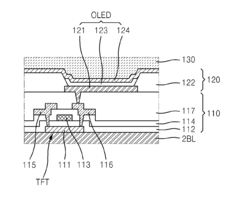
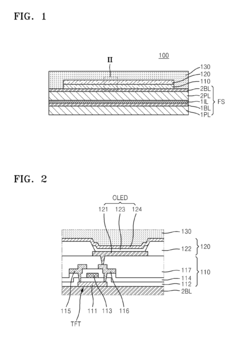
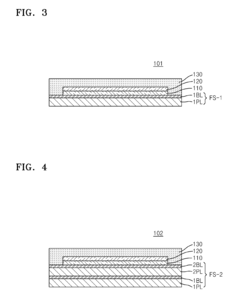
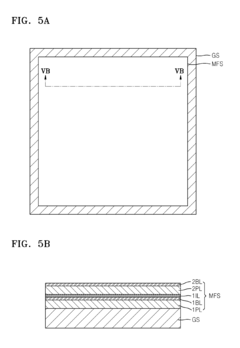
Organic light-emitting diode display, an electronic device including the same, and method of manufacturing the organic light-emitting diode display
PatentActiveUS20140339527A1
Innovation
- The implementation of a flexible OLED display structure that includes alternating layers of plastic and barrier layers, with silicon nitride as a primary material in the barrier layers, and an intermediate layer to enhance adhesive strength between the barrier and plastic layers, ensuring a longer water vapor transmission path and improved adhesion.
Environmental Impact Assessment of PEN-Based OLED Devices
The environmental implications of PEN-based OLED devices present a complex landscape of both challenges and opportunities within the broader context of sustainable electronics manufacturing. As the industry increasingly prioritizes environmental responsibility, comprehensive assessment of PEN's ecological footprint becomes crucial for informed decision-making and regulatory compliance.
PEN production involves several chemical processes that generate environmental concerns, particularly regarding greenhouse gas emissions and energy consumption. The polymerization process requires significant thermal energy input, typically resulting in higher carbon footprint compared to conventional plastic substrates. Manufacturing facilities must implement advanced emission control systems to manage volatile organic compounds and other byproducts released during synthesis.
Water usage represents another critical environmental factor, as PEN production requires substantial quantities for cooling, cleaning, and chemical processing. Industrial wastewater treatment becomes essential to prevent contamination of local water systems with chemical residues and thermal pollution. Advanced filtration and recycling systems can significantly reduce freshwater consumption and minimize discharge impacts.
The lifecycle assessment of PEN-based OLED devices reveals mixed environmental outcomes. While PEN substrates offer superior durability and longevity compared to glass alternatives, potentially extending device lifespan and reducing replacement frequency, the initial manufacturing impact remains substantial. Energy-intensive production processes contribute to higher embodied carbon, though this may be offset by improved device efficiency and extended operational life.
End-of-life considerations present both challenges and opportunities for PEN-based devices. Unlike glass substrates, PEN offers potential for chemical recycling through depolymerization processes, enabling recovery of base materials for reuse. However, the complex multilayer structure of OLED devices complicates separation and recovery processes, requiring specialized recycling infrastructure.
Emerging green chemistry approaches show promise for reducing PEN's environmental impact. Bio-based feedstock alternatives and catalytic processes operating under milder conditions could significantly reduce energy requirements and emissions. Additionally, solvent-free processing techniques and closed-loop manufacturing systems offer pathways toward more sustainable production methods.
Regulatory frameworks increasingly demand comprehensive environmental impact documentation, driving manufacturers to implement robust monitoring and reporting systems. Life cycle assessment methodologies specific to flexible electronics are evolving to better capture the unique environmental profiles of PEN-based devices, enabling more accurate environmental impact quantification and comparison with alternative technologies.
PEN production involves several chemical processes that generate environmental concerns, particularly regarding greenhouse gas emissions and energy consumption. The polymerization process requires significant thermal energy input, typically resulting in higher carbon footprint compared to conventional plastic substrates. Manufacturing facilities must implement advanced emission control systems to manage volatile organic compounds and other byproducts released during synthesis.
Water usage represents another critical environmental factor, as PEN production requires substantial quantities for cooling, cleaning, and chemical processing. Industrial wastewater treatment becomes essential to prevent contamination of local water systems with chemical residues and thermal pollution. Advanced filtration and recycling systems can significantly reduce freshwater consumption and minimize discharge impacts.
The lifecycle assessment of PEN-based OLED devices reveals mixed environmental outcomes. While PEN substrates offer superior durability and longevity compared to glass alternatives, potentially extending device lifespan and reducing replacement frequency, the initial manufacturing impact remains substantial. Energy-intensive production processes contribute to higher embodied carbon, though this may be offset by improved device efficiency and extended operational life.
End-of-life considerations present both challenges and opportunities for PEN-based devices. Unlike glass substrates, PEN offers potential for chemical recycling through depolymerization processes, enabling recovery of base materials for reuse. However, the complex multilayer structure of OLED devices complicates separation and recovery processes, requiring specialized recycling infrastructure.
Emerging green chemistry approaches show promise for reducing PEN's environmental impact. Bio-based feedstock alternatives and catalytic processes operating under milder conditions could significantly reduce energy requirements and emissions. Additionally, solvent-free processing techniques and closed-loop manufacturing systems offer pathways toward more sustainable production methods.
Regulatory frameworks increasingly demand comprehensive environmental impact documentation, driving manufacturers to implement robust monitoring and reporting systems. Life cycle assessment methodologies specific to flexible electronics are evolving to better capture the unique environmental profiles of PEN-based devices, enabling more accurate environmental impact quantification and comparison with alternative technologies.
Cost-Performance Trade-offs in PEN Substrate Manufacturing
The manufacturing of PEN substrates for OLED applications presents a complex optimization challenge where cost reduction efforts must be carefully balanced against performance requirements. Traditional cost-cutting measures such as reducing substrate thickness, lowering processing temperatures, or using less refined raw materials can significantly compromise the optical clarity, thermal stability, and dimensional accuracy that OLED displays demand.
Manufacturing scale represents a critical factor in achieving favorable cost-performance ratios. Large-scale production facilities can leverage economies of scale to reduce per-unit costs while maintaining stringent quality controls. However, the initial capital investment for high-precision PEN substrate manufacturing equipment ranges from $50-100 million, creating substantial barriers for new market entrants and limiting production flexibility for customized applications.
Raw material costs constitute approximately 40-50% of total PEN substrate manufacturing expenses. Premium-grade naphthalene dicarboxylic acid and ethylene glycol precursors command higher prices but deliver superior molecular uniformity and fewer impurities. Manufacturers face the dilemma of sourcing lower-cost alternatives that may introduce defects affecting OLED device performance, particularly in terms of moisture barrier properties and optical transmission rates.
Process optimization strategies focus on minimizing waste while maintaining critical performance parameters. Advanced extrusion and biaxial orientation techniques can reduce material consumption by 15-20% without compromising mechanical properties. However, these optimizations require sophisticated process control systems and skilled operators, increasing operational complexity and labor costs.
Quality control represents another significant cost-performance consideration. Comprehensive testing protocols for surface roughness, thermal expansion coefficients, and optical properties can add 8-12% to manufacturing costs but are essential for ensuring OLED device reliability. Manufacturers must determine optimal sampling rates and testing methodologies that provide adequate quality assurance without excessive cost burden.
The trade-off between substrate thickness and cost presents particular challenges. Thinner PEN substrates reduce material costs and enable more compact OLED designs but require more precise handling equipment and specialized packaging to prevent damage during transportation and processing. This necessitates additional investments in manufacturing infrastructure and supply chain management systems.
Manufacturing scale represents a critical factor in achieving favorable cost-performance ratios. Large-scale production facilities can leverage economies of scale to reduce per-unit costs while maintaining stringent quality controls. However, the initial capital investment for high-precision PEN substrate manufacturing equipment ranges from $50-100 million, creating substantial barriers for new market entrants and limiting production flexibility for customized applications.
Raw material costs constitute approximately 40-50% of total PEN substrate manufacturing expenses. Premium-grade naphthalene dicarboxylic acid and ethylene glycol precursors command higher prices but deliver superior molecular uniformity and fewer impurities. Manufacturers face the dilemma of sourcing lower-cost alternatives that may introduce defects affecting OLED device performance, particularly in terms of moisture barrier properties and optical transmission rates.
Process optimization strategies focus on minimizing waste while maintaining critical performance parameters. Advanced extrusion and biaxial orientation techniques can reduce material consumption by 15-20% without compromising mechanical properties. However, these optimizations require sophisticated process control systems and skilled operators, increasing operational complexity and labor costs.
Quality control represents another significant cost-performance consideration. Comprehensive testing protocols for surface roughness, thermal expansion coefficients, and optical properties can add 8-12% to manufacturing costs but are essential for ensuring OLED device reliability. Manufacturers must determine optimal sampling rates and testing methodologies that provide adequate quality assurance without excessive cost burden.
The trade-off between substrate thickness and cost presents particular challenges. Thinner PEN substrates reduce material costs and enable more compact OLED designs but require more precise handling equipment and specialized packaging to prevent damage during transportation and processing. This necessitates additional investments in manufacturing infrastructure and supply chain management systems.
Unlock deeper insights with PatSnap Eureka Quick Research — get a full tech report to explore trends and direct your research. Try now!
Generate Your Research Report Instantly with AI Agent
Supercharge your innovation with PatSnap Eureka AI Agent Platform!