
Micro LED Backplane Vs OLED: Which Offers Better Energy Efficiency?
Micro LED vs OLED Energy Efficiency Background and Goals
The display technology landscape has undergone remarkable transformation over the past two decades, with energy efficiency emerging as a critical differentiator in both consumer and industrial applications. Traditional LCD displays, while cost-effective, have inherent limitations in power consumption due to their reliance on backlighting systems that operate continuously regardless of displayed content. This fundamental constraint has driven the industry toward self-emissive technologies that promise superior energy management capabilities.
OLED technology represents the first major breakthrough in addressing energy efficiency challenges through its organic compound-based pixels that emit light directly when electrical current is applied. Since its commercial introduction in the early 2000s, OLED has demonstrated significant advantages in scenarios involving dark content, where pixels can be completely turned off, resulting in true black levels and reduced power consumption. However, OLED technology faces inherent limitations in peak brightness scenarios and suffers from degradation issues that impact long-term energy efficiency.
Micro LED technology has emerged as the next evolutionary step, combining the self-emissive advantages of OLED with the stability and efficiency of inorganic LED materials. Each pixel consists of microscopic LEDs that can be individually controlled, offering theoretical advantages in both brightness capability and energy conversion efficiency. The technology promises to overcome OLED's brightness limitations while maintaining the energy-saving benefits of pixel-level control.
The primary technical objective of this comparative analysis centers on quantifying the energy efficiency differences between Micro LED backplane architectures and OLED implementations across various operational scenarios. This includes evaluating power consumption patterns under different brightness levels, color gamuts, and content types to establish comprehensive efficiency profiles for both technologies.
Secondary objectives encompass assessing the long-term energy efficiency implications, considering factors such as material degradation, thermal management requirements, and manufacturing energy costs. The analysis aims to provide actionable insights for display manufacturers and system integrators seeking to optimize energy performance in next-generation display applications, particularly in mobile devices, automotive displays, and large-format installations where power efficiency directly impacts operational costs and user experience.
Market Demand Analysis for Energy-Efficient Display Technologies
The global display technology market is experiencing unprecedented demand for energy-efficient solutions, driven by multiple converging factors that are reshaping industry priorities. Environmental sustainability concerns have become paramount as governments worldwide implement stricter energy consumption regulations and carbon emission standards. This regulatory pressure is particularly intense in regions like the European Union and California, where energy efficiency requirements for electronic devices continue to tighten.
Consumer electronics manufacturers are responding to growing end-user awareness about power consumption, especially in battery-powered devices where energy efficiency directly impacts user experience. The proliferation of portable devices, from smartphones to laptops and wearables, has created a substantial market segment where display power consumption significantly affects battery life and overall device performance.
The automotive industry represents a rapidly expanding market for energy-efficient displays, particularly with the accelerating adoption of electric vehicles. Dashboard displays, infotainment systems, and emerging applications like transparent displays require technologies that minimize power drain on vehicle batteries. This sector's growth trajectory is creating substantial opportunities for both Micro LED and OLED technologies.
Enterprise and commercial applications are driving demand through large-scale deployments of digital signage, professional monitors, and industrial displays. Organizations are increasingly factoring total cost of ownership calculations that include energy consumption over the device lifecycle, making energy efficiency a critical procurement criterion.
The premium smartphone and television markets continue to expand globally, with manufacturers seeking differentiation through superior display quality while maintaining competitive power consumption profiles. Emerging markets are showing particular sensitivity to energy costs, creating demand for efficient display technologies that can reduce operational expenses.
Data center and server applications represent an often-overlooked but significant market segment where display energy efficiency contributes to overall facility power management strategies. As edge computing expands, the need for energy-efficient displays in distributed computing environments is growing substantially.
Market research indicates that energy efficiency has become the second most important factor in display technology selection after image quality, surpassing traditional considerations like initial cost in many application segments.
Current Energy Performance Status of Micro LED and OLED
Micro LED technology currently demonstrates superior theoretical energy efficiency compared to OLED displays, primarily due to its inorganic semiconductor structure and direct light emission mechanism. Micro LEDs achieve luminous efficacy ranging from 100-150 lumens per watt in laboratory conditions, with some advanced prototypes reaching up to 200 lm/W. This performance stems from the absence of organic materials that typically suffer from energy losses through heat generation and molecular degradation.
OLED displays exhibit varying energy performance depending on content and brightness levels. Current commercial OLED panels achieve approximately 60-100 lm/W efficiency, with white OLED configurations performing better than RGB OLED structures. The energy consumption in OLED displays is heavily influenced by pixel activation patterns, as black pixels consume virtually no power while bright white content can significantly increase power draw.
Peak brightness capabilities reveal substantial differences between the technologies. Micro LED displays can sustain brightness levels exceeding 4,000 nits while maintaining relatively stable power consumption, making them particularly suitable for outdoor applications and HDR content. OLED displays typically operate optimally between 100-800 nits, with power efficiency declining rapidly at higher brightness levels due to increased current density requirements.
Temperature stability significantly impacts energy performance in both technologies. Micro LEDs maintain consistent efficiency across wide temperature ranges, with minimal performance degradation from -40°C to 85°C. OLED displays experience notable efficiency reductions at elevated temperatures, often requiring additional thermal management systems that contribute to overall power consumption.
Manufacturing variations currently affect real-world energy performance. Commercial Micro LED displays show efficiency variations of 10-15% across different production batches, while OLED displays demonstrate more consistent performance with variations typically under 5%. However, Micro LED technology shows greater potential for efficiency improvements through advanced binning and calibration techniques.
Lifetime energy efficiency presents another critical consideration. Micro LEDs maintain over 90% of initial efficiency after 50,000 hours of operation, while OLED displays typically retain 80-85% efficiency over the same period. This degradation pattern significantly impacts long-term energy consumption calculations and total cost of ownership assessments for both consumer and commercial applications.
Current Energy Efficiency Solutions in Display Technologies
01 Micro LED backplane circuit design and driving methods
Advanced circuit architectures and driving techniques for micro LED displays focus on optimizing pixel control and addressing schemes. These methods involve sophisticated backplane designs that enable precise current control for individual micro LEDs, improving display uniformity and performance. The driving circuits incorporate active matrix configurations with thin-film transistors to manage power delivery and signal processing efficiently.- Micro LED backplane driving circuits and control systems: Advanced driving circuits and control systems are essential for micro LED displays to achieve optimal performance. These systems include pixel driving circuits, current control mechanisms, and addressing schemes that enable precise control of individual micro LEDs. The backplane architecture incorporates sophisticated switching elements and current sources to ensure uniform brightness and color accuracy across the display panel.
- OLED power management and energy optimization techniques: Energy efficiency in OLED displays is achieved through various power management strategies including adaptive brightness control, pixel-level power optimization, and dynamic voltage scaling. These techniques reduce power consumption by adjusting the driving conditions based on display content and ambient conditions. Advanced power management circuits monitor and control the energy distribution to individual pixels to maximize overall system efficiency.
- Substrate and manufacturing technologies for display backplanes: The substrate technology and manufacturing processes play a crucial role in both micro LED and OLED display performance. This includes the development of flexible substrates, low-temperature processing techniques, and advanced lithography methods for creating high-resolution backplane structures. The manufacturing approaches focus on achieving high yield rates while maintaining precise dimensional control for optimal device performance.
- Thermal management and heat dissipation solutions: Effective thermal management is critical for maintaining energy efficiency and extending the lifespan of both micro LED and OLED displays. Heat dissipation solutions include thermal interface materials, heat spreading structures, and active cooling systems. These technologies prevent thermal degradation of display components and maintain consistent performance under various operating conditions.
- Display driver integration and signal processing: Integration of display drivers with advanced signal processing capabilities enhances both performance and energy efficiency. This includes the development of integrated driver circuits, signal conditioning systems, and data processing algorithms that optimize the display output while minimizing power consumption. The integration approach reduces system complexity and improves overall energy efficiency through optimized data pathways and reduced component count.
02 OLED power management and energy optimization techniques
Energy efficiency improvements in OLED displays are achieved through advanced power management systems and optimization algorithms. These techniques include dynamic power scaling, adaptive brightness control, and efficient charge injection methods. The approaches focus on reducing power consumption while maintaining display quality through intelligent current modulation and voltage regulation strategies.Expand Specific Solutions03 Display panel manufacturing and substrate technologies
Manufacturing processes for advanced display panels involve specialized substrate preparation and fabrication techniques. These methods encompass novel approaches to creating high-resolution display structures with improved yield and performance characteristics. The technologies address challenges in mass production while ensuring consistent quality and reliability across large-scale manufacturing operations.Expand Specific Solutions04 Integrated control systems and signal processing
Sophisticated control architectures integrate multiple display functions including timing control, data processing, and interface management. These systems coordinate various display operations through advanced signal processing algorithms and hardware implementations. The integrated approach enables seamless operation between different display components while optimizing overall system performance and reducing complexity.Expand Specific Solutions05 Thermal management and reliability enhancement
Thermal control solutions and reliability improvement methods address heat dissipation challenges in high-performance displays. These approaches include advanced cooling mechanisms, thermal interface materials, and design strategies that prevent overheating while extending device lifespan. The solutions focus on maintaining optimal operating temperatures and ensuring long-term stability under various environmental conditions.Expand Specific Solutions
Major Players in Micro LED and OLED Display Industry
The Micro LED backplane versus OLED energy efficiency competition represents a rapidly evolving display technology landscape currently in its growth phase. The market demonstrates significant expansion potential, with global display revenues exceeding $150 billion annually. Technology maturity varies considerably between established OLED solutions and emerging Micro LED innovations. Major players like Samsung Electronics and BOE Technology Group lead OLED commercialization, while companies such as Intel Corp., Japan Display, and specialized firms like OLEDWorks drive technological advancement. Chinese manufacturers including China Star Optoelectronics, HKC Corp., and Tianma Microelectronics are aggressively scaling production capabilities. Research institutions like Fraunhofer-Gesellschaft and Fuzhou University contribute fundamental breakthroughs. The competitive dynamics show OLED technology achieving mainstream adoption across consumer electronics, while Micro LED backplane solutions remain in advanced development stages, promising superior energy efficiency but facing manufacturing scalability challenges that industry leaders are actively addressing through substantial R&D investments.
BOE Technology Group Co., Ltd.
Samsung Electronics Co., Ltd.
Core Patents in Micro LED Backplane Energy Management
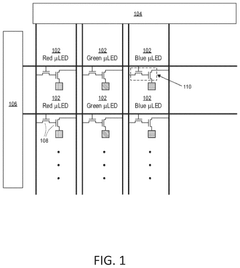
- A double-gate transistor structure is implemented with a first gate and a second gate disposed on either side of the active layer, where the edge of the orthographic projection of the first gate extends beyond the edge of the second gate, preventing segment differences during crystallization and ensuring improved crystallization quality, along with a source drain layer connected through vias to enhance current saturation.


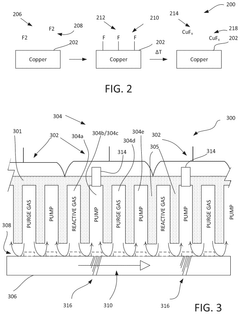
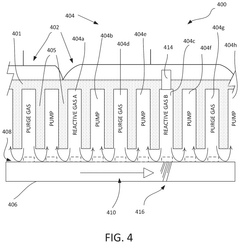
- A semiconductor manufacturing apparatus with discrete open chambers is used to smooth copper surfaces on large substrates, employing reactive plasma or ionic gases to form volatile compounds that are then vaporized and removed, followed by purging, to achieve atomic-level smoothness of copper contact pads, enabling effective bonding between micro-LED elements and the display backplane.
Environmental Regulations Impact on Display Energy Standards
Environmental regulations worldwide are increasingly shaping display technology standards, with energy efficiency becoming a critical compliance factor for both Micro LED and OLED technologies. The European Union's Ecodesign Directive and Energy Labeling Regulation have established stringent energy consumption thresholds for electronic displays, directly impacting manufacturer design decisions and market positioning strategies.
The Energy Star program in the United States has implemented specific power consumption limits for various display categories, creating measurable benchmarks that favor technologies with superior energy efficiency profiles. These standards typically evaluate power consumption during active operation, standby modes, and sleep states, areas where Micro LED and OLED technologies demonstrate different performance characteristics under regulatory scrutiny.
China's National Energy Efficiency Standards for Electronic Products have introduced mandatory energy consumption limits that align with global sustainability goals, while Japan's Top Runner Program continues to push manufacturers toward achieving best-in-class energy performance. These regulatory frameworks collectively establish minimum efficiency requirements that influence technology adoption patterns across different market segments.
Recent regulatory updates have introduced lifecycle energy assessment requirements, extending beyond operational power consumption to include manufacturing energy intensity and end-of-life disposal considerations. This comprehensive approach particularly affects Micro LED technology evaluation, given its complex manufacturing processes and material composition compared to OLED alternatives.
The California Energy Commission's Title 20 regulations have pioneered dynamic testing methodologies that assess display energy consumption under real-world usage patterns rather than static laboratory conditions. These evolving test protocols better capture the energy efficiency advantages of technologies that can dynamically adjust brightness and pixel activation based on content requirements.
Emerging regulations in developing markets are increasingly adopting energy efficiency standards modeled after established frameworks, creating global convergence toward stricter energy performance requirements. This regulatory harmonization is accelerating the competitive pressure between Micro LED and OLED technologies to demonstrate superior energy efficiency across diverse operating conditions and application scenarios.
Manufacturing Cost Analysis for Energy-Efficient Displays
Manufacturing costs represent a critical differentiator between Micro LED backplane and OLED technologies, significantly impacting their commercial viability in energy-efficient display applications. The cost structures of these technologies vary substantially due to fundamental differences in manufacturing processes, material requirements, and production scalability.
Micro LED displays face considerable manufacturing challenges that directly translate to higher production costs. The mass transfer process, which involves placing millions of microscopic LEDs onto substrates with precise alignment, remains the most significant cost driver. Current pick-and-place methods achieve transfer rates of only thousands of LEDs per second, making large-scale production economically challenging. Advanced techniques like laser lift-off and fluidic assembly show promise but require substantial capital investment in specialized equipment.
Material costs for Micro LED production are inherently higher due to the use of gallium nitride substrates and the need for individual LED chips. The substrate preparation and epitaxial growth processes require expensive equipment and high-purity materials. Additionally, the yield rates in Micro LED manufacturing remain relatively low, with defective pixels requiring repair or replacement, further increasing production costs.
OLED manufacturing benefits from more mature production processes adapted from existing LCD infrastructure. The vacuum deposition techniques used for organic material layers can be scaled efficiently, with established supply chains reducing material costs. However, OLED production still requires expensive equipment for precise layer deposition and encapsulation processes to prevent moisture and oxygen degradation.
The substrate requirements differ significantly between technologies. OLED displays can utilize flexible plastic substrates or glass, offering cost advantages and design flexibility. Micro LED displays typically require more rigid substrates with precise thermal management capabilities, increasing material costs but potentially reducing long-term operational expenses through improved durability.
Production yield rates significantly impact overall manufacturing economics. OLED production has achieved relatively high yields through process optimization, while Micro LED manufacturing continues to struggle with yield issues related to the mass transfer process and pixel uniformity. These yield challenges directly translate to higher per-unit costs for Micro LED displays.
Equipment depreciation costs favor OLED technology in the near term, as existing manufacturing infrastructure can be adapted more readily. Micro LED production requires entirely new fabrication equipment, representing substantial capital expenditure that must be amortized across production volumes. However, the potential for higher energy efficiency and longer lifespan in Micro LED displays may justify these initial cost premiums in specific applications where total cost of ownership considerations outweigh initial manufacturing expenses.