

Microcrystalline Cellulose in High-Solid Content Suspensions: Stability Assessment
JUL 23, 20259 MIN READ
Generate Your Research Report Instantly with AI Agent
PatSnap Eureka helps you evaluate technical feasibility & market potential.
MCC Suspension Background and Objectives
Microcrystalline cellulose (MCC) has emerged as a crucial material in various industries, particularly in pharmaceutical, food, and cosmetic applications. The study of MCC in high-solid content suspensions represents a significant advancement in material science and engineering, with far-reaching implications for product development and manufacturing processes.
The evolution of MCC technology can be traced back to its discovery in the 1950s. Initially utilized for its binding and disintegrant properties in tablet formulations, MCC has since found diverse applications due to its unique physicochemical properties. The progression of MCC research has led to a deeper understanding of its behavior in different environments, including high-solid content suspensions.
High-solid content MCC suspensions have gained attention due to their potential to enhance product efficiency and reduce processing costs. These suspensions offer advantages such as improved rheological properties, increased stability, and enhanced functionality in various formulations. However, the stability of MCC in high-solid content suspensions presents complex challenges that require thorough investigation and innovative solutions.
The primary objective of studying MCC stability in high-solid content suspensions is to develop a comprehensive understanding of the factors influencing suspension behavior. This includes examining the interactions between MCC particles, the effects of particle size distribution, and the impact of various environmental conditions on suspension stability. By elucidating these mechanisms, researchers aim to optimize formulation strategies and improve the overall performance of MCC-based products.
Another critical goal is to establish reliable methods for assessing and predicting the stability of high-solid content MCC suspensions. This involves developing standardized testing protocols, identifying key stability indicators, and creating predictive models that can guide formulation decisions. Such advancements would significantly enhance the efficiency of product development processes and ensure consistent quality across different applications.
Furthermore, the research aims to explore novel approaches to enhance the stability of high-solid content MCC suspensions. This may include investigating the use of additives, surface modifications, or innovative processing techniques to improve particle dispersion and prevent aggregation. The ultimate objective is to extend the range of applications for MCC suspensions and unlock new possibilities in product design and manufacturing.
As the demand for advanced materials continues to grow, understanding and controlling the stability of MCC in high-solid content suspensions becomes increasingly important. This research not only addresses current industry needs but also paves the way for future innovations in material science and engineering. The outcomes of this study are expected to have a profound impact on the development of next-generation products across multiple sectors, driving technological progress and economic growth.
The evolution of MCC technology can be traced back to its discovery in the 1950s. Initially utilized for its binding and disintegrant properties in tablet formulations, MCC has since found diverse applications due to its unique physicochemical properties. The progression of MCC research has led to a deeper understanding of its behavior in different environments, including high-solid content suspensions.
High-solid content MCC suspensions have gained attention due to their potential to enhance product efficiency and reduce processing costs. These suspensions offer advantages such as improved rheological properties, increased stability, and enhanced functionality in various formulations. However, the stability of MCC in high-solid content suspensions presents complex challenges that require thorough investigation and innovative solutions.
The primary objective of studying MCC stability in high-solid content suspensions is to develop a comprehensive understanding of the factors influencing suspension behavior. This includes examining the interactions between MCC particles, the effects of particle size distribution, and the impact of various environmental conditions on suspension stability. By elucidating these mechanisms, researchers aim to optimize formulation strategies and improve the overall performance of MCC-based products.
Another critical goal is to establish reliable methods for assessing and predicting the stability of high-solid content MCC suspensions. This involves developing standardized testing protocols, identifying key stability indicators, and creating predictive models that can guide formulation decisions. Such advancements would significantly enhance the efficiency of product development processes and ensure consistent quality across different applications.
Furthermore, the research aims to explore novel approaches to enhance the stability of high-solid content MCC suspensions. This may include investigating the use of additives, surface modifications, or innovative processing techniques to improve particle dispersion and prevent aggregation. The ultimate objective is to extend the range of applications for MCC suspensions and unlock new possibilities in product design and manufacturing.
As the demand for advanced materials continues to grow, understanding and controlling the stability of MCC in high-solid content suspensions becomes increasingly important. This research not only addresses current industry needs but also paves the way for future innovations in material science and engineering. The outcomes of this study are expected to have a profound impact on the development of next-generation products across multiple sectors, driving technological progress and economic growth.
Market Analysis for High-Solid MCC Suspensions
The market for high-solid content microcrystalline cellulose (MCC) suspensions has been experiencing significant growth in recent years, driven by the increasing demand for advanced materials in various industries. This market segment is particularly attractive due to the unique properties of MCC suspensions with high solid content, which offer improved stability, enhanced rheological characteristics, and superior performance in a wide range of applications.
The pharmaceutical industry remains the largest consumer of high-solid MCC suspensions, utilizing them as excipients in tablet formulations, controlled release systems, and other drug delivery applications. The growing emphasis on personalized medicine and the development of complex drug formulations have further boosted the demand for high-performance excipients like MCC suspensions.
In the food and beverage sector, high-solid MCC suspensions are gaining traction as stabilizers, thickeners, and texturizing agents. The clean label trend and consumer preference for natural ingredients have led to increased adoption of MCC-based products in this industry. Additionally, the cosmetics and personal care market has shown a rising interest in high-solid MCC suspensions for their ability to enhance product stability and texture.
The packaging industry represents another significant growth area for high-solid MCC suspensions. As sustainability concerns drive the shift towards bio-based materials, MCC suspensions are being increasingly used in the production of biodegradable packaging solutions. This trend is expected to continue as regulations on single-use plastics become more stringent globally.
Geographically, North America and Europe currently dominate the market for high-solid MCC suspensions, owing to their well-established pharmaceutical and food industries. However, the Asia-Pacific region is emerging as a rapidly growing market, fueled by the expanding manufacturing sector and increasing adoption of advanced materials in countries like China and India.
The market is characterized by intense competition among key players, including FMC Corporation, DuPont, and JRS Pharma. These companies are focusing on product innovation and strategic partnerships to maintain their market positions. The development of novel MCC grades with enhanced stability in high-solid content suspensions is a key area of research and development for many industry players.
Looking ahead, the market for high-solid MCC suspensions is projected to continue its growth trajectory. Factors such as the increasing demand for functional ingredients in the food industry, the rise of bio-based materials in packaging, and ongoing innovations in pharmaceutical formulations are expected to drive market expansion. However, challenges such as raw material availability and the need for consistent product quality in high-solid content formulations will need to be addressed to fully capitalize on the market potential.
The pharmaceutical industry remains the largest consumer of high-solid MCC suspensions, utilizing them as excipients in tablet formulations, controlled release systems, and other drug delivery applications. The growing emphasis on personalized medicine and the development of complex drug formulations have further boosted the demand for high-performance excipients like MCC suspensions.
In the food and beverage sector, high-solid MCC suspensions are gaining traction as stabilizers, thickeners, and texturizing agents. The clean label trend and consumer preference for natural ingredients have led to increased adoption of MCC-based products in this industry. Additionally, the cosmetics and personal care market has shown a rising interest in high-solid MCC suspensions for their ability to enhance product stability and texture.
The packaging industry represents another significant growth area for high-solid MCC suspensions. As sustainability concerns drive the shift towards bio-based materials, MCC suspensions are being increasingly used in the production of biodegradable packaging solutions. This trend is expected to continue as regulations on single-use plastics become more stringent globally.
Geographically, North America and Europe currently dominate the market for high-solid MCC suspensions, owing to their well-established pharmaceutical and food industries. However, the Asia-Pacific region is emerging as a rapidly growing market, fueled by the expanding manufacturing sector and increasing adoption of advanced materials in countries like China and India.
The market is characterized by intense competition among key players, including FMC Corporation, DuPont, and JRS Pharma. These companies are focusing on product innovation and strategic partnerships to maintain their market positions. The development of novel MCC grades with enhanced stability in high-solid content suspensions is a key area of research and development for many industry players.
Looking ahead, the market for high-solid MCC suspensions is projected to continue its growth trajectory. Factors such as the increasing demand for functional ingredients in the food industry, the rise of bio-based materials in packaging, and ongoing innovations in pharmaceutical formulations are expected to drive market expansion. However, challenges such as raw material availability and the need for consistent product quality in high-solid content formulations will need to be addressed to fully capitalize on the market potential.
Current Challenges in MCC Suspension Stability
The stability of microcrystalline cellulose (MCC) in high-solid content suspensions presents several significant challenges that researchers and industry professionals are currently grappling with. One of the primary issues is the tendency for MCC particles to aggregate and form clusters, leading to sedimentation and phase separation. This phenomenon is particularly pronounced in high-solid content suspensions, where the increased particle concentration exacerbates inter-particle interactions.
Another critical challenge is the rheological behavior of MCC suspensions at high concentrations. As the solid content increases, the suspension's viscosity rises dramatically, often resulting in non-Newtonian behavior. This can lead to processing difficulties, such as pumping and mixing problems, as well as inconsistencies in the final product quality. The complex rheology also makes it challenging to predict and control the suspension's flow properties, which is crucial for many industrial applications.
The surface chemistry of MCC particles plays a vital role in suspension stability, and managing this aspect presents its own set of challenges. The hydroxyl groups on the cellulose surface can form hydrogen bonds, leading to strong particle-particle interactions. In high-solid content suspensions, these interactions become more pronounced, potentially resulting in the formation of a gel-like network structure. Modifying the surface properties to enhance stability without compromising the desired functionality of MCC is a delicate balance that researchers are striving to achieve.
Environmental factors such as temperature, pH, and ionic strength significantly impact MCC suspension stability, and controlling these parameters in high-solid content systems is particularly challenging. Temperature fluctuations can alter the suspension's rheological properties and affect particle-particle interactions. pH changes can influence the surface charge of MCC particles, potentially leading to flocculation or dispersion. The presence of ions in the suspension medium can screen electrostatic repulsions between particles, further complicating stability control.
Long-term stability is another major concern, especially for commercial products. High-solid content MCC suspensions may exhibit satisfactory initial stability but can deteriorate over time due to factors such as particle size changes, chemical degradation, or microbial growth. Developing formulations that maintain stability throughout the product's shelf life without resorting to excessive use of additives or preservatives remains a significant challenge.
The scalability of laboratory findings to industrial production presents additional hurdles. Techniques and formulations that work well at small scales may not translate directly to large-scale manufacturing processes. Factors such as mixing dynamics, heat transfer, and the influence of processing equipment on suspension properties can differ significantly between laboratory and industrial settings, necessitating careful optimization and scale-up studies.
Another critical challenge is the rheological behavior of MCC suspensions at high concentrations. As the solid content increases, the suspension's viscosity rises dramatically, often resulting in non-Newtonian behavior. This can lead to processing difficulties, such as pumping and mixing problems, as well as inconsistencies in the final product quality. The complex rheology also makes it challenging to predict and control the suspension's flow properties, which is crucial for many industrial applications.
The surface chemistry of MCC particles plays a vital role in suspension stability, and managing this aspect presents its own set of challenges. The hydroxyl groups on the cellulose surface can form hydrogen bonds, leading to strong particle-particle interactions. In high-solid content suspensions, these interactions become more pronounced, potentially resulting in the formation of a gel-like network structure. Modifying the surface properties to enhance stability without compromising the desired functionality of MCC is a delicate balance that researchers are striving to achieve.
Environmental factors such as temperature, pH, and ionic strength significantly impact MCC suspension stability, and controlling these parameters in high-solid content systems is particularly challenging. Temperature fluctuations can alter the suspension's rheological properties and affect particle-particle interactions. pH changes can influence the surface charge of MCC particles, potentially leading to flocculation or dispersion. The presence of ions in the suspension medium can screen electrostatic repulsions between particles, further complicating stability control.
Long-term stability is another major concern, especially for commercial products. High-solid content MCC suspensions may exhibit satisfactory initial stability but can deteriorate over time due to factors such as particle size changes, chemical degradation, or microbial growth. Developing formulations that maintain stability throughout the product's shelf life without resorting to excessive use of additives or preservatives remains a significant challenge.
The scalability of laboratory findings to industrial production presents additional hurdles. Techniques and formulations that work well at small scales may not translate directly to large-scale manufacturing processes. Factors such as mixing dynamics, heat transfer, and the influence of processing equipment on suspension properties can differ significantly between laboratory and industrial settings, necessitating careful optimization and scale-up studies.
Existing Stability Enhancement Methods
01 Chemical modification for improved stability
Chemical modifications can be applied to microcrystalline cellulose to enhance its stability. These modifications may include crosslinking, esterification, or grafting of functional groups onto the cellulose backbone. Such treatments can improve the cellulose's resistance to environmental factors, pH changes, and temperature variations, leading to increased stability in various applications.- Chemical modification for improved stability: Chemical modifications can be applied to microcrystalline cellulose to enhance its stability. These modifications may include crosslinking, esterification, or grafting of functional groups onto the cellulose backbone. Such treatments can improve the cellulose's resistance to environmental factors, pH changes, and temperature variations, leading to increased stability in various applications.
- Particle size control for stability enhancement: Controlling the particle size of microcrystalline cellulose can significantly impact its stability. Smaller particle sizes often lead to improved dispersion and suspension stability in liquid formulations. Optimizing particle size distribution can also enhance the flow properties and compressibility of the material, contributing to better stability in solid dosage forms and other applications.
- Moisture content management: Managing the moisture content of microcrystalline cellulose is crucial for maintaining its stability. Proper drying techniques and storage conditions can help control moisture levels, preventing agglomeration and degradation. Low moisture content can improve the material's flowability and reduce the risk of microbial growth, thereby enhancing overall stability.
- Stabilization through co-processing: Co-processing microcrystalline cellulose with other excipients or additives can improve its stability. This technique involves combining the cellulose with materials such as silica, starch, or other polymers to create composite particles with enhanced properties. Co-processed microcrystalline cellulose often exhibits improved flow, compressibility, and stability compared to the individual components.
- Surface treatment for stability improvement: Surface treatments can be applied to microcrystalline cellulose particles to enhance their stability. These treatments may include coating with hydrophobic agents, surface silanization, or plasma treatment. Such modifications can improve the material's resistance to moisture, reduce particle aggregation, and enhance its compatibility with other ingredients in formulations.
02 Particle size control for stability enhancement
Controlling the particle size of microcrystalline cellulose can significantly impact its stability. Smaller particle sizes often lead to improved dispersion and suspension stability in liquid formulations. Optimizing particle size distribution can also enhance the flow properties and compressibility of the material, contributing to better stability in solid dosage forms.Expand Specific Solutions03 Moisture content management
Managing the moisture content of microcrystalline cellulose is crucial for maintaining its stability. Proper drying techniques and storage conditions can help control moisture levels, preventing agglomeration and degradation. Low moisture content can improve the material's flowability and reduce the risk of microbial growth, thereby enhancing overall stability.Expand Specific Solutions04 Stabilization through co-processing
Co-processing microcrystalline cellulose with other excipients or additives can improve its stability. This technique involves combining the cellulose with materials such as silica, starch, or polymers to create synergistic effects. Co-processed products often exhibit enhanced flow properties, compressibility, and resistance to environmental stresses, leading to improved stability in various formulations.Expand Specific Solutions05 Surface treatment for stability improvement
Surface treatment of microcrystalline cellulose particles can enhance their stability. Techniques such as coating with hydrophobic agents, surface silanization, or plasma treatment can modify the surface properties of the cellulose. These treatments can improve the material's resistance to moisture, reduce particle aggregation, and enhance its compatibility with other ingredients in formulations.Expand Specific Solutions
Key Players in MCC Suspension Industry
The microcrystalline cellulose (MCC) market in high-solid content suspensions is in a growth phase, driven by increasing demand in pharmaceutical, food, and cosmetic industries. The global market size is projected to expand significantly in the coming years. Technologically, MCC production is relatively mature, with established players like FMC Corp., Asahi Kasei Corp., and J. Rettenmaier & Söhne GmbH + Co. KG leading the field. However, ongoing research by companies such as Cellugy ApS and academic institutions like South China University of Technology indicates potential for innovation in stability and application of high-solid content MCC suspensions, suggesting room for technological advancements and market differentiation.
FMC Corp.
Technical Solution: FMC Corp. has developed advanced microcrystalline cellulose (MCC) products specifically designed for high-solid content suspensions. Their technology focuses on modifying MCC particles to enhance stability in concentrated systems. They utilize a proprietary surface treatment process that alters the hydrophilic nature of MCC, reducing particle-particle interactions and improving dispersion in high-solid content formulations[1]. This approach allows for the creation of stable suspensions with MCC concentrations up to 30% w/w, significantly higher than conventional limits[2]. FMC's MCC products also incorporate rheology modifiers to control viscosity and prevent sedimentation in high-solid content systems[3].
Strengths: Proprietary surface treatment technology enables higher MCC concentrations. Improved stability in high-solid content suspensions. Weaknesses: May require additional processing steps, potentially increasing production costs.
Lenzing AG
Technical Solution: Lenzing AG has developed a novel approach to stabilizing high-solid content MCC suspensions using their TENCEL™ branded lyocell fibers. Their method involves combining MCC with short, highly fibrillated lyocell fibers to create a three-dimensional network structure within the suspension[4]. This network enhances the stability of the system by preventing particle sedimentation and phase separation. Lenzing's technology allows for the creation of stable MCC suspensions with solid contents up to 25% w/w, while maintaining desirable rheological properties[5]. The company has also developed a patented process for surface modification of their lyocell fibers to further improve compatibility with MCC and enhance suspension stability[6].
Strengths: Unique combination of MCC and lyocell fibers for improved stability. Environmentally friendly, as TENCEL™ fibers are derived from sustainable sources. Weaknesses: May alter the texture and appearance of final products, potentially limiting applications.
Innovative Approaches to MCC Suspension Stability
Stabilizer for food applications
PatentWO2010136157A1
Innovation
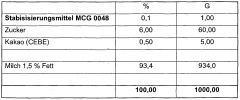
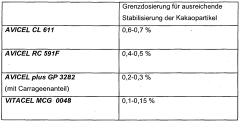
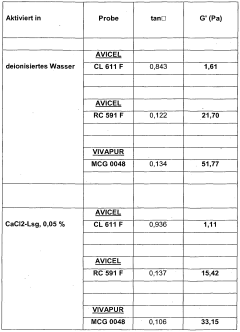
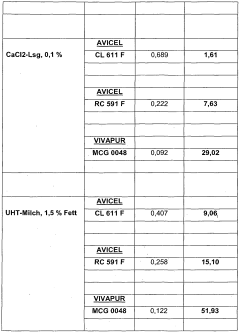
- A dispersion of microcrystalline cellulose (MCC) and carboxymethyl cellulose (CMC) with a specific degree of substitution, allowing for efficient stabilization with minimal amounts, enhanced activation, and improved tolerance to negative factors like electrolytes, demonstrated by higher storage moduli and reduced shear energy requirements.
Ultra-fine microcrystalline cellulose compositions and process
PatentInactiveUS6037380A
Innovation
- A process involving high-shear wet grinding of hydrolyzed cellulose wetcake with an attriting aid and optional protective colloid to produce microcrystalline cellulose compositions with up to 100% of particles less than 1 micron, ensuring colloidally stable dispersions that resist centrifugation and provide improved suspension and stabilization properties.
Regulatory Considerations for MCC Suspensions
Regulatory considerations for microcrystalline cellulose (MCC) suspensions are crucial for ensuring product safety, quality, and compliance with international standards. The use of MCC in high-solid content suspensions requires adherence to specific regulatory frameworks established by various governing bodies.
The U.S. Food and Drug Administration (FDA) classifies MCC as Generally Recognized as Safe (GRAS) for use in food and pharmaceutical applications. However, when used in high-solid content suspensions, manufacturers must comply with Good Manufacturing Practices (GMP) and provide detailed documentation on the production process, quality control measures, and stability assessments.
In the European Union, the European Medicines Agency (EMA) oversees the regulation of MCC suspensions. The EMA requires comprehensive stability studies to demonstrate the long-term safety and efficacy of MCC in high-solid content formulations. These studies must address potential issues such as sedimentation, agglomeration, and changes in rheological properties over time.
The International Conference on Harmonisation of Technical Requirements for Registration of Pharmaceuticals for Human Use (ICH) provides guidelines for stability testing of new drug substances and products. Manufacturers of MCC suspensions must adhere to ICH Q1A(R2) guidelines, which outline the requirements for stability testing protocols, including storage conditions, testing frequency, and acceptance criteria.
Regulatory bodies also focus on the potential environmental impact of MCC suspensions. The Environmental Protection Agency (EPA) in the United States and the European Chemicals Agency (ECHA) require manufacturers to assess the ecological effects of MCC production and disposal. This includes evaluating biodegradability, aquatic toxicity, and potential bioaccumulation in the environment.
For MCC suspensions used in food applications, compliance with food additive regulations is essential. The Joint FAO/WHO Expert Committee on Food Additives (JECFA) has established specifications for MCC used in food, including purity criteria and acceptable daily intake levels. Manufacturers must ensure their high-solid content MCC suspensions meet these specifications to gain regulatory approval for food use.
In the pharmaceutical industry, regulatory considerations extend to the entire supply chain. Suppliers of MCC for high-solid content suspensions must provide detailed certificates of analysis and comply with pharmaceutical-grade quality standards. This includes meeting specifications for particle size distribution, moisture content, and microbiological purity.
As nanotechnology advances, regulatory bodies are increasingly focusing on the potential risks associated with nanoparticles in MCC suspensions. The FDA and EMA have issued guidance documents addressing the use of nanomaterials in food and drug products, which may impact the regulatory landscape for high-solid content MCC suspensions in the future.
The U.S. Food and Drug Administration (FDA) classifies MCC as Generally Recognized as Safe (GRAS) for use in food and pharmaceutical applications. However, when used in high-solid content suspensions, manufacturers must comply with Good Manufacturing Practices (GMP) and provide detailed documentation on the production process, quality control measures, and stability assessments.
In the European Union, the European Medicines Agency (EMA) oversees the regulation of MCC suspensions. The EMA requires comprehensive stability studies to demonstrate the long-term safety and efficacy of MCC in high-solid content formulations. These studies must address potential issues such as sedimentation, agglomeration, and changes in rheological properties over time.
The International Conference on Harmonisation of Technical Requirements for Registration of Pharmaceuticals for Human Use (ICH) provides guidelines for stability testing of new drug substances and products. Manufacturers of MCC suspensions must adhere to ICH Q1A(R2) guidelines, which outline the requirements for stability testing protocols, including storage conditions, testing frequency, and acceptance criteria.
Regulatory bodies also focus on the potential environmental impact of MCC suspensions. The Environmental Protection Agency (EPA) in the United States and the European Chemicals Agency (ECHA) require manufacturers to assess the ecological effects of MCC production and disposal. This includes evaluating biodegradability, aquatic toxicity, and potential bioaccumulation in the environment.
For MCC suspensions used in food applications, compliance with food additive regulations is essential. The Joint FAO/WHO Expert Committee on Food Additives (JECFA) has established specifications for MCC used in food, including purity criteria and acceptable daily intake levels. Manufacturers must ensure their high-solid content MCC suspensions meet these specifications to gain regulatory approval for food use.
In the pharmaceutical industry, regulatory considerations extend to the entire supply chain. Suppliers of MCC for high-solid content suspensions must provide detailed certificates of analysis and comply with pharmaceutical-grade quality standards. This includes meeting specifications for particle size distribution, moisture content, and microbiological purity.
As nanotechnology advances, regulatory bodies are increasingly focusing on the potential risks associated with nanoparticles in MCC suspensions. The FDA and EMA have issued guidance documents addressing the use of nanomaterials in food and drug products, which may impact the regulatory landscape for high-solid content MCC suspensions in the future.
Environmental Impact of MCC Suspensions
The environmental impact of microcrystalline cellulose (MCC) suspensions is a crucial aspect to consider in their production and application. MCC, derived from natural cellulose sources, is generally regarded as an environmentally friendly material. However, the high-solid content suspensions of MCC present unique challenges and potential environmental concerns that warrant careful examination.
One of the primary environmental advantages of MCC suspensions is their biodegradability. As a natural polymer, MCC can be broken down by microorganisms in the environment, reducing long-term accumulation and pollution. This characteristic makes MCC suspensions a more sustainable alternative to synthetic polymer-based suspensions in various applications, including pharmaceuticals, food products, and cosmetics.
The production process of MCC suspensions, particularly those with high solid content, requires significant energy input for mixing and homogenization. This energy consumption contributes to the carbon footprint of the product. However, advancements in processing technologies have led to more energy-efficient methods, potentially mitigating this environmental impact. Additionally, the use of renewable energy sources in production facilities can further reduce the overall environmental burden.
Water usage is another critical factor to consider. High-solid content MCC suspensions typically require less water compared to lower concentration alternatives, potentially leading to reduced water consumption during production and application. This water-saving aspect is particularly beneficial in water-stressed regions and industries where water conservation is a priority.
The sourcing of raw materials for MCC production also plays a significant role in its environmental impact. Sustainable forestry practices and the use of agricultural by-products as cellulose sources can contribute to a more positive environmental profile. However, the transportation of raw materials and finished products can still contribute to greenhouse gas emissions, necessitating optimization of supply chains and logistics.
Waste management in the production and application of MCC suspensions is an important consideration. While MCC itself is biodegradable, additives used to stabilize high-solid content suspensions may have varying environmental impacts. Proper disposal and treatment of production waste and unused product are essential to minimize potential environmental contamination.
The stability of MCC in high-solid content suspensions also has indirect environmental implications. Improved stability can lead to longer shelf life and reduced product waste, thereby decreasing the overall environmental footprint associated with production and disposal. Furthermore, the use of MCC suspensions as a replacement for less environmentally friendly materials in various applications can contribute to broader sustainability goals across industries.
One of the primary environmental advantages of MCC suspensions is their biodegradability. As a natural polymer, MCC can be broken down by microorganisms in the environment, reducing long-term accumulation and pollution. This characteristic makes MCC suspensions a more sustainable alternative to synthetic polymer-based suspensions in various applications, including pharmaceuticals, food products, and cosmetics.
The production process of MCC suspensions, particularly those with high solid content, requires significant energy input for mixing and homogenization. This energy consumption contributes to the carbon footprint of the product. However, advancements in processing technologies have led to more energy-efficient methods, potentially mitigating this environmental impact. Additionally, the use of renewable energy sources in production facilities can further reduce the overall environmental burden.
Water usage is another critical factor to consider. High-solid content MCC suspensions typically require less water compared to lower concentration alternatives, potentially leading to reduced water consumption during production and application. This water-saving aspect is particularly beneficial in water-stressed regions and industries where water conservation is a priority.
The sourcing of raw materials for MCC production also plays a significant role in its environmental impact. Sustainable forestry practices and the use of agricultural by-products as cellulose sources can contribute to a more positive environmental profile. However, the transportation of raw materials and finished products can still contribute to greenhouse gas emissions, necessitating optimization of supply chains and logistics.
Waste management in the production and application of MCC suspensions is an important consideration. While MCC itself is biodegradable, additives used to stabilize high-solid content suspensions may have varying environmental impacts. Proper disposal and treatment of production waste and unused product are essential to minimize potential environmental contamination.
The stability of MCC in high-solid content suspensions also has indirect environmental implications. Improved stability can lead to longer shelf life and reduced product waste, thereby decreasing the overall environmental footprint associated with production and disposal. Furthermore, the use of MCC suspensions as a replacement for less environmentally friendly materials in various applications can contribute to broader sustainability goals across industries.
Unlock deeper insights with PatSnap Eureka Quick Research — get a full tech report to explore trends and direct your research. Try now!
Generate Your Research Report Instantly with AI Agent
Supercharge your innovation with PatSnap Eureka AI Agent Platform!