
Microtransfer Printing for Biomedical Applications: Best Practices
APR 23, 20269 MIN READ
Generate Your Research Report Instantly with AI Agent
Patsnap Eureka helps you evaluate technical feasibility & market potential.
Microtransfer Printing Biomedical Background and Objectives
Microtransfer printing has emerged as a transformative technology in biomedical applications, representing a convergence of advanced manufacturing techniques and precision medicine requirements. This technology enables the controlled transfer of microscale materials, devices, and biological components with unprecedented accuracy and reliability, addressing critical challenges in modern healthcare and biotechnology sectors.
The historical development of microtransfer printing traces back to early semiconductor manufacturing processes, where precise material placement was essential for device functionality. Over the past two decades, researchers have adapted and refined these techniques specifically for biomedical applications, recognizing the potential to revolutionize how medical devices, diagnostic tools, and therapeutic systems are manufactured and deployed.
Current technological evolution demonstrates a clear trajectory toward miniaturization and increased precision in biomedical applications. The integration of microtransfer printing with emerging fields such as personalized medicine, point-of-care diagnostics, and implantable medical devices has created new paradigms for healthcare delivery. This evolution is driven by the growing demand for minimally invasive procedures, portable diagnostic equipment, and customized therapeutic solutions.
The primary technical objectives center on achieving reliable transfer of diverse materials including organic semiconductors, biocompatible polymers, living cells, and functional biomolecules onto various substrate materials. These objectives encompass maintaining material integrity during transfer processes, ensuring precise spatial positioning with submicron accuracy, and establishing scalable manufacturing protocols suitable for clinical applications.
Key performance targets include achieving transfer yields exceeding 99.5% for critical applications, maintaining material functionality post-transfer, and establishing contamination-free processing environments. Additionally, the technology aims to enable multi-material integration within single devices, facilitating the development of complex biomedical systems with enhanced functionality.
The strategic importance of microtransfer printing in biomedical applications extends beyond immediate technical capabilities. This technology represents a foundational platform for next-generation medical devices, enabling innovations in areas such as neural interfaces, cardiac monitoring systems, drug delivery mechanisms, and regenerative medicine applications. The ability to precisely position functional materials at microscale dimensions opens new possibilities for creating sophisticated biomedical devices that were previously technically unfeasible or economically prohibitive.
The historical development of microtransfer printing traces back to early semiconductor manufacturing processes, where precise material placement was essential for device functionality. Over the past two decades, researchers have adapted and refined these techniques specifically for biomedical applications, recognizing the potential to revolutionize how medical devices, diagnostic tools, and therapeutic systems are manufactured and deployed.
Current technological evolution demonstrates a clear trajectory toward miniaturization and increased precision in biomedical applications. The integration of microtransfer printing with emerging fields such as personalized medicine, point-of-care diagnostics, and implantable medical devices has created new paradigms for healthcare delivery. This evolution is driven by the growing demand for minimally invasive procedures, portable diagnostic equipment, and customized therapeutic solutions.
The primary technical objectives center on achieving reliable transfer of diverse materials including organic semiconductors, biocompatible polymers, living cells, and functional biomolecules onto various substrate materials. These objectives encompass maintaining material integrity during transfer processes, ensuring precise spatial positioning with submicron accuracy, and establishing scalable manufacturing protocols suitable for clinical applications.
Key performance targets include achieving transfer yields exceeding 99.5% for critical applications, maintaining material functionality post-transfer, and establishing contamination-free processing environments. Additionally, the technology aims to enable multi-material integration within single devices, facilitating the development of complex biomedical systems with enhanced functionality.
The strategic importance of microtransfer printing in biomedical applications extends beyond immediate technical capabilities. This technology represents a foundational platform for next-generation medical devices, enabling innovations in areas such as neural interfaces, cardiac monitoring systems, drug delivery mechanisms, and regenerative medicine applications. The ability to precisely position functional materials at microscale dimensions opens new possibilities for creating sophisticated biomedical devices that were previously technically unfeasible or economically prohibitive.
Market Demand for Biomedical Microtransfer Solutions
The biomedical industry is experiencing unprecedented demand for advanced manufacturing technologies that can produce miniaturized, high-precision medical devices and diagnostic tools. Microtransfer printing has emerged as a critical enabling technology to address the growing need for microscale components in medical applications, including implantable devices, biosensors, and lab-on-chip systems. This demand is driven by the healthcare sector's continuous push toward personalized medicine, point-of-care diagnostics, and minimally invasive therapeutic solutions.
The global trend toward miniaturization in medical devices has created substantial market opportunities for microtransfer printing solutions. Healthcare providers increasingly require devices that offer enhanced functionality while maintaining smaller form factors, particularly in areas such as neural interfaces, cardiac monitoring systems, and drug delivery platforms. The aging global population and rising prevalence of chronic diseases further amplify the need for sophisticated biomedical devices that can be manufactured using precision microtransfer techniques.
Regulatory environments across major markets are evolving to accommodate innovative manufacturing approaches, creating favorable conditions for microtransfer printing adoption. The FDA's breakthrough device designation program and similar initiatives in Europe and Asia have accelerated the approval pathways for novel medical technologies, encouraging manufacturers to invest in advanced production capabilities. This regulatory support has stimulated demand for manufacturing solutions that can meet stringent quality and reproducibility requirements inherent in biomedical applications.
The pharmaceutical and biotechnology sectors represent significant growth drivers for microtransfer printing demand. Drug discovery processes increasingly rely on microfluidic platforms and high-throughput screening systems that require precise microscale component assembly. Additionally, the emergence of digital therapeutics and connected health devices has created new market segments where microtransfer printing capabilities are essential for producing integrated electronic-biological interfaces.
Market demand is particularly strong in regions with established medical device manufacturing ecosystems, including North America, Europe, and select Asian markets. These regions benefit from robust research infrastructure, skilled workforce availability, and proximity to end-user markets, making them attractive locations for microtransfer printing technology deployment and commercialization.
The global trend toward miniaturization in medical devices has created substantial market opportunities for microtransfer printing solutions. Healthcare providers increasingly require devices that offer enhanced functionality while maintaining smaller form factors, particularly in areas such as neural interfaces, cardiac monitoring systems, and drug delivery platforms. The aging global population and rising prevalence of chronic diseases further amplify the need for sophisticated biomedical devices that can be manufactured using precision microtransfer techniques.
Regulatory environments across major markets are evolving to accommodate innovative manufacturing approaches, creating favorable conditions for microtransfer printing adoption. The FDA's breakthrough device designation program and similar initiatives in Europe and Asia have accelerated the approval pathways for novel medical technologies, encouraging manufacturers to invest in advanced production capabilities. This regulatory support has stimulated demand for manufacturing solutions that can meet stringent quality and reproducibility requirements inherent in biomedical applications.
The pharmaceutical and biotechnology sectors represent significant growth drivers for microtransfer printing demand. Drug discovery processes increasingly rely on microfluidic platforms and high-throughput screening systems that require precise microscale component assembly. Additionally, the emergence of digital therapeutics and connected health devices has created new market segments where microtransfer printing capabilities are essential for producing integrated electronic-biological interfaces.
Market demand is particularly strong in regions with established medical device manufacturing ecosystems, including North America, Europe, and select Asian markets. These regions benefit from robust research infrastructure, skilled workforce availability, and proximity to end-user markets, making them attractive locations for microtransfer printing technology deployment and commercialization.
Current State and Challenges of Biomedical Microtransfer
Microtransfer printing technology has emerged as a promising fabrication method for biomedical applications, offering unprecedented precision in transferring microscale materials and structures. Currently, the technology demonstrates significant capabilities in creating biomedical devices, sensors, and therapeutic platforms with feature sizes ranging from nanometers to millimeters. Leading research institutions and biotechnology companies have successfully implemented microtransfer printing for applications including flexible bioelectronics, drug delivery systems, and tissue engineering scaffolds.
The current technological landscape shows substantial progress in substrate compatibility, with successful demonstrations on various biocompatible materials including polymers, ceramics, and biological tissues. Advanced elastomeric stamps and transfer mechanisms have achieved printing resolutions below 100 nanometers, enabling the fabrication of sophisticated biomedical microstructures. Recent developments have expanded the range of transferable materials to include living cells, biomolecules, and hybrid organic-inorganic composites.
Despite these advances, several critical challenges continue to limit widespread adoption in biomedical applications. Biocompatibility concerns remain paramount, as traditional printing materials and processes may introduce cytotoxic elements or inflammatory responses. The sterilization requirements for biomedical applications pose additional constraints on material selection and processing conditions, often conflicting with optimal printing parameters.
Scalability represents another significant hurdle, as current microtransfer printing processes are predominantly laboratory-scale operations with limited throughput capabilities. The transition from research prototypes to commercial biomedical products requires substantial improvements in manufacturing speed, yield, and cost-effectiveness. Quality control and standardization protocols specifically tailored for biomedical applications remain underdeveloped.
Technical challenges include maintaining structural integrity during transfer processes, especially for delicate biological materials and complex three-dimensional architectures. Adhesion control between stamps, inks, and target substrates requires precise optimization for each specific biomedical application. Environmental sensitivity of biological components during printing processes demands sophisticated control systems for temperature, humidity, and atmospheric conditions.
Regulatory compliance presents additional complexity, as biomedical microtransfer printing must meet stringent safety and efficacy standards established by health authorities. The lack of standardized testing protocols and validation methods specifically designed for microtransfer-printed biomedical devices creates uncertainty in regulatory pathways and market entry strategies.
The current technological landscape shows substantial progress in substrate compatibility, with successful demonstrations on various biocompatible materials including polymers, ceramics, and biological tissues. Advanced elastomeric stamps and transfer mechanisms have achieved printing resolutions below 100 nanometers, enabling the fabrication of sophisticated biomedical microstructures. Recent developments have expanded the range of transferable materials to include living cells, biomolecules, and hybrid organic-inorganic composites.
Despite these advances, several critical challenges continue to limit widespread adoption in biomedical applications. Biocompatibility concerns remain paramount, as traditional printing materials and processes may introduce cytotoxic elements or inflammatory responses. The sterilization requirements for biomedical applications pose additional constraints on material selection and processing conditions, often conflicting with optimal printing parameters.
Scalability represents another significant hurdle, as current microtransfer printing processes are predominantly laboratory-scale operations with limited throughput capabilities. The transition from research prototypes to commercial biomedical products requires substantial improvements in manufacturing speed, yield, and cost-effectiveness. Quality control and standardization protocols specifically tailored for biomedical applications remain underdeveloped.
Technical challenges include maintaining structural integrity during transfer processes, especially for delicate biological materials and complex three-dimensional architectures. Adhesion control between stamps, inks, and target substrates requires precise optimization for each specific biomedical application. Environmental sensitivity of biological components during printing processes demands sophisticated control systems for temperature, humidity, and atmospheric conditions.
Regulatory compliance presents additional complexity, as biomedical microtransfer printing must meet stringent safety and efficacy standards established by health authorities. The lack of standardized testing protocols and validation methods specifically designed for microtransfer-printed biomedical devices creates uncertainty in regulatory pathways and market entry strategies.
Current Microtransfer Printing Solution Approaches
01 Stamp-based transfer printing methods
Transfer printing techniques utilizing elastomeric stamps or molds to pick up and transfer micro-scale materials or structures from a donor substrate to a receiver substrate. The stamp makes conformal contact with the source material, allowing selective transfer through controlled adhesion and release mechanisms. This approach enables precise positioning and patterning of microscale elements including semiconductors, metals, and organic materials.- Stamp-based transfer printing methods: This category involves the use of elastomeric stamps or molds to transfer materials from a donor substrate to a receiver substrate. The stamp makes conformal contact with the donor surface, picks up the material through adhesion control, and then releases it onto the target substrate. This method enables precise pattern transfer and is particularly useful for transferring thin films, nanostructures, and functional materials with high fidelity.
- Transfer printing for electronic device fabrication: This approach focuses on using transfer printing techniques to fabricate electronic devices and circuits. The method allows for the assembly of semiconductor materials, conductive elements, and other electronic components onto various substrates including flexible and non-conventional surfaces. This enables the creation of flexible electronics, displays, and integrated circuits through selective transfer and positioning of pre-fabricated device elements.
- Adhesion control mechanisms in transfer printing: This category addresses methods for controlling adhesion between the transfer stamp and the materials being transferred. Techniques include modulating adhesion through kinetic control, rate-dependent peeling, surface energy modification, and the use of release layers. Proper adhesion control ensures reliable pickup from the donor substrate and controlled release onto the receiver substrate, which is critical for high-yield transfer printing processes.
- Micro and nano-scale pattern transfer: This technology focuses on transferring patterns and structures at micro and nanometer scales. It involves techniques for handling and positioning extremely small features with high precision and registration accuracy. The methods enable the transfer of patterned arrays, individual micro-components, and nanostructures for applications in photonics, sensors, and advanced manufacturing where feature size and placement accuracy are critical.
- Substrate compatibility and material versatility: This category encompasses transfer printing methods that enable material transfer across diverse substrate types and material systems. The techniques allow printing onto flexible, rigid, curved, or temperature-sensitive substrates that may not be compatible with conventional processing methods. This versatility extends the application range of transfer printing to include biological substrates, polymers, and other non-traditional materials while maintaining the integrity of both the transferred material and the receiving substrate.
02 Ink formulation and material composition for microtransfer
Development of specialized ink compositions and material systems optimized for microtransfer printing processes. These formulations include considerations for viscosity, surface tension, adhesion properties, and curing characteristics to enable effective transfer at microscale dimensions. The materials may comprise conductive inks, semiconductor materials, or functional polymers designed to maintain structural integrity during the transfer process.Expand Specific Solutions03 Alignment and registration systems for precision transfer
Methods and apparatus for achieving precise alignment and registration during microtransfer printing operations. These systems incorporate optical detection, mechanical positioning stages, and feedback control mechanisms to ensure accurate placement of transferred materials with submicron precision. The techniques address challenges in maintaining positional accuracy across multiple transfer cycles and large substrate areas.Expand Specific Solutions04 Applications in electronic device fabrication
Implementation of microtransfer printing for manufacturing electronic components and devices, including displays, sensors, and integrated circuits. The technology enables heterogeneous integration of different material systems, facilitating the creation of flexible electronics, microLED displays, and advanced semiconductor devices. This approach offers advantages in yield, cost reduction, and the ability to combine materials that cannot be processed together using conventional methods.Expand Specific Solutions05 Surface treatment and adhesion control mechanisms
Techniques for modifying surface properties and controlling adhesion forces to facilitate selective pickup and release during microtransfer printing. These methods include surface functionalization, adhesive layer engineering, and dynamic adhesion modulation through mechanical, thermal, or chemical means. Proper control of interfacial interactions is critical for achieving high transfer yields and preventing damage to delicate microstructures.Expand Specific Solutions
Key Players in Microtransfer Biomedical Industry
The microtransfer printing technology for biomedical applications represents an emerging field positioned at the intersection of advanced manufacturing and healthcare innovation. The industry is currently in its early-to-mid development stage, characterized by significant research activity across leading academic institutions and growing commercial interest. Market size remains relatively nascent but shows substantial growth potential as applications expand from research tools to clinical implementations. Technology maturity varies significantly across different applications and stakeholders. Academic leaders including MIT, Duke University, Tsinghua University, and Osaka University are driving fundamental research breakthroughs, while companies like BICO Group AB and Poietis SAS are advancing commercial bioprinting platforms. Industrial giants such as Canon Inc. and 3M Innovative Properties Co. are leveraging their precision manufacturing expertise to develop scalable solutions. Healthcare institutions like Brigham & Women's Hospital are pioneering clinical applications, creating a comprehensive ecosystem spanning from basic research through commercial deployment, indicating strong technological momentum toward mainstream adoption.
Poietis SAS
Technical Solution: Poietis has developed laser-assisted bioprinting (LAB) technology that utilizes microtransfer printing principles for precise cell deposition in biomedical applications. Their approach employs a donor slide coated with bioink containing living cells, which are transferred to a receiver substrate through laser-induced forward transfer. The technology enables single-cell resolution printing with high viability rates exceeding 95% for various cell types including stem cells, hepatocytes, and keratinocytes. The system operates at printing speeds of up to 10,000 droplets per second while maintaining spatial accuracy within 1 micrometer, making it suitable for tissue engineering, drug testing, and regenerative medicine applications.
Strengths: High cell viability, single-cell precision, fast printing speed. Weaknesses: Limited to specific bioink formulations, requires specialized laser equipment, higher operational costs.
Medprin Regenerative Medical Technologies Co., Ltd.
Technical Solution: Medprin has developed 3D bioprinting technology incorporating microtransfer printing methods for creating functional tissue constructs. Their platform combines pneumatic extrusion with micro-positioning systems to achieve precise cell placement for organ-on-chip applications and tissue models. The technology supports multiple bioink types including hydrogels, cell-laden materials, and biomimetic matrices with layer resolution down to 10 micrometers. Their system has been successfully applied in liver tissue engineering, skin regeneration, and pharmaceutical testing platforms, demonstrating compatibility with primary cells and maintaining cellular functionality post-printing.
Strengths: Multi-material compatibility, proven tissue engineering applications, good cellular functionality preservation. Weaknesses: Limited printing speed compared to other methods, requires optimization for each cell type, relatively new market presence.
Core Patents in Biomedical Microtransfer Innovation
Apparatus and methods for micro-transfer printing
PatentWO2016012409A2
Innovation
- The use of high acceleration during the pick process, plasma treatment for improved bonding, and design features such as multi-tiered posts and anti-sag posts on the transfer device to enhance adhesion and prevent unwanted material pickup, along with heat-assisted printing and polymer encapsulation to facilitate printing on non-native substrates with topographic features.


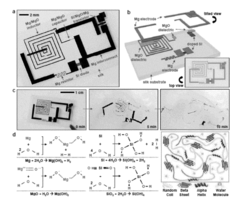
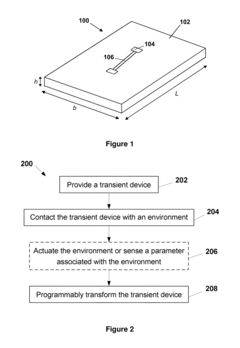
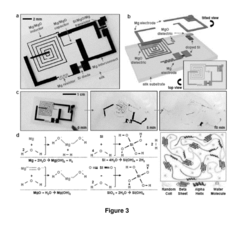
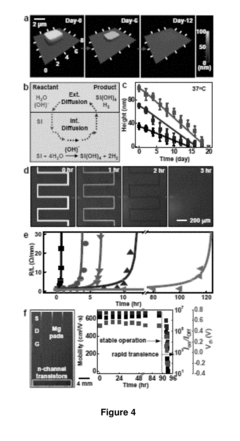
Transient Devices Designed to Undergo Programmable Transformations
PatentActiveUS20180175158A1
Innovation
- Development of transient electronic devices using degradable silicon components and substrates with selectively transformable materials, allowing for controlled transformation through stimuli such as bioresorption, hydrolysis, or chemical changes, enabling programmable changes in device function over time.
Regulatory Framework for Biomedical Printing Devices
The regulatory landscape for microtransfer printing devices in biomedical applications encompasses a complex framework of international, national, and regional standards that govern device safety, efficacy, and quality. The primary regulatory bodies include the U.S. Food and Drug Administration (FDA), the European Medicines Agency (EMA), and corresponding agencies in major markets worldwide. These organizations have established specific pathways for evaluating novel manufacturing technologies like microtransfer printing, particularly when applied to medical devices and therapeutic products.
Classification of microtransfer printing devices varies significantly based on their intended use and risk profile. Devices used for manufacturing implantable components typically fall under Class II or Class III categories, requiring extensive premarket approval processes. The FDA's 510(k) pathway may apply for devices substantially equivalent to existing predicate devices, while novel applications often necessitate the more rigorous Premarket Approval (PMA) process. The European Union's Medical Device Regulation (MDR) similarly categorizes these devices based on risk assessment criteria.
Quality management systems represent a cornerstone of regulatory compliance for microtransfer printing technologies. ISO 13485 certification is mandatory for medical device manufacturers, establishing comprehensive quality management requirements throughout the product lifecycle. Additionally, Good Manufacturing Practice (GMP) guidelines specifically address the unique challenges of additive manufacturing processes, including material traceability, process validation, and batch-to-batch consistency verification.
Biocompatibility testing requirements follow established standards such as ISO 10993 series, which evaluates biological responses to medical devices. For microtransfer printed components, particular attention is paid to material characterization, surface properties, and potential leachable substances. The printing process itself must be validated to ensure consistent biocompatibility across manufactured batches.
Emerging regulatory considerations include software validation for computer-controlled printing systems, cybersecurity requirements for networked manufacturing equipment, and post-market surveillance protocols specific to additively manufactured devices. Regulatory agencies are actively developing guidance documents addressing these novel manufacturing approaches, with particular emphasis on process validation, design controls, and risk management strategies tailored to microtransfer printing technologies.
Classification of microtransfer printing devices varies significantly based on their intended use and risk profile. Devices used for manufacturing implantable components typically fall under Class II or Class III categories, requiring extensive premarket approval processes. The FDA's 510(k) pathway may apply for devices substantially equivalent to existing predicate devices, while novel applications often necessitate the more rigorous Premarket Approval (PMA) process. The European Union's Medical Device Regulation (MDR) similarly categorizes these devices based on risk assessment criteria.
Quality management systems represent a cornerstone of regulatory compliance for microtransfer printing technologies. ISO 13485 certification is mandatory for medical device manufacturers, establishing comprehensive quality management requirements throughout the product lifecycle. Additionally, Good Manufacturing Practice (GMP) guidelines specifically address the unique challenges of additive manufacturing processes, including material traceability, process validation, and batch-to-batch consistency verification.
Biocompatibility testing requirements follow established standards such as ISO 10993 series, which evaluates biological responses to medical devices. For microtransfer printed components, particular attention is paid to material characterization, surface properties, and potential leachable substances. The printing process itself must be validated to ensure consistent biocompatibility across manufactured batches.
Emerging regulatory considerations include software validation for computer-controlled printing systems, cybersecurity requirements for networked manufacturing equipment, and post-market surveillance protocols specific to additively manufactured devices. Regulatory agencies are actively developing guidance documents addressing these novel manufacturing approaches, with particular emphasis on process validation, design controls, and risk management strategies tailored to microtransfer printing technologies.
Quality Standards and Best Practice Guidelines
Establishing comprehensive quality standards for microtransfer printing in biomedical applications requires adherence to internationally recognized frameworks while addressing the unique challenges of biological systems. The ISO 13485 medical device quality management standard serves as the foundational framework, supplemented by FDA 21 CFR Part 820 regulations for device manufacturing. These standards must be adapted to accommodate the precision requirements and biocompatibility constraints inherent in microtransfer printing processes.
Substrate preparation protocols constitute a critical component of quality assurance, demanding stringent cleanliness standards equivalent to Class 100 cleanroom environments. Surface characterization through atomic force microscopy and contact angle measurements ensures optimal adhesion properties. The substrate must undergo validated sterilization procedures, with ethylene oxide or gamma irradiation being preferred methods that preserve surface integrity while achieving sterility assurance levels of 10^-6.
Ink formulation and handling procedures require rigorous documentation and traceability systems. Biocompatible inks must undergo comprehensive cytotoxicity testing according to ISO 10993-5 standards, with batch-to-batch consistency verified through rheological analysis and particle size distribution measurements. Storage conditions must maintain ink stability within specified viscosity ranges, typically requiring temperature control within ±2°C and humidity levels below 40% relative humidity.
Process validation encompasses three critical phases: installation qualification, operational qualification, and performance qualification. Each printing parameter including contact pressure, dwell time, and separation velocity must be validated across their operational ranges. Statistical process control charts should monitor key performance indicators such as transfer efficiency, pattern fidelity, and defect rates, with control limits established through capability studies.
Documentation and record-keeping systems must ensure complete traceability from raw materials to final products. Electronic batch records should capture real-time process parameters, environmental conditions, and quality control measurements. Change control procedures must evaluate the impact of any modifications on product safety and efficacy, requiring risk assessment documentation and validation studies for significant changes.
Regular calibration and maintenance schedules for printing equipment ensure consistent performance over time. Calibration intervals should be established based on equipment stability studies and usage patterns, with calibration standards traceable to national measurement institutes. Preventive maintenance protocols must address critical components affecting print quality, including stamp alignment systems, pressure control mechanisms, and environmental control systems.
Substrate preparation protocols constitute a critical component of quality assurance, demanding stringent cleanliness standards equivalent to Class 100 cleanroom environments. Surface characterization through atomic force microscopy and contact angle measurements ensures optimal adhesion properties. The substrate must undergo validated sterilization procedures, with ethylene oxide or gamma irradiation being preferred methods that preserve surface integrity while achieving sterility assurance levels of 10^-6.
Ink formulation and handling procedures require rigorous documentation and traceability systems. Biocompatible inks must undergo comprehensive cytotoxicity testing according to ISO 10993-5 standards, with batch-to-batch consistency verified through rheological analysis and particle size distribution measurements. Storage conditions must maintain ink stability within specified viscosity ranges, typically requiring temperature control within ±2°C and humidity levels below 40% relative humidity.
Process validation encompasses three critical phases: installation qualification, operational qualification, and performance qualification. Each printing parameter including contact pressure, dwell time, and separation velocity must be validated across their operational ranges. Statistical process control charts should monitor key performance indicators such as transfer efficiency, pattern fidelity, and defect rates, with control limits established through capability studies.
Documentation and record-keeping systems must ensure complete traceability from raw materials to final products. Electronic batch records should capture real-time process parameters, environmental conditions, and quality control measurements. Change control procedures must evaluate the impact of any modifications on product safety and efficacy, requiring risk assessment documentation and validation studies for significant changes.
Regular calibration and maintenance schedules for printing equipment ensure consistent performance over time. Calibration intervals should be established based on equipment stability studies and usage patterns, with calibration standards traceable to national measurement institutes. Preventive maintenance protocols must address critical components affecting print quality, including stamp alignment systems, pressure control mechanisms, and environmental control systems.
Unlock deeper insights with Patsnap Eureka Quick Research — get a full tech report to explore trends and direct your research. Try now!
Generate Your Research Report Instantly with AI Agent
Supercharge your innovation with Patsnap Eureka AI Agent Platform!