

MOSFET vs SIC Transistors: Conductivity Performance
APR 1, 20268 MIN READ
Generate Your Research Report Instantly with AI Agent
PatSnap Eureka helps you evaluate technical feasibility & market potential.
MOSFET vs SiC Transistor Technology Background and Goals
The evolution of power semiconductor technology has been fundamentally shaped by the pursuit of enhanced conductivity performance and energy efficiency. Traditional silicon-based Metal-Oxide-Semiconductor Field-Effect Transistors (MOSFETs) have dominated the power electronics landscape for decades, serving as the backbone of switching applications across industries ranging from automotive to renewable energy systems. However, the inherent material limitations of silicon have created performance bottlenecks that increasingly constrain system efficiency and power density.
Silicon Carbide (SiC) transistors emerged as a revolutionary alternative, leveraging the superior material properties of wide-bandgap semiconductors. The development trajectory began in the 1990s with fundamental research into SiC crystal growth and device fabrication, eventually culminating in commercially viable products in the 2000s. This technological shift represents a paradigm change in power semiconductor design philosophy, moving beyond the incremental improvements possible with silicon technology.
The fundamental material properties driving this technological evolution center on conductivity performance differences. Silicon carbide exhibits a bandgap of 3.3 eV compared to silicon's 1.1 eV, enabling operation at higher temperatures and voltages while maintaining superior switching characteristics. The critical electric field strength of SiC reaches approximately 3 MV/cm, nearly ten times higher than silicon's 0.3 MV/cm, directly translating to reduced on-resistance and improved conductivity performance.
Current technological objectives focus on maximizing the conductivity advantages inherent in SiC technology while addressing manufacturing challenges and cost considerations. The primary goal involves achieving lower conduction losses through reduced on-resistance, particularly in high-voltage applications where SiC demonstrates exponential performance improvements over silicon MOSFETs. Additionally, the industry targets enhanced switching speed capabilities, enabling higher frequency operation and reduced system size.
The strategic importance of this technology comparison extends beyond individual device performance to encompass system-level efficiency gains. Modern power conversion systems demand higher power density, improved thermal management, and enhanced reliability under extreme operating conditions. SiC transistors address these requirements through superior conductivity characteristics, reduced switching losses, and enhanced temperature tolerance, positioning them as critical enablers for next-generation power electronics applications in electric vehicles, grid infrastructure, and industrial automation systems.
Silicon Carbide (SiC) transistors emerged as a revolutionary alternative, leveraging the superior material properties of wide-bandgap semiconductors. The development trajectory began in the 1990s with fundamental research into SiC crystal growth and device fabrication, eventually culminating in commercially viable products in the 2000s. This technological shift represents a paradigm change in power semiconductor design philosophy, moving beyond the incremental improvements possible with silicon technology.
The fundamental material properties driving this technological evolution center on conductivity performance differences. Silicon carbide exhibits a bandgap of 3.3 eV compared to silicon's 1.1 eV, enabling operation at higher temperatures and voltages while maintaining superior switching characteristics. The critical electric field strength of SiC reaches approximately 3 MV/cm, nearly ten times higher than silicon's 0.3 MV/cm, directly translating to reduced on-resistance and improved conductivity performance.
Current technological objectives focus on maximizing the conductivity advantages inherent in SiC technology while addressing manufacturing challenges and cost considerations. The primary goal involves achieving lower conduction losses through reduced on-resistance, particularly in high-voltage applications where SiC demonstrates exponential performance improvements over silicon MOSFETs. Additionally, the industry targets enhanced switching speed capabilities, enabling higher frequency operation and reduced system size.
The strategic importance of this technology comparison extends beyond individual device performance to encompass system-level efficiency gains. Modern power conversion systems demand higher power density, improved thermal management, and enhanced reliability under extreme operating conditions. SiC transistors address these requirements through superior conductivity characteristics, reduced switching losses, and enhanced temperature tolerance, positioning them as critical enablers for next-generation power electronics applications in electric vehicles, grid infrastructure, and industrial automation systems.
Market Demand for High-Performance Power Semiconductors
The global power semiconductor market is experiencing unprecedented growth driven by the accelerating transition toward electrification across multiple industries. Electric vehicles represent the most significant demand driver, with automotive manufacturers increasingly adopting high-performance power semiconductors to achieve superior energy efficiency and extended driving ranges. The automotive sector's shift from traditional silicon-based solutions to advanced semiconductor technologies reflects the critical need for components that can handle higher voltages, temperatures, and switching frequencies while maintaining optimal conductivity performance.
Industrial automation and renewable energy sectors constitute another major demand pillar for high-performance power semiconductors. Solar inverters, wind power systems, and energy storage solutions require power devices capable of managing substantial power loads with minimal energy losses. The growing emphasis on grid modernization and smart energy management systems further amplifies the need for semiconductors that can deliver exceptional conductivity characteristics under demanding operational conditions.
Data centers and telecommunications infrastructure represent rapidly expanding market segments demanding superior power semiconductor performance. The exponential growth in cloud computing, artificial intelligence processing, and 5G network deployment creates substantial requirements for power management solutions that can operate efficiently at high frequencies while minimizing thermal generation. These applications particularly benefit from semiconductors offering enhanced conductivity performance compared to conventional silicon technologies.
Consumer electronics markets continue driving demand for compact, efficient power management solutions. The proliferation of fast-charging technologies, wireless power transfer systems, and portable electronic devices necessitates power semiconductors that can deliver high performance within increasingly constrained form factors. The consumer sector's emphasis on energy efficiency and thermal management creates substantial opportunities for advanced semiconductor technologies.
The market demand trajectory indicates sustained growth across all major application segments, with particular emphasis on solutions that can deliver superior conductivity performance while operating under extreme conditions. This demand pattern strongly favors semiconductor technologies capable of outperforming traditional silicon solutions in terms of switching speed, thermal management, and overall energy efficiency, positioning advanced power semiconductor technologies as critical enablers for next-generation electronic systems.
Industrial automation and renewable energy sectors constitute another major demand pillar for high-performance power semiconductors. Solar inverters, wind power systems, and energy storage solutions require power devices capable of managing substantial power loads with minimal energy losses. The growing emphasis on grid modernization and smart energy management systems further amplifies the need for semiconductors that can deliver exceptional conductivity characteristics under demanding operational conditions.
Data centers and telecommunications infrastructure represent rapidly expanding market segments demanding superior power semiconductor performance. The exponential growth in cloud computing, artificial intelligence processing, and 5G network deployment creates substantial requirements for power management solutions that can operate efficiently at high frequencies while minimizing thermal generation. These applications particularly benefit from semiconductors offering enhanced conductivity performance compared to conventional silicon technologies.
Consumer electronics markets continue driving demand for compact, efficient power management solutions. The proliferation of fast-charging technologies, wireless power transfer systems, and portable electronic devices necessitates power semiconductors that can deliver high performance within increasingly constrained form factors. The consumer sector's emphasis on energy efficiency and thermal management creates substantial opportunities for advanced semiconductor technologies.
The market demand trajectory indicates sustained growth across all major application segments, with particular emphasis on solutions that can deliver superior conductivity performance while operating under extreme conditions. This demand pattern strongly favors semiconductor technologies capable of outperforming traditional silicon solutions in terms of switching speed, thermal management, and overall energy efficiency, positioning advanced power semiconductor technologies as critical enablers for next-generation electronic systems.
Current State and Challenges in Power Transistor Technology
The power transistor industry currently faces a critical transition period as traditional silicon-based MOSFETs encounter fundamental physical limitations while silicon carbide (SiC) transistors emerge as a promising alternative. Silicon MOSFETs have dominated power electronics for decades due to their mature manufacturing processes, cost-effectiveness, and well-established supply chains. However, these devices are approaching their theoretical performance limits, particularly in high-voltage and high-temperature applications where conductivity performance becomes increasingly challenging.
Silicon carbide transistors represent a significant technological advancement, offering superior material properties that directly impact conductivity performance. SiC's wider bandgap of 3.3 eV compared to silicon's 1.1 eV enables operation at higher temperatures and voltages while maintaining lower on-resistance. The critical electric field strength of SiC is approximately ten times higher than silicon, allowing for thinner drift regions and consequently reduced conduction losses.
Current manufacturing capabilities for SiC devices have matured considerably, with major semiconductor foundries achieving acceptable yield rates and quality standards. However, the technology still faces substantial cost barriers, with SiC wafers remaining significantly more expensive than silicon substrates. The limited availability of high-quality SiC substrates and the complexity of epitaxial growth processes contribute to higher production costs, typically 5-10 times that of equivalent silicon devices.
Performance disparities between MOSFET and SiC transistors are most pronounced in switching applications. SiC devices demonstrate superior switching speeds due to lower parasitic capacitances and faster carrier mobility, resulting in reduced switching losses and improved overall system efficiency. In conductivity terms, SiC transistors exhibit lower specific on-resistance, particularly beneficial in high-voltage applications where silicon devices require thicker drift regions that significantly increase conduction losses.
The primary technical challenges include gate oxide reliability in SiC MOSFETs, where the SiC-SiO2 interface quality remains inferior to silicon counterparts, leading to higher interface trap densities and threshold voltage instability. Additionally, the limited availability of p-type SiC substrates constrains device architecture options, while thermal management requirements, though reduced compared to silicon, still present system-level design challenges in high-power density applications.
Silicon carbide transistors represent a significant technological advancement, offering superior material properties that directly impact conductivity performance. SiC's wider bandgap of 3.3 eV compared to silicon's 1.1 eV enables operation at higher temperatures and voltages while maintaining lower on-resistance. The critical electric field strength of SiC is approximately ten times higher than silicon, allowing for thinner drift regions and consequently reduced conduction losses.
Current manufacturing capabilities for SiC devices have matured considerably, with major semiconductor foundries achieving acceptable yield rates and quality standards. However, the technology still faces substantial cost barriers, with SiC wafers remaining significantly more expensive than silicon substrates. The limited availability of high-quality SiC substrates and the complexity of epitaxial growth processes contribute to higher production costs, typically 5-10 times that of equivalent silicon devices.
Performance disparities between MOSFET and SiC transistors are most pronounced in switching applications. SiC devices demonstrate superior switching speeds due to lower parasitic capacitances and faster carrier mobility, resulting in reduced switching losses and improved overall system efficiency. In conductivity terms, SiC transistors exhibit lower specific on-resistance, particularly beneficial in high-voltage applications where silicon devices require thicker drift regions that significantly increase conduction losses.
The primary technical challenges include gate oxide reliability in SiC MOSFETs, where the SiC-SiO2 interface quality remains inferior to silicon counterparts, leading to higher interface trap densities and threshold voltage instability. Additionally, the limited availability of p-type SiC substrates constrains device architecture options, while thermal management requirements, though reduced compared to silicon, still present system-level design challenges in high-power density applications.
Key Players in Power Semiconductor Industry
The MOSFET versus SiC transistor conductivity performance landscape represents a mature industry undergoing significant technological transition. The market, valued at approximately $1.2 billion for SiC devices, is experiencing rapid growth driven by electric vehicle and renewable energy applications. Traditional silicon MOSFET technology dominates current applications but faces performance limitations at high temperatures and voltages. SiC technology demonstrates superior conductivity performance with lower switching losses and higher efficiency, though at premium costs. Key players exhibit varying technological maturity levels: established semiconductor giants like Infineon Technologies, Wolfspeed, ROHM, and Toshiba lead SiC innovation, while companies such as AMD and STMicroelectronics maintain strong MOSFET portfolios. Emerging players including Fast SiC Semiconductor and Chinese entities like Nanjing Third Generation Semiconductor represent growing regional competition, indicating the technology's transition from early adoption to mainstream deployment phases.
Infineon Technologies AG
Technical Solution: Infineon develops both silicon and SiC power transistor technologies with focus on conductivity optimization. Their CoolSiC MOSFET family features advanced trench technology that reduces on-resistance by up to 20% compared to previous generations. The company's silicon-based CoolMOS series utilizes superjunction technology to achieve low RDS(on) values while maintaining fast switching capabilities. For SiC transistors, Infineon's 650V and 1200V CoolSiC MOSFETs demonstrate on-resistance values ranging from 16mΩ to 160mΩ depending on voltage rating. Their proprietary .XT technology enhances conductivity through optimized chip design and advanced packaging solutions that minimize parasitic resistances and improve thermal management.
Strengths: Strong portfolio in both silicon and SiC technologies, excellent manufacturing capabilities, and comprehensive product range. Weaknesses: Intense competition in silicon MOSFET market, SiC products still command premium pricing.
Wolfspeed, Inc.
Technical Solution: Wolfspeed specializes in silicon carbide (SiC) power semiconductors and RF solutions. Their SiC MOSFETs demonstrate superior conductivity performance compared to traditional silicon MOSFETs, with significantly lower on-resistance (RDS(on)) values and higher switching frequencies. The company's C3M series SiC MOSFETs achieve RDS(on) values as low as 25 mΩ while maintaining high breakdown voltages up to 1700V. Their SiC technology enables 10x faster switching speeds compared to silicon IGBTs, resulting in reduced switching losses and improved overall system efficiency. The wide bandgap properties of SiC allow operation at higher temperatures (up to 200°C junction temperature) while maintaining excellent conductivity characteristics.
Strengths: Market leader in SiC technology with proven high-performance products, excellent thermal conductivity, and superior switching characteristics. Weaknesses: Higher manufacturing costs compared to silicon MOSFETs, limited supply chain scalability.
Core Patents in SiC vs MOSFET Conductivity Innovation
Transistors with a gate insulation layer having a channel depleting interfacial charge and related fabrication methods
PatentWO2011025577A1
Innovation
- A metal-insulator-semiconductor field-effect transistor (MISFET) with a silicon carbide layer and a gate insulation layer having a net charge along the interface that depletes majority carriers, increasing the threshold voltage and electron mobility by forming a silicon dioxide layer on the SiC layer with a high concentration of carbon atoms, which biases charge carriers away from the channel region.


Silicon carbide field-effect transistors
PatentActiveUS11894454B2
Innovation
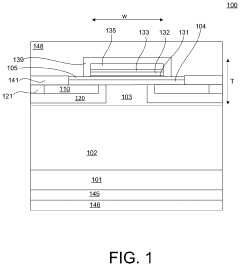
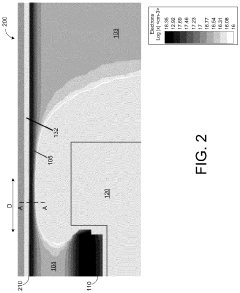
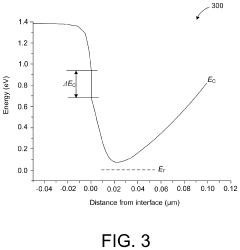
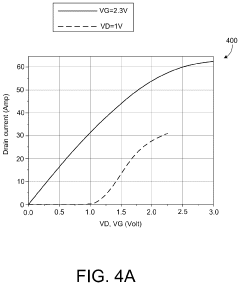
- The development of a silicon carbide (SiC) metal-oxide-semiconductor field-effect transistor (MOSFET) with a gate structure comprising a gate oxide layer, an aluminum nitride layer, and a p-type gallium nitride layer, which includes a lateral built-in channel with a p-type AlGaN gate and an AlN buffer layer, providing high threshold voltage and low interface trap density, enabling efficient operation with low on-state resistance.
Thermal Management in High-Conductivity Transistors
Thermal management represents a critical performance differentiator between traditional silicon MOSFETs and silicon carbide (SiC) transistors, particularly as conductivity requirements intensify in high-power applications. The superior thermal characteristics of SiC devices fundamentally alter heat dissipation strategies and enable more aggressive power density designs compared to conventional silicon-based solutions.
SiC transistors demonstrate exceptional thermal conductivity, approximately three times higher than silicon MOSFETs, reaching values of 3.3-4.9 W/cm·K versus silicon's 1.5 W/cm·K. This enhanced thermal conductivity directly correlates with improved heat spreading capabilities, reducing localized hot spots that typically limit conductivity performance in high-current applications. The superior thermal properties enable SiC devices to maintain stable electrical characteristics at elevated junction temperatures up to 200°C, compared to silicon's practical limit of 150°C.
Power dissipation management becomes increasingly complex as transistor conductivity improves and switching frequencies increase. SiC transistors generate significantly lower switching losses due to their faster switching characteristics and reduced reverse recovery losses. However, the concentrated power density in smaller die areas creates unique thermal challenges requiring advanced packaging solutions and heat sink designs optimized for the higher thermal flux densities.
Thermal resistance optimization strategies differ substantially between MOSFET and SiC implementations. Traditional silicon MOSFETs rely heavily on package-level thermal management, including copper lead frames and thermal interface materials. SiC transistors benefit from direct bonded copper substrates and advanced ceramic packaging that leverage the material's inherent thermal properties while maintaining electrical isolation.
Junction temperature stability directly impacts conductivity performance consistency. SiC devices exhibit superior temperature coefficients, maintaining lower on-resistance variations across operating temperature ranges. This thermal stability enables more predictable conductivity performance and reduces the need for complex thermal compensation circuits typically required in high-performance silicon MOSFET applications.
Advanced cooling methodologies, including liquid cooling and phase-change materials, become economically viable with SiC transistors due to their higher power handling capabilities. The improved thermal management efficiency translates to reduced system-level cooling requirements and enhanced overall power conversion efficiency in high-conductivity applications.
SiC transistors demonstrate exceptional thermal conductivity, approximately three times higher than silicon MOSFETs, reaching values of 3.3-4.9 W/cm·K versus silicon's 1.5 W/cm·K. This enhanced thermal conductivity directly correlates with improved heat spreading capabilities, reducing localized hot spots that typically limit conductivity performance in high-current applications. The superior thermal properties enable SiC devices to maintain stable electrical characteristics at elevated junction temperatures up to 200°C, compared to silicon's practical limit of 150°C.
Power dissipation management becomes increasingly complex as transistor conductivity improves and switching frequencies increase. SiC transistors generate significantly lower switching losses due to their faster switching characteristics and reduced reverse recovery losses. However, the concentrated power density in smaller die areas creates unique thermal challenges requiring advanced packaging solutions and heat sink designs optimized for the higher thermal flux densities.
Thermal resistance optimization strategies differ substantially between MOSFET and SiC implementations. Traditional silicon MOSFETs rely heavily on package-level thermal management, including copper lead frames and thermal interface materials. SiC transistors benefit from direct bonded copper substrates and advanced ceramic packaging that leverage the material's inherent thermal properties while maintaining electrical isolation.
Junction temperature stability directly impacts conductivity performance consistency. SiC devices exhibit superior temperature coefficients, maintaining lower on-resistance variations across operating temperature ranges. This thermal stability enables more predictable conductivity performance and reduces the need for complex thermal compensation circuits typically required in high-performance silicon MOSFET applications.
Advanced cooling methodologies, including liquid cooling and phase-change materials, become economically viable with SiC transistors due to their higher power handling capabilities. The improved thermal management efficiency translates to reduced system-level cooling requirements and enhanced overall power conversion efficiency in high-conductivity applications.
Cost-Performance Trade-offs in SiC vs Silicon Solutions
The cost-performance analysis between SiC and silicon MOSFET solutions reveals a complex landscape where initial investment costs must be weighed against long-term operational benefits. Silicon MOSFETs maintain a significant advantage in upfront costs, with established manufacturing processes and mature supply chains driving down unit prices. The cost differential can range from 3-10 times higher for SiC devices compared to equivalent silicon solutions, creating substantial barriers for cost-sensitive applications.
However, the performance advantages of SiC transistors fundamentally alter the total cost of ownership equation. SiC devices enable higher switching frequencies, reduced cooling requirements, and smaller passive components, leading to overall system cost reductions. Power density improvements of 2-3 times are achievable, translating to smaller heat sinks, reduced PCB area, and more compact designs that offset initial component costs.
Energy efficiency gains present the most compelling long-term value proposition for SiC adoption. In high-power applications, efficiency improvements of 2-5% directly translate to reduced operational costs over the device lifetime. For electric vehicle inverters operating at 95-98% efficiency with SiC versus 92-95% with silicon, the energy savings can justify the premium within 2-3 years of operation.
Manufacturing scalability remains a critical factor influencing the cost trajectory. Silicon wafer production benefits from decades of optimization and 12-inch wafer processing, while SiC manufacturing predominantly relies on smaller 6-inch wafers with lower yields. However, ongoing investments in SiC fabrication capacity and the transition to 8-inch wafers are expected to reduce cost gaps by 30-40% over the next five years.
Application-specific cost-performance optimization reveals distinct market segments where each technology excels. Low-frequency, cost-sensitive applications favor silicon solutions, while high-frequency, efficiency-critical systems increasingly justify SiC premiums. The crossover point continues to shift toward broader SiC adoption as manufacturing scales improve and performance requirements intensify across automotive, renewable energy, and industrial sectors.
However, the performance advantages of SiC transistors fundamentally alter the total cost of ownership equation. SiC devices enable higher switching frequencies, reduced cooling requirements, and smaller passive components, leading to overall system cost reductions. Power density improvements of 2-3 times are achievable, translating to smaller heat sinks, reduced PCB area, and more compact designs that offset initial component costs.
Energy efficiency gains present the most compelling long-term value proposition for SiC adoption. In high-power applications, efficiency improvements of 2-5% directly translate to reduced operational costs over the device lifetime. For electric vehicle inverters operating at 95-98% efficiency with SiC versus 92-95% with silicon, the energy savings can justify the premium within 2-3 years of operation.
Manufacturing scalability remains a critical factor influencing the cost trajectory. Silicon wafer production benefits from decades of optimization and 12-inch wafer processing, while SiC manufacturing predominantly relies on smaller 6-inch wafers with lower yields. However, ongoing investments in SiC fabrication capacity and the transition to 8-inch wafers are expected to reduce cost gaps by 30-40% over the next five years.
Application-specific cost-performance optimization reveals distinct market segments where each technology excels. Low-frequency, cost-sensitive applications favor silicon solutions, while high-frequency, efficiency-critical systems increasingly justify SiC premiums. The crossover point continues to shift toward broader SiC adoption as manufacturing scales improve and performance requirements intensify across automotive, renewable energy, and industrial sectors.
Unlock deeper insights with PatSnap Eureka Quick Research — get a full tech report to explore trends and direct your research. Try now!
Generate Your Research Report Instantly with AI Agent
Supercharge your innovation with PatSnap Eureka AI Agent Platform!