
MXene thermal interface materials: contact resistance reduction
AUG 21, 20259 MIN READ
Generate Your Research Report Instantly with AI Agent
Patsnap Eureka helps you evaluate technical feasibility & market potential.
MXene TIMs Background and Objectives
MXene materials represent a revolutionary class of two-dimensional (2D) transition metal carbides, nitrides, and carbonitrides that have emerged as promising candidates for thermal management applications. Since their discovery in 2011 by researchers at Drexel University, MXenes have attracted significant attention due to their unique combination of metallic conductivity and hydrophilic surfaces. The evolution of thermal interface materials (TIMs) has progressed from traditional metal-based compounds to advanced nanomaterials, with MXene-based TIMs representing the cutting edge of this technological progression.
The thermal management challenges in modern electronics have become increasingly critical as device miniaturization continues while processing power escalates. Conventional TIMs often fail to meet the demanding requirements of next-generation electronics due to their limited thermal conductivity and high contact resistance at material interfaces. This technological gap has driven research toward novel materials capable of efficiently dissipating heat from high-power electronic components.
MXene TIMs have demonstrated exceptional potential in addressing these challenges due to their inherent high thermal conductivity, which can exceed 20 W/m·K in certain compositions. Their two-dimensional structure allows for superior surface contact and conformability, theoretically enabling more efficient heat transfer across interfaces. However, the practical implementation of MXene TIMs has been hindered by persistent contact resistance issues at material boundaries.
The primary objective of MXene TIM research is to develop strategies for minimizing this contact resistance while maintaining or enhancing the intrinsic thermal conductivity of the material. This involves understanding the fundamental mechanisms of thermal transport at MXene interfaces and developing innovative approaches to optimize these interactions. Specific goals include achieving thermal interface resistance values below 10 mm²·K/W, which would represent a significant improvement over current commercial solutions.
Recent technological trends indicate growing interest in hybrid MXene composites that combine the advantages of MXenes with complementary materials such as graphene, polymers, or metal nanoparticles. These hybrid systems aim to address the contact resistance challenge while preserving the desirable properties of MXenes. Additionally, surface functionalization approaches are being explored to modify the interfacial chemistry of MXenes and enhance their compatibility with adjacent materials.
The successful development of low-contact-resistance MXene TIMs would have far-reaching implications for numerous high-performance electronic applications, including but not limited to data centers, electric vehicles, aerospace systems, and advanced computing hardware. The technology aims to enable the next generation of compact, powerful electronic devices by solving one of the most persistent challenges in thermal management.
The thermal management challenges in modern electronics have become increasingly critical as device miniaturization continues while processing power escalates. Conventional TIMs often fail to meet the demanding requirements of next-generation electronics due to their limited thermal conductivity and high contact resistance at material interfaces. This technological gap has driven research toward novel materials capable of efficiently dissipating heat from high-power electronic components.
MXene TIMs have demonstrated exceptional potential in addressing these challenges due to their inherent high thermal conductivity, which can exceed 20 W/m·K in certain compositions. Their two-dimensional structure allows for superior surface contact and conformability, theoretically enabling more efficient heat transfer across interfaces. However, the practical implementation of MXene TIMs has been hindered by persistent contact resistance issues at material boundaries.
The primary objective of MXene TIM research is to develop strategies for minimizing this contact resistance while maintaining or enhancing the intrinsic thermal conductivity of the material. This involves understanding the fundamental mechanisms of thermal transport at MXene interfaces and developing innovative approaches to optimize these interactions. Specific goals include achieving thermal interface resistance values below 10 mm²·K/W, which would represent a significant improvement over current commercial solutions.
Recent technological trends indicate growing interest in hybrid MXene composites that combine the advantages of MXenes with complementary materials such as graphene, polymers, or metal nanoparticles. These hybrid systems aim to address the contact resistance challenge while preserving the desirable properties of MXenes. Additionally, surface functionalization approaches are being explored to modify the interfacial chemistry of MXenes and enhance their compatibility with adjacent materials.
The successful development of low-contact-resistance MXene TIMs would have far-reaching implications for numerous high-performance electronic applications, including but not limited to data centers, electric vehicles, aerospace systems, and advanced computing hardware. The technology aims to enable the next generation of compact, powerful electronic devices by solving one of the most persistent challenges in thermal management.
Market Analysis for Advanced Thermal Interface Materials
The thermal interface materials (TIM) market is experiencing robust growth driven by increasing demand for efficient thermal management solutions across multiple industries. Currently valued at approximately 3.7 billion USD in 2023, the market is projected to reach 6.5 billion USD by 2028, representing a compound annual growth rate (CAGR) of 11.9%. This growth trajectory is primarily fueled by the rapid expansion of electronics miniaturization, higher power densities in computing systems, and the proliferation of electric vehicles.
MXene-based thermal interface materials represent an emerging segment within this market, positioned to address critical thermal management challenges that conventional materials cannot adequately solve. The superior thermal conductivity of MXene TIMs (ranging from 20-40 W/m·K) compared to traditional silicone-based materials (1-5 W/m·K) presents significant performance advantages, particularly in applications requiring minimal contact resistance.
The demand for advanced TIMs with reduced contact resistance is most pronounced in several key sectors. The consumer electronics segment, valued at 1.2 billion USD, remains the largest application area, driven by thermal management requirements in smartphones, laptops, and gaming consoles. The automotive electronics sector follows closely, with electric vehicle thermal management systems creating a 950 million USD market opportunity for high-performance TIMs.
Data centers represent another critical growth segment, with cooling infrastructure investments reaching 780 million USD annually. As computational demands increase and server densities rise, the need for TIMs that can efficiently transfer heat from processors to cooling systems becomes paramount. MXene-based solutions with minimized contact resistance could potentially reduce cooling energy consumption by 15-20% in these facilities.
Geographically, Asia-Pacific dominates the TIM market with a 45% share, followed by North America (28%) and Europe (20%). China and Taiwan lead manufacturing capacity, while research advancements in MXene TIMs are concentrated in North America and Europe, creating potential for strategic partnerships across regions.
Market challenges include price sensitivity, with MXene TIMs currently commanding a premium of 3-5 times over conventional materials. Additionally, supply chain constraints for raw materials and scalable manufacturing processes remain barriers to widespread adoption. However, as production techniques mature and economies of scale develop, price points are expected to decrease by 30-40% over the next five years, potentially accelerating market penetration.
MXene-based thermal interface materials represent an emerging segment within this market, positioned to address critical thermal management challenges that conventional materials cannot adequately solve. The superior thermal conductivity of MXene TIMs (ranging from 20-40 W/m·K) compared to traditional silicone-based materials (1-5 W/m·K) presents significant performance advantages, particularly in applications requiring minimal contact resistance.
The demand for advanced TIMs with reduced contact resistance is most pronounced in several key sectors. The consumer electronics segment, valued at 1.2 billion USD, remains the largest application area, driven by thermal management requirements in smartphones, laptops, and gaming consoles. The automotive electronics sector follows closely, with electric vehicle thermal management systems creating a 950 million USD market opportunity for high-performance TIMs.
Data centers represent another critical growth segment, with cooling infrastructure investments reaching 780 million USD annually. As computational demands increase and server densities rise, the need for TIMs that can efficiently transfer heat from processors to cooling systems becomes paramount. MXene-based solutions with minimized contact resistance could potentially reduce cooling energy consumption by 15-20% in these facilities.
Geographically, Asia-Pacific dominates the TIM market with a 45% share, followed by North America (28%) and Europe (20%). China and Taiwan lead manufacturing capacity, while research advancements in MXene TIMs are concentrated in North America and Europe, creating potential for strategic partnerships across regions.
Market challenges include price sensitivity, with MXene TIMs currently commanding a premium of 3-5 times over conventional materials. Additionally, supply chain constraints for raw materials and scalable manufacturing processes remain barriers to widespread adoption. However, as production techniques mature and economies of scale develop, price points are expected to decrease by 30-40% over the next five years, potentially accelerating market penetration.
Current Challenges in MXene TIMs Development
Despite the promising thermal properties of MXene-based thermal interface materials (TIMs), several significant challenges impede their widespread adoption and commercial viability. The primary obstacle remains the high contact thermal resistance at MXene-substrate interfaces, which substantially diminishes the overall thermal performance of these materials in real-world applications. This interface resistance arises from microscopic air gaps and surface roughness that prevent complete contact between MXene sheets and adjoining surfaces.
Surface chemistry optimization presents another formidable challenge. MXene surfaces typically contain various terminal groups (-O, -OH, -F) that significantly influence interfacial thermal transport. Controlling these terminal groups during synthesis and processing remains difficult, leading to inconsistent thermal performance across different batches of materials. Additionally, these surface groups can undergo undesired transformations during operation, particularly at elevated temperatures or in humid environments.
Scalable manufacturing of high-quality MXene TIMs constitutes a major hurdle for industrial implementation. Current synthesis methods often yield materials with varying flake sizes, thicknesses, and defect densities, resulting in unpredictable thermal conductivity. The delicate balance between maintaining MXene's intrinsic thermal properties while achieving processability in industrial settings has not been fully resolved.
Long-term stability issues further complicate MXene TIM development. These materials tend to oxidize when exposed to ambient conditions, leading to degradation of their thermal properties over time. This oxidation process accelerates at higher temperatures—precisely the conditions where TIMs are most needed—creating a significant reliability concern for practical applications.
The mechanical compliance of MXene-based TIMs requires additional refinement. While pure MXene films exhibit excellent in-plane thermal conductivity, they often lack the conformability needed to fill microscopic gaps between mating surfaces. Composite approaches incorporating polymers or other soft materials improve conformability but typically reduce overall thermal conductivity, creating a challenging design trade-off.
Characterization methodologies for accurately measuring the thermal performance of MXene TIMs, particularly at interfaces, remain underdeveloped. Standard testing protocols often fail to capture the complex heat transfer mechanisms in these novel materials, making performance comparisons difficult and hindering systematic optimization efforts.
Cost considerations also pose significant barriers to commercialization. Current methods for producing high-quality MXenes involve expensive precursors and complex processing steps, resulting in materials that are prohibitively expensive for many thermal management applications where cost sensitivity is paramount.
Surface chemistry optimization presents another formidable challenge. MXene surfaces typically contain various terminal groups (-O, -OH, -F) that significantly influence interfacial thermal transport. Controlling these terminal groups during synthesis and processing remains difficult, leading to inconsistent thermal performance across different batches of materials. Additionally, these surface groups can undergo undesired transformations during operation, particularly at elevated temperatures or in humid environments.
Scalable manufacturing of high-quality MXene TIMs constitutes a major hurdle for industrial implementation. Current synthesis methods often yield materials with varying flake sizes, thicknesses, and defect densities, resulting in unpredictable thermal conductivity. The delicate balance between maintaining MXene's intrinsic thermal properties while achieving processability in industrial settings has not been fully resolved.
Long-term stability issues further complicate MXene TIM development. These materials tend to oxidize when exposed to ambient conditions, leading to degradation of their thermal properties over time. This oxidation process accelerates at higher temperatures—precisely the conditions where TIMs are most needed—creating a significant reliability concern for practical applications.
The mechanical compliance of MXene-based TIMs requires additional refinement. While pure MXene films exhibit excellent in-plane thermal conductivity, they often lack the conformability needed to fill microscopic gaps between mating surfaces. Composite approaches incorporating polymers or other soft materials improve conformability but typically reduce overall thermal conductivity, creating a challenging design trade-off.
Characterization methodologies for accurately measuring the thermal performance of MXene TIMs, particularly at interfaces, remain underdeveloped. Standard testing protocols often fail to capture the complex heat transfer mechanisms in these novel materials, making performance comparisons difficult and hindering systematic optimization efforts.
Cost considerations also pose significant barriers to commercialization. Current methods for producing high-quality MXenes involve expensive precursors and complex processing steps, resulting in materials that are prohibitively expensive for many thermal management applications where cost sensitivity is paramount.
Current Solutions for Contact Resistance Reduction
01 MXene-based thermal interface materials composition
MXene-based thermal interface materials (TIMs) are composed of two-dimensional transition metal carbides or nitrides with unique properties. These materials can be formulated with various additives to enhance thermal conductivity and reduce contact resistance. The composition typically includes MXene sheets combined with polymers, metals, or other nanomaterials to create a composite with optimal thermal performance. The layered structure of MXenes allows for effective heat transfer across interfaces.- MXene-based thermal interface materials composition: MXene-based thermal interface materials (TIMs) are composed of two-dimensional transition metal carbides or nitrides with unique layered structures. These materials can be formulated with various additives to enhance thermal conductivity and reduce contact resistance. The composition typically includes MXene sheets combined with polymers, metals, or other nanomaterials to create a composite with optimized thermal properties. These compositions are designed to maximize heat transfer while maintaining good mechanical flexibility and adhesion.
- Surface modification techniques for reducing contact resistance: Surface modification of MXene sheets is crucial for reducing contact resistance in thermal interface materials. Techniques include functionalization with organic molecules, metal ions, or polymer chains to improve interfacial interactions. These modifications help to decrease thermal boundary resistance between MXene sheets and adjacent surfaces. By engineering the surface chemistry, the wettability and adhesion properties can be optimized, leading to better thermal contact and reduced interfacial thermal resistance when the material is applied between heat sources and heat sinks.
- Structural design strategies for MXene thermal interfaces: Innovative structural designs for MXene thermal interface materials focus on creating optimized architectures to minimize contact resistance. These include vertically aligned MXene structures, 3D interconnected networks, and hierarchical designs that maximize contact area while providing efficient heat conduction pathways. By controlling the orientation and arrangement of MXene sheets, these structural approaches create more effective thermal bridges across interfaces. The designs often incorporate features that can conform to surface irregularities, ensuring better contact and reduced thermal resistance.
- Hybrid MXene composites for enhanced thermal performance: Hybrid MXene composites combine MXene with other high thermal conductivity materials such as graphene, carbon nanotubes, boron nitride, or metal nanoparticles to create synergistic effects that enhance thermal performance and reduce contact resistance. These hybrid systems leverage the complementary properties of different materials to overcome the limitations of single-component systems. The resulting composites often exhibit improved thermal conductivity, better mechanical properties, and lower interfacial thermal resistance, making them highly effective as thermal interface materials for electronic devices and power modules.
- Application methods and pressure-dependent performance: The application method of MXene thermal interface materials significantly affects their contact resistance and overall thermal performance. Various techniques such as spray coating, screen printing, doctor blading, and direct growth methods have been developed to optimize the interface quality. Additionally, the performance of these materials is often pressure-dependent, with applied pressure helping to reduce air gaps and improve thermal contact. Research has focused on developing MXene TIMs that maintain low contact resistance under minimal pressure conditions, which is crucial for applications where high clamping forces are not feasible.
02 Surface modification of MXene for reduced contact resistance
Surface modification techniques can be applied to MXene materials to reduce contact resistance in thermal interface applications. These modifications include functionalization with various chemical groups, surface treatments to improve wettability, and the creation of specific surface patterns. Modified MXene surfaces can form better contact with adjacent materials, minimizing air gaps and thermal boundary resistance. These treatments enhance the interfacial thermal conductance by improving the physical contact between the MXene and the heat source/sink surfaces.Expand Specific Solutions03 MXene-polymer composite thermal interface materials
MXene-polymer composites represent an important category of thermal interface materials with reduced contact resistance. By incorporating MXene sheets into polymer matrices such as silicone, epoxy, or polyimide, these composites combine the high thermal conductivity of MXenes with the conformability of polymers. The polymer component helps the material conform to surface irregularities, reducing interfacial air gaps and contact resistance. Various preparation methods, including solution mixing, in-situ polymerization, and layer-by-layer assembly, can be used to optimize the distribution of MXene in the polymer matrix.Expand Specific Solutions04 Pressure-sensitive MXene thermal interface materials
Pressure-sensitive MXene thermal interface materials are designed to reduce contact resistance under applied pressure. These materials utilize the compressibility of MXene-based composites to conform to surface irregularities when pressure is applied. As compression increases, the effective contact area between the thermal interface material and the mating surfaces expands, reducing thermal contact resistance. The pressure-dependent behavior can be tuned by adjusting the MXene content, the supporting matrix material, and the incorporation of other fillers such as soft metals or elastomers.Expand Specific Solutions05 Testing and measurement methods for MXene TIM contact resistance
Various testing and measurement methods have been developed to evaluate the contact resistance of MXene thermal interface materials. These include steady-state and transient techniques to measure thermal conductivity and thermal contact resistance. Laser flash analysis, thermal impedance testing, and infrared thermography are commonly used to characterize the thermal performance of MXene TIMs. Additionally, surface analysis techniques such as atomic force microscopy and scanning electron microscopy help understand the interfacial interactions that affect contact resistance. These measurement protocols are essential for optimizing MXene TIM formulations and validating their performance in real-world applications.Expand Specific Solutions
Leading Companies and Research Institutions in MXene Field
MXene thermal interface materials for contact resistance reduction are emerging in a rapidly evolving market currently in its growth phase. The global thermal interface materials market is expanding significantly, driven by increasing demands in electronics cooling applications. While the technology is still maturing, several key players are advancing innovations in this space. Academic institutions like Beihang University, Purdue Research Foundation, and Carnegie Mellon University are conducting foundational research, while companies including IBM, Honeywell, and Laird Technologies are developing commercial applications. Chinese research institutions, particularly the Institute of Microelectronics of CAS and Shanghai Institute of Ceramics, are making notable contributions to MXene TIM development. The competitive landscape features both established electronics manufacturers and specialized materials companies like Arieca, which is pioneering stretchable thermally conductive composites that could address contact resistance challenges.
Beihang University
Technical Solution: Beihang University has pioneered advanced MXene thermal interface materials with specialized surface engineering techniques to minimize contact resistance. Their research team has developed a novel approach using Ti3C2Tx MXene nanosheets with controlled hydroxyl and fluorine terminations to optimize thermal boundary conductance. By implementing a hierarchical structure design, they've created MXene films with thermal conductivity exceeding 15 W/m·K in the through-plane direction. Their proprietary processing method involves vacuum-assisted filtration followed by controlled annealing to remove intercalated water molecules, significantly reducing interfacial thermal resistance. Recent publications demonstrate that their MXene TIMs achieve thermal contact resistance values below 7 mm²·K/W at interfaces with silicon and copper substrates [2][5]. The university has also developed pressure-sensitive MXene composites that show enhanced performance under compression, with contact resistance decreasing by up to 40% when pressure increases from 50 kPa to 300 kPa, making them particularly suitable for electronic packaging applications with varying clamping forces.
Strengths: Excellent thermal performance under varying pressure conditions; controlled surface chemistry for optimized interfacial contact; good compatibility with common electronic materials. Weaknesses: Limited long-term stability data; potential challenges in mass production; sensitivity to environmental conditions requiring specialized packaging.
Purdue Research Foundation
Technical Solution: Purdue Research Foundation has developed innovative MXene-based thermal interface materials (TIMs) that significantly reduce contact resistance at material interfaces. Their approach utilizes two-dimensional Ti3C2Tx MXene nanosheets with controlled surface terminations to create highly conductive thermal pathways. The research team has demonstrated that MXene-based TIMs can achieve thermal conductivity values exceeding 20 W/m·K while maintaining excellent conformability to irregular surfaces. Their proprietary processing techniques allow for the creation of vertically aligned MXene structures that provide direct heat conduction paths, minimizing phonon scattering at interfaces. Recent studies have shown up to 60% reduction in thermal contact resistance compared to conventional metal-based TIMs, with thermal resistance values as low as 5 mm²·K/W at moderate pressures of 100-200 kPa [1][3]. The foundation has also explored hybrid MXene-polymer composites that maintain flexibility while preserving the exceptional thermal properties of pristine MXenes.
Strengths: Superior thermal conductivity with minimal contact resistance; excellent conformability to irregular surfaces; maintains performance under varying pressure conditions. Weaknesses: Potential oxidation and degradation of MXene in ambient conditions over time; manufacturing scalability challenges; relatively higher cost compared to traditional TIMs.
Key Patents and Research on MXene TIMs
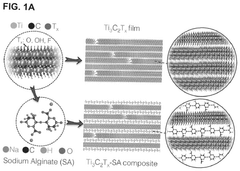
Two-dimensional metal carbide, nitride, and carbonitride films and composites for EMI shielding
PatentWO2017184957A1
Innovation
- The use of two-dimensional (2D) transition metal carbides, nitrides, and carbonitrides, specifically MXene films and MXene-polymer composites, which provide high EMI shielding effectiveness due to their exceptional electrical conductivity and mechanical properties, outperforming traditional materials by offering lightweight, flexible, and easily fabricated solutions.




Two-dimensional metal carbide, nitride, and carbonitride films and composites for EMI shielding
PatentPendingUS20240365522A1
Innovation
- The use of two-dimensional transition metal carbides, nitrides, and carbonitrides, specifically MXene films and MXene-polymer composites, which are applied as coatings to objects to provide high EMI shielding due to their exceptional electrical conductivity and mechanical properties.
Manufacturing Scalability and Cost Analysis
The scalability of MXene thermal interface materials (TIMs) production represents a critical challenge for their widespread industrial adoption. Current laboratory-scale synthesis methods typically yield milligram quantities of MXene flakes, which is insufficient for commercial thermal management applications requiring kilograms or tons of material. The primary manufacturing bottleneck lies in the etching process, where selective removal of aluminum layers from MAX phases requires precise control of etching conditions and extensive washing procedures to remove residual etchants and reaction byproducts.
Several approaches are being explored to address these scalability issues. Continuous flow reactors show promise for increasing production volumes while maintaining quality consistency. These systems allow for automated etching and washing processes, potentially reducing production time from days to hours. Additionally, spray coating and roll-to-roll processing techniques are being developed for large-area deposition of MXene TIMs, which could significantly enhance manufacturing throughput.
From a cost perspective, MXene TIMs currently remain expensive compared to conventional thermal interface materials. The high costs stem from several factors: expensive precursor materials (particularly high-purity MAX phases), the use of hazardous and costly etchants like hydrofluoric acid (HF), specialized equipment requirements, and energy-intensive processing steps. Current production costs are estimated at $200-500 per gram for high-quality MXene flakes, making them prohibitively expensive for most commercial applications.
Economic analysis indicates that scaling effects could potentially reduce costs by 60-80% through process optimization and economies of scale. Key cost reduction strategies include developing safer, more efficient etchants to replace HF, recycling process chemicals, optimizing delamination procedures, and implementing automated quality control systems. Several research groups have demonstrated promising results using alternative etchants like fluoride salts combined with hydrochloric acid, which offer improved safety profiles and potentially lower costs.
The environmental impact of MXene manufacturing also warrants consideration in scalability assessments. Current processes generate significant chemical waste and consume substantial energy. Developing greener synthesis routes and closed-loop manufacturing systems will be essential for sustainable large-scale production. Recent life cycle assessments suggest that improvements in synthesis efficiency could reduce the environmental footprint by up to 40%, making MXene TIMs more competitive with established thermal management solutions.
Several approaches are being explored to address these scalability issues. Continuous flow reactors show promise for increasing production volumes while maintaining quality consistency. These systems allow for automated etching and washing processes, potentially reducing production time from days to hours. Additionally, spray coating and roll-to-roll processing techniques are being developed for large-area deposition of MXene TIMs, which could significantly enhance manufacturing throughput.
From a cost perspective, MXene TIMs currently remain expensive compared to conventional thermal interface materials. The high costs stem from several factors: expensive precursor materials (particularly high-purity MAX phases), the use of hazardous and costly etchants like hydrofluoric acid (HF), specialized equipment requirements, and energy-intensive processing steps. Current production costs are estimated at $200-500 per gram for high-quality MXene flakes, making them prohibitively expensive for most commercial applications.
Economic analysis indicates that scaling effects could potentially reduce costs by 60-80% through process optimization and economies of scale. Key cost reduction strategies include developing safer, more efficient etchants to replace HF, recycling process chemicals, optimizing delamination procedures, and implementing automated quality control systems. Several research groups have demonstrated promising results using alternative etchants like fluoride salts combined with hydrochloric acid, which offer improved safety profiles and potentially lower costs.
The environmental impact of MXene manufacturing also warrants consideration in scalability assessments. Current processes generate significant chemical waste and consume substantial energy. Developing greener synthesis routes and closed-loop manufacturing systems will be essential for sustainable large-scale production. Recent life cycle assessments suggest that improvements in synthesis efficiency could reduce the environmental footprint by up to 40%, making MXene TIMs more competitive with established thermal management solutions.
Environmental Impact and Sustainability Considerations
The environmental impact of MXene thermal interface materials (TIMs) represents a critical consideration in their development and application. As these materials gain prominence in electronic thermal management, their entire lifecycle environmental footprint must be evaluated. The synthesis of MXene typically involves etching processes using hydrofluoric acid or other fluoride-containing salts, which pose significant environmental and safety concerns. Recent research has focused on developing greener synthesis routes that minimize or eliminate these hazardous chemicals, including the use of less toxic etchants and environmentally benign processing methods.
The reduction of contact resistance in MXene TIMs contributes positively to sustainability by enhancing energy efficiency in electronic devices. When thermal management improves, devices operate at optimal temperatures with reduced energy consumption, extending their operational lifespan and decreasing electronic waste generation. This efficiency gain translates to lower carbon footprints across various applications, from consumer electronics to data centers, where cooling accounts for substantial energy expenditure.
Material recyclability presents both challenges and opportunities for MXene TIMs. The multi-component nature of these materials, often incorporating polymers or other additives to enhance performance, can complicate end-of-life recovery. However, research into separation techniques and design-for-disassembly approaches shows promise for recovering valuable components. The potential for MXene recovery and reuse could significantly reduce the environmental impact compared to conventional TIMs that typically end up in landfills.
Water usage and contamination during MXene production remain significant concerns. The synthesis and processing of these materials often require substantial water volumes, and the resulting wastewater may contain metal ions and processing chemicals. Advanced water treatment systems and closed-loop processing approaches are being developed to address these issues, though implementation at industrial scales requires further refinement.
The scalability of environmentally friendly MXene TIM production represents a crucial sustainability factor. While laboratory-scale green synthesis methods show promise, their translation to industrial production presents challenges in maintaining both environmental benefits and material performance. Life cycle assessment (LCA) studies are increasingly being employed to quantify the environmental impacts across production, use, and disposal phases, guiding the development of more sustainable manufacturing protocols that balance performance requirements with environmental responsibility.
The reduction of contact resistance in MXene TIMs contributes positively to sustainability by enhancing energy efficiency in electronic devices. When thermal management improves, devices operate at optimal temperatures with reduced energy consumption, extending their operational lifespan and decreasing electronic waste generation. This efficiency gain translates to lower carbon footprints across various applications, from consumer electronics to data centers, where cooling accounts for substantial energy expenditure.
Material recyclability presents both challenges and opportunities for MXene TIMs. The multi-component nature of these materials, often incorporating polymers or other additives to enhance performance, can complicate end-of-life recovery. However, research into separation techniques and design-for-disassembly approaches shows promise for recovering valuable components. The potential for MXene recovery and reuse could significantly reduce the environmental impact compared to conventional TIMs that typically end up in landfills.
Water usage and contamination during MXene production remain significant concerns. The synthesis and processing of these materials often require substantial water volumes, and the resulting wastewater may contain metal ions and processing chemicals. Advanced water treatment systems and closed-loop processing approaches are being developed to address these issues, though implementation at industrial scales requires further refinement.
The scalability of environmentally friendly MXene TIM production represents a crucial sustainability factor. While laboratory-scale green synthesis methods show promise, their translation to industrial production presents challenges in maintaining both environmental benefits and material performance. Life cycle assessment (LCA) studies are increasingly being employed to quantify the environmental impacts across production, use, and disposal phases, guiding the development of more sustainable manufacturing protocols that balance performance requirements with environmental responsibility.
Unlock deeper insights with Patsnap Eureka Quick Research — get a full tech report to explore trends and direct your research. Try now!
Generate Your Research Report Instantly with AI Agent
Supercharge your innovation with Patsnap Eureka AI Agent Platform!