Optical Burst Switching vs Packet Switching: Throughput Analysis
MAR 2, 20269 MIN READ
Generate Your Research Report Instantly with AI Agent
Patsnap Eureka helps you evaluate technical feasibility & market potential.
OBS vs Packet Switching Background and Objectives
The evolution of network switching technologies has been driven by the relentless demand for higher bandwidth, lower latency, and improved efficiency in data transmission. Traditional packet switching, which emerged in the 1960s and became the foundation of modern internet infrastructure, processes data by breaking it into small packets that are individually routed through the network. While this approach has proven robust and scalable, it faces inherent limitations in handling the exponentially growing data volumes of contemporary applications.
Optical Burst Switching represents a paradigm shift in network switching technology, emerging in the late 1990s as a hybrid solution that combines the flexibility of packet switching with the efficiency of circuit switching. OBS operates by aggregating packets into larger data units called bursts, which are then transmitted optically without requiring optical-to-electrical conversion at intermediate nodes. This approach aims to leverage the vast bandwidth potential of optical fiber while minimizing the complexity and cost associated with optical packet processing.
The fundamental distinction between these technologies lies in their data handling mechanisms. Packet switching processes each packet individually, requiring buffering, header processing, and routing decisions at every network node. In contrast, OBS pre-establishes a path for the entire burst through control packet transmission, allowing the subsequent data burst to traverse the network with minimal processing overhead at intermediate nodes.
The primary objective of comparing OBS and packet switching throughput performance is to evaluate their respective capabilities in maximizing network utilization while maintaining quality of service requirements. This analysis becomes particularly critical as network operators seek to optimize their infrastructure investments and meet the bandwidth demands of emerging applications such as cloud computing, video streaming, and Internet of Things deployments.
Key performance metrics for this comparison include aggregate throughput capacity, burst loss probability, end-to-end latency, and network resource utilization efficiency. Understanding these parameters enables network designers to make informed decisions about technology adoption and deployment strategies.
The throughput analysis aims to identify the operational conditions under which each switching paradigm demonstrates superior performance, considering factors such as traffic patterns, network topology, and quality of service requirements. This evaluation provides essential insights for strategic technology planning and network architecture optimization.
Optical Burst Switching represents a paradigm shift in network switching technology, emerging in the late 1990s as a hybrid solution that combines the flexibility of packet switching with the efficiency of circuit switching. OBS operates by aggregating packets into larger data units called bursts, which are then transmitted optically without requiring optical-to-electrical conversion at intermediate nodes. This approach aims to leverage the vast bandwidth potential of optical fiber while minimizing the complexity and cost associated with optical packet processing.
The fundamental distinction between these technologies lies in their data handling mechanisms. Packet switching processes each packet individually, requiring buffering, header processing, and routing decisions at every network node. In contrast, OBS pre-establishes a path for the entire burst through control packet transmission, allowing the subsequent data burst to traverse the network with minimal processing overhead at intermediate nodes.
The primary objective of comparing OBS and packet switching throughput performance is to evaluate their respective capabilities in maximizing network utilization while maintaining quality of service requirements. This analysis becomes particularly critical as network operators seek to optimize their infrastructure investments and meet the bandwidth demands of emerging applications such as cloud computing, video streaming, and Internet of Things deployments.
Key performance metrics for this comparison include aggregate throughput capacity, burst loss probability, end-to-end latency, and network resource utilization efficiency. Understanding these parameters enables network designers to make informed decisions about technology adoption and deployment strategies.
The throughput analysis aims to identify the operational conditions under which each switching paradigm demonstrates superior performance, considering factors such as traffic patterns, network topology, and quality of service requirements. This evaluation provides essential insights for strategic technology planning and network architecture optimization.
Market Demand for High-Throughput Optical Networks
The global telecommunications landscape is experiencing unprecedented demand for high-throughput optical networks, driven by the exponential growth of data-intensive applications and services. Cloud computing, artificial intelligence, machine learning workloads, and real-time analytics require massive bandwidth capabilities that traditional networking infrastructures struggle to accommodate. Enterprise customers increasingly demand guaranteed high-speed connectivity to support their digital transformation initiatives, creating substantial market pressure for advanced optical switching technologies.
Data centers represent a critical market segment where throughput optimization directly impacts operational efficiency and service quality. The proliferation of hyperscale data centers and edge computing facilities has intensified the need for optical networks capable of handling burst traffic patterns while maintaining consistent performance. These facilities require switching technologies that can dynamically adapt to varying traffic loads without compromising latency or reliability standards.
The telecommunications service provider market faces mounting pressure to deliver enhanced bandwidth services while managing infrastructure costs effectively. Network operators seek solutions that maximize fiber utilization and provide superior throughput performance compared to conventional packet switching approaches. The growing adoption of 5G networks, Internet of Things deployments, and smart city initiatives further amplifies the demand for high-capacity optical backbone networks.
Financial services, healthcare, and media industries represent key vertical markets driving optical network demand. High-frequency trading platforms require ultra-low latency connections with guaranteed throughput capabilities. Medical imaging, telemedicine, and genomic research applications generate massive data volumes requiring reliable high-speed transmission. Media streaming services and content delivery networks need scalable optical infrastructure to support growing user bases and higher resolution content formats.
The market trend toward network virtualization and software-defined networking creates additional opportunities for advanced optical switching technologies. Organizations seek flexible, programmable network solutions that can optimize throughput based on real-time traffic patterns and application requirements. This shift toward intelligent network management drives demand for optical switching technologies that offer superior performance characteristics and dynamic resource allocation capabilities.
Emerging technologies such as augmented reality, virtual reality, and autonomous systems will further intensify bandwidth requirements, creating sustained market demand for high-throughput optical networks capable of supporting next-generation applications and services.
Data centers represent a critical market segment where throughput optimization directly impacts operational efficiency and service quality. The proliferation of hyperscale data centers and edge computing facilities has intensified the need for optical networks capable of handling burst traffic patterns while maintaining consistent performance. These facilities require switching technologies that can dynamically adapt to varying traffic loads without compromising latency or reliability standards.
The telecommunications service provider market faces mounting pressure to deliver enhanced bandwidth services while managing infrastructure costs effectively. Network operators seek solutions that maximize fiber utilization and provide superior throughput performance compared to conventional packet switching approaches. The growing adoption of 5G networks, Internet of Things deployments, and smart city initiatives further amplifies the demand for high-capacity optical backbone networks.
Financial services, healthcare, and media industries represent key vertical markets driving optical network demand. High-frequency trading platforms require ultra-low latency connections with guaranteed throughput capabilities. Medical imaging, telemedicine, and genomic research applications generate massive data volumes requiring reliable high-speed transmission. Media streaming services and content delivery networks need scalable optical infrastructure to support growing user bases and higher resolution content formats.
The market trend toward network virtualization and software-defined networking creates additional opportunities for advanced optical switching technologies. Organizations seek flexible, programmable network solutions that can optimize throughput based on real-time traffic patterns and application requirements. This shift toward intelligent network management drives demand for optical switching technologies that offer superior performance characteristics and dynamic resource allocation capabilities.
Emerging technologies such as augmented reality, virtual reality, and autonomous systems will further intensify bandwidth requirements, creating sustained market demand for high-throughput optical networks capable of supporting next-generation applications and services.
Current State and Challenges of OBS Technology
Optical Burst Switching technology has reached a significant level of maturity in research environments, with numerous proof-of-concept demonstrations and testbed implementations worldwide. Leading research institutions in North America, Europe, and Asia have successfully developed OBS prototypes capable of handling multi-terabit traffic loads. The technology demonstrates superior performance in terms of bandwidth utilization efficiency compared to traditional packet switching, particularly in scenarios involving large data transfers and multimedia streaming applications.
Current OBS implementations primarily focus on core network applications where the technology's advantages in handling bursty traffic patterns are most pronounced. Major telecommunications equipment vendors have integrated OBS capabilities into their high-end optical networking platforms, though commercial deployment remains limited to specific use cases. The technology shows particular promise in data center interconnection scenarios and metropolitan area networks where traffic patterns align well with burst-oriented transmission paradigms.
Despite technological advances, several critical challenges continue to impede widespread OBS adoption. Burst contention resolution remains the most significant technical hurdle, as simultaneous burst arrivals at network nodes can lead to substantial data loss without adequate buffering mechanisms. Current deflection routing and wavelength conversion solutions provide partial mitigation but introduce additional complexity and cost considerations that affect overall system economics.
Signaling protocol standardization presents another major challenge, as the industry lacks unified standards for burst header processing and reservation mechanisms. Existing protocols exhibit varying degrees of compatibility and performance characteristics, creating interoperability concerns for multi-vendor network deployments. The absence of standardized quality-of-service frameworks specifically designed for burst-switched networks further complicates service provider adoption decisions.
Network synchronization requirements pose additional implementation challenges, particularly in large-scale deployments where precise timing coordination becomes critical for optimal performance. Current solutions rely on complex synchronization protocols that increase operational overhead and potential failure points. The integration of OBS technology with existing network management systems also requires significant adaptation of monitoring and control mechanisms.
Economic viability concerns persist as OBS equipment costs remain substantially higher than conventional packet switching alternatives. The specialized optical components required for burst switching, including fast wavelength converters and optical buffers, contribute to elevated capital expenditure requirements that challenge the business case for many potential applications.
Current OBS implementations primarily focus on core network applications where the technology's advantages in handling bursty traffic patterns are most pronounced. Major telecommunications equipment vendors have integrated OBS capabilities into their high-end optical networking platforms, though commercial deployment remains limited to specific use cases. The technology shows particular promise in data center interconnection scenarios and metropolitan area networks where traffic patterns align well with burst-oriented transmission paradigms.
Despite technological advances, several critical challenges continue to impede widespread OBS adoption. Burst contention resolution remains the most significant technical hurdle, as simultaneous burst arrivals at network nodes can lead to substantial data loss without adequate buffering mechanisms. Current deflection routing and wavelength conversion solutions provide partial mitigation but introduce additional complexity and cost considerations that affect overall system economics.
Signaling protocol standardization presents another major challenge, as the industry lacks unified standards for burst header processing and reservation mechanisms. Existing protocols exhibit varying degrees of compatibility and performance characteristics, creating interoperability concerns for multi-vendor network deployments. The absence of standardized quality-of-service frameworks specifically designed for burst-switched networks further complicates service provider adoption decisions.
Network synchronization requirements pose additional implementation challenges, particularly in large-scale deployments where precise timing coordination becomes critical for optimal performance. Current solutions rely on complex synchronization protocols that increase operational overhead and potential failure points. The integration of OBS technology with existing network management systems also requires significant adaptation of monitoring and control mechanisms.
Economic viability concerns persist as OBS equipment costs remain substantially higher than conventional packet switching alternatives. The specialized optical components required for burst switching, including fast wavelength converters and optical buffers, contribute to elevated capital expenditure requirements that challenge the business case for many potential applications.
Current OBS and Packet Switching Solutions
01 Hybrid switching architectures combining optical burst and packet switching
Network architectures that integrate both optical burst switching (OBS) and optical packet switching (OPS) technologies to optimize throughput performance. These hybrid systems leverage the advantages of both switching paradigms, using burst switching for aggregated traffic and packet switching for fine-grained data transmission. The combination allows for improved bandwidth utilization and reduced latency while maintaining high throughput levels across different traffic patterns.- Hybrid switching architectures combining optical burst and packet switching: Network architectures that integrate both optical burst switching (OBS) and optical packet switching (OPS) technologies to optimize throughput performance. These hybrid systems leverage the advantages of both switching paradigms, using burst switching for aggregated traffic and packet switching for fine-grained data transmission. The combination allows for improved bandwidth utilization and reduced latency while maintaining high throughput levels across different traffic patterns.
- Contention resolution mechanisms for improving throughput: Techniques and methods for resolving contention issues that arise when multiple data bursts or packets attempt to access the same output port simultaneously. These mechanisms include fiber delay lines, wavelength conversion, and deflection routing strategies that minimize packet loss and maximize network throughput. Advanced buffering schemes and scheduling algorithms are employed to manage conflicts and ensure efficient data transmission through the optical network.
- Burst assembly and scheduling algorithms for throughput optimization: Methods for aggregating packets into bursts and scheduling their transmission to maximize network throughput. These algorithms determine optimal burst sizes, assembly times, and transmission schedules based on traffic characteristics and network conditions. Adaptive techniques adjust parameters dynamically to maintain high throughput under varying load conditions, while minimizing end-to-end delay and ensuring quality of service requirements.
- Quality of Service (QoS) differentiation in optical switching networks: Mechanisms for providing differentiated service levels in optical burst and packet switching networks to ensure throughput guarantees for priority traffic. These include priority-based scheduling, resource reservation protocols, and traffic classification schemes that allocate network resources according to service requirements. The techniques enable simultaneous support of multiple traffic classes while maintaining overall network throughput and fairness among users.
- Wavelength division multiplexing for enhanced switching throughput: Utilization of wavelength division multiplexing (WDM) technology in optical switching systems to increase aggregate throughput capacity. Multiple wavelength channels are employed to transmit bursts or packets simultaneously, effectively multiplying the available bandwidth. Advanced wavelength assignment and routing algorithms optimize channel utilization and minimize blocking probability, thereby maximizing overall network throughput in both burst and packet switching scenarios.
02 Contention resolution mechanisms for improving throughput
Techniques and methods for resolving contention issues that arise when multiple data bursts or packets attempt to access the same output port simultaneously. These mechanisms include buffering strategies, wavelength conversion, deflection routing, and burst/packet scheduling algorithms. By effectively managing contention, these solutions minimize data loss and maximize overall network throughput in optical switching systems.Expand Specific Solutions03 Adaptive burst assembly and disassembly algorithms
Dynamic algorithms that optimize the process of aggregating packets into bursts and subsequently disassembling them at destination nodes. These algorithms adjust burst size, assembly timeout, and transmission parameters based on network conditions and traffic characteristics to maximize throughput. The adaptive nature ensures efficient resource utilization under varying load conditions while maintaining quality of service requirements.Expand Specific Solutions04 Quality of Service (QoS) differentiation in optical switching
Methods for implementing service differentiation and priority-based forwarding in optical burst and packet switching networks. These approaches classify traffic into different service classes and allocate network resources accordingly to ensure throughput guarantees for high-priority traffic. Techniques include offset-time differentiation, wavelength assignment strategies, and preemption mechanisms that balance throughput optimization with service level requirements.Expand Specific Solutions05 Throughput optimization through wavelength division multiplexing
Utilization of wavelength division multiplexing (WDM) technology to enhance aggregate throughput in optical switching networks. These solutions employ multiple wavelength channels to transmit bursts or packets simultaneously, effectively multiplying the available bandwidth. Advanced wavelength assignment and routing algorithms coordinate the use of multiple wavelengths to minimize blocking probability and maximize overall system throughput.Expand Specific Solutions
Key Players in Optical Switching Industry
The optical burst switching versus packet switching throughput analysis represents a mature networking technology domain currently in the optimization and specialization phase. The market demonstrates significant scale with established telecommunications infrastructure investments exceeding billions globally, driven by increasing bandwidth demands and network efficiency requirements. Technology maturity varies considerably across key players, with telecommunications giants like Huawei Technologies, Samsung Electronics, and NEC Corp leading commercial implementations, while ZTE Corp and Nokia Solutions & Networks focus on carrier-grade solutions. Research institutions including University of Electronic Science & Technology of China, Beijing University of Posts & Telecommunications, and Shanghai Jiao Tong University contribute fundamental algorithmic advances. The competitive landscape shows convergence toward hybrid switching architectures, with companies like Alcatel-Lucent and Orange SA emphasizing service provider solutions, while academic institutions such as KAIST and National University of Singapore drive next-generation protocol development for enhanced network performance optimization.
Huawei Technologies Co., Ltd.
Technical Solution: Huawei has developed comprehensive optical burst switching solutions that leverage advanced buffering mechanisms and wavelength division multiplexing to achieve high throughput performance. Their OBS architecture incorporates intelligent burst assembly algorithms that optimize packet aggregation based on traffic patterns and QoS requirements. The company's implementation features adaptive burst scheduling with priority-based forwarding, enabling throughput improvements of up to 40% compared to traditional packet switching in high-load scenarios. Huawei's OBS solution integrates seamlessly with their existing optical transport networks, providing end-to-end bandwidth optimization and reduced latency for data center interconnections and metropolitan area networks.
Strengths: Strong integration with existing optical infrastructure, proven scalability in large networks. Weaknesses: Higher implementation complexity and cost compared to standard packet switching solutions.
Samsung Electronics Co., Ltd.
Technical Solution: Samsung has developed optical burst switching technology focused on data center applications, implementing burst-mode transceivers with rapid on-off switching capabilities. Their approach utilizes dynamic bandwidth allocation algorithms that can achieve burst rates up to 100 Gbps with microsecond-level switching times. Samsung's OBS implementation features advanced burst collision avoidance mechanisms and statistical multiplexing techniques that demonstrate superior throughput performance in bursty traffic scenarios. The solution incorporates machine learning-based traffic prediction to optimize burst assembly and scheduling, resulting in improved network utilization efficiency compared to conventional packet switching architectures.
Strengths: High-speed burst switching capabilities, AI-enhanced traffic optimization. Weaknesses: Limited deployment experience outside data center environments, requires specialized hardware components.
Core Patents in Optical Burst Switching
Method, device and communication equipment for controlling a burst assembly
PatentInactiveUS20090220238A1
Innovation
- A method that dynamically adjusts the length threshold based on load changes by comparing assembly time with predetermined thresholds, increasing or decreasing the length threshold when load changes are detected, and using a random adjustment mechanism to stabilize burst packet length and reduce assembly synchronization.


Optical burst switching node with internal speedup
PatentInactiveUS7499650B2
Innovation
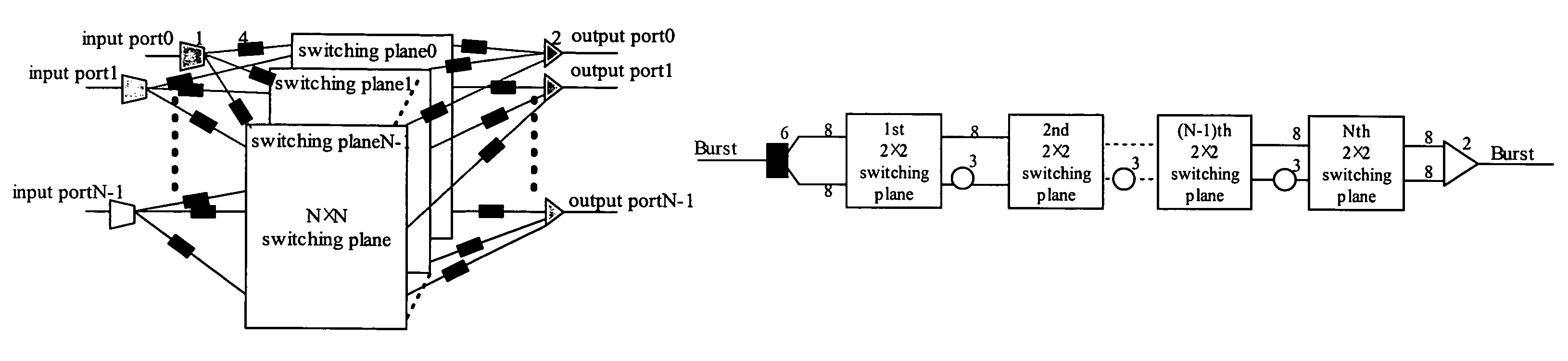
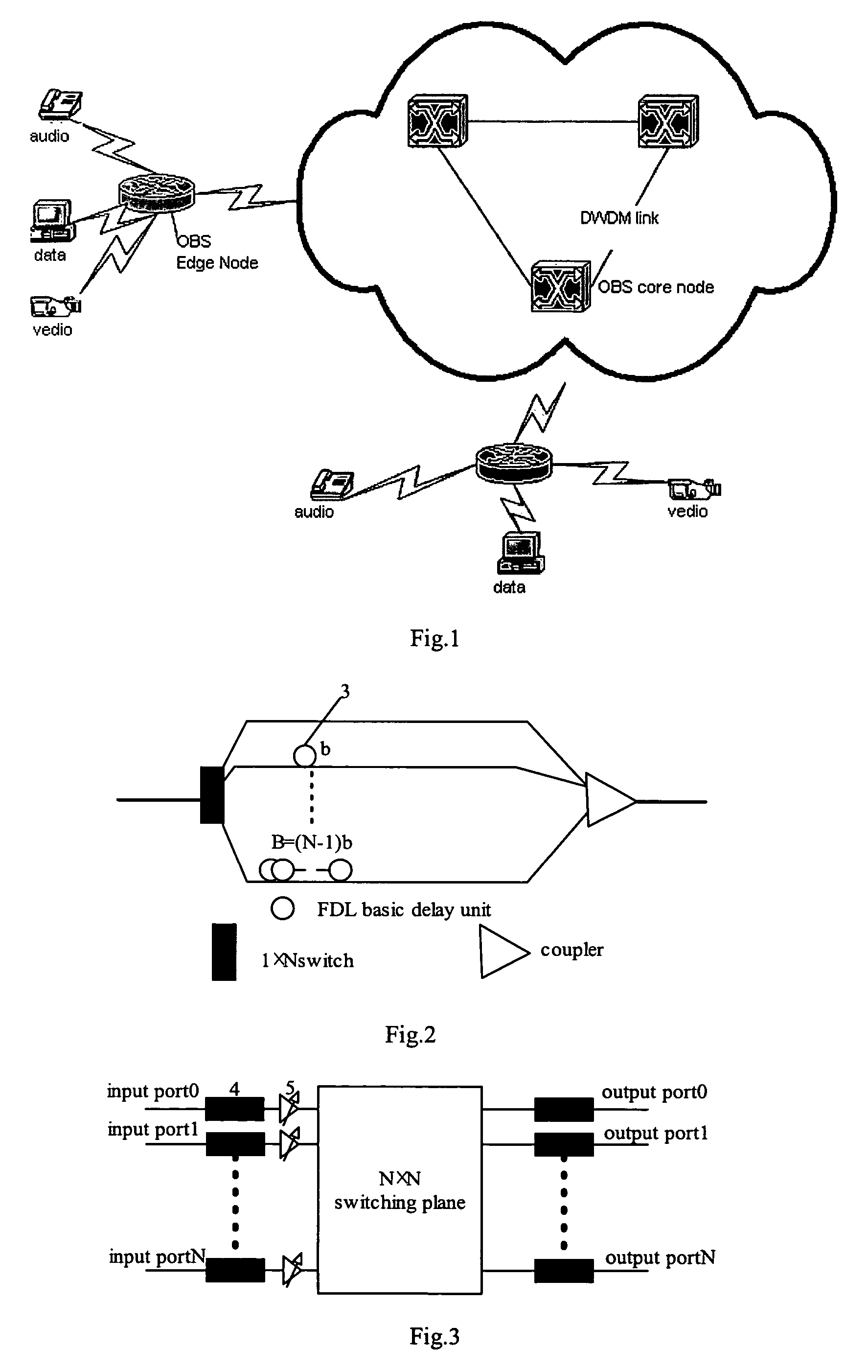
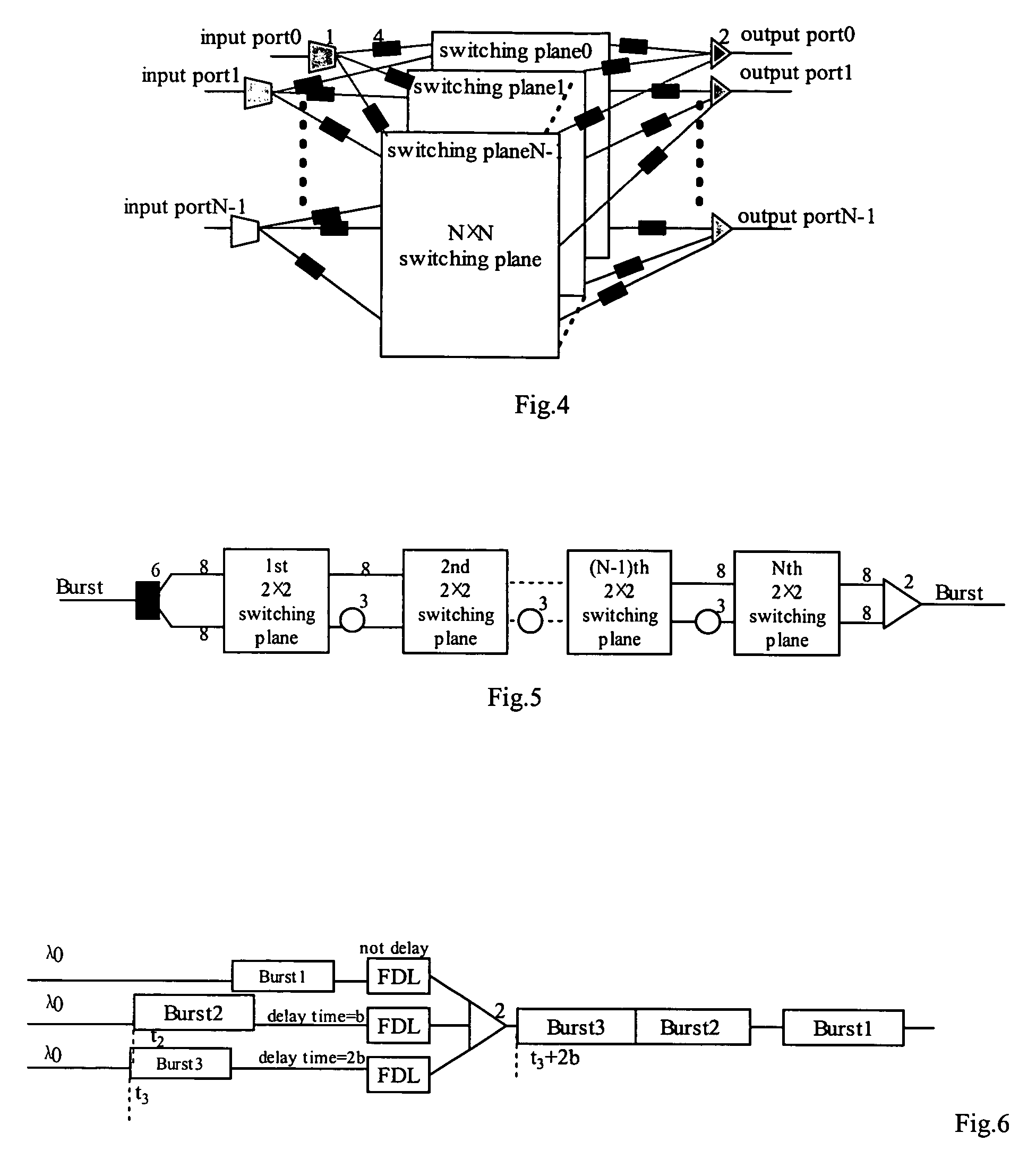
- A multi-plane OBS node architecture is introduced, featuring multiple switching planes and fiber delay lines (FDLs) that increase internal bandwidth, allowing for simultaneous switching and buffering of bursts, thereby eliminating the need for expensive TWC and improving buffering efficiency through a dynamic buffering policy.

Network Infrastructure Standards and Regulations
The regulatory landscape governing optical burst switching (OBS) and packet switching technologies encompasses multiple layers of standards and compliance requirements that significantly impact their deployment and performance characteristics. International Telecommunication Union (ITU-T) recommendations, particularly the G-series standards for optical transport networks, establish fundamental parameters for optical switching architectures. These standards define wavelength allocation, signal quality metrics, and interoperability requirements that directly influence throughput capabilities in both OBS and traditional packet switching implementations.
IEEE 802.3 Ethernet standards continue to evolve to accommodate higher data rates and improved switching mechanisms, with recent amendments addressing 400 Gigabit Ethernet and beyond. These specifications establish frame formats, timing requirements, and quality of service parameters that affect packet switching throughput analysis. The standards also define buffer management protocols and congestion control mechanisms that become critical when comparing switching paradigms.
Regional telecommunications authorities impose additional regulatory constraints that impact network infrastructure design choices. The Federal Communications Commission in the United States, European Telecommunications Standards Institute in Europe, and similar bodies worldwide establish spectrum allocation policies, equipment certification requirements, and network reliability standards. These regulations often favor proven packet switching technologies over emerging OBS implementations due to established testing procedures and certification pathways.
Network neutrality regulations and data protection requirements introduce additional complexity layers affecting switching technology selection. Quality of service guarantees mandated by regulatory frameworks may favor packet switching's mature traffic management capabilities over OBS's burst-oriented approach, despite potential throughput advantages.
Compliance with safety standards such as IEC 60825 for laser safety becomes particularly relevant for OBS implementations, as higher optical power levels required for burst transmission may necessitate additional protective measures. These requirements can impact system design costs and deployment timelines, influencing the practical throughput advantages that OBS technologies might otherwise provide in real-world network implementations.
IEEE 802.3 Ethernet standards continue to evolve to accommodate higher data rates and improved switching mechanisms, with recent amendments addressing 400 Gigabit Ethernet and beyond. These specifications establish frame formats, timing requirements, and quality of service parameters that affect packet switching throughput analysis. The standards also define buffer management protocols and congestion control mechanisms that become critical when comparing switching paradigms.
Regional telecommunications authorities impose additional regulatory constraints that impact network infrastructure design choices. The Federal Communications Commission in the United States, European Telecommunications Standards Institute in Europe, and similar bodies worldwide establish spectrum allocation policies, equipment certification requirements, and network reliability standards. These regulations often favor proven packet switching technologies over emerging OBS implementations due to established testing procedures and certification pathways.
Network neutrality regulations and data protection requirements introduce additional complexity layers affecting switching technology selection. Quality of service guarantees mandated by regulatory frameworks may favor packet switching's mature traffic management capabilities over OBS's burst-oriented approach, despite potential throughput advantages.
Compliance with safety standards such as IEC 60825 for laser safety becomes particularly relevant for OBS implementations, as higher optical power levels required for burst transmission may necessitate additional protective measures. These requirements can impact system design costs and deployment timelines, influencing the practical throughput advantages that OBS technologies might otherwise provide in real-world network implementations.
Performance Benchmarking Methodologies
Establishing robust performance benchmarking methodologies is critical for conducting meaningful throughput analysis between Optical Burst Switching and Packet Switching technologies. The complexity of these networking paradigms requires standardized measurement frameworks that can accurately capture performance differentials across varying operational conditions.
Network simulation environments form the foundation of comprehensive benchmarking approaches. Tools such as NS-3, OPNET, and OMNeT++ provide controlled testing environments where OBS and packet switching protocols can be evaluated under identical conditions. These platforms enable researchers to implement realistic network topologies, traffic patterns, and failure scenarios while maintaining precise control over experimental variables. Custom simulation modules specifically designed for burst assembly algorithms and optical switching mechanisms ensure accurate representation of OBS characteristics.
Hardware testbed methodologies complement simulation-based approaches by providing real-world validation of theoretical performance models. Dedicated optical switching testbeds incorporating wavelength division multiplexing equipment, optical cross-connects, and high-speed packet processing units enable direct measurement of switching latencies, buffer utilization, and throughput characteristics. These physical implementations reveal performance aspects that may not be captured in simulation environments, particularly regarding optical component limitations and electronic processing bottlenecks.
Standardized traffic generation protocols ensure consistent benchmarking across different research initiatives. Synthetic traffic models based on Poisson distributions, self-similar processes, and real network traces provide diverse testing scenarios. Burst assembly parameters, including timeout thresholds and burst size distributions, must be systematically varied to evaluate OBS performance across different operational regimes. Similarly, packet switching benchmarks should incorporate various queue management algorithms and forwarding mechanisms.
Metric collection frameworks require precise definition of throughput measurement methodologies. End-to-end throughput calculations must account for protocol overhead, retransmission penalties, and buffering delays inherent in each switching paradigm. Statistical analysis techniques, including confidence interval calculations and variance analysis, ensure reliable performance comparisons. Standardized reporting formats facilitate cross-study comparisons and meta-analysis of benchmarking results across different research groups.
Network simulation environments form the foundation of comprehensive benchmarking approaches. Tools such as NS-3, OPNET, and OMNeT++ provide controlled testing environments where OBS and packet switching protocols can be evaluated under identical conditions. These platforms enable researchers to implement realistic network topologies, traffic patterns, and failure scenarios while maintaining precise control over experimental variables. Custom simulation modules specifically designed for burst assembly algorithms and optical switching mechanisms ensure accurate representation of OBS characteristics.
Hardware testbed methodologies complement simulation-based approaches by providing real-world validation of theoretical performance models. Dedicated optical switching testbeds incorporating wavelength division multiplexing equipment, optical cross-connects, and high-speed packet processing units enable direct measurement of switching latencies, buffer utilization, and throughput characteristics. These physical implementations reveal performance aspects that may not be captured in simulation environments, particularly regarding optical component limitations and electronic processing bottlenecks.
Standardized traffic generation protocols ensure consistent benchmarking across different research initiatives. Synthetic traffic models based on Poisson distributions, self-similar processes, and real network traces provide diverse testing scenarios. Burst assembly parameters, including timeout thresholds and burst size distributions, must be systematically varied to evaluate OBS performance across different operational regimes. Similarly, packet switching benchmarks should incorporate various queue management algorithms and forwarding mechanisms.
Metric collection frameworks require precise definition of throughput measurement methodologies. End-to-end throughput calculations must account for protocol overhead, retransmission penalties, and buffering delays inherent in each switching paradigm. Statistical analysis techniques, including confidence interval calculations and variance analysis, ensure reliable performance comparisons. Standardized reporting formats facilitate cross-study comparisons and meta-analysis of benchmarking results across different research groups.
Unlock deeper insights with Patsnap Eureka Quick Research — get a full tech report to explore trends and direct your research. Try now!
Generate Your Research Report Instantly with AI Agent
Supercharge your innovation with Patsnap Eureka AI Agent Platform!