Optimize Beam Coverage in Laser Cladding for Maximal Output
APR 8, 20269 MIN READ
Generate Your Research Report Instantly with AI Agent
Patsnap Eureka helps you evaluate technical feasibility & market potential.
Laser Cladding Beam Coverage Background and Objectives
Laser cladding technology has emerged as a critical additive manufacturing and surface modification process, enabling the deposition of metallic materials onto substrates to create functional coatings, repair components, or build three-dimensional structures. The process utilizes a focused laser beam to simultaneously melt powder feedstock and a thin layer of the substrate surface, creating a metallurgical bond between the deposited material and the base component. Since its commercial introduction in the 1980s, laser cladding has evolved from a niche repair technology to a versatile manufacturing solution across aerospace, automotive, energy, and tooling industries.
The evolution of laser cladding has been marked by significant technological milestones, including the development of high-power fiber lasers, advanced powder delivery systems, and sophisticated beam shaping technologies. Early systems relied on CO2 lasers with relatively simple Gaussian beam profiles, which often resulted in non-uniform energy distribution and inconsistent clad quality. The transition to fiber lasers and the introduction of beam shaping optics have enabled more precise control over energy distribution, leading to improved process stability and enhanced metallurgical properties.
Current market demands are driving the need for higher productivity, improved material utilization efficiency, and enhanced process reliability in laser cladding applications. Industries are increasingly seeking solutions that can achieve maximum deposition rates while maintaining superior clad quality, minimal heat-affected zones, and reduced post-processing requirements. The optimization of beam coverage represents a fundamental challenge in meeting these demanding requirements.
The primary objective of optimizing beam coverage in laser cladding centers on maximizing output productivity while ensuring consistent quality across the entire clad geometry. This involves achieving uniform energy distribution across the interaction zone, minimizing overlap inconsistencies in multi-track operations, and reducing the formation of defects such as porosity, lack of fusion, and geometric irregularities. Enhanced beam coverage optimization directly correlates with improved powder capture efficiency, reduced material waste, and increased deposition rates.
Strategic goals include developing adaptive beam shaping technologies that can dynamically adjust energy distribution based on real-time process feedback, implementing advanced scanning strategies that optimize track spacing and overlap parameters, and establishing predictive models that correlate beam coverage patterns with final clad properties. These objectives aim to transform laser cladding from a predominantly empirical process to a data-driven, highly controllable manufacturing technology capable of meeting the stringent requirements of next-generation industrial applications.
The evolution of laser cladding has been marked by significant technological milestones, including the development of high-power fiber lasers, advanced powder delivery systems, and sophisticated beam shaping technologies. Early systems relied on CO2 lasers with relatively simple Gaussian beam profiles, which often resulted in non-uniform energy distribution and inconsistent clad quality. The transition to fiber lasers and the introduction of beam shaping optics have enabled more precise control over energy distribution, leading to improved process stability and enhanced metallurgical properties.
Current market demands are driving the need for higher productivity, improved material utilization efficiency, and enhanced process reliability in laser cladding applications. Industries are increasingly seeking solutions that can achieve maximum deposition rates while maintaining superior clad quality, minimal heat-affected zones, and reduced post-processing requirements. The optimization of beam coverage represents a fundamental challenge in meeting these demanding requirements.
The primary objective of optimizing beam coverage in laser cladding centers on maximizing output productivity while ensuring consistent quality across the entire clad geometry. This involves achieving uniform energy distribution across the interaction zone, minimizing overlap inconsistencies in multi-track operations, and reducing the formation of defects such as porosity, lack of fusion, and geometric irregularities. Enhanced beam coverage optimization directly correlates with improved powder capture efficiency, reduced material waste, and increased deposition rates.
Strategic goals include developing adaptive beam shaping technologies that can dynamically adjust energy distribution based on real-time process feedback, implementing advanced scanning strategies that optimize track spacing and overlap parameters, and establishing predictive models that correlate beam coverage patterns with final clad properties. These objectives aim to transform laser cladding from a predominantly empirical process to a data-driven, highly controllable manufacturing technology capable of meeting the stringent requirements of next-generation industrial applications.
Market Demand for Enhanced Laser Cladding Applications
The global laser cladding market has experienced substantial growth driven by increasing demands for surface enhancement technologies across multiple industrial sectors. Manufacturing industries are actively seeking advanced solutions to extend component lifecycles, reduce maintenance costs, and improve operational efficiency. The aerospace sector represents a particularly significant demand driver, where components must withstand extreme operating conditions while maintaining precise dimensional tolerances and surface properties.
Automotive manufacturers are increasingly adopting laser cladding technologies to enhance engine components, transmission parts, and tooling applications. The need for lightweight yet durable components has intensified interest in surface modification techniques that can provide superior wear resistance without adding substantial weight. This trend aligns with industry-wide efforts to improve fuel efficiency and reduce emissions through advanced materials engineering.
The oil and gas industry presents substantial market opportunities for enhanced laser cladding applications, particularly for downhole equipment and pipeline components exposed to corrosive environments. Offshore drilling operations require components with exceptional corrosion resistance and mechanical properties, driving demand for precision surface treatment technologies that can deliver consistent, high-quality results across large surface areas.
Power generation facilities, including both traditional and renewable energy sectors, require components capable of withstanding high-temperature, high-stress operating conditions. Turbine blades, generator components, and heat exchanger surfaces benefit significantly from optimized laser cladding processes that can provide uniform coverage and enhanced material properties.
The medical device industry has emerged as a growing market segment, where biocompatible surface treatments are essential for implants and surgical instruments. Precision beam coverage optimization enables manufacturers to achieve consistent surface properties while maintaining strict quality standards required for medical applications.
Mining and heavy machinery sectors continue to drive demand for wear-resistant surface treatments on cutting tools, excavation equipment, and processing machinery. The economic benefits of extending component service life through advanced cladding techniques have made these technologies increasingly attractive to equipment manufacturers and operators seeking to reduce total cost of ownership.
Automotive manufacturers are increasingly adopting laser cladding technologies to enhance engine components, transmission parts, and tooling applications. The need for lightweight yet durable components has intensified interest in surface modification techniques that can provide superior wear resistance without adding substantial weight. This trend aligns with industry-wide efforts to improve fuel efficiency and reduce emissions through advanced materials engineering.
The oil and gas industry presents substantial market opportunities for enhanced laser cladding applications, particularly for downhole equipment and pipeline components exposed to corrosive environments. Offshore drilling operations require components with exceptional corrosion resistance and mechanical properties, driving demand for precision surface treatment technologies that can deliver consistent, high-quality results across large surface areas.
Power generation facilities, including both traditional and renewable energy sectors, require components capable of withstanding high-temperature, high-stress operating conditions. Turbine blades, generator components, and heat exchanger surfaces benefit significantly from optimized laser cladding processes that can provide uniform coverage and enhanced material properties.
The medical device industry has emerged as a growing market segment, where biocompatible surface treatments are essential for implants and surgical instruments. Precision beam coverage optimization enables manufacturers to achieve consistent surface properties while maintaining strict quality standards required for medical applications.
Mining and heavy machinery sectors continue to drive demand for wear-resistant surface treatments on cutting tools, excavation equipment, and processing machinery. The economic benefits of extending component service life through advanced cladding techniques have made these technologies increasingly attractive to equipment manufacturers and operators seeking to reduce total cost of ownership.
Current Beam Coverage Limitations and Technical Challenges
Laser cladding processes face significant beam coverage limitations that directly impact material deposition efficiency and coating quality. Traditional single-beam systems typically achieve coverage areas ranging from 0.5 to 5 millimeters in width, creating substantial constraints for large-scale surface treatment applications. The fundamental limitation stems from the Gaussian intensity distribution of conventional laser beams, which concentrates energy at the center while gradually diminishing toward the edges, resulting in non-uniform heating patterns and inconsistent material fusion.
Beam divergence represents another critical challenge, particularly in applications requiring extended working distances. As the laser beam travels from the focusing optics to the substrate surface, natural divergence causes the beam diameter to expand, reducing power density and compromising the precision of the cladding process. This phenomenon becomes increasingly problematic when processing complex geometries or when maintaining consistent standoff distances proves difficult.
Thermal management issues arise from inadequate beam coverage patterns, leading to excessive heat accumulation in localized areas. Insufficient heat distribution creates temperature gradients that promote residual stress formation, cracking, and distortion in both the substrate and clad layer. These thermal inconsistencies also contribute to microstructural variations, affecting the mechanical properties and performance characteristics of the final coating.
Multi-pass processing requirements emerge as a direct consequence of limited beam coverage, necessitating overlapping tracks to achieve complete surface coverage. This approach introduces additional challenges including inter-pass reheating effects, dilution variations between overlapping zones, and increased processing time. The overlap regions often exhibit different metallurgical characteristics compared to single-pass areas, creating potential weak points in the coating structure.
Powder delivery synchronization becomes increasingly complex with limited beam coverage, as maintaining consistent powder flow distribution across varying beam geometries proves challenging. Conventional powder delivery systems struggle to match the beam's intensity profile, resulting in powder utilization inefficiencies and inconsistent clad layer thickness. This mismatch between powder distribution and beam coverage directly impacts material waste and process economics.
Process parameter optimization faces constraints due to the interdependence between beam coverage and other critical variables such as scanning speed, powder feed rate, and laser power. The limited coverage area restricts the available parameter window, forcing compromises between processing speed and quality outcomes that ultimately limit overall system productivity and output maximization potential.
Beam divergence represents another critical challenge, particularly in applications requiring extended working distances. As the laser beam travels from the focusing optics to the substrate surface, natural divergence causes the beam diameter to expand, reducing power density and compromising the precision of the cladding process. This phenomenon becomes increasingly problematic when processing complex geometries or when maintaining consistent standoff distances proves difficult.
Thermal management issues arise from inadequate beam coverage patterns, leading to excessive heat accumulation in localized areas. Insufficient heat distribution creates temperature gradients that promote residual stress formation, cracking, and distortion in both the substrate and clad layer. These thermal inconsistencies also contribute to microstructural variations, affecting the mechanical properties and performance characteristics of the final coating.
Multi-pass processing requirements emerge as a direct consequence of limited beam coverage, necessitating overlapping tracks to achieve complete surface coverage. This approach introduces additional challenges including inter-pass reheating effects, dilution variations between overlapping zones, and increased processing time. The overlap regions often exhibit different metallurgical characteristics compared to single-pass areas, creating potential weak points in the coating structure.
Powder delivery synchronization becomes increasingly complex with limited beam coverage, as maintaining consistent powder flow distribution across varying beam geometries proves challenging. Conventional powder delivery systems struggle to match the beam's intensity profile, resulting in powder utilization inefficiencies and inconsistent clad layer thickness. This mismatch between powder distribution and beam coverage directly impacts material waste and process economics.
Process parameter optimization faces constraints due to the interdependence between beam coverage and other critical variables such as scanning speed, powder feed rate, and laser power. The limited coverage area restricts the available parameter window, forcing compromises between processing speed and quality outcomes that ultimately limit overall system productivity and output maximization potential.
Existing Beam Coverage Optimization Solutions
01 Beam shaping and focusing techniques for laser cladding
Various optical systems and methods are employed to shape and focus the laser beam in cladding processes to achieve optimal coverage. These techniques include the use of specific lens configurations, beam expanders, and focusing optics to control beam diameter, intensity distribution, and focal point position. Advanced beam shaping ensures uniform energy distribution across the cladding area, improving coating quality and reducing defects.- Beam shaping and focusing techniques for laser cladding: Various optical systems and methods are employed to shape and focus the laser beam in cladding processes to achieve optimal coverage. These techniques include the use of specialized lenses, mirrors, and beam delivery systems that control beam diameter, intensity distribution, and focal point positioning. Advanced beam shaping ensures uniform energy distribution across the cladding area, improving coating quality and reducing defects. Precise control of beam geometry enables better material deposition and surface coverage.
- Multi-beam and scanning strategies for enhanced coverage: Implementation of multiple laser beams or sophisticated scanning patterns to improve cladding coverage and efficiency. These approaches involve coordinating multiple laser sources or using programmable scanning systems to cover larger areas or complex geometries. Scanning strategies include raster patterns, spiral patterns, and adaptive path planning that optimize overlap and minimize gaps. Such methods enable faster processing times while maintaining uniform coating thickness and quality across the substrate surface.
- Powder delivery and material feed optimization: Systems and methods for controlling powder flow and distribution in relation to the laser beam to ensure complete coverage during cladding. These include coaxial nozzle designs, lateral powder injection systems, and controlled feeding mechanisms that synchronize material delivery with beam movement. Optimization of powder stream geometry, flow rate, and particle distribution relative to the beam ensures efficient material utilization and uniform deposition. Advanced monitoring systems track powder-beam interaction to maintain consistent coverage quality.
- Process monitoring and adaptive control systems: Real-time monitoring technologies and feedback control systems that adjust laser parameters to maintain optimal beam coverage during cladding operations. These systems utilize sensors, cameras, and analytical tools to detect variations in coverage, temperature, or deposition quality. Adaptive algorithms automatically modify beam power, speed, or focus based on monitored conditions to compensate for substrate irregularities or process variations. Integration of machine learning and artificial intelligence enables predictive adjustments for consistent coverage across complex workpieces.
- Beam overlap and track spacing optimization: Techniques for determining and controlling the overlap between adjacent laser cladding tracks to achieve complete surface coverage without excessive material buildup. These methods involve calculating optimal track spacing based on beam diameter, material properties, and desired coating thickness. Precise control of overlap percentage prevents gaps between tracks while minimizing waste and post-processing requirements. Advanced planning algorithms account for substrate geometry and thermal effects to maintain consistent overlap throughout the cladding process.
02 Multi-beam and scanning strategies for enhanced coverage
Multiple laser beams or scanning patterns are utilized to improve coverage efficiency in laser cladding operations. These approaches involve coordinated movement of multiple laser sources or systematic scanning paths that ensure complete surface coverage. The strategies include overlapping beam patterns, spiral scanning, and raster scanning methods that optimize the cladding process for complex geometries and large surface areas.Expand Specific Solutions03 Powder delivery and beam interaction optimization
The interaction between powder feed systems and laser beam coverage is critical for achieving uniform cladding layers. Methods focus on synchronizing powder delivery with beam movement, controlling powder stream geometry, and optimizing the convergence point of powder and laser beam. These techniques ensure efficient material utilization and consistent layer thickness across the cladding area.Expand Specific Solutions04 Real-time monitoring and adaptive beam control
Advanced monitoring systems and feedback mechanisms are integrated to dynamically adjust beam parameters during the cladding process. These systems utilize sensors to detect surface conditions, temperature distribution, and coating quality, enabling real-time adjustments to beam power, position, and coverage patterns. Adaptive control ensures consistent results across varying substrate conditions and geometries.Expand Specific Solutions05 Beam coverage for complex geometries and three-dimensional surfaces
Specialized techniques address the challenges of achieving uniform beam coverage on non-planar and complex three-dimensional surfaces. These methods include multi-axis positioning systems, robotic manipulation, and path planning algorithms that account for surface curvature and accessibility. The approaches ensure complete coverage while maintaining consistent standoff distance and beam angle relative to the substrate surface.Expand Specific Solutions
Key Players in Laser Cladding Equipment Industry
The laser cladding industry for beam coverage optimization is in a mature development stage, driven by increasing demand for precision manufacturing and component repair across automotive, aerospace, and heavy machinery sectors. The market demonstrates significant growth potential, particularly in remanufacturing applications where companies like Caterpillar, Toyota, and Nissan leverage laser cladding for equipment restoration. Technology maturity varies considerably among key players: established laser manufacturers like IPG Photonics, Coherent, and TRUMPF offer advanced beam control systems, while specialized firms such as Titanova and Xi'An Bisheng focus on application-specific solutions. Research institutions including Huazhong University of Science & Technology and Penn State Research Foundation contribute fundamental advances in beam optimization algorithms. The competitive landscape shows consolidation among equipment manufacturers, with emerging Chinese companies like Changzhou Tianzheng challenging established Western players through cost-effective innovations in beam delivery systems.
Caterpillar, Inc.
Technical Solution: Caterpillar has implemented laser cladding technologies primarily for component repair and surface enhancement applications in heavy machinery manufacturing. Their approach focuses on optimizing beam coverage for large-scale industrial components, utilizing multi-pass cladding strategies with controlled overlap patterns to ensure uniform coating thickness. The company has developed specialized fixturing and beam positioning systems that enable consistent coverage across complex geometries typical in construction and mining equipment. Their laser cladding processes incorporate automated beam path planning software that optimizes coverage efficiency while minimizing heat input and distortion in large structural components.
Strengths: Extensive experience with large-scale industrial applications and robust process control systems. Weaknesses: Limited focus on advanced beam shaping technologies compared to specialized laser equipment manufacturers.
TRUMPF Laser- und Systemtechnik GmbH
Technical Solution: TRUMPF has developed advanced beam shaping technologies for laser cladding applications, including multi-beam systems and adaptive optics solutions. Their TruLaser Cell series incorporates sophisticated beam delivery systems with real-time monitoring capabilities to optimize coverage patterns. The company's coaxial powder feeding systems are integrated with precise beam control mechanisms that can adjust power distribution across the cladding area. Their proprietary beam oscillation technology enables uniform material deposition by creating controlled beam movement patterns, significantly improving surface quality and reducing heat-affected zones in laser cladding processes.
Strengths: Industry-leading beam control precision and comprehensive system integration capabilities. Weaknesses: High equipment costs and complex setup requirements for optimal performance.
Core Patents in Laser Beam Shaping and Control Systems
Puddle forming and shaping with primary and secondary lasers
PatentActiveUS20130105447A1
Innovation
- A dual-laser system is employed, where a primary line source laser melts the deposit material and a secondary laser with lower power shapes the molten puddle, allowing for independent control of the weld puddle's shape and position, reducing overlap distance and improving deposition efficiency.
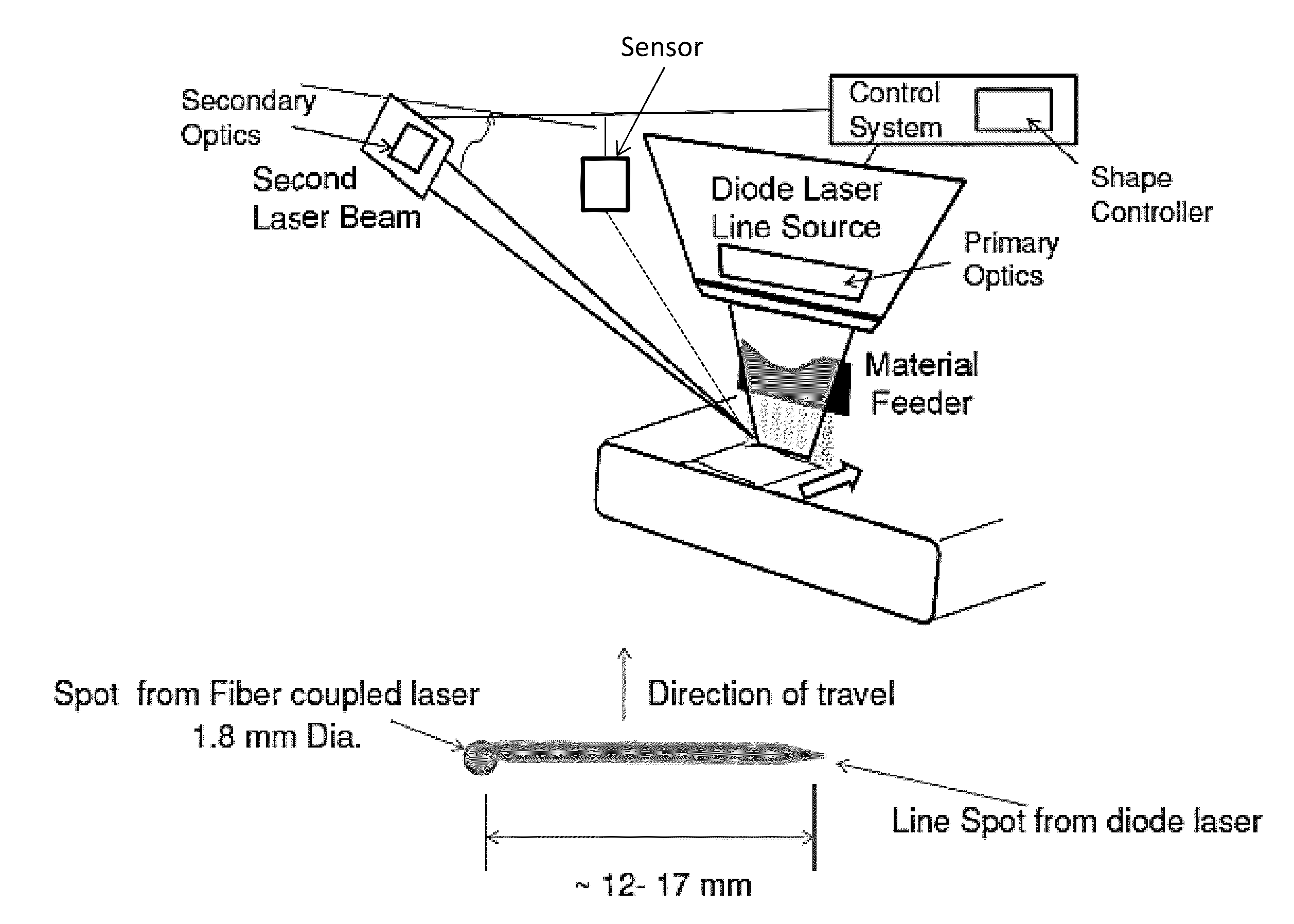
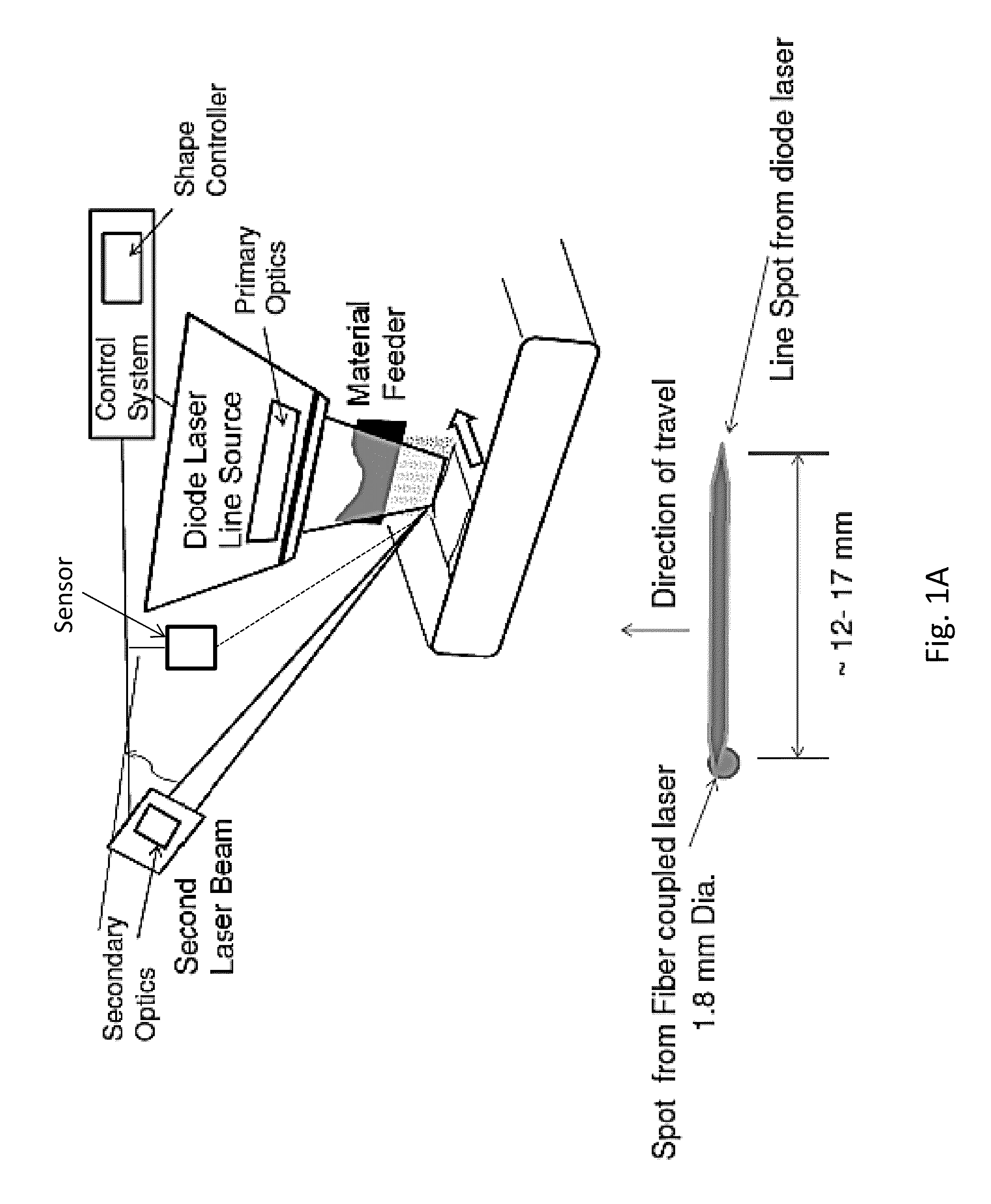
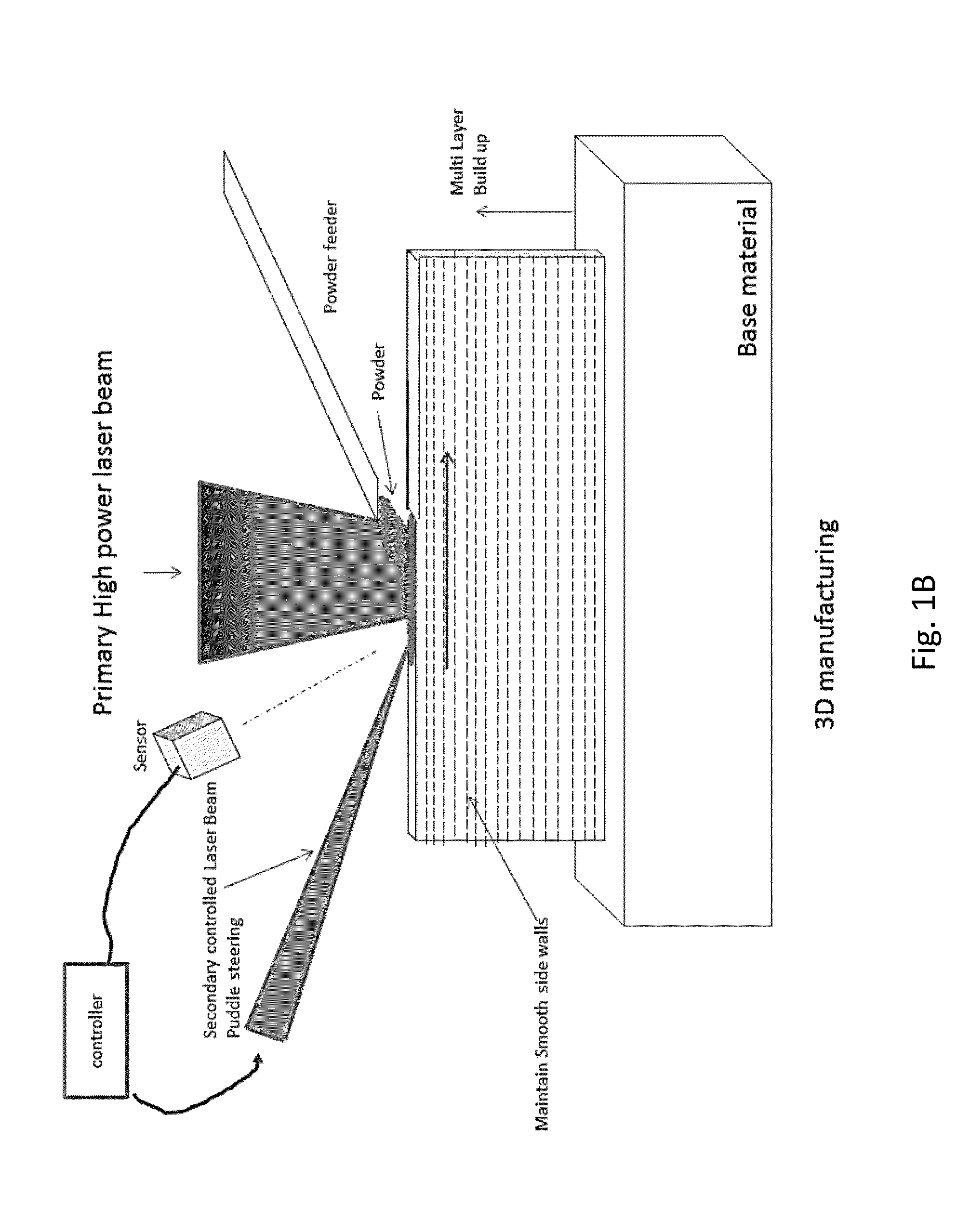

Laser system for laser cladding with a powder jet having hard-material particles
PatentWO2023209249A1
Innovation
- A laser system with a wavelength between 0.4 μm and 1.5 μm, using a disk, fiber, or diode laser, and a jet nozzle that aligns the laser beam orthogonally to the workpiece with a powder jet containing hard material particles, such as carbides, to create a reduced intensity core region, allowing for more uniform energy distribution and increased processing speed while preventing alloy formation and reducing internal stresses.


Safety Standards for Industrial Laser Processing
Industrial laser processing operations, particularly laser cladding for beam coverage optimization, must adhere to comprehensive safety frameworks established by international and national regulatory bodies. The primary standards governing laser safety include IEC 60825 series for laser product safety, ANSI Z136 series in North America, and ISO 11553 specifically addressing laser processing of materials. These standards establish fundamental requirements for laser classification, hazard assessment, and protective measures essential for industrial applications.
Laser cladding systems typically operate with Class 4 lasers, presenting significant risks including direct beam exposure, diffuse reflections, and fire hazards. The beam coverage optimization process involves high-power laser manipulation across varying surface geometries, creating dynamic hazard zones that require specialized safety protocols. Operators must implement engineering controls such as enclosed processing chambers, interlocked safety systems, and beam path containment to prevent accidental exposure during coverage pattern adjustments.
Personal protective equipment requirements for laser cladding operations include wavelength-specific laser safety eyewear with appropriate optical density ratings, flame-resistant clothing, and respiratory protection against metal fumes generated during the process. The optimization of beam coverage patterns necessitates frequent system adjustments, making proper training and certification of personnel critical for maintaining safety standards while achieving maximal output efficiency.
Environmental safety considerations encompass ventilation system design to manage airborne contaminants, proper disposal of cladding materials, and electromagnetic compatibility requirements. Beam coverage optimization often requires extended operational periods, making continuous monitoring systems essential for detecting potential safety breaches or equipment malfunctions that could compromise both worker safety and process integrity.
Emergency response procedures must address laser-specific incidents including eye injuries, fire suppression in metal processing environments, and system shutdown protocols. Regular safety audits and compliance verification ensure that beam coverage optimization activities maintain adherence to evolving safety standards while maximizing operational efficiency and output quality in industrial laser cladding applications.
Laser cladding systems typically operate with Class 4 lasers, presenting significant risks including direct beam exposure, diffuse reflections, and fire hazards. The beam coverage optimization process involves high-power laser manipulation across varying surface geometries, creating dynamic hazard zones that require specialized safety protocols. Operators must implement engineering controls such as enclosed processing chambers, interlocked safety systems, and beam path containment to prevent accidental exposure during coverage pattern adjustments.
Personal protective equipment requirements for laser cladding operations include wavelength-specific laser safety eyewear with appropriate optical density ratings, flame-resistant clothing, and respiratory protection against metal fumes generated during the process. The optimization of beam coverage patterns necessitates frequent system adjustments, making proper training and certification of personnel critical for maintaining safety standards while achieving maximal output efficiency.
Environmental safety considerations encompass ventilation system design to manage airborne contaminants, proper disposal of cladding materials, and electromagnetic compatibility requirements. Beam coverage optimization often requires extended operational periods, making continuous monitoring systems essential for detecting potential safety breaches or equipment malfunctions that could compromise both worker safety and process integrity.
Emergency response procedures must address laser-specific incidents including eye injuries, fire suppression in metal processing environments, and system shutdown protocols. Regular safety audits and compliance verification ensure that beam coverage optimization activities maintain adherence to evolving safety standards while maximizing operational efficiency and output quality in industrial laser cladding applications.
Energy Efficiency Considerations in Laser Cladding
Energy efficiency represents a critical performance metric in laser cladding operations, directly impacting both operational costs and environmental sustainability. The optimization of beam coverage for maximal output necessitates careful consideration of energy utilization patterns, as inefficient energy distribution can result in significant power waste and reduced process economics. Modern laser cladding systems typically operate with energy conversion efficiencies ranging from 15% to 40%, depending on laser type, beam delivery configuration, and process parameters.
The relationship between beam coverage optimization and energy consumption follows complex thermodynamic principles. Wider beam coverage generally requires higher total laser power to maintain adequate energy density across the entire coverage area. However, optimized beam shaping techniques can achieve superior energy distribution efficiency compared to conventional Gaussian beam profiles. Advanced beam shaping technologies, including diffractive optical elements and adaptive optics systems, enable more uniform energy distribution while reducing peak power requirements by up to 25%.
Pulse modulation strategies significantly influence energy efficiency in laser cladding applications. Continuous wave operation often results in excessive heat accumulation and energy waste through conduction losses. Pulsed laser systems with optimized duty cycles can achieve equivalent metallurgical results while reducing overall energy consumption by 20-30%. The temporal control of energy delivery allows for better heat management and reduced thermal losses to the substrate.
Beam scanning patterns directly affect energy utilization efficiency during cladding operations. Traditional raster scanning approaches often involve significant energy waste during beam transitions and overlapping regions. Advanced scanning strategies, such as spiral patterns and adaptive path planning, can minimize energy losses while maintaining uniform coverage. These optimized scanning techniques typically demonstrate 15-20% improvement in energy utilization compared to conventional linear scanning methods.
Thermal management considerations play a crucial role in overall energy efficiency. Excessive heat buildup not only wastes energy but also compromises clad quality and dimensional accuracy. Integrated cooling systems and thermal monitoring technologies enable real-time optimization of energy input based on substrate temperature feedback. This closed-loop approach can improve overall process energy efficiency by maintaining optimal thermal conditions throughout the cladding operation.
The selection of appropriate laser wavelength significantly impacts energy absorption efficiency in different substrate materials. Near-infrared wavelengths typically used in fiber lasers demonstrate superior absorption characteristics in metallic substrates compared to CO2 laser wavelengths, resulting in improved energy transfer efficiency and reduced power requirements for equivalent processing results.
The relationship between beam coverage optimization and energy consumption follows complex thermodynamic principles. Wider beam coverage generally requires higher total laser power to maintain adequate energy density across the entire coverage area. However, optimized beam shaping techniques can achieve superior energy distribution efficiency compared to conventional Gaussian beam profiles. Advanced beam shaping technologies, including diffractive optical elements and adaptive optics systems, enable more uniform energy distribution while reducing peak power requirements by up to 25%.
Pulse modulation strategies significantly influence energy efficiency in laser cladding applications. Continuous wave operation often results in excessive heat accumulation and energy waste through conduction losses. Pulsed laser systems with optimized duty cycles can achieve equivalent metallurgical results while reducing overall energy consumption by 20-30%. The temporal control of energy delivery allows for better heat management and reduced thermal losses to the substrate.
Beam scanning patterns directly affect energy utilization efficiency during cladding operations. Traditional raster scanning approaches often involve significant energy waste during beam transitions and overlapping regions. Advanced scanning strategies, such as spiral patterns and adaptive path planning, can minimize energy losses while maintaining uniform coverage. These optimized scanning techniques typically demonstrate 15-20% improvement in energy utilization compared to conventional linear scanning methods.
Thermal management considerations play a crucial role in overall energy efficiency. Excessive heat buildup not only wastes energy but also compromises clad quality and dimensional accuracy. Integrated cooling systems and thermal monitoring technologies enable real-time optimization of energy input based on substrate temperature feedback. This closed-loop approach can improve overall process energy efficiency by maintaining optimal thermal conditions throughout the cladding operation.
The selection of appropriate laser wavelength significantly impacts energy absorption efficiency in different substrate materials. Near-infrared wavelengths typically used in fiber lasers demonstrate superior absorption characteristics in metallic substrates compared to CO2 laser wavelengths, resulting in improved energy transfer efficiency and reduced power requirements for equivalent processing results.
Unlock deeper insights with Patsnap Eureka Quick Research — get a full tech report to explore trends and direct your research. Try now!
Generate Your Research Report Instantly with AI Agent
Supercharge your innovation with Patsnap Eureka AI Agent Platform!