
Optimize Hydrogen Storage Pressure Levels
MAR 27, 20269 MIN READ
Generate Your Research Report Instantly with AI Agent
Patsnap Eureka helps you evaluate technical feasibility & market potential.
Hydrogen Storage Technology Background and Pressure Optimization Goals
Hydrogen storage technology has emerged as a critical enabler for the global transition toward clean energy systems, with pressure optimization representing one of the most significant technical and economic challenges in the field. The development of efficient hydrogen storage solutions spans over a century, beginning with early industrial applications in the 1900s and evolving through successive generations of pressure vessel technology, materials science advances, and safety protocol refinements.
The historical trajectory of hydrogen storage has been marked by continuous efforts to balance storage density, safety requirements, and economic viability. Early storage systems operated at relatively low pressures due to material limitations, but the growing demand for higher energy density storage has driven the industry toward increasingly sophisticated high-pressure solutions. This evolution has been particularly accelerated by the automotive sector's adoption of fuel cell vehicles and the renewable energy sector's need for large-scale energy storage systems.
Current pressure optimization goals center on achieving maximum volumetric and gravimetric storage efficiency while maintaining stringent safety standards and cost-effectiveness. The industry has established several pressure benchmarks, with 350 bar and 700 bar systems representing the current mainstream standards for different applications. However, emerging research suggests that optimal pressure levels may vary significantly based on specific use cases, storage duration, and system integration requirements.
The primary technical objectives driving pressure optimization include minimizing compression energy requirements, reducing storage system weight and volume, extending operational lifespan, and enhancing safety margins. These goals must be balanced against material constraints, manufacturing costs, and infrastructure compatibility requirements. Advanced composite materials, innovative vessel designs, and smart pressure management systems represent key technological pathways toward achieving these optimization targets.
Future pressure optimization strategies are increasingly focused on adaptive and intelligent storage systems that can dynamically adjust operating parameters based on real-time conditions and usage patterns. This approach promises to unlock significant efficiency gains while addressing the diverse requirements of different hydrogen applications, from portable devices to industrial-scale storage facilities.
The historical trajectory of hydrogen storage has been marked by continuous efforts to balance storage density, safety requirements, and economic viability. Early storage systems operated at relatively low pressures due to material limitations, but the growing demand for higher energy density storage has driven the industry toward increasingly sophisticated high-pressure solutions. This evolution has been particularly accelerated by the automotive sector's adoption of fuel cell vehicles and the renewable energy sector's need for large-scale energy storage systems.
Current pressure optimization goals center on achieving maximum volumetric and gravimetric storage efficiency while maintaining stringent safety standards and cost-effectiveness. The industry has established several pressure benchmarks, with 350 bar and 700 bar systems representing the current mainstream standards for different applications. However, emerging research suggests that optimal pressure levels may vary significantly based on specific use cases, storage duration, and system integration requirements.
The primary technical objectives driving pressure optimization include minimizing compression energy requirements, reducing storage system weight and volume, extending operational lifespan, and enhancing safety margins. These goals must be balanced against material constraints, manufacturing costs, and infrastructure compatibility requirements. Advanced composite materials, innovative vessel designs, and smart pressure management systems represent key technological pathways toward achieving these optimization targets.
Future pressure optimization strategies are increasingly focused on adaptive and intelligent storage systems that can dynamically adjust operating parameters based on real-time conditions and usage patterns. This approach promises to unlock significant efficiency gains while addressing the diverse requirements of different hydrogen applications, from portable devices to industrial-scale storage facilities.
Market Demand Analysis for Optimized Hydrogen Storage Systems
The global hydrogen economy is experiencing unprecedented growth momentum, driven by urgent decarbonization imperatives across multiple industrial sectors. Transportation, energy storage, and industrial applications are creating substantial demand for efficient hydrogen storage solutions. The automotive sector, particularly fuel cell electric vehicles, represents a critical market segment where optimized pressure levels directly impact vehicle range, refueling time, and overall system economics.
Industrial hydrogen consumption continues expanding rapidly, with steel production, ammonia synthesis, and petroleum refining driving consistent demand growth. These applications require reliable, cost-effective storage systems capable of maintaining optimal pressure levels across varying operational conditions. The emerging power-to-gas sector further amplifies market requirements, as renewable energy integration necessitates large-scale hydrogen storage capabilities.
Current market dynamics reveal significant pressure optimization challenges affecting system adoption rates. Existing storage solutions often operate at suboptimal pressure levels, resulting in reduced energy density, increased infrastructure costs, and compromised safety margins. These inefficiencies create substantial market opportunities for advanced pressure optimization technologies.
Regional market analysis indicates varying demand patterns influenced by regulatory frameworks and industrial infrastructure development. European markets emphasize safety and efficiency standards, while Asian markets prioritize cost-effectiveness and scalability. North American markets focus on integration with existing natural gas infrastructure and transportation applications.
The commercial viability of hydrogen storage systems depends critically on achieving optimal pressure levels that balance energy density, safety requirements, and economic considerations. Market research indicates that pressure optimization improvements could reduce total system costs while enhancing performance metrics across diverse application scenarios.
Emerging applications in grid-scale energy storage and maritime transportation are creating new market segments with specific pressure optimization requirements. These sectors demand innovative solutions capable of maintaining stable pressure levels across extended operational periods while minimizing energy losses and maintenance requirements.
Market forecasts suggest accelerating adoption rates for optimized hydrogen storage systems, contingent upon technological advances in pressure management and regulatory support for hydrogen infrastructure development.
Industrial hydrogen consumption continues expanding rapidly, with steel production, ammonia synthesis, and petroleum refining driving consistent demand growth. These applications require reliable, cost-effective storage systems capable of maintaining optimal pressure levels across varying operational conditions. The emerging power-to-gas sector further amplifies market requirements, as renewable energy integration necessitates large-scale hydrogen storage capabilities.
Current market dynamics reveal significant pressure optimization challenges affecting system adoption rates. Existing storage solutions often operate at suboptimal pressure levels, resulting in reduced energy density, increased infrastructure costs, and compromised safety margins. These inefficiencies create substantial market opportunities for advanced pressure optimization technologies.
Regional market analysis indicates varying demand patterns influenced by regulatory frameworks and industrial infrastructure development. European markets emphasize safety and efficiency standards, while Asian markets prioritize cost-effectiveness and scalability. North American markets focus on integration with existing natural gas infrastructure and transportation applications.
The commercial viability of hydrogen storage systems depends critically on achieving optimal pressure levels that balance energy density, safety requirements, and economic considerations. Market research indicates that pressure optimization improvements could reduce total system costs while enhancing performance metrics across diverse application scenarios.
Emerging applications in grid-scale energy storage and maritime transportation are creating new market segments with specific pressure optimization requirements. These sectors demand innovative solutions capable of maintaining stable pressure levels across extended operational periods while minimizing energy losses and maintenance requirements.
Market forecasts suggest accelerating adoption rates for optimized hydrogen storage systems, contingent upon technological advances in pressure management and regulatory support for hydrogen infrastructure development.
Current Status and Challenges in Hydrogen Storage Pressure Management
The global hydrogen storage industry currently operates under a complex framework of pressure management systems, with compressed hydrogen storage dominating commercial applications. Most industrial implementations utilize high-pressure storage ranging from 350 to 700 bar, with emerging research pushing toward 1000 bar systems. However, significant disparities exist between different geographical regions in terms of technological advancement and regulatory frameworks.
Current pressure optimization technologies primarily rely on multi-stage compression systems and advanced composite materials for storage vessels. Leading nations including Japan, Germany, and South Korea have established comprehensive hydrogen infrastructure networks, while emerging markets struggle with standardization and safety protocols. The technological landscape reveals a concentration of advanced capabilities in developed economies, creating substantial gaps in global implementation consistency.
The primary technical challenges in hydrogen storage pressure management center around material limitations and energy efficiency concerns. Current carbon fiber reinforced polymer vessels face degradation issues under cyclic loading conditions, limiting their operational lifespan to approximately 15,000 cycles. Additionally, the compression energy requirements consume 10-15% of the stored hydrogen's energy content, significantly impacting overall system efficiency.
Safety considerations present another critical challenge, as high-pressure hydrogen systems require sophisticated monitoring and control mechanisms. Current leak detection technologies struggle with hydrogen's small molecular size and high diffusion rates, necessitating advanced sensor networks and real-time monitoring systems. The lack of standardized safety protocols across different applications further complicates widespread adoption.
Economic barriers significantly constrain optimal pressure level implementation. The capital costs for high-pressure storage systems increase exponentially with pressure ratings, while the marginal storage density improvements diminish at higher pressures. Current cost structures favor 350 bar systems for most applications, despite the superior volumetric efficiency of 700 bar alternatives.
Regulatory frameworks remain fragmented across different jurisdictions, creating compliance challenges for multinational hydrogen projects. Existing standards often lag behind technological capabilities, limiting innovation in pressure optimization strategies. The absence of harmonized international standards particularly affects mobile applications and cross-border hydrogen transportation systems.
Emerging research focuses on novel storage approaches including metal hydrides and liquid organic hydrogen carriers, which operate at significantly lower pressures but face their own technical limitations. These alternative technologies present potential solutions to current pressure management challenges while introducing new complexity in system integration and operational requirements.
Current pressure optimization technologies primarily rely on multi-stage compression systems and advanced composite materials for storage vessels. Leading nations including Japan, Germany, and South Korea have established comprehensive hydrogen infrastructure networks, while emerging markets struggle with standardization and safety protocols. The technological landscape reveals a concentration of advanced capabilities in developed economies, creating substantial gaps in global implementation consistency.
The primary technical challenges in hydrogen storage pressure management center around material limitations and energy efficiency concerns. Current carbon fiber reinforced polymer vessels face degradation issues under cyclic loading conditions, limiting their operational lifespan to approximately 15,000 cycles. Additionally, the compression energy requirements consume 10-15% of the stored hydrogen's energy content, significantly impacting overall system efficiency.
Safety considerations present another critical challenge, as high-pressure hydrogen systems require sophisticated monitoring and control mechanisms. Current leak detection technologies struggle with hydrogen's small molecular size and high diffusion rates, necessitating advanced sensor networks and real-time monitoring systems. The lack of standardized safety protocols across different applications further complicates widespread adoption.
Economic barriers significantly constrain optimal pressure level implementation. The capital costs for high-pressure storage systems increase exponentially with pressure ratings, while the marginal storage density improvements diminish at higher pressures. Current cost structures favor 350 bar systems for most applications, despite the superior volumetric efficiency of 700 bar alternatives.
Regulatory frameworks remain fragmented across different jurisdictions, creating compliance challenges for multinational hydrogen projects. Existing standards often lag behind technological capabilities, limiting innovation in pressure optimization strategies. The absence of harmonized international standards particularly affects mobile applications and cross-border hydrogen transportation systems.
Emerging research focuses on novel storage approaches including metal hydrides and liquid organic hydrogen carriers, which operate at significantly lower pressures but face their own technical limitations. These alternative technologies present potential solutions to current pressure management challenges while introducing new complexity in system integration and operational requirements.
Current Pressure Optimization Solutions for Hydrogen Storage
01 High-pressure hydrogen storage systems
High-pressure hydrogen storage systems typically operate at pressures ranging from 35 MPa to 70 MPa or higher. These systems utilize specialized pressure vessels and tanks designed to withstand extreme pressures while maintaining safety standards. The storage containers are constructed with advanced composite materials or high-strength steel to ensure structural integrity. Pressure regulation mechanisms and safety valves are integrated to control and monitor the storage pressure levels effectively.- High-pressure hydrogen storage systems: High-pressure hydrogen storage systems typically operate at pressures ranging from 35 MPa to 70 MPa or higher. These systems utilize specialized pressure vessels and tanks designed to withstand extreme pressures while maintaining safety standards. The storage containers are engineered with advanced materials and composite structures to ensure structural integrity and prevent hydrogen leakage under high-pressure conditions.
- Medium-pressure hydrogen storage solutions: Medium-pressure hydrogen storage systems operate in the range of 10 MPa to 35 MPa, providing a balance between storage capacity and safety requirements. These systems are commonly used in industrial applications and refueling stations. The pressure vessels are designed with appropriate wall thickness and safety mechanisms to handle the moderate pressure levels while ensuring efficient hydrogen storage and distribution.
- Low-pressure hydrogen storage technologies: Low-pressure hydrogen storage systems operate at pressures below 10 MPa and are often used in stationary applications or as buffer storage. These systems may incorporate metal hydride storage or other alternative storage methods that operate at lower pressures. The design focuses on cost-effectiveness and ease of operation while maintaining adequate storage capacity for specific applications.
- Pressure regulation and monitoring systems: Pressure regulation and monitoring systems are critical components in hydrogen storage infrastructure. These systems include pressure sensors, regulators, and control valves that maintain optimal pressure levels throughout the storage and distribution process. Advanced monitoring technologies enable real-time pressure tracking and automatic adjustment to ensure safe operation and prevent over-pressurization or under-pressurization conditions.
- Multi-stage pressure storage configurations: Multi-stage pressure storage configurations utilize cascading pressure levels to optimize hydrogen storage and dispensing efficiency. These systems typically incorporate multiple storage vessels operating at different pressure levels, allowing for staged compression and more efficient refueling processes. The configuration enables better energy management and reduces the overall compression work required during hydrogen transfer operations.
02 Medium-pressure hydrogen storage solutions
Medium-pressure hydrogen storage systems operate at intermediate pressure levels, typically between 10 MPa and 35 MPa. These systems balance storage capacity with safety requirements and are commonly used in industrial applications and refueling stations. The design incorporates pressure monitoring systems and control valves to maintain optimal pressure ranges. Material selection focuses on durability and resistance to hydrogen embrittlement while ensuring cost-effectiveness.Expand Specific Solutions03 Low-pressure hydrogen storage technologies
Low-pressure hydrogen storage systems operate at pressures below 10 MPa and are designed for applications requiring safer handling conditions. These systems often utilize larger volume containers to compensate for lower pressure storage. The technology includes pressure regulation devices and monitoring equipment to maintain stable pressure levels. Applications include stationary storage facilities and backup power systems where space is less constrained.Expand Specific Solutions04 Pressure vessel design and construction
Pressure vessel design for hydrogen storage involves specialized engineering considerations including material selection, wall thickness calculations, and structural reinforcement. The vessels incorporate multiple layers of composite materials or specialized alloys to withstand cyclic pressure loading. Design features include pressure relief systems, burst disks, and monitoring sensors. Manufacturing processes ensure compliance with international safety standards and regulations for high-pressure gas containment.Expand Specific Solutions05 Pressure monitoring and control systems
Pressure monitoring and control systems are essential components for maintaining safe hydrogen storage operations. These systems include pressure sensors, gauges, and automated control valves that continuously monitor and adjust pressure levels. Advanced systems incorporate digital monitoring with real-time data transmission and alarm functions. The control mechanisms ensure pressure remains within specified ranges and can automatically respond to pressure fluctuations or emergency conditions.Expand Specific Solutions
Major Players in Hydrogen Storage and Pressure Vessel Industry
The hydrogen storage pressure optimization sector represents a rapidly evolving market driven by the global transition to clean energy and hydrogen economy development. The industry is currently in an accelerated growth phase, with market expansion fueled by increasing investments in hydrogen infrastructure and fuel cell technologies. Major automotive manufacturers like Toyota Motor Corp., Hyundai Motor Co., BMW, and Kia Corp. are leading technological advancement through their hydrogen fuel cell vehicle programs, demonstrating high technology maturity in automotive applications. Industrial gas specialists such as Air Products & Chemicals and specialized hydrogen technology companies like GRZ Technologies and Intelligent Energy Inc are driving innovation in storage solutions. Chinese state enterprises including China National Petroleum Corp. and Sinopec are heavily investing in hydrogen infrastructure development, while emerging players like Nikola Corp. focus on commercial vehicle applications, indicating a competitive landscape with diverse technological approaches and varying maturity levels across different application segments.
Toyota Motor Corp.
Technical Solution: Toyota has developed a comprehensive hydrogen storage system utilizing high-pressure composite tanks operating at 700 bar (70 MPa) for their fuel cell vehicles like the Mirai. Their approach focuses on Type IV carbon fiber reinforced plastic (CFRP) tanks that provide optimal weight-to-storage capacity ratios. The company has implemented advanced pressure regulation systems with multiple safety valves and sensors to monitor tank integrity continuously. Toyota's hydrogen storage optimization includes thermal management systems to handle temperature variations during filling and operation, ensuring consistent pressure levels and maximizing storage efficiency while maintaining safety standards.
Strengths: Proven commercial deployment in mass-produced vehicles, extensive safety testing and validation, lightweight CFRP tank technology. Weaknesses: High manufacturing costs, limited refueling infrastructure compatibility, complex pressure management systems.
Hyundai Motor Co., Ltd.
Technical Solution: Hyundai has developed advanced hydrogen storage solutions featuring 700 bar pressure systems with enhanced safety protocols and improved storage density. Their NEXO fuel cell vehicle incorporates three hydrogen tanks with a total capacity of 156.6 liters, utilizing carbon fiber composite construction for weight reduction. The company focuses on optimizing pressure levels through advanced filling algorithms that account for ambient temperature and pre-cooling requirements. Hyundai's system includes sophisticated pressure relief devices and leak detection systems, with real-time monitoring of tank conditions to ensure optimal performance and safety throughout the vehicle's operational life.
Strengths: Integrated vehicle-level optimization, robust safety systems, competitive storage capacity. Weaknesses: High system complexity, expensive carbon fiber materials, dependency on specialized refueling infrastructure.
Core Technologies in Advanced Hydrogen Pressure Management
High volume, fast hydrogen fueling of a heavy-duty vehicle
PatentWO2020103993A1
Innovation
- A method that controls the mass flow of hydrogen from a high-pressure storage to a vehicle tank using a controller to divide the fueling into two periods, with a high initial mass flow rate to rapidly fill the tank and a lower rate to maintain pressure, allowing for efficient transfer of large volumes of hydrogen within 15 minutes.


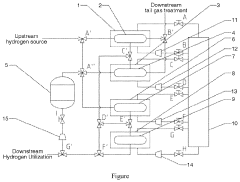
Integrated system and method for hydrogen purification, storage and pressurization
PatentActiveUS20230416086A1
Innovation
- An integrated system and method for hydrogen purification, storage, and pressurization using a multi-stage metal hydride reactor system with adjustable heat and cold sources, circulation pumps, and gas pumps, allowing for reversible hydrogen absorption and desorption reactions based on pressure-composition-temperature characteristics to achieve high-purity hydrogen at various pressure levels.
Safety Standards and Regulations for High-Pressure Hydrogen Storage
The regulatory landscape for high-pressure hydrogen storage is governed by a complex framework of international, national, and industry-specific standards designed to ensure safe operation across diverse applications. The International Organization for Standardization (ISO) provides foundational guidelines through ISO 19881 for gaseous hydrogen land vehicle fuel containers, while the Society of Automotive Engineers (SAE) establishes complementary standards for automotive applications. These frameworks establish maximum allowable working pressures, typically ranging from 350 bar to 700 bar for mobile applications, with industrial stationary storage systems operating at even higher pressures.
Pressure vessel certification requirements mandate rigorous testing protocols including burst tests, fatigue cycling, and environmental exposure assessments. The American Society of Mechanical Engineers (ASME) Boiler and Pressure Vessel Code Section VIII provides comprehensive guidelines for pressure vessel design and fabrication, requiring vessels to withstand pressures significantly exceeding normal operating conditions. European regulations under the Pressure Equipment Directive (PED) establish similar requirements with additional emphasis on conformity assessment procedures.
Material specifications for high-pressure hydrogen storage systems must address hydrogen embrittlement concerns, particularly for steel-based containers. Standards specify approved materials and manufacturing processes to prevent degradation under cyclic loading conditions. Composite overwrapped pressure vessels (COPVs) are subject to additional requirements covering fiber orientation, resin systems, and liner compatibility with hydrogen gas.
Installation and operational safety standards encompass ventilation requirements, leak detection systems, and emergency shutdown procedures. The National Fire Protection Association (NFPA) 2 Hydrogen Technologies Code establishes minimum safety distances, ventilation rates, and detection system specifications for hydrogen storage facilities. Regular inspection intervals and recertification requirements ensure continued compliance throughout the storage system lifecycle.
Emerging regulations address next-generation storage technologies including underground storage and advanced composite systems. Regulatory bodies are developing frameworks for higher pressure applications exceeding current 700 bar limits, with proposed standards for 875 bar systems currently under review. These evolving standards will significantly impact optimization strategies for future hydrogen storage pressure levels.
Pressure vessel certification requirements mandate rigorous testing protocols including burst tests, fatigue cycling, and environmental exposure assessments. The American Society of Mechanical Engineers (ASME) Boiler and Pressure Vessel Code Section VIII provides comprehensive guidelines for pressure vessel design and fabrication, requiring vessels to withstand pressures significantly exceeding normal operating conditions. European regulations under the Pressure Equipment Directive (PED) establish similar requirements with additional emphasis on conformity assessment procedures.
Material specifications for high-pressure hydrogen storage systems must address hydrogen embrittlement concerns, particularly for steel-based containers. Standards specify approved materials and manufacturing processes to prevent degradation under cyclic loading conditions. Composite overwrapped pressure vessels (COPVs) are subject to additional requirements covering fiber orientation, resin systems, and liner compatibility with hydrogen gas.
Installation and operational safety standards encompass ventilation requirements, leak detection systems, and emergency shutdown procedures. The National Fire Protection Association (NFPA) 2 Hydrogen Technologies Code establishes minimum safety distances, ventilation rates, and detection system specifications for hydrogen storage facilities. Regular inspection intervals and recertification requirements ensure continued compliance throughout the storage system lifecycle.
Emerging regulations address next-generation storage technologies including underground storage and advanced composite systems. Regulatory bodies are developing frameworks for higher pressure applications exceeding current 700 bar limits, with proposed standards for 875 bar systems currently under review. These evolving standards will significantly impact optimization strategies for future hydrogen storage pressure levels.
Environmental Impact Assessment of Hydrogen Storage Systems
The environmental implications of hydrogen storage systems operating at optimized pressure levels present a complex landscape of benefits and challenges that require comprehensive assessment. High-pressure hydrogen storage, typically ranging from 350 to 700 bar, offers superior energy density but introduces significant environmental considerations throughout the system lifecycle.
Manufacturing processes for high-pressure storage vessels demand substantial energy inputs and specialized materials, particularly carbon fiber composites and advanced steel alloys. The production of these materials generates considerable carbon emissions, with carbon fiber manufacturing alone contributing approximately 20-30 kg CO2 equivalent per kilogram of material. However, lifecycle assessments demonstrate that these initial environmental costs are typically offset within 2-3 years of operation when replacing conventional fossil fuel systems.
Operational environmental impacts vary significantly with pressure optimization strategies. Systems operating at 700 bar require more robust compression infrastructure, consuming 10-15% of the stored hydrogen's energy content for compression alone. This energy penalty directly translates to increased upstream emissions if the electricity grid relies on fossil fuels. Conversely, optimized pressure management systems that dynamically adjust storage pressures based on demand patterns can reduce compression energy requirements by 20-25%.
End-of-life considerations reveal both opportunities and challenges. High-pressure storage vessels constructed from composite materials present recycling difficulties, as current carbon fiber recycling technologies recover only 60-70% of material value. Steel-based pressure vessels demonstrate superior recyclability but carry higher manufacturing emissions. Advanced pressure optimization technologies incorporating smart materials and sensors complicate disposal processes but enable more efficient system operation.
Leak prevention becomes increasingly critical at optimized pressure levels, as hydrogen's small molecular size facilitates permeation through conventional sealing materials. While hydrogen itself produces only water vapor upon combustion, atmospheric release contributes to indirect climate effects through hydroxyl radical interactions. Modern pressure optimization systems incorporate advanced leak detection and prevention technologies, reducing fugitive emissions by up to 90% compared to conventional fixed-pressure systems.
The integration of renewable energy sources for compression operations significantly improves environmental profiles. Solar and wind-powered compression systems can achieve near-zero operational emissions, making pressure optimization strategies more environmentally favorable. Geographic deployment considerations also influence environmental impact, with systems in regions featuring abundant renewable energy demonstrating substantially lower lifecycle emissions than those dependent on fossil fuel-based electricity grids.
Manufacturing processes for high-pressure storage vessels demand substantial energy inputs and specialized materials, particularly carbon fiber composites and advanced steel alloys. The production of these materials generates considerable carbon emissions, with carbon fiber manufacturing alone contributing approximately 20-30 kg CO2 equivalent per kilogram of material. However, lifecycle assessments demonstrate that these initial environmental costs are typically offset within 2-3 years of operation when replacing conventional fossil fuel systems.
Operational environmental impacts vary significantly with pressure optimization strategies. Systems operating at 700 bar require more robust compression infrastructure, consuming 10-15% of the stored hydrogen's energy content for compression alone. This energy penalty directly translates to increased upstream emissions if the electricity grid relies on fossil fuels. Conversely, optimized pressure management systems that dynamically adjust storage pressures based on demand patterns can reduce compression energy requirements by 20-25%.
End-of-life considerations reveal both opportunities and challenges. High-pressure storage vessels constructed from composite materials present recycling difficulties, as current carbon fiber recycling technologies recover only 60-70% of material value. Steel-based pressure vessels demonstrate superior recyclability but carry higher manufacturing emissions. Advanced pressure optimization technologies incorporating smart materials and sensors complicate disposal processes but enable more efficient system operation.
Leak prevention becomes increasingly critical at optimized pressure levels, as hydrogen's small molecular size facilitates permeation through conventional sealing materials. While hydrogen itself produces only water vapor upon combustion, atmospheric release contributes to indirect climate effects through hydroxyl radical interactions. Modern pressure optimization systems incorporate advanced leak detection and prevention technologies, reducing fugitive emissions by up to 90% compared to conventional fixed-pressure systems.
The integration of renewable energy sources for compression operations significantly improves environmental profiles. Solar and wind-powered compression systems can achieve near-zero operational emissions, making pressure optimization strategies more environmentally favorable. Geographic deployment considerations also influence environmental impact, with systems in regions featuring abundant renewable energy demonstrating substantially lower lifecycle emissions than those dependent on fossil fuel-based electricity grids.
Unlock deeper insights with Patsnap Eureka Quick Research — get a full tech report to explore trends and direct your research. Try now!
Generate Your Research Report Instantly with AI Agent
Supercharge your innovation with Patsnap Eureka AI Agent Platform!