

Optimize Vanadium Battery Response for Backup Power
APR 27, 20269 MIN READ
Generate Your Research Report Instantly with AI Agent
Patsnap Eureka helps you evaluate technical feasibility & market potential.
Vanadium Battery Backup Power Technology Background and Goals
Vanadium redox flow batteries (VRFBs) have emerged as a critical energy storage technology since their initial development in the 1980s by Maria Skyllas-Kazacos at the University of New South Wales. The fundamental principle relies on vanadium ions in different oxidation states stored in separate electrolyte tanks, enabling energy storage through reversible electrochemical reactions. This unique architecture distinguishes VRFBs from conventional batteries by decoupling power and energy capacity, making them particularly suitable for large-scale stationary applications.
The evolution of VRFB technology has been driven by the increasing demand for reliable backup power systems across critical infrastructure sectors. Data centers, hospitals, telecommunications networks, and industrial facilities require uninterrupted power supply with rapid response capabilities during grid outages. Traditional backup solutions like diesel generators suffer from slow startup times, maintenance complexity, and environmental concerns, creating a market opportunity for advanced battery technologies.
Current technological development focuses on addressing key performance limitations that affect backup power applications. Response time optimization represents a primary challenge, as backup systems must transition from standby to full power delivery within milliseconds to seconds. The inherent characteristics of vanadium batteries, including electrolyte circulation requirements and thermal management needs, can introduce delays that compromise backup power effectiveness.
Power density enhancement constitutes another critical development area. While VRFBs excel in energy density and cycle life, their power output per unit volume traditionally lags behind lithium-ion alternatives. For backup power applications requiring high instantaneous power delivery, improving power density directly impacts system footprint and economic viability.
The primary technological objectives center on achieving sub-second response times while maintaining the inherent advantages of vanadium battery technology. This includes developing advanced power management systems that can rapidly modulate electrolyte flow rates, optimize stack temperature conditions, and implement predictive control algorithms. Enhanced electrode materials and membrane technologies aim to reduce internal resistance and improve ion transport efficiency.
Long-term goals encompass creating hybrid system architectures that combine vanadium batteries with complementary technologies for optimal backup power performance. Integration with supercapacitors or high-power lithium modules could address immediate response requirements while leveraging VRFB advantages for sustained power delivery. Additionally, developing intelligent grid integration capabilities will enable seamless transition between normal operation and backup modes, supporting the broader adoption of renewable energy systems requiring robust storage solutions.
The evolution of VRFB technology has been driven by the increasing demand for reliable backup power systems across critical infrastructure sectors. Data centers, hospitals, telecommunications networks, and industrial facilities require uninterrupted power supply with rapid response capabilities during grid outages. Traditional backup solutions like diesel generators suffer from slow startup times, maintenance complexity, and environmental concerns, creating a market opportunity for advanced battery technologies.
Current technological development focuses on addressing key performance limitations that affect backup power applications. Response time optimization represents a primary challenge, as backup systems must transition from standby to full power delivery within milliseconds to seconds. The inherent characteristics of vanadium batteries, including electrolyte circulation requirements and thermal management needs, can introduce delays that compromise backup power effectiveness.
Power density enhancement constitutes another critical development area. While VRFBs excel in energy density and cycle life, their power output per unit volume traditionally lags behind lithium-ion alternatives. For backup power applications requiring high instantaneous power delivery, improving power density directly impacts system footprint and economic viability.
The primary technological objectives center on achieving sub-second response times while maintaining the inherent advantages of vanadium battery technology. This includes developing advanced power management systems that can rapidly modulate electrolyte flow rates, optimize stack temperature conditions, and implement predictive control algorithms. Enhanced electrode materials and membrane technologies aim to reduce internal resistance and improve ion transport efficiency.
Long-term goals encompass creating hybrid system architectures that combine vanadium batteries with complementary technologies for optimal backup power performance. Integration with supercapacitors or high-power lithium modules could address immediate response requirements while leveraging VRFB advantages for sustained power delivery. Additionally, developing intelligent grid integration capabilities will enable seamless transition between normal operation and backup modes, supporting the broader adoption of renewable energy systems requiring robust storage solutions.
Market Demand Analysis for Vanadium Flow Battery Backup Systems
The global energy storage market is experiencing unprecedented growth driven by the increasing deployment of renewable energy sources and the critical need for grid stability. Vanadium flow batteries are emerging as a compelling solution for backup power applications, particularly in scenarios requiring long-duration energy storage and high reliability. The market demand for these systems is being propelled by several key factors that distinguish them from conventional battery technologies.
Industrial and commercial sectors represent the primary demand drivers for vanadium flow battery backup systems. Data centers, telecommunications infrastructure, and critical manufacturing facilities require uninterrupted power supply with extended discharge capabilities. Unlike lithium-ion batteries that experience capacity degradation over time, vanadium flow batteries maintain consistent performance across thousands of charge-discharge cycles, making them economically attractive for applications requiring frequent cycling and long operational lifespans.
The utility sector is increasingly recognizing the value proposition of vanadium flow batteries for grid-scale backup applications. These systems offer unique advantages in providing black-start capabilities and grid stabilization services during power outages. The ability to independently scale power and energy capacity allows utilities to customize solutions based on specific backup duration requirements, ranging from hours to days of continuous operation.
Regulatory frameworks and grid modernization initiatives are creating additional market pull for advanced energy storage solutions. Many regions are implementing mandates for renewable energy integration and grid resilience improvements, driving demand for reliable backup power systems that can support intermittent renewable sources while maintaining grid stability during emergencies.
The market potential is further enhanced by the growing awareness of supply chain security and material availability. Vanadium's recyclability and the closed-loop nature of flow battery systems address concerns about resource scarcity and environmental sustainability that affect other battery chemistries. This factor is particularly relevant for large-scale deployments where long-term material availability and cost predictability are crucial considerations.
Emerging applications in remote and off-grid installations are expanding the addressable market for vanadium flow battery backup systems. Mining operations, remote telecommunications sites, and island communities require robust backup power solutions that can operate reliably in harsh environments with minimal maintenance requirements, creating new market segments for optimized vanadium battery technologies.
Industrial and commercial sectors represent the primary demand drivers for vanadium flow battery backup systems. Data centers, telecommunications infrastructure, and critical manufacturing facilities require uninterrupted power supply with extended discharge capabilities. Unlike lithium-ion batteries that experience capacity degradation over time, vanadium flow batteries maintain consistent performance across thousands of charge-discharge cycles, making them economically attractive for applications requiring frequent cycling and long operational lifespans.
The utility sector is increasingly recognizing the value proposition of vanadium flow batteries for grid-scale backup applications. These systems offer unique advantages in providing black-start capabilities and grid stabilization services during power outages. The ability to independently scale power and energy capacity allows utilities to customize solutions based on specific backup duration requirements, ranging from hours to days of continuous operation.
Regulatory frameworks and grid modernization initiatives are creating additional market pull for advanced energy storage solutions. Many regions are implementing mandates for renewable energy integration and grid resilience improvements, driving demand for reliable backup power systems that can support intermittent renewable sources while maintaining grid stability during emergencies.
The market potential is further enhanced by the growing awareness of supply chain security and material availability. Vanadium's recyclability and the closed-loop nature of flow battery systems address concerns about resource scarcity and environmental sustainability that affect other battery chemistries. This factor is particularly relevant for large-scale deployments where long-term material availability and cost predictability are crucial considerations.
Emerging applications in remote and off-grid installations are expanding the addressable market for vanadium flow battery backup systems. Mining operations, remote telecommunications sites, and island communities require robust backup power solutions that can operate reliably in harsh environments with minimal maintenance requirements, creating new market segments for optimized vanadium battery technologies.
Current Status and Response Optimization Challenges
Vanadium redox flow batteries (VRFBs) have emerged as a promising technology for backup power applications due to their unique characteristics of decoupled energy and power capacity, long cycle life, and deep discharge capability. Currently, commercial VRFB systems demonstrate response times ranging from seconds to minutes, which positions them competitively against traditional backup power solutions such as diesel generators and lead-acid battery systems.
The present technological landscape shows that VRFB systems can achieve power response within 100-500 milliseconds under optimal conditions. However, this performance varies significantly based on system design, electrolyte temperature, state of charge, and stack configuration. Leading manufacturers have developed systems with power densities reaching 20-40 W/L, though this remains lower than lithium-ion alternatives.
Several critical challenges impede the optimization of VRFB response characteristics for backup power deployment. Electrolyte conductivity represents a fundamental limitation, as vanadium solutions exhibit inherently lower ionic conductivity compared to other battery chemistries. This constraint directly impacts the system's ability to deliver rapid power response, particularly during cold-start conditions or low-temperature operations.
Membrane performance constitutes another significant bottleneck in response optimization. Current ion-exchange membranes face trade-offs between selectivity and conductivity, leading to either reduced power output or increased capacity fade over time. The membrane's resistance contributes substantially to overall system impedance, limiting rapid response capabilities essential for backup power applications.
Stack design and flow management present additional optimization challenges. Achieving uniform electrolyte distribution across large electrode areas while maintaining low pressure drops requires sophisticated flow field engineering. Inadequate flow distribution results in localized current density variations, reducing overall system efficiency and response uniformity.
Temperature management emerges as a critical factor affecting response optimization. VRFB performance degrades significantly at low temperatures, with electrolyte viscosity increases and reduced reaction kinetics hampering rapid response. Conversely, elevated temperatures accelerate side reactions and increase maintenance requirements, creating operational constraints for backup power systems.
Control system complexity represents an often-overlooked challenge in response optimization. Coordinating pump speeds, flow rates, and power electronics to achieve optimal response while maintaining system stability requires advanced control algorithms. Current systems often prioritize safety margins over performance optimization, resulting in conservative response characteristics that may not fully exploit the technology's potential for backup power applications.
The present technological landscape shows that VRFB systems can achieve power response within 100-500 milliseconds under optimal conditions. However, this performance varies significantly based on system design, electrolyte temperature, state of charge, and stack configuration. Leading manufacturers have developed systems with power densities reaching 20-40 W/L, though this remains lower than lithium-ion alternatives.
Several critical challenges impede the optimization of VRFB response characteristics for backup power deployment. Electrolyte conductivity represents a fundamental limitation, as vanadium solutions exhibit inherently lower ionic conductivity compared to other battery chemistries. This constraint directly impacts the system's ability to deliver rapid power response, particularly during cold-start conditions or low-temperature operations.
Membrane performance constitutes another significant bottleneck in response optimization. Current ion-exchange membranes face trade-offs between selectivity and conductivity, leading to either reduced power output or increased capacity fade over time. The membrane's resistance contributes substantially to overall system impedance, limiting rapid response capabilities essential for backup power applications.
Stack design and flow management present additional optimization challenges. Achieving uniform electrolyte distribution across large electrode areas while maintaining low pressure drops requires sophisticated flow field engineering. Inadequate flow distribution results in localized current density variations, reducing overall system efficiency and response uniformity.
Temperature management emerges as a critical factor affecting response optimization. VRFB performance degrades significantly at low temperatures, with electrolyte viscosity increases and reduced reaction kinetics hampering rapid response. Conversely, elevated temperatures accelerate side reactions and increase maintenance requirements, creating operational constraints for backup power systems.
Control system complexity represents an often-overlooked challenge in response optimization. Coordinating pump speeds, flow rates, and power electronics to achieve optimal response while maintaining system stability requires advanced control algorithms. Current systems often prioritize safety margins over performance optimization, resulting in conservative response characteristics that may not fully exploit the technology's potential for backup power applications.
Current Response Optimization Solutions for VRFBs
01 Vanadium redox flow battery electrolyte composition and preparation
Development of optimized electrolyte solutions for vanadium redox flow batteries, focusing on the preparation methods and chemical composition of vanadium-based electrolytes. These solutions are designed to enhance the electrochemical performance and stability of the battery system through controlled vanadium ion concentrations and supporting electrolyte formulations.- Vanadium redox flow battery electrolyte composition and preparation: Development of optimized electrolyte solutions for vanadium redox flow batteries, focusing on the preparation methods and composition of vanadium-containing electrolytes. These solutions are critical for the electrochemical reactions that enable energy storage and discharge in vanadium battery systems. The electrolyte composition directly affects the battery's performance, stability, and efficiency.
- Vanadium battery electrode materials and structures: Innovation in electrode design and materials specifically tailored for vanadium battery applications. This includes the development of carbon-based electrodes, modified electrode surfaces, and novel electrode architectures that enhance the electrochemical activity and durability of vanadium batteries. The electrode materials play a crucial role in facilitating efficient charge transfer reactions.
- Vanadium battery system design and configuration: Comprehensive battery system designs that integrate various components including flow systems, pumps, tanks, and control mechanisms. These designs focus on optimizing the overall battery architecture for improved performance, scalability, and operational efficiency. The system configuration affects factors such as energy density, power output, and maintenance requirements.
- Vanadium battery membrane and separator technologies: Development of specialized membranes and separators that prevent crossover of vanadium species while allowing selective ion transport. These components are essential for maintaining the separation between positive and negative electrolytes while enabling proper ionic conductivity. Advanced membrane technologies improve battery efficiency and reduce capacity fade over time.
- Vanadium battery monitoring and control systems: Advanced monitoring and control technologies for vanadium battery operations, including state-of-charge detection, thermal management, and automated control systems. These systems ensure safe and efficient battery operation by monitoring key parameters such as electrolyte flow rates, temperature, and electrochemical conditions. Smart control systems optimize battery performance and extend operational lifetime.
02 Battery management and control systems for vanadium batteries
Advanced control mechanisms and monitoring systems specifically designed for vanadium battery operations. These systems manage charging and discharging cycles, monitor battery health parameters, and optimize performance through intelligent control algorithms and safety protocols.Expand Specific Solutions03 Electrode materials and membrane technologies
Innovation in electrode design and membrane separation technologies for vanadium flow batteries. Focus on developing materials that improve ion selectivity, reduce crossover effects, and enhance the overall efficiency of the electrochemical reactions within the battery system.Expand Specific Solutions04 Battery stack design and flow field optimization
Engineering improvements in the physical structure and flow distribution systems of vanadium battery stacks. These developments aim to optimize electrolyte flow patterns, minimize pressure drops, and improve mass transfer characteristics to enhance overall battery performance and longevity.Expand Specific Solutions05 Energy storage system integration and applications
Implementation strategies for integrating vanadium battery systems into larger energy storage networks and grid applications. Coverage includes system-level design considerations, power conversion interfaces, and application-specific adaptations for various energy storage requirements.Expand Specific Solutions
Major Players in Vanadium Battery and Energy Storage Market
The vanadium battery backup power sector is experiencing rapid growth as the industry transitions from early development to commercial deployment stages. The market demonstrates significant expansion potential, driven by increasing demand for reliable, long-duration energy storage solutions in backup power applications. Technology maturity varies considerably across market participants, with established players like VRB Energy and VFlowTech leading commercial deployment, while companies such as Pure Lithium Corp and Ashlawn Energy are advancing innovative approaches to vanadium-based systems. Traditional industrial giants including Sumitomo Electric Industries, BYD, and Furukawa Battery are leveraging their manufacturing expertise to scale production capabilities. Research institutions like Wuhan University of Science & Technology and Centre National de la Recherche Scientifique continue advancing fundamental vanadium battery technologies, supporting the sector's technical evolution toward optimized backup power performance and cost-effectiveness.
Sumitomo Electric Industries Ltd.
Technical Solution: Sumitomo Electric has developed advanced vanadium redox flow battery systems with focus on rapid response capabilities for backup power applications. Their technology incorporates proprietary carbon felt electrodes with enhanced surface area and conductivity, reducing internal resistance by up to 30% compared to conventional designs. The system features intelligent electrolyte circulation control that can adjust flow rates dynamically based on power demand, enabling response times under 100 milliseconds for backup power activation. Their modular design allows for easy scalability and maintenance, with integrated thermal management systems to optimize performance across varying environmental conditions and ensure reliable backup power delivery.
Strengths: Strong materials science expertise and established manufacturing capabilities, excellent thermal management systems. Weaknesses: Limited global market presence compared to competitors, higher complexity in system integration.
VRB Energy, Inc.
Technical Solution: VRB Energy specializes in vanadium redox flow battery (VRFB) systems optimized for backup power applications. Their technology features advanced electrolyte management systems with real-time monitoring and automated balancing to maintain optimal state of charge. The company's proprietary stack design incorporates enhanced membrane technology and optimized flow field patterns to reduce response time from minutes to seconds. Their backup power solutions include intelligent power management systems that can seamlessly switch between grid and battery power, with scalable energy storage from 250kWh to multi-MWh configurations specifically designed for critical infrastructure and industrial backup applications.
Strengths: Industry-leading VRFB technology with proven track record in large-scale deployments, excellent cycle life exceeding 20,000 cycles. Weaknesses: Higher initial capital costs compared to lithium-ion alternatives, requires larger physical footprint for installation.
Core Technologies for Vanadium Battery Response Enhancement
Vanadium battery SOC balance system structure and control method thereof
PatentPendingUS20230207844A1
Innovation
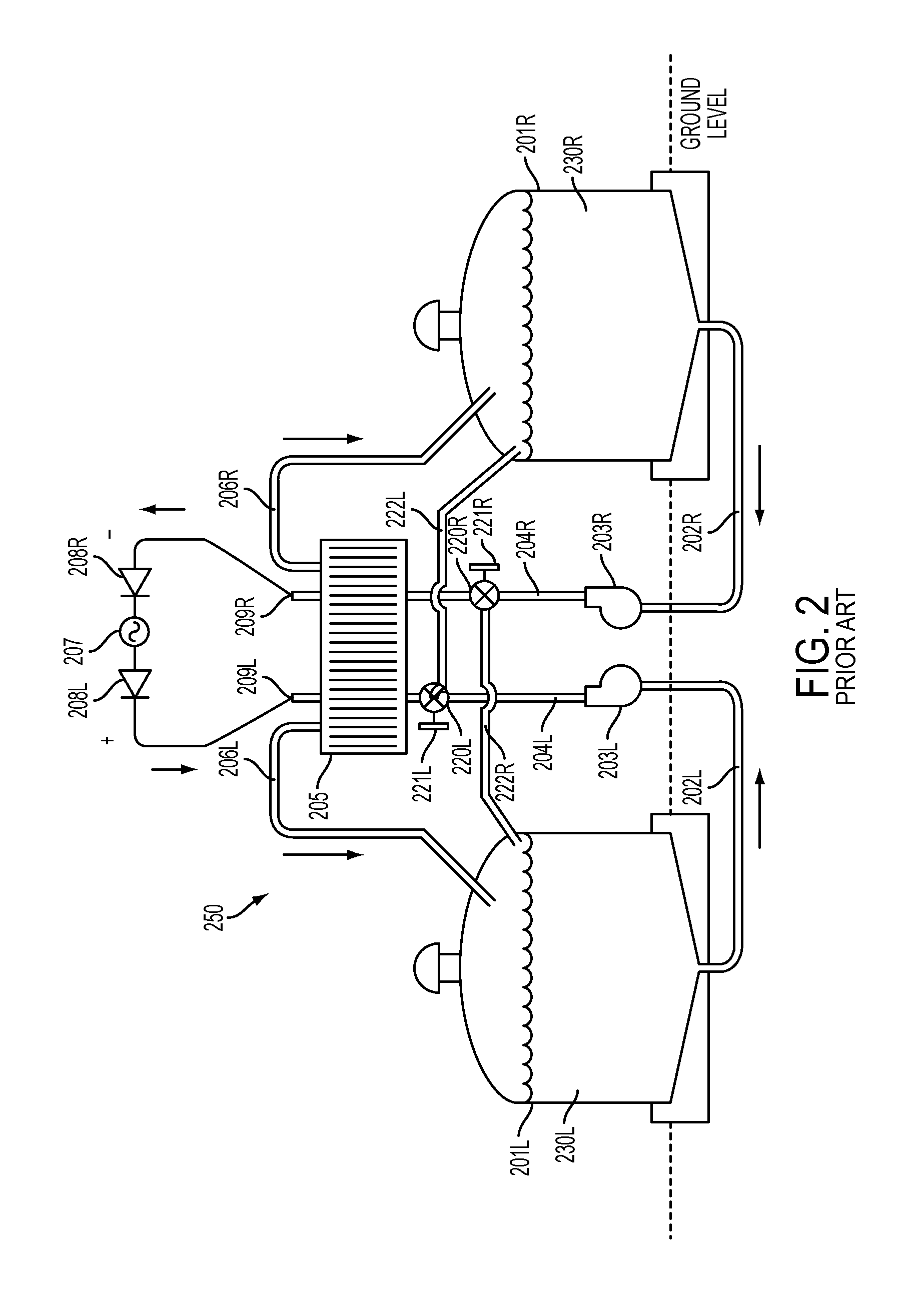
- A vanadium battery SOC balance system structure with an SOC detection module, state detection module, and control module, along with controllable switches in balance pipelines between electrolyte tanks, automatically adjusts charging and discharging to balance SOC values and reduce current flow, using circulating pumps to manage electrolyte flow.


Polarity switching flow battery system and method
PatentInactiveUS20140193673A1
Innovation
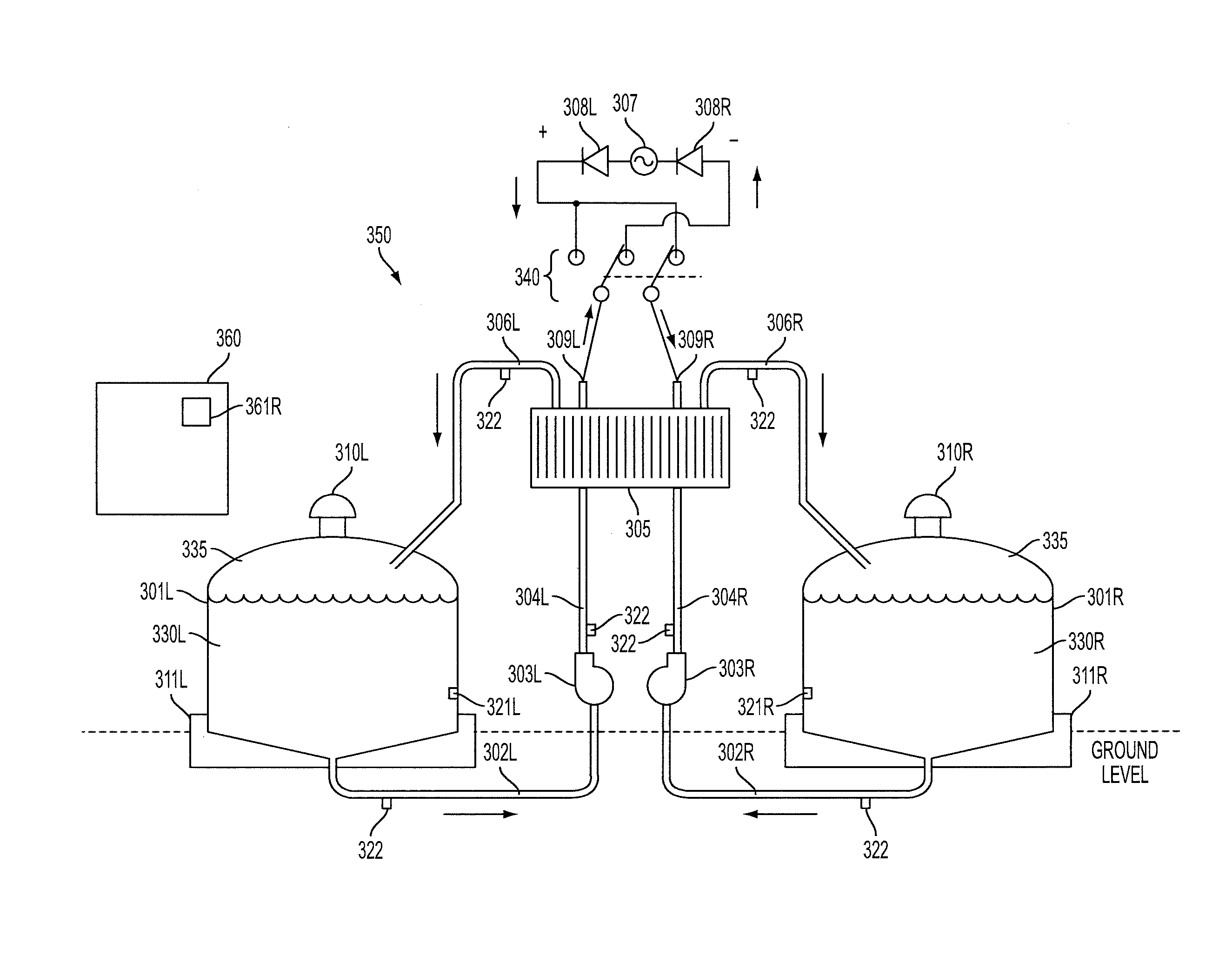
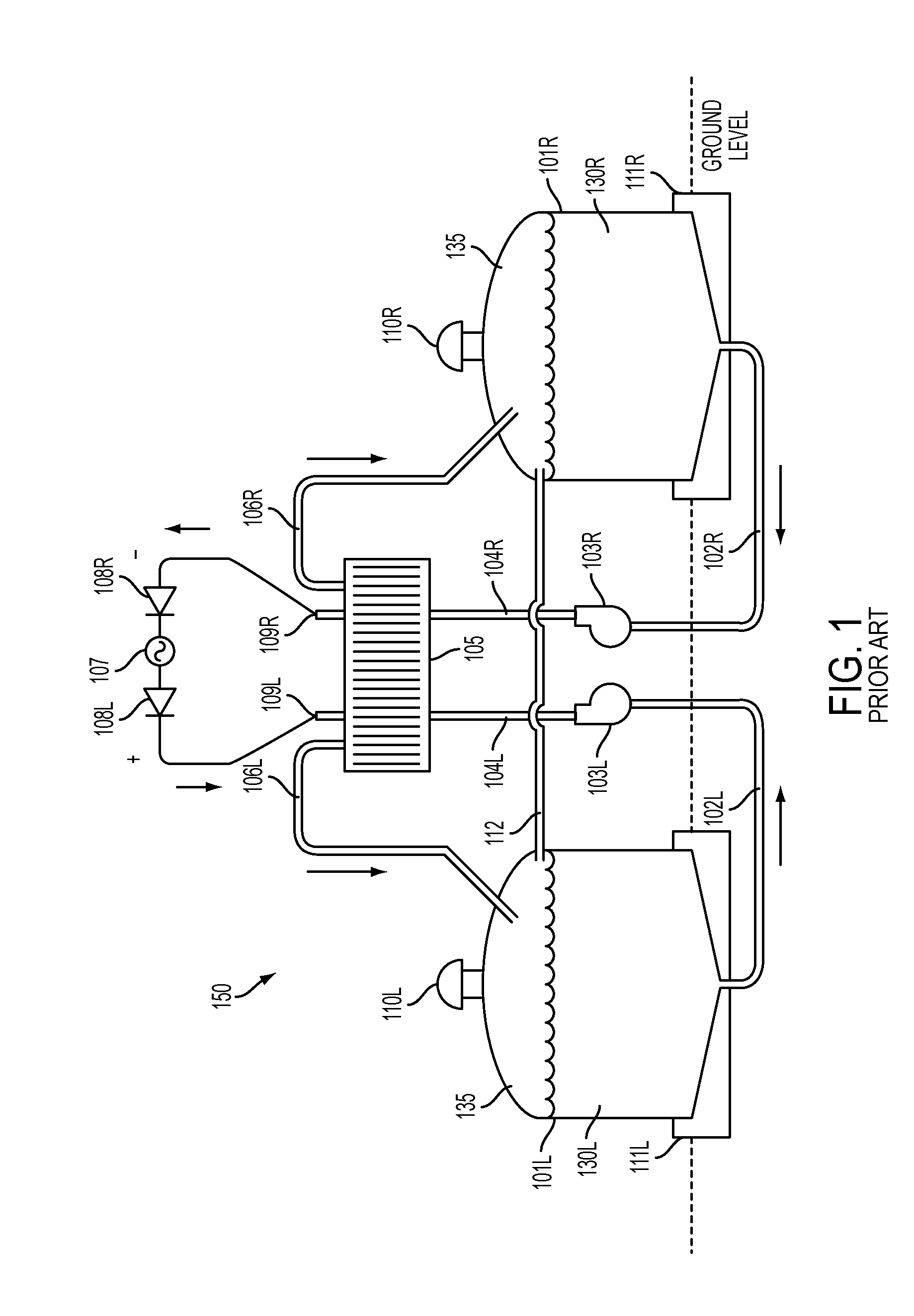
- Implementing a polarity switching method that reverses the flow of electrolytes in the battery system, allowing the positive electrolyte to be charged as negative and vice versa, thereby rebalancing ion reactant concentrations without the need for complete electrolyte mixing, which reduces energy requirements and extends the time between rebalancing procedures.

Energy Storage Safety Standards and Grid Integration Policies
The deployment of vanadium redox flow batteries (VRFBs) for backup power applications requires adherence to comprehensive safety standards that address the unique characteristics of vanadium electrolyte systems. Current safety frameworks primarily focus on thermal runaway prevention, electrolyte containment protocols, and ventilation requirements for vanadium compounds. The International Electrotechnical Commission (IEC) 62933 series provides foundational guidelines, while UL 9540 standards specifically address energy storage system safety requirements including fire suppression and hazard mitigation strategies.
Vanadium battery systems present distinct safety considerations compared to lithium-ion technologies, particularly regarding electrolyte management and corrosion prevention. Safety standards mandate robust containment systems to prevent vanadium electrolyte leakage, specialized materials compatibility testing, and comprehensive monitoring systems for electrolyte concentration and pH levels. Emergency response protocols must account for vanadium's environmental impact and proper disposal procedures.
Grid integration policies for vanadium batteries are evolving to accommodate their unique operational characteristics, including extended discharge duration capabilities and rapid response times. Regulatory frameworks such as IEEE 1547 standards govern interconnection requirements, while regional grid codes specify performance criteria for frequency regulation and voltage support services. These policies increasingly recognize VRFBs' advantages in providing long-duration energy storage without capacity degradation over cycling.
Policy development focuses on establishing clear certification pathways for vanadium battery installations, streamlining permitting processes, and defining grid service compensation mechanisms. Emerging regulations address cybersecurity requirements for grid-connected storage systems and mandate advanced communication protocols for real-time grid coordination. Utilities are developing specific interconnection standards that leverage VRFBs' ability to provide sustained power output during extended grid outages.
The regulatory landscape continues evolving to support vanadium battery deployment through updated building codes, environmental impact assessments, and standardized testing procedures. These developments create clearer pathways for commercial adoption while ensuring safe and reliable grid integration for backup power applications.
Vanadium battery systems present distinct safety considerations compared to lithium-ion technologies, particularly regarding electrolyte management and corrosion prevention. Safety standards mandate robust containment systems to prevent vanadium electrolyte leakage, specialized materials compatibility testing, and comprehensive monitoring systems for electrolyte concentration and pH levels. Emergency response protocols must account for vanadium's environmental impact and proper disposal procedures.
Grid integration policies for vanadium batteries are evolving to accommodate their unique operational characteristics, including extended discharge duration capabilities and rapid response times. Regulatory frameworks such as IEEE 1547 standards govern interconnection requirements, while regional grid codes specify performance criteria for frequency regulation and voltage support services. These policies increasingly recognize VRFBs' advantages in providing long-duration energy storage without capacity degradation over cycling.
Policy development focuses on establishing clear certification pathways for vanadium battery installations, streamlining permitting processes, and defining grid service compensation mechanisms. Emerging regulations address cybersecurity requirements for grid-connected storage systems and mandate advanced communication protocols for real-time grid coordination. Utilities are developing specific interconnection standards that leverage VRFBs' ability to provide sustained power output during extended grid outages.
The regulatory landscape continues evolving to support vanadium battery deployment through updated building codes, environmental impact assessments, and standardized testing procedures. These developments create clearer pathways for commercial adoption while ensuring safe and reliable grid integration for backup power applications.
Environmental Impact and Sustainability of Vanadium Batteries
Vanadium redox flow batteries (VRFBs) present significant environmental advantages compared to conventional battery technologies, particularly in backup power applications. The environmental profile of vanadium batteries is fundamentally shaped by their unique chemistry and operational characteristics, which minimize toxic waste generation and enable extensive recyclability throughout their lifecycle.
The sustainability credentials of VRFBs stem primarily from their non-toxic electrolyte composition and exceptional longevity. Unlike lithium-ion or lead-acid batteries, vanadium electrolytes do not contain heavy metals or hazardous materials that pose disposal challenges. The aqueous sulfuric acid solution used as the supporting electrolyte is relatively benign and can be safely handled with standard industrial protocols. This characteristic significantly reduces environmental risks during manufacturing, operation, and end-of-life management.
Lifecycle assessment studies indicate that VRFBs demonstrate superior environmental performance over extended operational periods. The separation of power and energy components allows for independent optimization, reducing material consumption per unit of energy storage capacity. The vanadium electrolyte maintains its chemical properties indefinitely, enabling battery systems to operate for 20-25 years with minimal performance degradation, substantially longer than competing technologies.
Resource sustainability represents another critical advantage, as vanadium exhibits near-perfect recyclability. At end-of-life, virtually 100% of the vanadium content can be recovered and reused in new battery systems without quality degradation. This closed-loop material cycle significantly reduces the environmental footprint associated with raw material extraction and processing. The stable vanadium oxidation states ensure that the recovered material maintains equivalent performance characteristics to virgin vanadium.
Carbon footprint analysis reveals favorable emissions profiles for VRFBs in backup power applications. The extended operational lifetime and high round-trip efficiency contribute to reduced lifecycle carbon emissions per kilowatt-hour stored. Manufacturing energy requirements are primarily concentrated in vanadium extraction and purification processes, but these impacts are amortized over the battery's extended service life.
However, environmental considerations include the energy-intensive vanadium production process and the relatively large physical footprint required for VRFB installations. Ongoing research focuses on developing more efficient vanadium extraction methods and exploring alternative vanadium sources, including recycling from steel production waste streams, to further enhance the environmental sustainability profile of these systems.
The sustainability credentials of VRFBs stem primarily from their non-toxic electrolyte composition and exceptional longevity. Unlike lithium-ion or lead-acid batteries, vanadium electrolytes do not contain heavy metals or hazardous materials that pose disposal challenges. The aqueous sulfuric acid solution used as the supporting electrolyte is relatively benign and can be safely handled with standard industrial protocols. This characteristic significantly reduces environmental risks during manufacturing, operation, and end-of-life management.
Lifecycle assessment studies indicate that VRFBs demonstrate superior environmental performance over extended operational periods. The separation of power and energy components allows for independent optimization, reducing material consumption per unit of energy storage capacity. The vanadium electrolyte maintains its chemical properties indefinitely, enabling battery systems to operate for 20-25 years with minimal performance degradation, substantially longer than competing technologies.
Resource sustainability represents another critical advantage, as vanadium exhibits near-perfect recyclability. At end-of-life, virtually 100% of the vanadium content can be recovered and reused in new battery systems without quality degradation. This closed-loop material cycle significantly reduces the environmental footprint associated with raw material extraction and processing. The stable vanadium oxidation states ensure that the recovered material maintains equivalent performance characteristics to virgin vanadium.
Carbon footprint analysis reveals favorable emissions profiles for VRFBs in backup power applications. The extended operational lifetime and high round-trip efficiency contribute to reduced lifecycle carbon emissions per kilowatt-hour stored. Manufacturing energy requirements are primarily concentrated in vanadium extraction and purification processes, but these impacts are amortized over the battery's extended service life.
However, environmental considerations include the energy-intensive vanadium production process and the relatively large physical footprint required for VRFB installations. Ongoing research focuses on developing more efficient vanadium extraction methods and exploring alternative vanadium sources, including recycling from steel production waste streams, to further enhance the environmental sustainability profile of these systems.
Unlock deeper insights with Patsnap Eureka Quick Research — get a full tech report to explore trends and direct your research. Try now!
Generate Your Research Report Instantly with AI Agent
Supercharge your innovation with Patsnap Eureka AI Agent Platform!