

Optimizing Data Analytics in Advanced Tactile Sensor Applications
APR 11, 20269 MIN READ
Generate Your Research Report Instantly with AI Agent
PatSnap Eureka helps you evaluate technical feasibility & market potential.
Tactile Sensor Data Analytics Background and Objectives
Tactile sensing technology has undergone remarkable evolution since its inception in the 1970s, transitioning from simple pressure-sensitive devices to sophisticated multi-modal sensor arrays capable of detecting force, texture, temperature, and vibration simultaneously. The field emerged from robotics research aimed at providing machines with human-like touch capabilities, but has since expanded into diverse applications including prosthetics, medical diagnostics, automotive interfaces, and consumer electronics.
The technological progression has been marked by several key milestones, beginning with resistive-based sensors, advancing through capacitive and piezoelectric technologies, and now incorporating cutting-edge materials such as graphene, carbon nanotubes, and flexible polymers. Modern tactile sensors generate unprecedented volumes of high-dimensional data, with sampling rates reaching kilohertz frequencies and spatial resolutions approaching human fingertip sensitivity.
Current market drivers indicate explosive growth potential, with the global tactile sensor market projected to reach $15.3 billion by 2028. This expansion is fueled by increasing demand for haptic feedback in virtual reality systems, autonomous vehicle safety requirements, and the proliferation of human-machine interfaces in industrial automation. Healthcare applications, particularly in surgical robotics and rehabilitation devices, represent another significant growth vector.
The primary objective of optimizing data analytics in advanced tactile sensor applications centers on extracting meaningful information from complex, multi-dimensional sensor data streams in real-time. Traditional signal processing approaches struggle with the volume, velocity, and variety of modern tactile data, necessitating advanced machine learning algorithms and edge computing solutions.
Key technical objectives include developing robust feature extraction methods that can distinguish between subtle tactile signatures, implementing real-time classification algorithms for object recognition and material identification, and creating adaptive learning systems that improve performance through continuous interaction. Additionally, there is a critical need for standardized data formats and interoperability protocols to enable seamless integration across different sensor platforms and applications.
The ultimate goal extends beyond mere data processing to achieving tactile intelligence that can match or exceed human touch perception capabilities, enabling autonomous systems to make sophisticated decisions based on tactile feedback while maintaining computational efficiency and reliability in diverse operational environments.
The technological progression has been marked by several key milestones, beginning with resistive-based sensors, advancing through capacitive and piezoelectric technologies, and now incorporating cutting-edge materials such as graphene, carbon nanotubes, and flexible polymers. Modern tactile sensors generate unprecedented volumes of high-dimensional data, with sampling rates reaching kilohertz frequencies and spatial resolutions approaching human fingertip sensitivity.
Current market drivers indicate explosive growth potential, with the global tactile sensor market projected to reach $15.3 billion by 2028. This expansion is fueled by increasing demand for haptic feedback in virtual reality systems, autonomous vehicle safety requirements, and the proliferation of human-machine interfaces in industrial automation. Healthcare applications, particularly in surgical robotics and rehabilitation devices, represent another significant growth vector.
The primary objective of optimizing data analytics in advanced tactile sensor applications centers on extracting meaningful information from complex, multi-dimensional sensor data streams in real-time. Traditional signal processing approaches struggle with the volume, velocity, and variety of modern tactile data, necessitating advanced machine learning algorithms and edge computing solutions.
Key technical objectives include developing robust feature extraction methods that can distinguish between subtle tactile signatures, implementing real-time classification algorithms for object recognition and material identification, and creating adaptive learning systems that improve performance through continuous interaction. Additionally, there is a critical need for standardized data formats and interoperability protocols to enable seamless integration across different sensor platforms and applications.
The ultimate goal extends beyond mere data processing to achieving tactile intelligence that can match or exceed human touch perception capabilities, enabling autonomous systems to make sophisticated decisions based on tactile feedback while maintaining computational efficiency and reliability in diverse operational environments.
Market Demand for Advanced Tactile Sensing Solutions
The global tactile sensing market is experiencing unprecedented growth driven by the convergence of artificial intelligence, robotics, and Internet of Things technologies. Advanced tactile sensors are becoming critical components across multiple industries, with manufacturing automation leading the demand surge. Industrial robots equipped with sophisticated tactile feedback systems can perform delicate assembly tasks, quality inspection, and material handling with human-like precision, significantly reducing production errors and improving operational efficiency.
Healthcare applications represent another rapidly expanding market segment for advanced tactile sensing solutions. Surgical robotics systems require ultra-sensitive tactile feedback to enable minimally invasive procedures, while prosthetic devices benefit from tactile sensors that can restore sensory feedback to amputees. Rehabilitation equipment incorporating tactile sensing capabilities allows for more personalized therapy programs and better patient outcomes. The aging global population and increasing prevalence of chronic conditions are driving sustained demand for these medical applications.
Consumer electronics manufacturers are increasingly integrating advanced tactile sensing technologies to enhance user experiences. Smartphones, tablets, and wearable devices utilize sophisticated haptic feedback systems that require precise tactile data processing. Gaming peripherals and virtual reality systems depend on tactile sensors to create immersive experiences, while smart home devices use touch-sensitive interfaces for intuitive user interaction.
The automotive industry presents substantial opportunities for tactile sensing applications, particularly with the advancement of autonomous vehicles. Advanced driver assistance systems rely on tactile sensors for steering wheel feedback, while autonomous navigation systems require tactile input for safe human-machine interaction. Electric vehicle manufacturers are incorporating tactile interfaces to replace traditional mechanical controls, creating demand for highly responsive and reliable tactile sensing solutions.
Market growth is further accelerated by the increasing adoption of collaborative robots in small and medium enterprises. These cobots require sophisticated tactile sensing capabilities to safely work alongside human operators, driving demand for cost-effective yet highly accurate tactile sensing solutions. The trend toward flexible manufacturing systems and mass customization is creating additional opportunities for tactile sensor applications in quality control and adaptive manufacturing processes.
Healthcare applications represent another rapidly expanding market segment for advanced tactile sensing solutions. Surgical robotics systems require ultra-sensitive tactile feedback to enable minimally invasive procedures, while prosthetic devices benefit from tactile sensors that can restore sensory feedback to amputees. Rehabilitation equipment incorporating tactile sensing capabilities allows for more personalized therapy programs and better patient outcomes. The aging global population and increasing prevalence of chronic conditions are driving sustained demand for these medical applications.
Consumer electronics manufacturers are increasingly integrating advanced tactile sensing technologies to enhance user experiences. Smartphones, tablets, and wearable devices utilize sophisticated haptic feedback systems that require precise tactile data processing. Gaming peripherals and virtual reality systems depend on tactile sensors to create immersive experiences, while smart home devices use touch-sensitive interfaces for intuitive user interaction.
The automotive industry presents substantial opportunities for tactile sensing applications, particularly with the advancement of autonomous vehicles. Advanced driver assistance systems rely on tactile sensors for steering wheel feedback, while autonomous navigation systems require tactile input for safe human-machine interaction. Electric vehicle manufacturers are incorporating tactile interfaces to replace traditional mechanical controls, creating demand for highly responsive and reliable tactile sensing solutions.
Market growth is further accelerated by the increasing adoption of collaborative robots in small and medium enterprises. These cobots require sophisticated tactile sensing capabilities to safely work alongside human operators, driving demand for cost-effective yet highly accurate tactile sensing solutions. The trend toward flexible manufacturing systems and mass customization is creating additional opportunities for tactile sensor applications in quality control and adaptive manufacturing processes.
Current State and Challenges in Tactile Data Processing
Advanced tactile sensor applications have reached a critical juncture where data processing capabilities significantly lag behind sensor hardware advancements. Current tactile sensors can capture multi-dimensional force, pressure, temperature, and texture information at microsecond intervals, generating data streams exceeding several gigabytes per hour. However, existing processing frameworks struggle to handle this volume while maintaining real-time responsiveness required for applications such as robotic surgery, autonomous navigation, and haptic feedback systems.
The primary technical challenge lies in the heterogeneous nature of tactile data, which combines spatial, temporal, and multi-modal sensory information. Unlike traditional sensor data that follows predictable patterns, tactile information exhibits high variability and context dependency. Current processing algorithms often fail to effectively correlate pressure gradients with temporal changes, leading to incomplete environmental understanding and delayed response times that can exceed acceptable thresholds for critical applications.
Signal noise and calibration inconsistencies represent another significant obstacle in tactile data processing. Environmental factors such as temperature fluctuations, humidity changes, and electromagnetic interference can introduce artifacts that traditional filtering methods cannot adequately address. These issues are particularly pronounced in industrial environments where tactile sensors must operate under extreme conditions while maintaining precision accuracy.
Real-time processing requirements create additional computational bottlenecks. Current embedded processing units in tactile sensor systems typically operate with limited memory and processing power, constraining the complexity of analytical algorithms that can be implemented. This limitation forces developers to choose between processing speed and analytical depth, often resulting in oversimplified data interpretation that fails to capture subtle tactile nuances essential for advanced applications.
Data fusion from multiple tactile sensors presents integration challenges that current architectures struggle to resolve efficiently. When multiple sensors operate simultaneously, synchronizing data streams while maintaining temporal accuracy becomes increasingly complex. Existing solutions often introduce latency or data loss during the fusion process, compromising overall system performance.
Machine learning integration faces particular difficulties in tactile data processing due to the lack of standardized datasets and training methodologies. Unlike visual or audio data processing, tactile sensing lacks comprehensive benchmark datasets, making it challenging to develop and validate advanced analytical models. This limitation significantly hampers the development of adaptive learning systems that could improve processing efficiency over time.
The primary technical challenge lies in the heterogeneous nature of tactile data, which combines spatial, temporal, and multi-modal sensory information. Unlike traditional sensor data that follows predictable patterns, tactile information exhibits high variability and context dependency. Current processing algorithms often fail to effectively correlate pressure gradients with temporal changes, leading to incomplete environmental understanding and delayed response times that can exceed acceptable thresholds for critical applications.
Signal noise and calibration inconsistencies represent another significant obstacle in tactile data processing. Environmental factors such as temperature fluctuations, humidity changes, and electromagnetic interference can introduce artifacts that traditional filtering methods cannot adequately address. These issues are particularly pronounced in industrial environments where tactile sensors must operate under extreme conditions while maintaining precision accuracy.
Real-time processing requirements create additional computational bottlenecks. Current embedded processing units in tactile sensor systems typically operate with limited memory and processing power, constraining the complexity of analytical algorithms that can be implemented. This limitation forces developers to choose between processing speed and analytical depth, often resulting in oversimplified data interpretation that fails to capture subtle tactile nuances essential for advanced applications.
Data fusion from multiple tactile sensors presents integration challenges that current architectures struggle to resolve efficiently. When multiple sensors operate simultaneously, synchronizing data streams while maintaining temporal accuracy becomes increasingly complex. Existing solutions often introduce latency or data loss during the fusion process, compromising overall system performance.
Machine learning integration faces particular difficulties in tactile data processing due to the lack of standardized datasets and training methodologies. Unlike visual or audio data processing, tactile sensing lacks comprehensive benchmark datasets, making it challenging to develop and validate advanced analytical models. This limitation significantly hampers the development of adaptive learning systems that could improve processing efficiency over time.
Existing Data Analytics Solutions for Tactile Applications
01 Machine learning algorithms for tactile sensor data processing
Advanced tactile sensors utilize machine learning and artificial intelligence algorithms to process and analyze raw sensor data. These algorithms can identify patterns, classify touch events, and extract meaningful features from complex tactile signals. The processing methods enable real-time interpretation of pressure, texture, and force measurements, improving the accuracy and responsiveness of tactile sensing systems.- Machine learning algorithms for tactile sensor data processing: Advanced tactile sensors utilize machine learning and artificial intelligence algorithms to process and analyze raw sensor data. These algorithms can identify patterns, classify touch events, and extract meaningful features from complex tactile signals. The implementation of neural networks and deep learning models enables real-time interpretation of pressure, texture, and force measurements, improving the accuracy and responsiveness of tactile sensing systems.
- Multi-modal sensor data fusion and integration: Tactile sensor systems integrate data from multiple sensing modalities to provide comprehensive touch information. By combining pressure sensors, temperature sensors, and proximity detectors, these systems create a unified data stream that captures various aspects of physical interaction. Data fusion techniques synchronize and correlate information from different sensor types, enabling more accurate object recognition and manipulation tasks in robotics and human-machine interfaces.
- Real-time signal processing and filtering techniques: Advanced signal processing methods are employed to filter noise and extract relevant information from tactile sensor outputs. These techniques include adaptive filtering, frequency domain analysis, and time-series processing to enhance signal quality. Real-time processing capabilities allow for immediate response to tactile events, which is critical for applications requiring instantaneous feedback such as prosthetics and surgical robotics.
- Spatial mapping and tactile image reconstruction: Tactile sensor arrays generate spatial data that can be processed to create tactile images or maps of contact surfaces. Advanced analytics convert discrete sensor readings into continuous spatial representations, enabling visualization of pressure distribution and contact geometry. These reconstruction techniques support applications in quality control, material characterization, and robotic grasping where understanding the spatial characteristics of touch is essential.
- Predictive analytics and anomaly detection: Data analytics frameworks for tactile sensors incorporate predictive models that anticipate future states based on historical touch data. Anomaly detection algorithms identify unusual patterns or deviations from normal tactile behavior, which is valuable for preventive maintenance and safety monitoring. These analytical capabilities enable systems to learn from experience and adapt to changing conditions, improving long-term performance and reliability in industrial and healthcare applications.
02 Multi-modal sensor data fusion and integration
Tactile sensing systems integrate data from multiple sensor modalities to provide comprehensive touch information. This approach combines pressure sensors, temperature sensors, and proximity sensors to create a unified data stream. The fusion techniques enable more accurate object recognition and manipulation by correlating different types of sensory input, enhancing the overall performance of robotic and haptic systems.Expand Specific Solutions03 Real-time data analytics and signal processing
Advanced signal processing techniques are employed to analyze tactile sensor data in real-time. These methods include filtering, noise reduction, and feature extraction algorithms that process high-frequency sensor signals. The analytics enable immediate response to touch events and provide continuous monitoring of contact conditions, which is essential for applications requiring precise tactile feedback and control.Expand Specific Solutions04 Spatial mapping and tactile data visualization
Tactile sensor arrays generate spatial maps of contact pressure and force distribution across sensing surfaces. Advanced analytics convert raw sensor readings into visual representations and three-dimensional models of touch interactions. These visualization techniques help in understanding complex tactile patterns and enable applications in medical diagnostics, quality control, and human-machine interfaces.Expand Specific Solutions05 Predictive analytics and adaptive calibration
Predictive models analyze historical tactile sensor data to anticipate future touch events and system behaviors. Adaptive calibration algorithms continuously adjust sensor parameters based on environmental conditions and usage patterns. These analytics improve sensor accuracy over time and compensate for drift, wear, and changing operational conditions, ensuring consistent performance throughout the sensor lifecycle.Expand Specific Solutions
Key Players in Tactile Sensor and Analytics Industry
The advanced tactile sensor data analytics field represents an emerging technology sector in its early growth phase, characterized by significant research momentum but limited commercial maturity. The market demonstrates substantial potential across automotive, robotics, and consumer electronics applications, with key players spanning established corporations and specialized startups. Technology maturity varies considerably among participants, with companies like Toyota Motor Corp. and Immersion Corp. leveraging extensive R&D capabilities for automotive and haptic applications, while specialized firms such as FingerVision Inc. and Haake Technik GmbH focus on niche robotic sensing solutions. Academic institutions including University of Tokyo, Tongji University, and Columbia University drive fundamental research advancement, while technology giants like Tencent explore consumer device integration. The competitive landscape reflects a fragmented ecosystem where traditional manufacturers, emerging tech companies, and research institutions collaborate to address complex challenges in sensor data processing, real-time analytics, and human-machine interface optimization across diverse industrial applications.
Toyota Motor Corp.
Technical Solution: Toyota has developed advanced tactile sensor systems integrated with machine learning algorithms for automotive applications, particularly in autonomous vehicle navigation and human-machine interface optimization. Their approach combines high-resolution pressure mapping with real-time data processing capabilities, enabling vehicles to detect and respond to various surface conditions and passenger interactions. The company's tactile sensing technology incorporates multi-modal sensor fusion, processing tactile data alongside visual and auditory inputs to enhance decision-making accuracy in complex driving scenarios. Their data analytics framework utilizes edge computing architectures to minimize latency while maximizing processing efficiency for safety-critical applications.
Strengths: Extensive automotive industry expertise and robust safety standards compliance. Weaknesses: Limited application scope primarily focused on automotive sector, potentially restricting broader tactile sensing innovations.
Immersion Corp.
Technical Solution: Immersion Corporation specializes in haptic feedback technology with advanced data analytics capabilities for tactile sensor applications. Their TouchSense platform integrates sophisticated algorithms that analyze tactile input patterns to generate precise haptic responses across various devices including smartphones, gaming controllers, and medical equipment. The company's analytics engine processes multi-dimensional tactile data streams in real-time, enabling adaptive feedback mechanisms that enhance user experience through personalized touch interactions. Their proprietary algorithms optimize tactile data compression and transmission, reducing bandwidth requirements while maintaining high-fidelity haptic reproduction across different hardware platforms and applications.
Strengths: Market-leading haptic technology expertise with extensive patent portfolio and proven commercial applications. Weaknesses: Primarily focused on consumer electronics, may lack specialized knowledge for industrial or medical tactile sensing applications.
Core Innovations in Tactile Data Processing Algorithms
Enhancement of real-time response to request for detached data analytics
PatentInactiveUS10467142B1
Innovation
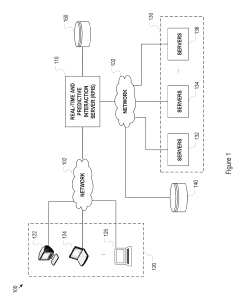
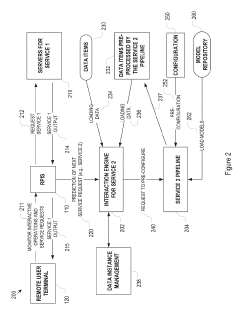
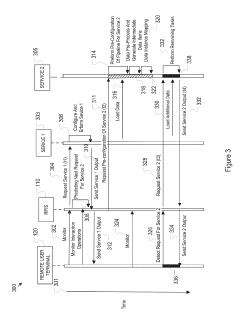
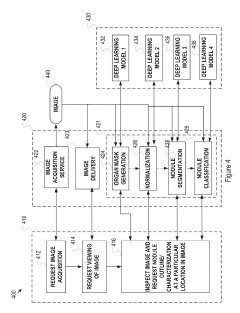
- A system and method that predictively pre-configure and pre-process data analytics pipelines based on user interactive operations, caching intermediate data for speedy access, allowing only real-time additional processing to complete the service upon actual request, thereby reducing user-perceived delay.
Graphics processing unit systems for performing data analytics operations in data science
PatentActiveUS11693667B2
Innovation
- The implementation of a graphics processing unit (GPU) with shared memory for data analytics operations, where data is stored and processed internally, eliminating the need for external data transfer and enabling parallel processing across multiple cores, thereby accelerating all phases of the data science workflow.


Edge Computing Integration for Tactile Systems
Edge computing integration represents a paradigmatic shift in tactile sensor system architecture, fundamentally transforming how data processing occurs within these sophisticated sensing networks. Traditional centralized processing models face significant limitations when dealing with the high-frequency, multi-dimensional data streams generated by advanced tactile sensors, particularly in applications requiring real-time responsiveness and low-latency decision-making.
The integration of edge computing capabilities directly into tactile sensor systems enables distributed processing architectures where computational resources are positioned closer to the data source. This proximity reduces transmission delays and bandwidth requirements while enhancing system responsiveness. Modern tactile sensor arrays can generate data rates exceeding several megabytes per second, making local processing capabilities essential for maintaining system performance and reducing network congestion.
Contemporary edge computing implementations in tactile systems typically employ specialized microprocessors and field-programmable gate arrays positioned at sensor cluster levels. These processing units handle preliminary data filtering, feature extraction, and basic pattern recognition tasks before transmitting refined information to higher-level systems. This hierarchical processing approach significantly reduces the computational burden on central processing units while maintaining data integrity and analytical precision.
Machine learning inference capabilities at the edge have become increasingly sophisticated, enabling real-time classification and anomaly detection within tactile sensor networks. Lightweight neural network models, specifically optimized for edge deployment, can process complex tactile patterns and provide immediate feedback without requiring cloud connectivity. These capabilities are particularly valuable in applications such as robotic manipulation, medical diagnostics, and industrial quality control.
Security considerations in edge-integrated tactile systems require robust encryption and authentication protocols to protect sensitive tactile data during local processing and transmission. Edge nodes must implement secure boot processes and hardware-based security modules to prevent unauthorized access and ensure data integrity throughout the processing pipeline.
Power management represents a critical challenge in edge-enabled tactile systems, particularly in battery-powered or energy-harvesting applications. Advanced power optimization techniques, including dynamic voltage scaling and selective processing activation, help maintain operational efficiency while preserving computational capabilities for critical tactile analysis tasks.
The integration of edge computing capabilities directly into tactile sensor systems enables distributed processing architectures where computational resources are positioned closer to the data source. This proximity reduces transmission delays and bandwidth requirements while enhancing system responsiveness. Modern tactile sensor arrays can generate data rates exceeding several megabytes per second, making local processing capabilities essential for maintaining system performance and reducing network congestion.
Contemporary edge computing implementations in tactile systems typically employ specialized microprocessors and field-programmable gate arrays positioned at sensor cluster levels. These processing units handle preliminary data filtering, feature extraction, and basic pattern recognition tasks before transmitting refined information to higher-level systems. This hierarchical processing approach significantly reduces the computational burden on central processing units while maintaining data integrity and analytical precision.
Machine learning inference capabilities at the edge have become increasingly sophisticated, enabling real-time classification and anomaly detection within tactile sensor networks. Lightweight neural network models, specifically optimized for edge deployment, can process complex tactile patterns and provide immediate feedback without requiring cloud connectivity. These capabilities are particularly valuable in applications such as robotic manipulation, medical diagnostics, and industrial quality control.
Security considerations in edge-integrated tactile systems require robust encryption and authentication protocols to protect sensitive tactile data during local processing and transmission. Edge nodes must implement secure boot processes and hardware-based security modules to prevent unauthorized access and ensure data integrity throughout the processing pipeline.
Power management represents a critical challenge in edge-enabled tactile systems, particularly in battery-powered or energy-harvesting applications. Advanced power optimization techniques, including dynamic voltage scaling and selective processing activation, help maintain operational efficiency while preserving computational capabilities for critical tactile analysis tasks.
Machine Learning Applications in Tactile Recognition
Machine learning has emerged as a transformative force in tactile recognition systems, fundamentally reshaping how advanced tactile sensors process and interpret complex touch-based data. The integration of sophisticated algorithms enables these systems to move beyond simple pressure detection toward nuanced understanding of texture, material properties, and dynamic interactions.
Deep learning architectures, particularly convolutional neural networks (CNNs), have demonstrated exceptional performance in processing multi-dimensional tactile data arrays. These networks excel at identifying spatial patterns within tactile sensor readings, enabling recognition of surface textures, object shapes, and material characteristics with unprecedented accuracy. Recurrent neural networks (RNNs) and Long Short-Term Memory (LSTM) networks prove invaluable for temporal tactile sequence analysis, capturing dynamic touch patterns and gesture recognition capabilities.
Supervised learning approaches dominate current tactile recognition implementations, utilizing extensive labeled datasets to train models for specific recognition tasks. Classification algorithms enable categorical identification of materials, objects, or surface properties, while regression models provide continuous parameter estimation for force magnitude, surface roughness, or compliance measurements. Support vector machines and random forests offer robust alternatives for scenarios with limited training data or specific feature requirements.
Unsupervised learning techniques are gaining prominence for exploratory tactile data analysis and anomaly detection. Clustering algorithms help identify natural groupings within tactile sensor responses, revealing previously unknown material categories or interaction patterns. Principal component analysis reduces high-dimensional tactile data complexity while preserving essential discriminative information, facilitating real-time processing requirements.
Reinforcement learning represents an emerging frontier in tactile recognition, enabling adaptive learning from tactile exploration experiences. These approaches allow systems to develop optimal sensing strategies through trial-and-error interactions, particularly valuable for robotic manipulation tasks requiring sophisticated tactile feedback.
Transfer learning techniques accelerate tactile recognition system development by leveraging pre-trained models from related domains. This approach proves especially beneficial when tactile training data is scarce or expensive to collect, enabling rapid deployment across diverse application scenarios while maintaining recognition accuracy and system reliability.
Deep learning architectures, particularly convolutional neural networks (CNNs), have demonstrated exceptional performance in processing multi-dimensional tactile data arrays. These networks excel at identifying spatial patterns within tactile sensor readings, enabling recognition of surface textures, object shapes, and material characteristics with unprecedented accuracy. Recurrent neural networks (RNNs) and Long Short-Term Memory (LSTM) networks prove invaluable for temporal tactile sequence analysis, capturing dynamic touch patterns and gesture recognition capabilities.
Supervised learning approaches dominate current tactile recognition implementations, utilizing extensive labeled datasets to train models for specific recognition tasks. Classification algorithms enable categorical identification of materials, objects, or surface properties, while regression models provide continuous parameter estimation for force magnitude, surface roughness, or compliance measurements. Support vector machines and random forests offer robust alternatives for scenarios with limited training data or specific feature requirements.
Unsupervised learning techniques are gaining prominence for exploratory tactile data analysis and anomaly detection. Clustering algorithms help identify natural groupings within tactile sensor responses, revealing previously unknown material categories or interaction patterns. Principal component analysis reduces high-dimensional tactile data complexity while preserving essential discriminative information, facilitating real-time processing requirements.
Reinforcement learning represents an emerging frontier in tactile recognition, enabling adaptive learning from tactile exploration experiences. These approaches allow systems to develop optimal sensing strategies through trial-and-error interactions, particularly valuable for robotic manipulation tasks requiring sophisticated tactile feedback.
Transfer learning techniques accelerate tactile recognition system development by leveraging pre-trained models from related domains. This approach proves especially beneficial when tactile training data is scarce or expensive to collect, enabling rapid deployment across diverse application scenarios while maintaining recognition accuracy and system reliability.
Unlock deeper insights with PatSnap Eureka Quick Research — get a full tech report to explore trends and direct your research. Try now!
Generate Your Research Report Instantly with AI Agent
Supercharge your innovation with PatSnap Eureka AI Agent Platform!