

Optimizing Elemental Sulfur for Superior Cycle Stability
MAR 31, 20269 MIN READ
Generate Your Research Report Instantly with AI Agent
Patsnap Eureka helps you evaluate technical feasibility & market potential.
Sulfur Battery Technology Background and Stability Goals
Lithium-sulfur batteries have emerged as one of the most promising next-generation energy storage technologies, offering theoretical specific capacities of 1675 mAh/g and energy densities reaching 2600 Wh/kg. These values significantly exceed those of conventional lithium-ion batteries, positioning sulfur-based systems as potential game-changers for applications demanding high energy density, including electric vehicles, aerospace systems, and grid-scale energy storage.
The evolution of sulfur battery technology traces back to the 1960s when researchers first explored sulfur as a cathode material. Initial investigations revealed sulfur's abundant availability, low cost, and environmental compatibility, making it an attractive alternative to traditional cathode materials. However, early implementations faced substantial challenges related to sulfur's inherent insulating properties and the complex electrochemical reactions occurring during charge-discharge cycles.
Throughout the 1990s and 2000s, significant breakthroughs in understanding sulfur's electrochemical behavior led to renewed interest in the technology. Researchers identified the polysulfide shuttle mechanism as a fundamental process governing battery performance, where intermediate lithium polysulfides dissolve into the electrolyte and migrate between electrodes. This discovery marked a pivotal moment in sulfur battery development, shifting focus toward managing these soluble intermediates.
The primary technical objective driving current sulfur battery research centers on achieving superior cycle stability while maintaining high capacity retention. Conventional sulfur cathodes typically experience rapid capacity degradation, often losing 50% of their initial capacity within 100 cycles. This limitation stems from multiple factors including polysulfide dissolution, volume expansion during lithiation, and active material loss.
Modern stability goals target achieving over 1000 stable cycles with capacity retention exceeding 80%, while maintaining coulombic efficiencies above 99%. These ambitious targets require comprehensive optimization strategies addressing sulfur's fundamental limitations through advanced material engineering, electrolyte design, and cell architecture innovations.
Contemporary research efforts focus on developing sulfur confinement strategies, including carbon host materials, polymer encapsulation, and metal-organic frameworks. These approaches aim to physically and chemically immobilize sulfur species while facilitating efficient ion transport and electron conduction. Additionally, electrolyte additives and separator modifications are being explored to suppress polysulfide migration and enhance overall system stability.
The convergence of these technological advances positions optimized elemental sulfur systems as viable candidates for commercial energy storage applications, with the potential to revolutionize battery performance standards across multiple industries.
The evolution of sulfur battery technology traces back to the 1960s when researchers first explored sulfur as a cathode material. Initial investigations revealed sulfur's abundant availability, low cost, and environmental compatibility, making it an attractive alternative to traditional cathode materials. However, early implementations faced substantial challenges related to sulfur's inherent insulating properties and the complex electrochemical reactions occurring during charge-discharge cycles.
Throughout the 1990s and 2000s, significant breakthroughs in understanding sulfur's electrochemical behavior led to renewed interest in the technology. Researchers identified the polysulfide shuttle mechanism as a fundamental process governing battery performance, where intermediate lithium polysulfides dissolve into the electrolyte and migrate between electrodes. This discovery marked a pivotal moment in sulfur battery development, shifting focus toward managing these soluble intermediates.
The primary technical objective driving current sulfur battery research centers on achieving superior cycle stability while maintaining high capacity retention. Conventional sulfur cathodes typically experience rapid capacity degradation, often losing 50% of their initial capacity within 100 cycles. This limitation stems from multiple factors including polysulfide dissolution, volume expansion during lithiation, and active material loss.
Modern stability goals target achieving over 1000 stable cycles with capacity retention exceeding 80%, while maintaining coulombic efficiencies above 99%. These ambitious targets require comprehensive optimization strategies addressing sulfur's fundamental limitations through advanced material engineering, electrolyte design, and cell architecture innovations.
Contemporary research efforts focus on developing sulfur confinement strategies, including carbon host materials, polymer encapsulation, and metal-organic frameworks. These approaches aim to physically and chemically immobilize sulfur species while facilitating efficient ion transport and electron conduction. Additionally, electrolyte additives and separator modifications are being explored to suppress polysulfide migration and enhance overall system stability.
The convergence of these technological advances positions optimized elemental sulfur systems as viable candidates for commercial energy storage applications, with the potential to revolutionize battery performance standards across multiple industries.
Market Demand for High-Performance Sulfur Batteries
The global energy storage market is experiencing unprecedented growth driven by the urgent need for sustainable energy solutions and grid stabilization technologies. Lithium-sulfur batteries have emerged as a promising next-generation energy storage technology, offering theoretical energy densities significantly higher than conventional lithium-ion systems. This superior energy density potential positions sulfur-based batteries as critical components for applications requiring lightweight, high-capacity energy storage solutions.
Electric vehicle manufacturers represent a primary market segment driving demand for high-performance sulfur batteries. The automotive industry's transition toward electrification has intensified requirements for batteries that can deliver extended driving ranges while maintaining compact form factors. Current lithium-ion technology faces inherent limitations in energy density, creating substantial market opportunities for advanced sulfur battery systems that can overcome cycle stability challenges.
Grid-scale energy storage applications constitute another significant market driver for optimized sulfur battery technology. Renewable energy integration requires robust storage systems capable of handling frequent charge-discharge cycles over extended operational periods. The intermittent nature of solar and wind power generation necessitates energy storage solutions that combine high capacity with exceptional cycle durability, characteristics that properly optimized sulfur batteries can potentially deliver.
Consumer electronics markets are increasingly demanding thinner, lighter devices with longer battery life, creating additional market pull for high-performance sulfur battery technology. Smartphones, laptops, and wearable devices require energy storage solutions that maximize capacity while minimizing weight and volume constraints. The theoretical advantages of sulfur-based systems align well with these evolving consumer expectations and device design requirements.
Aerospace and defense applications represent specialized but high-value market segments where superior cycle stability in sulfur batteries could provide significant competitive advantages. These applications often require energy storage systems that maintain performance under extreme conditions while delivering reliable operation over thousands of cycles. The weight advantages of sulfur-based systems make them particularly attractive for satellite, drone, and portable military equipment applications.
Market research indicates growing investment in sulfur battery commercialization efforts, with multiple technology companies and battery manufacturers actively developing solutions to address cycle stability limitations. The convergence of environmental regulations, performance requirements, and cost considerations is creating favorable market conditions for breakthrough technologies that can successfully optimize elemental sulfur for enhanced cycle performance.
Electric vehicle manufacturers represent a primary market segment driving demand for high-performance sulfur batteries. The automotive industry's transition toward electrification has intensified requirements for batteries that can deliver extended driving ranges while maintaining compact form factors. Current lithium-ion technology faces inherent limitations in energy density, creating substantial market opportunities for advanced sulfur battery systems that can overcome cycle stability challenges.
Grid-scale energy storage applications constitute another significant market driver for optimized sulfur battery technology. Renewable energy integration requires robust storage systems capable of handling frequent charge-discharge cycles over extended operational periods. The intermittent nature of solar and wind power generation necessitates energy storage solutions that combine high capacity with exceptional cycle durability, characteristics that properly optimized sulfur batteries can potentially deliver.
Consumer electronics markets are increasingly demanding thinner, lighter devices with longer battery life, creating additional market pull for high-performance sulfur battery technology. Smartphones, laptops, and wearable devices require energy storage solutions that maximize capacity while minimizing weight and volume constraints. The theoretical advantages of sulfur-based systems align well with these evolving consumer expectations and device design requirements.
Aerospace and defense applications represent specialized but high-value market segments where superior cycle stability in sulfur batteries could provide significant competitive advantages. These applications often require energy storage systems that maintain performance under extreme conditions while delivering reliable operation over thousands of cycles. The weight advantages of sulfur-based systems make them particularly attractive for satellite, drone, and portable military equipment applications.
Market research indicates growing investment in sulfur battery commercialization efforts, with multiple technology companies and battery manufacturers actively developing solutions to address cycle stability limitations. The convergence of environmental regulations, performance requirements, and cost considerations is creating favorable market conditions for breakthrough technologies that can successfully optimize elemental sulfur for enhanced cycle performance.
Current Challenges in Elemental Sulfur Cycle Stability
Elemental sulfur faces significant technical barriers that severely limit its practical application in energy storage systems, particularly in lithium-sulfur batteries. The primary challenge stems from sulfur's inherent insulating properties, with electrical conductivity as low as 5×10^-30 S/cm at room temperature, creating substantial resistance to electron transport during electrochemical reactions.
The polysulfide shuttle effect represents the most critical obstacle to achieving stable cycling performance. During discharge processes, intermediate lithium polysulfides (Li2Sx, 4≤x≤8) dissolve readily in organic electrolytes, migrating between electrodes and causing irreversible active material loss. This phenomenon results in rapid capacity degradation, typically losing 40-60% of initial capacity within 100 cycles under standard operating conditions.
Volume expansion during lithiation presents another fundamental challenge, with sulfur experiencing approximately 80% volumetric change during the Li2S formation process. This dramatic expansion generates mechanical stress that fractures electrode structures, disrupts electrical pathways, and accelerates performance deterioration. The repeated expansion-contraction cycles progressively degrade the electrode integrity.
Kinetic limitations further compound these issues, as sulfur conversion reactions exhibit sluggish kinetics due to poor ionic and electronic conductivity. The formation of insulating Li2S2 and Li2S phases creates additional barriers to charge transfer, leading to incomplete utilization of active materials and reduced energy efficiency.
Temperature sensitivity adds complexity to sulfur optimization efforts. At elevated temperatures, polysulfide dissolution accelerates, while low temperatures severely impair reaction kinetics. This narrow operational window restricts practical applications and demands sophisticated thermal management systems.
Interface instability between sulfur and current collectors creates additional complications. Poor adhesion and limited wetting properties result in contact resistance increases and active material detachment during cycling. The lack of effective binding mechanisms between sulfur particles and conductive substrates further exacerbates these interfacial challenges.
Current mitigation strategies, including carbon host materials and electrolyte additives, provide only partial solutions while introducing manufacturing complexity and cost increases. These approaches often address individual challenges in isolation rather than providing comprehensive solutions to the interconnected stability issues inherent in elemental sulfur systems.
The polysulfide shuttle effect represents the most critical obstacle to achieving stable cycling performance. During discharge processes, intermediate lithium polysulfides (Li2Sx, 4≤x≤8) dissolve readily in organic electrolytes, migrating between electrodes and causing irreversible active material loss. This phenomenon results in rapid capacity degradation, typically losing 40-60% of initial capacity within 100 cycles under standard operating conditions.
Volume expansion during lithiation presents another fundamental challenge, with sulfur experiencing approximately 80% volumetric change during the Li2S formation process. This dramatic expansion generates mechanical stress that fractures electrode structures, disrupts electrical pathways, and accelerates performance deterioration. The repeated expansion-contraction cycles progressively degrade the electrode integrity.
Kinetic limitations further compound these issues, as sulfur conversion reactions exhibit sluggish kinetics due to poor ionic and electronic conductivity. The formation of insulating Li2S2 and Li2S phases creates additional barriers to charge transfer, leading to incomplete utilization of active materials and reduced energy efficiency.
Temperature sensitivity adds complexity to sulfur optimization efforts. At elevated temperatures, polysulfide dissolution accelerates, while low temperatures severely impair reaction kinetics. This narrow operational window restricts practical applications and demands sophisticated thermal management systems.
Interface instability between sulfur and current collectors creates additional complications. Poor adhesion and limited wetting properties result in contact resistance increases and active material detachment during cycling. The lack of effective binding mechanisms between sulfur particles and conductive substrates further exacerbates these interfacial challenges.
Current mitigation strategies, including carbon host materials and electrolyte additives, provide only partial solutions while introducing manufacturing complexity and cost increases. These approaches often address individual challenges in isolation rather than providing comprehensive solutions to the interconnected stability issues inherent in elemental sulfur systems.
Existing Solutions for Sulfur Cycle Stability Enhancement
01 Sulfur recovery and stabilization processes
Methods for recovering elemental sulfur from various sources while maintaining its stability through controlled processing conditions. These processes involve temperature control, pressure management, and specific chemical treatments to prevent sulfur degradation and ensure long-term storage stability. The techniques focus on maintaining sulfur in its stable crystalline forms and preventing unwanted phase transitions.- Sulfur recovery and stabilization processes: Methods for recovering elemental sulfur from various sources while maintaining its stability through controlled processing conditions. These processes involve temperature control, pressure management, and specific chemical treatments to prevent sulfur degradation and ensure long-term stability of the recovered elemental sulfur. The techniques focus on maintaining sulfur in its stable allotropic forms during recovery and storage operations.
- Sulfur cycle stabilization through additives and modifiers: Use of chemical additives and modifiers to enhance the stability of elemental sulfur during cycling processes. These formulations include stabilizing agents that prevent phase transitions, reduce reactivity, and maintain sulfur properties over multiple cycles. The additives help control crystallization patterns and prevent unwanted chemical reactions that could compromise sulfur stability.
- Temperature-controlled sulfur handling systems: Systems and methods for maintaining elemental sulfur stability through precise temperature control during storage, transport, and processing. These approaches involve heating and cooling mechanisms that keep sulfur within optimal temperature ranges to prevent solidification, phase changes, or degradation. The systems ensure consistent sulfur quality throughout the operational cycle.
- Sulfur composition optimization for enhanced stability: Techniques for optimizing sulfur compositions and formulations to improve cycle stability and performance. These methods involve controlling sulfur purity, particle size distribution, and incorporation of stabilizing components that enhance resistance to environmental factors. The optimized compositions demonstrate improved stability during repeated cycling operations.
- Monitoring and control systems for sulfur cycle stability: Advanced monitoring and control technologies for tracking and maintaining elemental sulfur stability throughout operational cycles. These systems employ sensors, analytical methods, and automated controls to detect stability issues and implement corrective measures. The technologies enable real-time assessment of sulfur properties and adjustment of process parameters to ensure consistent stability.
02 Sulfur cycle optimization in biological systems
Biological and biochemical approaches to maintain stable sulfur cycling in microbial systems and environmental applications. These methods involve controlling microbial populations, optimizing nutrient conditions, and managing redox states to ensure consistent sulfur transformation rates. The stability of the sulfur cycle is enhanced through careful monitoring of biological activity and environmental parameters.Expand Specific Solutions03 Chemical stabilization of elemental sulfur
Techniques for chemically stabilizing elemental sulfur through the use of additives, coatings, or chemical modifications. These approaches prevent sulfur from undergoing unwanted reactions, polymerization, or phase changes that could affect its properties. Stabilization methods include the use of dispersants, surface treatments, and incorporation of stabilizing agents that maintain sulfur in its desired form over extended periods.Expand Specific Solutions04 Sulfur storage and handling stability
Methods and systems for storing and handling elemental sulfur to maintain its stability during transportation and long-term storage. These include specialized storage vessel designs, controlled atmosphere conditions, and temperature management systems. The approaches address issues such as sulfur caking, dust formation, and physical property changes that can occur during storage.Expand Specific Solutions05 Sulfur cycle monitoring and control systems
Advanced monitoring and control technologies for maintaining stable sulfur cycling in industrial processes. These systems employ sensors, analytical methods, and automated control mechanisms to track sulfur transformations and adjust process parameters in real-time. The technologies ensure consistent sulfur cycle performance by detecting and correcting deviations from optimal operating conditions.Expand Specific Solutions
Key Players in Sulfur Battery Development Industry
The elemental sulfur optimization technology for superior cycle stability represents an emerging field within the advanced battery materials sector, currently in its early-to-mid development stage. The market shows significant growth potential driven by increasing demand for high-performance energy storage solutions, particularly in electric vehicles and grid storage applications. Technology maturity varies considerably across key players, with established industrial giants like Tesla, Siemens AG, and Mitsubishi Materials Corp. leading commercialization efforts, while academic institutions including Xiamen University, Huazhong University of Science & Technology, and research centers like Dalian Institute of Chemical Physics focus on fundamental research breakthroughs. Specialized companies such as Sila Nanotechnologies demonstrate advanced development capabilities, bridging the gap between laboratory innovations and industrial applications, indicating a competitive landscape characterized by diverse technological approaches and varying levels of market readiness.
Xiamen University
Technical Solution: Xiamen University has conducted extensive research on elemental sulfur optimization for energy storage applications, developing innovative approaches for sulfur cathode materials in lithium-sulfur batteries. Their research focuses on creating sulfur-graphene composites and metal-organic framework (MOF) based sulfur hosts to address polysulfide dissolution issues. The university's team has developed novel synthesis methods for producing uniform sulfur nanoparticles and investigating the use of conductive polymers as sulfur hosts. Their work includes comprehensive studies on electrolyte optimization and separator design to improve overall battery performance and cycle stability.
Strengths: Strong fundamental research capabilities, extensive publication record and academic collaborations, access to advanced characterization equipment and techniques. Weaknesses: Limited commercial development experience, technology transfer and scaling challenges from laboratory to industrial production, funding constraints for large-scale development projects.
Sila Nanotechnologies, Inc.
Technical Solution: Sila Nanotechnologies has pioneered silicon-sulfur hybrid anode materials and advanced sulfur cathode technologies. Their proprietary approach involves engineering sulfur at the nanoscale level, creating structured sulfur composites with enhanced electrical conductivity and mechanical stability. The company's technology platform includes surface modification techniques and polymer binders specifically designed for sulfur electrodes. Their solutions demonstrate improved cycle life through controlled sulfur particle morphology and optimized electrode architecture, achieving capacity retention above 80% after 1000 cycles in laboratory conditions.
Strengths: Deep expertise in nanomaterial engineering, strong intellectual property portfolio, proven scalability for commercial production. Weaknesses: Higher manufacturing costs compared to conventional approaches, technology still in development phase for some applications.
Core Innovations in Elemental Sulfur Optimization Patents
Positive active material of a lithium-sulfur battery and method of fabricating same
PatentInactiveUS20040058246A1
Innovation
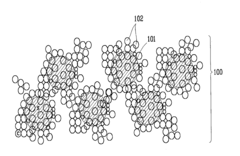
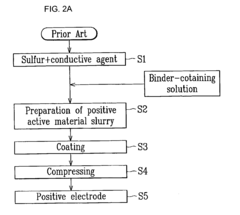
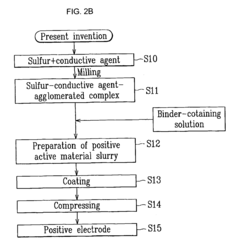
- A sulfur-conductive agent-agglomerated complex is created by attaching conductive agent particles onto sulfur particles with an average size of less than 7 μm, preventing aggregation and enhancing the reactive surface area, achieved through a milling process without adding solvents, and using a binder to maintain the conductive network structure.
High sulfur content copolymers and composite materials and electrochemical cells and optical elements using them
PatentWO2013023216A1
Innovation
- Development of high sulfur content copolymers with ethylenically unsaturated, epoxide, and thiirane monomers, which are polymerized with sulfur to form materials with improved conductivity and stability, enabling the creation of sulfur cathode materials for enhanced electrochemical performance and optical applications.


Safety Standards for Sulfur-Based Energy Storage Systems
The development of comprehensive safety standards for sulfur-based energy storage systems has become increasingly critical as these technologies advance toward commercial deployment. Current regulatory frameworks primarily address conventional lithium-ion batteries, leaving significant gaps in sulfur-specific safety protocols. The unique characteristics of elemental sulfur, including its thermal behavior, chemical reactivity, and potential for hydrogen sulfide generation, necessitate specialized safety considerations that extend beyond traditional battery safety measures.
Thermal management represents a fundamental aspect of sulfur battery safety standards. Elemental sulfur undergoes phase transitions at relatively low temperatures, with melting occurring around 115°C, which can lead to electrolyte degradation and cell failure. Safety protocols must establish strict temperature monitoring requirements, including multi-point thermal sensing and automated shutdown mechanisms when predetermined temperature thresholds are exceeded. Additionally, standards should mandate thermal runaway prevention systems specifically designed for sulfur chemistry, incorporating both active cooling systems and passive thermal barriers.
Chemical containment and ventilation requirements form another critical component of safety standards. Sulfur-based systems can potentially generate hydrogen sulfide gas under certain failure conditions, presenting both toxicity and flammability hazards. Safety standards must specify minimum ventilation rates, gas detection systems with appropriate alarm thresholds, and emergency response protocols for gas leakage incidents. Containment systems should be designed to prevent sulfur migration and maintain structural integrity under various failure scenarios.
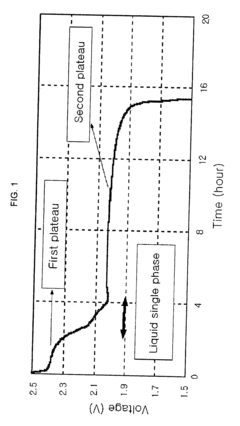
Electrical safety considerations for sulfur-based systems require specialized attention due to the unique electrochemical behavior of sulfur cathodes. Standards should address voltage monitoring protocols that account for the characteristic voltage plateaus of sulfur discharge curves, ensuring accurate state-of-charge determination and preventing over-discharge conditions that could compromise safety. Additionally, insulation requirements must consider the corrosive nature of polysulfide intermediates and their potential impact on electrical components over extended operational periods.
Testing and certification protocols specifically tailored to sulfur-based energy storage systems remain underdeveloped compared to established battery technologies. Safety standards should mandate comprehensive testing procedures including accelerated aging tests under sulfur-specific stress conditions, thermal abuse testing that accounts for sulfur's unique thermal properties, and mechanical integrity assessments that consider the volumetric changes associated with sulfur cycling. These testing protocols must be standardized across manufacturers to ensure consistent safety performance and facilitate regulatory approval processes for commercial deployment.
Thermal management represents a fundamental aspect of sulfur battery safety standards. Elemental sulfur undergoes phase transitions at relatively low temperatures, with melting occurring around 115°C, which can lead to electrolyte degradation and cell failure. Safety protocols must establish strict temperature monitoring requirements, including multi-point thermal sensing and automated shutdown mechanisms when predetermined temperature thresholds are exceeded. Additionally, standards should mandate thermal runaway prevention systems specifically designed for sulfur chemistry, incorporating both active cooling systems and passive thermal barriers.
Chemical containment and ventilation requirements form another critical component of safety standards. Sulfur-based systems can potentially generate hydrogen sulfide gas under certain failure conditions, presenting both toxicity and flammability hazards. Safety standards must specify minimum ventilation rates, gas detection systems with appropriate alarm thresholds, and emergency response protocols for gas leakage incidents. Containment systems should be designed to prevent sulfur migration and maintain structural integrity under various failure scenarios.
Electrical safety considerations for sulfur-based systems require specialized attention due to the unique electrochemical behavior of sulfur cathodes. Standards should address voltage monitoring protocols that account for the characteristic voltage plateaus of sulfur discharge curves, ensuring accurate state-of-charge determination and preventing over-discharge conditions that could compromise safety. Additionally, insulation requirements must consider the corrosive nature of polysulfide intermediates and their potential impact on electrical components over extended operational periods.
Testing and certification protocols specifically tailored to sulfur-based energy storage systems remain underdeveloped compared to established battery technologies. Safety standards should mandate comprehensive testing procedures including accelerated aging tests under sulfur-specific stress conditions, thermal abuse testing that accounts for sulfur's unique thermal properties, and mechanical integrity assessments that consider the volumetric changes associated with sulfur cycling. These testing protocols must be standardized across manufacturers to ensure consistent safety performance and facilitate regulatory approval processes for commercial deployment.
Environmental Impact Assessment of Sulfur Battery Materials
The environmental implications of sulfur battery materials present a complex landscape of both opportunities and challenges that must be carefully evaluated throughout the entire lifecycle of these energy storage systems. Sulfur-based batteries, particularly lithium-sulfur configurations, offer significant environmental advantages compared to conventional lithium-ion technologies, primarily due to sulfur's abundance and relatively benign nature as a raw material.
From a resource extraction perspective, elemental sulfur represents one of the most environmentally favorable cathode materials available for large-scale battery production. Unlike cobalt or nickel mining operations that often involve extensive environmental disruption and social concerns, sulfur is predominantly obtained as a byproduct of petroleum refining and natural gas processing, effectively utilizing waste streams that would otherwise require disposal. This circular approach to material sourcing significantly reduces the environmental footprint associated with primary resource extraction.
The manufacturing phase of sulfur battery materials demonstrates considerably lower carbon intensity compared to traditional battery chemistries. Processing elemental sulfur into battery-grade materials requires minimal energy input and generates fewer toxic byproducts than the complex metallurgical processes needed for transition metal cathodes. However, the incorporation of carbon additives and conductive polymers to address cycle stability challenges introduces additional environmental considerations, particularly regarding the sourcing and processing of these supporting materials.
During operational deployment, sulfur batteries contribute positively to environmental sustainability through their potential for higher energy density and reduced material intensity per unit of stored energy. The absence of critical metals like cobalt and reduced reliance on lithium compared to conventional systems alleviates pressure on environmentally sensitive mining regions and reduces supply chain-related environmental impacts.
End-of-life management presents unique opportunities for sulfur battery systems, as elemental sulfur can be readily recovered and reprocessed without complex hydrometallurgical treatments. The recyclability of sulfur materials approaches near-complete recovery rates, enabling closed-loop material flows that minimize waste generation and reduce demand for virgin materials. This characteristic positions sulfur batteries as particularly attractive for applications where environmental stewardship is paramount, such as grid-scale energy storage supporting renewable energy integration.
From a resource extraction perspective, elemental sulfur represents one of the most environmentally favorable cathode materials available for large-scale battery production. Unlike cobalt or nickel mining operations that often involve extensive environmental disruption and social concerns, sulfur is predominantly obtained as a byproduct of petroleum refining and natural gas processing, effectively utilizing waste streams that would otherwise require disposal. This circular approach to material sourcing significantly reduces the environmental footprint associated with primary resource extraction.
The manufacturing phase of sulfur battery materials demonstrates considerably lower carbon intensity compared to traditional battery chemistries. Processing elemental sulfur into battery-grade materials requires minimal energy input and generates fewer toxic byproducts than the complex metallurgical processes needed for transition metal cathodes. However, the incorporation of carbon additives and conductive polymers to address cycle stability challenges introduces additional environmental considerations, particularly regarding the sourcing and processing of these supporting materials.
During operational deployment, sulfur batteries contribute positively to environmental sustainability through their potential for higher energy density and reduced material intensity per unit of stored energy. The absence of critical metals like cobalt and reduced reliance on lithium compared to conventional systems alleviates pressure on environmentally sensitive mining regions and reduces supply chain-related environmental impacts.
End-of-life management presents unique opportunities for sulfur battery systems, as elemental sulfur can be readily recovered and reprocessed without complex hydrometallurgical treatments. The recyclability of sulfur materials approaches near-complete recovery rates, enabling closed-loop material flows that minimize waste generation and reduce demand for virgin materials. This characteristic positions sulfur batteries as particularly attractive for applications where environmental stewardship is paramount, such as grid-scale energy storage supporting renewable energy integration.
Unlock deeper insights with Patsnap Eureka Quick Research — get a full tech report to explore trends and direct your research. Try now!
Generate Your Research Report Instantly with AI Agent
Supercharge your innovation with Patsnap Eureka AI Agent Platform!