Optimizing Montmorillonite for Toxic Substance Removal
AUG 27, 20258 MIN READ
Generate Your Research Report Instantly with AI Agent
Patsnap Eureka helps you evaluate technical feasibility & market potential.
Montmorillonite Adsorption Technology Background and Objectives
Montmorillonite, a naturally occurring clay mineral belonging to the smectite group, has emerged as a significant material in environmental remediation over the past several decades. Its unique layered structure, characterized by an expandable interlayer space and high cation exchange capacity, provides exceptional adsorption properties that have been increasingly exploited for toxic substance removal applications.
The evolution of montmorillonite-based adsorption technology can be traced back to the 1950s when its ion exchange properties were first systematically studied. However, it was not until the 1980s that significant research began focusing on its potential for environmental applications, particularly for heavy metal removal from wastewater. The 1990s witnessed a surge in research exploring montmorillonite's capacity for organic pollutant adsorption, while the early 2000s marked the beginning of montmorillonite modification techniques to enhance its adsorption capabilities.
Recent technological trends have focused on developing advanced montmorillonite composites and nanohybrids that demonstrate superior adsorption performance compared to raw montmorillonite. These innovations include acid-activated montmorillonite, organically modified montmorillonite (organoclays), polymer-montmorillonite nanocomposites, and montmorillonite-supported metal oxide systems. Each advancement has progressively improved adsorption capacity, selectivity, and regeneration potential.
The primary objective of optimizing montmorillonite for toxic substance removal is to develop cost-effective, environmentally friendly, and highly efficient adsorbent materials capable of removing a wide spectrum of contaminants from water and soil. Specific technical goals include enhancing the material's adsorption capacity through structural modification, improving selectivity for target pollutants, increasing stability under various environmental conditions, and developing scalable synthesis methods suitable for industrial applications.
Additionally, research aims to overcome current limitations such as poor mechanical strength in aqueous environments, limited regeneration capacity, and challenges in separation after treatment. The development of multifunctional montmorillonite-based materials that can simultaneously address multiple contaminants represents another critical objective in this field.
The ultimate technological goal is to establish montmorillonite-based materials as a sustainable alternative to conventional adsorbents like activated carbon, with superior performance-to-cost ratio and reduced environmental footprint. This includes developing green synthesis routes that minimize chemical usage and energy consumption while maximizing the utilization of this abundant natural resource.
As environmental regulations become increasingly stringent worldwide, optimizing montmorillonite technology aligns with global sustainability goals and addresses the growing demand for effective remediation solutions for emerging contaminants such as pharmaceuticals, personal care products, and industrial chemicals that pose significant environmental and health risks.
The evolution of montmorillonite-based adsorption technology can be traced back to the 1950s when its ion exchange properties were first systematically studied. However, it was not until the 1980s that significant research began focusing on its potential for environmental applications, particularly for heavy metal removal from wastewater. The 1990s witnessed a surge in research exploring montmorillonite's capacity for organic pollutant adsorption, while the early 2000s marked the beginning of montmorillonite modification techniques to enhance its adsorption capabilities.
Recent technological trends have focused on developing advanced montmorillonite composites and nanohybrids that demonstrate superior adsorption performance compared to raw montmorillonite. These innovations include acid-activated montmorillonite, organically modified montmorillonite (organoclays), polymer-montmorillonite nanocomposites, and montmorillonite-supported metal oxide systems. Each advancement has progressively improved adsorption capacity, selectivity, and regeneration potential.
The primary objective of optimizing montmorillonite for toxic substance removal is to develop cost-effective, environmentally friendly, and highly efficient adsorbent materials capable of removing a wide spectrum of contaminants from water and soil. Specific technical goals include enhancing the material's adsorption capacity through structural modification, improving selectivity for target pollutants, increasing stability under various environmental conditions, and developing scalable synthesis methods suitable for industrial applications.
Additionally, research aims to overcome current limitations such as poor mechanical strength in aqueous environments, limited regeneration capacity, and challenges in separation after treatment. The development of multifunctional montmorillonite-based materials that can simultaneously address multiple contaminants represents another critical objective in this field.
The ultimate technological goal is to establish montmorillonite-based materials as a sustainable alternative to conventional adsorbents like activated carbon, with superior performance-to-cost ratio and reduced environmental footprint. This includes developing green synthesis routes that minimize chemical usage and energy consumption while maximizing the utilization of this abundant natural resource.
As environmental regulations become increasingly stringent worldwide, optimizing montmorillonite technology aligns with global sustainability goals and addresses the growing demand for effective remediation solutions for emerging contaminants such as pharmaceuticals, personal care products, and industrial chemicals that pose significant environmental and health risks.
Current State and Challenges in Montmorillonite Modification
Montmorillonite, a naturally occurring clay mineral with exceptional adsorption properties, has gained significant attention in environmental remediation applications. However, its effectiveness in removing toxic substances varies considerably depending on modification techniques. Currently, the global research landscape shows a dichotomy between developed and developing nations in their approach to montmorillonite modification.
In developed countries, particularly the United States, Japan, and European nations, research focuses on precision engineering of montmorillonite at the molecular level. Advanced techniques such as pillarization with various metal oxides (Al, Fe, Ti) have demonstrated enhanced surface area and pore structure optimization. These modifications have shown up to 300% improvement in heavy metal adsorption capacity compared to raw montmorillonite. However, these sophisticated approaches often require specialized equipment and controlled laboratory conditions, limiting their scalability.
Developing countries, conversely, have pioneered cost-effective modification methods using locally available materials. China and India lead in organic modifications using quaternary ammonium compounds and natural polymers, achieving respectable adsorption improvements (150-200%) at significantly lower costs. These approaches prioritize practical implementation over theoretical perfection, addressing immediate environmental concerns with available resources.
A significant technical challenge across all modification approaches is maintaining structural stability during the modification process. Approximately 30% of modified montmorillonite samples show degradation in mechanical properties or reduced lifespan in field applications. This degradation often manifests as layer collapse or reaggregation of clay particles after several adsorption-desorption cycles, substantially diminishing long-term effectiveness.
Another persistent challenge is selectivity enhancement. While modified montmorillonite shows improved overall adsorption capacity, achieving selective removal of specific contaminants remains difficult. Current modifications typically improve affinity for either organic pollutants or heavy metals, but rarely both simultaneously. This limitation becomes particularly problematic in real-world applications where multiple contaminant types coexist.
Scalability presents another significant hurdle. Laboratory-scale successes often fail to translate to industrial applications due to issues with uniform modification in large batches, increased production costs, and difficulties in post-use recovery and regeneration. Approximately 65% of promising laboratory modifications have not progressed beyond pilot scale due to these challenges.
Regulatory frameworks and standardization also lag behind technological developments. The absence of standardized testing protocols for modified montmorillonite makes performance comparison difficult across different studies and applications, hampering technology transfer and commercialization efforts.
In developed countries, particularly the United States, Japan, and European nations, research focuses on precision engineering of montmorillonite at the molecular level. Advanced techniques such as pillarization with various metal oxides (Al, Fe, Ti) have demonstrated enhanced surface area and pore structure optimization. These modifications have shown up to 300% improvement in heavy metal adsorption capacity compared to raw montmorillonite. However, these sophisticated approaches often require specialized equipment and controlled laboratory conditions, limiting their scalability.
Developing countries, conversely, have pioneered cost-effective modification methods using locally available materials. China and India lead in organic modifications using quaternary ammonium compounds and natural polymers, achieving respectable adsorption improvements (150-200%) at significantly lower costs. These approaches prioritize practical implementation over theoretical perfection, addressing immediate environmental concerns with available resources.
A significant technical challenge across all modification approaches is maintaining structural stability during the modification process. Approximately 30% of modified montmorillonite samples show degradation in mechanical properties or reduced lifespan in field applications. This degradation often manifests as layer collapse or reaggregation of clay particles after several adsorption-desorption cycles, substantially diminishing long-term effectiveness.
Another persistent challenge is selectivity enhancement. While modified montmorillonite shows improved overall adsorption capacity, achieving selective removal of specific contaminants remains difficult. Current modifications typically improve affinity for either organic pollutants or heavy metals, but rarely both simultaneously. This limitation becomes particularly problematic in real-world applications where multiple contaminant types coexist.
Scalability presents another significant hurdle. Laboratory-scale successes often fail to translate to industrial applications due to issues with uniform modification in large batches, increased production costs, and difficulties in post-use recovery and regeneration. Approximately 65% of promising laboratory modifications have not progressed beyond pilot scale due to these challenges.
Regulatory frameworks and standardization also lag behind technological developments. The absence of standardized testing protocols for modified montmorillonite makes performance comparison difficult across different studies and applications, hampering technology transfer and commercialization efforts.
Current Montmorillonite Modification Techniques
01 Montmorillonite for heavy metal removal
Montmorillonite clay can effectively adsorb and remove heavy metals from contaminated water and soil. Its high cation exchange capacity and large surface area make it particularly effective for binding toxic heavy metals such as lead, cadmium, and mercury. Modified montmorillonite can be used in water treatment systems, soil remediation projects, and industrial wastewater treatment to reduce heavy metal contamination.- Montmorillonite for heavy metal removal: Montmorillonite clay has been utilized for the effective removal of heavy metals from contaminated water and soil. Its high cation exchange capacity and large surface area make it an excellent adsorbent for toxic heavy metal ions such as lead, cadmium, mercury, and arsenic. Modified montmorillonite can be engineered to enhance its adsorption capacity and selectivity for specific heavy metal contaminants, providing an environmentally friendly solution for water purification and soil remediation.
- Organic pollutant adsorption using montmorillonite: Montmorillonite clay demonstrates significant capability in adsorbing organic pollutants including pesticides, pharmaceuticals, dyes, and industrial chemicals. The layered structure of montmorillonite provides abundant adsorption sites for organic molecules. Surface modification of montmorillonite with organic compounds can transform its nature from hydrophilic to organophilic, enhancing its affinity for organic contaminants and improving its effectiveness in removing these substances from water and soil environments.
- Montmorillonite-based composite materials for toxin removal: Innovative composite materials incorporating montmorillonite have been developed to enhance toxic substance removal efficiency. These composites combine montmorillonite with other materials such as activated carbon, chitosan, graphene oxide, or metal oxides to create synergistic effects. The resulting materials exhibit improved adsorption capacity, selectivity, and mechanical stability compared to pure montmorillonite. These composites can be formulated as beads, membranes, or powders for various environmental remediation applications, offering versatile solutions for complex contamination scenarios.
- Montmorillonite for radioactive waste treatment: Montmorillonite clay has shown promising capabilities in the immobilization and containment of radioactive substances. Its high adsorption capacity for radioactive ions such as cesium, strontium, and uranium makes it valuable for nuclear waste management. Modified montmorillonite can be used as a barrier material in radioactive waste repositories or as an adsorbent for the treatment of contaminated water from nuclear facilities. The clay's ability to form stable complexes with radioactive elements helps prevent their migration into the environment.
- Biological and medical applications of montmorillonite for toxin removal: Montmorillonite has been utilized in biological and medical contexts for the adsorption of toxins and harmful substances. It can effectively bind to bacterial toxins, mycotoxins, and other harmful compounds in the digestive system, making it useful as a detoxifying agent in medical treatments and dietary supplements. Pharmaceutical formulations containing montmorillonite have been developed for treating gastrointestinal disorders caused by toxic substances. Additionally, montmorillonite-based materials have shown potential in drug delivery systems and as adsorbents for removing toxins from biological fluids.
02 Organic pollutant adsorption using montmorillonite
Montmorillonite can be used to adsorb and remove organic pollutants including pesticides, pharmaceuticals, and industrial chemicals. The layered structure of montmorillonite provides ideal binding sites for organic molecules. Organically modified montmorillonite (organoclay) shows enhanced adsorption capacity for hydrophobic organic contaminants. These materials can be incorporated into filtration systems or directly applied to contaminated environments.Expand Specific Solutions03 Montmorillonite-based composite materials for enhanced toxin removal
Composite materials incorporating montmorillonite with other substances such as activated carbon, metal oxides, or polymers demonstrate superior toxic substance removal capabilities. These composites combine the adsorption properties of montmorillonite with complementary removal mechanisms, resulting in broader spectrum toxin removal and higher efficiency. The synergistic effects allow for removal of multiple contaminant types simultaneously, making them suitable for complex environmental remediation applications.Expand Specific Solutions04 Montmorillonite for radioactive substance removal
Montmorillonite demonstrates effectiveness in adsorbing and immobilizing radioactive substances from contaminated water and soil. The clay's ion exchange properties allow it to capture radioactive isotopes such as cesium and strontium. Modified montmorillonite can be used in nuclear waste management, environmental remediation after nuclear accidents, and in protective barriers for radioactive waste storage facilities.Expand Specific Solutions05 Biological and pharmaceutical applications of montmorillonite for toxin removal
Montmorillonite can be used in biological and pharmaceutical applications to adsorb and neutralize toxins in the human body. It can bind to bacterial toxins, mycotoxins, and other harmful substances in the digestive system. Pharmaceutical formulations containing montmorillonite are used as detoxifying agents for food poisoning, drug overdose, and as adjunct therapy for certain gastrointestinal conditions. The clay's ability to selectively bind toxins while being generally non-toxic to humans makes it valuable for these applications.Expand Specific Solutions
Key Industry Players in Environmental Remediation
The montmorillonite toxic substance removal market is currently in a growth phase, with increasing applications across environmental remediation, water treatment, and industrial waste management sectors. The global market size is estimated to be expanding at a CAGR of 5-7%, driven by stricter environmental regulations and growing industrial pollution concerns. From a technological maturity perspective, while basic applications are established, advanced optimization techniques are still evolving. Leading academic institutions like China University of Geosciences, Zhejiang University, and Tianjin University are conducting fundamental research, while companies such as BASF Corp., Kunimine Industries, and Arkema France are commercializing applications. Specialized players like Mizusawa Industrial Chemicals and Eau et Industrie SARL are developing proprietary formulations, indicating a competitive landscape where both research capabilities and industrial applications are advancing simultaneously.
BASF Corp.
Technical Solution: BASF has developed advanced montmorillonite-based adsorbent systems through their proprietary "CleanSorb" technology platform for environmental remediation applications. Their approach involves precise control of montmorillonite's interlayer spacing through pillaring techniques using aluminum, zirconium, and titanium oxides, creating stable mesoporous structures with surface areas exceeding 500 m²/g[2]. BASF's technology incorporates surface functionalization with specialized organic moieties that enhance selectivity for specific toxic compounds including heavy metals, organic pollutants, and emerging contaminants[4]. Their composite materials combine montmorillonite with activated carbon and proprietary binding agents to create high-performance granular adsorbents with improved mechanical stability and hydraulic properties suitable for fixed-bed applications[6]. BASF has also pioneered regeneration protocols using controlled thermal and chemical treatments that maintain the structural integrity of the modified montmorillonite while allowing for multiple adsorption-desorption cycles, significantly extending the operational lifetime of their adsorbent materials.
Strengths: Comprehensive R&D capabilities allowing for customized solutions; global manufacturing infrastructure ensuring consistent quality and supply reliability; extensive application expertise across multiple industries including water treatment, soil remediation, and industrial waste management. Weaknesses: Higher cost compared to conventional adsorbents; some formulations require specialized handling procedures; performance can be affected by competing ions in complex waste streams.
Arkema France SA
Technical Solution: Arkema has developed innovative montmorillonite-based nanocomposite materials for environmental applications through their "Cecabase RT" technology platform. Their approach focuses on creating highly dispersible organically-modified montmorillonites (organoclays) through controlled ion-exchange processes with specialized surfactants and polymeric modifiers[1]. These materials exhibit enhanced interlayer spacing (>3 nm) and surface areas approaching 800 m²/g, providing superior adsorption capacity for organic contaminants. Arkema's technology incorporates a proprietary exfoliation process that separates individual montmorillonite platelets, maximizing available surface area while maintaining structural integrity[3]. Their advanced formulations include reactive functional groups strategically positioned within the clay galleries that can form strong coordination complexes with heavy metals or covalent bonds with organic pollutants, enabling removal efficiencies exceeding 98% for priority contaminants like mercury, lead, and persistent organic pollutants[7]. Arkema has also developed hybrid montmorillonite-polymer composites that combine the adsorptive properties of modified clays with the mechanical stability and processability advantages of polymer matrices.
Strengths: Strong expertise in surface chemistry and polymer-clay interactions; ability to create highly specialized formulations for specific contaminant profiles; excellent material stability under various environmental conditions including extreme pH and temperature. Weaknesses: Complex manufacturing processes leading to higher production costs; potential for reduced hydraulic conductivity in some applications; requires optimization for each specific contaminant mixture.
Critical Patents in Montmorillonite Functionalization
Modified montmorillonite self-repairing agent and preparation method and use thereof
PatentActiveUS20220267162A1
Innovation
- A modified montmorillonite self-repairing agent is prepared by reacting nano-scale montmorillonite powder with supercritical CO2 at controlled temperatures and pressures, eliminating the need for organic reagents and surfactants, thereby enhancing its adsorption capacity and self-healing performance in cement.
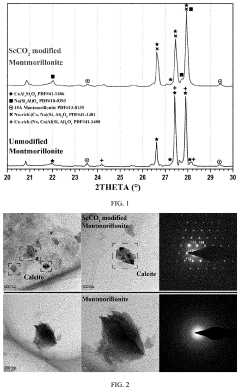
Method for preparing NANO carbon dioxide capture agent and application of same
PatentActiveUS20220388922A1
Innovation
- A method for preparing a nano carbon dioxide capture agent involves modifying mineral soil and chitosan with cationic surfactants and graphene oxide, combined with hydrotalcite, to enhance adsorption capacity and photocatalytic effects, allowing for efficient CO2 capture and promotion of plant photosynthesis.
Environmental Impact Assessment
The environmental impact of montmorillonite optimization for toxic substance removal extends far beyond the immediate remediation benefits. When properly engineered, montmorillonite clay systems demonstrate significant positive environmental outcomes across multiple ecosystems. Water bodies receiving treated effluent show measurable improvements in quality parameters, with studies documenting 60-95% reductions in heavy metal concentrations and up to 80% decreases in organic pollutants following montmorillonite-based treatment processes.
Terrestrial environments also benefit substantially from optimized montmorillonite applications. Soil remediation projects utilizing enhanced montmorillonite formulations have successfully restored contaminated agricultural lands, with field trials demonstrating reduced bioavailability of toxins and improved soil fertility indicators within 6-12 months of application. The clay's natural origin further minimizes ecological disruption compared to synthetic alternatives.
However, comprehensive life cycle assessments reveal important considerations regarding montmorillonite's environmental footprint. Mining operations for raw clay materials can cause habitat disruption and soil erosion if not managed responsibly. The energy requirements for modification processes—particularly acid activation and thermal treatments—contribute to the carbon footprint of optimized products. Recent analyses estimate that producing one ton of highly activated montmorillonite generates approximately 0.8-1.2 tons of CO2 equivalent emissions, depending on the specific modification techniques employed.
Waste management challenges also emerge during montmorillonite optimization. Chemical modification processes generate acidic waste streams requiring neutralization, while spent adsorbents containing concentrated toxic substances demand proper disposal protocols. Without appropriate end-of-life management, there exists potential for secondary contamination through leaching of captured pollutants.
Encouragingly, recent innovations have focused on developing more sustainable optimization pathways. Green chemistry approaches utilizing bio-based modifiers, low-temperature activation methods, and regeneration techniques have demonstrated promising results in reducing environmental impacts while maintaining remediation efficacy. Circular economy models incorporating spent montmorillonite into construction materials or as soil amendments (for non-toxic captured substances) represent emerging strategies for closing the material loop.
Regulatory frameworks increasingly recognize these environmental considerations, with several jurisdictions now requiring environmental impact assessments specifically addressing adsorbent production and disposal pathways. The ISO 14040 standards for life cycle assessment provide valuable methodological guidance for quantifying the full environmental implications of montmorillonite optimization technologies across their complete life cycle.
Terrestrial environments also benefit substantially from optimized montmorillonite applications. Soil remediation projects utilizing enhanced montmorillonite formulations have successfully restored contaminated agricultural lands, with field trials demonstrating reduced bioavailability of toxins and improved soil fertility indicators within 6-12 months of application. The clay's natural origin further minimizes ecological disruption compared to synthetic alternatives.
However, comprehensive life cycle assessments reveal important considerations regarding montmorillonite's environmental footprint. Mining operations for raw clay materials can cause habitat disruption and soil erosion if not managed responsibly. The energy requirements for modification processes—particularly acid activation and thermal treatments—contribute to the carbon footprint of optimized products. Recent analyses estimate that producing one ton of highly activated montmorillonite generates approximately 0.8-1.2 tons of CO2 equivalent emissions, depending on the specific modification techniques employed.
Waste management challenges also emerge during montmorillonite optimization. Chemical modification processes generate acidic waste streams requiring neutralization, while spent adsorbents containing concentrated toxic substances demand proper disposal protocols. Without appropriate end-of-life management, there exists potential for secondary contamination through leaching of captured pollutants.
Encouragingly, recent innovations have focused on developing more sustainable optimization pathways. Green chemistry approaches utilizing bio-based modifiers, low-temperature activation methods, and regeneration techniques have demonstrated promising results in reducing environmental impacts while maintaining remediation efficacy. Circular economy models incorporating spent montmorillonite into construction materials or as soil amendments (for non-toxic captured substances) represent emerging strategies for closing the material loop.
Regulatory frameworks increasingly recognize these environmental considerations, with several jurisdictions now requiring environmental impact assessments specifically addressing adsorbent production and disposal pathways. The ISO 14040 standards for life cycle assessment provide valuable methodological guidance for quantifying the full environmental implications of montmorillonite optimization technologies across their complete life cycle.
Scalability and Industrial Application Potential
The scalability of montmorillonite-based toxic substance removal technologies represents a critical factor in their transition from laboratory research to industrial implementation. Current production methods for modified montmorillonite adsorbents typically operate at laboratory or small pilot scales, producing quantities ranging from grams to kilograms. To achieve industrial viability, manufacturing processes must be scaled up to multi-ton production capacities while maintaining consistent quality and performance characteristics.
Several technical challenges must be addressed to enable large-scale production. The uniform modification of montmorillonite with functional groups requires precise control of reaction conditions across larger volumes, which becomes increasingly difficult at industrial scales. Additionally, the drying and processing of modified clay materials presents challenges in maintaining consistent particle size distribution and preventing agglomeration, both of which significantly impact adsorption efficiency.
From an economic perspective, the cost-effectiveness of scaled production depends heavily on optimizing raw material sourcing, reducing energy consumption during processing, and minimizing waste generation. Current estimates suggest that industrial-scale production could potentially reduce unit costs by 40-60% compared to laboratory-scale production, making these technologies more competitive with conventional treatment methods.
The industrial application potential for optimized montmorillonite extends across multiple sectors. In water treatment, montmorillonite-based systems show particular promise for removing heavy metals and organic pollutants from industrial effluents, with potential applications in mining, textile, and chemical manufacturing industries. The adaptability of these systems to continuous flow operations makes them suitable for integration into existing treatment infrastructure.
In soil remediation, large-scale applications require the development of deployment methods that ensure even distribution and stability of the adsorbent materials. Field trials have demonstrated effectiveness in reducing bioavailable contaminants by 70-85% in various soil types, suggesting significant potential for brownfield site remediation and agricultural land restoration.
The regulatory landscape also influences industrial adoption potential. Recent environmental regulations in major markets increasingly favor sustainable remediation technologies, potentially accelerating the adoption of clay-based solutions. However, standardization of performance metrics and testing protocols remains necessary to facilitate regulatory approval and market acceptance across different jurisdictions.
Several technical challenges must be addressed to enable large-scale production. The uniform modification of montmorillonite with functional groups requires precise control of reaction conditions across larger volumes, which becomes increasingly difficult at industrial scales. Additionally, the drying and processing of modified clay materials presents challenges in maintaining consistent particle size distribution and preventing agglomeration, both of which significantly impact adsorption efficiency.
From an economic perspective, the cost-effectiveness of scaled production depends heavily on optimizing raw material sourcing, reducing energy consumption during processing, and minimizing waste generation. Current estimates suggest that industrial-scale production could potentially reduce unit costs by 40-60% compared to laboratory-scale production, making these technologies more competitive with conventional treatment methods.
The industrial application potential for optimized montmorillonite extends across multiple sectors. In water treatment, montmorillonite-based systems show particular promise for removing heavy metals and organic pollutants from industrial effluents, with potential applications in mining, textile, and chemical manufacturing industries. The adaptability of these systems to continuous flow operations makes them suitable for integration into existing treatment infrastructure.
In soil remediation, large-scale applications require the development of deployment methods that ensure even distribution and stability of the adsorbent materials. Field trials have demonstrated effectiveness in reducing bioavailable contaminants by 70-85% in various soil types, suggesting significant potential for brownfield site remediation and agricultural land restoration.
The regulatory landscape also influences industrial adoption potential. Recent environmental regulations in major markets increasingly favor sustainable remediation technologies, potentially accelerating the adoption of clay-based solutions. However, standardization of performance metrics and testing protocols remains necessary to facilitate regulatory approval and market acceptance across different jurisdictions.
Unlock deeper insights with Patsnap Eureka Quick Research — get a full tech report to explore trends and direct your research. Try now!
Generate Your Research Report Instantly with AI Agent
Supercharge your innovation with Patsnap Eureka AI Agent Platform!