Optimizing Predictive Modelling in Thorium Reactor Designs
APR 1, 20269 MIN READ
Generate Your Research Report Instantly with AI Agent
PatSnap Eureka helps you evaluate technical feasibility & market potential.
Thorium Reactor Technology Background and Objectives
Thorium reactor technology represents a paradigm shift in nuclear energy generation, leveraging thorium-232 as a fertile material that can be converted into fissile uranium-233 through neutron absorption. This technology emerged from early nuclear research in the 1960s, with significant contributions from Oak Ridge National Laboratory's Molten Salt Reactor Experiment. Unlike conventional uranium-based reactors, thorium reactors offer inherent safety advantages, reduced long-lived radioactive waste, and enhanced proliferation resistance.
The fundamental principle underlying thorium reactors involves the thorium fuel cycle, where thorium-232 captures neutrons to form thorium-233, which subsequently decays to protactinium-233 and finally to fissile uranium-233. This breeding process enables sustained nuclear reactions while maintaining favorable neutron economics. Various reactor designs have been proposed, including Molten Salt Reactors (MSRs), High-Temperature Gas-Cooled Reactors (HTGRs), and Accelerator-Driven Systems (ADS).
The evolution of thorium reactor technology has been driven by the pursuit of enhanced safety, sustainability, and economic viability. Modern designs incorporate passive safety systems, walk-away safe characteristics, and the ability to consume existing nuclear waste. The liquid fuel nature of many thorium reactor concepts enables online fuel processing and continuous removal of fission products, significantly improving operational flexibility and safety margins.
Current technological objectives focus on optimizing reactor physics, developing advanced materials capable of withstanding harsh operating conditions, and establishing efficient fuel cycle processes. Key challenges include managing the complex neutron spectrum requirements, developing corrosion-resistant materials for molten salt environments, and establishing remote handling technologies for radioactive fuel processing.
The integration of predictive modeling capabilities has become increasingly critical as thorium reactor designs advance toward commercial deployment. Advanced computational tools are essential for optimizing neutron flux distributions, predicting fuel behavior under various operating conditions, and ensuring long-term structural integrity. These modeling capabilities directly support the overarching goal of developing economically competitive, inherently safe thorium-based nuclear power systems that can contribute significantly to global clean energy objectives while addressing concerns about nuclear waste management and proliferation risks.
The fundamental principle underlying thorium reactors involves the thorium fuel cycle, where thorium-232 captures neutrons to form thorium-233, which subsequently decays to protactinium-233 and finally to fissile uranium-233. This breeding process enables sustained nuclear reactions while maintaining favorable neutron economics. Various reactor designs have been proposed, including Molten Salt Reactors (MSRs), High-Temperature Gas-Cooled Reactors (HTGRs), and Accelerator-Driven Systems (ADS).
The evolution of thorium reactor technology has been driven by the pursuit of enhanced safety, sustainability, and economic viability. Modern designs incorporate passive safety systems, walk-away safe characteristics, and the ability to consume existing nuclear waste. The liquid fuel nature of many thorium reactor concepts enables online fuel processing and continuous removal of fission products, significantly improving operational flexibility and safety margins.
Current technological objectives focus on optimizing reactor physics, developing advanced materials capable of withstanding harsh operating conditions, and establishing efficient fuel cycle processes. Key challenges include managing the complex neutron spectrum requirements, developing corrosion-resistant materials for molten salt environments, and establishing remote handling technologies for radioactive fuel processing.
The integration of predictive modeling capabilities has become increasingly critical as thorium reactor designs advance toward commercial deployment. Advanced computational tools are essential for optimizing neutron flux distributions, predicting fuel behavior under various operating conditions, and ensuring long-term structural integrity. These modeling capabilities directly support the overarching goal of developing economically competitive, inherently safe thorium-based nuclear power systems that can contribute significantly to global clean energy objectives while addressing concerns about nuclear waste management and proliferation risks.
Market Demand for Advanced Nuclear Reactor Systems
The global nuclear energy sector is experiencing a renaissance driven by urgent climate commitments and growing energy security concerns. Advanced nuclear reactor systems, particularly thorium-based designs, are gaining significant traction as governments and utilities seek carbon-free baseload power solutions that complement intermittent renewable sources. This renewed interest stems from thorium's abundant availability, enhanced safety characteristics, and reduced long-lived radioactive waste production compared to conventional uranium-fueled reactors.
Market demand for advanced nuclear technologies is being propelled by several converging factors. Aging nuclear fleets in developed nations require replacement with next-generation systems that offer improved safety margins and operational flexibility. Simultaneously, emerging economies are pursuing nuclear power to meet rapidly expanding electricity demands while adhering to international climate agreements. The integration challenges posed by variable renewable energy sources have highlighted nuclear power's critical role in providing grid stability and continuous power generation.
Thorium reactor systems represent a particularly compelling market opportunity due to their inherent safety advantages and fuel cycle benefits. Unlike traditional uranium reactors, thorium-based designs operate at atmospheric pressure and feature passive safety systems that significantly reduce accident risks. These characteristics address public concerns about nuclear safety while offering utilities more predictable operational profiles and reduced insurance costs.
The predictive modeling optimization challenge directly impacts market viability by addressing key commercial barriers. Enhanced modeling capabilities enable more accurate performance predictions, reduced design uncertainties, and accelerated licensing processes. These improvements translate to lower development costs, shorter construction timelines, and improved investor confidence in thorium reactor projects.
Regional market dynamics vary significantly, with countries like India, China, and several European nations actively investing in thorium research programs. India's three-stage nuclear program specifically incorporates thorium utilization as a long-term strategy, creating substantial demand for advanced reactor designs and supporting technologies. China's ambitious nuclear expansion plans include thorium reactor development as part of their comprehensive energy security strategy.
The market potential extends beyond electricity generation to include industrial applications such as process heat for chemical manufacturing, hydrogen production, and desalination. These diverse applications create multiple revenue streams and enhance the economic attractiveness of thorium reactor investments, driving sustained demand for optimized predictive modeling solutions that can accurately forecast performance across various operational scenarios.
Market demand for advanced nuclear technologies is being propelled by several converging factors. Aging nuclear fleets in developed nations require replacement with next-generation systems that offer improved safety margins and operational flexibility. Simultaneously, emerging economies are pursuing nuclear power to meet rapidly expanding electricity demands while adhering to international climate agreements. The integration challenges posed by variable renewable energy sources have highlighted nuclear power's critical role in providing grid stability and continuous power generation.
Thorium reactor systems represent a particularly compelling market opportunity due to their inherent safety advantages and fuel cycle benefits. Unlike traditional uranium reactors, thorium-based designs operate at atmospheric pressure and feature passive safety systems that significantly reduce accident risks. These characteristics address public concerns about nuclear safety while offering utilities more predictable operational profiles and reduced insurance costs.
The predictive modeling optimization challenge directly impacts market viability by addressing key commercial barriers. Enhanced modeling capabilities enable more accurate performance predictions, reduced design uncertainties, and accelerated licensing processes. These improvements translate to lower development costs, shorter construction timelines, and improved investor confidence in thorium reactor projects.
Regional market dynamics vary significantly, with countries like India, China, and several European nations actively investing in thorium research programs. India's three-stage nuclear program specifically incorporates thorium utilization as a long-term strategy, creating substantial demand for advanced reactor designs and supporting technologies. China's ambitious nuclear expansion plans include thorium reactor development as part of their comprehensive energy security strategy.
The market potential extends beyond electricity generation to include industrial applications such as process heat for chemical manufacturing, hydrogen production, and desalination. These diverse applications create multiple revenue streams and enhance the economic attractiveness of thorium reactor investments, driving sustained demand for optimized predictive modeling solutions that can accurately forecast performance across various operational scenarios.
Current State of Thorium Reactor Predictive Modeling
The current landscape of thorium reactor predictive modeling represents a complex intersection of nuclear physics, computational science, and engineering design optimization. Contemporary modeling approaches primarily rely on multi-physics simulation frameworks that integrate neutronics, thermal-hydraulics, and fuel performance calculations. These systems utilize Monte Carlo neutron transport codes such as MCNP and Serpent, coupled with thermal-hydraulic analysis tools like RELAP5 and TRACE, to simulate reactor behavior under various operational scenarios.
Existing predictive models face significant computational challenges due to the unique characteristics of thorium fuel cycles. The Th-232 to U-233 breeding process involves complex neutron capture and decay chains that require sophisticated cross-section libraries and burnup calculations. Current modeling capabilities struggle with accurately predicting the temporal evolution of fissile material inventory and the associated reactivity changes throughout the fuel cycle.
Machine learning integration into thorium reactor modeling remains in its nascent stages, with most applications focusing on surrogate modeling and uncertainty quantification. Neural networks and Gaussian process regression are being explored to accelerate computationally intensive calculations, particularly for real-time reactor monitoring and control system optimization. However, the limited availability of experimental validation data constrains the development of robust data-driven models.
Validation and verification present substantial obstacles in current thorium reactor predictive modeling efforts. The scarcity of operational thorium reactor data, with only limited experience from facilities like the Molten Salt Reactor Experiment, creates significant gaps in model benchmarking capabilities. Most validation efforts rely on critical experiments and small-scale test facilities, which may not fully capture the complex phenomena occurring in full-scale reactor systems.
Current modeling frameworks also grapple with multi-scale phenomena integration, particularly the coupling between microscopic fuel behavior and macroscopic reactor dynamics. The corrosive nature of molten salt environments in many thorium reactor designs introduces additional complexity in predicting material degradation and its impact on reactor performance over extended operational periods.
Despite these challenges, recent advances in high-performance computing and advanced numerical methods are enabling more sophisticated modeling approaches. Coupled multi-physics simulations with improved spatial and temporal resolution are becoming feasible, though computational costs remain prohibitive for routine design optimization applications. The development of reduced-order models and efficient uncertainty propagation techniques represents a critical frontier for enhancing predictive modeling capabilities in thorium reactor design optimization.
Existing predictive models face significant computational challenges due to the unique characteristics of thorium fuel cycles. The Th-232 to U-233 breeding process involves complex neutron capture and decay chains that require sophisticated cross-section libraries and burnup calculations. Current modeling capabilities struggle with accurately predicting the temporal evolution of fissile material inventory and the associated reactivity changes throughout the fuel cycle.
Machine learning integration into thorium reactor modeling remains in its nascent stages, with most applications focusing on surrogate modeling and uncertainty quantification. Neural networks and Gaussian process regression are being explored to accelerate computationally intensive calculations, particularly for real-time reactor monitoring and control system optimization. However, the limited availability of experimental validation data constrains the development of robust data-driven models.
Validation and verification present substantial obstacles in current thorium reactor predictive modeling efforts. The scarcity of operational thorium reactor data, with only limited experience from facilities like the Molten Salt Reactor Experiment, creates significant gaps in model benchmarking capabilities. Most validation efforts rely on critical experiments and small-scale test facilities, which may not fully capture the complex phenomena occurring in full-scale reactor systems.
Current modeling frameworks also grapple with multi-scale phenomena integration, particularly the coupling between microscopic fuel behavior and macroscopic reactor dynamics. The corrosive nature of molten salt environments in many thorium reactor designs introduces additional complexity in predicting material degradation and its impact on reactor performance over extended operational periods.
Despite these challenges, recent advances in high-performance computing and advanced numerical methods are enabling more sophisticated modeling approaches. Coupled multi-physics simulations with improved spatial and temporal resolution are becoming feasible, though computational costs remain prohibitive for routine design optimization applications. The development of reduced-order models and efficient uncertainty propagation techniques represents a critical frontier for enhancing predictive modeling capabilities in thorium reactor design optimization.
Existing Predictive Modeling Solutions for Thorium Systems
01 Machine learning model optimization techniques
Various techniques are employed to optimize machine learning models for improved predictive accuracy. These include hyperparameter tuning, feature selection, and algorithm selection methods. Advanced optimization approaches utilize automated processes to identify optimal model configurations, reducing computational costs while enhancing prediction performance. Cross-validation and ensemble methods are integrated to ensure robust model generalization across different datasets.- Machine learning algorithms for predictive model enhancement: Advanced machine learning techniques including neural networks, deep learning, and ensemble methods are employed to improve the accuracy and efficiency of predictive models. These algorithms can process large datasets, identify complex patterns, and automatically adjust parameters to optimize prediction outcomes. The methods focus on feature selection, model training, and validation processes to enhance predictive capabilities across various applications.
- Data preprocessing and feature engineering techniques: Optimization of predictive models through systematic data preprocessing, including data cleaning, normalization, transformation, and feature extraction methods. These techniques involve handling missing values, removing outliers, scaling variables, and creating new features from existing data to improve model performance. The approach emphasizes the importance of data quality and relevant feature selection in building robust predictive models.
- Hyperparameter tuning and model selection strategies: Systematic approaches for optimizing model hyperparameters through grid search, random search, Bayesian optimization, and automated machine learning techniques. These methods evaluate multiple model configurations to identify optimal settings that maximize predictive accuracy while minimizing computational costs. The strategies include cross-validation techniques and performance metrics evaluation to ensure model generalization.
- Real-time prediction and adaptive learning systems: Implementation of dynamic predictive models that continuously learn and adapt from new data streams in real-time environments. These systems incorporate online learning algorithms, incremental model updates, and feedback mechanisms to maintain prediction accuracy as conditions change. The approach enables models to respond quickly to emerging patterns and evolving data distributions without complete retraining.
- Multi-objective optimization and ensemble modeling: Integration of multiple predictive models and optimization objectives to balance competing goals such as accuracy, interpretability, and computational efficiency. These techniques combine predictions from diverse models through voting, stacking, or weighted averaging methods. The approach addresses trade-offs between different performance metrics and creates more robust predictions by leveraging the strengths of individual models.
02 Data preprocessing and feature engineering for predictive models
Effective data preprocessing and feature engineering are critical for optimizing predictive models. Techniques include data normalization, handling missing values, outlier detection, and dimensionality reduction. Feature extraction methods transform raw data into meaningful representations that improve model training efficiency. Advanced preprocessing pipelines automate data cleaning and transformation processes to ensure high-quality input for predictive algorithms.Expand Specific Solutions03 Neural network architecture optimization
Optimization of neural network architectures involves selecting appropriate layer configurations, activation functions, and network depth. Techniques such as neural architecture search automate the design process to identify optimal network structures. Methods include pruning redundant connections, quantization for reduced computational requirements, and transfer learning to leverage pre-trained models. These approaches enhance both training efficiency and inference speed while maintaining prediction accuracy.Expand Specific Solutions04 Real-time predictive model deployment and monitoring
Deployment strategies focus on implementing predictive models in production environments with continuous monitoring capabilities. This includes model versioning, A/B testing frameworks, and performance tracking systems. Real-time optimization adjusts model parameters based on incoming data streams and feedback loops. Monitoring systems detect model drift and trigger retraining processes to maintain prediction accuracy over time.Expand Specific Solutions05 Multi-objective optimization for predictive modeling
Multi-objective optimization balances competing goals such as accuracy, computational efficiency, and interpretability in predictive models. Techniques employ Pareto optimization to identify trade-offs between different performance metrics. Approaches include weighted objective functions, constraint-based optimization, and evolutionary algorithms. These methods enable practitioners to select models that best meet specific application requirements while considering multiple performance criteria simultaneously.Expand Specific Solutions
Key Players in Thorium Reactor Development Industry
The thorium reactor predictive modeling sector represents an emerging technology domain within the broader nuclear energy landscape, currently in its early developmental stage with significant growth potential driven by increasing demand for clean energy alternatives. The global market remains relatively nascent, estimated in the hundreds of millions, but shows promising expansion trajectories as governments and industries seek safer nuclear technologies. Technology maturity varies considerably across key players, with established nuclear giants like Hitachi-GE Nuclear Energy, Mitsubishi Heavy Industries, and Siemens AG leveraging decades of conventional reactor expertise to advance thorium applications. Chinese entities including China General Nuclear Power Corp., CGN Power, and China Nuclear Power Technology Research Institute demonstrate strong governmental backing and rapid technological advancement. Academic institutions such as Tsinghua University, Shanghai Jiao Tong University, and Huazhong University of Science & Technology contribute fundamental research capabilities. Specialized companies like Thorium Power Inc. focus exclusively on thorium fuel development, while industrial technology providers including Schlumberger and ALD Vacuum Technologies offer supporting infrastructure solutions, creating a diverse ecosystem spanning from pure research to commercial implementation.
Hitachi-GE Nuclear Energy Ltd.
Technical Solution: Hitachi-GE Nuclear Energy has developed comprehensive predictive modeling frameworks for advanced reactor designs, including thorium-based systems. Their approach integrates multi-physics simulation tools combining neutronics, thermal-hydraulics, and structural mechanics to optimize reactor performance. The company employs advanced computational fluid dynamics models coupled with machine learning algorithms to predict reactor behavior under transient conditions. Their SIMULATE-5 code has been adapted for thorium fuel cycle analysis, incorporating burnup-dependent cross-section libraries and advanced nodal methods. The predictive models include real-time monitoring capabilities and digital twin technologies to enhance operational safety and efficiency in next-generation reactor designs including thorium-based configurations.
Strengths: Extensive nuclear industry experience with proven simulation technologies and regulatory approval processes. Weaknesses: Primary focus remains on conventional reactor technologies with limited thorium-specific operational data.
Thorium Power, Inc.
Technical Solution: Thorium Power Inc. specializes in developing advanced thorium-based nuclear reactor designs with integrated predictive modeling capabilities. Their approach combines Monte Carlo neutronics simulations with machine learning algorithms to optimize fuel cycle performance and reactor safety parameters. The company's proprietary THORIMS (Thorium Reactor Integrated Modeling System) utilizes real-time data analytics to predict fuel burnup patterns, criticality margins, and thermal-hydraulic behavior in thorium-uranium fuel cycles. Their predictive models incorporate uncertainty quantification methods to assess reactor performance under various operational scenarios, enabling enhanced safety margins and improved fuel utilization efficiency in thorium molten salt reactor configurations.
Strengths: Specialized expertise in thorium reactor technology with dedicated predictive modeling systems. Weaknesses: Limited operational experience compared to conventional uranium reactor technologies.
Core Innovations in Thorium Reactor Simulation Methods
Rapid Digital Nuclear Reactor Design Using Machine Learning
PatentPendingUS20230237226A1
Innovation
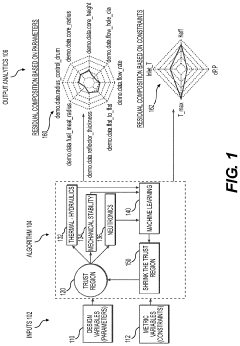
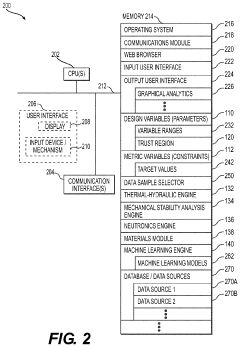
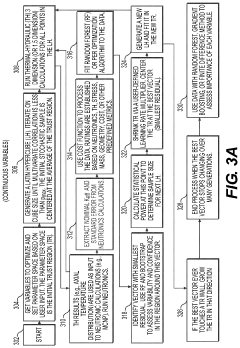
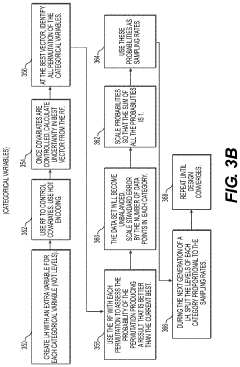
- An AI suite utilizing machine learning algorithms for rapid optimization of design parameters, employing global population-based algorithms and multiphysics analysis to identify optimal design spaces within user-specified constraints, reducing the need for extensive computational resources and expert engineering time.
Predictive Model Construction Method and Prediction Method
PatentActiveUS20210098142A1
Innovation
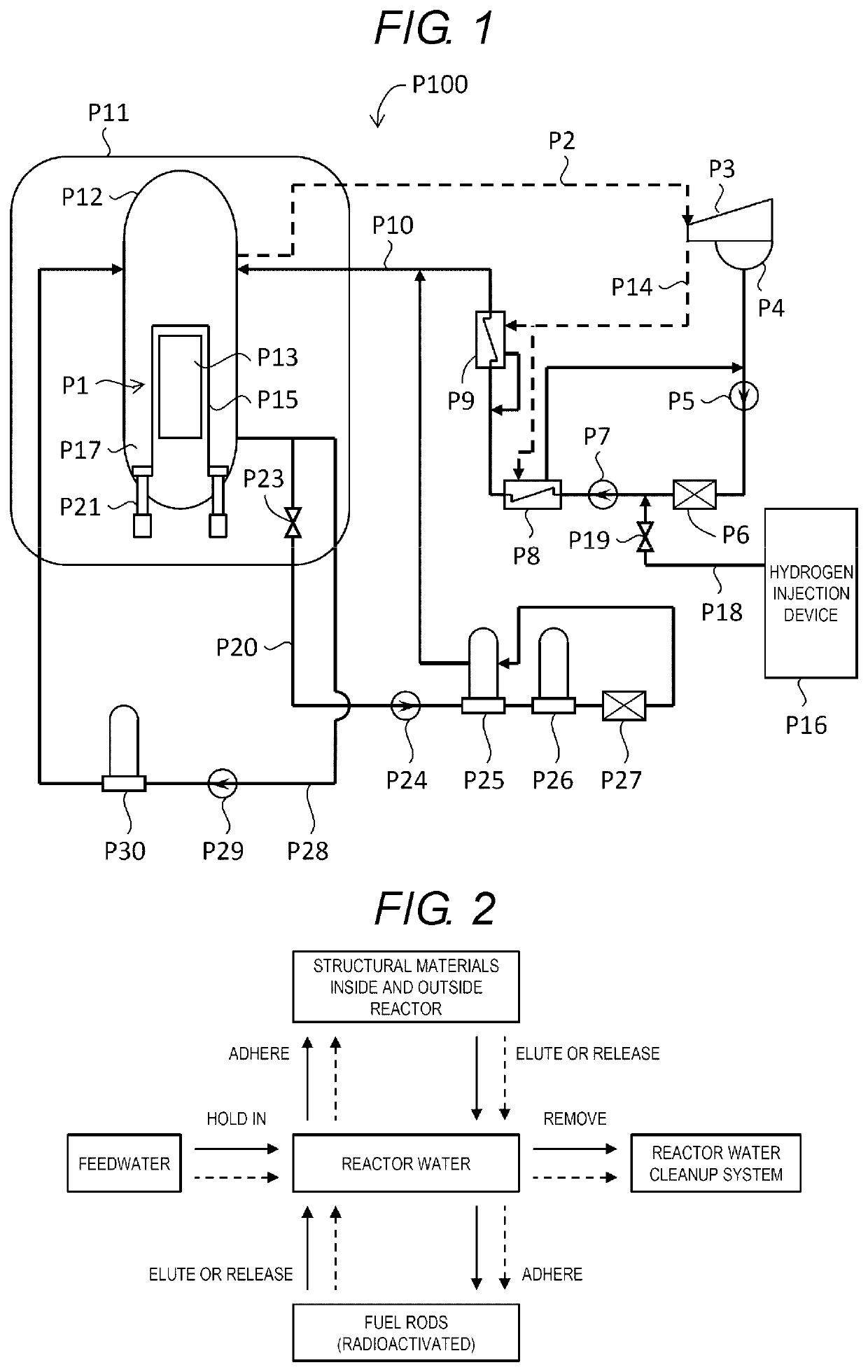
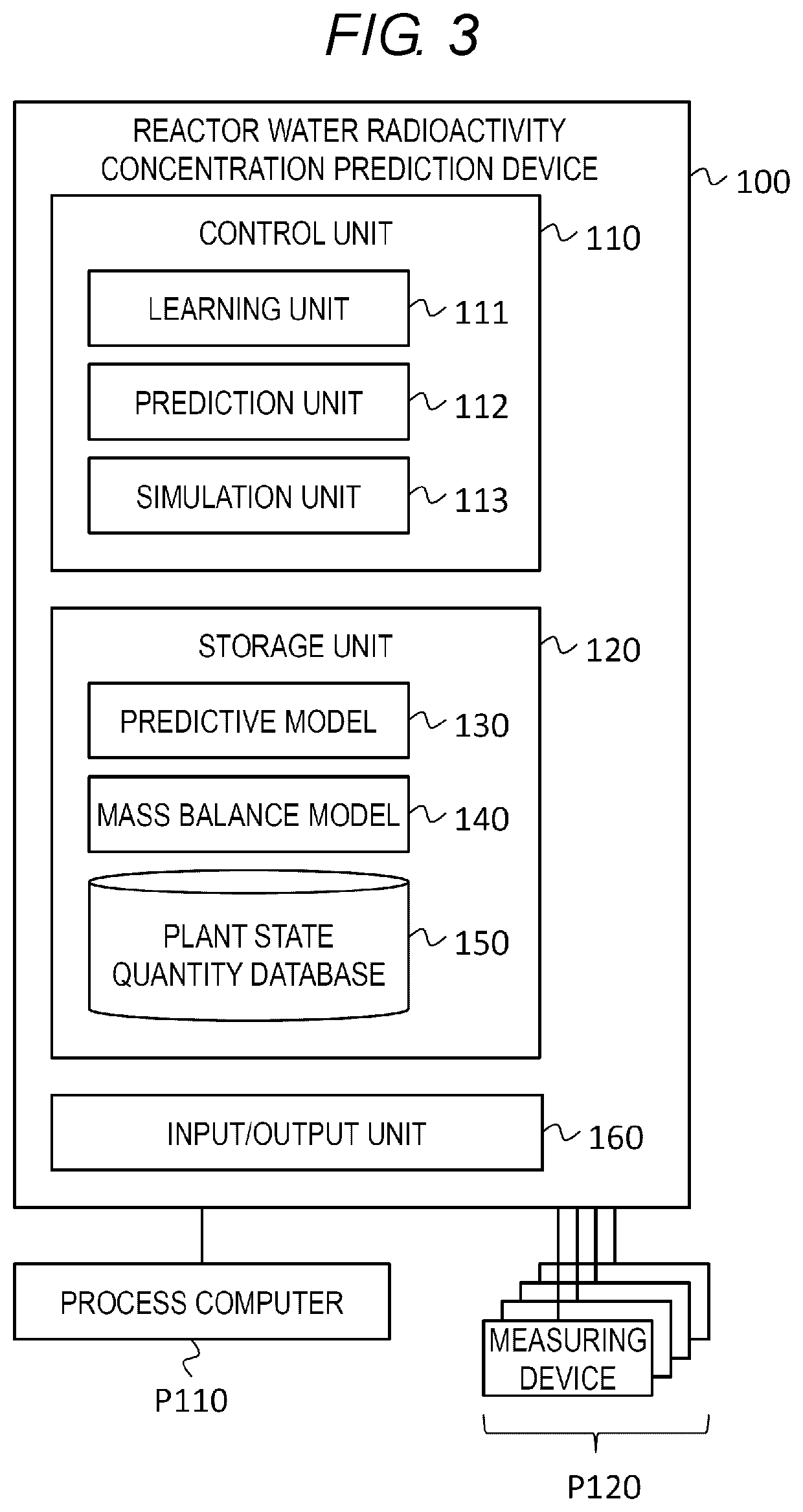
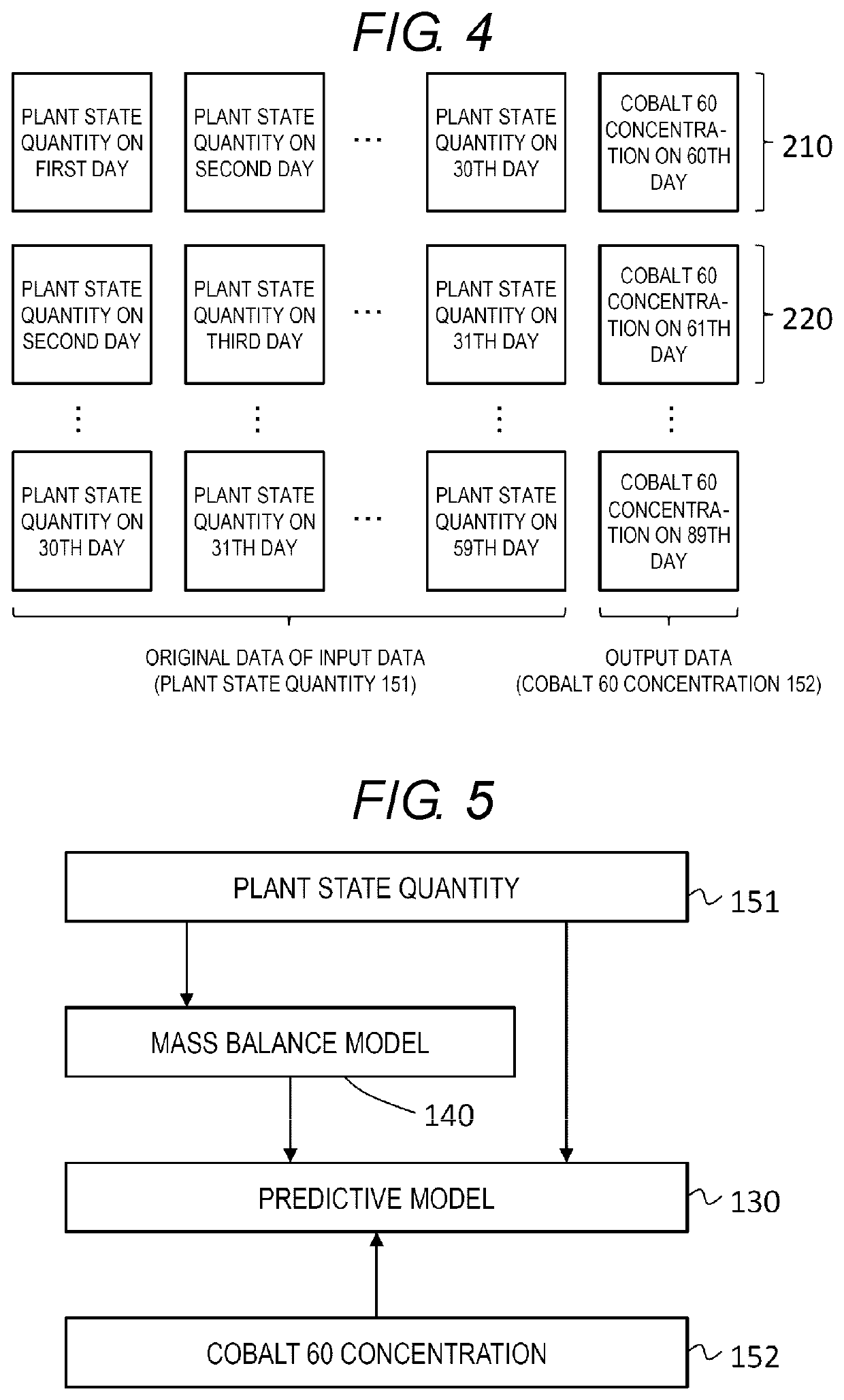
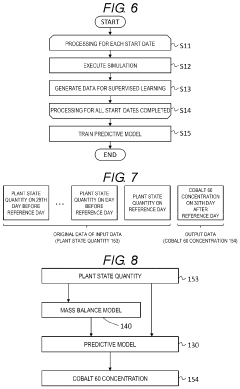
- A predictive model construction method that combines a physical model with machine learning, using supervised learning to predict radioactive metal corrosion product concentrations in reactor water, incorporating input data such as flow rate of feedwater, metal corrosion product concentration, and electrical output, to improve prediction accuracy.
Nuclear Regulatory Framework for Thorium Technologies
The nuclear regulatory framework for thorium technologies represents a critical infrastructure component that directly impacts the optimization of predictive modeling in thorium reactor designs. Current regulatory structures, primarily developed for uranium-based systems, require substantial adaptation to accommodate the unique characteristics and operational parameters of thorium fuel cycles.
Existing regulatory bodies, including the Nuclear Regulatory Commission (NRC) in the United States and the International Atomic Energy Agency (IAEA) globally, are actively developing thorium-specific guidelines. These frameworks establish the foundational requirements for safety analysis, licensing procedures, and operational standards that predictive models must incorporate to ensure regulatory compliance.
The regulatory landscape presents both opportunities and constraints for predictive modeling optimization. Enhanced safety margins required by regulators necessitate more sophisticated modeling approaches, particularly in areas such as neutron flux distribution, fuel burnup calculations, and thermal-hydraulic behavior. These requirements drive the development of higher-fidelity computational models that can demonstrate compliance with stringent safety criteria.
Licensing pathways for thorium technologies vary significantly across jurisdictions, creating complexity for predictive model validation and acceptance. The European Union's approach emphasizes performance-based regulations, while other regions maintain more prescriptive frameworks. This regulatory diversity requires predictive models to be adaptable and capable of meeting multiple regulatory standards simultaneously.
Emerging regulatory trends focus on risk-informed decision-making processes, which rely heavily on probabilistic safety assessments and advanced modeling techniques. This shift toward evidence-based regulation creates opportunities for sophisticated predictive models to play central roles in licensing and operational approval processes.
The integration of digital twin technologies and real-time monitoring systems within regulatory frameworks is reshaping expectations for predictive model capabilities. Regulators increasingly expect continuous model validation against operational data, requiring robust uncertainty quantification and adaptive modeling approaches that can evolve with operational experience and regulatory updates.
Existing regulatory bodies, including the Nuclear Regulatory Commission (NRC) in the United States and the International Atomic Energy Agency (IAEA) globally, are actively developing thorium-specific guidelines. These frameworks establish the foundational requirements for safety analysis, licensing procedures, and operational standards that predictive models must incorporate to ensure regulatory compliance.
The regulatory landscape presents both opportunities and constraints for predictive modeling optimization. Enhanced safety margins required by regulators necessitate more sophisticated modeling approaches, particularly in areas such as neutron flux distribution, fuel burnup calculations, and thermal-hydraulic behavior. These requirements drive the development of higher-fidelity computational models that can demonstrate compliance with stringent safety criteria.
Licensing pathways for thorium technologies vary significantly across jurisdictions, creating complexity for predictive model validation and acceptance. The European Union's approach emphasizes performance-based regulations, while other regions maintain more prescriptive frameworks. This regulatory diversity requires predictive models to be adaptable and capable of meeting multiple regulatory standards simultaneously.
Emerging regulatory trends focus on risk-informed decision-making processes, which rely heavily on probabilistic safety assessments and advanced modeling techniques. This shift toward evidence-based regulation creates opportunities for sophisticated predictive models to play central roles in licensing and operational approval processes.
The integration of digital twin technologies and real-time monitoring systems within regulatory frameworks is reshaping expectations for predictive model capabilities. Regulators increasingly expect continuous model validation against operational data, requiring robust uncertainty quantification and adaptive modeling approaches that can evolve with operational experience and regulatory updates.
Safety Considerations in Thorium Reactor Design Optimization
Safety considerations represent the paramount concern in thorium reactor design optimization, fundamentally shaping every aspect of predictive modeling frameworks. The inherent safety characteristics of thorium fuel cycles, including the inability to sustain chain reactions without external neutron sources and reduced production of long-lived actinides, provide significant advantages over conventional uranium-based systems. However, these benefits must be carefully balanced against unique safety challenges that emerge during optimization processes.
The predictive modeling of thorium reactors must account for complex safety phenomena including thermal hydraulic behavior under transient conditions, neutron flux distribution variations, and material degradation patterns. Advanced computational models integrate probabilistic safety assessment methodologies with deterministic analysis to evaluate accident scenarios and their potential consequences. These models must capture the dynamic interactions between fuel performance, structural integrity, and containment systems under various operational and emergency conditions.
Radiation protection considerations play a critical role in design optimization, particularly regarding the handling of uranium-233 bred from thorium-232. The presence of uranium-232 as a contaminant introduces hard gamma radiation that necessitates enhanced shielding requirements and remote handling capabilities. Predictive models must accurately simulate radiation fields throughout the reactor lifecycle to ensure worker safety and optimize maintenance procedures.
Emergency response planning integration within optimization frameworks requires sophisticated modeling of potential accident progressions and their mitigation strategies. The unique characteristics of thorium fuel behavior during loss-of-coolant accidents, reactivity insertion events, and other design basis accidents must be thoroughly understood and incorporated into safety analysis codes. These models enable the optimization of passive safety systems and emergency core cooling mechanisms specific to thorium reactor designs.
Regulatory compliance considerations significantly influence the optimization process, as existing safety frameworks were primarily developed for uranium-fueled reactors. Predictive models must demonstrate compliance with evolving regulatory standards while accounting for the distinct safety profile of thorium systems. This includes validation of safety margins, demonstration of defense-in-depth principles, and quantification of risk metrics that regulatory bodies require for licensing approval.
The predictive modeling of thorium reactors must account for complex safety phenomena including thermal hydraulic behavior under transient conditions, neutron flux distribution variations, and material degradation patterns. Advanced computational models integrate probabilistic safety assessment methodologies with deterministic analysis to evaluate accident scenarios and their potential consequences. These models must capture the dynamic interactions between fuel performance, structural integrity, and containment systems under various operational and emergency conditions.
Radiation protection considerations play a critical role in design optimization, particularly regarding the handling of uranium-233 bred from thorium-232. The presence of uranium-232 as a contaminant introduces hard gamma radiation that necessitates enhanced shielding requirements and remote handling capabilities. Predictive models must accurately simulate radiation fields throughout the reactor lifecycle to ensure worker safety and optimize maintenance procedures.
Emergency response planning integration within optimization frameworks requires sophisticated modeling of potential accident progressions and their mitigation strategies. The unique characteristics of thorium fuel behavior during loss-of-coolant accidents, reactivity insertion events, and other design basis accidents must be thoroughly understood and incorporated into safety analysis codes. These models enable the optimization of passive safety systems and emergency core cooling mechanisms specific to thorium reactor designs.
Regulatory compliance considerations significantly influence the optimization process, as existing safety frameworks were primarily developed for uranium-fueled reactors. Predictive models must demonstrate compliance with evolving regulatory standards while accounting for the distinct safety profile of thorium systems. This includes validation of safety margins, demonstration of defense-in-depth principles, and quantification of risk metrics that regulatory bodies require for licensing approval.
Unlock deeper insights with PatSnap Eureka Quick Research — get a full tech report to explore trends and direct your research. Try now!
Generate Your Research Report Instantly with AI Agent
Supercharge your innovation with PatSnap Eureka AI Agent Platform!