
Osmotic Power System Vs Battery: Efficiency Comparison
APR 20, 202610 MIN READ
Generate Your Research Report Instantly with AI Agent
Patsnap Eureka helps you evaluate technical feasibility & market potential.
Osmotic Power vs Battery Technology Background and Objectives
The global energy landscape is undergoing a fundamental transformation driven by the urgent need for sustainable power solutions and the limitations of conventional energy storage systems. Traditional battery technologies, while revolutionary in enabling portable electronics and electric vehicles, face inherent constraints including finite energy density, degradation over time, and environmental concerns related to material extraction and disposal. These challenges have intensified the search for alternative energy harvesting and storage mechanisms that can complement or potentially replace battery systems in specific applications.
Osmotic power systems represent an emerging renewable energy technology that harnesses the chemical potential difference between solutions of varying salinity concentrations. This phenomenon, also known as salinity gradient power or blue energy, occurs naturally where freshwater rivers meet seawater, creating a theoretically vast and continuous energy resource. The technology operates on the principle of selective ion transport through specialized membranes, converting the mixing entropy of different salinity solutions directly into electrical energy.
The historical development of osmotic power technology traces back to the 1970s when researchers first recognized the theoretical potential of salinity gradients as an energy source. Early investigations focused on pressure-retarded osmosis and reverse electrodialysis as primary conversion mechanisms. However, practical implementation remained elusive due to membrane limitations, low power densities, and economic viability concerns. Recent advances in nanotechnology, membrane science, and materials engineering have renewed interest in osmotic power systems as a viable renewable energy option.
Battery technology evolution has followed a different trajectory, progressing from early lead-acid systems to modern lithium-ion configurations with increasingly sophisticated chemistries. Contemporary battery research focuses on enhancing energy density, extending cycle life, reducing charging times, and developing sustainable material alternatives. Despite significant improvements, fundamental thermodynamic and kinetic limitations continue to constrain battery performance, particularly in large-scale energy storage applications.
The primary objective of comparing osmotic power systems with battery technology centers on evaluating their respective efficiency characteristics across different operational parameters and application scenarios. This analysis aims to identify the conditions under which each technology demonstrates superior performance, considering factors such as energy conversion efficiency, power density, operational lifetime, and environmental impact. Understanding these comparative advantages is crucial for determining optimal deployment strategies and identifying potential synergies between the two technologies.
Furthermore, this technological assessment seeks to establish benchmarks for future development priorities in both domains. By quantifying efficiency metrics and identifying performance gaps, researchers and engineers can focus their efforts on addressing the most critical limitations while leveraging the inherent strengths of each approach to create more effective energy solutions for diverse applications.
Osmotic power systems represent an emerging renewable energy technology that harnesses the chemical potential difference between solutions of varying salinity concentrations. This phenomenon, also known as salinity gradient power or blue energy, occurs naturally where freshwater rivers meet seawater, creating a theoretically vast and continuous energy resource. The technology operates on the principle of selective ion transport through specialized membranes, converting the mixing entropy of different salinity solutions directly into electrical energy.
The historical development of osmotic power technology traces back to the 1970s when researchers first recognized the theoretical potential of salinity gradients as an energy source. Early investigations focused on pressure-retarded osmosis and reverse electrodialysis as primary conversion mechanisms. However, practical implementation remained elusive due to membrane limitations, low power densities, and economic viability concerns. Recent advances in nanotechnology, membrane science, and materials engineering have renewed interest in osmotic power systems as a viable renewable energy option.
Battery technology evolution has followed a different trajectory, progressing from early lead-acid systems to modern lithium-ion configurations with increasingly sophisticated chemistries. Contemporary battery research focuses on enhancing energy density, extending cycle life, reducing charging times, and developing sustainable material alternatives. Despite significant improvements, fundamental thermodynamic and kinetic limitations continue to constrain battery performance, particularly in large-scale energy storage applications.
The primary objective of comparing osmotic power systems with battery technology centers on evaluating their respective efficiency characteristics across different operational parameters and application scenarios. This analysis aims to identify the conditions under which each technology demonstrates superior performance, considering factors such as energy conversion efficiency, power density, operational lifetime, and environmental impact. Understanding these comparative advantages is crucial for determining optimal deployment strategies and identifying potential synergies between the two technologies.
Furthermore, this technological assessment seeks to establish benchmarks for future development priorities in both domains. By quantifying efficiency metrics and identifying performance gaps, researchers and engineers can focus their efforts on addressing the most critical limitations while leveraging the inherent strengths of each approach to create more effective energy solutions for diverse applications.
Market Demand Analysis for Alternative Energy Storage Solutions
The global energy storage market is experiencing unprecedented growth driven by the urgent need for sustainable and reliable power solutions. Traditional battery technologies, while dominant, face increasing scrutiny regarding environmental impact, resource scarcity, and lifecycle costs. This creates substantial market opportunities for alternative energy storage solutions, particularly osmotic power systems that leverage salinity gradients for energy generation and storage.
Grid-scale energy storage represents the largest market segment, with utilities seeking cost-effective solutions to balance renewable energy intermittency. Osmotic power systems offer unique advantages in coastal regions where seawater and freshwater sources converge naturally. The technology addresses critical market demands for long-duration storage without the degradation issues associated with conventional battery systems.
Industrial applications demonstrate growing interest in osmotic power technology, particularly in sectors requiring continuous, low-maintenance power sources. Manufacturing facilities, data centers, and remote installations increasingly prioritize energy storage solutions with minimal environmental footprint and reduced operational complexity compared to battery systems requiring frequent replacement cycles.
The residential and commercial energy storage markets show emerging demand for alternative technologies as consumers become more environmentally conscious. Osmotic power systems appeal to markets seeking sustainable energy solutions without the toxic materials and disposal challenges inherent in battery technologies. This trend is particularly pronounced in regions with abundant water resources and environmental regulations favoring clean energy alternatives.
Geographic market analysis reveals strongest demand potential in coastal nations and regions with significant salinity differentials. Northern European countries, island nations, and areas with extensive river delta systems present optimal market conditions for osmotic power deployment. These regions often face high energy costs and environmental constraints that make alternative storage solutions economically attractive.
Market barriers include limited public awareness of osmotic power technology and established supply chains favoring battery solutions. However, increasing regulatory pressure on battery disposal and raw material sourcing creates market openings for osmotic systems. The technology's potential for integration with existing water treatment infrastructure presents additional market opportunities in municipal and industrial water management sectors.
Investment trends indicate growing venture capital and government funding directed toward alternative energy storage research. Market demand increasingly emphasizes total cost of ownership rather than initial capital expenditure, favoring technologies with longer operational lifespans and lower maintenance requirements compared to traditional battery systems.
Grid-scale energy storage represents the largest market segment, with utilities seeking cost-effective solutions to balance renewable energy intermittency. Osmotic power systems offer unique advantages in coastal regions where seawater and freshwater sources converge naturally. The technology addresses critical market demands for long-duration storage without the degradation issues associated with conventional battery systems.
Industrial applications demonstrate growing interest in osmotic power technology, particularly in sectors requiring continuous, low-maintenance power sources. Manufacturing facilities, data centers, and remote installations increasingly prioritize energy storage solutions with minimal environmental footprint and reduced operational complexity compared to battery systems requiring frequent replacement cycles.
The residential and commercial energy storage markets show emerging demand for alternative technologies as consumers become more environmentally conscious. Osmotic power systems appeal to markets seeking sustainable energy solutions without the toxic materials and disposal challenges inherent in battery technologies. This trend is particularly pronounced in regions with abundant water resources and environmental regulations favoring clean energy alternatives.
Geographic market analysis reveals strongest demand potential in coastal nations and regions with significant salinity differentials. Northern European countries, island nations, and areas with extensive river delta systems present optimal market conditions for osmotic power deployment. These regions often face high energy costs and environmental constraints that make alternative storage solutions economically attractive.
Market barriers include limited public awareness of osmotic power technology and established supply chains favoring battery solutions. However, increasing regulatory pressure on battery disposal and raw material sourcing creates market openings for osmotic systems. The technology's potential for integration with existing water treatment infrastructure presents additional market opportunities in municipal and industrial water management sectors.
Investment trends indicate growing venture capital and government funding directed toward alternative energy storage research. Market demand increasingly emphasizes total cost of ownership rather than initial capital expenditure, favoring technologies with longer operational lifespans and lower maintenance requirements compared to traditional battery systems.
Current Status and Challenges of Osmotic Power Systems
Osmotic power systems have emerged as a promising renewable energy technology that harnesses the chemical potential difference between saltwater and freshwater to generate electricity. Currently, two primary technologies dominate this field: Pressure Retarded Osmosis (PRO) and Reverse Electrodialysis (RED). PRO systems utilize semi-permeable membranes to allow water molecules to pass from the freshwater side to the saltwater side, creating hydraulic pressure that drives turbines. RED systems employ ion-exchange membranes to capture the energy released when ions move between solutions of different concentrations.
The global development of osmotic power technology remains in its nascent stages, with most installations operating as pilot projects or small-scale demonstration facilities. Norway leads the field with Statkraft's prototype plant, which has achieved power densities of approximately 2.7 W/m² using PRO technology. The Netherlands follows closely with REDstack's RED-based systems, demonstrating power densities around 1.3 W/m². Japan and South Korea have also invested significantly in research facilities, focusing primarily on membrane optimization and system integration challenges.
Despite technological advances, osmotic power systems face substantial efficiency limitations that significantly impact their competitiveness against battery storage solutions. Current PRO systems achieve overall energy conversion efficiencies of only 1-3%, far below the 85-95% round-trip efficiency typical of modern lithium-ion batteries. This low efficiency stems from multiple factors including membrane fouling, concentration polarization, and parasitic energy losses in pumping systems.
Membrane technology represents the most critical bottleneck in osmotic power development. Existing membranes suffer from trade-offs between permeability and selectivity, with high-performance membranes exhibiting power densities insufficient for commercial viability. Fouling remains a persistent challenge, as organic matter, scaling, and biofouling reduce membrane performance over time, requiring frequent cleaning cycles that further diminish overall system efficiency.
Economic viability poses another significant challenge, with current capital costs estimated at $6,000-8,000 per kW installed capacity, substantially higher than battery systems which range from $300-600 per kWh. The intermittent nature of freshwater availability in many coastal regions compounds operational challenges, limiting capacity factors to 40-60% compared to batteries' on-demand availability.
Geographical constraints further limit osmotic power deployment, as systems require proximity to both saltwater sources and substantial freshwater flows. This restricts potential installations to specific coastal regions with river deltas, eliminating vast inland markets where battery systems excel. Additionally, environmental concerns regarding altered salinity levels in discharge waters and potential impacts on marine ecosystems present regulatory hurdles that battery installations typically avoid.
The global development of osmotic power technology remains in its nascent stages, with most installations operating as pilot projects or small-scale demonstration facilities. Norway leads the field with Statkraft's prototype plant, which has achieved power densities of approximately 2.7 W/m² using PRO technology. The Netherlands follows closely with REDstack's RED-based systems, demonstrating power densities around 1.3 W/m². Japan and South Korea have also invested significantly in research facilities, focusing primarily on membrane optimization and system integration challenges.
Despite technological advances, osmotic power systems face substantial efficiency limitations that significantly impact their competitiveness against battery storage solutions. Current PRO systems achieve overall energy conversion efficiencies of only 1-3%, far below the 85-95% round-trip efficiency typical of modern lithium-ion batteries. This low efficiency stems from multiple factors including membrane fouling, concentration polarization, and parasitic energy losses in pumping systems.
Membrane technology represents the most critical bottleneck in osmotic power development. Existing membranes suffer from trade-offs between permeability and selectivity, with high-performance membranes exhibiting power densities insufficient for commercial viability. Fouling remains a persistent challenge, as organic matter, scaling, and biofouling reduce membrane performance over time, requiring frequent cleaning cycles that further diminish overall system efficiency.
Economic viability poses another significant challenge, with current capital costs estimated at $6,000-8,000 per kW installed capacity, substantially higher than battery systems which range from $300-600 per kWh. The intermittent nature of freshwater availability in many coastal regions compounds operational challenges, limiting capacity factors to 40-60% compared to batteries' on-demand availability.
Geographical constraints further limit osmotic power deployment, as systems require proximity to both saltwater sources and substantial freshwater flows. This restricts potential installations to specific coastal regions with river deltas, eliminating vast inland markets where battery systems excel. Additionally, environmental concerns regarding altered salinity levels in discharge waters and potential impacts on marine ecosystems present regulatory hurdles that battery installations typically avoid.
Current Technical Solutions for Energy Storage Efficiency
01 Osmotic membrane systems for power generation
Osmotic power systems utilize semi-permeable membranes to generate electricity through the osmotic pressure difference between solutions of different concentrations. These systems employ selective membranes that allow water molecules to pass while blocking ions, creating a pressure differential that can drive turbines or generate electrical power. The efficiency of these systems depends on membrane selectivity, surface area, and the concentration gradient between the solutions.- Osmotic membrane systems for power generation: Osmotic power systems utilize semi-permeable membranes to generate electricity through the osmotic pressure difference between solutions of different concentrations. These systems employ selective membranes that allow water molecules to pass while blocking ions, creating a pressure differential that can drive turbines or generate electrical power. The efficiency of these systems depends on membrane selectivity, surface area, and the concentration gradient between the solutions.
- Battery electrode materials and compositions: Advanced electrode materials are developed to enhance battery efficiency through improved ionic conductivity and charge storage capacity. These materials include composite electrodes, modified active materials, and specialized coatings that reduce internal resistance and increase energy density. The formulations focus on optimizing the electrochemical properties of both cathode and anode materials to achieve higher power output and longer cycle life.
- Electrolyte optimization for enhanced battery performance: Battery efficiency can be significantly improved through the development of advanced electrolyte systems with enhanced ionic conductivity and stability. These electrolyte formulations include additives, ionic liquids, and polymer-based systems that reduce internal resistance and improve charge transfer rates. The optimization focuses on maintaining electrolyte performance across wide temperature ranges while preventing degradation and side reactions.
- Battery management and control systems: Sophisticated battery management systems are implemented to optimize charging and discharging cycles, monitor cell conditions, and balance power distribution. These systems employ sensors, algorithms, and control circuits to maximize energy efficiency, extend battery lifespan, and prevent overcharging or deep discharge conditions. The management systems can dynamically adjust operating parameters based on real-time performance data.
- Hybrid power systems combining multiple energy sources: Integrated power systems combine different energy generation and storage technologies to achieve optimal efficiency and reliability. These hybrid systems may incorporate batteries with alternative power sources, utilizing intelligent switching and power distribution mechanisms. The integration allows for complementary operation where different components handle varying load demands and operating conditions, resulting in improved overall system efficiency.
02 Battery electrode materials and compositions
Advanced electrode materials play a crucial role in improving battery efficiency. Various compositions including metal oxides, carbon-based materials, and composite structures are designed to enhance charge storage capacity, conductivity, and cycling stability. The selection and formulation of electrode materials directly impact the energy density, power output, and overall performance of battery systems.Expand Specific Solutions03 Electrolyte solutions and ionic conductivity enhancement
Electrolyte formulations are critical for optimizing battery efficiency by facilitating ion transport between electrodes. Advanced electrolyte systems incorporate specific salt concentrations, solvents, and additives to improve ionic conductivity, electrochemical stability, and operating temperature range. These formulations help reduce internal resistance and enhance charge-discharge efficiency in various battery configurations.Expand Specific Solutions04 Battery management and control systems
Sophisticated battery management systems monitor and control various parameters to maximize efficiency and lifespan. These systems regulate charging and discharging processes, balance cell voltages, manage thermal conditions, and prevent overcharge or deep discharge conditions. Advanced algorithms and control strategies optimize power delivery while protecting battery components from degradation.Expand Specific Solutions05 Hybrid power systems integrating multiple energy sources
Integrated power systems combine different energy generation and storage technologies to achieve higher overall efficiency. These hybrid configurations may incorporate osmotic power generation with battery storage, allowing for continuous power supply and load balancing. The integration strategies optimize energy conversion, minimize losses, and provide flexible power management across varying operational conditions.Expand Specific Solutions
Major Players in Osmotic Power and Battery Industries
The osmotic power system versus battery efficiency comparison represents an emerging energy sector where osmotic power technology remains in early developmental stages compared to mature battery systems. While the global battery market exceeds $100 billion with established players like Toyota Motor Corp., Samsung SDI, and CALB Group leading commercialization, osmotic power represents a nascent market with limited commercial deployment. Technology maturity varies significantly - battery systems demonstrate proven efficiency and scalability through companies like Toshiba Corp. and Hitachi Ltd., while osmotic power research is primarily conducted at academic institutions including EPFL, Nanyang Technological University, and KAUST. Specialized firms like Saltpower Holding ApS and NRGTEK Inc focus on osmotic power development, but the technology faces substantial efficiency and cost challenges compared to established battery solutions from industry leaders.
Saltpower Holding ApS
Technical Solution: Saltpower specializes in developing commercial osmotic power systems using pressure retarded osmosis (PRO) technology. Their systems utilize selective membranes to generate electricity from salinity gradients between seawater and freshwater. The company has developed proprietary membrane technology that can achieve power densities of up to 5-10 W/m² under optimal conditions. Their pilot installations demonstrate continuous power generation with minimal environmental impact, targeting coastal regions with access to both seawater and river water sources for sustainable energy production.
Strengths: Specialized focus on osmotic power with proven pilot-scale implementations and proprietary membrane technology. Weaknesses: Lower power density compared to conventional batteries and limited geographical applicability requiring specific water sources.
École Polytechnique Fédérale de Lausanne
Technical Solution: EPFL has conducted extensive research on osmotic power systems, developing novel nanofluidic membranes and studying the fundamental mechanisms of salinity gradient power generation. Their research focuses on improving membrane selectivity and power conversion efficiency through advanced materials science. The institution has published significant work on theoretical limits of osmotic power systems and developed experimental setups to test various membrane configurations. Their studies indicate potential for achieving power densities up to 20 W/m² with optimized membrane structures and operating conditions.
Strengths: Leading research institution with deep fundamental understanding and innovative membrane development capabilities. Weaknesses: Academic focus with limited commercial application and technology transfer challenges for industrial implementation.
Core Technologies in Osmotic Power System Design
Pressure retarded osmosis and systems integrating it for osmotic energy harvesting and storage
PatentWO2023107006A2
Innovation
- A system incorporating multiple membrane modules, energy recovery devices, and tank configurations that allow for semi-closed, closed-loop, and closed-circuit operations, enabling controllable hydraulic pressure application and energy recovery across multiple cycles, with selectively permeable membranes and energy storage capabilities.


Osmosis energy storage & restoration system and indirect solar powerplant
PatentInactiveUS20180180034A1
Innovation
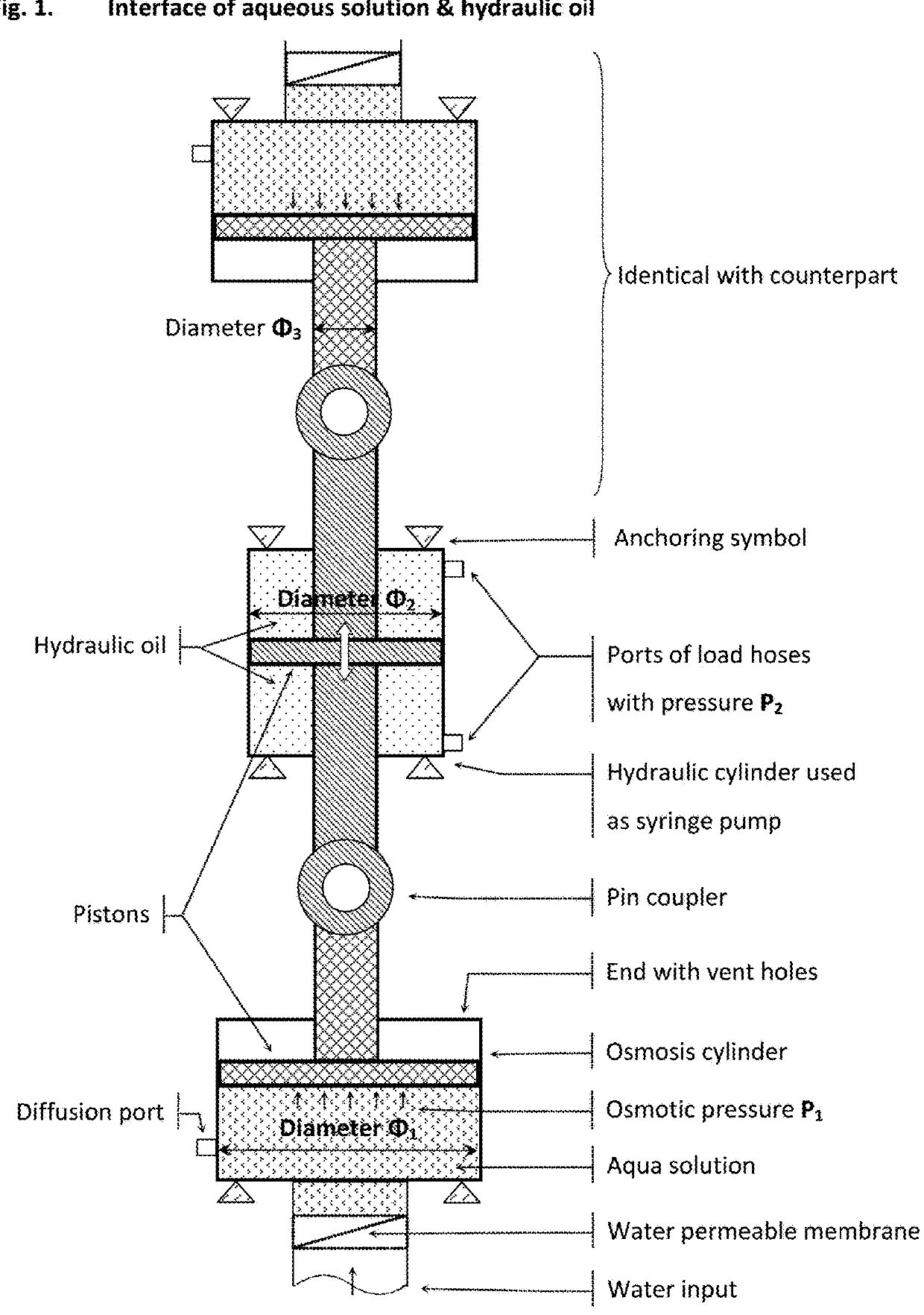
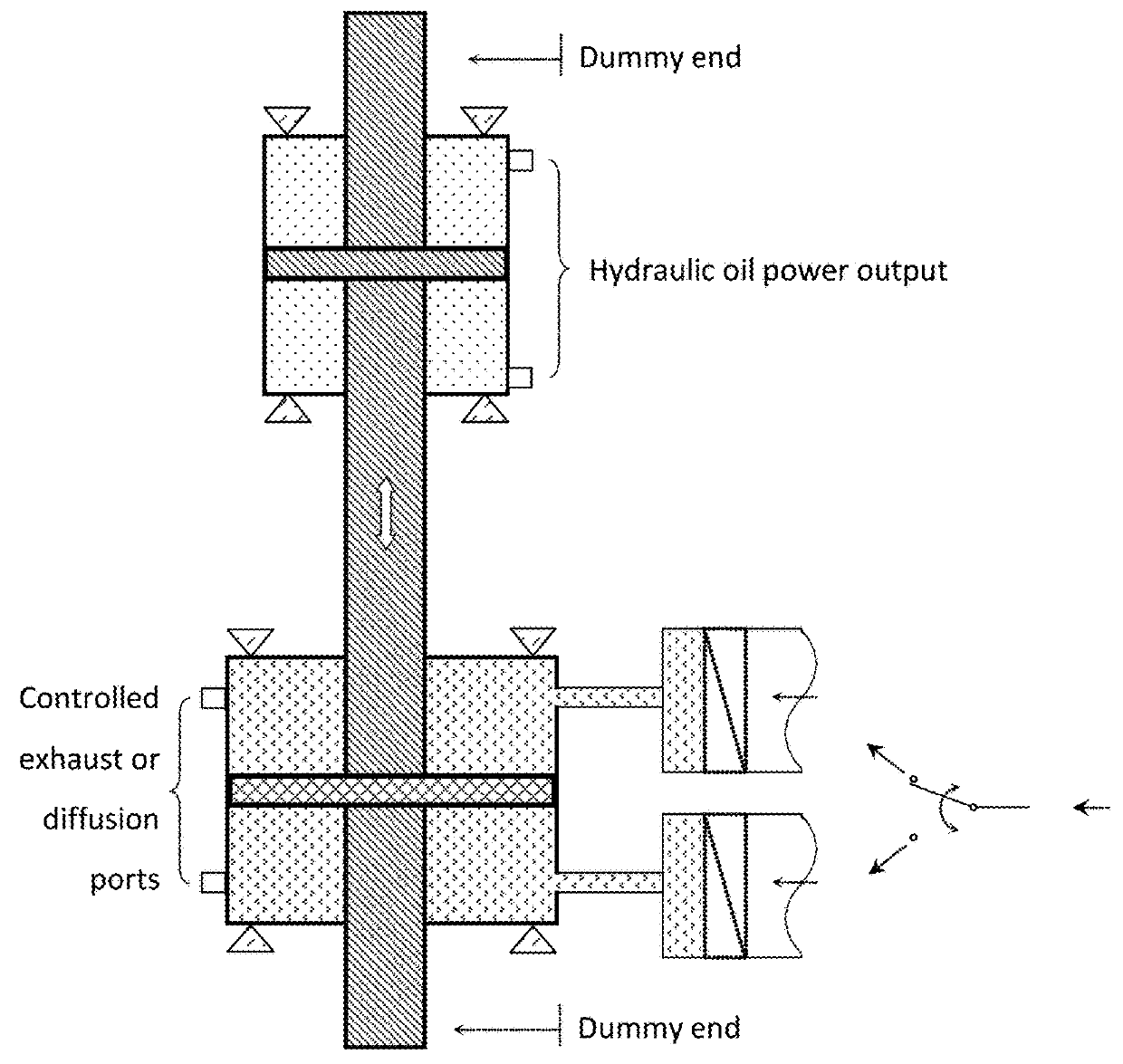
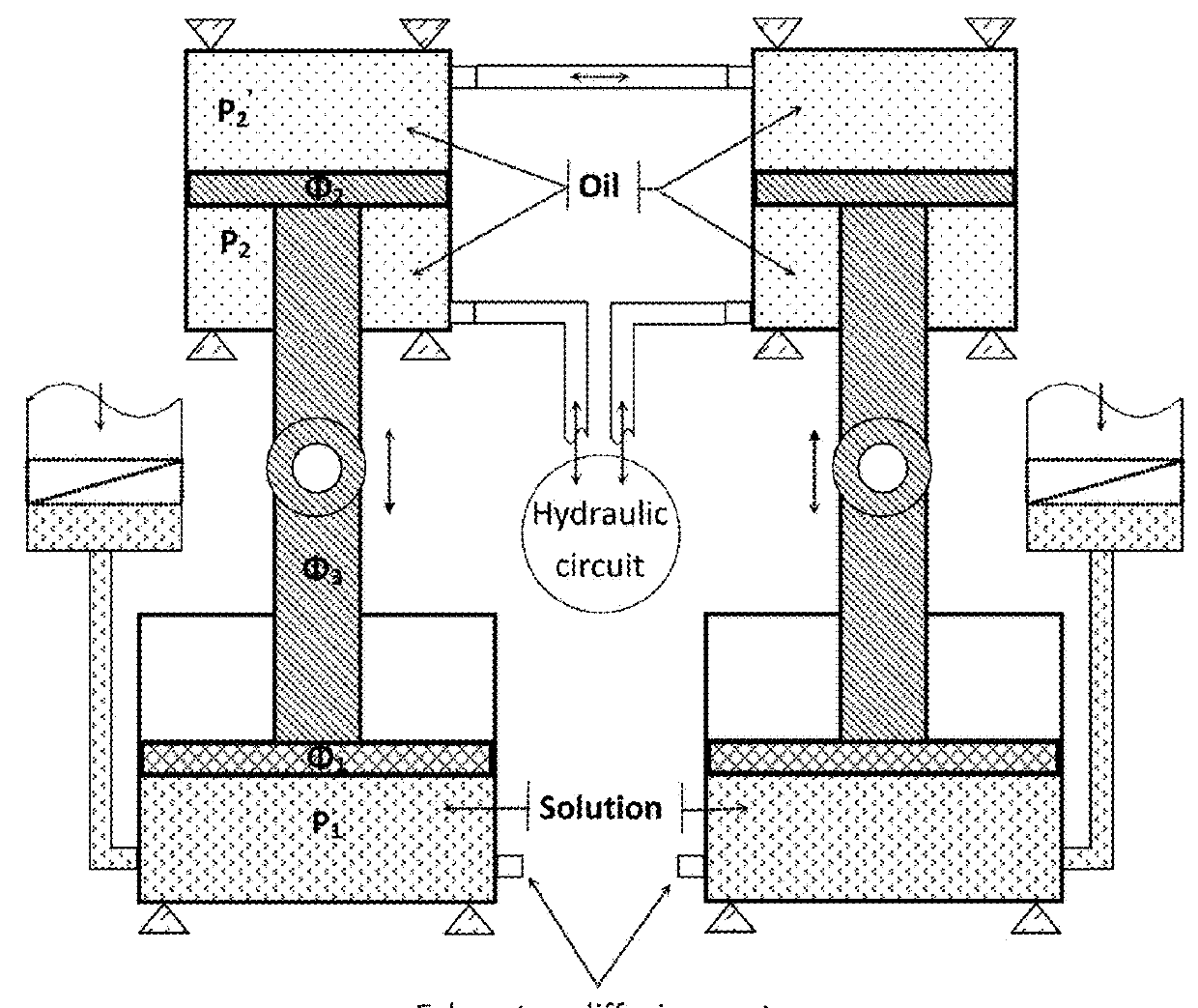
- A novel pressure retarded osmosis power system integrating a large surface aqueous solution pool, osmosis membrane assembly, osmotic to hydraulic pressure transformer, hydraulic subsystem, and electricity generator, which converts osmotic pressure into hydraulic power using a semi-permeable membrane and osmotic-hydraulic pressure transformer, reducing membrane area needs and enhancing energy density.

Environmental Impact Assessment of Energy Storage Systems
The environmental implications of osmotic power systems and battery technologies present distinctly different profiles across their respective lifecycles. Osmotic power generation, utilizing salinity gradients through selective membranes, demonstrates minimal direct environmental disruption during operation. The technology primarily requires saltwater and freshwater sources, generating electricity without producing harmful emissions or chemical byproducts. However, membrane manufacturing involves synthetic polymers and specialized materials that require energy-intensive production processes.
Battery systems exhibit more complex environmental considerations throughout their operational lifecycle. Lithium-ion batteries, the predominant energy storage technology, necessitate extensive mining operations for lithium, cobalt, and rare earth elements. These extraction processes often result in significant ecological disruption, water contamination, and habitat destruction in mining regions. Manufacturing facilities consume substantial energy and generate chemical waste streams requiring careful management.
Operational phase environmental impacts reveal contrasting characteristics between these technologies. Osmotic power systems maintain continuous operation with minimal maintenance requirements, producing no toxic emissions or waste products. The primary environmental concern involves potential impacts on marine ecosystems through water intake and discharge processes. Battery systems require periodic replacement cycles, typically every 8-15 years depending on application and technology type, generating substantial electronic waste streams.
End-of-life considerations highlight critical differences in environmental sustainability. Osmotic power infrastructure demonstrates extended operational lifespans with membrane components representing the primary replacement requirement. Membrane disposal presents manageable waste volumes compared to battery systems. Battery recycling processes, while advancing rapidly, currently recover only 50-70% of valuable materials, with remaining components requiring specialized disposal methods.
Carbon footprint analysis reveals osmotic power systems achieving carbon neutrality within 2-3 years of operation, primarily due to manufacturing emissions. Battery systems typically require 5-8 years to offset manufacturing carbon costs, depending on grid electricity sources used for charging. Long-term environmental benefits favor osmotic power systems through reduced material consumption and waste generation compared to battery replacement cycles.
Water resource impacts constitute another significant environmental consideration. Osmotic power systems require continuous access to salinity gradient sources but return processed water to natural systems without chemical contamination. Battery manufacturing consumes substantial water resources during lithium processing and cell production, often in water-scarce regions where lithium deposits occur naturally.
Battery systems exhibit more complex environmental considerations throughout their operational lifecycle. Lithium-ion batteries, the predominant energy storage technology, necessitate extensive mining operations for lithium, cobalt, and rare earth elements. These extraction processes often result in significant ecological disruption, water contamination, and habitat destruction in mining regions. Manufacturing facilities consume substantial energy and generate chemical waste streams requiring careful management.
Operational phase environmental impacts reveal contrasting characteristics between these technologies. Osmotic power systems maintain continuous operation with minimal maintenance requirements, producing no toxic emissions or waste products. The primary environmental concern involves potential impacts on marine ecosystems through water intake and discharge processes. Battery systems require periodic replacement cycles, typically every 8-15 years depending on application and technology type, generating substantial electronic waste streams.
End-of-life considerations highlight critical differences in environmental sustainability. Osmotic power infrastructure demonstrates extended operational lifespans with membrane components representing the primary replacement requirement. Membrane disposal presents manageable waste volumes compared to battery systems. Battery recycling processes, while advancing rapidly, currently recover only 50-70% of valuable materials, with remaining components requiring specialized disposal methods.
Carbon footprint analysis reveals osmotic power systems achieving carbon neutrality within 2-3 years of operation, primarily due to manufacturing emissions. Battery systems typically require 5-8 years to offset manufacturing carbon costs, depending on grid electricity sources used for charging. Long-term environmental benefits favor osmotic power systems through reduced material consumption and waste generation compared to battery replacement cycles.
Water resource impacts constitute another significant environmental consideration. Osmotic power systems require continuous access to salinity gradient sources but return processed water to natural systems without chemical contamination. Battery manufacturing consumes substantial water resources during lithium processing and cell production, often in water-scarce regions where lithium deposits occur naturally.
Economic Feasibility Analysis of Osmotic Power Implementation
The economic feasibility of osmotic power implementation presents a complex landscape of capital requirements, operational costs, and revenue potential that must be carefully evaluated against traditional energy storage solutions. Current osmotic power systems require substantial upfront investments, with membrane technology representing the most significant cost component, often accounting for 40-60% of total capital expenditure. The specialized semi-permeable membranes essential for pressure-retarded osmosis processes command premium pricing due to limited manufacturing scale and sophisticated material requirements.
Operational expenditures for osmotic power facilities encompass membrane replacement cycles, typically occurring every 3-5 years depending on water quality and system design. Maintenance costs include regular cleaning protocols, pressure system monitoring, and water treatment infrastructure to ensure optimal salinity gradients. These recurring expenses significantly impact the levelized cost of energy, often ranging from $0.15-0.25 per kWh in current implementations, substantially higher than conventional battery storage systems.
Revenue generation models for osmotic power systems depend heavily on geographic location and available salinity differentials. Coastal installations with access to seawater and freshwater sources demonstrate the most promising economic profiles, particularly in regions with high electricity prices or favorable renewable energy incentives. The continuous power generation capability of osmotic systems provides advantages over intermittent storage solutions, enabling consistent revenue streams through grid services and baseload power provision.
Comparative analysis with battery systems reveals distinct economic trade-offs. While lithium-ion batteries exhibit higher round-trip efficiency and lower initial costs per kWh, osmotic power systems offer extended operational lifespans of 20-25 years compared to typical battery replacement cycles of 8-12 years. The absence of rare earth material dependencies in osmotic systems provides price stability advantages, particularly as battery material costs fluctuate with global supply chain dynamics.
Economic viability projections indicate that osmotic power implementation becomes increasingly attractive at utility scale, where economies of scale can reduce per-unit costs. Break-even analysis suggests that installations exceeding 10 MW capacity demonstrate improved financial metrics, with payback periods potentially decreasing to 12-15 years under optimal conditions. Government subsidies and carbon credit mechanisms further enhance economic attractiveness in jurisdictions prioritizing renewable energy transition.
Operational expenditures for osmotic power facilities encompass membrane replacement cycles, typically occurring every 3-5 years depending on water quality and system design. Maintenance costs include regular cleaning protocols, pressure system monitoring, and water treatment infrastructure to ensure optimal salinity gradients. These recurring expenses significantly impact the levelized cost of energy, often ranging from $0.15-0.25 per kWh in current implementations, substantially higher than conventional battery storage systems.
Revenue generation models for osmotic power systems depend heavily on geographic location and available salinity differentials. Coastal installations with access to seawater and freshwater sources demonstrate the most promising economic profiles, particularly in regions with high electricity prices or favorable renewable energy incentives. The continuous power generation capability of osmotic systems provides advantages over intermittent storage solutions, enabling consistent revenue streams through grid services and baseload power provision.
Comparative analysis with battery systems reveals distinct economic trade-offs. While lithium-ion batteries exhibit higher round-trip efficiency and lower initial costs per kWh, osmotic power systems offer extended operational lifespans of 20-25 years compared to typical battery replacement cycles of 8-12 years. The absence of rare earth material dependencies in osmotic systems provides price stability advantages, particularly as battery material costs fluctuate with global supply chain dynamics.
Economic viability projections indicate that osmotic power implementation becomes increasingly attractive at utility scale, where economies of scale can reduce per-unit costs. Break-even analysis suggests that installations exceeding 10 MW capacity demonstrate improved financial metrics, with payback periods potentially decreasing to 12-15 years under optimal conditions. Government subsidies and carbon credit mechanisms further enhance economic attractiveness in jurisdictions prioritizing renewable energy transition.
Unlock deeper insights with Patsnap Eureka Quick Research — get a full tech report to explore trends and direct your research. Try now!
Generate Your Research Report Instantly with AI Agent
Supercharge your innovation with Patsnap Eureka AI Agent Platform!