PCM Reliability vs Material Degradation
MAR 27, 20269 MIN READ
Generate Your Research Report Instantly with AI Agent
PatSnap Eureka helps you evaluate technical feasibility & market potential.
PCM Material Degradation Background and Reliability Goals
Phase Change Memory (PCM) technology has emerged as a promising non-volatile memory solution, leveraging the reversible phase transitions between crystalline and amorphous states in chalcogenide materials. The fundamental principle relies on applying controlled thermal pulses to switch between these phases, representing binary data states. However, the repeated thermal cycling inherent to PCM operation introduces significant material degradation challenges that directly impact device reliability and longevity.
The evolution of PCM technology spans several decades, beginning with early research on chalcogenide glasses in the 1960s and progressing through various material compositions including Ge-Sb-Te (GST) alloys. Initial implementations focused primarily on achieving fast switching speeds and high storage density, but as the technology matured toward commercial applications, reliability concerns became paramount. The transition from laboratory demonstrations to industrial deployment revealed critical degradation mechanisms that were not fully understood in early development phases.
Material degradation in PCM devices manifests through multiple interconnected mechanisms. Elemental segregation occurs during repeated phase transitions, leading to compositional drift and gradual performance deterioration. Structural relaxation in the amorphous phase causes resistance drift over time, affecting data retention reliability. Additionally, thermal stress from rapid heating and cooling cycles can induce mechanical damage, void formation, and interface degradation between the PCM material and surrounding layers.
The reliability goals for PCM technology are stringent and application-dependent. For enterprise storage applications, devices must demonstrate endurance exceeding 10^6 write cycles while maintaining data retention for over 10 years at operating temperatures. Consumer applications may accept lower endurance requirements but demand consistent performance across varying environmental conditions. These targets necessitate comprehensive understanding of degradation kinetics and development of mitigation strategies.
Current reliability objectives focus on achieving predictable and controllable degradation patterns rather than eliminating degradation entirely. This approach enables the development of error correction algorithms and wear-leveling techniques that can compensate for gradual performance changes. The ultimate goal is establishing a quantitative relationship between material properties, operating conditions, and reliability metrics to enable accurate lifetime prediction and optimization of device design parameters for specific applications.
The evolution of PCM technology spans several decades, beginning with early research on chalcogenide glasses in the 1960s and progressing through various material compositions including Ge-Sb-Te (GST) alloys. Initial implementations focused primarily on achieving fast switching speeds and high storage density, but as the technology matured toward commercial applications, reliability concerns became paramount. The transition from laboratory demonstrations to industrial deployment revealed critical degradation mechanisms that were not fully understood in early development phases.
Material degradation in PCM devices manifests through multiple interconnected mechanisms. Elemental segregation occurs during repeated phase transitions, leading to compositional drift and gradual performance deterioration. Structural relaxation in the amorphous phase causes resistance drift over time, affecting data retention reliability. Additionally, thermal stress from rapid heating and cooling cycles can induce mechanical damage, void formation, and interface degradation between the PCM material and surrounding layers.
The reliability goals for PCM technology are stringent and application-dependent. For enterprise storage applications, devices must demonstrate endurance exceeding 10^6 write cycles while maintaining data retention for over 10 years at operating temperatures. Consumer applications may accept lower endurance requirements but demand consistent performance across varying environmental conditions. These targets necessitate comprehensive understanding of degradation kinetics and development of mitigation strategies.
Current reliability objectives focus on achieving predictable and controllable degradation patterns rather than eliminating degradation entirely. This approach enables the development of error correction algorithms and wear-leveling techniques that can compensate for gradual performance changes. The ultimate goal is establishing a quantitative relationship between material properties, operating conditions, and reliability metrics to enable accurate lifetime prediction and optimization of device design parameters for specific applications.
Market Demand for Durable PCM Applications
The global phase change materials market is experiencing unprecedented growth driven by escalating demands for energy-efficient thermal management solutions across multiple industries. Building and construction sectors represent the largest application segment, where PCMs are increasingly integrated into walls, roofs, and HVAC systems to reduce energy consumption and maintain comfortable indoor temperatures. However, the long-term reliability of these materials remains a critical concern, as building applications typically require operational lifespans exceeding twenty to thirty years without significant performance degradation.
Electronics and telecommunications industries are driving substantial demand for durable PCM solutions, particularly in data centers and electronic device thermal management. The exponential growth of cloud computing and edge computing infrastructure has created urgent needs for reliable thermal regulation systems that can operate continuously under high thermal cycling conditions. Material degradation issues directly impact the total cost of ownership, as premature PCM failure necessitates costly system replacements and maintenance interventions.
Automotive and aerospace sectors are emerging as high-value market segments demanding ultra-reliable PCM solutions. Electric vehicle battery thermal management systems require PCMs that maintain consistent performance throughout vehicle lifecycles, typically spanning ten to fifteen years. Similarly, aerospace applications demand materials capable of withstanding extreme temperature variations and mechanical stresses while maintaining thermal properties over extended operational periods.
The renewable energy storage market presents significant opportunities for durable PCM applications, particularly in concentrated solar power systems and grid-scale energy storage. These applications require materials that can endure thousands of thermal cycles while maintaining phase change characteristics and thermal conductivity. Market adoption rates are directly correlated with demonstrated long-term reliability data and material stability performance metrics.
Industrial process optimization applications, including waste heat recovery and temperature-controlled manufacturing, are increasingly specifying PCM solutions with enhanced durability requirements. These sectors prioritize materials with proven resistance to chemical degradation, thermal cycling fatigue, and mechanical stress-induced performance losses. Market penetration in these segments depends heavily on comprehensive reliability testing data and validated degradation prediction models.
Emerging applications in cold chain logistics and pharmaceutical storage are creating new market segments with stringent reliability requirements. These applications demand PCMs that maintain consistent phase change temperatures and thermal capacities throughout extended storage periods and repeated thermal cycling events, directly linking material durability to market viability and regulatory compliance.
Electronics and telecommunications industries are driving substantial demand for durable PCM solutions, particularly in data centers and electronic device thermal management. The exponential growth of cloud computing and edge computing infrastructure has created urgent needs for reliable thermal regulation systems that can operate continuously under high thermal cycling conditions. Material degradation issues directly impact the total cost of ownership, as premature PCM failure necessitates costly system replacements and maintenance interventions.
Automotive and aerospace sectors are emerging as high-value market segments demanding ultra-reliable PCM solutions. Electric vehicle battery thermal management systems require PCMs that maintain consistent performance throughout vehicle lifecycles, typically spanning ten to fifteen years. Similarly, aerospace applications demand materials capable of withstanding extreme temperature variations and mechanical stresses while maintaining thermal properties over extended operational periods.
The renewable energy storage market presents significant opportunities for durable PCM applications, particularly in concentrated solar power systems and grid-scale energy storage. These applications require materials that can endure thousands of thermal cycles while maintaining phase change characteristics and thermal conductivity. Market adoption rates are directly correlated with demonstrated long-term reliability data and material stability performance metrics.
Industrial process optimization applications, including waste heat recovery and temperature-controlled manufacturing, are increasingly specifying PCM solutions with enhanced durability requirements. These sectors prioritize materials with proven resistance to chemical degradation, thermal cycling fatigue, and mechanical stress-induced performance losses. Market penetration in these segments depends heavily on comprehensive reliability testing data and validated degradation prediction models.
Emerging applications in cold chain logistics and pharmaceutical storage are creating new market segments with stringent reliability requirements. These applications demand PCMs that maintain consistent phase change temperatures and thermal capacities throughout extended storage periods and repeated thermal cycling events, directly linking material durability to market viability and regulatory compliance.
Current PCM Degradation Issues and Technical Challenges
Phase Change Memory (PCM) technology faces significant degradation challenges that directly impact device reliability and commercial viability. The primary degradation mechanisms stem from structural and compositional changes in chalcogenide materials during repeated programming cycles, leading to progressive deterioration of switching characteristics and data retention capabilities.
Thermal-induced degradation represents the most critical challenge in PCM reliability. During SET and RESET operations, localized heating to temperatures exceeding 600°C causes atomic migration and phase segregation within the chalcogenide layer. This thermal cycling results in elemental redistribution, particularly the migration of tellurium and germanium atoms, creating compositionally inhomogeneous regions that alter the crystallization kinetics and electrical properties of the material.
Structural relaxation poses another fundamental challenge, where the amorphous phase undergoes continuous atomic rearrangement even at room temperature. This phenomenon leads to resistance drift, causing the programmed resistance states to shift over time and compromising data integrity. The drift coefficient varies significantly with material composition and device geometry, making it difficult to establish universal compensation algorithms.
Interface degradation between the chalcogenide layer and electrode materials creates additional reliability concerns. Repeated thermal cycling promotes interdiffusion and formation of interfacial compounds, increasing contact resistance and reducing switching efficiency. Carbon-based electrodes, while offering improved thermal stability, still exhibit gradual degradation under high-temperature programming conditions.
Crystallization threshold voltage shift represents a progressive failure mechanism where the voltage required for phase transition increases with cycling. This degradation stems from the accumulation of defects and compositional changes that modify the nucleation and growth dynamics of crystalline phases. The threshold shift varies non-linearly with cycle count, making endurance prediction challenging.
Current technical challenges include developing predictive models for degradation behavior across different operating conditions and material compositions. The complex interplay between thermal, electrical, and mechanical stresses during operation makes it difficult to isolate individual degradation mechanisms and establish accelerated testing protocols that accurately reflect real-world performance.
Manufacturing variability compounds these challenges, as slight variations in material composition, thickness, and processing conditions can significantly impact degradation rates. This variability necessitates robust design margins that often compromise device performance and density scaling potential.
Thermal-induced degradation represents the most critical challenge in PCM reliability. During SET and RESET operations, localized heating to temperatures exceeding 600°C causes atomic migration and phase segregation within the chalcogenide layer. This thermal cycling results in elemental redistribution, particularly the migration of tellurium and germanium atoms, creating compositionally inhomogeneous regions that alter the crystallization kinetics and electrical properties of the material.
Structural relaxation poses another fundamental challenge, where the amorphous phase undergoes continuous atomic rearrangement even at room temperature. This phenomenon leads to resistance drift, causing the programmed resistance states to shift over time and compromising data integrity. The drift coefficient varies significantly with material composition and device geometry, making it difficult to establish universal compensation algorithms.
Interface degradation between the chalcogenide layer and electrode materials creates additional reliability concerns. Repeated thermal cycling promotes interdiffusion and formation of interfacial compounds, increasing contact resistance and reducing switching efficiency. Carbon-based electrodes, while offering improved thermal stability, still exhibit gradual degradation under high-temperature programming conditions.
Crystallization threshold voltage shift represents a progressive failure mechanism where the voltage required for phase transition increases with cycling. This degradation stems from the accumulation of defects and compositional changes that modify the nucleation and growth dynamics of crystalline phases. The threshold shift varies non-linearly with cycle count, making endurance prediction challenging.
Current technical challenges include developing predictive models for degradation behavior across different operating conditions and material compositions. The complex interplay between thermal, electrical, and mechanical stresses during operation makes it difficult to isolate individual degradation mechanisms and establish accelerated testing protocols that accurately reflect real-world performance.
Manufacturing variability compounds these challenges, as slight variations in material composition, thickness, and processing conditions can significantly impact degradation rates. This variability necessitates robust design margins that often compromise device performance and density scaling potential.
Existing Solutions for PCM Degradation Mitigation
01 PCM material composition and encapsulation techniques
Phase change materials require specific composition formulations and encapsulation methods to ensure long-term stability and reliability. The encapsulation process protects the PCM core material from environmental factors and prevents leakage during phase transitions. Various encapsulation techniques including microencapsulation, macroencapsulation, and polymer matrix encapsulation are employed to enhance the structural integrity and thermal cycling performance of PCM materials.- PCM material composition and encapsulation techniques: Phase change materials (PCM) can be formulated with specific compositions and encapsulation methods to enhance their reliability and stability. Encapsulation protects the PCM core material from environmental factors and prevents leakage during phase transitions. Various encapsulation techniques including microencapsulation, macroencapsulation, and polymer matrix encapsulation can be employed to improve the structural integrity and long-term performance of PCM systems.
- Thermal cycling stability and durability testing: The reliability of PCM systems can be evaluated through repeated thermal cycling tests to assess their performance degradation over time. Testing methods include monitoring phase change temperatures, latent heat capacity retention, and structural integrity after multiple heating and cooling cycles. Enhanced formulations and additives can be incorporated to maintain consistent thermal properties and prevent material degradation during extended operational periods.
- PCM container and packaging design for leak prevention: Reliable PCM systems require proper container design and sealing mechanisms to prevent leakage during phase transitions and volume changes. Container materials must be compatible with the PCM composition and withstand thermal expansion and contraction cycles. Design considerations include flexible containment structures, pressure relief mechanisms, and barrier materials that maintain integrity under varying temperature conditions.
- Thermal conductivity enhancement and heat transfer optimization: Improving the thermal conductivity of PCM materials enhances their reliability by ensuring uniform heat distribution and reducing thermal stress concentrations. Methods include incorporating high thermal conductivity additives such as metal particles, carbon materials, or expanded graphite into the PCM matrix. Optimized heat transfer characteristics lead to more predictable performance and reduced risk of localized overheating or incomplete phase transitions.
- PCM integration in electronic and thermal management systems: The reliability of PCM-based thermal management systems in electronics depends on proper integration methods and interface design. Effective thermal coupling between heat sources and PCM materials ensures consistent temperature regulation and prevents thermal runaway conditions. System-level considerations include PCM placement, thermal interface materials, and monitoring mechanisms to maintain reliable operation under varying load conditions.
02 Thermal cycling stability and degradation prevention
Ensuring PCM reliability requires addressing thermal cycling stability through the prevention of material degradation over repeated melting and solidification cycles. Stabilization methods include the addition of nucleating agents, thermal stabilizers, and antioxidants to maintain consistent phase change properties. Testing protocols involve subjecting materials to thousands of thermal cycles to verify performance retention and identify potential failure modes.Expand Specific Solutions03 Containment systems and leak prevention
Reliable PCM systems require robust containment solutions to prevent leakage during phase transitions and volume changes. Container design considerations include material compatibility, expansion accommodation, and seal integrity under thermal stress. Advanced containment systems incorporate flexible membranes, pressure relief mechanisms, and multi-layer barrier structures to ensure long-term leak-proof operation.Expand Specific Solutions04 Performance monitoring and quality control methods
Maintaining PCM reliability necessitates comprehensive testing and monitoring protocols to assess material performance over time. Quality control methods include differential scanning calorimetry, thermal conductivity measurements, and accelerated aging tests. Real-time monitoring systems can detect changes in phase change temperature, latent heat capacity, and thermal conductivity to predict potential failures before they occur.Expand Specific Solutions05 Integration and system-level reliability enhancement
System-level reliability of PCM applications depends on proper integration with heat exchangers, thermal management systems, and structural components. Design considerations include thermal interface optimization, mechanical stress management during phase transitions, and compatibility with surrounding materials. Advanced integration techniques employ composite structures, enhanced heat transfer surfaces, and modular designs to improve overall system reliability and maintainability.Expand Specific Solutions
Key Players in PCM and Thermal Storage Industry
The PCM reliability versus material degradation field represents an emerging technology sector in the early growth stage, driven by increasing demand for thermal management solutions across electronics, automotive, and energy storage applications. The market demonstrates significant expansion potential as industries seek sustainable temperature control alternatives, with the global PCM market projected to reach multi-billion dollar valuations. Technology maturity varies considerably among key players, with established semiconductor companies like Micron Technology and IBM leading in advanced material integration, while specialized firms such as PureTemp.com focus on bio-based PCM innovations. Research institutions including Peking University, Beihang University, and University of Michigan contribute fundamental research on degradation mechanisms. Industrial giants like DuPont, SABIC Global Technologies, and Air Liquide provide material science expertise and manufacturing capabilities. The competitive landscape shows a convergence of traditional chemical companies, semiconductor manufacturers, and emerging PCM specialists, indicating technology transition from laboratory research to commercial applications, though reliability standardization remains challenging.
Schlumberger Technologies, Inc.
Technical Solution: Schlumberger applies PCM technology in harsh downhole environments where material reliability is critical for oil and gas exploration equipment. Their approach focuses on developing PCM solutions that can withstand extreme temperatures, pressures, and corrosive conditions while maintaining data integrity. They implement specialized material formulations and protective coatings designed to prevent degradation in challenging operational environments. Schlumberger's PCM systems incorporate robust error detection and correction mechanisms specifically tailored for high-reliability applications where material degradation could lead to critical system failures.
Strengths: Expertise in harsh environment applications, robust reliability testing protocols, specialized high-temperature materials knowledge. Weaknesses: Limited consumer electronics applications, specialized niche market focus, higher cost solutions.
Micron Technology, Inc.
Technical Solution: Micron has developed advanced PCM (Phase Change Memory) technologies focusing on material engineering to enhance reliability and mitigate degradation issues. Their approach involves optimizing the chalcogenide material composition, particularly Ge-Sb-Te alloys, to improve crystallization stability and reduce material drift over cycling. They implement sophisticated thermal management techniques and employ multi-level cell architectures to distribute wear across memory cells. Micron's PCM solutions incorporate error correction algorithms and wear leveling mechanisms to compensate for material degradation effects, extending device lifetime significantly.
Strengths: Industry-leading memory expertise, advanced manufacturing capabilities, comprehensive reliability testing infrastructure. Weaknesses: High manufacturing costs, complex material optimization processes, limited scalability for certain applications.
Core Innovations in PCM Stability Enhancement
Phase change material composition and uses thereof
PatentWO2015176184A1
Innovation
- A PCM composition comprising an aqueous solution of lithium nitrate and nitric acid, potentially with additives like graphite or clay, which reduces supercooling and enhances stability, maintaining high latent heat absorption and thermal conductivity while being non-flammable, suitable for thermoregulation in fire-resistant garments.
Phase change materials and methods of regulating temperature
PatentWO2017042530A1
Innovation
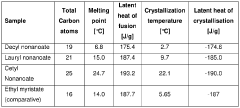
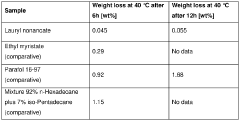
- A PCM composition comprising an ester of a linear alcohol with at least 4 carbon atoms and a linear carboxylic acid with at least 4 carbon atoms, with a total carbon range of 13 to 31, which reduces evaporation rates and improves melting point, thereby enhancing containment and performance.
Environmental Impact Assessment of PCM Materials
The environmental impact assessment of PCM materials represents a critical evaluation framework that examines the ecological footprint throughout the entire lifecycle of phase change materials. This assessment encompasses raw material extraction, manufacturing processes, operational deployment, and end-of-life disposal or recycling scenarios. The growing emphasis on sustainable energy storage solutions has positioned environmental considerations as a fundamental criterion in PCM material selection and application design.
Manufacturing processes of PCM materials generate varying degrees of environmental burden depending on the material category. Organic PCMs, particularly paraffin-based compounds, rely on petroleum-derived feedstocks, contributing to carbon emissions during production. Salt hydrates and eutectic mixtures typically require energy-intensive crystallization and purification processes, while bio-based PCMs offer reduced environmental impact through renewable feedstock utilization and biodegradable properties.
Operational environmental benefits of PCM materials significantly outweigh their production impacts through enhanced energy efficiency in thermal management applications. Building integration of PCMs reduces HVAC energy consumption by 15-30%, translating to substantial carbon footprint reduction over operational lifespans. Industrial thermal storage applications demonstrate similar environmental advantages through waste heat recovery and peak load shifting capabilities.
End-of-life environmental considerations vary dramatically across PCM material categories. Inorganic salt hydrates present minimal disposal concerns due to their non-toxic nature and potential for material recovery. Organic PCMs require careful handling to prevent soil and groundwater contamination, though advanced recycling technologies enable material reclamation and reprocessing. Bio-based PCMs offer superior end-of-life profiles through natural biodegradation pathways.
Lifecycle assessment studies indicate that PCM materials typically achieve environmental payback within 2-5 years of deployment, depending on application efficiency and regional energy mix factors. Emerging bio-based PCM formulations demonstrate 40-60% lower carbon footprints compared to conventional petroleum-derived alternatives, supporting sustainable thermal energy storage objectives while maintaining comparable thermal performance characteristics.
Manufacturing processes of PCM materials generate varying degrees of environmental burden depending on the material category. Organic PCMs, particularly paraffin-based compounds, rely on petroleum-derived feedstocks, contributing to carbon emissions during production. Salt hydrates and eutectic mixtures typically require energy-intensive crystallization and purification processes, while bio-based PCMs offer reduced environmental impact through renewable feedstock utilization and biodegradable properties.
Operational environmental benefits of PCM materials significantly outweigh their production impacts through enhanced energy efficiency in thermal management applications. Building integration of PCMs reduces HVAC energy consumption by 15-30%, translating to substantial carbon footprint reduction over operational lifespans. Industrial thermal storage applications demonstrate similar environmental advantages through waste heat recovery and peak load shifting capabilities.
End-of-life environmental considerations vary dramatically across PCM material categories. Inorganic salt hydrates present minimal disposal concerns due to their non-toxic nature and potential for material recovery. Organic PCMs require careful handling to prevent soil and groundwater contamination, though advanced recycling technologies enable material reclamation and reprocessing. Bio-based PCMs offer superior end-of-life profiles through natural biodegradation pathways.
Lifecycle assessment studies indicate that PCM materials typically achieve environmental payback within 2-5 years of deployment, depending on application efficiency and regional energy mix factors. Emerging bio-based PCM formulations demonstrate 40-60% lower carbon footprints compared to conventional petroleum-derived alternatives, supporting sustainable thermal energy storage objectives while maintaining comparable thermal performance characteristics.
Standardization Framework for PCM Reliability Testing
The establishment of a comprehensive standardization framework for PCM reliability testing represents a critical need in the phase change materials industry. Current testing methodologies lack uniformity across different applications and manufacturers, leading to inconsistent performance evaluations and reliability assessments. This fragmentation hinders the widespread adoption of PCM technologies and creates barriers for quality assurance and comparative analysis.
International standardization organizations, including ASTM International and ISO, have initiated preliminary efforts to develop unified testing protocols for PCM materials. These frameworks aim to establish consistent measurement parameters for thermal cycling, temperature stability, and long-term performance evaluation. The proposed standards encompass both accelerated aging tests and real-world simulation conditions to ensure comprehensive reliability assessment.
Key components of the emerging standardization framework include standardized thermal cycling protocols with defined temperature ranges, heating and cooling rates, and cycle counts. The framework also specifies requirements for sample preparation, testing equipment calibration, and data collection methodologies. Particular emphasis is placed on establishing baseline performance metrics that can be universally applied across different PCM compositions and applications.
The framework addresses critical testing parameters such as enthalpy measurement accuracy, temperature uniformity requirements, and contamination prevention protocols. Standardized procedures for subcooling evaluation, phase separation detection, and corrosion assessment are integral components. These protocols ensure that reliability testing captures the full spectrum of potential degradation mechanisms that affect PCM performance over extended operational periods.
Implementation challenges include harmonizing existing proprietary testing methods with proposed standards and ensuring compatibility across different PCM categories. The framework must accommodate the diverse range of PCM materials, from organic paraffins to inorganic salt hydrates, each requiring specific testing considerations. Validation studies across multiple laboratories are essential to establish the reproducibility and accuracy of standardized testing procedures.
The standardization framework also incorporates provisions for emerging PCM technologies and novel material compositions. Flexibility within the standards allows for adaptation to new testing requirements while maintaining core reliability assessment principles. This approach ensures the framework remains relevant as PCM technology continues to evolve and new applications emerge in various industrial sectors.
International standardization organizations, including ASTM International and ISO, have initiated preliminary efforts to develop unified testing protocols for PCM materials. These frameworks aim to establish consistent measurement parameters for thermal cycling, temperature stability, and long-term performance evaluation. The proposed standards encompass both accelerated aging tests and real-world simulation conditions to ensure comprehensive reliability assessment.
Key components of the emerging standardization framework include standardized thermal cycling protocols with defined temperature ranges, heating and cooling rates, and cycle counts. The framework also specifies requirements for sample preparation, testing equipment calibration, and data collection methodologies. Particular emphasis is placed on establishing baseline performance metrics that can be universally applied across different PCM compositions and applications.
The framework addresses critical testing parameters such as enthalpy measurement accuracy, temperature uniformity requirements, and contamination prevention protocols. Standardized procedures for subcooling evaluation, phase separation detection, and corrosion assessment are integral components. These protocols ensure that reliability testing captures the full spectrum of potential degradation mechanisms that affect PCM performance over extended operational periods.
Implementation challenges include harmonizing existing proprietary testing methods with proposed standards and ensuring compatibility across different PCM categories. The framework must accommodate the diverse range of PCM materials, from organic paraffins to inorganic salt hydrates, each requiring specific testing considerations. Validation studies across multiple laboratories are essential to establish the reproducibility and accuracy of standardized testing procedures.
The standardization framework also incorporates provisions for emerging PCM technologies and novel material compositions. Flexibility within the standards allows for adaptation to new testing requirements while maintaining core reliability assessment principles. This approach ensures the framework remains relevant as PCM technology continues to evolve and new applications emerge in various industrial sectors.
Unlock deeper insights with PatSnap Eureka Quick Research — get a full tech report to explore trends and direct your research. Try now!
Generate Your Research Report Instantly with AI Agent
Supercharge your innovation with PatSnap Eureka AI Agent Platform!