Cyclone Separator vs Twin-Cyclone Design: Performance Variability
FEB 11, 20269 MIN READ
Generate Your Research Report Instantly with AI Agent
Patsnap Eureka helps you evaluate technical feasibility & market potential.
Cyclone Separation Technology Background and Objectives
Cyclone separation technology has been a cornerstone of industrial particle separation processes for over a century, with its origins tracing back to the late 1800s when the first cyclone separators were developed for dust collection in manufacturing facilities. The fundamental principle relies on centrifugal force to separate particles from gas or liquid streams, offering a simple yet effective solution without moving parts or complex maintenance requirements. Over the decades, this technology has evolved from basic single-cyclone designs to more sophisticated configurations, including the twin-cyclone arrangement that emerged as researchers sought to address performance limitations inherent in conventional designs.
The evolution of cyclone technology has been driven by increasing demands for higher separation efficiency, lower pressure drops, and more compact installations across diverse industries including petrochemical processing, power generation, cement manufacturing, and environmental control systems. Traditional single-cyclone separators, while robust and cost-effective, often face challenges in achieving optimal performance across varying operational conditions, particularly when dealing with wide particle size distributions or fluctuating flow rates. These limitations have spurred continuous innovation in cyclone geometry and configuration strategies.
The twin-cyclone design represents a significant advancement in addressing performance variability issues. By employing two cyclone units operating in parallel or series configurations, this approach aims to enhance separation stability, reduce sensitivity to inlet condition variations, and improve overall particle collection efficiency. However, the comparative performance characteristics between conventional single-cyclone and twin-cyclone designs remain a critical area requiring systematic investigation.
The primary objective of this technical research is to comprehensively evaluate and compare the performance variability between standard cyclone separators and twin-cyclone configurations under diverse operating conditions. This investigation seeks to quantify differences in separation efficiency, pressure drop characteristics, particle size cut-point stability, and operational flexibility. Understanding these performance variations will enable informed decision-making for industrial applications where consistent separation performance is critical, ultimately contributing to optimized process design and enhanced operational reliability in particle separation systems.
The evolution of cyclone technology has been driven by increasing demands for higher separation efficiency, lower pressure drops, and more compact installations across diverse industries including petrochemical processing, power generation, cement manufacturing, and environmental control systems. Traditional single-cyclone separators, while robust and cost-effective, often face challenges in achieving optimal performance across varying operational conditions, particularly when dealing with wide particle size distributions or fluctuating flow rates. These limitations have spurred continuous innovation in cyclone geometry and configuration strategies.
The twin-cyclone design represents a significant advancement in addressing performance variability issues. By employing two cyclone units operating in parallel or series configurations, this approach aims to enhance separation stability, reduce sensitivity to inlet condition variations, and improve overall particle collection efficiency. However, the comparative performance characteristics between conventional single-cyclone and twin-cyclone designs remain a critical area requiring systematic investigation.
The primary objective of this technical research is to comprehensively evaluate and compare the performance variability between standard cyclone separators and twin-cyclone configurations under diverse operating conditions. This investigation seeks to quantify differences in separation efficiency, pressure drop characteristics, particle size cut-point stability, and operational flexibility. Understanding these performance variations will enable informed decision-making for industrial applications where consistent separation performance is critical, ultimately contributing to optimized process design and enhanced operational reliability in particle separation systems.
Market Demand for Enhanced Cyclone Separation Systems
The global market for cyclone separation systems is experiencing sustained growth driven by increasingly stringent environmental regulations and industrial efficiency requirements across multiple sectors. Industries such as cement manufacturing, power generation, chemical processing, petrochemicals, and mining operations represent the primary demand sources for advanced cyclone separation technologies. These sectors face mounting pressure to reduce particulate emissions, improve process efficiency, and minimize operational costs, creating substantial market opportunities for enhanced cyclone designs that demonstrate superior performance characteristics.
Traditional single cyclone separators, while widely deployed, often struggle to meet evolving performance standards in applications requiring high separation efficiency across varying particle size distributions and fluctuating operational conditions. This performance gap has catalyzed demand for innovative designs such as twin-cyclone configurations that promise improved separation efficiency, reduced pressure drop, and enhanced operational stability. Industries processing materials with complex particle characteristics or operating under variable flow conditions particularly seek solutions that maintain consistent performance across diverse operating scenarios.
The cement and mineral processing industries represent especially significant demand drivers, as these sectors handle massive volumes of particulate matter and face substantial penalties for emissions non-compliance. Power generation facilities, particularly coal-fired plants in regions with tightening air quality standards, actively pursue cyclone technologies offering enhanced fine particle capture capabilities. Chemical and pharmaceutical manufacturing operations increasingly require separation systems that deliver reliable performance while accommodating batch processing variations and diverse material properties.
Emerging markets in Asia-Pacific and developing regions demonstrate accelerating adoption rates as industrialization intensifies and environmental awareness grows. Established markets in North America and Europe show sustained demand for retrofit solutions and performance upgrades to existing installations. The market trajectory indicates strong preference for cyclone designs demonstrating measurable performance advantages, particularly systems offering reduced maintenance requirements, extended operational lifespan, and adaptability to varying process conditions. This demand landscape creates compelling commercial incentives for comparative performance analysis between conventional and advanced cyclone configurations, directly supporting the technical investigation of single versus twin-cyclone design performance variability.
Traditional single cyclone separators, while widely deployed, often struggle to meet evolving performance standards in applications requiring high separation efficiency across varying particle size distributions and fluctuating operational conditions. This performance gap has catalyzed demand for innovative designs such as twin-cyclone configurations that promise improved separation efficiency, reduced pressure drop, and enhanced operational stability. Industries processing materials with complex particle characteristics or operating under variable flow conditions particularly seek solutions that maintain consistent performance across diverse operating scenarios.
The cement and mineral processing industries represent especially significant demand drivers, as these sectors handle massive volumes of particulate matter and face substantial penalties for emissions non-compliance. Power generation facilities, particularly coal-fired plants in regions with tightening air quality standards, actively pursue cyclone technologies offering enhanced fine particle capture capabilities. Chemical and pharmaceutical manufacturing operations increasingly require separation systems that deliver reliable performance while accommodating batch processing variations and diverse material properties.
Emerging markets in Asia-Pacific and developing regions demonstrate accelerating adoption rates as industrialization intensifies and environmental awareness grows. Established markets in North America and Europe show sustained demand for retrofit solutions and performance upgrades to existing installations. The market trajectory indicates strong preference for cyclone designs demonstrating measurable performance advantages, particularly systems offering reduced maintenance requirements, extended operational lifespan, and adaptability to varying process conditions. This demand landscape creates compelling commercial incentives for comparative performance analysis between conventional and advanced cyclone configurations, directly supporting the technical investigation of single versus twin-cyclone design performance variability.
Current Performance Status and Variability Challenges
Cyclone separators have been widely adopted in industrial applications for particulate matter removal due to their simple structure, low maintenance requirements, and absence of moving parts. Traditional single-cyclone designs typically achieve separation efficiencies ranging from 70% to 90% for particles above 5 micrometers, with pressure drops between 500 to 2000 Pa depending on operational conditions. However, performance consistency remains a significant challenge, as efficiency can fluctuate by 10-15% under varying inlet velocities, particle size distributions, and gas flow rates.
The twin-cyclone design emerged as an alternative configuration aimed at improving separation performance through parallel or series arrangements of two cyclone units. Current implementations demonstrate enhanced particle capture rates, particularly for fine particles in the 2-5 micrometer range, with reported efficiency improvements of 5-12% compared to conventional single-cyclone systems. Despite these advantages, twin-cyclone configurations introduce additional complexity in flow distribution and pressure balance between the two units.
Performance variability in both designs stems from multiple factors including inlet geometry variations, vortex finder positioning tolerances, and manufacturing inconsistencies in cone angles. Single-cyclone separators exhibit greater sensitivity to inlet velocity fluctuations, with efficiency degradation of up to 20% when operating outside the optimal velocity range of 15-25 m/s. Twin-cyclone systems show improved stability under variable loading conditions but face challenges in maintaining equal flow distribution between parallel units, with imbalances reaching 15-20% in poorly designed systems.
Current operational data reveals that single-cyclone designs demonstrate more predictable performance patterns but limited adaptability to changing process conditions. Twin-cyclone configurations offer superior performance potential but require sophisticated control systems to manage flow distribution and prevent preferential flow paths. The pressure drop penalty in twin-cyclone systems typically increases by 20-35% compared to single units, impacting overall energy consumption and operational costs.
The primary technical challenge lies in achieving consistent performance across varying operational windows while maintaining energy efficiency. Existing monitoring systems often lack real-time capability to detect and compensate for performance drift, resulting in suboptimal separation efficiency during transient conditions. This variability directly impacts downstream processes and overall system reliability, necessitating innovative approaches to design optimization and operational control strategies.
The twin-cyclone design emerged as an alternative configuration aimed at improving separation performance through parallel or series arrangements of two cyclone units. Current implementations demonstrate enhanced particle capture rates, particularly for fine particles in the 2-5 micrometer range, with reported efficiency improvements of 5-12% compared to conventional single-cyclone systems. Despite these advantages, twin-cyclone configurations introduce additional complexity in flow distribution and pressure balance between the two units.
Performance variability in both designs stems from multiple factors including inlet geometry variations, vortex finder positioning tolerances, and manufacturing inconsistencies in cone angles. Single-cyclone separators exhibit greater sensitivity to inlet velocity fluctuations, with efficiency degradation of up to 20% when operating outside the optimal velocity range of 15-25 m/s. Twin-cyclone systems show improved stability under variable loading conditions but face challenges in maintaining equal flow distribution between parallel units, with imbalances reaching 15-20% in poorly designed systems.
Current operational data reveals that single-cyclone designs demonstrate more predictable performance patterns but limited adaptability to changing process conditions. Twin-cyclone configurations offer superior performance potential but require sophisticated control systems to manage flow distribution and prevent preferential flow paths. The pressure drop penalty in twin-cyclone systems typically increases by 20-35% compared to single units, impacting overall energy consumption and operational costs.
The primary technical challenge lies in achieving consistent performance across varying operational windows while maintaining energy efficiency. Existing monitoring systems often lack real-time capability to detect and compensate for performance drift, resulting in suboptimal separation efficiency during transient conditions. This variability directly impacts downstream processes and overall system reliability, necessitating innovative approaches to design optimization and operational control strategies.
Mainstream Cyclone and Twin-Cyclone Design Solutions
01 Dual cyclone configuration and arrangement optimization
Twin-cyclone separators utilize two cyclone units arranged in parallel or series configurations to enhance separation efficiency. The arrangement and geometric relationship between the two cyclones significantly affects overall performance. Optimizing the positioning, orientation, and connection methods between cyclones can reduce performance variability and improve consistency in particle separation across different operating conditions.- Dual cyclone configuration and arrangement optimization: Twin-cyclone separators utilize two cyclone units arranged in parallel or series configurations to enhance separation efficiency. The arrangement and geometric relationship between the two cyclones significantly affects overall performance. Optimizing the positioning, orientation, and connection methods between cyclones can reduce pressure drop while maintaining high separation efficiency. Design considerations include inlet distribution, inter-cyclone spacing, and flow balancing mechanisms to ensure uniform loading across both cyclone units.
- Flow distribution and inlet design variations: Performance variability in twin-cyclone systems is heavily influenced by how the inlet flow is distributed between the two cyclone chambers. Uneven flow distribution can lead to one cyclone being overloaded while the other operates below capacity, reducing overall efficiency. Advanced inlet designs incorporate flow splitters, adjustable vanes, or pre-separation chambers to achieve balanced flow distribution. The inlet geometry, including entry angle and velocity profile, plays a crucial role in minimizing turbulence and ensuring consistent performance across both cyclones.
- Geometric parameter variations and dimensional tolerances: Manufacturing tolerances and geometric variations between the two cyclone units can lead to performance inconsistencies in twin-cyclone designs. Critical dimensions such as cyclone diameter, vortex finder diameter, cone angle, and cylinder height must be carefully controlled to minimize performance variability. Even small differences in these parameters between the two cyclones can result in unequal pressure drops and separation efficiencies. Design strategies include standardized manufacturing processes, quality control measures, and compensation mechanisms to account for inevitable dimensional variations.
- Particle loading effects and capacity management: The performance of twin-cyclone separators varies with particle concentration and loading conditions. High particle loading can cause one cyclone to experience premature saturation or blockage, leading to flow redistribution and reduced overall efficiency. Design features such as adjustable dust discharge systems, load monitoring capabilities, and automatic flow balancing mechanisms help maintain consistent performance under varying particle concentrations. Understanding the relationship between particle loading and separation efficiency is essential for predicting and managing performance variability in industrial applications.
- Operating condition sensitivity and performance monitoring: Twin-cyclone separator performance exhibits sensitivity to operating conditions such as flow rate, temperature, and gas properties. Variations in these parameters can affect the centrifugal force, residence time, and separation efficiency differently in each cyclone unit. Performance monitoring systems incorporating pressure sensors, flow meters, and efficiency indicators enable real-time assessment of individual cyclone performance and overall system variability. Adaptive control strategies can adjust operating parameters to compensate for changing conditions and maintain optimal performance across both cyclone units.
02 Flow distribution and balancing mechanisms
Performance variability in twin-cyclone designs often stems from uneven flow distribution between the two cyclone units. Implementing flow balancing mechanisms, inlet distribution chambers, or flow control devices helps ensure equal flow rates through each cyclone. Proper flow distribution reduces performance inconsistencies and maintains stable separation efficiency across varying operational loads and conditions.Expand Specific Solutions03 Geometric parameter standardization and dimensional control
Variations in cyclone dimensions, cone angles, inlet configurations, and outlet designs between the two units can lead to performance discrepancies. Standardizing geometric parameters and maintaining tight manufacturing tolerances ensures consistent performance characteristics. Critical dimensions including vortex finder diameter, cylinder height, and cone angle must be precisely controlled to minimize performance variability between the twin cyclones.Expand Specific Solutions04 Pressure drop equalization and vortex stability
Differential pressure drops between twin cyclones cause flow imbalances and performance variations. Design features that equalize pressure drops, such as matched resistance paths and symmetrical outlet configurations, help stabilize vortex formation in both units. Maintaining consistent vortex stability across both cyclones reduces separation efficiency variations and improves overall system reliability under different operating conditions.Expand Specific Solutions05 Particle loading effects and capacity management
Twin-cyclone performance variability increases with uneven particle loading distribution between units. Implementing load-sensing mechanisms, adaptive inlet designs, or particle pre-distribution systems helps manage capacity variations. Understanding how particle concentration, size distribution, and loading rates affect each cyclone independently allows for better prediction and control of overall system performance variability.Expand Specific Solutions
Major Players in Cyclone Separation Equipment Industry
The cyclone separator technology market demonstrates mature development with established industrial applications across petrochemical, environmental, and consumer sectors. Major players span diverse segments: industrial giants like SINOPEC Engineering, China Petroleum & Chemical Corp., and Petróleo Brasileiro SA dominate large-scale petrochemical applications; specialized filtration companies including MANN+HUMMEL GmbH, Donaldson Filtration Deutschland GmbH, and EagleBurgmann Germany GmbH focus on industrial separation systems; consumer appliance manufacturers such as Dyson Technology Ltd., LG Electronics, Mitsubishi Electric Corp., and Ecovacs Robotics integrate cyclone technology into vacuum cleaners. Research institutions like Lanzhou University, China Petroleum University Beijing, and Donghua University drive innovation in twin-cyclone designs and performance optimization. The competitive landscape reflects technology maturity with incremental improvements in efficiency, miniaturization, and multi-cyclone configurations, while market growth concentrates in emerging applications including robotics, air purification, and sustainable energy systems.
Dyson Technology Ltd.
Technical Solution: Dyson has developed advanced cyclone separation technology featuring radial root cyclone designs that optimize particle separation efficiency through precise geometric configurations. Their twin-cyclone systems incorporate multiple stages of separation with strategically positioned inlet and outlet arrangements to minimize pressure drop while maximizing dust collection efficiency. The technology utilizes computational fluid dynamics optimization to achieve separation efficiencies exceeding 99.5% for particles above 0.3 microns. Their designs feature compact form factors with reduced turbulence zones and enhanced vortex stability through carefully engineered cone angles and cylinder-to-cone length ratios. The system demonstrates superior performance in maintaining consistent separation efficiency across varying flow rates and particle loading conditions compared to conventional single cyclone designs.
Strengths: Industry-leading separation efficiency with minimal pressure drop, compact design suitable for consumer applications, extensive patent portfolio protecting key innovations. Weaknesses: Higher manufacturing complexity and cost, primarily optimized for lower flow rate applications typical in vacuum cleaners rather than industrial-scale operations.
MANN+HUMMEL GmbH
Technical Solution: MANN+HUMMEL has developed industrial-scale cyclone separator systems with emphasis on twin-cyclone configurations for automotive and industrial filtration applications. Their technology incorporates parallel twin-cyclone arrangements that provide redundancy and increased throughput capacity while maintaining separation efficiency above 95% for particles larger than 5 microns. The design features optimized inlet velocity profiles and tangential entry geometries that reduce wall wear and energy consumption. Their systems integrate pre-separation cyclones with secondary fine separation stages, achieving overall system efficiencies of 98-99%. The twin-cyclone design allows for continuous operation with one unit undergoing maintenance while the other remains operational, critical for industrial applications requiring high uptime.
Strengths: Robust industrial-grade construction, proven reliability in harsh operating environments, modular design enabling scalability and maintenance flexibility. Weaknesses: Larger footprint requirements compared to single cyclone units, higher initial capital investment, performance optimization focused on specific particle size ranges.
Core Patents in Twin-Cyclone Performance Optimization
Cyclone separator
PatentInactiveAU1988013983A1
Innovation
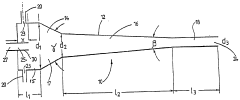
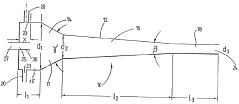
- A cyclone separator of the de-watering type is designed with specific geometrical modifications, including a reduced cross-sectional dimension at the downstream end of the feed inlet section and a vortex finder to prevent re-entrainment of droplets, allowing for efficient separation of denser and less dense components.
Cyclone Separator For Separating Solids and/or Liquids From a Process Stream
PatentPendingUS20250296094A1
Innovation
- A cyclone separator with a guiding means that is variable in cross-section, allowing adaptation to different process streams by adjusting its geometry to optimize operating parameters, including the use of elastic guide tubes and controlled cross-sectional changes.


Energy Efficiency and Environmental Impact Assessment
Energy efficiency represents a critical performance metric when comparing cyclone separators and twin-cyclone designs, directly impacting operational costs and sustainability outcomes. Traditional single cyclone separators typically exhibit pressure drops ranging from 500 to 2000 Pa depending on inlet velocity and geometric configuration, translating to specific energy consumption between 0.3 to 1.2 kWh per 1000 m³ of processed gas. Twin-cyclone arrangements, while offering enhanced separation efficiency, generally demonstrate 15-30% higher pressure drops due to increased flow path complexity and additional structural components. This elevated pressure differential necessitates greater fan power requirements, potentially offsetting efficiency gains achieved through improved particle capture rates.
The energy performance variability between these configurations becomes particularly pronounced under fluctuating operational conditions. Single cyclones maintain relatively stable energy consumption across varying load conditions, whereas twin-cyclone systems exhibit more sensitive energy profiles when operating below design capacity. Studies indicate that twin-cyclone designs may consume up to 40% additional energy at 50% load compared to optimal operating points, while conventional cyclones show only 20-25% variation under similar conditions.
Environmental impact assessment reveals multifaceted considerations beyond direct energy consumption. Twin-cyclone configurations typically achieve 5-12% higher particulate matter removal efficiency, particularly for particles in the 2-10 micron range, resulting in reduced atmospheric emissions and improved air quality compliance. This enhanced capture efficiency translates to decreased secondary environmental burden from escaped particulates, including reduced soil contamination and ecosystem exposure.
Carbon footprint analysis demonstrates that despite higher operational energy demands, twin-cyclone systems may present favorable lifecycle environmental profiles in high-emission industrial applications. The improved separation performance reduces downstream filtration requirements and associated maintenance activities, potentially decreasing overall system-level energy consumption by 8-15% when considering complete gas cleaning trains.
Noise pollution represents an additional environmental consideration, with twin-cyclone designs generally producing 3-6 dB higher sound levels due to increased turbulence and flow interactions. Material degradation and maintenance frequency also influence long-term environmental sustainability, as twin-cyclone configurations typically require more frequent component replacement, generating additional waste streams and embodied energy considerations throughout operational lifecycles.
The energy performance variability between these configurations becomes particularly pronounced under fluctuating operational conditions. Single cyclones maintain relatively stable energy consumption across varying load conditions, whereas twin-cyclone systems exhibit more sensitive energy profiles when operating below design capacity. Studies indicate that twin-cyclone designs may consume up to 40% additional energy at 50% load compared to optimal operating points, while conventional cyclones show only 20-25% variation under similar conditions.
Environmental impact assessment reveals multifaceted considerations beyond direct energy consumption. Twin-cyclone configurations typically achieve 5-12% higher particulate matter removal efficiency, particularly for particles in the 2-10 micron range, resulting in reduced atmospheric emissions and improved air quality compliance. This enhanced capture efficiency translates to decreased secondary environmental burden from escaped particulates, including reduced soil contamination and ecosystem exposure.
Carbon footprint analysis demonstrates that despite higher operational energy demands, twin-cyclone systems may present favorable lifecycle environmental profiles in high-emission industrial applications. The improved separation performance reduces downstream filtration requirements and associated maintenance activities, potentially decreasing overall system-level energy consumption by 8-15% when considering complete gas cleaning trains.
Noise pollution represents an additional environmental consideration, with twin-cyclone designs generally producing 3-6 dB higher sound levels due to increased turbulence and flow interactions. Material degradation and maintenance frequency also influence long-term environmental sustainability, as twin-cyclone configurations typically require more frequent component replacement, generating additional waste streams and embodied energy considerations throughout operational lifecycles.
Performance Testing Standards and Quality Control Methods
Performance testing standards for cyclone separators and twin-cyclone designs require rigorous protocols to ensure accurate comparison and reliable operation. International standards such as ISO 14644 for cleanroom classification and ASTM D6616 for particulate matter measurement provide foundational frameworks for evaluating separation efficiency. These standards establish baseline parameters including particle size distribution analysis, pressure drop measurements, and collection efficiency calculations across various operating conditions. Testing protocols must account for variables such as inlet velocity, particle loading concentration, and gas temperature to generate reproducible results that enable meaningful performance comparisons between single and twin-cyclone configurations.
Quality control methodologies encompass both design verification and operational validation phases. During design verification, computational fluid dynamics simulations are validated against physical prototypes through systematic testing at multiple flow rates and particle size ranges. Operational validation requires continuous monitoring of key performance indicators including separation efficiency, pressure differential, and wear patterns on internal surfaces. Statistical process control techniques, particularly control charts and capability indices, help identify performance drift and maintain consistency across production units. For twin-cyclone systems, additional quality checks focus on flow distribution uniformity between parallel units and synchronization of operational parameters.
Calibration procedures for measurement instruments constitute a critical component of quality assurance. Particle counters, pressure transducers, and flow meters must undergo regular calibration against traceable standards to maintain measurement accuracy within acceptable tolerances. Documentation protocols require comprehensive recording of test conditions, equipment specifications, and environmental factors that may influence performance outcomes. This systematic approach enables identification of performance variability sources and supports continuous improvement initiatives. Quality control methods also incorporate failure mode analysis to predict potential degradation mechanisms and establish preventive maintenance schedules that preserve optimal separation performance throughout the equipment lifecycle.
Quality control methodologies encompass both design verification and operational validation phases. During design verification, computational fluid dynamics simulations are validated against physical prototypes through systematic testing at multiple flow rates and particle size ranges. Operational validation requires continuous monitoring of key performance indicators including separation efficiency, pressure differential, and wear patterns on internal surfaces. Statistical process control techniques, particularly control charts and capability indices, help identify performance drift and maintain consistency across production units. For twin-cyclone systems, additional quality checks focus on flow distribution uniformity between parallel units and synchronization of operational parameters.
Calibration procedures for measurement instruments constitute a critical component of quality assurance. Particle counters, pressure transducers, and flow meters must undergo regular calibration against traceable standards to maintain measurement accuracy within acceptable tolerances. Documentation protocols require comprehensive recording of test conditions, equipment specifications, and environmental factors that may influence performance outcomes. This systematic approach enables identification of performance variability sources and supports continuous improvement initiatives. Quality control methods also incorporate failure mode analysis to predict potential degradation mechanisms and establish preventive maintenance schedules that preserve optimal separation performance throughout the equipment lifecycle.
Unlock deeper insights with Patsnap Eureka Quick Research — get a full tech report to explore trends and direct your research. Try now!
Generate Your Research Report Instantly with AI Agent
Supercharge your innovation with Patsnap Eureka AI Agent Platform!