

Photonics Interposers and Beam Splitting: Efficiency Studies
APR 15, 20269 MIN READ
Generate Your Research Report Instantly with AI Agent
PatSnap Eureka helps you evaluate technical feasibility & market potential.
Photonic Interposer Technology Background and Objectives
Photonic interposer technology represents a revolutionary approach to addressing the growing bandwidth and latency challenges in modern electronic systems. This technology emerged from the convergence of silicon photonics and advanced packaging solutions, offering a pathway to integrate optical and electronic components on a single platform. The fundamental concept involves creating an intermediate substrate that facilitates high-speed optical interconnections between different chips and subsystems.
The historical development of photonic interposers traces back to the early 2000s when researchers began exploring silicon-on-insulator platforms for optical applications. Initial efforts focused on basic waveguide structures and simple optical components. The technology gained significant momentum around 2010 as the semiconductor industry recognized the limitations of traditional copper interconnects in meeting the demands of high-performance computing and data center applications.
Key technological milestones include the demonstration of low-loss silicon waveguides, the integration of active optical components such as modulators and photodetectors, and the development of efficient coupling mechanisms between optical fibers and on-chip waveguides. The evolution progressed from simple passive structures to complex multi-layer architectures capable of supporting wavelength division multiplexing and advanced signal processing functions.
The primary objective of current photonic interposer development centers on achieving seamless integration between electronic processing units and optical communication channels. This integration aims to overcome the bandwidth bottleneck that occurs when high-speed electronic signals must traverse traditional electrical interconnects. The technology targets applications in data centers, high-performance computing clusters, and telecommunications infrastructure where data throughput and energy efficiency are critical performance metrics.
Beam splitting functionality within photonic interposers serves as a fundamental building block for creating scalable optical networks. The efficiency of beam splitting operations directly impacts the overall system performance, making it a crucial area of investigation. Current research objectives focus on minimizing insertion losses, maximizing splitting uniformity, and maintaining signal integrity across multiple output channels while operating over broad wavelength ranges.
The strategic importance of photonic interposers extends beyond immediate performance improvements to enable entirely new system architectures. These platforms promise to support disaggregated computing models where processing, memory, and storage resources can be dynamically allocated across optical networks, fundamentally changing how large-scale systems are designed and operated.
The historical development of photonic interposers traces back to the early 2000s when researchers began exploring silicon-on-insulator platforms for optical applications. Initial efforts focused on basic waveguide structures and simple optical components. The technology gained significant momentum around 2010 as the semiconductor industry recognized the limitations of traditional copper interconnects in meeting the demands of high-performance computing and data center applications.
Key technological milestones include the demonstration of low-loss silicon waveguides, the integration of active optical components such as modulators and photodetectors, and the development of efficient coupling mechanisms between optical fibers and on-chip waveguides. The evolution progressed from simple passive structures to complex multi-layer architectures capable of supporting wavelength division multiplexing and advanced signal processing functions.
The primary objective of current photonic interposer development centers on achieving seamless integration between electronic processing units and optical communication channels. This integration aims to overcome the bandwidth bottleneck that occurs when high-speed electronic signals must traverse traditional electrical interconnects. The technology targets applications in data centers, high-performance computing clusters, and telecommunications infrastructure where data throughput and energy efficiency are critical performance metrics.
Beam splitting functionality within photonic interposers serves as a fundamental building block for creating scalable optical networks. The efficiency of beam splitting operations directly impacts the overall system performance, making it a crucial area of investigation. Current research objectives focus on minimizing insertion losses, maximizing splitting uniformity, and maintaining signal integrity across multiple output channels while operating over broad wavelength ranges.
The strategic importance of photonic interposers extends beyond immediate performance improvements to enable entirely new system architectures. These platforms promise to support disaggregated computing models where processing, memory, and storage resources can be dynamically allocated across optical networks, fundamentally changing how large-scale systems are designed and operated.
Market Demand Analysis for Photonic Integration Solutions
The global photonic integration market is experiencing unprecedented growth driven by the exponential increase in data traffic and the limitations of traditional electronic interconnects. Data centers worldwide are struggling with bandwidth bottlenecks and power consumption challenges, creating substantial demand for photonic solutions that can handle higher data rates while maintaining energy efficiency. The shift toward cloud computing, artificial intelligence, and 5G networks has intensified the need for advanced optical interconnect technologies.
Telecommunications infrastructure represents the largest market segment for photonic integration solutions, with service providers actively seeking technologies that can support next-generation network architectures. The deployment of coherent optical systems and wavelength division multiplexing requires sophisticated photonic interposers capable of efficient beam splitting and routing. Network operators are particularly interested in solutions that can reduce system complexity while improving signal integrity and reducing insertion losses.
High-performance computing applications constitute another rapidly expanding market segment. Supercomputing facilities and hyperscale data centers are increasingly adopting photonic interconnects to overcome the bandwidth and latency limitations of copper-based connections. The demand for photonic interposers in these applications is driven by the need to maintain signal quality across multiple optical channels while enabling compact form factors.
The automotive industry is emerging as a significant growth driver, particularly with the advancement of autonomous vehicles and advanced driver assistance systems. LiDAR applications require precise beam splitting capabilities and efficient photonic integration to achieve the performance levels necessary for safety-critical applications. The automotive sector's stringent reliability requirements are pushing innovation in photonic interposer design and manufacturing processes.
Consumer electronics manufacturers are exploring photonic integration for next-generation devices, including augmented reality systems and high-speed consumer networking equipment. The miniaturization requirements in consumer applications are driving demand for highly integrated photonic solutions that can deliver multiple functions within constrained space and power budgets.
Manufacturing cost reduction remains a critical market driver, with industry stakeholders seeking photonic integration solutions that can achieve economies of scale. The transition from discrete optical components to integrated photonic circuits represents a fundamental shift in how optical systems are designed and manufactured, creating opportunities for companies that can deliver cost-effective, high-volume production capabilities.
Regional market dynamics show strong growth in Asia-Pacific regions, particularly in countries with significant semiconductor manufacturing capabilities. The concentration of electronics manufacturing in these regions is creating localized demand for photonic integration solutions and driving investment in advanced manufacturing infrastructure.
Telecommunications infrastructure represents the largest market segment for photonic integration solutions, with service providers actively seeking technologies that can support next-generation network architectures. The deployment of coherent optical systems and wavelength division multiplexing requires sophisticated photonic interposers capable of efficient beam splitting and routing. Network operators are particularly interested in solutions that can reduce system complexity while improving signal integrity and reducing insertion losses.
High-performance computing applications constitute another rapidly expanding market segment. Supercomputing facilities and hyperscale data centers are increasingly adopting photonic interconnects to overcome the bandwidth and latency limitations of copper-based connections. The demand for photonic interposers in these applications is driven by the need to maintain signal quality across multiple optical channels while enabling compact form factors.
The automotive industry is emerging as a significant growth driver, particularly with the advancement of autonomous vehicles and advanced driver assistance systems. LiDAR applications require precise beam splitting capabilities and efficient photonic integration to achieve the performance levels necessary for safety-critical applications. The automotive sector's stringent reliability requirements are pushing innovation in photonic interposer design and manufacturing processes.
Consumer electronics manufacturers are exploring photonic integration for next-generation devices, including augmented reality systems and high-speed consumer networking equipment. The miniaturization requirements in consumer applications are driving demand for highly integrated photonic solutions that can deliver multiple functions within constrained space and power budgets.
Manufacturing cost reduction remains a critical market driver, with industry stakeholders seeking photonic integration solutions that can achieve economies of scale. The transition from discrete optical components to integrated photonic circuits represents a fundamental shift in how optical systems are designed and manufactured, creating opportunities for companies that can deliver cost-effective, high-volume production capabilities.
Regional market dynamics show strong growth in Asia-Pacific regions, particularly in countries with significant semiconductor manufacturing capabilities. The concentration of electronics manufacturing in these regions is creating localized demand for photonic integration solutions and driving investment in advanced manufacturing infrastructure.
Current Status and Challenges in Beam Splitting Efficiency
The current landscape of beam splitting efficiency in photonic interposers presents a complex array of technological achievements alongside persistent challenges that continue to limit widespread commercial deployment. Contemporary beam splitters integrated within photonic interposers typically achieve efficiency rates ranging from 85% to 95% for single-mode applications, with multimode configurations often experiencing reduced performance due to modal dispersion and coupling losses.
Silicon photonics platforms have emerged as the dominant technology for implementing beam splitting functions, leveraging mature CMOS fabrication processes to create directional couplers, multimode interferometers, and Y-junction splitters. However, these silicon-based solutions face fundamental limitations including temperature sensitivity, wavelength-dependent performance variations, and polarization dependence that can reduce splitting ratios by up to 15% across operational temperature ranges.
The integration density requirements of modern photonic interposers create significant challenges for maintaining beam splitting efficiency. As device dimensions shrink below 500nm feature sizes, fabrication tolerances become increasingly critical, with sidewall roughness and dimensional variations directly impacting coupling efficiency. Current manufacturing processes struggle to maintain the sub-10nm precision required for optimal performance, resulting in device-to-device variations that can exceed 20% in splitting efficiency.
Wavelength division multiplexing applications present additional complexity, as beam splitters must maintain consistent performance across broad spectral ranges. Current solutions exhibit wavelength-dependent losses that vary by 2-3dB across C-band operations, limiting their effectiveness in dense wavelength division multiplexing systems where uniform channel performance is essential.
Thermal management represents another critical challenge, as localized heating from high-power optical signals can create refractive index variations that degrade splitting uniformity. Existing thermal compensation techniques add complexity and power consumption while providing only partial mitigation of temperature-induced performance degradation.
Cross-talk between adjacent channels in high-density photonic interposers remains problematic, with current isolation levels typically limited to -25dB to -30dB. This level of isolation proves insufficient for next-generation applications requiring -40dB or better channel separation to maintain signal integrity in complex routing architectures.
Manufacturing yield issues further compound these technical challenges, as the precise alignment requirements for efficient beam splitting result in lower production yields compared to electronic interposers. Current industry reports indicate yield rates of 60-75% for complex photonic interposers incorporating multiple beam splitting elements, significantly impacting cost-effectiveness and commercial viability for high-volume applications.
Silicon photonics platforms have emerged as the dominant technology for implementing beam splitting functions, leveraging mature CMOS fabrication processes to create directional couplers, multimode interferometers, and Y-junction splitters. However, these silicon-based solutions face fundamental limitations including temperature sensitivity, wavelength-dependent performance variations, and polarization dependence that can reduce splitting ratios by up to 15% across operational temperature ranges.
The integration density requirements of modern photonic interposers create significant challenges for maintaining beam splitting efficiency. As device dimensions shrink below 500nm feature sizes, fabrication tolerances become increasingly critical, with sidewall roughness and dimensional variations directly impacting coupling efficiency. Current manufacturing processes struggle to maintain the sub-10nm precision required for optimal performance, resulting in device-to-device variations that can exceed 20% in splitting efficiency.
Wavelength division multiplexing applications present additional complexity, as beam splitters must maintain consistent performance across broad spectral ranges. Current solutions exhibit wavelength-dependent losses that vary by 2-3dB across C-band operations, limiting their effectiveness in dense wavelength division multiplexing systems where uniform channel performance is essential.
Thermal management represents another critical challenge, as localized heating from high-power optical signals can create refractive index variations that degrade splitting uniformity. Existing thermal compensation techniques add complexity and power consumption while providing only partial mitigation of temperature-induced performance degradation.
Cross-talk between adjacent channels in high-density photonic interposers remains problematic, with current isolation levels typically limited to -25dB to -30dB. This level of isolation proves insufficient for next-generation applications requiring -40dB or better channel separation to maintain signal integrity in complex routing architectures.
Manufacturing yield issues further compound these technical challenges, as the precise alignment requirements for efficient beam splitting result in lower production yields compared to electronic interposers. Current industry reports indicate yield rates of 60-75% for complex photonic interposers incorporating multiple beam splitting elements, significantly impacting cost-effectiveness and commercial viability for high-volume applications.
Current Beam Splitting Solutions and Efficiency Metrics
01 Optical coupling and alignment structures in photonic interposers
Photonic interposers can incorporate specialized optical coupling structures and alignment features to improve light transmission efficiency between optical components. These structures include waveguide couplers, grating couplers, and precision alignment marks that enable accurate positioning of optical elements. Advanced coupling mechanisms reduce insertion loss and improve signal integrity by minimizing optical path misalignment and reflection losses.- Optical coupling and alignment structures in photonic interposers: Photonic interposers can incorporate specialized optical coupling structures and alignment features to improve light transmission efficiency between optical components. These structures include waveguide couplers, grating couplers, and precision alignment marks that enable accurate positioning of optical elements. Advanced coupling mechanisms reduce insertion loss and improve signal integrity by minimizing optical path misalignment and reflection losses.
- Integration of active and passive optical components: Efficient photonic interposers enable the integration of both active optical components such as lasers and photodetectors with passive components like waveguides and splitters on a single platform. This integration approach reduces the number of interfaces and connections, thereby minimizing signal loss and improving overall system efficiency. The interposer provides electrical and optical connectivity while maintaining thermal management capabilities.
- Material selection and fabrication techniques for low-loss transmission: The efficiency of photonic interposers is significantly influenced by the choice of materials and fabrication methods. Low-loss optical materials such as silicon, silicon nitride, and specialized polymers are used to construct waveguides with minimal absorption and scattering. Advanced fabrication techniques including lithography, etching, and deposition processes enable the creation of high-quality optical structures with smooth surfaces and precise dimensions that enhance light propagation efficiency.
- Thermal management and packaging solutions: Effective thermal management is critical for maintaining the efficiency of photonic interposers, as temperature variations can affect optical performance and component reliability. Interposer designs incorporate heat dissipation structures, thermal interface materials, and packaging solutions that maintain stable operating temperatures. These thermal management strategies prevent wavelength drift, reduce thermal crosstalk, and ensure consistent optical performance across varying operating conditions.
- Multi-layer and three-dimensional photonic integration: Advanced photonic interposers utilize multi-layer and three-dimensional integration architectures to maximize component density and minimize interconnection lengths, thereby improving overall efficiency. These designs stack multiple optical layers with vertical coupling elements, enabling compact routing of optical signals and reduced footprint. Three-dimensional integration also facilitates better isolation between optical channels and allows for more complex optical circuit designs with improved performance metrics.
02 Integration of electronic and photonic components on interposer substrates
Photonic interposers enable the co-integration of electronic and photonic components on a single substrate platform, improving overall system efficiency. This integration approach reduces interconnect lengths, minimizes signal degradation, and enables high-density packaging. The interposer substrate provides electrical routing alongside optical waveguides, facilitating efficient electro-optic conversion and signal processing.Expand Specific Solutions03 Thermal management and heat dissipation in photonic interposers
Efficient thermal management structures are incorporated into photonic interposers to maintain optimal operating temperatures and improve device efficiency. These include thermal vias, heat spreaders, and specialized substrate materials with high thermal conductivity. Proper heat dissipation prevents thermal crosstalk between components, maintains stable optical properties, and extends device lifetime while improving overall system performance.Expand Specific Solutions04 Waveguide design and optical loss reduction
Photonic interposers utilize optimized waveguide designs to minimize optical propagation losses and improve transmission efficiency. These designs include low-loss waveguide materials, optimized cross-sectional geometries, and bend radius optimization. Advanced fabrication techniques enable the creation of smooth waveguide surfaces and precise dimensional control, reducing scattering losses and improving modal confinement for enhanced optical signal transmission.Expand Specific Solutions05 Multi-layer interconnect architectures for photonic interposers
Multi-layer interconnect architectures in photonic interposers enable complex routing of both optical and electrical signals, improving system integration density and efficiency. These architectures utilize multiple waveguide layers, through-substrate vias, and redistribution layers to create three-dimensional interconnect networks. The multi-layer approach reduces signal path lengths, minimizes crosstalk, and enables flexible component placement for optimized system performance.Expand Specific Solutions
Major Players in Photonic Interposer Industry
The photonics interposers and beam splitting efficiency field represents an emerging technology sector currently in its early-to-mid development stage, characterized by significant research investments from both established semiconductor giants and specialized photonics startups. The market demonstrates substantial growth potential, driven by increasing demand for high-performance computing and AI applications requiring advanced optical interconnects. Technology maturity varies considerably across players, with companies like Intel, TSMC, and ASML leveraging their semiconductor manufacturing expertise to develop integrated photonic solutions, while specialized firms such as Lightmatter and aiXscale Photonics focus on breakthrough photonic architectures. Leading research institutions including Caltech, ETH Zurich, and University of Southampton contribute fundamental advances in beam splitting efficiency and interposer design. The competitive landscape shows convergence between traditional electronics manufacturers like Huawei, Canon, and Bosch expanding into photonics, alongside pure-play photonic companies developing next-generation solutions for data center and telecommunications applications.
Lightmatter, Inc.
Technical Solution: Lightmatter develops photonic interposer technology that integrates optical and electronic components on a single substrate to enable high-speed data communication in AI and datacenter applications. Their approach utilizes silicon photonics manufacturing processes to create compact beam splitting networks with wavelength division multiplexing capabilities. The company's photonic interposers feature integrated photodetectors, modulators, and beam splitters that can achieve coupling efficiencies above 80% while maintaining low insertion losses below 1dB. Their beam splitting architecture employs directional couplers and multimode interference structures optimized for 1310nm and 1550nm wavelengths, enabling parallel optical processing for neural network computations.
Strengths: High integration density, proven manufacturing scalability, strong AI/ML market focus. Weaknesses: Limited wavelength range optimization, relatively high power consumption for complex splitting networks.
Huawei Technologies Co., Ltd.
Technical Solution: Huawei develops photonic interposer solutions for telecommunications and datacenter applications, focusing on high-efficiency beam splitting networks for optical switching and signal distribution. Their technology incorporates silicon photonics platforms with integrated beam splitters based on multimode interference (MMI) structures and directional couplers optimized for C-band and O-band wavelengths. Huawei's photonic interposers feature advanced thermal compensation mechanisms and can achieve beam splitting efficiencies exceeding 85% with insertion losses below 0.8dB per split. The company's approach includes the integration of variable optical attenuators and optical switches within the interposer substrate, enabling dynamic beam management and power balancing. Their manufacturing process utilizes CMOS-compatible fabrication techniques, allowing for cost-effective production while maintaining high performance standards for telecommunications infrastructure applications.
Strengths: Strong telecommunications market presence, integrated system approach, cost-effective manufacturing. Weaknesses: Limited access to advanced Western semiconductor tools, geopolitical supply chain constraints, reduced global market accessibility.
Core Patents in High-Efficiency Photonic Beam Splitting
A photonic interposer, a photonic arrangement and a method for manufacturing a photonic interposer
PatentWO2022253405A1
Innovation
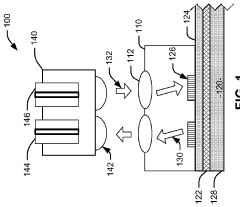
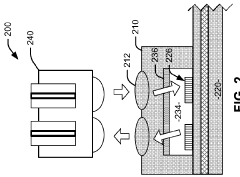
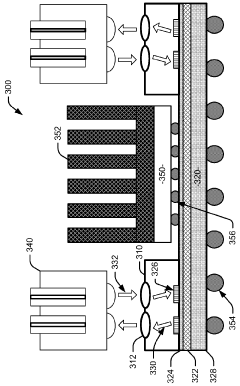
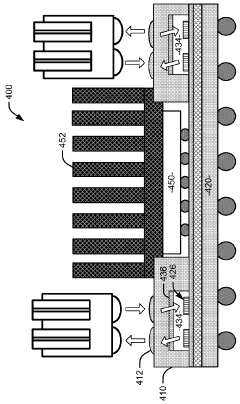
- A photonic interposer with a polarization selective beam splitter/combiner is used to couple light between optical fibers and a photonic integrated circuit, incorporating glass-molded micro-optics with thin film coatings for polarization management, allowing for reduced size and increased scalability by handling mixed polarization light without additional modulators, and enabling efficient coupling of multiple fibers.


Photonic interposer with wafer bonded microlenses
PatentWO2016068876A1
Innovation
- The integration of wafer-bonded microlenses with grating couplers and expanded beam fiber optic connectors, leveraging MEMS fabrication techniques for precise alignment and signal collimation, reduces the need for active alignment of multiple optical elements, facilitating high-precision signal transfer and improved assembly efficiency.
Manufacturing Standards for Photonic Integration Devices
The manufacturing of photonic integration devices, particularly photonics interposers and beam splitting components, requires adherence to stringent standards that ensure consistent performance and reliability across different production environments. Current manufacturing standards encompass dimensional tolerances, material specifications, and process control parameters that directly impact the efficiency of beam splitting operations.
Dimensional accuracy represents a critical manufacturing standard, with typical tolerances ranging from ±50 nanometers for waveguide width variations to ±10 nanometers for surface roughness specifications. These tight tolerances are essential for maintaining consistent coupling efficiency and minimizing insertion losses in photonics interposers. The International Electrotechnical Commission (IEC) has established preliminary guidelines under IEC 62496 series, though comprehensive standards specific to photonic integration remain under development.
Material quality standards focus on optical-grade silicon, silicon nitride, and polymer substrates used in photonic device fabrication. Refractive index uniformity must be maintained within ±0.001 across the substrate, while material absorption coefficients should not exceed 0.1 dB/cm at operating wavelengths. These specifications ensure predictable beam splitting ratios and minimize unwanted optical losses that could compromise device efficiency.
Process control standards encompass lithography resolution requirements, typically demanding sub-100nm feature definition capabilities for advanced photonic circuits. Etching depth control must maintain uniformity within ±5% across the substrate to ensure consistent waveguide performance. Temperature control during fabrication processes requires stability within ±1°C to prevent thermal-induced stress that could affect optical properties.
Packaging and assembly standards address the integration of photonic components with electronic systems. These include alignment tolerances for fiber-to-chip coupling, typically requiring positioning accuracy within ±0.5 micrometers, and hermetic sealing requirements to protect sensitive optical interfaces from environmental contamination.
Quality assurance protocols mandate comprehensive optical testing at multiple manufacturing stages, including insertion loss measurements, crosstalk characterization, and long-term reliability assessments under accelerated aging conditions. These standards collectively ensure that photonics interposers and beam splitting devices meet the performance requirements necessary for commercial deployment in telecommunications, data center, and sensing applications.
Dimensional accuracy represents a critical manufacturing standard, with typical tolerances ranging from ±50 nanometers for waveguide width variations to ±10 nanometers for surface roughness specifications. These tight tolerances are essential for maintaining consistent coupling efficiency and minimizing insertion losses in photonics interposers. The International Electrotechnical Commission (IEC) has established preliminary guidelines under IEC 62496 series, though comprehensive standards specific to photonic integration remain under development.
Material quality standards focus on optical-grade silicon, silicon nitride, and polymer substrates used in photonic device fabrication. Refractive index uniformity must be maintained within ±0.001 across the substrate, while material absorption coefficients should not exceed 0.1 dB/cm at operating wavelengths. These specifications ensure predictable beam splitting ratios and minimize unwanted optical losses that could compromise device efficiency.
Process control standards encompass lithography resolution requirements, typically demanding sub-100nm feature definition capabilities for advanced photonic circuits. Etching depth control must maintain uniformity within ±5% across the substrate to ensure consistent waveguide performance. Temperature control during fabrication processes requires stability within ±1°C to prevent thermal-induced stress that could affect optical properties.
Packaging and assembly standards address the integration of photonic components with electronic systems. These include alignment tolerances for fiber-to-chip coupling, typically requiring positioning accuracy within ±0.5 micrometers, and hermetic sealing requirements to protect sensitive optical interfaces from environmental contamination.
Quality assurance protocols mandate comprehensive optical testing at multiple manufacturing stages, including insertion loss measurements, crosstalk characterization, and long-term reliability assessments under accelerated aging conditions. These standards collectively ensure that photonics interposers and beam splitting devices meet the performance requirements necessary for commercial deployment in telecommunications, data center, and sensing applications.
Thermal Management Considerations in Photonic Systems
Thermal management represents a critical design consideration in photonic interposer systems, particularly when implementing beam splitting functionalities that demand high optical efficiency. The concentrated optical power densities inherent in photonic integrated circuits generate substantial heat loads that can significantly impact device performance, reliability, and long-term operational stability.
Heat generation in photonic interposers primarily originates from optical absorption losses within waveguide materials, coupling inefficiencies at beam splitter junctions, and electrical power dissipation in active components such as modulators and photodetectors. Silicon photonic platforms, while offering excellent integration capabilities, exhibit temperature-dependent refractive index variations that directly affect beam splitting ratios and overall system efficiency. These thermal effects become particularly pronounced in dense wavelength division multiplexing applications where multiple optical channels operate simultaneously.
The thermal coefficient of silicon's refractive index, approximately 1.8×10⁻⁴ K⁻¹, introduces wavelength-dependent phase shifts that can degrade beam splitter performance and cause spectral drift in resonant structures. Temperature variations as small as 1°C can result in significant wavelength shifts, compromising the precision required for efficient beam splitting operations.
Effective thermal management strategies encompass both passive and active cooling approaches. Passive solutions include optimized substrate materials with high thermal conductivity, such as silicon carbide or aluminum nitride, and strategic placement of thermal vias to enhance heat dissipation pathways. Advanced packaging techniques incorporating copper heat spreaders and thermal interface materials provide additional heat removal capacity.
Active thermal control systems employ thermoelectric coolers or micro-fluidic cooling channels integrated directly into the interposer substrate. These solutions enable precise temperature regulation but introduce additional complexity and power consumption considerations. Thermal isolation techniques, including air gaps and low thermal conductivity materials, help minimize cross-talk between adjacent photonic components.
Design optimization requires comprehensive thermal modeling to predict temperature distributions and identify potential hotspots that could compromise beam splitting efficiency. Finite element analysis tools enable engineers to evaluate various cooling configurations and material selections during the design phase, ensuring optimal thermal performance while maintaining compact form factors essential for photonic interposer applications.
Heat generation in photonic interposers primarily originates from optical absorption losses within waveguide materials, coupling inefficiencies at beam splitter junctions, and electrical power dissipation in active components such as modulators and photodetectors. Silicon photonic platforms, while offering excellent integration capabilities, exhibit temperature-dependent refractive index variations that directly affect beam splitting ratios and overall system efficiency. These thermal effects become particularly pronounced in dense wavelength division multiplexing applications where multiple optical channels operate simultaneously.
The thermal coefficient of silicon's refractive index, approximately 1.8×10⁻⁴ K⁻¹, introduces wavelength-dependent phase shifts that can degrade beam splitter performance and cause spectral drift in resonant structures. Temperature variations as small as 1°C can result in significant wavelength shifts, compromising the precision required for efficient beam splitting operations.
Effective thermal management strategies encompass both passive and active cooling approaches. Passive solutions include optimized substrate materials with high thermal conductivity, such as silicon carbide or aluminum nitride, and strategic placement of thermal vias to enhance heat dissipation pathways. Advanced packaging techniques incorporating copper heat spreaders and thermal interface materials provide additional heat removal capacity.
Active thermal control systems employ thermoelectric coolers or micro-fluidic cooling channels integrated directly into the interposer substrate. These solutions enable precise temperature regulation but introduce additional complexity and power consumption considerations. Thermal isolation techniques, including air gaps and low thermal conductivity materials, help minimize cross-talk between adjacent photonic components.
Design optimization requires comprehensive thermal modeling to predict temperature distributions and identify potential hotspots that could compromise beam splitting efficiency. Finite element analysis tools enable engineers to evaluate various cooling configurations and material selections during the design phase, ensuring optimal thermal performance while maintaining compact form factors essential for photonic interposer applications.
Unlock deeper insights with PatSnap Eureka Quick Research — get a full tech report to explore trends and direct your research. Try now!
Generate Your Research Report Instantly with AI Agent
Supercharge your innovation with PatSnap Eureka AI Agent Platform!