

Polymer Electrolytes Vs Ionic Liquids: Battery Cycle Life Analysis
MAY 20, 20269 MIN READ
Generate Your Research Report Instantly with AI Agent
PatSnap Eureka helps you evaluate technical feasibility & market potential.
Polymer Electrolyte and Ionic Liquid Battery Technology Background
The development of advanced battery technologies has been driven by the increasing demand for high-performance energy storage systems across multiple sectors, including electric vehicles, portable electronics, and grid-scale energy storage. Traditional lithium-ion batteries utilizing liquid organic electrolytes have dominated the market for decades, but their inherent safety concerns, limited operating temperature ranges, and cycle life limitations have prompted extensive research into alternative electrolyte systems.
Polymer electrolytes emerged in the 1970s as a promising solid-state alternative, offering enhanced safety through the elimination of flammable liquid solvents. These systems typically consist of a polymer matrix, such as polyethylene oxide (PEO), combined with lithium salts to provide ionic conductivity. The solid-state nature of polymer electrolytes addresses critical safety issues including thermal runaway and electrolyte leakage while potentially enabling the use of lithium metal anodes for higher energy density applications.
Ionic liquids, discovered in the early 20th century but gaining significant attention for battery applications since the 1990s, represent another revolutionary approach to electrolyte design. These room-temperature molten salts consist entirely of ions and exhibit unique properties including negligible vapor pressure, wide electrochemical stability windows, and excellent thermal stability. Their tunable nature through cation and anion selection allows for customized properties to meet specific battery performance requirements.
The evolution of both technologies has been marked by significant milestones in addressing fundamental challenges. For polymer electrolytes, key developments have focused on improving ionic conductivity at room temperature, which traditionally required elevated operating temperatures above 60°C for practical performance. Recent advances in polymer architecture, including block copolymers and single-ion conductors, have substantially improved conductivity while maintaining mechanical integrity.
Ionic liquid research has progressed from early imidazolium-based systems to more electrochemically stable alternatives such as pyrrolidinium and piperidinium cations paired with various anions including bis(trifluoromethanesulfonyl)imide (TFSI) and fluorosulfonyl derivatives. These developments have expanded the operational voltage range and improved compatibility with electrode materials, particularly addressing aluminum corrosion issues that plagued early formulations.
The convergence of these technologies has led to hybrid approaches, including gel polymer electrolytes incorporating ionic liquids and solid polymer matrices with ionic liquid plasticizers. These systems aim to combine the mechanical stability of polymers with the superior electrochemical properties of ionic liquids, representing a significant advancement in electrolyte design philosophy.
Current research objectives focus on achieving optimal balance between ionic conductivity, mechanical properties, electrochemical stability, and interfacial compatibility with electrode materials. The ultimate goal is developing electrolyte systems that can support thousands of charge-discharge cycles while maintaining capacity retention, thermal stability, and safety standards required for commercial applications.
Polymer electrolytes emerged in the 1970s as a promising solid-state alternative, offering enhanced safety through the elimination of flammable liquid solvents. These systems typically consist of a polymer matrix, such as polyethylene oxide (PEO), combined with lithium salts to provide ionic conductivity. The solid-state nature of polymer electrolytes addresses critical safety issues including thermal runaway and electrolyte leakage while potentially enabling the use of lithium metal anodes for higher energy density applications.
Ionic liquids, discovered in the early 20th century but gaining significant attention for battery applications since the 1990s, represent another revolutionary approach to electrolyte design. These room-temperature molten salts consist entirely of ions and exhibit unique properties including negligible vapor pressure, wide electrochemical stability windows, and excellent thermal stability. Their tunable nature through cation and anion selection allows for customized properties to meet specific battery performance requirements.
The evolution of both technologies has been marked by significant milestones in addressing fundamental challenges. For polymer electrolytes, key developments have focused on improving ionic conductivity at room temperature, which traditionally required elevated operating temperatures above 60°C for practical performance. Recent advances in polymer architecture, including block copolymers and single-ion conductors, have substantially improved conductivity while maintaining mechanical integrity.
Ionic liquid research has progressed from early imidazolium-based systems to more electrochemically stable alternatives such as pyrrolidinium and piperidinium cations paired with various anions including bis(trifluoromethanesulfonyl)imide (TFSI) and fluorosulfonyl derivatives. These developments have expanded the operational voltage range and improved compatibility with electrode materials, particularly addressing aluminum corrosion issues that plagued early formulations.
The convergence of these technologies has led to hybrid approaches, including gel polymer electrolytes incorporating ionic liquids and solid polymer matrices with ionic liquid plasticizers. These systems aim to combine the mechanical stability of polymers with the superior electrochemical properties of ionic liquids, representing a significant advancement in electrolyte design philosophy.
Current research objectives focus on achieving optimal balance between ionic conductivity, mechanical properties, electrochemical stability, and interfacial compatibility with electrode materials. The ultimate goal is developing electrolyte systems that can support thousands of charge-discharge cycles while maintaining capacity retention, thermal stability, and safety standards required for commercial applications.
Market Demand for Advanced Battery Cycle Life Solutions
The global battery market is experiencing unprecedented growth driven by the rapid expansion of electric vehicles, renewable energy storage systems, and portable electronics. This surge has created substantial demand for advanced battery technologies that can deliver superior cycle life performance, with polymer electrolytes and ionic liquids emerging as critical materials for next-generation energy storage solutions.
Electric vehicle manufacturers are particularly focused on extending battery longevity to reduce total cost of ownership and enhance consumer confidence. Current lithium-ion batteries typically offer 1,000 to 3,000 charge cycles, but market demands are pushing toward systems capable of 5,000 to 10,000 cycles while maintaining capacity retention above 80 percent. This requirement has intensified research into advanced electrolyte systems that can minimize degradation mechanisms.
Grid-scale energy storage applications present another significant market driver, where cycle life directly impacts project economics and return on investment. Utility companies and renewable energy developers require battery systems with extended operational lifespans to justify capital expenditures and ensure grid stability. The intermittent nature of renewable energy sources necessitates frequent charge-discharge cycles, making cycle life optimization paramount.
Consumer electronics continue to demand thinner, lighter batteries with longer operational lifespans. Smartphones, laptops, and wearable devices require electrolyte solutions that can withstand thousands of cycles while maintaining form factor constraints. The market increasingly values devices that retain battery performance over extended periods, driving manufacturers to seek advanced electrolyte technologies.
Industrial applications, including backup power systems, medical devices, and aerospace applications, represent high-value market segments where battery reliability and longevity are critical. These sectors often prioritize performance over cost, creating opportunities for premium electrolyte solutions that deliver exceptional cycle life characteristics.
The growing emphasis on sustainability and circular economy principles has further amplified demand for longer-lasting battery technologies. Regulatory pressures and corporate sustainability commitments are pushing manufacturers to develop batteries with extended lifespans to reduce electronic waste and environmental impact. This trend particularly benefits advanced electrolyte technologies that can significantly extend battery operational life.
Market research indicates strong growth potential for electrolyte technologies that can address cycle life limitations. The convergence of performance requirements, cost considerations, and environmental concerns creates a compelling market opportunity for polymer electrolytes and ionic liquids that demonstrate superior cycle life characteristics compared to conventional liquid electrolytes.
Electric vehicle manufacturers are particularly focused on extending battery longevity to reduce total cost of ownership and enhance consumer confidence. Current lithium-ion batteries typically offer 1,000 to 3,000 charge cycles, but market demands are pushing toward systems capable of 5,000 to 10,000 cycles while maintaining capacity retention above 80 percent. This requirement has intensified research into advanced electrolyte systems that can minimize degradation mechanisms.
Grid-scale energy storage applications present another significant market driver, where cycle life directly impacts project economics and return on investment. Utility companies and renewable energy developers require battery systems with extended operational lifespans to justify capital expenditures and ensure grid stability. The intermittent nature of renewable energy sources necessitates frequent charge-discharge cycles, making cycle life optimization paramount.
Consumer electronics continue to demand thinner, lighter batteries with longer operational lifespans. Smartphones, laptops, and wearable devices require electrolyte solutions that can withstand thousands of cycles while maintaining form factor constraints. The market increasingly values devices that retain battery performance over extended periods, driving manufacturers to seek advanced electrolyte technologies.
Industrial applications, including backup power systems, medical devices, and aerospace applications, represent high-value market segments where battery reliability and longevity are critical. These sectors often prioritize performance over cost, creating opportunities for premium electrolyte solutions that deliver exceptional cycle life characteristics.
The growing emphasis on sustainability and circular economy principles has further amplified demand for longer-lasting battery technologies. Regulatory pressures and corporate sustainability commitments are pushing manufacturers to develop batteries with extended lifespans to reduce electronic waste and environmental impact. This trend particularly benefits advanced electrolyte technologies that can significantly extend battery operational life.
Market research indicates strong growth potential for electrolyte technologies that can address cycle life limitations. The convergence of performance requirements, cost considerations, and environmental concerns creates a compelling market opportunity for polymer electrolytes and ionic liquids that demonstrate superior cycle life characteristics compared to conventional liquid electrolytes.
Current State of Polymer vs Ionic Liquid Electrolyte Technologies
Polymer electrolytes represent a mature technology category that has undergone significant development over the past three decades. Solid polymer electrolytes (SPEs) based on polyethylene oxide (PEO) matrices with lithium salts have achieved commercial viability in certain applications, particularly in thin-film batteries and some electric vehicle systems. These systems typically demonstrate ionic conductivities ranging from 10^-5 to 10^-3 S/cm at room temperature, with operational temperature windows often requiring elevation to 60-80°C for optimal performance.
Current polymer electrolyte formulations face inherent trade-offs between mechanical stability and ionic conductivity. Gel polymer electrolytes (GPEs) incorporating liquid plasticizers achieve higher conductivities approaching 10^-3 S/cm but sacrifice some mechanical integrity. Recent advances in composite polymer electrolytes integrating ceramic fillers like LLZO or LAGP have shown promise in addressing these limitations, achieving conductivities exceeding 10^-4 S/cm while maintaining structural stability.
Ionic liquid electrolytes present a fundamentally different technological approach, leveraging the unique properties of room-temperature molten salts. Contemporary ionic liquid formulations, particularly those based on imidazolium, pyrrolidinium, and phosphonium cations paired with TFSI or FSI anions, demonstrate exceptional electrochemical stability windows exceeding 4V and thermal stability up to 300°C. However, their ionic conductivities typically range from 10^-3 to 10^-2 S/cm, which, while competitive, often require optimization for specific battery chemistries.
The current technological landscape reveals distinct performance profiles for each approach. Polymer electrolytes excel in providing mechanical separation between electrodes and demonstrate superior compatibility with lithium metal anodes, addressing dendrite formation concerns that significantly impact cycle life. Their solid-state nature enables simplified battery pack designs and enhanced safety profiles through elimination of flammable liquid components.
Ionic liquids offer superior electrochemical windows and thermal stability, making them particularly attractive for high-voltage cathode systems and extreme operating conditions. Recent developments in ionic liquid-polymer hybrid systems attempt to combine the mechanical properties of polymers with the electrochemical advantages of ionic liquids, representing a convergent technological pathway.
Manufacturing scalability differs significantly between these technologies. Polymer electrolyte production leverages established polymer processing techniques, while ionic liquid synthesis requires specialized purification processes to achieve the purity levels necessary for battery applications. Cost considerations currently favor polymer systems for large-scale deployment, though ionic liquid costs continue to decrease with improved synthetic routes and economies of scale.
Current polymer electrolyte formulations face inherent trade-offs between mechanical stability and ionic conductivity. Gel polymer electrolytes (GPEs) incorporating liquid plasticizers achieve higher conductivities approaching 10^-3 S/cm but sacrifice some mechanical integrity. Recent advances in composite polymer electrolytes integrating ceramic fillers like LLZO or LAGP have shown promise in addressing these limitations, achieving conductivities exceeding 10^-4 S/cm while maintaining structural stability.
Ionic liquid electrolytes present a fundamentally different technological approach, leveraging the unique properties of room-temperature molten salts. Contemporary ionic liquid formulations, particularly those based on imidazolium, pyrrolidinium, and phosphonium cations paired with TFSI or FSI anions, demonstrate exceptional electrochemical stability windows exceeding 4V and thermal stability up to 300°C. However, their ionic conductivities typically range from 10^-3 to 10^-2 S/cm, which, while competitive, often require optimization for specific battery chemistries.
The current technological landscape reveals distinct performance profiles for each approach. Polymer electrolytes excel in providing mechanical separation between electrodes and demonstrate superior compatibility with lithium metal anodes, addressing dendrite formation concerns that significantly impact cycle life. Their solid-state nature enables simplified battery pack designs and enhanced safety profiles through elimination of flammable liquid components.
Ionic liquids offer superior electrochemical windows and thermal stability, making them particularly attractive for high-voltage cathode systems and extreme operating conditions. Recent developments in ionic liquid-polymer hybrid systems attempt to combine the mechanical properties of polymers with the electrochemical advantages of ionic liquids, representing a convergent technological pathway.
Manufacturing scalability differs significantly between these technologies. Polymer electrolyte production leverages established polymer processing techniques, while ionic liquid synthesis requires specialized purification processes to achieve the purity levels necessary for battery applications. Cost considerations currently favor polymer systems for large-scale deployment, though ionic liquid costs continue to decrease with improved synthetic routes and economies of scale.
Existing Cycle Life Enhancement Solutions
01 Polymer electrolyte composition and structure optimization
Advanced polymer electrolyte systems focus on optimizing the molecular structure and composition to enhance ionic conductivity and mechanical properties. These systems typically involve cross-linked polymer networks, copolymer structures, and specialized polymer matrices that provide stable ion transport pathways while maintaining structural integrity during repeated charge-discharge cycles.- Polymer electrolyte composition and structure optimization: Advanced polymer electrolyte systems utilize specific polymer matrices and ionic conductors to enhance electrochemical performance and extend operational lifespan. These compositions focus on optimizing molecular structure, crosslinking density, and ionic pathways to improve stability and reduce degradation during charge-discharge cycles. The formulations often incorporate specialized additives and stabilizers to maintain structural integrity over extended periods.
- Ionic liquid electrolyte formulations for enhanced durability: Ionic liquid-based electrolytes are designed with specific cation-anion combinations to maximize cycle stability and minimize decomposition reactions. These formulations focus on thermal stability, electrochemical window optimization, and compatibility with electrode materials to prevent capacity fade and maintain performance over numerous cycles. The selection of ionic liquid components is critical for achieving long-term operational reliability.
- Cycle life enhancement through additive incorporation: Strategic incorporation of functional additives into electrolyte systems significantly improves cycle life performance by preventing unwanted side reactions and stabilizing electrode-electrolyte interfaces. These additives work to form protective layers, scavenge reactive species, and maintain electrolyte integrity throughout repeated cycling. The approach focuses on molecular-level interactions that preserve system functionality over extended operational periods.
- Interface stabilization and protective layer formation: Development of electrolyte systems that promote stable interface formation between electrodes and electrolytes is crucial for extending cycle life. These approaches focus on controlling surface chemistry, preventing dendrite formation, and maintaining consistent ion transport properties. The technology emphasizes creating self-healing or self-maintaining interfaces that resist degradation during repeated electrochemical processes.
- Advanced electrolyte processing and manufacturing techniques: Specialized processing methods and manufacturing techniques are employed to produce electrolyte systems with superior cycle life characteristics. These approaches include controlled synthesis conditions, purification processes, and quality control measures that ensure consistent performance and longevity. The focus is on eliminating impurities and optimizing physical properties that directly impact long-term stability and cycling performance.
02 Ionic liquid integration and compatibility
Integration of ionic liquids into polymer electrolyte systems requires careful consideration of compatibility and interaction mechanisms. The selection and incorporation of specific ionic liquid formulations can significantly impact the electrochemical stability, temperature range, and overall performance characteristics of the electrolyte system during extended cycling operations.Expand Specific Solutions03 Cycle life enhancement through additive systems
Various additive systems and stabilizing agents are employed to extend the operational lifespan of polymer electrolytes and ionic liquid systems. These enhancement strategies focus on preventing degradation reactions, maintaining electrochemical stability, and preserving the structural integrity of the electrolyte matrix throughout numerous charge-discharge cycles.Expand Specific Solutions04 Interface stability and electrode compatibility
The interface between polymer electrolytes or ionic liquids and electrode materials plays a crucial role in determining cycle life performance. Optimization strategies include surface modification techniques, interfacial layer formation, and compatibility enhancement methods that reduce interfacial resistance and prevent unwanted side reactions during cycling.Expand Specific Solutions05 Temperature and environmental stability optimization
Maintaining stable performance across various temperature ranges and environmental conditions is essential for practical applications. Advanced formulations focus on thermal stability, moisture resistance, and environmental durability to ensure consistent performance and extended cycle life under diverse operating conditions.Expand Specific Solutions
Key Players in Polymer and Ionic Liquid Battery Industry
The polymer electrolytes versus ionic liquids battery technology sector represents a rapidly evolving competitive landscape within the broader energy storage industry. The market is currently in a growth phase, driven by increasing demand for safer, higher-performance batteries across electric vehicles, consumer electronics, and grid storage applications. Major established players like Contemporary Amperex Technology, LG Energy Solution, Samsung SDI, and Toyota Motor Corp dominate manufacturing and commercialization, while innovative companies such as Sionic Energy, Anthro Energy, and New Dominion Enterprises focus on next-generation electrolyte technologies. The technology maturity varies significantly, with traditional liquid electrolytes being well-established, while solid polymer electrolytes and ionic liquid solutions remain in advanced development stages. Research institutions like California Institute of Technology and Shizuoka University contribute fundamental breakthroughs, while material suppliers including Sumitomo Chemical and Shenzhen Capchem provide critical components, creating a diverse ecosystem spanning from basic research to commercial deployment.
Contemporary Amperex Technology Co., Ltd.
Technical Solution: CATL has developed advanced polymer electrolyte systems for their lithium-ion batteries, focusing on improving cycle life through optimized electrolyte formulations. Their polymer electrolytes utilize cross-linked polymer matrices that provide enhanced mechanical stability and ionic conductivity. The company has implemented gel polymer electrolytes (GPE) that combine the advantages of liquid and solid electrolytes, achieving over 3000 charge-discharge cycles while maintaining 80% capacity retention. Their research emphasizes the balance between ionic conductivity and mechanical properties, utilizing lithium salt concentrations optimized for long-term cycling performance. CATL's polymer electrolyte technology incorporates flame-retardant additives and thermal stability enhancers to ensure safety during extended cycling operations.
Strengths: Market-leading production capacity, extensive R&D investment, proven commercial scalability. Weaknesses: Heavy reliance on traditional lithium-ion chemistry, limited breakthrough in next-generation solid-state technologies.
LG Energy Solution Ltd.
Technical Solution: LG Energy Solution has developed proprietary polymer electrolyte technologies focusing on NCM (Nickel Cobalt Manganese) cathode compatibility for enhanced cycle life. Their polymer electrolyte systems incorporate advanced plasticizers and cross-linking agents that maintain structural integrity over thousands of cycles. The company's approach includes the development of solid polymer electrolytes (SPE) with lithium bis(trifluoromethanesulfonyl)imide (LiTFSI) salt systems, achieving cycle lives exceeding 2500 cycles at 80% depth of discharge. Their polymer matrix design emphasizes temperature stability and low interfacial resistance, crucial for automotive applications. LG's electrolyte formulations include specialized additives for SEI layer stabilization, contributing to improved long-term cycling performance and reduced capacity fade rates.
Strengths: Strong automotive partnerships, advanced manufacturing capabilities, comprehensive battery system integration. Weaknesses: Intense competition pressure, dependency on raw material supply chains, slower adoption of emerging electrolyte technologies.
Core Patents in Electrolyte Cycle Life Optimization
Carbon fiber battery electrodes with ionic liquid and gel electrolytes
PatentActiveUS20220407107A1
Innovation
- A gel polymer electrolyte is developed comprising a metal salt, ionic liquid, and polymerized monomer, with at least one electrode comprising carbon fiber, which is used to create flexible electrochemical cells suitable for wearable and low-power applications, utilizing a mixture of metal salts like LiTFSI and ionic liquids like 1-ethyl-3-methylimidazolium bis(trifluoromethanesulfonyl)imide, and monomers like tetraethylene glycol dimethacrylate, and polymerized using initiators like tert-butyl peroxide.


Solid polymer electrolyte for batteries
PatentWO2018229560A1
Innovation
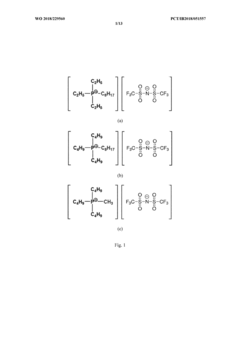
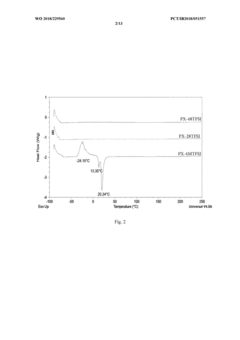
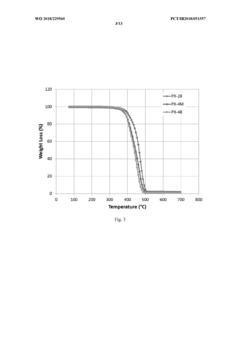
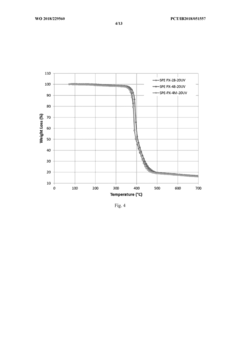
- A solid polymer electrolyte comprising a dissociable metal salt, a metal ion conductive polymer system, and a phosphonium salt with a specific formula, which improves ionic conductivity and stability, allowing the electrolyte to operate safely over a wide temperature range while preventing dendrite growth.
Environmental Impact Assessment of Battery Materials
The environmental implications of polymer electrolytes and ionic liquids in battery applications present distinct sustainability profiles that significantly influence their long-term viability. Polymer electrolytes, typically composed of polyethylene oxide (PEO) or polyvinylidene fluoride (PVDF) matrices, demonstrate relatively favorable environmental characteristics due to their organic polymer backbone. These materials generally exhibit lower toxicity levels and can potentially undergo controlled degradation processes under specific conditions.
Ionic liquids, while offering superior electrochemical performance, raise more complex environmental concerns. Their non-volatile nature prevents atmospheric emissions during operation, yet their chemical stability creates challenges for end-of-life disposal. Many ionic liquids contain fluorinated anions or complex organic cations that resist natural biodegradation processes, potentially leading to persistent environmental contamination if not properly managed.
Manufacturing processes for both electrolyte types generate different environmental footprints. Polymer electrolyte production typically involves conventional polymerization techniques with established waste treatment protocols. Conversely, ionic liquid synthesis often requires specialized chemical processes and purification steps that may generate hazardous byproducts requiring careful handling and disposal.
Recycling potential varies significantly between these technologies. Polymer electrolytes can potentially be processed through thermal or chemical recycling methods, allowing recovery of valuable components. The polymer matrix may be depolymerized or repurposed for other applications. Ionic liquids present both opportunities and challenges for recycling, as their chemical stability enables potential reuse after purification, but their complex molecular structures complicate separation and recovery processes.
Life cycle assessments reveal that ionic liquids may offer environmental advantages through extended battery lifespans, reducing overall material consumption and waste generation. However, their production energy requirements and potential for environmental persistence must be weighed against these benefits. Polymer electrolytes, while potentially more biodegradable, may require more frequent replacement, increasing cumulative environmental impact through higher material turnover rates.
Ionic liquids, while offering superior electrochemical performance, raise more complex environmental concerns. Their non-volatile nature prevents atmospheric emissions during operation, yet their chemical stability creates challenges for end-of-life disposal. Many ionic liquids contain fluorinated anions or complex organic cations that resist natural biodegradation processes, potentially leading to persistent environmental contamination if not properly managed.
Manufacturing processes for both electrolyte types generate different environmental footprints. Polymer electrolyte production typically involves conventional polymerization techniques with established waste treatment protocols. Conversely, ionic liquid synthesis often requires specialized chemical processes and purification steps that may generate hazardous byproducts requiring careful handling and disposal.
Recycling potential varies significantly between these technologies. Polymer electrolytes can potentially be processed through thermal or chemical recycling methods, allowing recovery of valuable components. The polymer matrix may be depolymerized or repurposed for other applications. Ionic liquids present both opportunities and challenges for recycling, as their chemical stability enables potential reuse after purification, but their complex molecular structures complicate separation and recovery processes.
Life cycle assessments reveal that ionic liquids may offer environmental advantages through extended battery lifespans, reducing overall material consumption and waste generation. However, their production energy requirements and potential for environmental persistence must be weighed against these benefits. Polymer electrolytes, while potentially more biodegradable, may require more frequent replacement, increasing cumulative environmental impact through higher material turnover rates.
Safety Standards for Advanced Electrolyte Systems
The development of comprehensive safety standards for advanced electrolyte systems has become increasingly critical as polymer electrolytes and ionic liquids gain prominence in next-generation battery technologies. Current regulatory frameworks primarily address conventional liquid electrolytes, creating significant gaps in safety protocols for these emerging materials. International organizations including IEC, UL, and ISO are actively working to establish unified standards that encompass the unique characteristics and potential hazards associated with advanced electrolyte chemistries.
Thermal stability requirements represent a fundamental pillar of safety standards for advanced electrolyte systems. Polymer electrolytes must demonstrate stable performance across operating temperature ranges of -40°C to 85°C, with specific protocols for thermal runaway prevention and containment. Testing procedures include differential scanning calorimetry analysis, accelerated aging tests, and thermal abuse tolerance evaluations. For ionic liquids, standards focus on their inherently superior thermal stability while addressing potential decomposition pathways and gas evolution under extreme conditions.
Chemical compatibility and toxicity assessments form another crucial component of safety standardization. Advanced electrolyte systems require comprehensive evaluation of material interactions with cell components, including separators, electrodes, and packaging materials. Standardized protocols now mandate long-term compatibility testing under various stress conditions, including overcharge, overdischarge, and mechanical abuse scenarios. Toxicity evaluation procedures have been expanded to address the unique chemical properties of ionic liquids and polymer matrices.
Fire safety and flammability standards have evolved significantly to accommodate the non-flammable nature of many advanced electrolytes. New testing methodologies evaluate flame retardancy, smoke generation, and toxic gas emission during thermal events. These standards recognize that while polymer electrolytes and ionic liquids may offer improved fire safety compared to conventional electrolytes, they require specific evaluation criteria for their combustion characteristics and potential hazardous decomposition products.
Environmental and handling safety protocols address the lifecycle management of advanced electrolyte systems. Standards now include guidelines for manufacturing safety, transportation requirements, end-of-life disposal, and recycling procedures. Special attention is given to the environmental impact assessment of ionic liquids and polymer degradation products, ensuring that safety considerations extend beyond operational use to encompass the entire product lifecycle.
Thermal stability requirements represent a fundamental pillar of safety standards for advanced electrolyte systems. Polymer electrolytes must demonstrate stable performance across operating temperature ranges of -40°C to 85°C, with specific protocols for thermal runaway prevention and containment. Testing procedures include differential scanning calorimetry analysis, accelerated aging tests, and thermal abuse tolerance evaluations. For ionic liquids, standards focus on their inherently superior thermal stability while addressing potential decomposition pathways and gas evolution under extreme conditions.
Chemical compatibility and toxicity assessments form another crucial component of safety standardization. Advanced electrolyte systems require comprehensive evaluation of material interactions with cell components, including separators, electrodes, and packaging materials. Standardized protocols now mandate long-term compatibility testing under various stress conditions, including overcharge, overdischarge, and mechanical abuse scenarios. Toxicity evaluation procedures have been expanded to address the unique chemical properties of ionic liquids and polymer matrices.
Fire safety and flammability standards have evolved significantly to accommodate the non-flammable nature of many advanced electrolytes. New testing methodologies evaluate flame retardancy, smoke generation, and toxic gas emission during thermal events. These standards recognize that while polymer electrolytes and ionic liquids may offer improved fire safety compared to conventional electrolytes, they require specific evaluation criteria for their combustion characteristics and potential hazardous decomposition products.
Environmental and handling safety protocols address the lifecycle management of advanced electrolyte systems. Standards now include guidelines for manufacturing safety, transportation requirements, end-of-life disposal, and recycling procedures. Special attention is given to the environmental impact assessment of ionic liquids and polymer degradation products, ensuring that safety considerations extend beyond operational use to encompass the entire product lifecycle.
Unlock deeper insights with PatSnap Eureka Quick Research — get a full tech report to explore trends and direct your research. Try now!
Generate Your Research Report Instantly with AI Agent
Supercharge your innovation with PatSnap Eureka AI Agent Platform!