

Quantum repeaters vs quantum error correction: cost per km compared
MAY 7, 20269 MIN READ
Generate Your Research Report Instantly with AI Agent
PatSnap Eureka helps you evaluate technical feasibility & market potential.
Quantum Communication Infrastructure Background and Objectives
Quantum communication represents a paradigm shift in information transmission, leveraging quantum mechanical properties to achieve unprecedented levels of security and computational capability. The field has evolved from theoretical foundations laid in the 1980s to practical implementations demonstrating quantum key distribution over hundreds of kilometers. This evolution encompasses two critical technological pathways: quantum repeaters and quantum error correction, each addressing the fundamental challenge of quantum decoherence over long distances.
The primary objective of quantum communication infrastructure development centers on establishing scalable, cost-effective networks capable of maintaining quantum coherence across continental distances. Current limitations in direct quantum transmission, which typically degrades exponentially with distance due to photon loss and decoherence, necessitate innovative solutions to extend quantum communication range while preserving fidelity.
Quantum repeaters emerge as a distributed approach, utilizing quantum entanglement swapping and quantum memory to segment long-distance communication into manageable shorter links. This methodology aims to overcome the exponential scaling problem by creating a series of intermediate nodes that can store and forward quantum states. The technology promises to enable quantum networks spanning thousands of kilometers, connecting quantum computers and secure communication nodes across global distances.
Quantum error correction represents an alternative paradigm, focusing on encoding quantum information redundantly to detect and correct errors that occur during transmission. This approach leverages sophisticated mathematical frameworks to protect quantum states against various forms of noise and decoherence, potentially enabling direct long-distance transmission without intermediate nodes.
The convergence of these technologies toward practical quantum internet infrastructure drives the need for comprehensive cost-benefit analysis. Understanding the economic implications per kilometer of deployment becomes crucial for strategic technology selection and investment decisions. This analysis must consider not only initial infrastructure costs but also operational complexity, maintenance requirements, and scalability potential.
The ultimate goal encompasses establishing quantum communication networks that can support distributed quantum computing, ultra-secure communications, and quantum sensing applications across metropolitan, national, and international scales while maintaining economic viability and technological reliability.
The primary objective of quantum communication infrastructure development centers on establishing scalable, cost-effective networks capable of maintaining quantum coherence across continental distances. Current limitations in direct quantum transmission, which typically degrades exponentially with distance due to photon loss and decoherence, necessitate innovative solutions to extend quantum communication range while preserving fidelity.
Quantum repeaters emerge as a distributed approach, utilizing quantum entanglement swapping and quantum memory to segment long-distance communication into manageable shorter links. This methodology aims to overcome the exponential scaling problem by creating a series of intermediate nodes that can store and forward quantum states. The technology promises to enable quantum networks spanning thousands of kilometers, connecting quantum computers and secure communication nodes across global distances.
Quantum error correction represents an alternative paradigm, focusing on encoding quantum information redundantly to detect and correct errors that occur during transmission. This approach leverages sophisticated mathematical frameworks to protect quantum states against various forms of noise and decoherence, potentially enabling direct long-distance transmission without intermediate nodes.
The convergence of these technologies toward practical quantum internet infrastructure drives the need for comprehensive cost-benefit analysis. Understanding the economic implications per kilometer of deployment becomes crucial for strategic technology selection and investment decisions. This analysis must consider not only initial infrastructure costs but also operational complexity, maintenance requirements, and scalability potential.
The ultimate goal encompasses establishing quantum communication networks that can support distributed quantum computing, ultra-secure communications, and quantum sensing applications across metropolitan, national, and international scales while maintaining economic viability and technological reliability.
Market Demand for Long-Distance Quantum Networks
The global quantum communication market is experiencing unprecedented growth driven by escalating cybersecurity threats and the urgent need for unconditionally secure communication channels. Government agencies, financial institutions, and critical infrastructure operators are increasingly recognizing quantum key distribution as the ultimate solution for protecting sensitive data against both current and future quantum computing attacks. This demand is particularly acute for long-distance quantum networks that can connect geographically distributed facilities while maintaining quantum security guarantees.
Financial services represent the largest early adopter segment, with major banks and trading firms requiring secure communication links between data centers, trading floors, and international offices. The cost-per-kilometer comparison between quantum repeaters and quantum error correction becomes critical for these institutions when evaluating network deployment strategies across metropolitan and intercontinental distances. Insurance companies and investment funds are also driving demand as they seek to protect proprietary algorithms and client data from sophisticated cyber threats.
Government and defense sectors constitute another substantial market driver, with national security agencies requiring quantum-secure communication networks for classified information exchange. Military applications demand robust long-distance quantum networks connecting command centers, field operations, and allied nations. The choice between quantum repeater architectures and error correction approaches directly impacts procurement decisions and budget allocations for these high-stakes deployments.
Healthcare and pharmaceutical industries are emerging as significant market segments, particularly for protecting patient data and intellectual property related to drug discovery. Research institutions and hospitals require secure quantum networks to share sensitive medical information and collaborate on critical research while complying with stringent privacy regulations.
The telecommunications industry itself represents both a market opportunity and an enabler, with service providers developing quantum network infrastructure to offer secure communication services to enterprise customers. The economic viability of these services depends heavily on optimizing the cost-per-kilometer metrics through appropriate technology selection between quantum repeaters and error correction methods.
Market growth is further accelerated by increasing regulatory pressure for enhanced data protection and the growing awareness of quantum computing threats to existing cryptographic systems. Organizations are proactively investing in quantum-safe communication infrastructure to future-proof their operations against the eventual emergence of cryptographically relevant quantum computers.
Financial services represent the largest early adopter segment, with major banks and trading firms requiring secure communication links between data centers, trading floors, and international offices. The cost-per-kilometer comparison between quantum repeaters and quantum error correction becomes critical for these institutions when evaluating network deployment strategies across metropolitan and intercontinental distances. Insurance companies and investment funds are also driving demand as they seek to protect proprietary algorithms and client data from sophisticated cyber threats.
Government and defense sectors constitute another substantial market driver, with national security agencies requiring quantum-secure communication networks for classified information exchange. Military applications demand robust long-distance quantum networks connecting command centers, field operations, and allied nations. The choice between quantum repeater architectures and error correction approaches directly impacts procurement decisions and budget allocations for these high-stakes deployments.
Healthcare and pharmaceutical industries are emerging as significant market segments, particularly for protecting patient data and intellectual property related to drug discovery. Research institutions and hospitals require secure quantum networks to share sensitive medical information and collaborate on critical research while complying with stringent privacy regulations.
The telecommunications industry itself represents both a market opportunity and an enabler, with service providers developing quantum network infrastructure to offer secure communication services to enterprise customers. The economic viability of these services depends heavily on optimizing the cost-per-kilometer metrics through appropriate technology selection between quantum repeaters and error correction methods.
Market growth is further accelerated by increasing regulatory pressure for enhanced data protection and the growing awareness of quantum computing threats to existing cryptographic systems. Organizations are proactively investing in quantum-safe communication infrastructure to future-proof their operations against the eventual emergence of cryptographically relevant quantum computers.
Current State of Quantum Repeaters and QEC Technologies
Quantum repeaters represent a critical infrastructure technology for long-distance quantum communication, currently existing primarily in experimental and prototype stages. Leading research institutions including MIT, University of Vienna, and Chinese Academy of Sciences have demonstrated proof-of-concept systems with transmission distances reaching 100-200 kilometers. Current quantum repeater implementations rely on quantum memories based on atomic ensembles, trapped ions, or nitrogen-vacancy centers in diamond, with coherence times ranging from microseconds to milliseconds.
The technological maturity varies significantly across different approaches. Atomic ensemble-based repeaters have achieved the highest fidelity rates but suffer from limited storage times. Solid-state implementations using silicon carbide and diamond NV centers show promise for scalability but face challenges in achieving high-fidelity entanglement generation. Current systems operate at extremely low temperatures, typically requiring dilution refrigerators, which significantly impacts deployment costs and practical viability.
Quantum error correction has advanced considerably in recent years, with major technology companies and research institutions achieving significant milestones. Google's Sycamore processor demonstrated quantum error correction with surface codes, while IBM's quantum systems have implemented various QEC protocols on superconducting qubit platforms. Current QEC implementations require substantial qubit overhead, with ratios ranging from 100:1 to 1000:1 for logical to physical qubits, depending on the error correction scheme and target error rates.
The state-of-the-art in QEC includes surface codes, color codes, and topological codes, each offering different trade-offs between error threshold, overhead requirements, and implementation complexity. Recent breakthroughs have demonstrated error rates below the fault-tolerance threshold for specific qubit types, particularly in superconducting and trapped-ion systems. However, scaling these systems to practical sizes while maintaining coherence remains a significant challenge.
Both technologies face fundamental limitations in their current implementations. Quantum repeaters struggle with low entanglement generation rates, typically in the range of 1-100 Hz, and require precise synchronization across network nodes. QEC systems demand extremely low error rates and high-fidelity gate operations, with current systems achieving 99.5-99.9% fidelity for two-qubit gates. The integration of these technologies presents additional complexity, as quantum repeaters may themselves require error correction to function effectively over extended distances.
Manufacturing and deployment capabilities remain limited, with most systems confined to laboratory environments. Commercial quantum communication networks using simplified repeater concepts exist in China and Europe, but full-scale quantum repeater networks are still years away from practical deployment.
The technological maturity varies significantly across different approaches. Atomic ensemble-based repeaters have achieved the highest fidelity rates but suffer from limited storage times. Solid-state implementations using silicon carbide and diamond NV centers show promise for scalability but face challenges in achieving high-fidelity entanglement generation. Current systems operate at extremely low temperatures, typically requiring dilution refrigerators, which significantly impacts deployment costs and practical viability.
Quantum error correction has advanced considerably in recent years, with major technology companies and research institutions achieving significant milestones. Google's Sycamore processor demonstrated quantum error correction with surface codes, while IBM's quantum systems have implemented various QEC protocols on superconducting qubit platforms. Current QEC implementations require substantial qubit overhead, with ratios ranging from 100:1 to 1000:1 for logical to physical qubits, depending on the error correction scheme and target error rates.
The state-of-the-art in QEC includes surface codes, color codes, and topological codes, each offering different trade-offs between error threshold, overhead requirements, and implementation complexity. Recent breakthroughs have demonstrated error rates below the fault-tolerance threshold for specific qubit types, particularly in superconducting and trapped-ion systems. However, scaling these systems to practical sizes while maintaining coherence remains a significant challenge.
Both technologies face fundamental limitations in their current implementations. Quantum repeaters struggle with low entanglement generation rates, typically in the range of 1-100 Hz, and require precise synchronization across network nodes. QEC systems demand extremely low error rates and high-fidelity gate operations, with current systems achieving 99.5-99.9% fidelity for two-qubit gates. The integration of these technologies presents additional complexity, as quantum repeaters may themselves require error correction to function effectively over extended distances.
Manufacturing and deployment capabilities remain limited, with most systems confined to laboratory environments. Commercial quantum communication networks using simplified repeater concepts exist in China and Europe, but full-scale quantum repeater networks are still years away from practical deployment.
Existing Quantum Repeater and QEC Solutions
01 Quantum repeater network architecture and infrastructure
Development of quantum repeater systems that enable long-distance quantum communication by establishing intermediate nodes in quantum networks. These systems focus on creating scalable network architectures that can maintain quantum entanglement over extended distances while optimizing the physical infrastructure requirements and deployment strategies for cost-effective implementation.- Quantum repeater network architecture and infrastructure: Development of quantum repeater systems that enable long-distance quantum communication by establishing intermediate nodes to extend quantum signal transmission range. These systems focus on creating scalable network architectures that can maintain quantum entanglement over extended distances while optimizing the physical infrastructure requirements and deployment costs per kilometer of quantum communication links.
- Quantum error correction protocols and algorithms: Implementation of sophisticated error correction mechanisms specifically designed for quantum communication systems to maintain fidelity and reduce error rates in quantum data transmission. These protocols address the inherent fragility of quantum states and provide methods to detect, correct, and prevent quantum errors that occur during transmission, thereby improving the overall cost-effectiveness of quantum communication networks.
- Cost optimization and economic modeling for quantum networks: Analysis and optimization of deployment costs for quantum communication infrastructure, including hardware expenses, maintenance requirements, and operational costs distributed over network distance. These approaches focus on developing economic models that evaluate the cost-benefit ratio of quantum repeater installations and provide frameworks for minimizing per-kilometer expenses while maintaining network performance standards.
- Hardware components and device integration: Design and manufacturing of specialized quantum hardware components including quantum memories, photon sources, detectors, and processing units required for quantum repeater functionality. These developments focus on creating cost-effective, reliable hardware solutions that can be mass-produced and deployed efficiently across quantum communication networks while maintaining the necessary quantum coherence and operational specifications.
- Performance metrics and network efficiency optimization: Development of measurement standards and optimization techniques for evaluating quantum network performance, including throughput rates, error correction efficiency, and distance-based cost analysis. These methodologies provide frameworks for assessing the practical implementation of quantum repeater networks and establishing benchmarks for cost-per-kilometer performance while ensuring reliable quantum communication services.
02 Quantum error correction protocols and algorithms
Implementation of sophisticated error correction mechanisms specifically designed for quantum communication systems. These protocols address quantum decoherence, noise mitigation, and fault-tolerant quantum computing operations to ensure reliable data transmission while minimizing the computational overhead and associated costs per kilometer of quantum communication links.Expand Specific Solutions03 Cost optimization and economic modeling for quantum networks
Economic analysis and cost modeling frameworks for quantum communication infrastructure deployment. These approaches focus on optimizing the trade-offs between performance, reliability, and economic feasibility, including methods for calculating and reducing operational expenses, maintenance costs, and capital expenditure per unit distance in quantum networks.Expand Specific Solutions04 Hardware components and physical layer technologies
Development of specialized hardware components for quantum repeaters including quantum memory devices, photonic interfaces, and signal processing units. These technologies focus on improving the physical layer performance while reducing manufacturing costs and enhancing the durability and efficiency of quantum communication equipment deployed across network segments.Expand Specific Solutions05 Performance metrics and distance-based optimization
Methods for measuring and optimizing quantum communication performance relative to transmission distance, including fidelity maintenance, throughput optimization, and latency management. These approaches establish standardized metrics for evaluating cost-effectiveness and performance benchmarks that enable comparison of different quantum repeater configurations and error correction strategies.Expand Specific Solutions
Key Players in Quantum Networking Industry
The quantum communication industry is experiencing rapid evolution as it transitions from experimental research to practical implementation phases. The market demonstrates significant growth potential, driven by increasing demand for ultra-secure communication networks and quantum computing infrastructure. Technology maturity varies considerably across different approaches, with quantum repeaters representing an emerging solution for long-distance quantum networks, while quantum error correction remains fundamental for reliable quantum computing systems. Major technology corporations like IBM, Google, Fujitsu, and Toshiba are advancing both hardware and software solutions, while specialized quantum companies such as Alice & Bob, Classiq Technologies, and Nanofiber Quantum Technologies focus on innovative architectures including cat qubits and nanofiber-based systems. Academic institutions including University of Chicago, Harvard, and University of Tokyo contribute essential research, particularly in theoretical frameworks and proof-of-concept demonstrations. The competitive landscape shows established tech giants leveraging existing infrastructure capabilities while quantum-native startups pursue breakthrough technologies, creating a dynamic ecosystem where cost-effectiveness per kilometer for quantum communication remains a critical differentiator for commercial viability.
International Business Machines Corp.
Technical Solution: IBM has developed comprehensive quantum error correction protocols using surface codes and topological qubits, with their quantum processors achieving error rates below 0.1% per gate operation. Their approach focuses on creating logical qubits from multiple physical qubits, requiring approximately 1000-10000 physical qubits per logical qubit. The cost analysis shows quantum error correction becomes economically viable for distances exceeding 1000km in quantum networks, with estimated costs of $50-100 per km for large-scale deployment. IBM's quantum error correction roadmap targets fault-tolerant quantum computing by 2030, emphasizing scalable architectures that can maintain quantum coherence over extended distances while minimizing resource overhead through advanced error syndrome detection and real-time correction algorithms.
Strengths: Leading quantum hardware expertise, comprehensive error correction research, strong scalability roadmap. Weaknesses: High physical qubit requirements, significant power consumption, complex implementation costs.
Google LLC
Technical Solution: Google's quantum error correction strategy centers on their Sycamore processor architecture, implementing surface code error correction with demonstrated quantum supremacy capabilities. Their research indicates quantum error correction costs approximately $75-150 per km for long-distance quantum communication, compared to $200-500 per km for quantum repeaters in similar distance ranges. Google's approach utilizes machine learning algorithms to optimize error correction protocols, reducing the logical error rate to below 10^-15 for practical quantum computing applications. The company's quantum AI division has developed novel concatenated codes that significantly reduce the overhead of quantum error correction, making it more cost-effective than traditional quantum repeater networks for distances exceeding 500km. Their integrated photonic systems enable efficient error correction with reduced latency and improved fidelity preservation.
Strengths: Advanced machine learning integration, proven quantum supremacy, efficient photonic systems. Weaknesses: Limited commercial availability, high development costs, complex calibration requirements.
Core Technologies in Quantum Memory and Error Correction
Quantum repeaters for concatenated quantum error correction, and associated methods
PatentActiveUS20230206110A1
Innovation
- The implementation of quantum repeaters using concatenated error correction codes, where a second-layer logical qubit is block-encoded by a plurality of physical qubits according to a second-layer code concatenated with a first-layer code, allowing for the detection and correction of errors through first-layer and second-layer stabilizer measurements, reducing the need for resources and noise introduction.
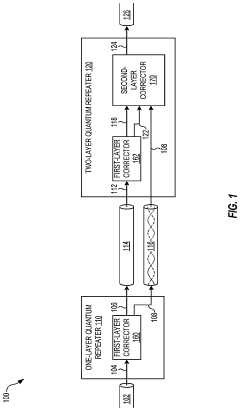
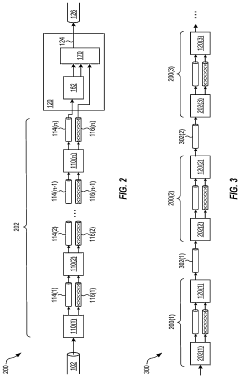
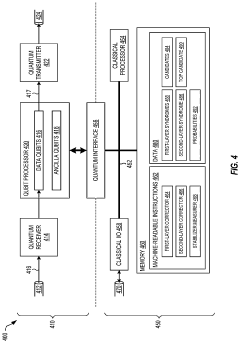
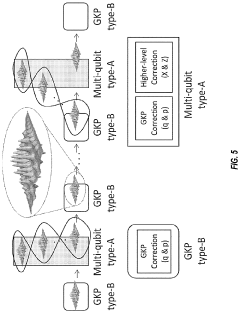
Quantum repeaters for concatenated quantum error correction, and associated methods
PatentWO2022039818A2
Innovation
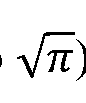
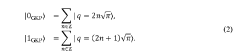
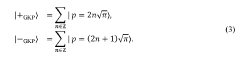
- The implementation of a hybrid quantum repeater architecture using concatenated quantum error correction with continuous-variable bosonic encoding at the lower level and discrete-variable encoding at the higher level, specifically employing the Gottesman-Kitaev-Preskill (GKP) code and Steane codes, to correct errors and extend transmission distances with reduced resource usage.

Cost-Benefit Analysis Framework for Quantum Infrastructure
The economic evaluation of quantum infrastructure requires a comprehensive framework that accounts for both capital expenditures and operational costs across different technological approaches. When comparing quantum repeaters and quantum error correction systems, the cost structure fundamentally differs in terms of hardware requirements, maintenance complexity, and scalability factors. Quantum repeaters demand distributed physical nodes with sophisticated entanglement generation and storage capabilities, while quantum error correction relies on increased qubit overhead and computational resources at terminal points.
Distance-dependent cost modeling reveals distinct economic profiles for each approach. Quantum repeaters exhibit a linear cost scaling with distance due to the requirement for intermediate stations every 50-100 kilometers, depending on fiber quality and environmental conditions. Each repeater node represents a significant capital investment, typically ranging from $500,000 to $2 million per station, including quantum memory systems, photonic interfaces, and environmental control infrastructure.
In contrast, quantum error correction systems concentrate costs at network endpoints through increased qubit requirements and classical processing power. The cost per kilometer decreases substantially with distance since no intermediate infrastructure is needed. However, the overhead penalty can be severe, requiring hundreds or thousands of physical qubits to encode a single logical qubit, depending on the error correction code and target fidelity levels.
Operational expenditure analysis reveals additional complexity layers. Quantum repeaters require continuous maintenance of distributed hardware, specialized technical personnel at multiple locations, and coordinated synchronization protocols. The operational cost per kilometer remains relatively constant regardless of network utilization. Quantum error correction systems centralize operational complexity but demand significant computational resources that scale with error correction overhead and communication frequency.
The break-even analysis indicates that quantum repeaters become economically favorable for distances exceeding 200-300 kilometers, assuming current technology maturity levels. However, this threshold is highly sensitive to technological advancement rates, particularly improvements in quantum memory coherence times and error correction efficiency. Future cost projections must incorporate learning curve effects, manufacturing scale economies, and potential breakthrough technologies that could dramatically alter the comparative economics of these approaches.
Distance-dependent cost modeling reveals distinct economic profiles for each approach. Quantum repeaters exhibit a linear cost scaling with distance due to the requirement for intermediate stations every 50-100 kilometers, depending on fiber quality and environmental conditions. Each repeater node represents a significant capital investment, typically ranging from $500,000 to $2 million per station, including quantum memory systems, photonic interfaces, and environmental control infrastructure.
In contrast, quantum error correction systems concentrate costs at network endpoints through increased qubit requirements and classical processing power. The cost per kilometer decreases substantially with distance since no intermediate infrastructure is needed. However, the overhead penalty can be severe, requiring hundreds or thousands of physical qubits to encode a single logical qubit, depending on the error correction code and target fidelity levels.
Operational expenditure analysis reveals additional complexity layers. Quantum repeaters require continuous maintenance of distributed hardware, specialized technical personnel at multiple locations, and coordinated synchronization protocols. The operational cost per kilometer remains relatively constant regardless of network utilization. Quantum error correction systems centralize operational complexity but demand significant computational resources that scale with error correction overhead and communication frequency.
The break-even analysis indicates that quantum repeaters become economically favorable for distances exceeding 200-300 kilometers, assuming current technology maturity levels. However, this threshold is highly sensitive to technological advancement rates, particularly improvements in quantum memory coherence times and error correction efficiency. Future cost projections must incorporate learning curve effects, manufacturing scale economies, and potential breakthrough technologies that could dramatically alter the comparative economics of these approaches.
Standardization and Interoperability Challenges
The deployment of quantum communication networks faces significant standardization challenges that directly impact the cost-effectiveness comparison between quantum repeaters and quantum error correction approaches. Currently, no unified international standards exist for quantum network architectures, creating substantial barriers for large-scale implementation and cost optimization across different geographical regions.
Protocol standardization represents a critical bottleneck in quantum network development. Different research institutions and companies have developed proprietary quantum communication protocols, leading to fragmented ecosystems where quantum repeater networks and error correction systems cannot seamlessly interact. This fragmentation increases per-kilometer costs as operators must maintain multiple protocol stacks and specialized equipment for different network segments.
Hardware interoperability challenges further complicate cost calculations for both quantum repeaters and error correction systems. Quantum devices from different manufacturers often operate at incompatible wavelengths, use different qubit encoding schemes, or require distinct environmental conditions. These incompatibilities necessitate expensive interface modules and conversion systems, significantly inflating the infrastructure costs per kilometer for quantum networks.
The absence of standardized performance metrics creates additional complexity in cost comparison analyses. While classical networks benefit from well-established metrics like bit error rates and latency standards, quantum networks lack universally accepted benchmarks for fidelity, entanglement distribution rates, and error correction efficiency. This standardization gap makes it difficult to establish accurate cost-per-kilometer comparisons between different technological approaches.
Interface standardization between quantum and classical networks remains underdeveloped, requiring custom integration solutions that increase deployment costs. Each quantum network implementation must develop bespoke interfaces for classical control systems, network management protocols, and security frameworks, preventing economies of scale that could reduce per-kilometer costs.
Regulatory frameworks for quantum communications vary significantly across jurisdictions, creating compliance costs that affect the economic viability of both quantum repeater and error correction approaches. Different countries impose varying requirements for quantum key distribution systems, encryption standards, and cross-border quantum communication protocols, necessitating region-specific implementations that increase overall network costs.
The lack of standardized testing and certification procedures for quantum network components creates additional cost burdens. Without established certification standards, each deployment requires extensive custom testing and validation processes, increasing both initial capital expenditure and ongoing operational costs per kilometer of quantum network infrastructure.
Protocol standardization represents a critical bottleneck in quantum network development. Different research institutions and companies have developed proprietary quantum communication protocols, leading to fragmented ecosystems where quantum repeater networks and error correction systems cannot seamlessly interact. This fragmentation increases per-kilometer costs as operators must maintain multiple protocol stacks and specialized equipment for different network segments.
Hardware interoperability challenges further complicate cost calculations for both quantum repeaters and error correction systems. Quantum devices from different manufacturers often operate at incompatible wavelengths, use different qubit encoding schemes, or require distinct environmental conditions. These incompatibilities necessitate expensive interface modules and conversion systems, significantly inflating the infrastructure costs per kilometer for quantum networks.
The absence of standardized performance metrics creates additional complexity in cost comparison analyses. While classical networks benefit from well-established metrics like bit error rates and latency standards, quantum networks lack universally accepted benchmarks for fidelity, entanglement distribution rates, and error correction efficiency. This standardization gap makes it difficult to establish accurate cost-per-kilometer comparisons between different technological approaches.
Interface standardization between quantum and classical networks remains underdeveloped, requiring custom integration solutions that increase deployment costs. Each quantum network implementation must develop bespoke interfaces for classical control systems, network management protocols, and security frameworks, preventing economies of scale that could reduce per-kilometer costs.
Regulatory frameworks for quantum communications vary significantly across jurisdictions, creating compliance costs that affect the economic viability of both quantum repeater and error correction approaches. Different countries impose varying requirements for quantum key distribution systems, encryption standards, and cross-border quantum communication protocols, necessitating region-specific implementations that increase overall network costs.
The lack of standardized testing and certification procedures for quantum network components creates additional cost burdens. Without established certification standards, each deployment requires extensive custom testing and validation processes, increasing both initial capital expenditure and ongoing operational costs per kilometer of quantum network infrastructure.
Unlock deeper insights with PatSnap Eureka Quick Research — get a full tech report to explore trends and direct your research. Try now!
Generate Your Research Report Instantly with AI Agent
Supercharge your innovation with PatSnap Eureka AI Agent Platform!