

Quantum repeaters vs surface codes: which hits target logical error?
MAY 7, 20269 MIN READ
Generate Your Research Report Instantly with AI Agent
PatSnap Eureka helps you evaluate technical feasibility & market potential.
Quantum Error Correction Background and Logical Error Targets
Quantum error correction represents a fundamental paradigm shift in quantum computing, addressing the inherent fragility of quantum states due to decoherence and operational errors. Unlike classical error correction, quantum error correction must preserve quantum superposition and entanglement while detecting and correcting errors without directly measuring the quantum information itself. This challenge has driven the development of sophisticated quantum error correction codes and protocols that can maintain quantum coherence across extended computational processes.
The theoretical foundation of quantum error correction emerged in the mid-1990s with pioneering work by Shor, Steane, and others, establishing that quantum computation could theoretically achieve fault-tolerant operation. The key insight was that quantum errors could be discretized and corrected using carefully designed quantum codes, provided the physical error rates remained below certain threshold values. This breakthrough transformed quantum computing from a theoretical curiosity into a potentially practical computational paradigm.
Surface codes have emerged as the leading candidate for practical quantum error correction due to their high error threshold and compatibility with nearest-neighbor architectures. These topological codes can theoretically achieve logical error rates that decrease exponentially with code distance, making them particularly attractive for large-scale quantum computing implementations. The surface code's planar geometry and local stabilizer measurements align well with current quantum hardware constraints, particularly in superconducting and trapped-ion systems.
Quantum repeaters represent an alternative approach, originally developed for quantum communication networks but increasingly relevant for distributed quantum computing architectures. These systems use quantum error correction principles to extend quantum coherence across longer distances and time scales, potentially offering different scaling advantages compared to traditional surface code implementations. The repeater architecture leverages entanglement purification and quantum memory to achieve error suppression through fundamentally different mechanisms.
The target logical error rates for practical quantum computing applications typically range from 10^-12 to 10^-15, depending on the specific computational task and algorithm requirements. Achieving these targets requires careful consideration of both the underlying physical error rates and the efficiency of the chosen error correction scheme. Current experimental demonstrations have achieved logical error rates in the 10^-3 to 10^-6 range, indicating substantial progress toward practical thresholds but highlighting the significant challenges that remain.
The comparative analysis between quantum repeaters and surface codes centers on their respective pathways to achieving these target logical error rates, considering factors such as resource overhead, scalability constraints, and compatibility with existing quantum hardware platforms.
The theoretical foundation of quantum error correction emerged in the mid-1990s with pioneering work by Shor, Steane, and others, establishing that quantum computation could theoretically achieve fault-tolerant operation. The key insight was that quantum errors could be discretized and corrected using carefully designed quantum codes, provided the physical error rates remained below certain threshold values. This breakthrough transformed quantum computing from a theoretical curiosity into a potentially practical computational paradigm.
Surface codes have emerged as the leading candidate for practical quantum error correction due to their high error threshold and compatibility with nearest-neighbor architectures. These topological codes can theoretically achieve logical error rates that decrease exponentially with code distance, making them particularly attractive for large-scale quantum computing implementations. The surface code's planar geometry and local stabilizer measurements align well with current quantum hardware constraints, particularly in superconducting and trapped-ion systems.
Quantum repeaters represent an alternative approach, originally developed for quantum communication networks but increasingly relevant for distributed quantum computing architectures. These systems use quantum error correction principles to extend quantum coherence across longer distances and time scales, potentially offering different scaling advantages compared to traditional surface code implementations. The repeater architecture leverages entanglement purification and quantum memory to achieve error suppression through fundamentally different mechanisms.
The target logical error rates for practical quantum computing applications typically range from 10^-12 to 10^-15, depending on the specific computational task and algorithm requirements. Achieving these targets requires careful consideration of both the underlying physical error rates and the efficiency of the chosen error correction scheme. Current experimental demonstrations have achieved logical error rates in the 10^-3 to 10^-6 range, indicating substantial progress toward practical thresholds but highlighting the significant challenges that remain.
The comparative analysis between quantum repeaters and surface codes centers on their respective pathways to achieving these target logical error rates, considering factors such as resource overhead, scalability constraints, and compatibility with existing quantum hardware platforms.
Market Demand for Fault-Tolerant Quantum Computing Solutions
The quantum computing industry is experiencing unprecedented growth driven by the critical need for fault-tolerant quantum systems capable of performing reliable computations at scale. Organizations across sectors including pharmaceuticals, financial services, logistics, and cybersecurity are increasingly recognizing that current noisy intermediate-scale quantum devices cannot deliver the computational advantages required for practical applications. This recognition has created substantial market demand for fault-tolerant quantum computing solutions that can achieve target logical error rates necessary for real-world deployment.
Enterprise adoption patterns reveal that pharmaceutical companies are particularly interested in fault-tolerant quantum systems for drug discovery and molecular simulation applications. These organizations require quantum computers capable of maintaining coherent calculations over extended periods, making the comparison between quantum repeaters and surface codes highly relevant to their procurement decisions. The ability to achieve and maintain low logical error rates directly impacts the commercial viability of quantum advantage in these computationally intensive applications.
Financial institutions represent another significant market segment driving demand for fault-tolerant quantum solutions. Risk analysis, portfolio optimization, and cryptographic applications require quantum systems with demonstrable error correction capabilities. The market preference increasingly favors solutions that can provide clear pathways to achieving target logical error rates within reasonable timeframes and resource constraints.
Government and defense sectors are investing heavily in fault-tolerant quantum technologies, with procurement requirements specifically emphasizing error correction performance metrics. These organizations evaluate quantum computing solutions based on their ability to meet stringent reliability standards, making the technical comparison between different fault-tolerance approaches a critical factor in vendor selection processes.
The competitive landscape shows that quantum computing companies are differentiating their offerings based on their approaches to achieving fault tolerance. Market demand is increasingly sophisticated, with customers requesting detailed technical specifications regarding logical error rates, resource overhead, and scalability projections. This trend indicates that the market is moving beyond proof-of-concept demonstrations toward practical implementation considerations.
Venture capital and corporate investment patterns reflect strong market confidence in fault-tolerant quantum computing solutions. Investment decisions increasingly focus on companies that can demonstrate clear technical pathways to achieving practical fault tolerance, whether through quantum repeater architectures, surface code implementations, or hybrid approaches that combine multiple error correction strategies.
Enterprise adoption patterns reveal that pharmaceutical companies are particularly interested in fault-tolerant quantum systems for drug discovery and molecular simulation applications. These organizations require quantum computers capable of maintaining coherent calculations over extended periods, making the comparison between quantum repeaters and surface codes highly relevant to their procurement decisions. The ability to achieve and maintain low logical error rates directly impacts the commercial viability of quantum advantage in these computationally intensive applications.
Financial institutions represent another significant market segment driving demand for fault-tolerant quantum solutions. Risk analysis, portfolio optimization, and cryptographic applications require quantum systems with demonstrable error correction capabilities. The market preference increasingly favors solutions that can provide clear pathways to achieving target logical error rates within reasonable timeframes and resource constraints.
Government and defense sectors are investing heavily in fault-tolerant quantum technologies, with procurement requirements specifically emphasizing error correction performance metrics. These organizations evaluate quantum computing solutions based on their ability to meet stringent reliability standards, making the technical comparison between different fault-tolerance approaches a critical factor in vendor selection processes.
The competitive landscape shows that quantum computing companies are differentiating their offerings based on their approaches to achieving fault tolerance. Market demand is increasingly sophisticated, with customers requesting detailed technical specifications regarding logical error rates, resource overhead, and scalability projections. This trend indicates that the market is moving beyond proof-of-concept demonstrations toward practical implementation considerations.
Venture capital and corporate investment patterns reflect strong market confidence in fault-tolerant quantum computing solutions. Investment decisions increasingly focus on companies that can demonstrate clear technical pathways to achieving practical fault tolerance, whether through quantum repeater architectures, surface code implementations, or hybrid approaches that combine multiple error correction strategies.
Current State of Quantum Repeaters vs Surface Codes Development
Quantum repeaters and surface codes represent two fundamentally different approaches to achieving fault-tolerant quantum computation, each currently at distinct stages of technological maturity. Quantum repeaters focus on enabling long-distance quantum communication by establishing entanglement across extended networks, while surface codes concentrate on error correction within localized quantum processors to maintain logical qubit fidelity during computation.
The current development landscape shows surface codes maintaining a significant lead in practical implementation and experimental validation. Major quantum computing companies including IBM, Google, and Rigetti have successfully demonstrated surface code implementations on their superconducting qubit platforms. IBM's recent achievements include implementing distance-3 and distance-5 surface codes, achieving logical error rates below the break-even threshold where logical qubits outperform physical qubits in terms of error suppression.
Google's quantum supremacy experiments and subsequent error correction demonstrations have validated surface code scalability, showing that increasing code distance effectively reduces logical error rates. Their latest publications demonstrate logical error rates approaching 10^-3 for distance-5 codes, with clear pathways toward the 10^-6 to 10^-12 range required for practical quantum algorithms.
Quantum repeater technology faces more substantial implementation challenges, primarily due to the complexity of maintaining entanglement across multiple network nodes while managing decoherence effects. Current experimental demonstrations remain limited to proof-of-principle setups with modest distances and fidelities. The most advanced implementations achieve entanglement distribution over hundreds of kilometers, but with success rates and fidelities that fall short of practical quantum networking requirements.
The technical maturity gap becomes evident when examining error rate achievements. Surface codes have demonstrated exponential error suppression with increasing code distance, following theoretical predictions closely. Conversely, quantum repeaters struggle with cumulative errors across multiple repeater stations, making it challenging to achieve the ultra-low error rates necessary for distributed quantum computing applications.
Manufacturing and scalability considerations further differentiate these approaches. Surface code implementations leverage existing quantum processor fabrication techniques, allowing incremental improvements through established semiconductor manufacturing processes. Quantum repeater networks require coordinated development of quantum memories, photonic interfaces, and classical control systems across geographically distributed locations, presenting significantly greater engineering complexity.
Current funding and research momentum strongly favor surface code development, with substantial industrial investment driving rapid progress toward commercial quantum computing systems. Quantum repeater research, while scientifically important for future quantum internet applications, receives comparatively limited resources and faces longer development timelines before achieving practical deployment thresholds.
The current development landscape shows surface codes maintaining a significant lead in practical implementation and experimental validation. Major quantum computing companies including IBM, Google, and Rigetti have successfully demonstrated surface code implementations on their superconducting qubit platforms. IBM's recent achievements include implementing distance-3 and distance-5 surface codes, achieving logical error rates below the break-even threshold where logical qubits outperform physical qubits in terms of error suppression.
Google's quantum supremacy experiments and subsequent error correction demonstrations have validated surface code scalability, showing that increasing code distance effectively reduces logical error rates. Their latest publications demonstrate logical error rates approaching 10^-3 for distance-5 codes, with clear pathways toward the 10^-6 to 10^-12 range required for practical quantum algorithms.
Quantum repeater technology faces more substantial implementation challenges, primarily due to the complexity of maintaining entanglement across multiple network nodes while managing decoherence effects. Current experimental demonstrations remain limited to proof-of-principle setups with modest distances and fidelities. The most advanced implementations achieve entanglement distribution over hundreds of kilometers, but with success rates and fidelities that fall short of practical quantum networking requirements.
The technical maturity gap becomes evident when examining error rate achievements. Surface codes have demonstrated exponential error suppression with increasing code distance, following theoretical predictions closely. Conversely, quantum repeaters struggle with cumulative errors across multiple repeater stations, making it challenging to achieve the ultra-low error rates necessary for distributed quantum computing applications.
Manufacturing and scalability considerations further differentiate these approaches. Surface code implementations leverage existing quantum processor fabrication techniques, allowing incremental improvements through established semiconductor manufacturing processes. Quantum repeater networks require coordinated development of quantum memories, photonic interfaces, and classical control systems across geographically distributed locations, presenting significantly greater engineering complexity.
Current funding and research momentum strongly favor surface code development, with substantial industrial investment driving rapid progress toward commercial quantum computing systems. Quantum repeater research, while scientifically important for future quantum internet applications, receives comparatively limited resources and faces longer development timelines before achieving practical deployment thresholds.
Existing QEC Solutions: Repeaters and Surface Code Approaches
01 Quantum error correction using surface codes
Surface codes are a class of topological quantum error correction codes that provide high fault tolerance for quantum computing systems. These codes use a two-dimensional lattice structure where qubits are arranged on the edges or vertices, and stabilizer measurements are performed to detect and correct errors. The surface code architecture enables scalable quantum error correction with relatively low overhead and high error thresholds.- Quantum error correction using surface codes: Surface codes are a class of topological quantum error correction codes that provide high fault tolerance for quantum computing systems. These codes use a two-dimensional lattice structure to detect and correct both bit-flip and phase-flip errors. The implementation involves measuring stabilizer operators on a grid of qubits to identify error syndromes and apply appropriate corrections to maintain quantum information integrity.
- Quantum repeater architectures for long-distance communication: Quantum repeaters enable long-distance quantum communication by overcoming photon loss in optical fibers through quantum memory and entanglement swapping protocols. These systems use quantum error correction to maintain entanglement fidelity across multiple repeater nodes, allowing for the establishment of quantum networks spanning continental distances.
- Logical qubit implementation and error threshold analysis: Logical qubits are encoded using multiple physical qubits to achieve error rates below the fault-tolerance threshold. The analysis focuses on determining the minimum number of physical qubits required and the maximum tolerable error rate for maintaining quantum coherence. This involves studying the relationship between physical error rates and logical error rates in various quantum error correction schemes.
- Error syndrome detection and correction algorithms: Advanced algorithms for detecting and correcting quantum errors in real-time quantum systems. These methods involve efficient syndrome extraction techniques, machine learning approaches for error pattern recognition, and adaptive correction strategies that minimize the impact of measurement errors and gate imperfections on the overall system performance.
- Fault-tolerant quantum gate operations and circuit design: Implementation of quantum gates that maintain error correction properties while performing computational operations on logical qubits. This includes the design of transversal gates, magic state distillation protocols, and circuit-level optimization techniques that preserve the error correction capabilities of surface codes during quantum computation processes.
02 Logical qubit implementation and protection
Logical qubits are encoded using multiple physical qubits to provide protection against quantum errors through redundancy and error correction protocols. The implementation involves creating logical quantum states that can maintain coherence and fidelity even when individual physical qubits experience errors. Various encoding schemes and protection mechanisms are employed to ensure reliable quantum information processing.Expand Specific Solutions03 Quantum repeater networks and communication
Quantum repeaters enable long-distance quantum communication by extending the range of quantum entanglement distribution. These systems use quantum memory, entanglement swapping, and purification protocols to overcome the limitations of direct quantum transmission. The repeater architecture allows for the creation of quantum networks that can maintain quantum correlations over extended distances.Expand Specific Solutions04 Error syndrome detection and correction algorithms
Advanced algorithms are developed to detect error syndromes in quantum systems and implement appropriate correction procedures. These methods involve measuring stabilizer operators, analyzing error patterns, and applying corrective operations to restore the quantum state. The algorithms are designed to handle various types of quantum errors including bit-flip, phase-flip, and more complex correlated errors.Expand Specific Solutions05 Fault-tolerant quantum computing architectures
Comprehensive system designs that integrate error correction, logical operations, and quantum control to achieve fault-tolerant quantum computation. These architectures incorporate multiple layers of error correction, optimized qubit layouts, and specialized control protocols to maintain computational accuracy even in the presence of hardware imperfections. The designs focus on scalability and practical implementation of large-scale quantum computers.Expand Specific Solutions
Key Players in Quantum Computing and Error Correction Industry
The quantum error correction landscape is experiencing intense competition between quantum repeaters and surface codes approaches, representing a mature research phase with significant commercial potential. The market demonstrates substantial growth driven by the race to achieve practical quantum advantage, with technology readiness varying significantly across different implementations. Leading players including Google LLC, IBM, Microsoft Technology Licensing LLC, and PsiQuantum Corp. are pursuing diverse strategies, while academic institutions like Delft University of Technology, University of Chicago, and KAIST provide foundational research. Asian companies such as Alibaba Dharma Institute, Huawei Technologies, and specialized quantum firms like Alice & Bob SAS and Quantum Motion Technologies are advancing complementary approaches. The competitive dynamics suggest the field is transitioning from pure research toward commercial viability, with surface codes gaining momentum in near-term applications while quantum repeaters target long-distance quantum communication networks.
Google LLC
Technical Solution: Google has developed advanced surface code implementations with their Sycamore quantum processor, achieving quantum error correction milestones through topological surface codes. Their approach focuses on creating logical qubits with error rates below the threshold required for fault-tolerant quantum computing. Google's surface code architecture utilizes a 2D lattice of physical qubits where data qubits are surrounded by ancilla qubits for syndrome detection. They have demonstrated error correction cycles with microsecond-scale operations and achieved logical error rates that scale favorably with code distance, showing exponential suppression of logical errors as physical error rates improve.
Strengths: Leading experimental demonstrations, strong integration with superconducting hardware, proven scalability. Weaknesses: High physical qubit overhead, requires extremely low physical error rates for practical advantage.
Microsoft Technology Licensing LLC
Technical Solution: Microsoft's approach focuses on topological qubits combined with surface codes to achieve target logical error rates. Their unique strategy involves anyonic braiding in topological superconductors, which naturally provides protection against certain types of errors. Microsoft's surface code implementation is designed to work with their topological qubits, potentially requiring fewer physical qubits per logical qubit compared to conventional approaches. They are targeting logical error rates of 10^-15 for cryptographically relevant applications. Their theoretical work suggests that combining topological protection with surface codes could achieve target logical error rates more efficiently than either approach alone.
Strengths: Novel topological approach offers inherent error protection, potentially lower overhead than conventional surface codes. Weaknesses: Topological qubits still in development phase, unproven at scale, high technical risk.
Core Innovations in Quantum Repeater and Surface Code Patents
Quantum repeaters for concatenated quantum error correction, and associated methods
PatentActiveUS20230206110A1
Innovation
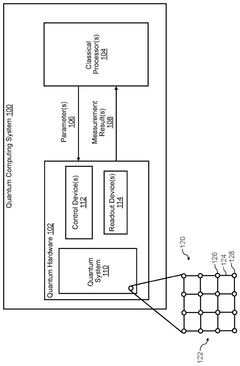
- The implementation of quantum repeaters using concatenated error correction codes, where a second-layer logical qubit is block-encoded by a plurality of physical qubits according to a second-layer code concatenated with a first-layer code, allowing for the detection and correction of errors through first-layer and second-layer stabilizer measurements, reducing the need for resources and noise introduction.
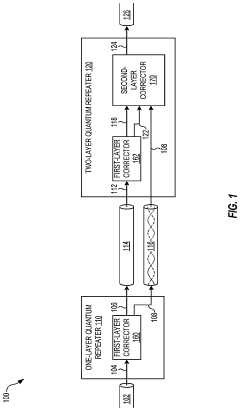
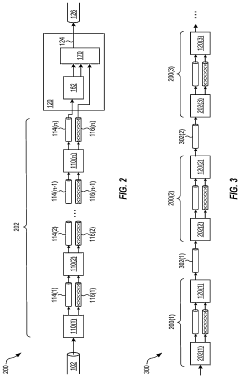
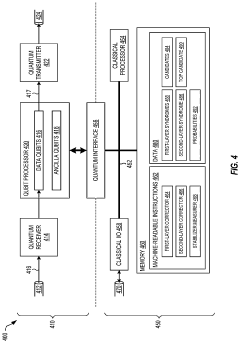
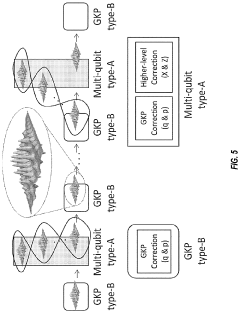
Nested quantum error correction codes for fault-tolerant quantum computation
PatentWO2025096766A1
Innovation
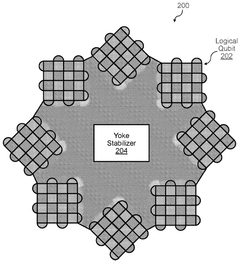
- The implementation of nested quantum error correction (QEC) codes, which consist of an inner surface code and an outer high-rate parity check code, reduces qubit overhead and improves error correction capabilities.

Quantum Computing Standards and Certification Requirements
The quantum computing industry faces significant challenges in establishing comprehensive standards and certification frameworks, particularly when evaluating competing error correction approaches like quantum repeaters versus surface codes. Current standardization efforts primarily focus on hardware specifications, software interfaces, and basic performance metrics, yet lack sophisticated frameworks for assessing logical error rate achievements across different quantum error correction methodologies.
International standards organizations including ISO/IEC JTC 1/SC 27 and IEEE have initiated preliminary quantum computing standardization working groups, but these efforts remain fragmented regarding error correction evaluation criteria. The absence of unified benchmarking standards creates substantial challenges for organizations attempting to validate whether quantum repeater networks or surface code implementations can reliably achieve target logical error rates under real-world operational conditions.
Certification requirements for quantum error correction systems currently lack industry consensus on fundamental metrics such as logical qubit fidelity thresholds, error correction cycle timing standards, and acceptable physical-to-logical error rate conversion factors. This standardization gap particularly impacts the comparative assessment of quantum repeaters and surface codes, as each approach requires distinct evaluation methodologies and performance indicators.
Emerging certification frameworks must address several critical areas including quantum system security standards, error correction protocol validation procedures, and interoperability requirements between different quantum computing platforms. The development of these standards becomes increasingly urgent as quantum repeater networks and surface code implementations approach practical deployment thresholds for achieving target logical error rates.
Regulatory bodies across major quantum computing markets are beginning to establish preliminary compliance requirements, yet significant work remains in creating standardized testing procedures that can objectively compare the logical error performance of quantum repeaters against surface code implementations. These evolving standards will ultimately determine which error correction approach can demonstrably meet industry-accepted logical error targets while maintaining certification compliance across diverse operational environments.
International standards organizations including ISO/IEC JTC 1/SC 27 and IEEE have initiated preliminary quantum computing standardization working groups, but these efforts remain fragmented regarding error correction evaluation criteria. The absence of unified benchmarking standards creates substantial challenges for organizations attempting to validate whether quantum repeater networks or surface code implementations can reliably achieve target logical error rates under real-world operational conditions.
Certification requirements for quantum error correction systems currently lack industry consensus on fundamental metrics such as logical qubit fidelity thresholds, error correction cycle timing standards, and acceptable physical-to-logical error rate conversion factors. This standardization gap particularly impacts the comparative assessment of quantum repeaters and surface codes, as each approach requires distinct evaluation methodologies and performance indicators.
Emerging certification frameworks must address several critical areas including quantum system security standards, error correction protocol validation procedures, and interoperability requirements between different quantum computing platforms. The development of these standards becomes increasingly urgent as quantum repeater networks and surface code implementations approach practical deployment thresholds for achieving target logical error rates.
Regulatory bodies across major quantum computing markets are beginning to establish preliminary compliance requirements, yet significant work remains in creating standardized testing procedures that can objectively compare the logical error performance of quantum repeaters against surface code implementations. These evolving standards will ultimately determine which error correction approach can demonstrably meet industry-accepted logical error targets while maintaining certification compliance across diverse operational environments.
Resource Optimization Strategies for Scalable QEC Implementation
Resource optimization in quantum error correction implementation requires careful consideration of the fundamental trade-offs between quantum repeaters and surface codes when targeting specific logical error rates. The choice between these approaches significantly impacts resource allocation strategies, as each method demands different types of quantum resources and exhibits distinct scaling behaviors.
Quantum repeaters offer a distributed approach to quantum error correction, requiring fewer physical qubits per node but necessitating classical communication overhead and synchronization protocols. The resource optimization for repeater-based systems focuses on minimizing the total number of elementary links while maximizing entanglement generation rates. This approach typically requires optimization of memory coherence times, gate fidelities, and measurement efficiencies across distributed nodes.
Surface codes, conversely, demand substantial qubit overhead but provide more predictable scaling laws for achieving target logical error rates. Resource optimization strategies for surface codes center on determining optimal code distances and patch sizes that balance physical qubit requirements against desired logical error thresholds. The key optimization parameters include physical error rates, code distance selection, and decoder efficiency.
For scalable implementation, hybrid optimization strategies emerge as particularly promising. These approaches leverage the strengths of both methodologies by implementing surface codes within individual nodes of a quantum repeater network. Such hybrid systems require sophisticated resource allocation algorithms that dynamically balance local error correction capabilities with network-level error management.
Critical optimization considerations include memory resource allocation, where quantum repeaters require high-fidelity quantum memories with extended coherence times, while surface codes demand large arrays of physical qubits with uniform error characteristics. The temporal resource optimization differs significantly, as repeaters operate on communication timescales while surface codes require continuous real-time error correction cycles.
Practical implementation strategies must account for hardware constraints and fabrication limitations. Resource optimization algorithms should incorporate realistic noise models, finite gate times, and measurement errors to provide actionable guidance for system designers. The optimization framework must also consider the economic aspects of scaling, including manufacturing costs and operational complexity.
Quantum repeaters offer a distributed approach to quantum error correction, requiring fewer physical qubits per node but necessitating classical communication overhead and synchronization protocols. The resource optimization for repeater-based systems focuses on minimizing the total number of elementary links while maximizing entanglement generation rates. This approach typically requires optimization of memory coherence times, gate fidelities, and measurement efficiencies across distributed nodes.
Surface codes, conversely, demand substantial qubit overhead but provide more predictable scaling laws for achieving target logical error rates. Resource optimization strategies for surface codes center on determining optimal code distances and patch sizes that balance physical qubit requirements against desired logical error thresholds. The key optimization parameters include physical error rates, code distance selection, and decoder efficiency.
For scalable implementation, hybrid optimization strategies emerge as particularly promising. These approaches leverage the strengths of both methodologies by implementing surface codes within individual nodes of a quantum repeater network. Such hybrid systems require sophisticated resource allocation algorithms that dynamically balance local error correction capabilities with network-level error management.
Critical optimization considerations include memory resource allocation, where quantum repeaters require high-fidelity quantum memories with extended coherence times, while surface codes demand large arrays of physical qubits with uniform error characteristics. The temporal resource optimization differs significantly, as repeaters operate on communication timescales while surface codes require continuous real-time error correction cycles.
Practical implementation strategies must account for hardware constraints and fabrication limitations. Resource optimization algorithms should incorporate realistic noise models, finite gate times, and measurement errors to provide actionable guidance for system designers. The optimization framework must also consider the economic aspects of scaling, including manufacturing costs and operational complexity.
Unlock deeper insights with PatSnap Eureka Quick Research — get a full tech report to explore trends and direct your research. Try now!
Generate Your Research Report Instantly with AI Agent
Supercharge your innovation with PatSnap Eureka AI Agent Platform!