

Multiphysics Simulation vs Reaction Coupling
MAR 26, 20269 MIN READ
Generate Your Research Report Instantly with AI Agent
PatSnap Eureka helps you evaluate technical feasibility & market potential.
Multiphysics Simulation Background and Research Objectives
Multiphysics simulation has emerged as a critical computational methodology in modern engineering and scientific research, representing the convergence of multiple physical phenomena within unified mathematical frameworks. This approach addresses the inherent complexity of real-world systems where thermal, mechanical, electromagnetic, fluid dynamic, and chemical processes interact simultaneously and influence each other's behavior.
The evolution of multiphysics simulation can be traced back to the 1960s when early finite element methods began incorporating coupled heat transfer and structural mechanics. However, significant advancement occurred during the 1980s and 1990s with the development of sophisticated numerical algorithms and increased computational power. The integration of reaction coupling mechanisms into multiphysics frameworks represents a more recent development, driven by demands from industries such as chemical processing, materials science, and energy systems.
Traditional simulation approaches often treated individual physical processes in isolation, leading to incomplete understanding of system behavior and suboptimal design solutions. The recognition that physical phenomena are inherently coupled in nature has driven the development of comprehensive multiphysics platforms that can simultaneously solve governing equations for different physical domains while accounting for their mutual interactions.
The primary objective of current multiphysics simulation research focuses on achieving seamless integration between reaction kinetics and transport phenomena. This involves developing robust coupling algorithms that can handle the disparate time scales and spatial distributions characteristic of chemical reactions and physical transport processes. Key technical goals include improving numerical stability, enhancing computational efficiency, and ensuring accurate representation of interface conditions between different physical domains.
Contemporary research efforts concentrate on advancing coupling methodologies that can effectively bridge the gap between molecular-scale reaction mechanisms and macroscopic transport phenomena. This includes developing adaptive mesh refinement techniques, implementing advanced time-stepping algorithms, and creating efficient solver architectures that can handle the nonlinear nature of coupled reaction-transport systems.
The ultimate research objective aims to establish predictive simulation capabilities that can accurately forecast system performance under varying operational conditions, enable optimization of complex processes, and facilitate the design of next-generation technologies in fields ranging from catalytic reactors to energy storage systems.
The evolution of multiphysics simulation can be traced back to the 1960s when early finite element methods began incorporating coupled heat transfer and structural mechanics. However, significant advancement occurred during the 1980s and 1990s with the development of sophisticated numerical algorithms and increased computational power. The integration of reaction coupling mechanisms into multiphysics frameworks represents a more recent development, driven by demands from industries such as chemical processing, materials science, and energy systems.
Traditional simulation approaches often treated individual physical processes in isolation, leading to incomplete understanding of system behavior and suboptimal design solutions. The recognition that physical phenomena are inherently coupled in nature has driven the development of comprehensive multiphysics platforms that can simultaneously solve governing equations for different physical domains while accounting for their mutual interactions.
The primary objective of current multiphysics simulation research focuses on achieving seamless integration between reaction kinetics and transport phenomena. This involves developing robust coupling algorithms that can handle the disparate time scales and spatial distributions characteristic of chemical reactions and physical transport processes. Key technical goals include improving numerical stability, enhancing computational efficiency, and ensuring accurate representation of interface conditions between different physical domains.
Contemporary research efforts concentrate on advancing coupling methodologies that can effectively bridge the gap between molecular-scale reaction mechanisms and macroscopic transport phenomena. This includes developing adaptive mesh refinement techniques, implementing advanced time-stepping algorithms, and creating efficient solver architectures that can handle the nonlinear nature of coupled reaction-transport systems.
The ultimate research objective aims to establish predictive simulation capabilities that can accurately forecast system performance under varying operational conditions, enable optimization of complex processes, and facilitate the design of next-generation technologies in fields ranging from catalytic reactors to energy storage systems.
Market Demand for Advanced Multiphysics Coupling Solutions
The global demand for advanced multiphysics coupling solutions has experienced unprecedented growth across multiple industrial sectors, driven by the increasing complexity of modern engineering challenges and the need for more accurate predictive modeling capabilities. Industries ranging from aerospace and automotive to chemical processing and energy generation are recognizing the critical importance of understanding coupled physical phenomena to optimize product performance and reduce development costs.
Manufacturing industries represent one of the largest market segments for multiphysics simulation technologies. The automotive sector particularly demands sophisticated coupling solutions to address thermal-structural interactions in engine components, fluid-structure coupling in aerodynamic design, and electromagnetic-thermal coupling in electric vehicle battery systems. These applications require seamless integration between different physics domains to capture real-world behavior accurately.
The energy sector has emerged as another significant driver of market demand, with renewable energy applications creating new requirements for multiphysics modeling. Wind turbine design necessitates fluid-structure-acoustic coupling analysis, while solar panel optimization requires thermal-electrical-mechanical coupling simulations. Traditional energy sectors also contribute substantially, with oil and gas companies requiring advanced reaction-flow coupling for reservoir modeling and refinery process optimization.
Chemical and process industries demonstrate growing appetite for reaction coupling capabilities within multiphysics frameworks. These sectors require sophisticated modeling of chemical reactions coupled with heat and mass transfer phenomena, particularly in reactor design, catalyst development, and process intensification applications. The pharmaceutical industry similarly demands these capabilities for drug manufacturing process optimization and crystallization studies.
Emerging technologies are creating entirely new market segments for advanced coupling solutions. Additive manufacturing requires thermal-mechanical-metallurgical coupling to predict part quality and residual stresses. Semiconductor manufacturing demands electromagnetic-thermal-chemical coupling for process optimization and yield improvement. These applications often push the boundaries of existing simulation capabilities.
The market trend indicates a shift toward cloud-based and high-performance computing solutions to handle the computational intensity of coupled simulations. Organizations are increasingly seeking integrated platforms that can seamlessly handle multiple physics domains rather than relying on separate specialized tools that require complex data exchange protocols.
Regional market analysis reveals strong demand growth in Asia-Pacific regions, particularly in China and India, where rapid industrialization and infrastructure development drive the need for advanced simulation capabilities. North American and European markets show steady growth with emphasis on innovation and next-generation technology development.
Manufacturing industries represent one of the largest market segments for multiphysics simulation technologies. The automotive sector particularly demands sophisticated coupling solutions to address thermal-structural interactions in engine components, fluid-structure coupling in aerodynamic design, and electromagnetic-thermal coupling in electric vehicle battery systems. These applications require seamless integration between different physics domains to capture real-world behavior accurately.
The energy sector has emerged as another significant driver of market demand, with renewable energy applications creating new requirements for multiphysics modeling. Wind turbine design necessitates fluid-structure-acoustic coupling analysis, while solar panel optimization requires thermal-electrical-mechanical coupling simulations. Traditional energy sectors also contribute substantially, with oil and gas companies requiring advanced reaction-flow coupling for reservoir modeling and refinery process optimization.
Chemical and process industries demonstrate growing appetite for reaction coupling capabilities within multiphysics frameworks. These sectors require sophisticated modeling of chemical reactions coupled with heat and mass transfer phenomena, particularly in reactor design, catalyst development, and process intensification applications. The pharmaceutical industry similarly demands these capabilities for drug manufacturing process optimization and crystallization studies.
Emerging technologies are creating entirely new market segments for advanced coupling solutions. Additive manufacturing requires thermal-mechanical-metallurgical coupling to predict part quality and residual stresses. Semiconductor manufacturing demands electromagnetic-thermal-chemical coupling for process optimization and yield improvement. These applications often push the boundaries of existing simulation capabilities.
The market trend indicates a shift toward cloud-based and high-performance computing solutions to handle the computational intensity of coupled simulations. Organizations are increasingly seeking integrated platforms that can seamlessly handle multiple physics domains rather than relying on separate specialized tools that require complex data exchange protocols.
Regional market analysis reveals strong demand growth in Asia-Pacific regions, particularly in China and India, where rapid industrialization and infrastructure development drive the need for advanced simulation capabilities. North American and European markets show steady growth with emphasis on innovation and next-generation technology development.
Current State of Multiphysics-Reaction Coupling Technologies
The current landscape of multiphysics-reaction coupling technologies represents a rapidly evolving field that addresses the complex interplay between physical phenomena and chemical reactions across multiple scales and domains. Contemporary approaches primarily focus on integrating computational fluid dynamics with chemical kinetics, heat transfer with mass transport, and mechanical deformation with reactive processes.
Existing commercial software platforms such as COMSOL Multiphysics, ANSYS Fluent, and OpenFOAM have established foundational capabilities for coupled simulations. These platforms typically employ operator splitting methods, where physical and chemical processes are solved sequentially or through iterative coupling schemes. However, significant challenges persist in achieving robust convergence and maintaining numerical stability when dealing with stiff reaction systems and disparate time scales.
The aerospace and automotive industries have driven substantial advances in combustion modeling, where multiphysics-reaction coupling is critical for engine optimization and emissions control. Current methodologies successfully handle relatively simple reaction mechanisms but struggle with detailed chemical kinetics involving hundreds of species and thousands of reactions. The computational overhead often necessitates reduced-order models that sacrifice accuracy for feasibility.
In the chemical processing sector, reactor design and optimization rely heavily on coupled simulations that integrate fluid flow, heat transfer, and complex reaction networks. Present-day approaches face limitations when dealing with multiphase systems, particularly in scenarios involving phase transitions coupled with chemical transformations. The treatment of interface phenomena and mass transfer across phase boundaries remains a significant technical bottleneck.
Recent developments in high-performance computing have enabled more sophisticated coupling strategies, including fully implicit methods and adaptive mesh refinement techniques. Machine learning integration has emerged as a promising approach to accelerate reaction rate calculations and improve convergence behavior. However, validation and verification of these advanced methods against experimental data remain ongoing challenges that limit widespread industrial adoption.
Existing commercial software platforms such as COMSOL Multiphysics, ANSYS Fluent, and OpenFOAM have established foundational capabilities for coupled simulations. These platforms typically employ operator splitting methods, where physical and chemical processes are solved sequentially or through iterative coupling schemes. However, significant challenges persist in achieving robust convergence and maintaining numerical stability when dealing with stiff reaction systems and disparate time scales.
The aerospace and automotive industries have driven substantial advances in combustion modeling, where multiphysics-reaction coupling is critical for engine optimization and emissions control. Current methodologies successfully handle relatively simple reaction mechanisms but struggle with detailed chemical kinetics involving hundreds of species and thousands of reactions. The computational overhead often necessitates reduced-order models that sacrifice accuracy for feasibility.
In the chemical processing sector, reactor design and optimization rely heavily on coupled simulations that integrate fluid flow, heat transfer, and complex reaction networks. Present-day approaches face limitations when dealing with multiphase systems, particularly in scenarios involving phase transitions coupled with chemical transformations. The treatment of interface phenomena and mass transfer across phase boundaries remains a significant technical bottleneck.
Recent developments in high-performance computing have enabled more sophisticated coupling strategies, including fully implicit methods and adaptive mesh refinement techniques. Machine learning integration has emerged as a promising approach to accelerate reaction rate calculations and improve convergence behavior. However, validation and verification of these advanced methods against experimental data remain ongoing challenges that limit widespread industrial adoption.
Existing Multiphysics-Reaction Coupling Approaches
01 Multiphysics coupling simulation methods for complex systems
Advanced simulation methods that integrate multiple physical phenomena such as fluid dynamics, heat transfer, structural mechanics, and electromagnetic fields. These methods enable comprehensive analysis of complex systems by solving coupled equations simultaneously, providing accurate predictions of system behavior under various operating conditions. The coupling approaches include direct coupling, sequential coupling, and iterative coupling strategies to handle interactions between different physical domains.- Multiphysics coupling simulation methods for complex systems: Advanced simulation methods that integrate multiple physical phenomena such as fluid dynamics, heat transfer, structural mechanics, and electromagnetic fields. These methods enable comprehensive analysis of complex systems by solving coupled equations simultaneously, providing accurate predictions of system behavior under various operating conditions. The coupling approaches include direct coupling, sequential coupling, and iterative coupling strategies to handle interactions between different physical domains.
- Chemical reaction coupling in multiphysics simulations: Integration of chemical reaction kinetics with transport phenomena in simulation frameworks. This approach combines reaction mechanisms with mass transfer, heat transfer, and fluid flow to accurately model reactive systems. The methods account for reaction rates, species concentration changes, temperature effects on reactions, and the feedback between chemical transformations and physical processes, enabling optimization of reactor design and process conditions.
- Computational frameworks for electrochemical and thermal coupling: Simulation platforms that couple electrochemical reactions with thermal management and electrical behavior. These frameworks model charge transfer processes, ion transport, heat generation from reactions and resistive losses, and temperature-dependent material properties. Applications include battery systems, fuel cells, and electrochemical reactors where understanding the interplay between electrical, chemical, and thermal phenomena is critical for performance optimization and safety analysis.
- Fluid-structure-thermal interaction modeling: Coupled simulation techniques for systems involving interactions between fluid flow, structural deformation, and thermal effects. These methods solve the governing equations for fluid dynamics, solid mechanics, and heat transfer in a coupled manner, accounting for moving boundaries, thermal expansion, and stress-induced changes in flow patterns. Applications span aerospace, energy systems, and manufacturing processes where multiple physics domains strongly influence each other.
- Multiscale and multiphysics simulation platforms: Integrated computational platforms that enable simulation across multiple length and time scales while coupling various physical phenomena. These platforms provide tools for linking microscale phenomena with macroscale behavior, incorporating material properties derived from lower-scale simulations, and managing the computational complexity of coupled multiphysics problems. Features include adaptive meshing, parallel computing capabilities, and modular coupling interfaces for different physics solvers.
02 Chemical reaction coupling in multiphysics simulations
Integration of chemical reaction kinetics with transport phenomena in simulation frameworks. This approach combines reaction mechanisms with mass transfer, heat transfer, and fluid flow to accurately model reactive systems. The methods account for reaction rates, species concentration changes, temperature effects on reactions, and the feedback between chemical transformations and physical processes, enabling optimization of reactor designs and process conditions.Expand Specific Solutions03 Computational frameworks for electrochemical and thermal coupling
Simulation platforms that couple electrochemical reactions with thermal management and electrical behavior. These frameworks model charge transfer processes, ion transport, heat generation from reactions and resistive losses, and temperature-dependent material properties. Applications include battery systems, fuel cells, and electrochemical reactors where understanding the interplay between electrical, chemical, and thermal phenomena is critical for performance optimization and safety analysis.Expand Specific Solutions04 Fluid-structure-thermal interaction modeling
Coupled simulation techniques for systems involving interactions between fluid flow, structural deformation, and thermal effects. These methods solve governing equations for fluid dynamics, solid mechanics, and heat transfer in a coupled manner, accounting for moving boundaries, thermal expansion, and stress-induced changes in flow patterns. Applications span aerospace, energy systems, and manufacturing processes where multiple physics domains strongly influence each other.Expand Specific Solutions05 Multiscale and multiphysics simulation platforms
Integrated computational environments that enable simulation across multiple length and time scales while coupling various physical phenomena. These platforms provide tools for linking microscale phenomena with macroscale behavior, incorporating material properties from atomic to continuum levels, and managing data exchange between different simulation modules. The frameworks support parallel computing, adaptive meshing, and efficient solution algorithms for handling the computational complexity of coupled multiphysics problems.Expand Specific Solutions
Key Players in Multiphysics Simulation Software Industry
The multiphysics simulation and reaction coupling field represents a mature technology domain experiencing rapid growth, driven by increasing computational demands across nuclear, energy, and biotechnology sectors. The market demonstrates significant expansion potential, estimated in billions globally, as industries seek integrated solutions for complex system modeling. Technology maturity varies considerably among key players: established leaders like NVIDIA Corp. and IBM provide robust computational infrastructure and AI-enhanced simulation platforms, while specialized firms such as D.E. Shaw Research and hte AG focus on domain-specific applications in molecular dynamics and high-throughput experimentation. Academic institutions including Xi'an Jiaotong University, ETH Zurich, and Zhejiang University contribute fundamental research advances, particularly in coupling algorithms and numerical methods. Industrial players like China Nuclear Power Research Institute, Schlumberger Technologies, and Bayer AG drive practical applications in nuclear engineering, petroleum exploration, and pharmaceutical development respectively. The competitive landscape shows convergence toward cloud-based, AI-integrated platforms with enhanced automation capabilities, positioning the field for continued technological advancement and market expansion.
Commissariat à l´énergie atomique et aux énergies Alternatives
Technical Solution: CEA develops sophisticated multiphysics simulation codes specifically for nuclear reactor applications where reaction coupling is critical. Their CATHARE and TRIO_U codes simulate coupled neutronics, thermal-hydraulics, and chemical reactions in nuclear systems. The organization's approach integrates neutron transport equations with fluid dynamics and heat transfer, while accounting for complex chemical reactions including corrosion, hydrogen production, and fission product behavior. Their simulation frameworks handle multi-scale phenomena from molecular-level reactions to system-level thermal-hydraulic behavior, enabling comprehensive safety analysis of nuclear installations under various operating conditions.
Strengths: Deep expertise in nuclear multiphysics and extensive validation databases. Weaknesses: Primarily focused on nuclear applications with limited commercial availability for other industries.
Schlumberger Technologies, Inc.
Technical Solution: Schlumberger develops advanced multiphysics simulation tools for petroleum reservoir engineering, focusing on coupled reaction-transport processes in porous media. Their ECLIPSE and INTERSECT simulators handle complex chemical reactions including enhanced oil recovery processes, CO2 sequestration, and geochemical interactions. The company's approach integrates reservoir flow simulation with geochemical modeling, enabling prediction of mineral precipitation, dissolution, and fluid-rock interactions. Their multiphase flow simulators couple with reaction kinetics models to simulate processes like polymer flooding, surfactant injection, and in-situ combustion, providing comprehensive analysis of subsurface chemical and physical processes.
Strengths: Industry-leading expertise in subsurface multiphysics and extensive field validation. Weaknesses: Specialized focus on oil and gas applications limits broader industrial applicability.
Core Algorithms in Coupled Simulation Technologies
Multi-physically coupled system and method for reactor simulation
PatentActiveCN109063235A
Innovation
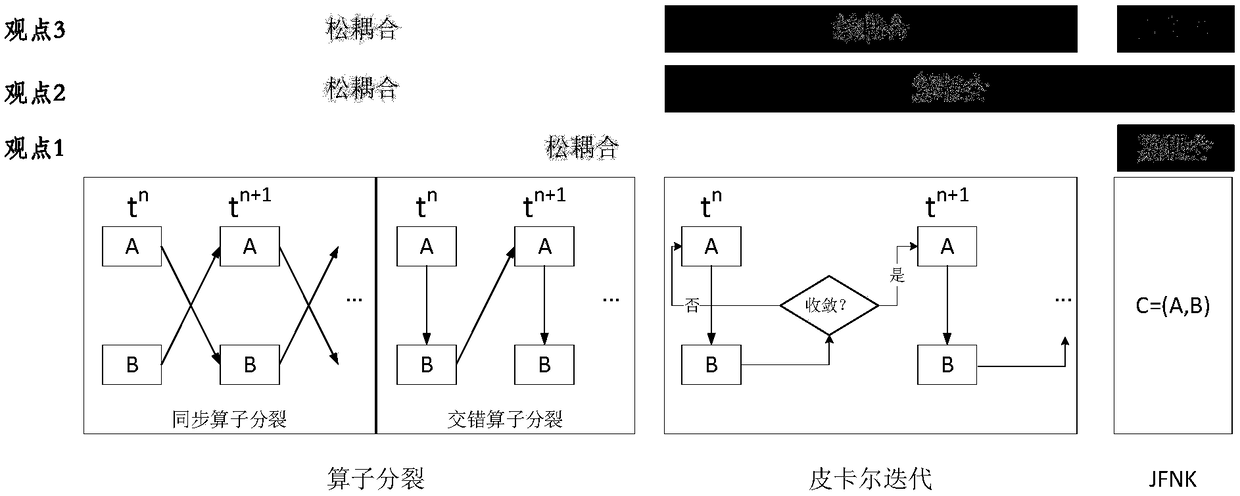
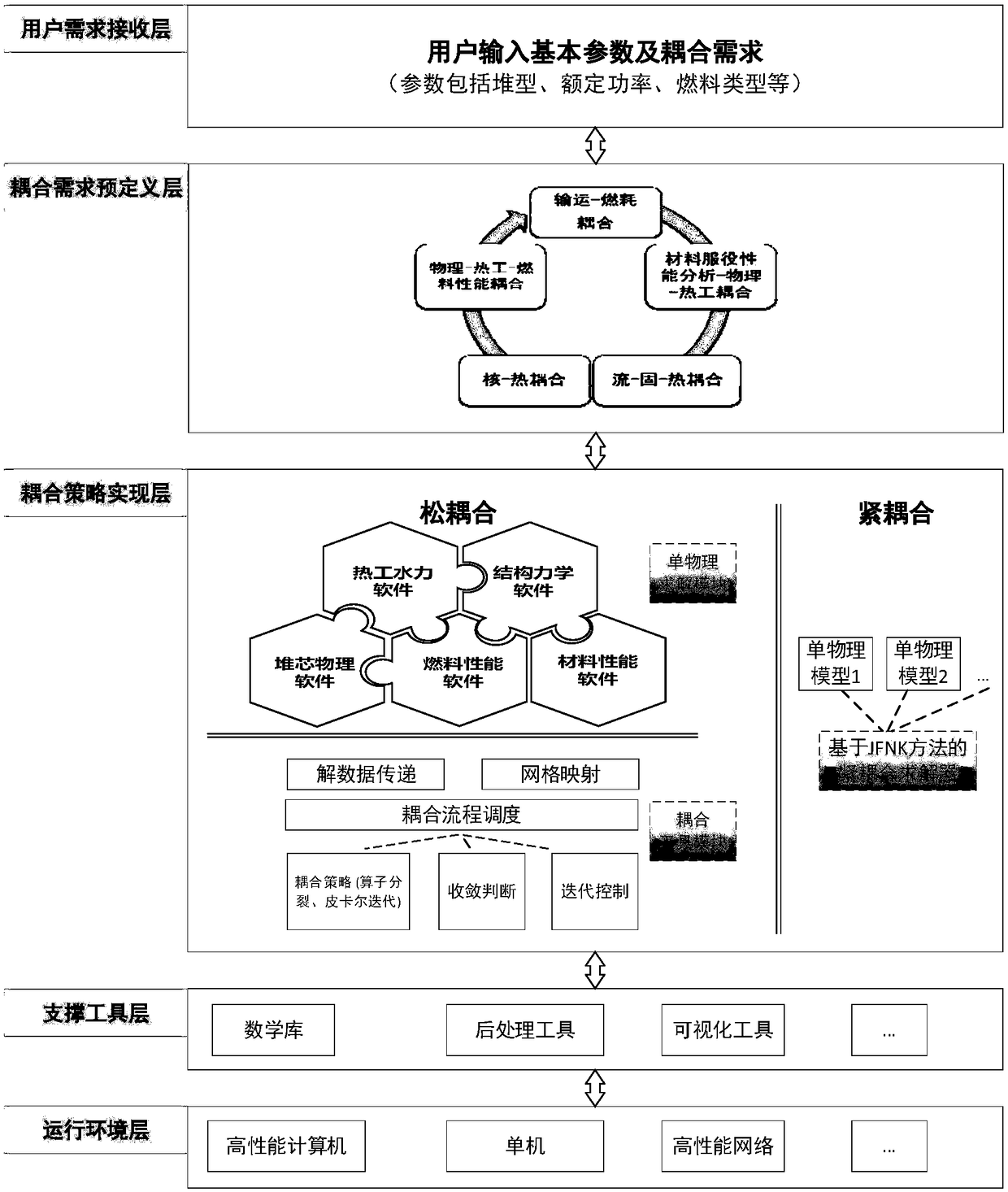
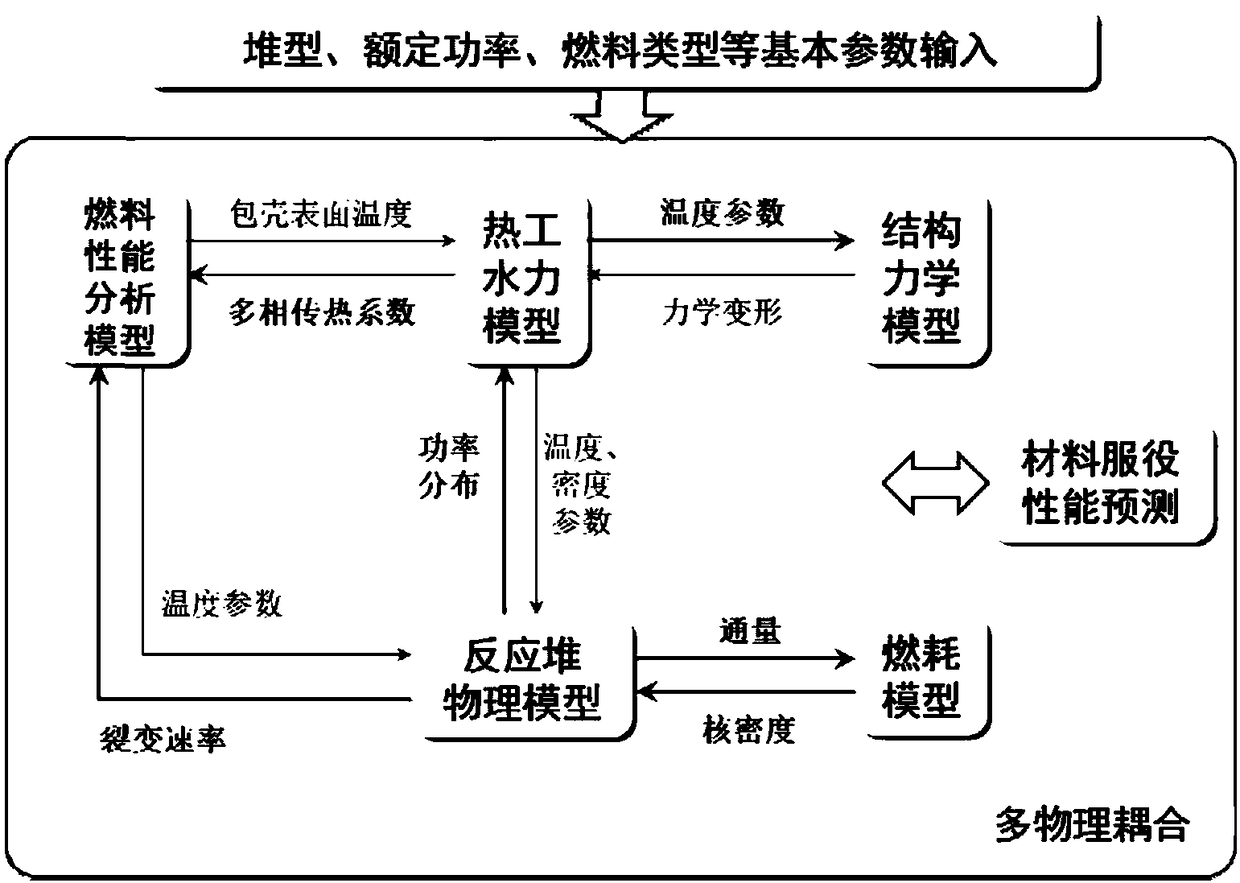
- A multi-physics coupling system is designed, including user requirement receiving layer, coupling requirement predefined layer, coupling implementation layer, support tool layer and operating environment layer. It supports loose coupling and tight coupling strategies, and uses the JFNK method to realize the equations of multi-physics processes. Solve simultaneously and provide grid mapping tools, data transfer tools and visualization tools to adapt to various environments from stand-alone to cluster.

Computational Resource Requirements and Optimization
Multiphysics simulation coupled with reaction modeling presents significant computational challenges that require careful resource allocation and optimization strategies. The computational intensity stems from the need to simultaneously solve multiple governing equations across different physical domains while maintaining temporal and spatial coupling between chemical reactions and transport phenomena.
Memory requirements for coupled multiphysics-reaction systems typically scale exponentially with problem complexity. Large-scale simulations often demand 64-512 GB of RAM for industrial applications, with memory consumption driven by mesh density, number of chemical species, and reaction network complexity. The storage of Jacobian matrices for implicit coupling schemes represents a major memory bottleneck, particularly when dealing with detailed chemical kinetics involving hundreds of species and thousands of reactions.
CPU utilization patterns reveal distinct computational hotspots in coupled simulations. Reaction rate calculations typically consume 40-60% of total computational time, while transport equation solving accounts for 25-35%. The remaining resources are allocated to coupling interface operations and convergence checking. Modern multi-core architectures enable parallel decomposition strategies, though load balancing becomes challenging due to varying reaction stiffness across spatial domains.
Optimization strategies focus on several key areas to enhance computational efficiency. Adaptive mesh refinement reduces computational overhead by concentrating grid points in regions with steep gradients or high reaction activity. Operator splitting techniques decouple physics and chemistry calculations, allowing independent optimization of each subsystem. This approach enables the use of specialized solvers tailored for specific physical phenomena.
Advanced preconditioning methods significantly improve convergence rates for coupled systems. Block-structured preconditioners that exploit the mathematical structure of multiphysics problems can reduce iteration counts by 50-70%. GPU acceleration has emerged as a promising approach, particularly for reaction rate evaluations and linear algebra operations, achieving speedups of 5-15x for suitable problem formulations.
Scalability considerations become critical for large-scale industrial applications. Hybrid parallelization combining MPI and OpenMP demonstrates superior performance on modern HPC clusters. Domain decomposition strategies must account for chemical reaction coupling across processor boundaries, requiring sophisticated communication protocols to maintain solution accuracy while minimizing data exchange overhead.
Memory requirements for coupled multiphysics-reaction systems typically scale exponentially with problem complexity. Large-scale simulations often demand 64-512 GB of RAM for industrial applications, with memory consumption driven by mesh density, number of chemical species, and reaction network complexity. The storage of Jacobian matrices for implicit coupling schemes represents a major memory bottleneck, particularly when dealing with detailed chemical kinetics involving hundreds of species and thousands of reactions.
CPU utilization patterns reveal distinct computational hotspots in coupled simulations. Reaction rate calculations typically consume 40-60% of total computational time, while transport equation solving accounts for 25-35%. The remaining resources are allocated to coupling interface operations and convergence checking. Modern multi-core architectures enable parallel decomposition strategies, though load balancing becomes challenging due to varying reaction stiffness across spatial domains.
Optimization strategies focus on several key areas to enhance computational efficiency. Adaptive mesh refinement reduces computational overhead by concentrating grid points in regions with steep gradients or high reaction activity. Operator splitting techniques decouple physics and chemistry calculations, allowing independent optimization of each subsystem. This approach enables the use of specialized solvers tailored for specific physical phenomena.
Advanced preconditioning methods significantly improve convergence rates for coupled systems. Block-structured preconditioners that exploit the mathematical structure of multiphysics problems can reduce iteration counts by 50-70%. GPU acceleration has emerged as a promising approach, particularly for reaction rate evaluations and linear algebra operations, achieving speedups of 5-15x for suitable problem formulations.
Scalability considerations become critical for large-scale industrial applications. Hybrid parallelization combining MPI and OpenMP demonstrates superior performance on modern HPC clusters. Domain decomposition strategies must account for chemical reaction coupling across processor boundaries, requiring sophisticated communication protocols to maintain solution accuracy while minimizing data exchange overhead.
Validation and Verification Standards for Coupled Simulations
The establishment of robust validation and verification (V&V) standards for coupled simulations represents a critical challenge in multiphysics modeling, where the complexity of interactions between different physical phenomena demands rigorous quality assurance protocols. Current industry practices often rely on fragmented approaches that address individual physics domains separately, creating gaps in the overall assessment of coupled system behavior.
Verification standards for coupled simulations focus on ensuring mathematical accuracy and proper implementation of coupling algorithms. These standards typically encompass mesh convergence studies across multiple physics domains, temporal discretization error analysis for time-dependent coupling schemes, and conservation property verification at interface boundaries. The verification process must account for the propagation of numerical errors between coupled fields and establish convergence criteria that consider the interdependencies of multiple physics phenomena.
Validation standards present greater complexity as they require experimental data that captures the coupled behavior of multiple physics domains simultaneously. Traditional validation approaches often validate individual physics components separately, which may not adequately represent the coupled system performance. Emerging standards emphasize the need for hierarchical validation strategies that progress from simplified coupled problems to full-scale multiphysics scenarios, incorporating uncertainty quantification methods to account for experimental variability and model limitations.
International standardization efforts are developing frameworks that address specific coupling methodologies, including explicit and implicit coupling schemes, partitioned and monolithic approaches, and co-simulation techniques. These frameworks establish metrics for assessing coupling stability, accuracy, and computational efficiency while providing guidelines for documentation and reproducibility requirements.
The integration of machine learning techniques into V&V processes is emerging as a promising direction, enabling automated detection of coupling-related anomalies and adaptive validation strategies. However, the lack of standardized benchmarks for complex multiphysics problems remains a significant barrier to widespread adoption of comprehensive V&V protocols in industrial applications.
Verification standards for coupled simulations focus on ensuring mathematical accuracy and proper implementation of coupling algorithms. These standards typically encompass mesh convergence studies across multiple physics domains, temporal discretization error analysis for time-dependent coupling schemes, and conservation property verification at interface boundaries. The verification process must account for the propagation of numerical errors between coupled fields and establish convergence criteria that consider the interdependencies of multiple physics phenomena.
Validation standards present greater complexity as they require experimental data that captures the coupled behavior of multiple physics domains simultaneously. Traditional validation approaches often validate individual physics components separately, which may not adequately represent the coupled system performance. Emerging standards emphasize the need for hierarchical validation strategies that progress from simplified coupled problems to full-scale multiphysics scenarios, incorporating uncertainty quantification methods to account for experimental variability and model limitations.
International standardization efforts are developing frameworks that address specific coupling methodologies, including explicit and implicit coupling schemes, partitioned and monolithic approaches, and co-simulation techniques. These frameworks establish metrics for assessing coupling stability, accuracy, and computational efficiency while providing guidelines for documentation and reproducibility requirements.
The integration of machine learning techniques into V&V processes is emerging as a promising direction, enabling automated detection of coupling-related anomalies and adaptive validation strategies. However, the lack of standardized benchmarks for complex multiphysics problems remains a significant barrier to widespread adoption of comprehensive V&V protocols in industrial applications.
Unlock deeper insights with PatSnap Eureka Quick Research — get a full tech report to explore trends and direct your research. Try now!
Generate Your Research Report Instantly with AI Agent
Supercharge your innovation with PatSnap Eureka AI Agent Platform!