
Sensor Drift vs Environmental Stability
MAR 27, 20269 MIN READ
Generate Your Research Report Instantly with AI Agent
Patsnap Eureka helps you evaluate technical feasibility & market potential.
Sensor Drift Background and Stability Goals
Sensor drift represents one of the most persistent challenges in modern sensing technology, fundamentally affecting the long-term reliability and accuracy of measurement systems across diverse applications. This phenomenon manifests as gradual changes in sensor output over time, even when measuring constant physical parameters, leading to systematic errors that can compromise system performance and data integrity.
The evolution of sensor technology has been marked by continuous efforts to minimize drift effects while maximizing environmental stability. Early sensor systems in the 1960s and 1970s primarily focused on basic functionality, with limited consideration for long-term stability. However, as applications became more demanding, particularly in aerospace, medical devices, and industrial automation, the need for drift-resistant sensors became paramount.
Environmental factors serve as primary catalysts for sensor drift, including temperature fluctuations, humidity variations, mechanical stress, electromagnetic interference, and chemical exposure. These factors interact with sensor materials and structures, causing molecular-level changes that manifest as output variations. Temperature-induced drift remains the most significant contributor, affecting virtually all sensor types through thermal expansion, material property changes, and electronic component variations.
The relationship between sensor drift and environmental stability has driven technological advancement toward more robust sensing solutions. Modern sensor design increasingly emphasizes material selection, packaging techniques, and compensation algorithms to achieve superior environmental resilience. Silicon-based MEMS sensors, for instance, have evolved to incorporate temperature compensation circuits and hermetic packaging to minimize environmental sensitivity.
Current stability goals in sensor development target drift rates below 0.1% per year for critical applications, with some specialized sensors achieving drift rates as low as 0.01% annually. These ambitious targets require comprehensive understanding of drift mechanisms and implementation of advanced mitigation strategies.
The pursuit of environmental stability has led to breakthrough innovations in sensor architecture, including self-calibrating systems, redundant sensing elements, and adaptive compensation algorithms. These developments represent significant progress toward achieving the ultimate goal of maintenance-free, long-term stable sensing systems that can operate reliably across diverse environmental conditions while maintaining measurement accuracy throughout their operational lifetime.
The evolution of sensor technology has been marked by continuous efforts to minimize drift effects while maximizing environmental stability. Early sensor systems in the 1960s and 1970s primarily focused on basic functionality, with limited consideration for long-term stability. However, as applications became more demanding, particularly in aerospace, medical devices, and industrial automation, the need for drift-resistant sensors became paramount.
Environmental factors serve as primary catalysts for sensor drift, including temperature fluctuations, humidity variations, mechanical stress, electromagnetic interference, and chemical exposure. These factors interact with sensor materials and structures, causing molecular-level changes that manifest as output variations. Temperature-induced drift remains the most significant contributor, affecting virtually all sensor types through thermal expansion, material property changes, and electronic component variations.
The relationship between sensor drift and environmental stability has driven technological advancement toward more robust sensing solutions. Modern sensor design increasingly emphasizes material selection, packaging techniques, and compensation algorithms to achieve superior environmental resilience. Silicon-based MEMS sensors, for instance, have evolved to incorporate temperature compensation circuits and hermetic packaging to minimize environmental sensitivity.
Current stability goals in sensor development target drift rates below 0.1% per year for critical applications, with some specialized sensors achieving drift rates as low as 0.01% annually. These ambitious targets require comprehensive understanding of drift mechanisms and implementation of advanced mitigation strategies.
The pursuit of environmental stability has led to breakthrough innovations in sensor architecture, including self-calibrating systems, redundant sensing elements, and adaptive compensation algorithms. These developments represent significant progress toward achieving the ultimate goal of maintenance-free, long-term stable sensing systems that can operate reliably across diverse environmental conditions while maintaining measurement accuracy throughout their operational lifetime.
Market Demand for Drift-Resistant Sensor Solutions
The global sensor market is experiencing unprecedented growth driven by the proliferation of Internet of Things applications, autonomous systems, and precision manufacturing processes. Industries ranging from automotive and aerospace to healthcare and environmental monitoring increasingly rely on sensor technologies that maintain accuracy over extended operational periods. This dependency has created a substantial market demand for sensors that can resist drift phenomena while maintaining stable performance across varying environmental conditions.
Industrial automation represents one of the largest market segments demanding drift-resistant sensor solutions. Manufacturing facilities require sensors that maintain calibration accuracy over months or years of continuous operation, as frequent recalibration leads to production downtime and increased maintenance costs. Process industries such as chemical manufacturing, oil and gas, and pharmaceutical production particularly value sensors that demonstrate long-term stability in harsh environments characterized by temperature fluctuations, chemical exposure, and mechanical vibrations.
The automotive sector has emerged as a critical driver of demand for environmentally stable sensors. Advanced driver assistance systems and autonomous vehicle technologies require sensor arrays that function reliably across extreme temperature ranges, humidity variations, and electromagnetic interference conditions. The transition toward electric vehicles has further intensified requirements for battery management sensors that maintain precision over the vehicle's operational lifetime without significant drift.
Healthcare and medical device applications represent a high-value market segment where sensor drift can have critical consequences. Continuous glucose monitors, implantable devices, and diagnostic equipment require sensors that maintain accuracy over extended periods while exposed to biological environments. The aging global population and increasing prevalence of chronic diseases continue to expand this market segment.
Environmental monitoring and smart city initiatives have created substantial demand for sensor networks capable of long-term autonomous operation. Air quality monitoring, water quality assessment, and climate monitoring systems require sensors that maintain calibration accuracy over years of deployment in outdoor environments subject to temperature cycling, humidity variations, and contamination exposure.
The aerospace and defense sectors demand sensors with exceptional environmental stability for applications ranging from aircraft engine monitoring to satellite systems. These applications require sensors that maintain performance across extreme temperature ranges, radiation exposure, and mechanical stress conditions while operating for extended periods without maintenance opportunities.
Emerging applications in renewable energy systems, particularly wind and solar installations, require sensors that can withstand outdoor environmental conditions while providing accurate performance monitoring data over decades of operation. The growth of distributed energy resources continues to expand this market segment.
Industrial automation represents one of the largest market segments demanding drift-resistant sensor solutions. Manufacturing facilities require sensors that maintain calibration accuracy over months or years of continuous operation, as frequent recalibration leads to production downtime and increased maintenance costs. Process industries such as chemical manufacturing, oil and gas, and pharmaceutical production particularly value sensors that demonstrate long-term stability in harsh environments characterized by temperature fluctuations, chemical exposure, and mechanical vibrations.
The automotive sector has emerged as a critical driver of demand for environmentally stable sensors. Advanced driver assistance systems and autonomous vehicle technologies require sensor arrays that function reliably across extreme temperature ranges, humidity variations, and electromagnetic interference conditions. The transition toward electric vehicles has further intensified requirements for battery management sensors that maintain precision over the vehicle's operational lifetime without significant drift.
Healthcare and medical device applications represent a high-value market segment where sensor drift can have critical consequences. Continuous glucose monitors, implantable devices, and diagnostic equipment require sensors that maintain accuracy over extended periods while exposed to biological environments. The aging global population and increasing prevalence of chronic diseases continue to expand this market segment.
Environmental monitoring and smart city initiatives have created substantial demand for sensor networks capable of long-term autonomous operation. Air quality monitoring, water quality assessment, and climate monitoring systems require sensors that maintain calibration accuracy over years of deployment in outdoor environments subject to temperature cycling, humidity variations, and contamination exposure.
The aerospace and defense sectors demand sensors with exceptional environmental stability for applications ranging from aircraft engine monitoring to satellite systems. These applications require sensors that maintain performance across extreme temperature ranges, radiation exposure, and mechanical stress conditions while operating for extended periods without maintenance opportunities.
Emerging applications in renewable energy systems, particularly wind and solar installations, require sensors that can withstand outdoor environmental conditions while providing accurate performance monitoring data over decades of operation. The growth of distributed energy resources continues to expand this market segment.
Current Sensor Drift Issues and Environmental Challenges
Sensor drift represents one of the most persistent challenges in modern sensing technology, manifesting as gradual changes in sensor output over time even when measuring constant physical parameters. This phenomenon significantly impacts measurement accuracy and system reliability across diverse applications, from industrial process control to environmental monitoring systems. The complexity of drift mechanisms varies substantially depending on sensor type, with electrochemical sensors exhibiting baseline shifts due to electrode degradation, while optical sensors may experience sensitivity changes from component aging or contamination.
Temperature fluctuations constitute the primary environmental factor influencing sensor stability, causing thermal expansion of sensing elements, altered electronic characteristics, and modified chemical reaction rates in electrochemical devices. Many sensors exhibit non-linear temperature coefficients, making compensation algorithms complex and often inadequate for extreme temperature ranges. Humidity presents another critical challenge, particularly for sensors with hygroscopic materials or exposed electronic components, leading to moisture-induced drift that can be both reversible and irreversible depending on exposure duration and intensity.
Mechanical stress and vibration introduce additional complexity to sensor stability, especially in industrial environments where equipment operation generates continuous mechanical disturbances. These factors can cause physical deformation of sensing elements, alter internal component alignment, and induce fatigue in mechanical structures. Pressure variations, whether atmospheric or process-related, further compound stability issues by affecting sensor housing integrity and internal component positioning.
Chemical contamination represents a particularly challenging environmental factor, as trace amounts of reactive substances can permanently alter sensor characteristics through surface adsorption, chemical reactions, or material degradation. This is especially problematic in harsh industrial environments where sensors encounter corrosive gases, particulate matter, or chemical vapors that gradually compromise sensing element performance.
Electromagnetic interference adds another layer of complexity, particularly for electronic sensors operating in environments with high-power electrical equipment, radio frequency sources, or switching devices. This interference can cause both immediate measurement errors and long-term drift through component degradation or altered electronic behavior.
The temporal nature of environmental challenges creates additional complications, as sensors must maintain stability across varying exposure durations and cycling conditions. Rapid environmental changes can induce thermal shock or mechanical stress, while prolonged exposure to adverse conditions may cause gradual material degradation or component aging that manifests as progressive drift over extended operational periods.
Temperature fluctuations constitute the primary environmental factor influencing sensor stability, causing thermal expansion of sensing elements, altered electronic characteristics, and modified chemical reaction rates in electrochemical devices. Many sensors exhibit non-linear temperature coefficients, making compensation algorithms complex and often inadequate for extreme temperature ranges. Humidity presents another critical challenge, particularly for sensors with hygroscopic materials or exposed electronic components, leading to moisture-induced drift that can be both reversible and irreversible depending on exposure duration and intensity.
Mechanical stress and vibration introduce additional complexity to sensor stability, especially in industrial environments where equipment operation generates continuous mechanical disturbances. These factors can cause physical deformation of sensing elements, alter internal component alignment, and induce fatigue in mechanical structures. Pressure variations, whether atmospheric or process-related, further compound stability issues by affecting sensor housing integrity and internal component positioning.
Chemical contamination represents a particularly challenging environmental factor, as trace amounts of reactive substances can permanently alter sensor characteristics through surface adsorption, chemical reactions, or material degradation. This is especially problematic in harsh industrial environments where sensors encounter corrosive gases, particulate matter, or chemical vapors that gradually compromise sensing element performance.
Electromagnetic interference adds another layer of complexity, particularly for electronic sensors operating in environments with high-power electrical equipment, radio frequency sources, or switching devices. This interference can cause both immediate measurement errors and long-term drift through component degradation or altered electronic behavior.
The temporal nature of environmental challenges creates additional complications, as sensors must maintain stability across varying exposure durations and cycling conditions. Rapid environmental changes can induce thermal shock or mechanical stress, while prolonged exposure to adverse conditions may cause gradual material degradation or component aging that manifests as progressive drift over extended operational periods.
Existing Drift Correction and Calibration Methods
01 Compensation algorithms for sensor drift correction
Various compensation algorithms and calibration methods can be implemented to correct sensor drift over time. These techniques involve mathematical models that adjust sensor readings based on historical data, temperature variations, and aging effects. Advanced signal processing methods including adaptive filtering and machine learning algorithms can predict and compensate for drift patterns, ensuring long-term measurement accuracy and reliability.- Compensation algorithms for sensor drift correction: Various compensation algorithms and calibration methods can be implemented to correct sensor drift over time. These techniques involve mathematical models that adjust sensor readings based on historical data, temperature variations, and aging effects. Advanced signal processing methods including adaptive filtering and machine learning algorithms can predict and compensate for drift patterns, ensuring long-term measurement accuracy and reliability.
- Temperature compensation and thermal stability enhancement: Temperature variations significantly impact sensor performance and contribute to drift. Solutions include integrated temperature sensors for real-time compensation, thermal isolation structures, and temperature-independent sensing materials. Hardware designs incorporate thermal management systems and reference elements that maintain stable operation across wide temperature ranges, reducing environmental sensitivity.
- Self-calibration and auto-zeroing techniques: Self-calibration mechanisms enable sensors to automatically adjust their baseline and correct for drift without external intervention. These systems periodically perform reference measurements, store calibration coefficients, and update correction parameters. Auto-zeroing circuits eliminate offset drift by periodically resetting the sensor to a known state, improving long-term stability in varying environmental conditions.
- Environmental sealing and protective packaging: Physical protection methods enhance sensor stability by isolating sensing elements from harsh environmental factors. Hermetic sealing, protective coatings, and encapsulation materials prevent moisture ingress, chemical contamination, and mechanical stress. Advanced packaging designs incorporate getter materials and controlled atmospheres to maintain stable operating conditions and minimize drift caused by environmental exposure.
- Reference sensor and differential measurement systems: Differential measurement architectures utilize reference sensors or dummy elements to cancel common-mode drift effects. By comparing the active sensor output against a reference element exposed to similar environmental conditions but isolated from the measurand, drift components can be identified and subtracted. This approach effectively eliminates temperature-induced drift, aging effects, and environmental interference while preserving measurement sensitivity.
02 Temperature compensation and thermal stability enhancement
Temperature variations significantly impact sensor performance and contribute to drift. Solutions include integrated temperature sensors for real-time compensation, thermal isolation structures, and temperature-independent sensing materials. Hardware designs incorporating thermal management systems and temperature coefficient correction algorithms help maintain stable sensor output across wide temperature ranges.Expand Specific Solutions03 Environmental sealing and protective packaging
Physical protection methods prevent environmental factors from affecting sensor stability. These include hermetic sealing techniques, moisture-resistant coatings, and protective encapsulation materials that shield sensors from humidity, contaminants, and corrosive substances. Multi-layer packaging structures and barrier films provide long-term protection while maintaining sensor sensitivity and response characteristics.Expand Specific Solutions04 Reference sensor and differential measurement techniques
Implementing reference sensors or differential measurement configurations helps eliminate common-mode drift and environmental interference. These systems use matched sensor pairs or reference elements exposed to controlled conditions to provide baseline measurements. The differential approach cancels out environmental effects and aging-related drift, improving overall measurement stability and accuracy.Expand Specific Solutions05 Material selection and structural design for stability
Careful selection of sensing materials with low drift characteristics and stable physical properties is crucial for environmental stability. This includes using materials with minimal hysteresis, low temperature coefficients, and resistance to aging. Structural designs incorporating stress-relief features, stable substrates, and optimized geometries minimize mechanical drift and enhance long-term stability under varying environmental conditions.Expand Specific Solutions
Key Players in Sensor Drift Compensation Industry
The sensor drift versus environmental stability research field represents a mature yet rapidly evolving market driven by increasing demand for precision sensing across automotive, industrial, and IoT applications. The competitive landscape features established industrial giants like Robert Bosch GmbH, Siemens AG, and Honeywell International Technologies leading in automotive and industrial sensor solutions, while specialized companies such as First Sensor AG, Kulite Semiconductor Products, and Semtech Corp focus on niche applications requiring high environmental stability. Technology maturity varies significantly across segments, with traditional temperature and pressure sensors reaching commercial maturity, while emerging applications in harsh environments and wireless sensing remain in development phases. Academic institutions including Shenzhen University and research organizations like Fraunhofer-Gesellschaft contribute fundamental research, particularly in novel materials and compensation algorithms, supporting the industry's transition toward more environmentally robust sensor architectures.
Robert Bosch GmbH
Technical Solution: Bosch has developed advanced MEMS sensor technology with integrated temperature compensation algorithms and multi-point calibration systems to address sensor drift issues. Their automotive-grade sensors incorporate real-time drift correction mechanisms using machine learning algorithms that continuously monitor environmental parameters including temperature, humidity, and vibration. The company's sensor fusion approach combines multiple sensing elements with predictive analytics to maintain accuracy over extended operational periods. Their environmental stability solutions include hermetic packaging technologies and advanced materials that resist degradation under harsh conditions, ensuring consistent performance across temperature ranges from -40°C to +125°C with drift rates below 0.1% per year.
Strengths: Market-leading automotive sensor expertise, robust environmental testing capabilities, integrated compensation algorithms. Weaknesses: Higher cost compared to consumer-grade solutions, complex integration requirements for advanced features.
TE Connectivity Solutions GmbH
Technical Solution: TE Connectivity focuses on sensor design optimization for environmental stability through advanced materials science and packaging technologies. Their approach addresses sensor drift through hermetic sealing solutions, temperature-compensated designs, and multi-point calibration systems that maintain accuracy across varying environmental conditions. The company's sensor portfolio includes pressure, temperature, and position sensors with integrated drift correction algorithms and real-time environmental monitoring capabilities. Their environmental stability solutions incorporate corrosion-resistant materials and protective coatings that ensure long-term performance in harsh industrial and automotive applications, with specialized designs for aerospace and medical applications requiring exceptional stability and reliability over extended operational lifespans.
Strengths: Advanced materials expertise, comprehensive sensor portfolio, strong automotive and aerospace market presence. Weaknesses: Limited software analytics capabilities compared to pure-play technology companies, higher costs for specialized applications.
Core Innovations in Environmental Stability Enhancement
Method and Device for Compensating for Sensor Drift
PatentInactiveUS20230332926A1
Innovation
- A method and device that analyze the suitability of sensor data, define a transformation model based on external environmental variables, and optimize it using a genetic algorithm to minimize loss functions, thereby compensating for sensor drift by transforming sensor data.


Compensation of environmentally-induced drift in an electrochemical carbon-monoxide sensor
PatentActiveUS20200256839A1
Innovation
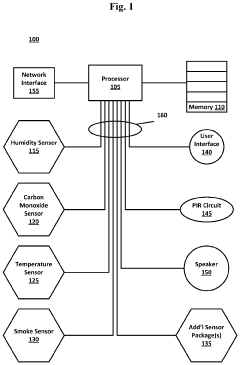
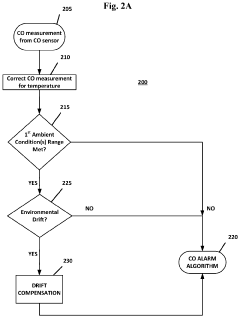
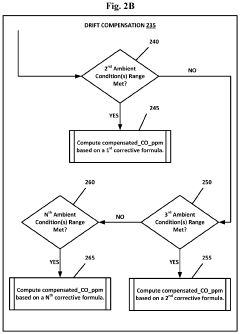
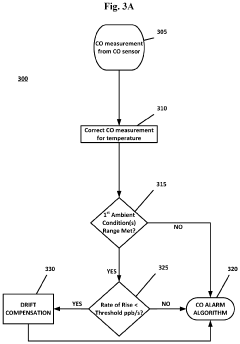
- A hazard detection device equipped with humidity, temperature, and carbon monoxide sensors, along with a processor that calculates corrected CO measurements by determining ambient conditions and applying compensation factors to account for sensor drift, ensuring accurate alerts.
Standardization Requirements for Sensor Stability
The establishment of comprehensive standardization requirements for sensor stability represents a critical foundation for ensuring reliable performance across diverse environmental conditions. Current industry practices reveal significant gaps in unified standards, with different sectors applying varying criteria for acceptable drift parameters and stability metrics. The absence of harmonized standards creates challenges in cross-platform compatibility and performance benchmarking, particularly when sensors operate in extreme environmental conditions.
International standardization bodies, including ISO, IEC, and IEEE, have initiated efforts to develop comprehensive frameworks for sensor stability assessment. These emerging standards focus on defining quantitative metrics for drift characterization, environmental stress testing protocols, and long-term stability validation procedures. The standardization process emphasizes the need for reproducible testing methodologies that can accurately predict sensor behavior under real-world operating conditions.
Key standardization requirements encompass multiple performance dimensions, including thermal stability coefficients, humidity sensitivity thresholds, and mechanical stress tolerance limits. Standards must define acceptable drift rates across specified temperature ranges, typically requiring stability within ±0.1% per degree Celsius for precision applications. Additionally, standardization frameworks must address calibration intervals, traceability requirements, and uncertainty quantification methods to ensure measurement reliability.
The automotive and aerospace industries drive stringent standardization requirements due to safety-critical applications. These sectors demand comprehensive qualification procedures that include accelerated aging tests, thermal cycling protocols, and vibration resistance evaluations. Standards must specify minimum operational lifespans, typically ranging from 10 to 15 years for automotive applications, while maintaining drift performance within specified tolerance bands.
Emerging standardization efforts also address digital sensor interfaces and data integrity requirements. Modern standards incorporate provisions for self-diagnostic capabilities, real-time drift compensation algorithms, and predictive maintenance indicators. These requirements ensure that sensor systems can autonomously monitor their stability performance and provide early warning indicators when drift parameters approach critical thresholds, thereby enhancing overall system reliability and reducing maintenance costs.
International standardization bodies, including ISO, IEC, and IEEE, have initiated efforts to develop comprehensive frameworks for sensor stability assessment. These emerging standards focus on defining quantitative metrics for drift characterization, environmental stress testing protocols, and long-term stability validation procedures. The standardization process emphasizes the need for reproducible testing methodologies that can accurately predict sensor behavior under real-world operating conditions.
Key standardization requirements encompass multiple performance dimensions, including thermal stability coefficients, humidity sensitivity thresholds, and mechanical stress tolerance limits. Standards must define acceptable drift rates across specified temperature ranges, typically requiring stability within ±0.1% per degree Celsius for precision applications. Additionally, standardization frameworks must address calibration intervals, traceability requirements, and uncertainty quantification methods to ensure measurement reliability.
The automotive and aerospace industries drive stringent standardization requirements due to safety-critical applications. These sectors demand comprehensive qualification procedures that include accelerated aging tests, thermal cycling protocols, and vibration resistance evaluations. Standards must specify minimum operational lifespans, typically ranging from 10 to 15 years for automotive applications, while maintaining drift performance within specified tolerance bands.
Emerging standardization efforts also address digital sensor interfaces and data integrity requirements. Modern standards incorporate provisions for self-diagnostic capabilities, real-time drift compensation algorithms, and predictive maintenance indicators. These requirements ensure that sensor systems can autonomously monitor their stability performance and provide early warning indicators when drift parameters approach critical thresholds, thereby enhancing overall system reliability and reducing maintenance costs.
Cost-Performance Trade-offs in Drift Mitigation
The economic considerations surrounding sensor drift mitigation present a complex landscape where organizations must balance performance requirements against budget constraints. Traditional high-precision sensors with built-in drift compensation mechanisms can cost 3-5 times more than standard alternatives, yet may only provide marginal improvements in specific operating conditions. This cost differential becomes particularly pronounced in large-scale deployments where hundreds or thousands of sensors are required.
Software-based drift correction algorithms offer an attractive middle ground, requiring minimal hardware investment while providing substantial performance improvements. These solutions typically involve periodic recalibration routines, statistical filtering, and machine learning-based compensation models. Implementation costs remain relatively low, primarily involving development time and computational resources, making them accessible to organizations with limited budgets.
Hardware redundancy approaches, while offering superior reliability, introduce significant cost multipliers. Dual or triple sensor configurations can increase system costs by 100-200%, though they provide enhanced fault tolerance and cross-validation capabilities. The economic justification for such approaches depends heavily on application criticality and the potential costs of measurement failures.
Calibration frequency represents another critical cost-performance variable. More frequent calibration cycles reduce drift-related errors but increase operational expenses through labor, reference standards, and system downtime. Organizations must establish optimal calibration intervals based on sensor characteristics, environmental conditions, and acceptable error tolerances.
Environmental control systems present an alternative strategy where modifying operating conditions can reduce drift rates more cost-effectively than upgrading sensors. Temperature stabilization, humidity control, and vibration isolation can significantly extend calibration intervals and improve measurement stability. However, these solutions require careful analysis of implementation costs versus long-term operational benefits.
The total cost of ownership analysis must encompass initial procurement, installation, calibration, maintenance, and replacement costs over the sensor's operational lifetime. This comprehensive evaluation often reveals that higher initial investments in drift-resistant technologies can provide superior long-term value through reduced maintenance requirements and extended service intervals.
Software-based drift correction algorithms offer an attractive middle ground, requiring minimal hardware investment while providing substantial performance improvements. These solutions typically involve periodic recalibration routines, statistical filtering, and machine learning-based compensation models. Implementation costs remain relatively low, primarily involving development time and computational resources, making them accessible to organizations with limited budgets.
Hardware redundancy approaches, while offering superior reliability, introduce significant cost multipliers. Dual or triple sensor configurations can increase system costs by 100-200%, though they provide enhanced fault tolerance and cross-validation capabilities. The economic justification for such approaches depends heavily on application criticality and the potential costs of measurement failures.
Calibration frequency represents another critical cost-performance variable. More frequent calibration cycles reduce drift-related errors but increase operational expenses through labor, reference standards, and system downtime. Organizations must establish optimal calibration intervals based on sensor characteristics, environmental conditions, and acceptable error tolerances.
Environmental control systems present an alternative strategy where modifying operating conditions can reduce drift rates more cost-effectively than upgrading sensors. Temperature stabilization, humidity control, and vibration isolation can significantly extend calibration intervals and improve measurement stability. However, these solutions require careful analysis of implementation costs versus long-term operational benefits.
The total cost of ownership analysis must encompass initial procurement, installation, calibration, maintenance, and replacement costs over the sensor's operational lifetime. This comprehensive evaluation often reveals that higher initial investments in drift-resistant technologies can provide superior long-term value through reduced maintenance requirements and extended service intervals.
Unlock deeper insights with Patsnap Eureka Quick Research — get a full tech report to explore trends and direct your research. Try now!
Generate Your Research Report Instantly with AI Agent
Supercharge your innovation with Patsnap Eureka AI Agent Platform!