
Gradient Descent vs Coordinate Updates: Parallelization Potential
OCT 9, 20269 MIN READ
Generate Your Research Report Instantly with AI Agent
Patsnap Eureka helps you evaluate technical feasibility & market potential.
Parallel Optimization Background and Objectives
Parallel optimization has emerged as a critical enabler for solving large-scale machine learning and data analytics problems in the era of big data. The exponential growth in dataset sizes and model complexity has rendered sequential optimization algorithms increasingly impractical, necessitating the development of parallel computing strategies that can leverage modern distributed computing architectures. Traditional optimization methods, while mathematically elegant, often face significant computational bottlenecks when applied to problems involving millions or billions of parameters.
The fundamental challenge lies in decomposing optimization algorithms into parallelizable components without sacrificing convergence guarantees or solution quality. Gradient Descent and Coordinate Updates represent two distinct paradigms in iterative optimization, each with unique characteristics that influence their parallelization potential. Gradient Descent computes the full gradient across all dimensions simultaneously, while Coordinate Updates iteratively refine individual coordinates or coordinate blocks. Understanding how these approaches scale across multiple processors is essential for designing efficient distributed optimization systems.
The primary objective of this research is to systematically compare the parallelization capabilities of Gradient Descent and Coordinate Updates across multiple dimensions. This includes analyzing their theoretical speedup limits, communication overhead patterns, synchronization requirements, and convergence behavior under parallel execution. The investigation aims to identify scenarios where each method demonstrates superior parallel efficiency, considering factors such as problem dimensionality, sparsity patterns, and hardware architectures.
A secondary objective involves establishing practical guidelines for algorithm selection in distributed computing environments. By quantifying the trade-offs between computational parallelism, communication costs, and convergence rates, this research seeks to provide actionable insights for practitioners designing scalable optimization systems. The analysis will encompass both synchronous and asynchronous parallel implementations, examining how coordination strategies impact overall performance.
Ultimately, this research aims to advance the theoretical understanding of parallel optimization while delivering practical frameworks that enable more efficient utilization of modern computing infrastructure for large-scale machine learning applications.
The fundamental challenge lies in decomposing optimization algorithms into parallelizable components without sacrificing convergence guarantees or solution quality. Gradient Descent and Coordinate Updates represent two distinct paradigms in iterative optimization, each with unique characteristics that influence their parallelization potential. Gradient Descent computes the full gradient across all dimensions simultaneously, while Coordinate Updates iteratively refine individual coordinates or coordinate blocks. Understanding how these approaches scale across multiple processors is essential for designing efficient distributed optimization systems.
The primary objective of this research is to systematically compare the parallelization capabilities of Gradient Descent and Coordinate Updates across multiple dimensions. This includes analyzing their theoretical speedup limits, communication overhead patterns, synchronization requirements, and convergence behavior under parallel execution. The investigation aims to identify scenarios where each method demonstrates superior parallel efficiency, considering factors such as problem dimensionality, sparsity patterns, and hardware architectures.
A secondary objective involves establishing practical guidelines for algorithm selection in distributed computing environments. By quantifying the trade-offs between computational parallelism, communication costs, and convergence rates, this research seeks to provide actionable insights for practitioners designing scalable optimization systems. The analysis will encompass both synchronous and asynchronous parallel implementations, examining how coordination strategies impact overall performance.
Ultimately, this research aims to advance the theoretical understanding of parallel optimization while delivering practical frameworks that enable more efficient utilization of modern computing infrastructure for large-scale machine learning applications.
Market Demand for Scalable ML Training
The demand for scalable machine learning training has intensified dramatically as organizations across industries seek to leverage increasingly complex models and massive datasets. Enterprises in sectors ranging from technology and finance to healthcare and autonomous systems are deploying deep learning architectures that require processing billions or even trillions of parameters. This computational intensity has created urgent pressure to develop training methodologies that can efficiently utilize distributed computing resources, making parallelization strategies a critical competitive differentiator.
Cloud service providers and AI-focused companies face mounting expectations to reduce training time from weeks to hours while managing computational costs. The economic implications are substantial, as prolonged training cycles directly impact time-to-market for AI-driven products and services. Organizations investing heavily in large language models, computer vision systems, and recommendation engines require training frameworks that can scale horizontally across hundreds or thousands of processing units without proportional increases in training duration.
The proliferation of edge computing and federated learning scenarios has further diversified scalability requirements. Applications demanding real-time model updates or privacy-preserving distributed training introduce unique parallelization challenges that traditional gradient descent approaches struggle to address efficiently. Coordinate update methods have emerged as potential alternatives precisely because they offer different parallelization characteristics that may better suit certain distributed architectures.
Research institutions and technology leaders are actively exploring optimization algorithms that can maximize hardware utilization across heterogeneous computing environments. The growing adoption of specialized accelerators including GPUs, TPUs, and custom AI chips has created demand for training algorithms that can adapt to diverse hardware configurations while maintaining convergence guarantees. This hardware diversity amplifies the importance of understanding how different optimization strategies parallelize across varied computational substrates.
The market increasingly values solutions that balance training speed, resource efficiency, and model quality. Organizations seek optimization approaches that not only reduce wall-clock training time but also optimize energy consumption and infrastructure costs, making the comparative analysis of parallelization potential between gradient descent and coordinate updates directly relevant to strategic technology investment decisions.
Cloud service providers and AI-focused companies face mounting expectations to reduce training time from weeks to hours while managing computational costs. The economic implications are substantial, as prolonged training cycles directly impact time-to-market for AI-driven products and services. Organizations investing heavily in large language models, computer vision systems, and recommendation engines require training frameworks that can scale horizontally across hundreds or thousands of processing units without proportional increases in training duration.
The proliferation of edge computing and federated learning scenarios has further diversified scalability requirements. Applications demanding real-time model updates or privacy-preserving distributed training introduce unique parallelization challenges that traditional gradient descent approaches struggle to address efficiently. Coordinate update methods have emerged as potential alternatives precisely because they offer different parallelization characteristics that may better suit certain distributed architectures.
Research institutions and technology leaders are actively exploring optimization algorithms that can maximize hardware utilization across heterogeneous computing environments. The growing adoption of specialized accelerators including GPUs, TPUs, and custom AI chips has created demand for training algorithms that can adapt to diverse hardware configurations while maintaining convergence guarantees. This hardware diversity amplifies the importance of understanding how different optimization strategies parallelize across varied computational substrates.
The market increasingly values solutions that balance training speed, resource efficiency, and model quality. Organizations seek optimization approaches that not only reduce wall-clock training time but also optimize energy consumption and infrastructure costs, making the comparative analysis of parallelization potential between gradient descent and coordinate updates directly relevant to strategic technology investment decisions.
Current Parallelization Challenges in Optimization
Parallelization of optimization algorithms faces fundamental challenges rooted in the inherent dependencies within iterative computation processes. Traditional gradient descent methods require sequential updates where each iteration depends on the complete gradient computation from the previous step, creating synchronization bottlenecks that limit scalability. The global nature of gradient calculations necessitates aggregating information across all data points or model parameters before proceeding, which becomes increasingly problematic as dataset sizes and model dimensions grow exponentially in modern machine learning applications.
Communication overhead represents a critical bottleneck in distributed optimization environments. When parallelizing gradient-based methods across multiple computing nodes, the cost of transmitting gradient information and synchronizing parameter updates often outweighs the computational benefits of parallel processing. This challenge intensifies with increasing network latency and bandwidth constraints, particularly in heterogeneous computing environments where processing speeds vary significantly across nodes. The resulting idle time during synchronization phases substantially degrades overall system efficiency and undermines the theoretical speedup gains from parallelization.
Memory access patterns and data locality issues further complicate parallelization efforts. Optimization algorithms frequently require random or irregular access to training data and model parameters, leading to cache misses and memory bandwidth saturation. Coordinate update methods, while offering potential advantages in certain scenarios, face challenges in maintaining consistency when multiple coordinates are updated simultaneously. The risk of race conditions and the need for atomic operations introduce additional computational overhead that can negate parallelization benefits.
Load balancing emerges as another significant challenge, especially when dealing with sparse data structures or non-uniform computational complexity across different parameters or data samples. Uneven workload distribution causes some processors to remain idle while others are overloaded, reducing overall parallel efficiency. Dynamic load balancing mechanisms introduce their own overhead and complexity, requiring sophisticated scheduling algorithms that adapt to varying computational demands throughout the optimization process.
The convergence behavior of parallelized optimization algorithms often deviates from their sequential counterparts, introducing theoretical and practical complications. Asynchronous updates, while reducing synchronization costs, can lead to stale gradient information and delayed convergence or even divergence in certain problem settings. Establishing convergence guarantees and maintaining solution quality while maximizing parallelization efficiency remains an active research challenge requiring careful algorithm design and theoretical analysis.
Communication overhead represents a critical bottleneck in distributed optimization environments. When parallelizing gradient-based methods across multiple computing nodes, the cost of transmitting gradient information and synchronizing parameter updates often outweighs the computational benefits of parallel processing. This challenge intensifies with increasing network latency and bandwidth constraints, particularly in heterogeneous computing environments where processing speeds vary significantly across nodes. The resulting idle time during synchronization phases substantially degrades overall system efficiency and undermines the theoretical speedup gains from parallelization.
Memory access patterns and data locality issues further complicate parallelization efforts. Optimization algorithms frequently require random or irregular access to training data and model parameters, leading to cache misses and memory bandwidth saturation. Coordinate update methods, while offering potential advantages in certain scenarios, face challenges in maintaining consistency when multiple coordinates are updated simultaneously. The risk of race conditions and the need for atomic operations introduce additional computational overhead that can negate parallelization benefits.
Load balancing emerges as another significant challenge, especially when dealing with sparse data structures or non-uniform computational complexity across different parameters or data samples. Uneven workload distribution causes some processors to remain idle while others are overloaded, reducing overall parallel efficiency. Dynamic load balancing mechanisms introduce their own overhead and complexity, requiring sophisticated scheduling algorithms that adapt to varying computational demands throughout the optimization process.
The convergence behavior of parallelized optimization algorithms often deviates from their sequential counterparts, introducing theoretical and practical complications. Asynchronous updates, while reducing synchronization costs, can lead to stale gradient information and delayed convergence or even divergence in certain problem settings. Establishing convergence guarantees and maintaining solution quality while maximizing parallelization efficiency remains an active research challenge requiring careful algorithm design and theoretical analysis.
Existing Parallel GD and Coordinate Update Solutions
01 Parallelized Stochastic and Asynchronous Gradient Descent Methods
Techniques for implementing parallel and asynchronous gradient descent architectures, particularly in distributed environments such as federated learning or machine learning training. These methods enable simultaneous model parameter updates, helping to improve computing throughput, speed up convergence, and manage global parameter synchronization efficiently.- Parallelized Stochastic Gradient Descent: Implementing stochastic gradient descent in a parallelized manner enables distributed computing resources to process large-scale datasets simultaneously. This approach accelerates parameter updates, enhances machine learning training efficiency, and maximizes parallel execution potential across multiple computational nodes.
- Asynchronous and Parameter Multiplexed Gradient Descent: Utilizing asynchronous execution or parameter multiplexing in gradient descent architectures reduces thread blocking and synchronization overhead. This enables efficient parallel updating of model parameters, mitigating global non-convergence issues while improving overall throughput in parallelized systems.
- Coordinate Descent Optimization Techniques: Applying coordinate descent methods allows optimization problems to be broken down into individual or block coordinate updates. These updates can be computed independently or in overlapping clusters, saving execution time and simplifying complex multidimensional search spaces.
- Hardware Architecture and Parallelization Metrics: Optimizing microcomputer hardware architectures and measuring parallelization capacity allows for adaptive depth adjustments during program execution. This prevents multi-core efficiency degradation and ensures balanced workload distribution during heavy computational operations.
- Sequential Iterative and Mini-Batch Optimization Methods: Structuring gradient calculations into mini-batches or sequential iterative frameworks enables structured data processing. This optimizes parasitic parameter analysis and computational flow, balancing parallel workload distribution with stable algorithmic convergence.
02 Coordinate Descent and Block Coordinate Optimization Strategies
Optimization methodologies relying on coordinate updates, block coordinate descent, and overlapping cluster strategies. These approaches reduce overall computation time, eliminate redundant calculation steps, and facilitate complex trajectory planning and high-dimensional parameter optimization by solving problems along sub-dimensional components.Expand Specific Solutions03 Hardware Acceleration and Computing Architecture Optimization
Hardware-level chip architectures, parameter multiplexing systems, and parallelization tools designed for gradient calculation and program execution. These technological enhancements optimize multi-core microcomputer processing efficiency, control program execution depth, and enable dedicated hardware processing for gradient descent functions.Expand Specific Solutions04 Transaction and Execution Parallelization Metrics Technology
Systematic measurement and evaluation methods for assessing parallelization metrics during multi-program execution or transaction processing. By monitoring program control and transaction parallelization potential, these systems reduce redundant computational output and prevent microcomputer processor performance degradation.Expand Specific Solutions05 Advanced Gradient Variant Implementations and Hybrid Optimization Algorithms
Methods utilizing specialized variants of gradient descent—including projected, mini-batch, alternating, and conjugate gradient algorithms—integrated with heuristic or dynamic frameworks. These systems solve specific domain problems such as dynamic reservoir simulation, adversarial attack detection, fast shear wave splitting, and dynamic path optimization.Expand Specific Solutions
Key Players in Distributed ML Frameworks
The parallelization of Gradient Descent versus Coordinate Updates represents a mature optimization research domain currently in the advanced development stage, with growing market relevance driven by large-scale machine learning and distributed computing demands. Leading academic institutions including National University of Defense Technology, University of Science & Technology of China, Sun Yat-Sen University, and Huazhong University of Science & Technology are advancing theoretical foundations and algorithmic innovations. Technology maturity is demonstrated through industrial implementations by Huawei Technologies, Baidu, Amazon Technologies, Microsoft Technology Licensing, and QUALCOMM, who integrate these optimization techniques into production systems. Research entities like NEC Laboratories America and Preferred Networks are bridging academic research with commercial applications, while emerging players such as SambaNova Systems and Hypernet Labs are exploring novel hardware-software co-design approaches for accelerated parallel optimization in AI workloads.
Huawei Technologies Co., Ltd.
Technical Solution: Huawei has developed advanced distributed training frameworks that leverage both gradient descent and coordinate update parallelization strategies. Their approach implements asynchronous stochastic gradient descent (ASGD) with parameter server architecture, enabling efficient parallel processing across multiple computing nodes. The system incorporates adaptive learning rate mechanisms and gradient compression techniques to optimize communication overhead. For coordinate updates, Huawei employs block-coordinate descent methods with intelligent partitioning algorithms that maximize parallelization potential while minimizing synchronization costs. Their MindSpore framework supports flexible parallelization modes including data parallelism, model parallelism, and hybrid parallelism, allowing dynamic switching between gradient-based and coordinate-based optimization depending on model architecture and hardware configuration.
Strengths: Comprehensive enterprise-level framework with production-proven scalability; excellent hardware-software co-optimization. Weaknesses: Proprietary ecosystem may limit interoperability with third-party tools; steeper learning curve for developers.
QUALCOMM, Inc.
Technical Solution: Qualcomm focuses on parallelization optimization for edge and mobile AI scenarios, implementing efficient gradient descent algorithms optimized for heterogeneous computing architectures combining CPU, GPU, and DSP units. Their Snapdragon Neural Processing Engine utilizes quantized gradient descent with parallel batch processing capabilities tailored for resource-constrained environments. The company has developed specialized coordinate update methods for sparse neural networks, enabling parallel updates of independent coordinate blocks across different processing units. Their approach emphasizes energy efficiency through adaptive parallelization that dynamically adjusts the degree of parallelism based on thermal constraints and battery status, making gradient descent and coordinate updates viable for on-device training and fine-tuning applications.
Strengths: Exceptional power efficiency and thermal management; optimized for mobile and edge deployment scenarios. Weaknesses: Limited scalability to large-scale distributed training; primarily focused on inference rather than training workloads.
Core Techniques in Parallelization Efficiency
Parallelized block coordinate descent for machine learned models
PatentInactiveUS20190197013A1
Innovation
- Implementing a Generalized Additive Mixed Effect (GAME) model with a global, per-user, and per-item model, using parallelized block coordinate descent under a Bulk Synchronous Parallel paradigm to capture user and item-specific behaviors, and leveraging ID-level regression coefficients for improved prediction accuracy.


Training SVMs with parallelized stochastic gradient descent
PatentInactiveUS8626677B2
Innovation
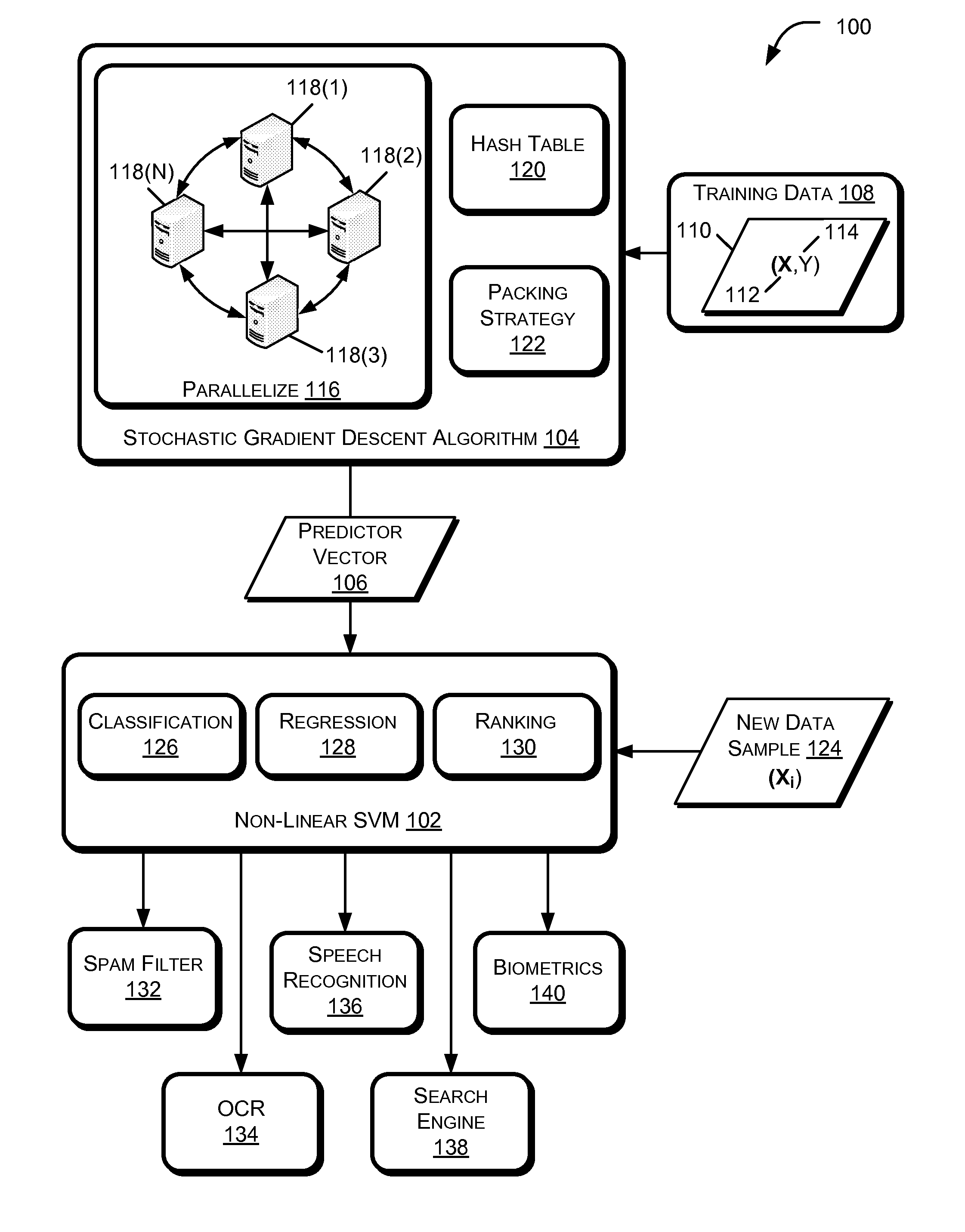
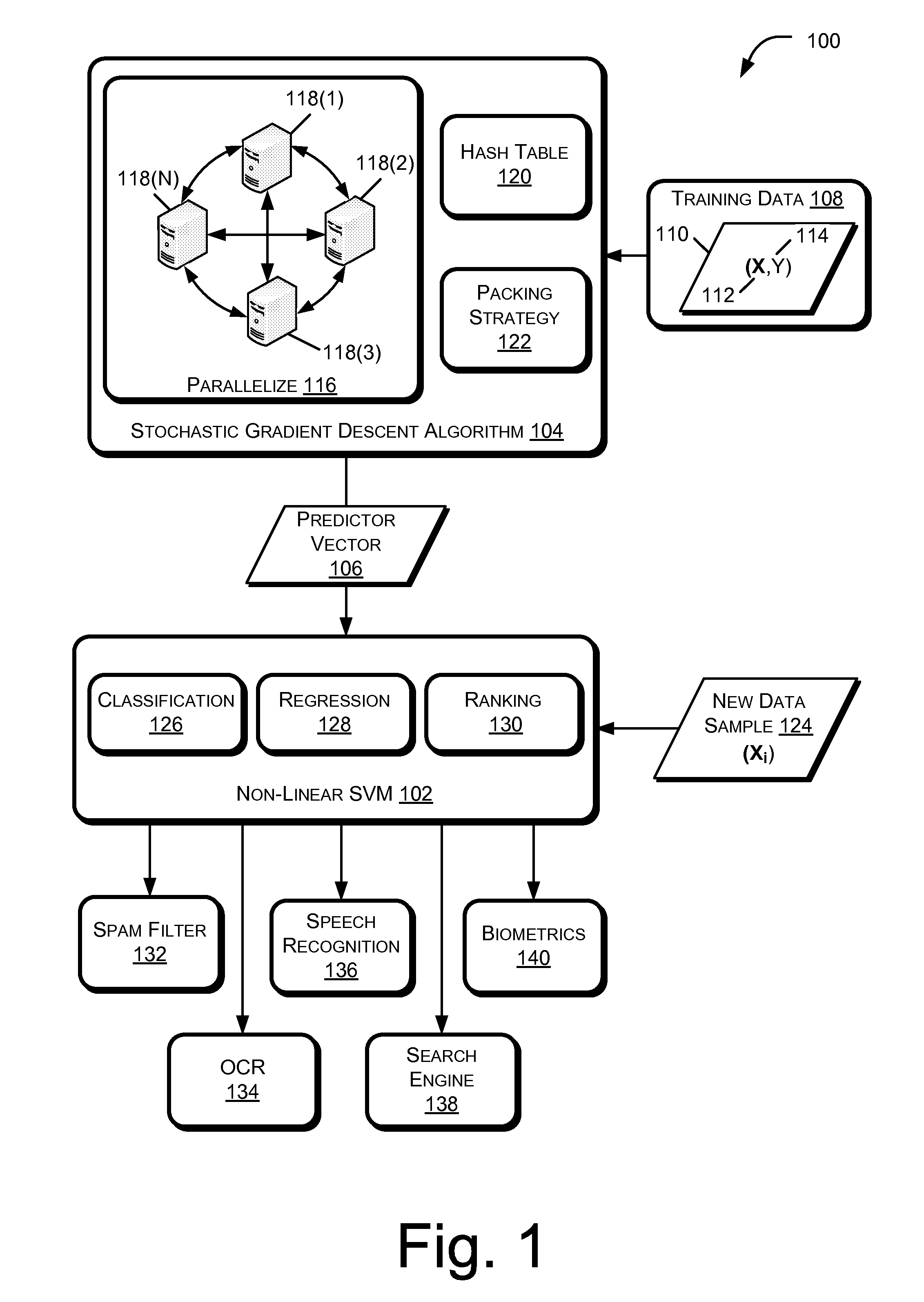
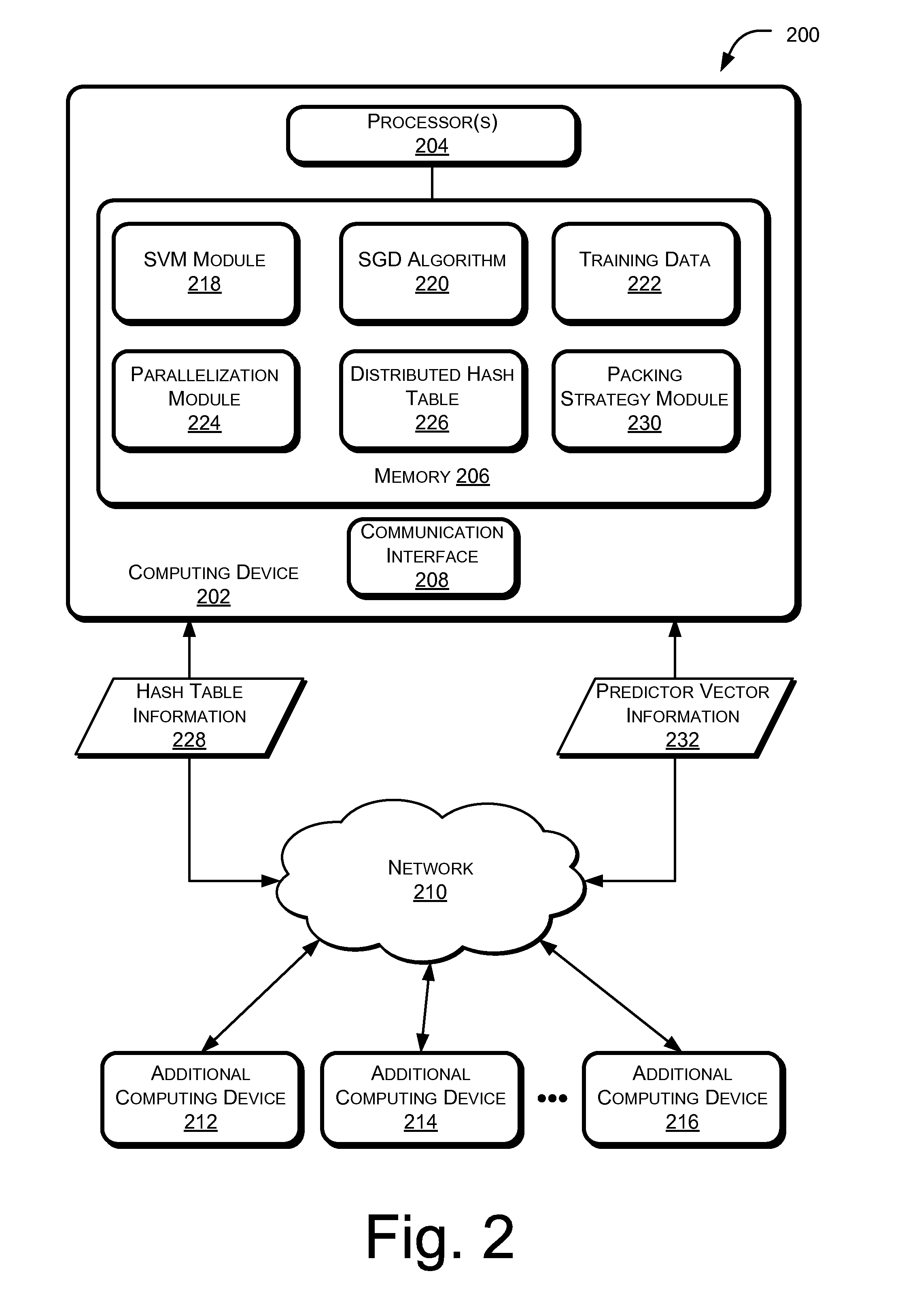
- Implementing a parallelized stochastic gradient descent algorithm that optimizes the primal SVM objective function, utilizing a packing strategy to reduce inter-processor communication and leveraging a hash table distributed among processors to determine a predictor vector.

Hardware Architecture Impact on Parallelization
The hardware architecture fundamentally determines the parallelization efficiency of both Gradient Descent and Coordinate Updates algorithms. Modern computing platforms exhibit distinct characteristics that influence how these optimization methods can be decomposed and executed concurrently. The architectural features including memory hierarchy, interconnect topology, and computational unit organization create varying opportunities and constraints for parallel implementation of these two approaches.
GPU architectures with their massive thread parallelism and SIMD execution model naturally favor Gradient Descent implementations. The algorithm's uniform computational pattern across all parameters aligns well with GPU's requirement for coherent memory access and identical instruction execution across thread blocks. The high memory bandwidth and specialized tensor cores in modern GPUs enable efficient matrix-vector operations essential for gradient computation. However, Coordinate Updates face challenges on GPUs due to their inherently sequential nature and irregular memory access patterns that lead to thread divergence and underutilized computational resources.
Multi-core CPU architectures present different trade-offs for these algorithms. CPUs with sophisticated cache hierarchies and branch prediction mechanisms can better accommodate the conditional logic and variable update patterns in Coordinate Updates. The larger per-core cache sizes enable efficient storage of intermediate results during coordinate-wise optimization. Gradient Descent on CPUs benefits from vectorization capabilities through AVX or similar instruction sets, though the parallelization degree remains limited compared to GPU implementations.
Distributed computing environments introduce additional architectural considerations. Network latency and bandwidth become critical factors when synchronizing gradient updates across multiple nodes in Gradient Descent implementations. Coordinate Updates can potentially reduce communication overhead through asynchronous updates, but this advantage depends heavily on the interconnect architecture and whether the system supports efficient fine-grained synchronization primitives. Emerging architectures like TPUs and specialized AI accelerators with systolic arrays demonstrate optimized data flow patterns that particularly benefit structured parallel operations characteristic of Gradient Descent, while offering limited advantages for the adaptive execution patterns required by Coordinate Updates.
GPU architectures with their massive thread parallelism and SIMD execution model naturally favor Gradient Descent implementations. The algorithm's uniform computational pattern across all parameters aligns well with GPU's requirement for coherent memory access and identical instruction execution across thread blocks. The high memory bandwidth and specialized tensor cores in modern GPUs enable efficient matrix-vector operations essential for gradient computation. However, Coordinate Updates face challenges on GPUs due to their inherently sequential nature and irregular memory access patterns that lead to thread divergence and underutilized computational resources.
Multi-core CPU architectures present different trade-offs for these algorithms. CPUs with sophisticated cache hierarchies and branch prediction mechanisms can better accommodate the conditional logic and variable update patterns in Coordinate Updates. The larger per-core cache sizes enable efficient storage of intermediate results during coordinate-wise optimization. Gradient Descent on CPUs benefits from vectorization capabilities through AVX or similar instruction sets, though the parallelization degree remains limited compared to GPU implementations.
Distributed computing environments introduce additional architectural considerations. Network latency and bandwidth become critical factors when synchronizing gradient updates across multiple nodes in Gradient Descent implementations. Coordinate Updates can potentially reduce communication overhead through asynchronous updates, but this advantage depends heavily on the interconnect architecture and whether the system supports efficient fine-grained synchronization primitives. Emerging architectures like TPUs and specialized AI accelerators with systolic arrays demonstrate optimized data flow patterns that particularly benefit structured parallel operations characteristic of Gradient Descent, while offering limited advantages for the adaptive execution patterns required by Coordinate Updates.
Convergence-Communication Trade-offs Analysis
The fundamental tension between convergence speed and communication overhead represents a critical consideration when evaluating parallelization strategies for Gradient Descent and Coordinate Updates. In distributed optimization scenarios, achieving faster convergence often necessitates more frequent information exchange among computing nodes, creating an inherent trade-off that significantly impacts overall system performance. This trade-off becomes particularly pronounced when comparing these two algorithmic paradigms, as their communication patterns and convergence characteristics differ substantially.
Gradient Descent typically requires global synchronization at each iteration, where all workers must communicate their local gradient computations before the model parameters can be updated. This synchronous communication pattern ensures consistent convergence behavior but introduces substantial overhead, especially as the number of parallel workers increases. The communication cost scales linearly with model dimensionality and worker count, potentially offsetting the computational benefits of parallelization. However, this approach guarantees theoretical convergence rates similar to sequential implementations under appropriate learning rate schedules.
Coordinate Updates present an alternative communication paradigm where only subsets of parameters require synchronization at each iteration. This selective communication strategy can dramatically reduce bandwidth requirements and synchronization delays. Asynchronous coordinate update schemes further minimize communication overhead by allowing workers to proceed without waiting for global synchronization. Nevertheless, these communication savings come at the cost of potentially slower convergence rates due to the use of stale or partially updated information during computation.
The optimal balance between convergence efficiency and communication cost depends heavily on problem characteristics, including model dimensionality, data distribution, network topology, and hardware capabilities. For high-dimensional problems with sparse gradients, coordinate-based methods may achieve superior overall performance despite slower per-iteration convergence. Conversely, in bandwidth-rich environments with moderate dimensionality, the faster convergence of synchronized gradient methods may justify their higher communication demands. Quantifying these trade-offs requires careful analysis of both theoretical convergence bounds and empirical performance metrics across diverse deployment scenarios.
Gradient Descent typically requires global synchronization at each iteration, where all workers must communicate their local gradient computations before the model parameters can be updated. This synchronous communication pattern ensures consistent convergence behavior but introduces substantial overhead, especially as the number of parallel workers increases. The communication cost scales linearly with model dimensionality and worker count, potentially offsetting the computational benefits of parallelization. However, this approach guarantees theoretical convergence rates similar to sequential implementations under appropriate learning rate schedules.
Coordinate Updates present an alternative communication paradigm where only subsets of parameters require synchronization at each iteration. This selective communication strategy can dramatically reduce bandwidth requirements and synchronization delays. Asynchronous coordinate update schemes further minimize communication overhead by allowing workers to proceed without waiting for global synchronization. Nevertheless, these communication savings come at the cost of potentially slower convergence rates due to the use of stale or partially updated information during computation.
The optimal balance between convergence efficiency and communication cost depends heavily on problem characteristics, including model dimensionality, data distribution, network topology, and hardware capabilities. For high-dimensional problems with sparse gradients, coordinate-based methods may achieve superior overall performance despite slower per-iteration convergence. Conversely, in bandwidth-rich environments with moderate dimensionality, the faster convergence of synchronized gradient methods may justify their higher communication demands. Quantifying these trade-offs requires careful analysis of both theoretical convergence bounds and empirical performance metrics across diverse deployment scenarios.
Unlock deeper insights with Patsnap Eureka Quick Research — get a full tech report to explore trends and direct your research. Try now!
Generate Your Research Report Instantly with AI Agent
Supercharge your innovation with Patsnap Eureka AI Agent Platform!