

Silicon Controlled Rectifier vs Diac: Frequency Response Comparison
MAR 13, 20269 MIN READ
Generate Your Research Report Instantly with AI Agent
PatSnap Eureka helps you evaluate technical feasibility & market potential.
SCR vs DIAC Background and Technical Objectives
Silicon Controlled Rectifiers (SCRs) and DIACs represent two fundamental categories of semiconductor switching devices that have evolved along distinct technological pathways since the mid-20th century. SCRs, first developed in the 1950s at Bell Laboratories, emerged as three-terminal thyristor devices capable of controlled rectification and switching applications. These devices revolutionized power electronics by enabling precise control over AC power delivery through gate triggering mechanisms.
DIACs, or Diode for Alternating Current, were subsequently developed as two-terminal bidirectional trigger devices in the 1960s. Unlike SCRs, DIACs function as symmetrical breakover devices that conduct current in both directions once their breakover voltage is exceeded. This bidirectional characteristic made them particularly valuable in triggering circuits and phase control applications.
The technological evolution of both devices has been driven by increasing demands for efficient power management, precise timing control, and improved frequency response characteristics. Early SCR implementations were limited to low-frequency applications, typically operating effectively below 1 kHz due to inherent turn-off time constraints and thermal considerations. DIAC technology similarly faced frequency limitations, though their simpler structure often allowed for faster switching transitions.
Modern semiconductor manufacturing advances have significantly enhanced the frequency response capabilities of both device types. Contemporary SCRs now achieve switching frequencies extending into the tens of kilohertz range, while advanced DIAC designs demonstrate improved high-frequency performance through optimized junction geometries and reduced parasitic capacitances.
The primary technical objective driving current research focuses on comprehensive frequency response characterization and optimization. Understanding the comparative frequency behavior between SCRs and DIACs becomes crucial for applications requiring precise timing control, such as motor drives, lighting dimmers, and power factor correction circuits. Key performance metrics include switching speed, frequency-dependent losses, harmonic distortion, and thermal stability across varying operational frequencies.
Current development efforts target extending operational frequency ranges while maintaining device reliability and cost-effectiveness. This involves addressing fundamental physical limitations including carrier lifetime, junction capacitances, and thermal management challenges that traditionally constrain high-frequency operation in both SCR and DIAC technologies.
DIACs, or Diode for Alternating Current, were subsequently developed as two-terminal bidirectional trigger devices in the 1960s. Unlike SCRs, DIACs function as symmetrical breakover devices that conduct current in both directions once their breakover voltage is exceeded. This bidirectional characteristic made them particularly valuable in triggering circuits and phase control applications.
The technological evolution of both devices has been driven by increasing demands for efficient power management, precise timing control, and improved frequency response characteristics. Early SCR implementations were limited to low-frequency applications, typically operating effectively below 1 kHz due to inherent turn-off time constraints and thermal considerations. DIAC technology similarly faced frequency limitations, though their simpler structure often allowed for faster switching transitions.
Modern semiconductor manufacturing advances have significantly enhanced the frequency response capabilities of both device types. Contemporary SCRs now achieve switching frequencies extending into the tens of kilohertz range, while advanced DIAC designs demonstrate improved high-frequency performance through optimized junction geometries and reduced parasitic capacitances.
The primary technical objective driving current research focuses on comprehensive frequency response characterization and optimization. Understanding the comparative frequency behavior between SCRs and DIACs becomes crucial for applications requiring precise timing control, such as motor drives, lighting dimmers, and power factor correction circuits. Key performance metrics include switching speed, frequency-dependent losses, harmonic distortion, and thermal stability across varying operational frequencies.
Current development efforts target extending operational frequency ranges while maintaining device reliability and cost-effectiveness. This involves addressing fundamental physical limitations including carrier lifetime, junction capacitances, and thermal management challenges that traditionally constrain high-frequency operation in both SCR and DIAC technologies.
Market Demand for Power Control Semiconductor Devices
The global power control semiconductor device market demonstrates robust growth driven by increasing demand for energy-efficient solutions across multiple industrial sectors. Power electronics applications in renewable energy systems, electric vehicles, industrial automation, and consumer electronics continue to expand, creating substantial opportunities for advanced semiconductor technologies including Silicon Controlled Rectifiers and Diacs.
Industrial automation represents a significant demand driver, where precise power control capabilities are essential for motor drives, heating systems, and process control equipment. Manufacturing facilities increasingly require sophisticated power management solutions that can handle varying frequency responses and switching characteristics. The automotive sector's transition toward electrification further amplifies demand for power semiconductors capable of efficient AC power control and phase angle regulation.
Renewable energy infrastructure development creates substantial market opportunities for power control devices. Solar inverters, wind power systems, and energy storage solutions require semiconductors with specific frequency response characteristics to manage power conversion efficiently. Grid-tied applications particularly benefit from devices offering reliable triggering mechanisms and controlled conduction properties across different operating frequencies.
Consumer electronics and home appliance markets continue driving volume demand for cost-effective power control solutions. Applications ranging from dimmer switches to motor speed controllers require semiconductors that balance performance with economic considerations. The growing smart home ecosystem introduces additional requirements for devices capable of precise power regulation while maintaining compatibility with digital control systems.
Emerging markets in Asia-Pacific and Latin America contribute significantly to demand growth, supported by industrial development and infrastructure modernization initiatives. These regions demonstrate increasing adoption of automated manufacturing processes and energy-efficient technologies, creating opportunities for both established and innovative power semiconductor solutions.
The market exhibits distinct preferences for devices offering superior frequency response characteristics, particularly in applications requiring precise timing control and minimal harmonic distortion. End-users increasingly prioritize semiconductors that maintain consistent performance across wide frequency ranges while providing reliable switching behavior under varying load conditions.
Industrial automation represents a significant demand driver, where precise power control capabilities are essential for motor drives, heating systems, and process control equipment. Manufacturing facilities increasingly require sophisticated power management solutions that can handle varying frequency responses and switching characteristics. The automotive sector's transition toward electrification further amplifies demand for power semiconductors capable of efficient AC power control and phase angle regulation.
Renewable energy infrastructure development creates substantial market opportunities for power control devices. Solar inverters, wind power systems, and energy storage solutions require semiconductors with specific frequency response characteristics to manage power conversion efficiently. Grid-tied applications particularly benefit from devices offering reliable triggering mechanisms and controlled conduction properties across different operating frequencies.
Consumer electronics and home appliance markets continue driving volume demand for cost-effective power control solutions. Applications ranging from dimmer switches to motor speed controllers require semiconductors that balance performance with economic considerations. The growing smart home ecosystem introduces additional requirements for devices capable of precise power regulation while maintaining compatibility with digital control systems.
Emerging markets in Asia-Pacific and Latin America contribute significantly to demand growth, supported by industrial development and infrastructure modernization initiatives. These regions demonstrate increasing adoption of automated manufacturing processes and energy-efficient technologies, creating opportunities for both established and innovative power semiconductor solutions.
The market exhibits distinct preferences for devices offering superior frequency response characteristics, particularly in applications requiring precise timing control and minimal harmonic distortion. End-users increasingly prioritize semiconductors that maintain consistent performance across wide frequency ranges while providing reliable switching behavior under varying load conditions.
Current State and Frequency Limitations of SCR and DIAC
Silicon Controlled Rectifiers (SCRs) and DIACs represent two distinct categories of semiconductor switching devices, each exhibiting unique frequency response characteristics that define their operational boundaries and application domains. The current technological landscape reveals significant disparities in their frequency handling capabilities, primarily stemming from their fundamental structural differences and switching mechanisms.
SCRs, as four-layer PNPN devices, demonstrate inherently limited high-frequency performance due to their charge storage characteristics and turn-off time constraints. Modern SCRs typically operate effectively in frequency ranges from DC to approximately 400 Hz for standard power applications, with specialized fast-switching variants extending this range to several kilohertz. The primary limitation arises from the device's turn-off time, which ranges from 5 to 100 microseconds depending on the specific design and manufacturing process.
The frequency response of SCRs is fundamentally constrained by minority carrier lifetime and junction capacitances. During the turn-off process, stored charge must be removed from the device junctions, creating a recovery time that limits switching frequency. Additionally, the gate triggering sensitivity decreases at higher frequencies due to parasitic capacitances and reduced current gain in the internal transistor structure.
DIACs, functioning as bidirectional trigger devices, exhibit different frequency limitations primarily related to their avalanche breakdown mechanism and recovery characteristics. These devices typically operate in trigger applications where frequency response is less critical than precise voltage threshold characteristics. DIACs can respond to frequency components up to several hundred kilohertz, though their effectiveness as switching elements diminishes significantly beyond 10 kHz due to thermal considerations and breakdown voltage variations.
Contemporary DIAC technology faces frequency limitations imposed by the avalanche multiplication process and thermal recovery time. The device's ability to maintain consistent breakover voltage characteristics deteriorates at higher frequencies, particularly when repetitive switching occurs without adequate cooling periods. This thermal dependency creates practical frequency boundaries that vary with ambient temperature and device thermal management.
Current research efforts focus on addressing these frequency limitations through advanced semiconductor processing techniques, including optimized doping profiles and reduced junction areas. However, fundamental physics constraints continue to limit both device types in high-frequency applications, necessitating alternative technologies such as MOSFETs or IGBTs for applications requiring switching frequencies above their operational thresholds.
SCRs, as four-layer PNPN devices, demonstrate inherently limited high-frequency performance due to their charge storage characteristics and turn-off time constraints. Modern SCRs typically operate effectively in frequency ranges from DC to approximately 400 Hz for standard power applications, with specialized fast-switching variants extending this range to several kilohertz. The primary limitation arises from the device's turn-off time, which ranges from 5 to 100 microseconds depending on the specific design and manufacturing process.
The frequency response of SCRs is fundamentally constrained by minority carrier lifetime and junction capacitances. During the turn-off process, stored charge must be removed from the device junctions, creating a recovery time that limits switching frequency. Additionally, the gate triggering sensitivity decreases at higher frequencies due to parasitic capacitances and reduced current gain in the internal transistor structure.
DIACs, functioning as bidirectional trigger devices, exhibit different frequency limitations primarily related to their avalanche breakdown mechanism and recovery characteristics. These devices typically operate in trigger applications where frequency response is less critical than precise voltage threshold characteristics. DIACs can respond to frequency components up to several hundred kilohertz, though their effectiveness as switching elements diminishes significantly beyond 10 kHz due to thermal considerations and breakdown voltage variations.
Contemporary DIAC technology faces frequency limitations imposed by the avalanche multiplication process and thermal recovery time. The device's ability to maintain consistent breakover voltage characteristics deteriorates at higher frequencies, particularly when repetitive switching occurs without adequate cooling periods. This thermal dependency creates practical frequency boundaries that vary with ambient temperature and device thermal management.
Current research efforts focus on addressing these frequency limitations through advanced semiconductor processing techniques, including optimized doping profiles and reduced junction areas. However, fundamental physics constraints continue to limit both device types in high-frequency applications, necessitating alternative technologies such as MOSFETs or IGBTs for applications requiring switching frequencies above their operational thresholds.
Existing Frequency Response Solutions for SCR and DIAC
01 SCR trigger circuits with diac for phase control
Silicon controlled rectifiers can be triggered using diac devices in phase control circuits to regulate power delivery. The diac provides symmetrical breakover characteristics that enable precise timing control of the SCR gate signal. This configuration is commonly used in dimmer circuits and motor speed controllers where frequency response and phase angle control are critical for performance.- SCR trigger circuits with diac for phase control: Silicon controlled rectifiers can be triggered using diac devices in phase control circuits to regulate power delivery. The diac provides symmetrical breakover characteristics that enable precise timing control of the SCR firing angle. This configuration is commonly used in dimmer circuits and motor speed controllers where frequency response and timing accuracy are critical for proper operation.
- Frequency response characteristics of SCR-diac combinations: The frequency response of circuits combining silicon controlled rectifiers and diacs is influenced by the switching speed and recovery time of both components. At higher frequencies, the diac breakover voltage and SCR turn-on time become limiting factors. Circuit designs must account for these characteristics to ensure stable operation across the intended frequency range, particularly in applications involving AC power control and signal processing.
- High-frequency SCR switching circuits: Advanced silicon controlled rectifier designs enable improved frequency response for high-speed switching applications. These circuits incorporate optimized gate drive configurations and snubber networks to enhance switching performance. The integration of protection mechanisms ensures reliable operation at elevated frequencies while maintaining thermal stability and reducing electromagnetic interference.
- Diac-based trigger circuits for power control: Diac devices serve as reliable triggering elements in power control circuits, providing consistent breakover voltage characteristics across temperature variations. These trigger circuits enable smooth phase angle control and maintain stable frequency response in various load conditions. The symmetrical switching behavior of diacs makes them particularly suitable for bidirectional power control applications.
- Integrated SCR-diac control systems: Modern control systems integrate silicon controlled rectifiers with diac trigger circuits to achieve enhanced frequency response and improved power regulation. These integrated designs incorporate feedback mechanisms and protection features to optimize performance across wide frequency ranges. The combination enables precise control of power delivery while maintaining circuit stability and reducing harmonic distortion in AC applications.
02 Frequency response characteristics of SCR-diac combinations
The frequency response of circuits combining silicon controlled rectifiers and diacs is influenced by the switching speed, recovery time, and capacitive effects of both components. At higher frequencies, the diac breakover voltage and SCR turn-on time become limiting factors. Circuit designs must account for these characteristics to maintain stable operation across the intended frequency range, particularly in AC power control applications.Expand Specific Solutions03 High-frequency SCR switching circuits
Advanced silicon controlled rectifier designs enable operation at elevated frequencies through optimized gate structures and reduced carrier lifetimes. These devices can be combined with trigger circuits to achieve faster switching responses suitable for modern power electronics applications. Improvements in semiconductor processing and device geometry contribute to enhanced frequency performance while maintaining voltage and current ratings.Expand Specific Solutions04 Diac-based trigger circuits for power control
Diac devices serve as reliable triggering elements in power control circuits due to their bidirectional switching characteristics and predictable breakover voltage. When integrated with silicon controlled rectifiers, these circuits provide consistent phase control across varying load conditions. The frequency response of such trigger circuits depends on the RC time constants and the inherent switching delays of the diac component.Expand Specific Solutions05 Temperature and frequency stability in SCR-diac systems
The performance of silicon controlled rectifier and diac combinations is affected by temperature variations which influence breakover voltages and switching times. Frequency response stability requires careful thermal management and component selection to maintain consistent operation across environmental conditions. Circuit designs often incorporate compensation techniques to minimize temperature-dependent frequency response variations in critical applications.Expand Specific Solutions
Key Players in Power Semiconductor Industry
The Silicon Controlled Rectifier (SCR) versus Diac frequency response comparison represents a mature segment within the power semiconductor industry, currently in its consolidation phase with established market dynamics. The global power semiconductor market, valued at approximately $45 billion, demonstrates steady growth driven by automotive electrification and renewable energy applications. Technology maturity varies significantly among key players: established giants like Toshiba Corp., Mitsubishi Electric Corp., and Panasonic Holdings Corp. possess decades of SCR expertise, while specialized firms such as Power Integrations Inc. and GeneSiC Semiconductor LLC focus on advanced wide-bandgap solutions. Regional players including ABOV Semiconductor and Shenzhen H&T Intelligent Control contribute to cost-effective implementations. The competitive landscape shows clear technological differentiation, with traditional silicon-based solutions from major Japanese manufacturers competing against innovative SiC technologies from emerging specialists, indicating a transitioning market toward next-generation power devices.
Fuji Electric Co., Ltd.
Technical Solution: Fuji Electric develops specialized thyristor devices including SCRs and DIACs with focus on frequency response characteristics for power electronics applications. Their SCR technology incorporates advanced semiconductor structures to optimize frequency handling capabilities while maintaining high blocking voltage and current ratings. The company's frequency response analysis demonstrates SCRs provide excellent performance in power control applications operating at line frequencies and low switching frequencies. Fuji Electric's DIAC solutions feature precise breakover voltage characteristics with consistent frequency response behavior essential for reliable trigger circuit operation. Their comparative studies show DIACs offer superior frequency stability and lower variation across temperature changes compared to SCRs. The company provides comprehensive frequency response data and design guidelines for selecting optimal devices based on switching frequency requirements, power handling needs, and environmental operating conditions for various industrial power control applications.
Strengths: Specialized power electronics expertise with detailed frequency response characterization and strong industrial application focus. Weaknesses: Limited product variety compared to larger semiconductor manufacturers, higher costs for low-volume specialized applications.
Toshiba Corp.
Technical Solution: Toshiba develops high-performance SCR and DIAC devices with specialized focus on frequency response optimization for industrial power control applications. Their SCR technology incorporates advanced semiconductor processing techniques to achieve fast switching characteristics while maintaining high current handling capability. The frequency response analysis shows SCRs demonstrate superior performance in low to medium frequency ranges (50Hz-1kHz) with excellent current carrying capacity. Toshiba's DIAC solutions feature precise breakover voltage control with consistent frequency response characteristics essential for trigger circuit applications. The company's research indicates DIACs provide more stable frequency response across wider temperature ranges compared to SCRs. Their comparative studies demonstrate frequency-dependent switching losses and provide optimization guidelines for selecting appropriate devices based on specific frequency requirements and thermal considerations.
Strengths: Advanced semiconductor processing capabilities with strong focus on frequency response optimization and thermal performance. Weaknesses: Limited availability in some regional markets, higher development costs for specialized frequency applications.
Core Patents in High-Frequency Thyristor Design
Silicon controlled rectifier
PatentActiveUS20170309612A1
Innovation
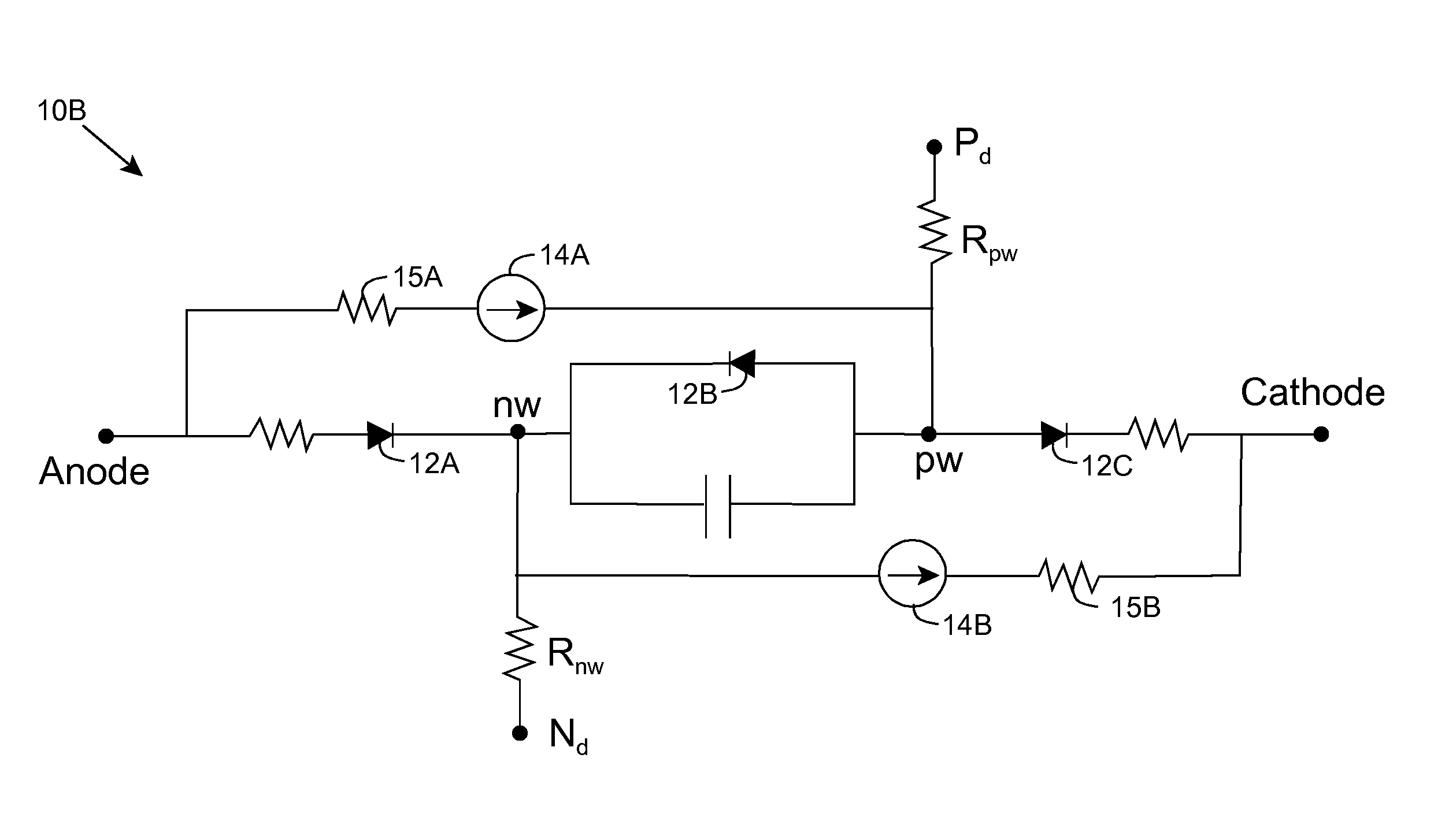
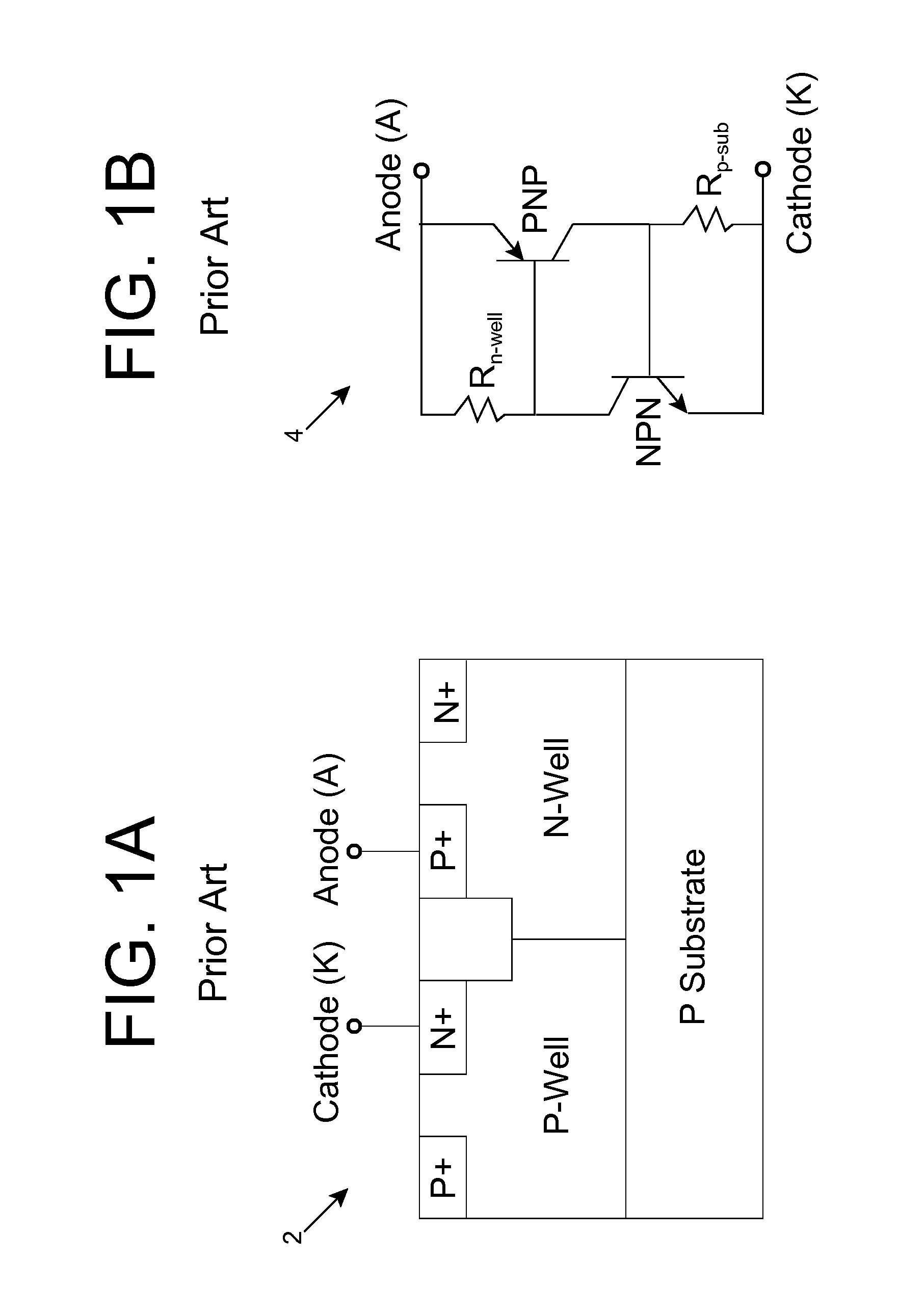
- A silicon controlled rectifier design featuring semiconductor regions with different conductivity types and a silicide layer, strategically located and doped to achieve a low trigger voltage and reduced capacitance, suitable for high-frequency applications.


Silicon controlled rectifier modeling
PatentInactiveUS8489378B2
Innovation
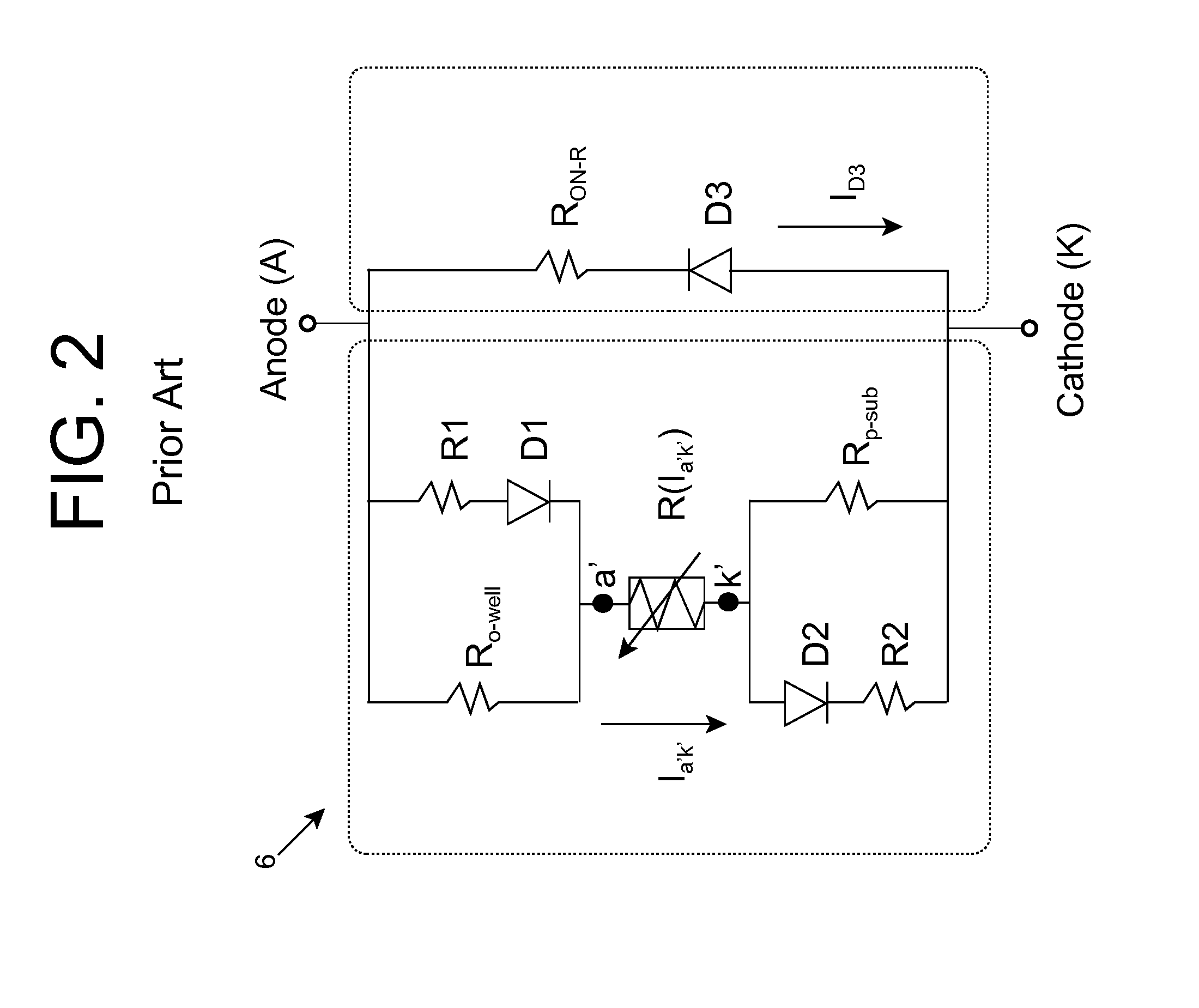
- A model comprising three diode models connected in series, with a reverse-biased middle diode, simulating DC operation of junctions in SCRs, and using current-controlled voltage sources with smoothing functions to capture snapback and high current turn-on characteristics, allowing for reduced measurement and parameter extraction efforts.

EMI Standards for High-Frequency Power Electronics
Electromagnetic interference (EMI) standards for high-frequency power electronics have become increasingly critical as switching frequencies in power conversion systems continue to rise. The comparison between Silicon Controlled Rectifiers (SCRs) and Diacs in frequency response characteristics directly impacts EMI compliance, particularly in applications operating above 150 kHz where conducted emissions regulations become stringent.
Current EMI standards governing high-frequency power electronics are primarily defined by CISPR 11, CISPR 22, and FCC Part 15, which establish limits for both conducted and radiated emissions. These standards specify measurement procedures using Line Impedance Stabilization Networks (LISNs) and define frequency ranges from 150 kHz to 30 MHz for conducted emissions, and 30 MHz to 1 GHz for radiated emissions. The standards also mandate specific measurement bandwidths and detector functions for accurate assessment.
The frequency response differences between SCRs and Diacs significantly influence EMI generation patterns. SCRs exhibit controlled turn-on characteristics with gate triggering, allowing for precise timing control that can minimize high-frequency harmonics. However, their turn-off behavior is governed by current zero-crossing, which can create abrupt current transitions and associated EMI. Diacs, being bidirectional trigger devices, demonstrate symmetrical switching characteristics but generate broader frequency spectra due to their avalanche breakdown mechanism.
Compliance testing for devices incorporating these components requires adherence to specific measurement protocols. The standards mandate the use of calibrated EMI receivers with quasi-peak and average detectors, positioned at standardized distances from the device under test. Pre-compliance testing often utilizes spectrum analyzers with appropriate correction factors, while final compliance verification must employ certified EMI test facilities meeting ANSI C63.4 or CISPR 16 requirements.
Filter design considerations for EMI mitigation differ substantially between SCR and Diac-based circuits. SCR applications typically require common-mode chokes and Y-capacitors to address the asymmetrical noise characteristics, while Diac circuits benefit from differential-mode filtering due to their symmetrical operation. The selection of filter components must account for the specific frequency response characteristics of each device type to achieve optimal EMI suppression while maintaining circuit functionality.
Current EMI standards governing high-frequency power electronics are primarily defined by CISPR 11, CISPR 22, and FCC Part 15, which establish limits for both conducted and radiated emissions. These standards specify measurement procedures using Line Impedance Stabilization Networks (LISNs) and define frequency ranges from 150 kHz to 30 MHz for conducted emissions, and 30 MHz to 1 GHz for radiated emissions. The standards also mandate specific measurement bandwidths and detector functions for accurate assessment.
The frequency response differences between SCRs and Diacs significantly influence EMI generation patterns. SCRs exhibit controlled turn-on characteristics with gate triggering, allowing for precise timing control that can minimize high-frequency harmonics. However, their turn-off behavior is governed by current zero-crossing, which can create abrupt current transitions and associated EMI. Diacs, being bidirectional trigger devices, demonstrate symmetrical switching characteristics but generate broader frequency spectra due to their avalanche breakdown mechanism.
Compliance testing for devices incorporating these components requires adherence to specific measurement protocols. The standards mandate the use of calibrated EMI receivers with quasi-peak and average detectors, positioned at standardized distances from the device under test. Pre-compliance testing often utilizes spectrum analyzers with appropriate correction factors, while final compliance verification must employ certified EMI test facilities meeting ANSI C63.4 or CISPR 16 requirements.
Filter design considerations for EMI mitigation differ substantially between SCR and Diac-based circuits. SCR applications typically require common-mode chokes and Y-capacitors to address the asymmetrical noise characteristics, while Diac circuits benefit from differential-mode filtering due to their symmetrical operation. The selection of filter components must account for the specific frequency response characteristics of each device type to achieve optimal EMI suppression while maintaining circuit functionality.
Thermal Management in High-Speed Switching Applications
Thermal management represents a critical challenge in high-speed switching applications utilizing Silicon Controlled Rectifiers (SCRs) and Diacs, particularly when operating at elevated frequencies. The fundamental difference in switching characteristics between these devices directly impacts their thermal behavior and heat dissipation requirements.
SCRs exhibit superior thermal performance in high-frequency applications due to their controlled turn-on mechanism and lower switching losses. The gate-controlled triggering allows for precise timing control, reducing overlap losses during switching transitions. This controlled switching behavior results in more predictable heat generation patterns, enabling more effective thermal management strategies. The junction temperature rise in SCRs follows a more linear relationship with switching frequency, making thermal design calculations more straightforward.
Diacs present unique thermal challenges in high-speed switching scenarios due to their breakover voltage characteristics and bilateral switching nature. The avalanche-based triggering mechanism generates instantaneous current spikes that create localized heating effects. These thermal hotspots can lead to thermal runaway conditions if not properly managed, particularly at frequencies above 10 kHz where switching losses become dominant.
Heat dissipation strategies differ significantly between the two devices. SCR-based systems typically employ conventional heat sinking approaches with thermal interface materials optimized for steady-state heat transfer. The predictable power dissipation patterns allow for standard thermal resistance calculations and heat sink sizing methodologies.
Advanced thermal management techniques for high-frequency Diac applications include active cooling systems, thermal spreading layers, and temperature-compensated biasing circuits. Copper-core substrates and embedded heat pipes have shown effectiveness in managing the transient thermal loads characteristic of Diac switching operations.
Junction temperature monitoring becomes crucial for both devices in high-speed applications. Temperature-sensitive parameter monitoring, such as forward voltage drop tracking for SCRs and breakover voltage monitoring for Diacs, provides real-time thermal feedback for protection systems.
Thermal cycling considerations also differ between the technologies. SCRs demonstrate better thermal cycling endurance due to more uniform current distribution, while Diacs require careful attention to thermal expansion matching between die and package materials to prevent mechanical stress-induced failures during rapid temperature transitions.
SCRs exhibit superior thermal performance in high-frequency applications due to their controlled turn-on mechanism and lower switching losses. The gate-controlled triggering allows for precise timing control, reducing overlap losses during switching transitions. This controlled switching behavior results in more predictable heat generation patterns, enabling more effective thermal management strategies. The junction temperature rise in SCRs follows a more linear relationship with switching frequency, making thermal design calculations more straightforward.
Diacs present unique thermal challenges in high-speed switching scenarios due to their breakover voltage characteristics and bilateral switching nature. The avalanche-based triggering mechanism generates instantaneous current spikes that create localized heating effects. These thermal hotspots can lead to thermal runaway conditions if not properly managed, particularly at frequencies above 10 kHz where switching losses become dominant.
Heat dissipation strategies differ significantly between the two devices. SCR-based systems typically employ conventional heat sinking approaches with thermal interface materials optimized for steady-state heat transfer. The predictable power dissipation patterns allow for standard thermal resistance calculations and heat sink sizing methodologies.
Advanced thermal management techniques for high-frequency Diac applications include active cooling systems, thermal spreading layers, and temperature-compensated biasing circuits. Copper-core substrates and embedded heat pipes have shown effectiveness in managing the transient thermal loads characteristic of Diac switching operations.
Junction temperature monitoring becomes crucial for both devices in high-speed applications. Temperature-sensitive parameter monitoring, such as forward voltage drop tracking for SCRs and breakover voltage monitoring for Diacs, provides real-time thermal feedback for protection systems.
Thermal cycling considerations also differ between the technologies. SCRs demonstrate better thermal cycling endurance due to more uniform current distribution, while Diacs require careful attention to thermal expansion matching between die and package materials to prevent mechanical stress-induced failures during rapid temperature transitions.
Unlock deeper insights with PatSnap Eureka Quick Research — get a full tech report to explore trends and direct your research. Try now!
Generate Your Research Report Instantly with AI Agent
Supercharge your innovation with PatSnap Eureka AI Agent Platform!