
Silicon Controlled Rectifier vs Diode: Conductance Rate
MAR 13, 20269 MIN READ
Generate Your Research Report Instantly with AI Agent
Patsnap Eureka helps you evaluate technical feasibility & market potential.
SCR vs Diode Conductance Background and Objectives
Silicon Controlled Rectifiers and conventional diodes represent two fundamental semiconductor technologies that have shaped power electronics development since the mid-20th century. Both devices serve as critical components in power conversion, control systems, and electronic switching applications, yet they exhibit distinctly different conductance characteristics that determine their suitability for specific applications.
The evolution of semiconductor technology began with the development of basic PN junction diodes in the 1940s, which provided unidirectional current flow capabilities. The subsequent introduction of SCRs in the 1950s marked a significant advancement, offering controllable switching functionality through the addition of a gate terminal to the traditional diode structure. This innovation enabled precise timing control over power delivery in various industrial and consumer applications.
Conductance rate comparison between SCRs and diodes has emerged as a critical research area due to the increasing demand for efficient power management solutions in modern electronics. The fundamental difference lies in their switching mechanisms: diodes conduct immediately when forward-biased, while SCRs require both forward bias and gate trigger signals to initiate conduction. This distinction significantly impacts their respective conductance rates and switching speeds.
Current technological objectives focus on optimizing the trade-off between switching speed and power handling capability in both device types. For diodes, research emphasizes reducing forward voltage drop and minimizing reverse recovery time to enhance overall conductance performance. Meanwhile, SCR development targets faster turn-on times while maintaining robust gate sensitivity and thermal stability.
The growing adoption of renewable energy systems, electric vehicles, and smart grid technologies has intensified the need for comprehensive understanding of conductance rate characteristics. These applications demand precise control over power flow timing and efficiency, making the selection between SCRs and diodes increasingly critical for system performance optimization.
Modern research initiatives aim to establish standardized methodologies for conductance rate measurement and comparison, enabling engineers to make informed decisions based on quantitative performance metrics rather than theoretical specifications alone.
The evolution of semiconductor technology began with the development of basic PN junction diodes in the 1940s, which provided unidirectional current flow capabilities. The subsequent introduction of SCRs in the 1950s marked a significant advancement, offering controllable switching functionality through the addition of a gate terminal to the traditional diode structure. This innovation enabled precise timing control over power delivery in various industrial and consumer applications.
Conductance rate comparison between SCRs and diodes has emerged as a critical research area due to the increasing demand for efficient power management solutions in modern electronics. The fundamental difference lies in their switching mechanisms: diodes conduct immediately when forward-biased, while SCRs require both forward bias and gate trigger signals to initiate conduction. This distinction significantly impacts their respective conductance rates and switching speeds.
Current technological objectives focus on optimizing the trade-off between switching speed and power handling capability in both device types. For diodes, research emphasizes reducing forward voltage drop and minimizing reverse recovery time to enhance overall conductance performance. Meanwhile, SCR development targets faster turn-on times while maintaining robust gate sensitivity and thermal stability.
The growing adoption of renewable energy systems, electric vehicles, and smart grid technologies has intensified the need for comprehensive understanding of conductance rate characteristics. These applications demand precise control over power flow timing and efficiency, making the selection between SCRs and diodes increasingly critical for system performance optimization.
Modern research initiatives aim to establish standardized methodologies for conductance rate measurement and comparison, enabling engineers to make informed decisions based on quantitative performance metrics rather than theoretical specifications alone.
Market Demand for High-Speed Switching Semiconductors
The semiconductor industry is experiencing unprecedented demand for high-speed switching devices, driven by the rapid expansion of power electronics applications across multiple sectors. This surge in demand stems from the critical need to improve energy efficiency, reduce power losses, and enhance system performance in modern electronic systems. The transition toward renewable energy systems, electric vehicles, and advanced industrial automation has created substantial market opportunities for semiconductors capable of operating at high frequencies with minimal switching losses.
Power management applications represent the largest segment driving demand for high-speed switching semiconductors. Data centers, which consume significant global electricity, require efficient power conversion systems to minimize energy waste and operational costs. The proliferation of cloud computing, artificial intelligence, and cryptocurrency mining has intensified the need for power supplies that can operate at higher switching frequencies while maintaining thermal stability and reliability.
The automotive sector has emerged as a transformative force in semiconductor demand, particularly with the accelerated adoption of electric and hybrid vehicles. Modern automotive systems require sophisticated power management for battery charging, motor control, and onboard electronics. High-speed switching capabilities enable more compact and efficient power conversion systems, directly impacting vehicle range, charging speed, and overall performance. Advanced driver assistance systems and autonomous driving technologies further amplify the demand for precise, fast-responding semiconductor devices.
Industrial automation and motor drive applications constitute another significant demand driver. Manufacturing facilities increasingly rely on variable frequency drives and servo systems that require rapid switching capabilities to achieve precise control and energy efficiency. The Industry 4.0 revolution has accelerated the adoption of smart manufacturing technologies, creating sustained demand for high-performance switching semiconductors.
Telecommunications infrastructure, particularly the deployment of 5G networks and edge computing systems, requires power-efficient solutions capable of handling dynamic load conditions. Base stations and network equipment must operate reliably while minimizing power consumption, driving demand for semiconductors with superior switching characteristics.
The consumer electronics market continues to push for smaller, more efficient devices with extended battery life. Smartphones, laptops, and portable devices require compact power management solutions that can deliver high efficiency across varying load conditions. Fast charging technologies and wireless power transfer systems further emphasize the importance of high-speed switching capabilities.
Market growth is also supported by regulatory initiatives promoting energy efficiency and carbon reduction. Government policies worldwide are establishing stricter efficiency standards for electronic devices and industrial equipment, compelling manufacturers to adopt advanced semiconductor technologies that can meet these requirements while maintaining cost competitiveness.
Power management applications represent the largest segment driving demand for high-speed switching semiconductors. Data centers, which consume significant global electricity, require efficient power conversion systems to minimize energy waste and operational costs. The proliferation of cloud computing, artificial intelligence, and cryptocurrency mining has intensified the need for power supplies that can operate at higher switching frequencies while maintaining thermal stability and reliability.
The automotive sector has emerged as a transformative force in semiconductor demand, particularly with the accelerated adoption of electric and hybrid vehicles. Modern automotive systems require sophisticated power management for battery charging, motor control, and onboard electronics. High-speed switching capabilities enable more compact and efficient power conversion systems, directly impacting vehicle range, charging speed, and overall performance. Advanced driver assistance systems and autonomous driving technologies further amplify the demand for precise, fast-responding semiconductor devices.
Industrial automation and motor drive applications constitute another significant demand driver. Manufacturing facilities increasingly rely on variable frequency drives and servo systems that require rapid switching capabilities to achieve precise control and energy efficiency. The Industry 4.0 revolution has accelerated the adoption of smart manufacturing technologies, creating sustained demand for high-performance switching semiconductors.
Telecommunications infrastructure, particularly the deployment of 5G networks and edge computing systems, requires power-efficient solutions capable of handling dynamic load conditions. Base stations and network equipment must operate reliably while minimizing power consumption, driving demand for semiconductors with superior switching characteristics.
The consumer electronics market continues to push for smaller, more efficient devices with extended battery life. Smartphones, laptops, and portable devices require compact power management solutions that can deliver high efficiency across varying load conditions. Fast charging technologies and wireless power transfer systems further emphasize the importance of high-speed switching capabilities.
Market growth is also supported by regulatory initiatives promoting energy efficiency and carbon reduction. Government policies worldwide are establishing stricter efficiency standards for electronic devices and industrial equipment, compelling manufacturers to adopt advanced semiconductor technologies that can meet these requirements while maintaining cost competitiveness.
Current SCR and Diode Conductance Performance Status
Silicon Controlled Rectifiers and conventional diodes exhibit fundamentally different conductance characteristics due to their distinct structural designs and operational mechanisms. Current performance analysis reveals that standard silicon diodes typically achieve forward voltage drops ranging from 0.7V to 1.2V under normal operating conditions, with conductance values varying from 10 to 100 siemens depending on current density and junction temperature.
SCRs demonstrate a unique three-state conductance profile that distinguishes them from traditional diodes. In the blocking state, SCRs maintain extremely low conductance levels, typically in the microsiemens range, effectively preventing current flow until triggered. Once activated through gate triggering, SCRs transition to a high-conductance state with forward voltage drops comparable to standard diodes, usually between 1.0V and 1.8V depending on device specifications and current levels.
Modern high-performance diodes, particularly Schottky barrier diodes, achieve superior conductance rates with forward voltage drops as low as 0.3V to 0.5V, resulting in significantly higher conductance values. These devices demonstrate rapid switching characteristics with minimal reverse recovery time, making them suitable for high-frequency applications where conductance efficiency is critical.
Contemporary SCR technology has evolved to incorporate advanced semiconductor materials and optimized doping profiles, enabling improved conductance performance. Fast-switching SCRs now achieve turn-on times below 1 microsecond while maintaining robust current-handling capabilities exceeding 1000 amperes. The conductance rate during the on-state approaches that of equivalent-rated diodes, with some high-performance SCRs demonstrating forward voltage drops below 1.5V at rated current.
Temperature dependency significantly affects conductance performance in both device types. Silicon diodes typically exhibit negative temperature coefficients, with conductance increasing as temperature rises due to reduced forward voltage drop. SCRs display similar temperature characteristics but with additional complexity due to their multi-junction structure and gate control requirements.
Recent developments in wide-bandgap semiconductors have introduced silicon carbide and gallium nitride variants of both diodes and SCRs, offering enhanced conductance performance at elevated temperatures and frequencies. These advanced materials enable operation at higher current densities while maintaining superior conductance rates compared to traditional silicon-based devices.
Current measurement techniques utilize precision instrumentation capable of characterizing conductance across wide dynamic ranges, from blocking-state microsiemens levels to conducting-state values exceeding 1000 siemens. Advanced testing protocols now incorporate pulsed measurement methods to minimize self-heating effects and provide accurate conductance characterization under realistic operating conditions.
SCRs demonstrate a unique three-state conductance profile that distinguishes them from traditional diodes. In the blocking state, SCRs maintain extremely low conductance levels, typically in the microsiemens range, effectively preventing current flow until triggered. Once activated through gate triggering, SCRs transition to a high-conductance state with forward voltage drops comparable to standard diodes, usually between 1.0V and 1.8V depending on device specifications and current levels.
Modern high-performance diodes, particularly Schottky barrier diodes, achieve superior conductance rates with forward voltage drops as low as 0.3V to 0.5V, resulting in significantly higher conductance values. These devices demonstrate rapid switching characteristics with minimal reverse recovery time, making them suitable for high-frequency applications where conductance efficiency is critical.
Contemporary SCR technology has evolved to incorporate advanced semiconductor materials and optimized doping profiles, enabling improved conductance performance. Fast-switching SCRs now achieve turn-on times below 1 microsecond while maintaining robust current-handling capabilities exceeding 1000 amperes. The conductance rate during the on-state approaches that of equivalent-rated diodes, with some high-performance SCRs demonstrating forward voltage drops below 1.5V at rated current.
Temperature dependency significantly affects conductance performance in both device types. Silicon diodes typically exhibit negative temperature coefficients, with conductance increasing as temperature rises due to reduced forward voltage drop. SCRs display similar temperature characteristics but with additional complexity due to their multi-junction structure and gate control requirements.
Recent developments in wide-bandgap semiconductors have introduced silicon carbide and gallium nitride variants of both diodes and SCRs, offering enhanced conductance performance at elevated temperatures and frequencies. These advanced materials enable operation at higher current densities while maintaining superior conductance rates compared to traditional silicon-based devices.
Current measurement techniques utilize precision instrumentation capable of characterizing conductance across wide dynamic ranges, from blocking-state microsiemens levels to conducting-state values exceeding 1000 siemens. Advanced testing protocols now incorporate pulsed measurement methods to minimize self-heating effects and provide accurate conductance characterization under realistic operating conditions.
Existing Conductance Enhancement Solutions
01 SCR triggering and gate control circuits
Silicon controlled rectifiers require specific triggering mechanisms to initiate conduction. Gate control circuits are designed to provide precise triggering pulses that control the firing angle and conduction timing of the SCR. These circuits may include pulse generators, timing circuits, and isolation components to ensure reliable triggering while protecting the gate junction from excessive current or voltage.- SCR triggering and gate control circuits: Silicon controlled rectifiers require specific triggering mechanisms to initiate conduction. Gate control circuits are designed to provide precise triggering pulses that control the firing angle and conduction timing of the SCR. These circuits may include pulse generators, timing circuits, and isolation components to ensure reliable triggering while protecting the gate junction from excessive current or voltage.
- SCR and diode switching speed optimization: The conductance rate and switching characteristics of silicon controlled rectifiers and diodes can be improved through various structural and material modifications. Techniques include optimizing doping profiles, reducing carrier lifetime, and implementing specific junction geometries to achieve faster turn-on and turn-off times. These improvements are critical for high-frequency applications and reducing switching losses in power conversion systems.
- Protection circuits for SCR and diode devices: Protection mechanisms are essential for preventing damage to silicon controlled rectifiers and diodes during abnormal operating conditions. These circuits include overvoltage protection, overcurrent limiting, and snubber networks that control the rate of voltage and current change. Protection schemes help maintain device reliability and extend operational lifetime by preventing destructive failure modes such as thermal runaway or junction breakdown.
- Integrated SCR-diode structures and configurations: Integrated circuit designs combine silicon controlled rectifiers with diodes in various configurations to achieve specific functional characteristics. These structures may include anti-parallel connections, series-parallel arrangements, or monolithic integration on a single substrate. Such configurations enable improved power handling, bidirectional control, and enhanced thermal management while reducing component count and system complexity.
- Current conduction and voltage regulation in SCR-diode systems: The conductance characteristics of silicon controlled rectifiers and diodes determine their performance in voltage regulation and current control applications. Design considerations include forward voltage drop, holding current requirements, and dynamic resistance during conduction. Advanced designs incorporate feedback mechanisms and adaptive control to maintain stable operation across varying load conditions and temperature ranges, ensuring efficient power delivery and minimal losses.
02 SCR and diode switching speed optimization
The conductance rate and switching characteristics of silicon controlled rectifiers and diodes can be improved through various structural and material modifications. Techniques include optimizing doping profiles, reducing carrier lifetime, and implementing specific junction geometries to achieve faster turn-on and turn-off times. These improvements enable higher frequency operation and reduced switching losses in power electronic applications.Expand Specific Solutions03 Protection circuits for SCR and diode devices
Protection mechanisms are essential for preventing damage to silicon controlled rectifiers and diodes during abnormal operating conditions. These circuits include overvoltage protection, overcurrent limiting, and thermal management systems. Snubber circuits and voltage clamping devices are commonly employed to control voltage and current transients, ensuring device reliability and extending operational lifetime.Expand Specific Solutions04 Integrated SCR-diode structures and configurations
Integrated semiconductor structures combine silicon controlled rectifiers with diodes in various configurations to achieve specific circuit functions. These integrated designs may include anti-parallel connections, series arrangements, or monolithic integration on a single chip. Such configurations optimize space utilization, reduce parasitic effects, and improve overall system performance in power conversion and control applications.Expand Specific Solutions05 Current rating and thermal management for high-power devices
High-power silicon controlled rectifiers and diodes require careful consideration of current carrying capacity and heat dissipation. Design approaches include optimizing chip area, implementing advanced packaging techniques, and incorporating efficient thermal interfaces. Proper thermal management ensures that devices can handle rated currents while maintaining junction temperatures within safe operating limits, thereby maximizing conductance performance and device reliability.Expand Specific Solutions
Major Semiconductor Manufacturers and Market Leaders
The Silicon Controlled Rectifier (SCR) versus diode conductance rate technology represents a mature semiconductor market in its consolidation phase, with established global players dominating the landscape. The market demonstrates substantial scale, driven by power electronics applications across automotive, industrial automation, and energy infrastructure sectors. Technology maturity is evidenced by the presence of industry leaders including Texas Instruments, Infineon Technologies, STMicroelectronics, and Mitsubishi Electric, who possess decades of expertise in power semiconductor design and manufacturing. Asian manufacturers like Taiwan Semiconductor Manufacturing Company, ROHM, and Fuji Electric contribute significant foundry capabilities and specialized device production. The competitive landscape shows geographic diversification with strong representation from European firms like Infineon, Japanese companies including Sony and Nichia, and emerging Chinese players such as Silergy Semiconductor, indicating a globally distributed but technologically mature industry with incremental innovations focusing on efficiency improvements and integration capabilities.
Mitsubishi Electric Corp.
Technical Solution: Mitsubishi Electric specializes in high-power SCR and diode technologies with focus on conductance optimization for industrial applications. Their SCR devices feature advanced gate design that enables rapid conductance switching with minimal power loss during transition states. The company's comparative studies show that their SCRs achieve conductance rates 5-8 times higher than equivalent diode ratings when fully conducting, while their diode solutions maintain steady-state conductance with faster initial response times. Mitsubishi's power modules integrate both SCR and diode technologies to optimize overall system conductance, utilizing SCRs for main power paths and diodes for freewheeling and protection functions in power conversion applications.
Strengths: Excellent high-power device expertise with proven industrial applications and robust conductance performance. Weaknesses: Higher cost and complexity for applications where simple diode conductance characteristics are sufficient.
Stmicroelectronics Srl
Technical Solution: STMicroelectronics develops power semiconductor devices that address the conductance rate differences between SCRs and diodes through innovative device architectures. Their SCR solutions feature optimized doping profiles and advanced gate structures that enable rapid transition to high-conductance states, typically achieving 4-6 times higher current carrying capacity compared to equivalent diode structures. The company's research demonstrates that while diodes provide immediate conductance upon forward bias, SCRs offer superior conductance rates once triggered, making them ideal for high-current applications. Their power devices incorporate thermal management features that maintain optimal conductance characteristics across varying operating conditions.
Strengths: Strong power semiconductor portfolio with excellent thermal management and high-current handling capabilities. Weaknesses: SCR solutions require more complex control circuitry compared to straightforward diode implementations.
Core Patents in SCR Conductance Optimization
Rectifier with less conduction loss than a diode
PatentInactiveUS8232830B2
Innovation
- A rectifier design incorporating a semiconductor switching device with a parallel diode and self-drive control circuit that generates drive signals using the forward voltage between terminals, eliminating the need for external power and allowing continuous operation.


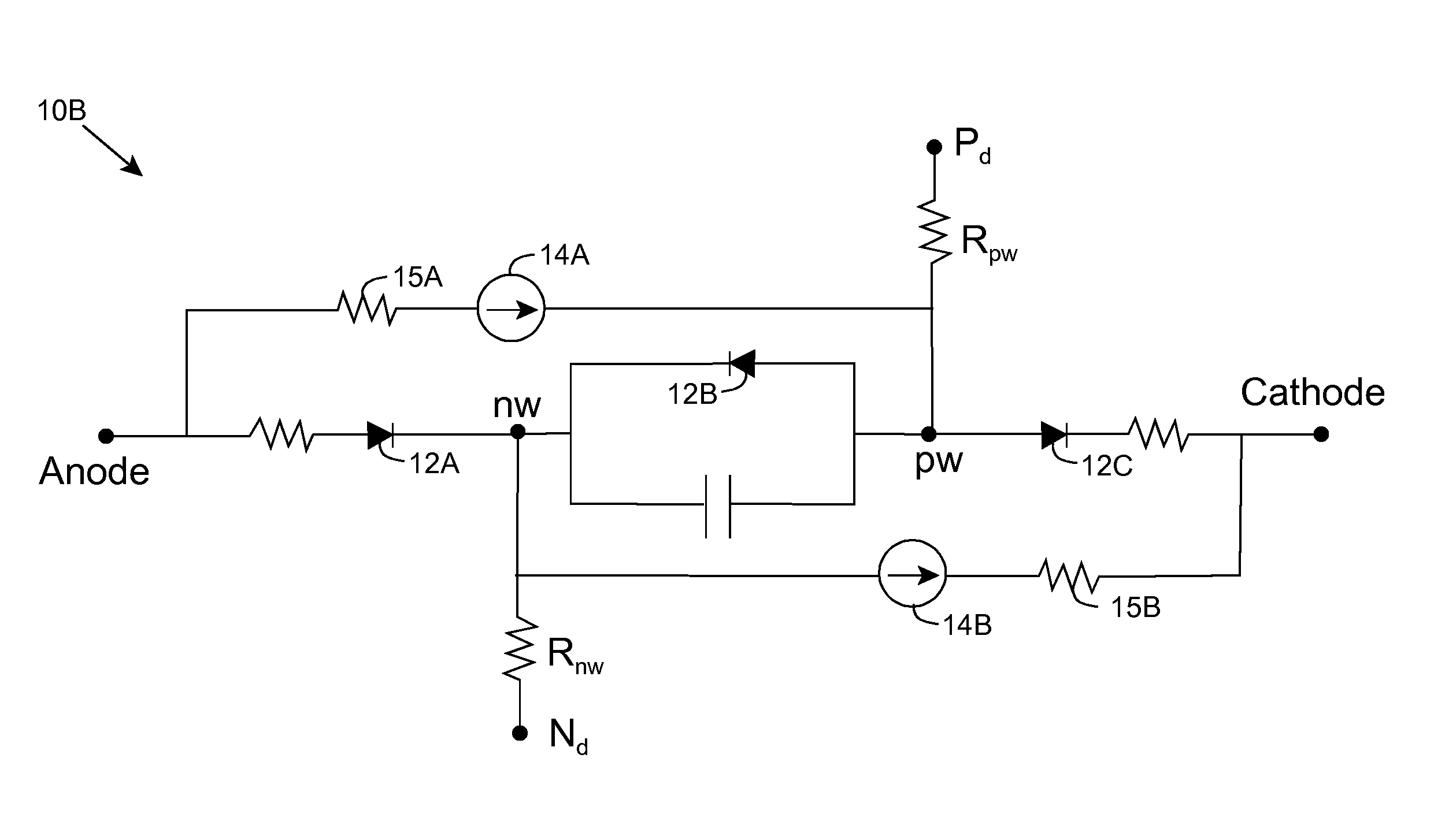
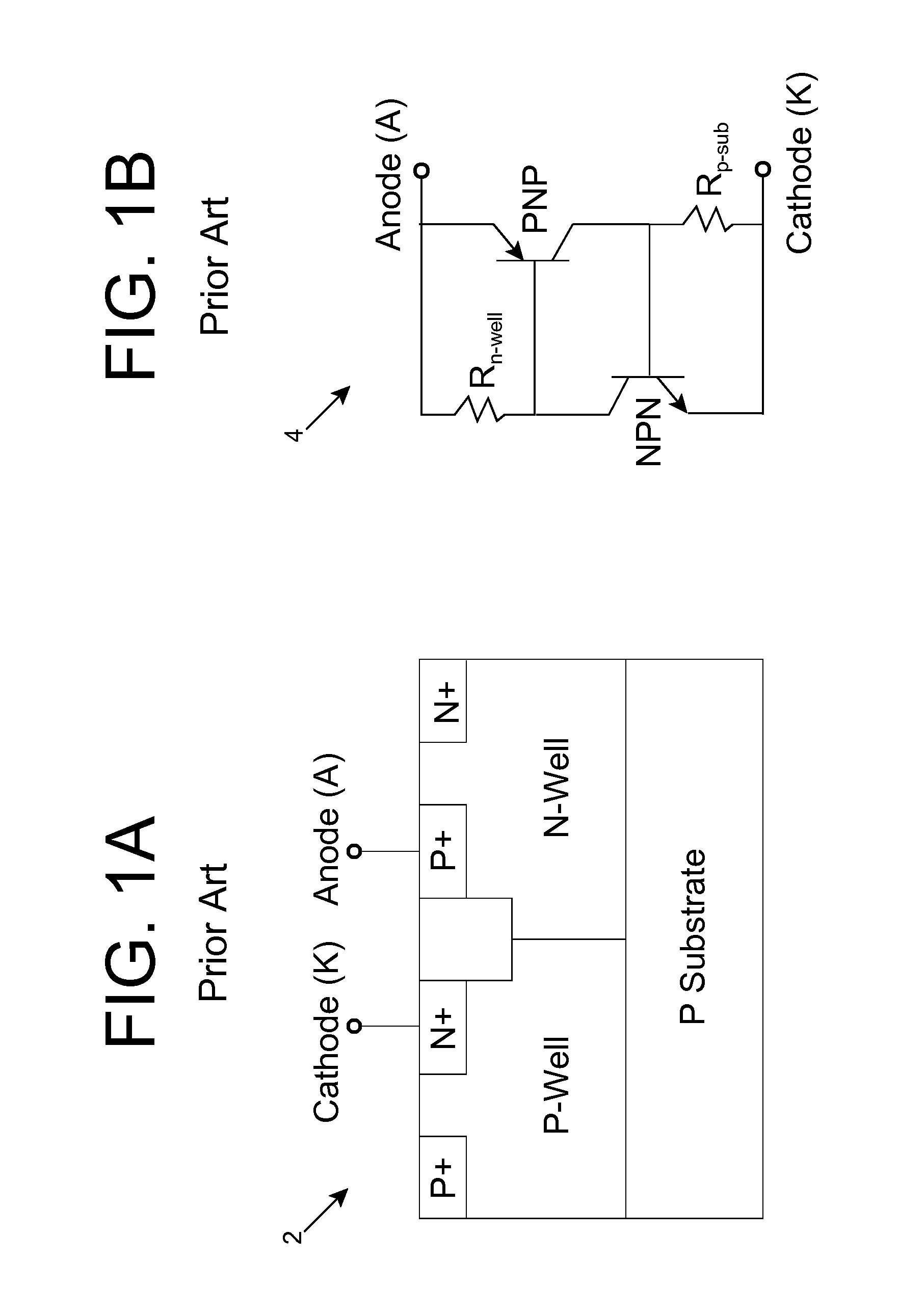
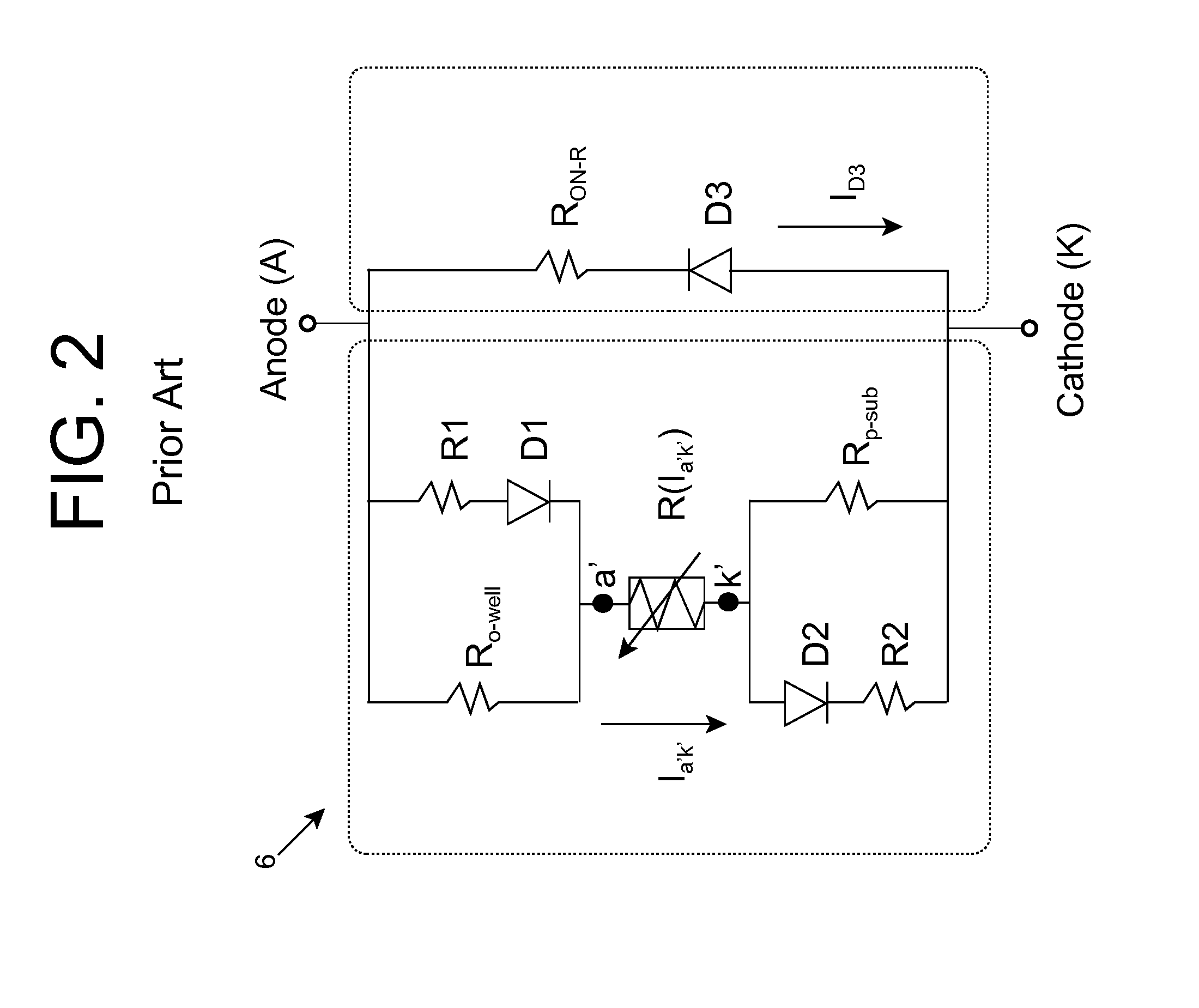
Silicon controlled rectifier modeling
PatentInactiveUS8489378B2
Innovation
- A model comprising three diode models connected in series, with a reverse-biased middle diode, simulating DC operation of junctions in SCRs, and using current-controlled voltage sources with smoothing functions to capture snapback and high current turn-on characteristics, allowing for reduced measurement and parameter extraction efforts.

Power Electronics Safety Standards and Regulations
The safety standards and regulations governing power electronics, particularly in applications involving Silicon Controlled Rectifiers (SCRs) and diodes, form a comprehensive framework designed to ensure reliable operation and protect both equipment and personnel. These standards address the unique characteristics of semiconductor switching devices, including their conductance behavior, thermal management, and failure modes.
International standards such as IEC 61000 series establish electromagnetic compatibility requirements for power electronic systems utilizing SCRs and diodes. These regulations specify conducted and radiated emission limits, ensuring that the switching characteristics of these devices do not interfere with other electronic systems. The IEC 60747 series specifically addresses semiconductor devices, defining safety requirements for discrete semiconductors including forward voltage drop specifications, surge current ratings, and thermal derating guidelines.
UL 508A and IEC 61800 series standards govern industrial control panels and adjustable speed electrical power drive systems respectively. These regulations mandate specific protection schemes for SCR-based motor drives and rectifier circuits, including overcurrent protection, ground fault detection, and safe torque-off functionality. The standards require comprehensive testing of conductance characteristics under various operating conditions to ensure predictable behavior during normal and fault scenarios.
IEEE 519 establishes harmonic distortion limits for power electronic equipment, directly impacting SCR and diode rectifier design. The standard requires harmonic analysis considering the non-linear conductance characteristics of these devices, particularly during commutation periods. Compliance testing must demonstrate that total harmonic distortion remains within specified limits across the full operating range.
Functional safety standards including IEC 61508 and ISO 13849 apply to safety-critical applications using SCRs and diodes. These standards mandate systematic hazard analysis, considering failure modes such as short-circuit failures in SCRs or reverse recovery failures in fast-switching diodes. Safety integrity levels must be achieved through redundant protection circuits and diagnostic coverage of critical parameters including forward voltage monitoring and thermal protection.
Regional regulations such as CE marking requirements in Europe and FCC Part 15 in North America impose additional compliance obligations. These regulations require extensive documentation of device characteristics, including detailed conductance specifications, thermal performance data, and electromagnetic compatibility test results for market approval.
International standards such as IEC 61000 series establish electromagnetic compatibility requirements for power electronic systems utilizing SCRs and diodes. These regulations specify conducted and radiated emission limits, ensuring that the switching characteristics of these devices do not interfere with other electronic systems. The IEC 60747 series specifically addresses semiconductor devices, defining safety requirements for discrete semiconductors including forward voltage drop specifications, surge current ratings, and thermal derating guidelines.
UL 508A and IEC 61800 series standards govern industrial control panels and adjustable speed electrical power drive systems respectively. These regulations mandate specific protection schemes for SCR-based motor drives and rectifier circuits, including overcurrent protection, ground fault detection, and safe torque-off functionality. The standards require comprehensive testing of conductance characteristics under various operating conditions to ensure predictable behavior during normal and fault scenarios.
IEEE 519 establishes harmonic distortion limits for power electronic equipment, directly impacting SCR and diode rectifier design. The standard requires harmonic analysis considering the non-linear conductance characteristics of these devices, particularly during commutation periods. Compliance testing must demonstrate that total harmonic distortion remains within specified limits across the full operating range.
Functional safety standards including IEC 61508 and ISO 13849 apply to safety-critical applications using SCRs and diodes. These standards mandate systematic hazard analysis, considering failure modes such as short-circuit failures in SCRs or reverse recovery failures in fast-switching diodes. Safety integrity levels must be achieved through redundant protection circuits and diagnostic coverage of critical parameters including forward voltage monitoring and thermal protection.
Regional regulations such as CE marking requirements in Europe and FCC Part 15 in North America impose additional compliance obligations. These regulations require extensive documentation of device characteristics, including detailed conductance specifications, thermal performance data, and electromagnetic compatibility test results for market approval.
Thermal Management in High-Conductance Applications
Thermal management represents a critical engineering challenge when comparing Silicon Controlled Rectifiers (SCRs) and diodes in high-conductance applications. The fundamental difference in their conduction mechanisms directly impacts heat generation patterns and thermal dissipation requirements. SCRs, with their three-junction structure, exhibit higher forward voltage drops compared to conventional diodes, typically ranging from 1.2V to 2.0V versus 0.7V to 1.2V for standard silicon diodes. This voltage differential translates to significantly increased power dissipation during conduction phases.
The thermal characteristics of SCRs become particularly pronounced in high-current applications where conductance rates exceed several hundred amperes. Unlike diodes that maintain relatively consistent thermal profiles during continuous operation, SCRs experience thermal cycling due to their switching nature. This cycling creates thermal stress concentrations at junction interfaces, requiring sophisticated heat sink designs and thermal interface materials to maintain junction temperatures below critical thresholds of 125°C to 150°C.
Advanced thermal management strategies for high-conductance SCR applications incorporate multi-layer heat spreading techniques, including copper base plates with thermal conductivities exceeding 400 W/mK and direct liquid cooling systems. Phase change materials are increasingly employed to buffer thermal transients during switching operations. Thermal resistance calculations must account for the SCR's larger die size compared to equivalent-rated diodes, typically 30% to 50% larger, which affects both heat generation density and dissipation surface area.
Modern high-power applications utilize thermal monitoring systems with embedded temperature sensors and predictive algorithms to optimize switching frequencies and prevent thermal runaway conditions. These systems enable dynamic thermal management, adjusting operational parameters based on real-time junction temperature measurements. The integration of wide-bandgap materials in next-generation devices promises improved thermal performance, with silicon carbide variants demonstrating superior thermal conductivity and higher operating temperature tolerances compared to traditional silicon-based components.
The thermal characteristics of SCRs become particularly pronounced in high-current applications where conductance rates exceed several hundred amperes. Unlike diodes that maintain relatively consistent thermal profiles during continuous operation, SCRs experience thermal cycling due to their switching nature. This cycling creates thermal stress concentrations at junction interfaces, requiring sophisticated heat sink designs and thermal interface materials to maintain junction temperatures below critical thresholds of 125°C to 150°C.
Advanced thermal management strategies for high-conductance SCR applications incorporate multi-layer heat spreading techniques, including copper base plates with thermal conductivities exceeding 400 W/mK and direct liquid cooling systems. Phase change materials are increasingly employed to buffer thermal transients during switching operations. Thermal resistance calculations must account for the SCR's larger die size compared to equivalent-rated diodes, typically 30% to 50% larger, which affects both heat generation density and dissipation surface area.
Modern high-power applications utilize thermal monitoring systems with embedded temperature sensors and predictive algorithms to optimize switching frequencies and prevent thermal runaway conditions. These systems enable dynamic thermal management, adjusting operational parameters based on real-time junction temperature measurements. The integration of wide-bandgap materials in next-generation devices promises improved thermal performance, with silicon carbide variants demonstrating superior thermal conductivity and higher operating temperature tolerances compared to traditional silicon-based components.
Unlock deeper insights with Patsnap Eureka Quick Research — get a full tech report to explore trends and direct your research. Try now!
Generate Your Research Report Instantly with AI Agent
Supercharge your innovation with Patsnap Eureka AI Agent Platform!