
Sulfide Electrolytes vs Liquid: Conductivity Analysis
APR 13, 20269 MIN READ
Generate Your Research Report Instantly with AI Agent
Patsnap Eureka helps you evaluate technical feasibility & market potential.
Sulfide Electrolyte Development Background and Objectives
Sulfide electrolytes represent a critical advancement in solid-state battery technology, emerging from decades of research aimed at overcoming the fundamental limitations of conventional liquid electrolyte systems. The development of these materials traces back to the early 1980s when researchers first identified the potential of sulfide-based compounds to conduct lithium ions in solid form. This breakthrough opened new possibilities for creating safer, more energy-dense battery systems that could operate without the flammability risks associated with organic liquid electrolytes.
The evolution of sulfide electrolytes has been driven by the increasing demand for high-performance energy storage solutions across multiple sectors, particularly in electric vehicles, portable electronics, and grid-scale energy storage. Traditional liquid electrolyte batteries face inherent safety concerns due to their volatile and flammable nature, thermal instability, and potential for electrolyte leakage. These limitations have created an urgent need for solid-state alternatives that can maintain high ionic conductivity while eliminating safety risks.
The primary objective of sulfide electrolyte development centers on achieving ionic conductivity levels comparable to or exceeding those of liquid electrolytes, which typically range from 1-10 mS/cm at room temperature. Early sulfide materials showed promising but insufficient conductivity levels, prompting extensive research into compositional optimization and structural engineering. The breakthrough came with the development of argyrodite-type and LGPS-type sulfide electrolytes, which demonstrated conductivities approaching 10^-2 S/cm.
Current research objectives focus on addressing several key challenges that limit the practical implementation of sulfide electrolytes. These include improving chemical stability against lithium metal anodes, enhancing mechanical properties for processing and handling, and developing cost-effective synthesis methods for large-scale production. Additionally, researchers aim to optimize the interface compatibility between sulfide electrolytes and electrode materials to minimize interfacial resistance.
The strategic importance of sulfide electrolyte development extends beyond mere performance improvements. These materials represent a pathway toward next-generation battery architectures that could enable significantly higher energy densities, faster charging capabilities, and extended operational lifespans. The technology promises to unlock new applications in aerospace, medical devices, and extreme environment operations where traditional liquid electrolyte systems prove inadequate.
Future development trajectories emphasize the integration of advanced characterization techniques, computational modeling, and high-throughput screening methods to accelerate material discovery and optimization processes.
The evolution of sulfide electrolytes has been driven by the increasing demand for high-performance energy storage solutions across multiple sectors, particularly in electric vehicles, portable electronics, and grid-scale energy storage. Traditional liquid electrolyte batteries face inherent safety concerns due to their volatile and flammable nature, thermal instability, and potential for electrolyte leakage. These limitations have created an urgent need for solid-state alternatives that can maintain high ionic conductivity while eliminating safety risks.
The primary objective of sulfide electrolyte development centers on achieving ionic conductivity levels comparable to or exceeding those of liquid electrolytes, which typically range from 1-10 mS/cm at room temperature. Early sulfide materials showed promising but insufficient conductivity levels, prompting extensive research into compositional optimization and structural engineering. The breakthrough came with the development of argyrodite-type and LGPS-type sulfide electrolytes, which demonstrated conductivities approaching 10^-2 S/cm.
Current research objectives focus on addressing several key challenges that limit the practical implementation of sulfide electrolytes. These include improving chemical stability against lithium metal anodes, enhancing mechanical properties for processing and handling, and developing cost-effective synthesis methods for large-scale production. Additionally, researchers aim to optimize the interface compatibility between sulfide electrolytes and electrode materials to minimize interfacial resistance.
The strategic importance of sulfide electrolyte development extends beyond mere performance improvements. These materials represent a pathway toward next-generation battery architectures that could enable significantly higher energy densities, faster charging capabilities, and extended operational lifespans. The technology promises to unlock new applications in aerospace, medical devices, and extreme environment operations where traditional liquid electrolyte systems prove inadequate.
Future development trajectories emphasize the integration of advanced characterization techniques, computational modeling, and high-throughput screening methods to accelerate material discovery and optimization processes.
Market Demand for Advanced Battery Electrolyte Solutions
The global battery electrolyte market is experiencing unprecedented growth driven by the rapid expansion of electric vehicles, energy storage systems, and portable electronics. Traditional liquid electrolytes have dominated the market for decades, but emerging safety concerns, energy density limitations, and performance requirements are creating substantial demand for advanced electrolyte solutions. The automotive industry's transition toward electrification represents the largest growth driver, with manufacturers seeking electrolytes that can deliver higher energy density, improved safety profiles, and enhanced thermal stability.
Sulfide-based solid electrolytes are emerging as a critical technology to address these market demands. The superior ionic conductivity of sulfide electrolytes, often exceeding that of conventional liquid electrolytes, positions them as a transformative solution for next-generation battery applications. This conductivity advantage directly translates to improved battery performance, faster charging capabilities, and enhanced power delivery, which are essential requirements for electric vehicle manufacturers and grid-scale energy storage providers.
The consumer electronics sector continues to drive demand for compact, high-performance batteries where electrolyte conductivity plays a crucial role in device miniaturization and extended operational life. Sulfide electrolytes offer the potential to enable thinner battery designs while maintaining or improving performance metrics, addressing the industry's ongoing pursuit of lighter and more efficient portable devices.
Industrial applications, particularly in aerospace and medical devices, are creating niche but high-value market segments for advanced electrolyte solutions. These applications demand exceptional reliability, wide operating temperature ranges, and long-term stability characteristics that sulfide electrolytes can potentially deliver through their solid-state nature and superior conductivity properties.
The energy storage market for renewable energy integration represents another significant demand driver. Grid-scale battery systems require electrolytes that can maintain consistent performance across thousands of charge-discharge cycles while operating in varying environmental conditions. The enhanced conductivity and thermal stability of sulfide electrolytes make them attractive candidates for these demanding applications.
Market demand is also being shaped by regulatory pressures and safety standards that favor solid-state electrolyte technologies. The elimination of flammable liquid components addresses critical safety concerns while the superior conductivity ensures that performance standards are not compromised in the transition to safer battery technologies.
Sulfide-based solid electrolytes are emerging as a critical technology to address these market demands. The superior ionic conductivity of sulfide electrolytes, often exceeding that of conventional liquid electrolytes, positions them as a transformative solution for next-generation battery applications. This conductivity advantage directly translates to improved battery performance, faster charging capabilities, and enhanced power delivery, which are essential requirements for electric vehicle manufacturers and grid-scale energy storage providers.
The consumer electronics sector continues to drive demand for compact, high-performance batteries where electrolyte conductivity plays a crucial role in device miniaturization and extended operational life. Sulfide electrolytes offer the potential to enable thinner battery designs while maintaining or improving performance metrics, addressing the industry's ongoing pursuit of lighter and more efficient portable devices.
Industrial applications, particularly in aerospace and medical devices, are creating niche but high-value market segments for advanced electrolyte solutions. These applications demand exceptional reliability, wide operating temperature ranges, and long-term stability characteristics that sulfide electrolytes can potentially deliver through their solid-state nature and superior conductivity properties.
The energy storage market for renewable energy integration represents another significant demand driver. Grid-scale battery systems require electrolytes that can maintain consistent performance across thousands of charge-discharge cycles while operating in varying environmental conditions. The enhanced conductivity and thermal stability of sulfide electrolytes make them attractive candidates for these demanding applications.
Market demand is also being shaped by regulatory pressures and safety standards that favor solid-state electrolyte technologies. The elimination of flammable liquid components addresses critical safety concerns while the superior conductivity ensures that performance standards are not compromised in the transition to safer battery technologies.
Current Status and Challenges of Sulfide vs Liquid Electrolytes
Sulfide electrolytes have emerged as promising candidates for next-generation solid-state batteries, demonstrating remarkable ionic conductivity that rivals conventional liquid electrolytes. Leading sulfide materials such as Li10GeP2S12 (LGPS) and Li6PS5Cl achieve conductivities exceeding 10^-2 S/cm at room temperature, approaching the performance levels of organic liquid electrolytes. However, these materials face significant stability challenges when interfacing with lithium metal anodes and high-voltage cathodes.
The current technological landscape reveals distinct advantages and limitations for each electrolyte type. Liquid electrolytes maintain superior wetting properties and established manufacturing processes, enabling intimate contact with electrode materials and facilitating ion transport across interfaces. Their conductivity typically ranges from 10^-3 to 10^-2 S/cm, with well-understood temperature dependencies and electrochemical windows.
Sulfide electrolytes exhibit exceptional bulk ionic conductivity due to their unique crystal structures and favorable lithium ion migration pathways. The three-dimensional framework in materials like LGPS provides multiple conduction channels, while argyrodite-type compounds offer tunable compositions for optimized performance. Nevertheless, these materials suffer from narrow electrochemical stability windows, typically limited to 1.7-2.1V versus Li/Li+.
Interface engineering represents a critical challenge for sulfide electrolytes. Chemical reactions at electrode interfaces lead to the formation of resistive interphases, significantly impacting overall cell performance. Space charge effects and mechanical contact issues further complicate the implementation of sulfide-based systems, requiring sophisticated coating strategies and buffer layers.
Manufacturing scalability poses another significant hurdle for sulfide electrolytes. Current synthesis methods involve high-temperature processing and controlled atmosphere requirements, contrasting with the mature production infrastructure available for liquid electrolyte systems. The moisture sensitivity of sulfide materials necessitates stringent handling protocols, increasing production complexity and costs.
Recent developments focus on compositional modifications and surface treatments to enhance sulfide electrolyte stability. Halide substitutions in argyrodite structures and oxide coating applications show promise for expanding electrochemical windows while maintaining high conductivity levels.
The current technological landscape reveals distinct advantages and limitations for each electrolyte type. Liquid electrolytes maintain superior wetting properties and established manufacturing processes, enabling intimate contact with electrode materials and facilitating ion transport across interfaces. Their conductivity typically ranges from 10^-3 to 10^-2 S/cm, with well-understood temperature dependencies and electrochemical windows.
Sulfide electrolytes exhibit exceptional bulk ionic conductivity due to their unique crystal structures and favorable lithium ion migration pathways. The three-dimensional framework in materials like LGPS provides multiple conduction channels, while argyrodite-type compounds offer tunable compositions for optimized performance. Nevertheless, these materials suffer from narrow electrochemical stability windows, typically limited to 1.7-2.1V versus Li/Li+.
Interface engineering represents a critical challenge for sulfide electrolytes. Chemical reactions at electrode interfaces lead to the formation of resistive interphases, significantly impacting overall cell performance. Space charge effects and mechanical contact issues further complicate the implementation of sulfide-based systems, requiring sophisticated coating strategies and buffer layers.
Manufacturing scalability poses another significant hurdle for sulfide electrolytes. Current synthesis methods involve high-temperature processing and controlled atmosphere requirements, contrasting with the mature production infrastructure available for liquid electrolyte systems. The moisture sensitivity of sulfide materials necessitates stringent handling protocols, increasing production complexity and costs.
Recent developments focus on compositional modifications and surface treatments to enhance sulfide electrolyte stability. Halide substitutions in argyrodite structures and oxide coating applications show promise for expanding electrochemical windows while maintaining high conductivity levels.
Current Conductivity Enhancement Solutions
01 Composite sulfide electrolytes with enhanced ionic conductivity
Composite sulfide electrolytes can be formulated by combining different sulfide materials or incorporating additives to enhance ionic conductivity. These composites often feature optimized crystal structures and reduced grain boundary resistance, leading to improved ion transport properties. The incorporation of specific dopants or secondary phases can create synergistic effects that significantly increase the overall conductivity of the electrolyte system.- Composite sulfide electrolytes with enhanced ionic conductivity: Composite sulfide electrolytes can be formulated by combining different sulfide materials or incorporating additives to enhance ionic conductivity. These composites often feature optimized crystal structures and reduced grain boundary resistance, leading to improved ion transport properties. The composition and microstructure of these materials are carefully controlled to achieve high conductivity values suitable for solid-state battery applications.
- Doping strategies to improve sulfide electrolyte conductivity: Doping sulfide electrolytes with specific elements or compounds can significantly enhance their ionic conductivity. By introducing dopants into the sulfide matrix, the crystal structure can be modified to create more favorable pathways for ion migration. This approach helps to reduce activation energy for ion transport and increase the overall conductivity of the electrolyte material.
- Processing methods for optimizing sulfide electrolyte performance: Various processing techniques such as mechanical milling, heat treatment, and sintering can be employed to optimize the conductivity of sulfide electrolytes. These methods help to control particle size, improve material homogeneity, and reduce interfacial resistance. Proper processing conditions are critical for achieving dense microstructures and enhanced ionic transport properties in the final electrolyte material.
- Interface engineering between sulfide electrolytes and electrodes: The interface between sulfide electrolytes and electrode materials plays a crucial role in overall conductivity and battery performance. Interface engineering strategies include the use of buffer layers, surface modifications, and coating techniques to reduce interfacial resistance and improve ion transfer. These approaches help to minimize contact resistance and enhance the effective conductivity of the electrolyte system.
- Characterization and measurement techniques for sulfide electrolyte conductivity: Advanced characterization methods are essential for accurately measuring and understanding the conductivity of sulfide electrolytes. Techniques such as electrochemical impedance spectroscopy, temperature-dependent conductivity measurements, and structural analysis help to evaluate ionic transport properties. These measurement approaches provide insights into the relationship between material composition, structure, and conductivity performance.
02 Doping strategies for sulfide electrolyte conductivity enhancement
The conductivity of sulfide electrolytes can be significantly improved through strategic doping with various elements. Doping modifies the crystal structure and creates additional charge carriers or facilitates ion migration pathways. Different dopant concentrations and types can be optimized to achieve maximum ionic conductivity while maintaining structural stability and electrochemical performance.Expand Specific Solutions03 Processing methods for improving sulfide electrolyte conductivity
Various processing techniques including mechanical milling, heat treatment, and sintering conditions can be optimized to enhance the conductivity of sulfide electrolytes. These methods affect particle size, crystallinity, and interfacial properties, which are critical factors influencing ionic conductivity. Controlled processing parameters can reduce defects and improve the densification of the electrolyte material.Expand Specific Solutions04 Novel sulfide electrolyte compositions with high conductivity
New sulfide electrolyte compositions featuring specific stoichiometric ratios and novel chemical formulations have been developed to achieve high ionic conductivity. These materials often incorporate multiple sulfide compounds or utilize unique structural frameworks that facilitate rapid ion transport. The design of these compositions focuses on optimizing both the intrinsic conductivity and the stability of the electrolyte.Expand Specific Solutions05 Interface engineering for sulfide electrolyte conductivity improvement
Interface modification and engineering techniques can be employed to reduce interfacial resistance and enhance the overall conductivity of sulfide electrolyte systems. These approaches include surface coating, interface layer formation, and the use of buffer layers to improve contact between the electrolyte and electrode materials. Proper interface design minimizes charge transfer resistance and promotes efficient ion conduction across boundaries.Expand Specific Solutions
Major Players in Sulfide Electrolyte Industry
The sulfide electrolytes versus liquid conductivity analysis represents a rapidly evolving sector within the advanced battery technology landscape, currently in a transitional phase from research-intensive development to early commercialization. The market demonstrates substantial growth potential, driven by increasing demand for high-performance solid-state batteries in electric vehicles and energy storage applications. Technology maturity varies significantly across key players, with established battery manufacturers like LG Energy Solution, Samsung SDI, and Contemporary Amperex Technology leading in liquid electrolyte optimization, while companies such as Solid Power Operating and research institutions including MIT and Korea Institute of Science and Technology are pioneering sulfide solid-state electrolyte innovations. Asian automotive giants Toyota, Hyundai, and Honda are actively investing in next-generation battery technologies, positioning themselves for the anticipated transition to solid-state systems that promise superior energy density and safety profiles compared to conventional liquid electrolytes.
LG Energy Solution Ltd.
Technical Solution: LG Energy Solution has developed proprietary sulfide solid electrolyte technology based on Li6PS5Cl and Li10GeP2S12 (LGPS) compositions, achieving ionic conductivities exceeding 10^-2 S/cm. Their technology platform focuses on comparative analysis between sulfide and liquid electrolytes, demonstrating 3-5 times higher conductivity than conventional liquid systems. The company has established pilot-scale manufacturing processes for sulfide electrolyte production and developed comprehensive testing protocols for conductivity measurement and performance validation. Their research emphasizes interface optimization between sulfide electrolytes and electrode materials to minimize resistance and enhance overall battery performance.
Strengths: High conductivity achievements, established manufacturing processes, strong R&D capabilities. Weaknesses: Scalability challenges, material stability concerns, higher production costs compared to liquid systems.
Idemitsu Kosan Co., Ltd.
Technical Solution: Idemitsu Kosan has developed sulfide solid electrolyte technology focusing on Li2S-P2S5 glass and glass-ceramic systems with ionic conductivities reaching 10^-2 S/cm at room temperature. Their approach emphasizes detailed conductivity analysis comparing sulfide electrolytes to conventional liquid systems, demonstrating superior performance in terms of ionic transport properties. The company has established specialized manufacturing processes for sulfide electrolyte production, including controlled atmosphere processing and advanced characterization techniques. Idemitsu's technology platform includes comprehensive evaluation of temperature-dependent conductivity behavior and long-term stability assessment of sulfide electrolytes versus liquid alternatives.
Strengths: Specialized manufacturing expertise, comprehensive conductivity analysis capabilities, strong material science foundation. Weaknesses: Limited scale production experience, material handling complexity, cost optimization challenges.
Core Patents in Sulfide Electrolyte Conductivity
Sulfide-based solid electrolyte, method for preparing same, and all-solid-state battery comprising same
PatentWO2025216534A1
Innovation
- A sulfide-based solid electrolyte with a specific chemical formula (Li 7-x-y+na P 1-a M a S 6-x-y-z X z Cl x Br y ) is produced by mixing lithium and sulfur compounds with metal halides and chalcogenides, followed by pulverization and heat-treatment, incorporating cation and anion doping to enhance ionic conductivity and atmospheric stability.
Elastomer/Inorganic Hybrid Solid-State Electrolytes, Lithium Batteries Containing Same, and Production Processes
PatentInactiveUS20230238575A1
Innovation
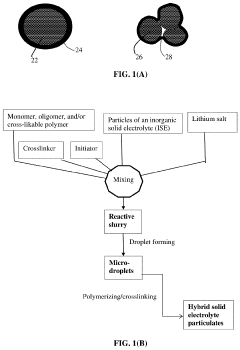
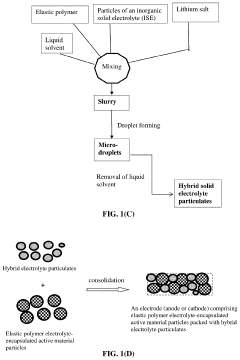
- A hybrid solid electrolyte system comprising inorganic solid electrolyte particles encapsulated in an elastic polymer shell, which provides lithium-ion conductivity from 10^-6 to 5×10^-2 S/cm, minimizes electrolyte volume, and forms a contiguous phase with electrode active materials, while being compatible with existing battery production facilities.
Safety Standards for Solid-State Battery Systems
The development of comprehensive safety standards for solid-state battery systems represents a critical milestone in the commercialization of next-generation energy storage technologies. As solid-state batteries transition from laboratory prototypes to industrial applications, establishing robust safety frameworks becomes paramount to ensure reliable operation across diverse deployment scenarios.
Current safety standard development efforts focus on addressing the unique characteristics of solid-state architectures, particularly the behavior of sulfide electrolytes under various stress conditions. Unlike conventional liquid electrolyte systems, solid-state batteries exhibit different failure modes, thermal runaway characteristics, and mechanical stress responses that require specialized testing protocols and safety criteria.
International standardization bodies, including IEC, ISO, and UL, are actively developing dedicated standards for solid-state battery systems. These emerging standards address critical safety aspects such as electrolyte stability under humidity exposure, interface integrity during thermal cycling, and gas generation potential during cell failure events. The standards also establish specific testing methodologies for evaluating ionic conductivity degradation under safety-critical conditions.
Key safety considerations for sulfide-based solid-state batteries include hydrogen sulfide gas generation upon moisture contact, mechanical integrity of ceramic electrolyte layers, and thermal stability at elevated temperatures. Standards are being developed to define acceptable limits for these parameters and establish mandatory testing procedures for commercial deployment.
The regulatory framework emphasizes the need for comprehensive risk assessment protocols that account for the interdependence between ionic conductivity performance and safety characteristics. This includes establishing minimum conductivity thresholds under various environmental conditions while maintaining safety compliance.
Manufacturing quality standards are being integrated with safety requirements to ensure consistent electrolyte properties and interface stability. These standards define acceptable variations in ionic conductivity, mechanical strength, and chemical stability that directly impact both performance and safety outcomes.
Certification processes for solid-state battery systems are evolving to incorporate specialized testing equipment and methodologies specific to solid electrolyte technologies. This includes development of standardized test cells, environmental chambers, and analytical procedures for evaluating long-term safety performance under realistic operating conditions.
Current safety standard development efforts focus on addressing the unique characteristics of solid-state architectures, particularly the behavior of sulfide electrolytes under various stress conditions. Unlike conventional liquid electrolyte systems, solid-state batteries exhibit different failure modes, thermal runaway characteristics, and mechanical stress responses that require specialized testing protocols and safety criteria.
International standardization bodies, including IEC, ISO, and UL, are actively developing dedicated standards for solid-state battery systems. These emerging standards address critical safety aspects such as electrolyte stability under humidity exposure, interface integrity during thermal cycling, and gas generation potential during cell failure events. The standards also establish specific testing methodologies for evaluating ionic conductivity degradation under safety-critical conditions.
Key safety considerations for sulfide-based solid-state batteries include hydrogen sulfide gas generation upon moisture contact, mechanical integrity of ceramic electrolyte layers, and thermal stability at elevated temperatures. Standards are being developed to define acceptable limits for these parameters and establish mandatory testing procedures for commercial deployment.
The regulatory framework emphasizes the need for comprehensive risk assessment protocols that account for the interdependence between ionic conductivity performance and safety characteristics. This includes establishing minimum conductivity thresholds under various environmental conditions while maintaining safety compliance.
Manufacturing quality standards are being integrated with safety requirements to ensure consistent electrolyte properties and interface stability. These standards define acceptable variations in ionic conductivity, mechanical strength, and chemical stability that directly impact both performance and safety outcomes.
Certification processes for solid-state battery systems are evolving to incorporate specialized testing equipment and methodologies specific to solid electrolyte technologies. This includes development of standardized test cells, environmental chambers, and analytical procedures for evaluating long-term safety performance under realistic operating conditions.
Manufacturing Scalability of Sulfide Electrolytes
The manufacturing scalability of sulfide electrolytes presents significant challenges that differentiate it from conventional liquid electrolyte production. Unlike liquid electrolytes that can be synthesized through straightforward chemical mixing processes, sulfide electrolytes require complex solid-state synthesis methods involving high-temperature reactions, mechanical milling, and precise atmospheric control. These processes are inherently more difficult to scale due to their batch-oriented nature and stringent environmental requirements.
Current production methods for sulfide electrolytes primarily rely on laboratory-scale techniques such as ball milling and hot pressing, which are time-intensive and energy-consuming. The transition from gram-scale laboratory production to kilogram or ton-scale industrial manufacturing faces substantial technical barriers. The uniformity of particle size distribution, crystalline structure consistency, and chemical composition homogeneity become increasingly challenging to maintain as production volumes increase.
The manufacturing infrastructure requirements for sulfide electrolytes are considerably more complex than those for liquid electrolytes. Production facilities must incorporate inert atmosphere handling systems, specialized milling equipment, and advanced powder processing capabilities. The sensitivity of sulfide materials to moisture and oxygen necessitates sophisticated environmental control systems throughout the entire manufacturing chain, significantly increasing capital expenditure and operational complexity.
Quality control and process monitoring present additional scalability challenges. Unlike liquid electrolytes where composition can be readily verified through standard analytical techniques, sulfide electrolytes require advanced characterization methods including X-ray diffraction, impedance spectroscopy, and specialized surface analysis. Implementing these quality assurance measures at industrial scale requires substantial investment in analytical equipment and skilled personnel.
Economic considerations further complicate the scalability equation. The current cost structure of sulfide electrolyte production is dominated by raw material expenses and energy-intensive processing steps. Achieving cost parity with liquid electrolytes requires not only economies of scale but also fundamental improvements in synthesis efficiency and yield optimization. The development of continuous processing methods and automated handling systems represents critical pathways toward commercial viability.
Despite these challenges, emerging manufacturing approaches show promise for addressing scalability limitations. Continuous flow synthesis, spray drying techniques, and advanced powder metallurgy methods are being investigated as potential solutions for large-scale sulfide electrolyte production, offering pathways toward more economically viable manufacturing processes.
Current production methods for sulfide electrolytes primarily rely on laboratory-scale techniques such as ball milling and hot pressing, which are time-intensive and energy-consuming. The transition from gram-scale laboratory production to kilogram or ton-scale industrial manufacturing faces substantial technical barriers. The uniformity of particle size distribution, crystalline structure consistency, and chemical composition homogeneity become increasingly challenging to maintain as production volumes increase.
The manufacturing infrastructure requirements for sulfide electrolytes are considerably more complex than those for liquid electrolytes. Production facilities must incorporate inert atmosphere handling systems, specialized milling equipment, and advanced powder processing capabilities. The sensitivity of sulfide materials to moisture and oxygen necessitates sophisticated environmental control systems throughout the entire manufacturing chain, significantly increasing capital expenditure and operational complexity.
Quality control and process monitoring present additional scalability challenges. Unlike liquid electrolytes where composition can be readily verified through standard analytical techniques, sulfide electrolytes require advanced characterization methods including X-ray diffraction, impedance spectroscopy, and specialized surface analysis. Implementing these quality assurance measures at industrial scale requires substantial investment in analytical equipment and skilled personnel.
Economic considerations further complicate the scalability equation. The current cost structure of sulfide electrolyte production is dominated by raw material expenses and energy-intensive processing steps. Achieving cost parity with liquid electrolytes requires not only economies of scale but also fundamental improvements in synthesis efficiency and yield optimization. The development of continuous processing methods and automated handling systems represents critical pathways toward commercial viability.
Despite these challenges, emerging manufacturing approaches show promise for addressing scalability limitations. Continuous flow synthesis, spray drying techniques, and advanced powder metallurgy methods are being investigated as potential solutions for large-scale sulfide electrolyte production, offering pathways toward more economically viable manufacturing processes.
Unlock deeper insights with Patsnap Eureka Quick Research — get a full tech report to explore trends and direct your research. Try now!
Generate Your Research Report Instantly with AI Agent
Supercharge your innovation with Patsnap Eureka AI Agent Platform!