

Sulfur loading optimization in lithium-sulfur cathodes
FEB 14, 20269 MIN READ
Generate Your Research Report Instantly with AI Agent
PatSnap Eureka helps you evaluate technical feasibility & market potential.
Lithium-Sulfur Battery Technology Background and Sulfur Loading Targets
Lithium-sulfur (Li-S) battery technology has emerged as one of the most promising next-generation energy storage systems, driven by the urgent demand for high-energy-density batteries in electric vehicles, portable electronics, and grid-scale energy storage applications. The theoretical specific energy of Li-S batteries reaches 2600 Wh/kg, approximately five times higher than conventional lithium-ion batteries, while sulfur offers advantages of natural abundance, low cost, and environmental friendliness. These characteristics position Li-S batteries as a compelling alternative to address the limitations of current lithium-ion technology.
The development of Li-S batteries has progressed through several distinct phases since initial research in the 1960s. Early investigations focused on fundamental electrochemical mechanisms and cell configurations. The technology gained renewed attention in the 1990s with advances in materials science and nanotechnology, enabling better control of sulfur cathode architectures. Recent decades have witnessed accelerated progress in addressing core technical challenges, particularly the polysulfide shuttle effect, poor electronic conductivity of sulfur, and volumetric expansion during cycling.
Sulfur loading in cathodes represents a critical parameter that directly determines the practical energy density and commercial viability of Li-S batteries. Current research-scale demonstrations typically employ sulfur loadings between 1-3 mg/cm², which, while useful for fundamental studies, fall significantly short of commercial requirements. Industry consensus indicates that sulfur loadings must reach at least 4-6 mg/cm² to achieve competitive energy densities at the cell level, with ultimate targets extending to 8-10 mg/cm² for applications demanding maximum energy storage.
The optimization of sulfur loading presents multifaceted challenges that extend beyond simply increasing sulfur content. Higher loadings introduce complications including increased electrode thickness, reduced ionic and electronic transport, insufficient electrolyte infiltration, and amplified polysulfide dissolution. These factors collectively compromise rate capability, cycling stability, and sulfur utilization efficiency. Achieving high sulfur loading while maintaining acceptable electrochemical performance requires systematic innovations in cathode architecture design, conductive framework engineering, electrolyte formulation, and cell configuration optimization.
The development of Li-S batteries has progressed through several distinct phases since initial research in the 1960s. Early investigations focused on fundamental electrochemical mechanisms and cell configurations. The technology gained renewed attention in the 1990s with advances in materials science and nanotechnology, enabling better control of sulfur cathode architectures. Recent decades have witnessed accelerated progress in addressing core technical challenges, particularly the polysulfide shuttle effect, poor electronic conductivity of sulfur, and volumetric expansion during cycling.
Sulfur loading in cathodes represents a critical parameter that directly determines the practical energy density and commercial viability of Li-S batteries. Current research-scale demonstrations typically employ sulfur loadings between 1-3 mg/cm², which, while useful for fundamental studies, fall significantly short of commercial requirements. Industry consensus indicates that sulfur loadings must reach at least 4-6 mg/cm² to achieve competitive energy densities at the cell level, with ultimate targets extending to 8-10 mg/cm² for applications demanding maximum energy storage.
The optimization of sulfur loading presents multifaceted challenges that extend beyond simply increasing sulfur content. Higher loadings introduce complications including increased electrode thickness, reduced ionic and electronic transport, insufficient electrolyte infiltration, and amplified polysulfide dissolution. These factors collectively compromise rate capability, cycling stability, and sulfur utilization efficiency. Achieving high sulfur loading while maintaining acceptable electrochemical performance requires systematic innovations in cathode architecture design, conductive framework engineering, electrolyte formulation, and cell configuration optimization.
Market Demand for High-Energy-Density Li-S Batteries
The global battery market is undergoing a transformative shift driven by the accelerating electrification of transportation and the expanding deployment of renewable energy storage systems. Lithium-sulfur batteries have emerged as a compelling next-generation energy storage technology, primarily due to their theoretical specific energy exceeding 2600 Wh/kg, which is substantially higher than conventional lithium-ion systems. This superior energy density positions Li-S batteries as a critical enabler for applications demanding extended range and reduced weight, particularly in electric aviation, long-haul electric vehicles, and portable electronics.
The electric vehicle sector represents the most significant demand driver for high-energy-density battery technologies. Automotive manufacturers are actively seeking battery solutions that can deliver driving ranges comparable to internal combustion vehicles while minimizing vehicle weight and maximizing cargo capacity. Current lithium-ion batteries face inherent limitations in meeting these requirements, creating substantial market pull for alternative chemistries like lithium-sulfur that promise breakthrough performance improvements.
Aerospace and defense applications constitute another critical market segment where energy density requirements are paramount. Unmanned aerial vehicles, electric aircraft, and military portable power systems require batteries that maximize energy storage while minimizing weight penalties. The weight-sensitive nature of these applications makes Li-S technology particularly attractive, as even incremental improvements in energy density translate directly into enhanced operational capabilities and mission duration.
The renewable energy storage market also presents significant opportunities for high-energy-density Li-S batteries. Grid-scale storage systems benefit from reduced installation footprint and lower structural requirements when battery energy density increases. Additionally, the abundance and low cost of sulfur as a raw material align well with the economic requirements of large-scale energy storage deployments, potentially addressing both performance and cost considerations simultaneously.
Consumer electronics manufacturers continue to demand thinner, lighter devices with longer battery life, creating persistent market pressure for energy density improvements. Smartphones, laptops, and wearable devices could achieve substantially extended operating times or reduced form factors through the adoption of Li-S battery technology, provided that cycle life and reliability challenges are adequately addressed through innovations such as sulfur loading optimization.
The electric vehicle sector represents the most significant demand driver for high-energy-density battery technologies. Automotive manufacturers are actively seeking battery solutions that can deliver driving ranges comparable to internal combustion vehicles while minimizing vehicle weight and maximizing cargo capacity. Current lithium-ion batteries face inherent limitations in meeting these requirements, creating substantial market pull for alternative chemistries like lithium-sulfur that promise breakthrough performance improvements.
Aerospace and defense applications constitute another critical market segment where energy density requirements are paramount. Unmanned aerial vehicles, electric aircraft, and military portable power systems require batteries that maximize energy storage while minimizing weight penalties. The weight-sensitive nature of these applications makes Li-S technology particularly attractive, as even incremental improvements in energy density translate directly into enhanced operational capabilities and mission duration.
The renewable energy storage market also presents significant opportunities for high-energy-density Li-S batteries. Grid-scale storage systems benefit from reduced installation footprint and lower structural requirements when battery energy density increases. Additionally, the abundance and low cost of sulfur as a raw material align well with the economic requirements of large-scale energy storage deployments, potentially addressing both performance and cost considerations simultaneously.
Consumer electronics manufacturers continue to demand thinner, lighter devices with longer battery life, creating persistent market pressure for energy density improvements. Smartphones, laptops, and wearable devices could achieve substantially extended operating times or reduced form factors through the adoption of Li-S battery technology, provided that cycle life and reliability challenges are adequately addressed through innovations such as sulfur loading optimization.
Current Sulfur Loading Status and Technical Challenges
Current sulfur loading in lithium-sulfur cathodes typically ranges from 1 to 3 mg/cm², which remains significantly lower than the commercial benchmark of approximately 4 mg/cm² required for practical applications. Laboratory-scale demonstrations have achieved sulfur loadings up to 8-10 mg/cm², yet these configurations often suffer from severe performance degradation. The disparity between experimental achievements and industrial requirements highlights a critical gap in translating research advances into commercially viable products. Most academic studies prioritize achieving high specific capacity at low sulfur loadings, which masks the fundamental challenges that emerge at elevated loading levels.
The primary technical challenge stems from the insulating nature of sulfur and its discharge products, lithium sulfides. As sulfur loading increases, the cathode thickness expands proportionally, creating extended electron and ion transport pathways. This geometric constraint leads to incomplete sulfur utilization, particularly in the interior regions of thick electrodes where active material remains electrochemically inaccessible. The resulting capacity loss becomes exponentially severe beyond 4 mg/cm², with utilization rates dropping below 60% in many cases.
Electrolyte infiltration presents another critical bottleneck at high sulfur loadings. Thick cathode architectures require substantially larger electrolyte volumes to ensure adequate wetting of all active material surfaces. However, excessive electrolyte usage contradicts the energy density objectives of lithium-sulfur technology, as it adds parasitic weight without contributing to capacity. The industry faces a paradox where insufficient electrolyte causes mass transport limitations, while excess electrolyte compromises overall energy metrics.
Polysulfide dissolution and shuttling effects intensify proportionally with sulfur content. Higher sulfur loadings generate greater concentrations of soluble polysulfide intermediates, accelerating capacity fade through irreversible loss mechanisms. The lithium anode experiences accelerated corrosion under these conditions, while the separator and current collector suffer from progressive passivation. These cumulative degradation processes severely limit cycle life, particularly in thick electrode configurations where polysulfide management strategies prove less effective.
Mechanical integrity deteriorates as cathode thickness increases beyond conventional dimensions. The substantial volume expansion during lithiation, approximately 80% for the sulfur-to-lithium sulfide conversion, generates significant mechanical stress within thick electrodes. This stress induces electrode cracking, delamination from current collectors, and loss of electrical connectivity. Manufacturing challenges further compound these issues, as achieving uniform sulfur distribution and maintaining structural cohesion become increasingly difficult in high-loading formulations.
The primary technical challenge stems from the insulating nature of sulfur and its discharge products, lithium sulfides. As sulfur loading increases, the cathode thickness expands proportionally, creating extended electron and ion transport pathways. This geometric constraint leads to incomplete sulfur utilization, particularly in the interior regions of thick electrodes where active material remains electrochemically inaccessible. The resulting capacity loss becomes exponentially severe beyond 4 mg/cm², with utilization rates dropping below 60% in many cases.
Electrolyte infiltration presents another critical bottleneck at high sulfur loadings. Thick cathode architectures require substantially larger electrolyte volumes to ensure adequate wetting of all active material surfaces. However, excessive electrolyte usage contradicts the energy density objectives of lithium-sulfur technology, as it adds parasitic weight without contributing to capacity. The industry faces a paradox where insufficient electrolyte causes mass transport limitations, while excess electrolyte compromises overall energy metrics.
Polysulfide dissolution and shuttling effects intensify proportionally with sulfur content. Higher sulfur loadings generate greater concentrations of soluble polysulfide intermediates, accelerating capacity fade through irreversible loss mechanisms. The lithium anode experiences accelerated corrosion under these conditions, while the separator and current collector suffer from progressive passivation. These cumulative degradation processes severely limit cycle life, particularly in thick electrode configurations where polysulfide management strategies prove less effective.
Mechanical integrity deteriorates as cathode thickness increases beyond conventional dimensions. The substantial volume expansion during lithiation, approximately 80% for the sulfur-to-lithium sulfide conversion, generates significant mechanical stress within thick electrodes. This stress induces electrode cracking, delamination from current collectors, and loss of electrical connectivity. Manufacturing challenges further compound these issues, as achieving uniform sulfur distribution and maintaining structural cohesion become increasingly difficult in high-loading formulations.
Current Sulfur Loading Optimization Solutions
01 High sulfur loading cathode structures
Lithium-sulfur cathodes can achieve high sulfur loading through optimized cathode structures and architectures. These structures include porous carbon frameworks, three-dimensional conductive networks, and hierarchical porous materials that can accommodate large amounts of sulfur while maintaining electrical conductivity. The cathode design focuses on maximizing sulfur content per unit area while ensuring efficient electron and ion transport pathways.- High sulfur loading cathode structures: Advanced cathode architectures designed to accommodate high sulfur content while maintaining structural integrity and electrochemical performance. These structures utilize optimized electrode designs, porous frameworks, and conductive networks to support increased sulfur loading levels, typically exceeding 3-5 mg/cm². The designs focus on maximizing active material utilization while ensuring adequate electron and ion transport pathways throughout the cathode.
- Carbon-based host materials for sulfur immobilization: Utilization of various carbon materials as host matrices to confine and stabilize sulfur in lithium-sulfur cathodes. These materials include porous carbon, carbon nanotubes, graphene, and carbon composites that provide high surface area and conductivity. The carbon hosts help to accommodate volume expansion, improve electron transport, and mitigate polysulfide dissolution, enabling higher sulfur loading while maintaining cycle stability.
- Binder systems and electrode fabrication methods: Development of specialized binder materials and electrode preparation techniques to support high sulfur loading cathodes. These approaches include novel polymeric binders, aqueous processing methods, and optimized slurry formulations that ensure uniform sulfur distribution and strong adhesion. The fabrication methods focus on achieving dense electrode structures with controlled porosity to maximize volumetric energy density while maintaining mechanical stability.
- Conductive additives and interlayer designs: Incorporation of conductive additives and functional interlayers to enhance the performance of high sulfur loading cathodes. These components include carbon black, metal oxides, and specialized separator coatings that improve electrical conductivity and trap polysulfides. The interlayer designs create additional barriers to prevent active material loss and facilitate uniform current distribution across thick cathode structures.
- Sulfur composite materials and encapsulation strategies: Development of sulfur-containing composite materials where sulfur is chemically or physically combined with other components to enable higher loading. These strategies include sulfur encapsulation in polymer matrices, metal-organic frameworks, or ceramic materials that provide structural support and chemical interaction sites. The composites are designed to maintain high sulfur content while improving utilization efficiency and preventing capacity fade associated with polysulfide shuttling.
02 Carbon-sulfur composite materials
Carbon-based materials serve as hosts for sulfur in lithium-sulfur cathodes to improve sulfur loading and utilization. Various carbon materials including mesoporous carbon, carbon nanotubes, graphene, and activated carbon are used to create composites with sulfur. These carbon hosts provide conductive pathways and help confine sulfur and polysulfides within the cathode structure, enabling higher sulfur loading while maintaining electrochemical performance.Expand Specific Solutions03 Sulfur immobilization and confinement strategies
Various strategies are employed to immobilize and confine sulfur within the cathode to achieve stable high sulfur loading. These include physical confinement through porous structures, chemical bonding with functional groups, and the use of coating layers or interlayers. Such approaches prevent sulfur loss and polysulfide dissolution, allowing for increased sulfur content while maintaining cycle stability and capacity retention.Expand Specific Solutions04 Binder and electrolyte optimization for high sulfur loading
The selection and optimization of binders and electrolytes play a crucial role in supporting high sulfur loading cathodes. Advanced binders provide better adhesion and flexibility to accommodate volume changes during cycling. Electrolyte formulations are designed to minimize polysulfide dissolution and improve sulfur utilization. These optimizations enable cathodes to maintain structural integrity and electrochemical performance at elevated sulfur loadings.Expand Specific Solutions05 Cathode fabrication methods for enhanced sulfur loading
Specialized fabrication techniques are developed to achieve high sulfur loading in lithium-sulfur cathodes. These methods include melt-diffusion processes, solution infiltration, vapor deposition, and slurry coating techniques. The fabrication approaches aim to uniformly distribute sulfur throughout the cathode structure, optimize electrode thickness and density, and ensure good contact between sulfur and conductive materials to maximize both sulfur content and electrochemical accessibility.Expand Specific Solutions
Key Players in Li-S Battery Development
The lithium-sulfur cathode technology landscape represents an emerging yet rapidly maturing sector, transitioning from fundamental research to early commercialization stages. The competitive arena encompasses diverse players spanning academic powerhouses like MIT, Cornell University, and Chinese Academy of Sciences institutes (Dalian Institute of Chemical Physics, Shanghai Institute of Ceramics), alongside specialized battery innovators such as Theion GmbH, Sila Nanotechnologies, and Honeycomb Battery Co. Traditional industry giants including Toyota Motor, Robert Bosch, and Corning maintain strategic positions, while research institutions like CIC energiGUNE and various global universities drive technological advancement. Market potential remains substantial given electric vehicle and energy storage demands, though technology maturity varies significantly—academic entities focus on fundamental sulfur loading optimization mechanisms, while companies like Theion demonstrate advanced prototyping capabilities targeting 1000 Wh/kg energy densities, indicating an accelerating transition toward commercial viability despite persistent challenges in sulfur utilization efficiency and cycle stability.
Massachusetts Institute of Technology
Technical Solution: MIT researchers have pioneered fundamental approaches to sulfur loading optimization through rational design of cathode host materials and electrode architectures. Their work demonstrates sulfur loadings of 5-8 mg/cm² using carbon nanotube and graphene-based scaffolds with controlled interlayer spacing. The research group has developed multi-scale modeling frameworks that predict optimal sulfur distribution patterns based on electrode thickness, porosity, and binder content. Key innovations include the use of polar metal oxide coatings on carbon substrates to create strong sulfur-host interactions through chemical bonding, reducing polysulfide dissolution even at high sulfur contents. Their studies systematically investigate the trade-offs between sulfur loading, electrode thickness (50-200 μm), and electrolyte-to-sulfur ratios to maximize areal capacity while maintaining acceptable rate capability and cycle stability over 200-500 cycles.
Strengths: World-class fundamental research capabilities with deep understanding of lithium-sulfur chemistry and transport phenomena; extensive publication record providing scientific foundation for industry development. Weaknesses: Academic focus may result in technologies optimized for laboratory conditions rather than manufacturing scalability; technology transfer timelines can be extended.
Sila Nanotechnologies, Inc.
Technical Solution: Sila Nanotechnologies has developed advanced cathode engineering solutions applicable to lithium-sulfur systems, focusing on optimizing active material loading through nanostructured architectures. Their approach involves creating hierarchical porous structures with controlled pore size distribution ranging from 2-50 nm to accommodate sulfur while maintaining electronic conductivity networks. The company utilizes computational modeling to optimize sulfur loading between 60-70 wt% in the cathode composite, balancing energy density with cycle life requirements. Their technology incorporates conductive carbon frameworks with surface functionalization to enhance sulfur anchoring and minimize polysulfide migration. Manufacturing processes include scalable solution-based deposition methods and calendaring optimization to achieve electrode densities of 0.8-1.2 g/cm³ while preserving necessary porosity for electrolyte penetration and lithium-ion diffusion.
Strengths: Strong materials science expertise with proven track record in battery innovation; established partnerships with major automotive manufacturers providing validation pathways. Weaknesses: Primary focus has been on silicon anode technology; lithium-sulfur cathode solutions may be at earlier development stage compared to core competencies.
Core Patents in High Sulfur Loading Cathode Design
Lithium-sulfur battery with high sulfur loading
PatentActiveUS11527775B1
Innovation
- The use of sulfur-infused conductive porous carbon particles encapsulated by an ionic and electronic conductivity polymer, combined with LAGP ceramic particles, allows for thicker cathode layers with improved lithium and electron conductivity, reducing parasitic weight and enhancing sulfur accessibility within the cathode.


Cathode for lithium-sulfur batteries
PatentPendingUS20240145707A1
Innovation
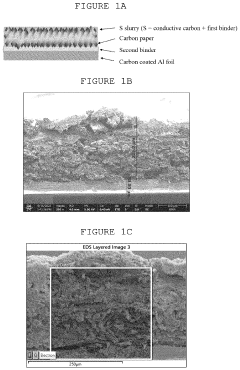
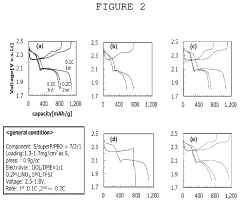
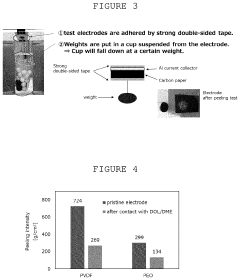
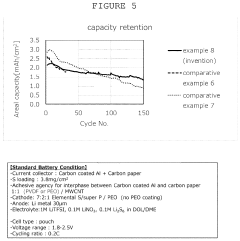
- A dual-layer sulfur cathode configuration is introduced, featuring a porous carbon layer as a host for sulfur active material, with a first binder to suppress polysulfide shuttle and a second binder for mechanical integrity, using polyethylene oxide and poly(vinylidene difluoride) to enhance adhesion and swelling properties.
Environmental Impact and Sulfur Resource Sustainability
The environmental implications of sulfur loading optimization in lithium-sulfur cathodes present both opportunities and challenges for sustainable energy storage development. Sulfur, as the primary active material in these cathodes, offers significant environmental advantages compared to conventional lithium-ion battery materials. Its natural abundance, low toxicity, and minimal ecological footprint during extraction make it an inherently sustainable choice. However, the optimization of sulfur loading directly influences the overall environmental profile of battery production and lifecycle management.
Higher sulfur loading strategies contribute to improved sustainability metrics by reducing the proportion of inactive materials required per unit of energy storage capacity. This optimization decreases the overall material consumption, manufacturing energy requirements, and transportation emissions associated with battery production. The reduction in auxiliary components such as conductive additives, binders, and current collectors per kilowatt-hour of storage capacity represents a substantial environmental benefit that scales with commercial deployment.
Sulfur resource sustainability remains robust due to the material's widespread availability as a byproduct of petroleum refining and natural gas processing. Global sulfur production currently exceeds 80 million tons annually, with significant quantities available from industrial desulfurization processes. This industrial symbiosis transforms what would otherwise be waste material into a valuable battery component, exemplifying circular economy principles. The utilization of industrial sulfur byproducts for battery applications creates minimal additional environmental burden while adding economic value to existing industrial processes.
The end-of-life considerations for sulfur-based cathodes also favor environmental sustainability. Sulfur's chemical stability and non-toxic nature simplify recycling processes compared to heavy metal-containing cathode materials. Recovery and reprocessing of sulfur from spent batteries require less energy-intensive procedures and generate fewer hazardous byproducts. As sulfur loading optimization advances toward commercial viability, establishing efficient recycling infrastructure will be essential to maintain the environmental advantages throughout the complete battery lifecycle and ensure long-term resource sustainability.
Higher sulfur loading strategies contribute to improved sustainability metrics by reducing the proportion of inactive materials required per unit of energy storage capacity. This optimization decreases the overall material consumption, manufacturing energy requirements, and transportation emissions associated with battery production. The reduction in auxiliary components such as conductive additives, binders, and current collectors per kilowatt-hour of storage capacity represents a substantial environmental benefit that scales with commercial deployment.
Sulfur resource sustainability remains robust due to the material's widespread availability as a byproduct of petroleum refining and natural gas processing. Global sulfur production currently exceeds 80 million tons annually, with significant quantities available from industrial desulfurization processes. This industrial symbiosis transforms what would otherwise be waste material into a valuable battery component, exemplifying circular economy principles. The utilization of industrial sulfur byproducts for battery applications creates minimal additional environmental burden while adding economic value to existing industrial processes.
The end-of-life considerations for sulfur-based cathodes also favor environmental sustainability. Sulfur's chemical stability and non-toxic nature simplify recycling processes compared to heavy metal-containing cathode materials. Recovery and reprocessing of sulfur from spent batteries require less energy-intensive procedures and generate fewer hazardous byproducts. As sulfur loading optimization advances toward commercial viability, establishing efficient recycling infrastructure will be essential to maintain the environmental advantages throughout the complete battery lifecycle and ensure long-term resource sustainability.
Manufacturing Scalability of High-Loading Sulfur Cathodes
The transition from laboratory-scale lithium-sulfur cathode fabrication to industrial-scale manufacturing presents substantial technical and economic challenges that must be addressed to enable commercial viability. Current research predominantly focuses on achieving high sulfur loadings between 4-8 mg/cm², yet translating these achievements into mass production requires fundamental reconsideration of processing methodologies, equipment capabilities, and quality control systems. The scalability gap becomes particularly pronounced when conventional slurry coating techniques encounter limitations in maintaining uniform sulfur distribution and structural integrity across large electrode areas.
Traditional batch processing methods employed in research settings prove inadequate for commercial production volumes, necessitating the adoption of continuous roll-to-roll manufacturing processes. However, high-loading sulfur cathodes introduce specific complications including increased slurry viscosity, extended drying times, and heightened susceptibility to cracking during solvent evaporation. These factors directly impact production throughput and yield rates, creating economic barriers to market entry. The thick electrode architecture required for high sulfur loading also demands modified drying protocols to prevent surface skin formation and internal porosity defects that compromise electrochemical performance.
Material supply chain considerations further complicate scalability efforts. Sourcing consistent quality sulfur precursors, conductive additives, and specialized binders at industrial volumes while maintaining cost competitiveness remains challenging. The sensitivity of cathode performance to material batch variations necessitates stringent incoming quality specifications and potentially vertical integration strategies. Additionally, the handling of sulfur-containing materials at scale introduces safety considerations regarding dust control and thermal management during processing.
Equipment adaptation represents another critical scalability dimension. Standard lithium-ion battery manufacturing lines require significant modifications to accommodate the unique rheological properties of high-loading sulfur slurries and the specific environmental controls needed to prevent premature sulfur reactions. Investment in specialized coating heads, precision metering systems, and advanced drying chambers with controlled atmosphere capabilities becomes essential. Quality assurance protocols must evolve beyond conventional thickness and loading measurements to include real-time monitoring of sulfur distribution homogeneity and structural integrity across continuous production runs.
Traditional batch processing methods employed in research settings prove inadequate for commercial production volumes, necessitating the adoption of continuous roll-to-roll manufacturing processes. However, high-loading sulfur cathodes introduce specific complications including increased slurry viscosity, extended drying times, and heightened susceptibility to cracking during solvent evaporation. These factors directly impact production throughput and yield rates, creating economic barriers to market entry. The thick electrode architecture required for high sulfur loading also demands modified drying protocols to prevent surface skin formation and internal porosity defects that compromise electrochemical performance.
Material supply chain considerations further complicate scalability efforts. Sourcing consistent quality sulfur precursors, conductive additives, and specialized binders at industrial volumes while maintaining cost competitiveness remains challenging. The sensitivity of cathode performance to material batch variations necessitates stringent incoming quality specifications and potentially vertical integration strategies. Additionally, the handling of sulfur-containing materials at scale introduces safety considerations regarding dust control and thermal management during processing.
Equipment adaptation represents another critical scalability dimension. Standard lithium-ion battery manufacturing lines require significant modifications to accommodate the unique rheological properties of high-loading sulfur slurries and the specific environmental controls needed to prevent premature sulfur reactions. Investment in specialized coating heads, precision metering systems, and advanced drying chambers with controlled atmosphere capabilities becomes essential. Quality assurance protocols must evolve beyond conventional thickness and loading measurements to include real-time monitoring of sulfur distribution homogeneity and structural integrity across continuous production runs.
Unlock deeper insights with PatSnap Eureka Quick Research — get a full tech report to explore trends and direct your research. Try now!
Generate Your Research Report Instantly with AI Agent
Supercharge your innovation with PatSnap Eureka AI Agent Platform!