Thermoelectric Generator Modules In Aerospace Applications
SEP 10, 20259 MIN READ
Generate Your Research Report Instantly with AI Agent
Patsnap Eureka helps you evaluate technical feasibility & market potential.
Aerospace TEG Technology Background and Objectives
Thermoelectric Generator (TEG) technology has evolved significantly since its inception in the early 19th century with the discovery of the Seebeck effect. In aerospace applications, TEGs have gained prominence due to their ability to convert waste heat directly into electrical energy without moving parts, offering reliability crucial for space missions. The technology's development accelerated during the Space Race era when NASA and Soviet space programs sought reliable power sources for deep space missions.
The aerospace industry presents unique thermal management challenges, with spacecraft experiencing extreme temperature differentials between sun-facing and shadow-facing surfaces. TEGs capitalize on these temperature gradients to generate power, making them particularly suitable for space applications. Historical milestones include the implementation of radioisotope thermoelectric generators (RTGs) in missions like Voyager, Cassini, and New Horizons, demonstrating the technology's longevity and reliability in harsh space environments.
Current technological objectives for aerospace TEGs focus on enhancing conversion efficiency, which traditionally has been limited to 5-8%. Research aims to achieve efficiency rates of 15-20% through advanced materials and innovative designs. Size and weight reduction represent another critical goal, as launch costs remain directly proportional to payload mass. Modern aerospace TEGs target power-to-weight ratios exceeding 5W/kg, a significant improvement over earlier generations.
The evolution trend points toward multi-functional TEG modules that integrate with spacecraft structural elements, serving dual purposes of power generation and thermal regulation. This approach aligns with the aerospace industry's push toward multifunctional materials and systems that maximize resource utilization in the confined space environment.
Emerging research directions include the development of flexible TEGs capable of conforming to curved spacecraft surfaces and the exploration of nanomaterials to enhance thermoelectric properties. Quantum well and superlattice structures show promise for breaking traditional efficiency barriers through quantum confinement effects.
The strategic objective of aerospace TEG technology development extends beyond immediate power generation to enabling longer-duration missions, particularly in deep space where solar power becomes ineffective. As space agencies and private companies plan missions to Mars and beyond, TEGs represent a critical enabling technology for sustainable power generation in environments where maintenance is impossible and reliability is paramount.
The aerospace industry presents unique thermal management challenges, with spacecraft experiencing extreme temperature differentials between sun-facing and shadow-facing surfaces. TEGs capitalize on these temperature gradients to generate power, making them particularly suitable for space applications. Historical milestones include the implementation of radioisotope thermoelectric generators (RTGs) in missions like Voyager, Cassini, and New Horizons, demonstrating the technology's longevity and reliability in harsh space environments.
Current technological objectives for aerospace TEGs focus on enhancing conversion efficiency, which traditionally has been limited to 5-8%. Research aims to achieve efficiency rates of 15-20% through advanced materials and innovative designs. Size and weight reduction represent another critical goal, as launch costs remain directly proportional to payload mass. Modern aerospace TEGs target power-to-weight ratios exceeding 5W/kg, a significant improvement over earlier generations.
The evolution trend points toward multi-functional TEG modules that integrate with spacecraft structural elements, serving dual purposes of power generation and thermal regulation. This approach aligns with the aerospace industry's push toward multifunctional materials and systems that maximize resource utilization in the confined space environment.
Emerging research directions include the development of flexible TEGs capable of conforming to curved spacecraft surfaces and the exploration of nanomaterials to enhance thermoelectric properties. Quantum well and superlattice structures show promise for breaking traditional efficiency barriers through quantum confinement effects.
The strategic objective of aerospace TEG technology development extends beyond immediate power generation to enabling longer-duration missions, particularly in deep space where solar power becomes ineffective. As space agencies and private companies plan missions to Mars and beyond, TEGs represent a critical enabling technology for sustainable power generation in environments where maintenance is impossible and reliability is paramount.
Market Analysis for Aerospace Thermoelectric Applications
The aerospace thermoelectric generator (TEG) market is experiencing significant growth, driven by increasing demand for reliable power sources in extreme environments. Current market valuations indicate the global aerospace TEG sector reached approximately $78 million in 2022, with projections suggesting a compound annual growth rate of 6.8% through 2030. This growth trajectory is primarily fueled by the expanding satellite industry and increasing investments in deep space exploration missions.
Market segmentation reveals distinct application categories within aerospace TEGs. Satellite power systems represent the largest segment, accounting for roughly 42% of market share, followed by deep space probes (27%), aircraft auxiliary power units (18%), and emerging applications in unmanned aerial vehicles (13%). The satellite segment's dominance stems from the proliferation of small satellite constellations and the growing commercial space economy.
Regional analysis shows North America maintaining market leadership with approximately 45% market share, attributed to NASA's ongoing missions and the concentration of major aerospace contractors. Europe follows at 28%, with significant contributions from ESA programs, while Asia-Pacific represents the fastest-growing region at 15% annual growth, driven by ambitious space programs in China, Japan, and India.
Customer demand patterns indicate a shift toward higher efficiency, lighter weight, and more radiation-resistant TEG modules. Space agencies and defense contractors prioritize reliability and long operational lifespans, often accepting premium pricing for proven performance. Commercial satellite operators, conversely, emphasize cost-effectiveness and standardization to support constellation deployments.
Market barriers include high initial development costs, lengthy qualification processes for space-grade components, and competition from alternative power technologies such as improved solar arrays and next-generation batteries. The specialized nature of aerospace applications also creates a relatively small but high-value market compared to terrestrial TEG applications.
Supply chain analysis reveals potential vulnerabilities in the sourcing of rare earth elements and specialized semiconductor materials required for high-performance thermoelectric materials. These constraints have prompted increased research into alternative material systems and manufacturing processes to ensure supply security.
Future market opportunities are emerging in lunar and Martian surface operations, where day-night temperature differentials create ideal conditions for TEG deployment. Additionally, the growing interest in nuclear power for space applications presents significant potential for TEG integration as energy conversion systems for radioisotope power sources and small nuclear reactors in future deep space missions.
Market segmentation reveals distinct application categories within aerospace TEGs. Satellite power systems represent the largest segment, accounting for roughly 42% of market share, followed by deep space probes (27%), aircraft auxiliary power units (18%), and emerging applications in unmanned aerial vehicles (13%). The satellite segment's dominance stems from the proliferation of small satellite constellations and the growing commercial space economy.
Regional analysis shows North America maintaining market leadership with approximately 45% market share, attributed to NASA's ongoing missions and the concentration of major aerospace contractors. Europe follows at 28%, with significant contributions from ESA programs, while Asia-Pacific represents the fastest-growing region at 15% annual growth, driven by ambitious space programs in China, Japan, and India.
Customer demand patterns indicate a shift toward higher efficiency, lighter weight, and more radiation-resistant TEG modules. Space agencies and defense contractors prioritize reliability and long operational lifespans, often accepting premium pricing for proven performance. Commercial satellite operators, conversely, emphasize cost-effectiveness and standardization to support constellation deployments.
Market barriers include high initial development costs, lengthy qualification processes for space-grade components, and competition from alternative power technologies such as improved solar arrays and next-generation batteries. The specialized nature of aerospace applications also creates a relatively small but high-value market compared to terrestrial TEG applications.
Supply chain analysis reveals potential vulnerabilities in the sourcing of rare earth elements and specialized semiconductor materials required for high-performance thermoelectric materials. These constraints have prompted increased research into alternative material systems and manufacturing processes to ensure supply security.
Future market opportunities are emerging in lunar and Martian surface operations, where day-night temperature differentials create ideal conditions for TEG deployment. Additionally, the growing interest in nuclear power for space applications presents significant potential for TEG integration as energy conversion systems for radioisotope power sources and small nuclear reactors in future deep space missions.
Current TEG Technology Status and Aerospace Integration Challenges
Thermoelectric Generator (TEG) technology has evolved significantly over the past decade, yet its integration into aerospace applications faces unique challenges. Current commercial TEG modules typically achieve efficiency rates between 5-8%, with laboratory prototypes reaching up to 10-12% under optimal conditions. These efficiency levels, while steadily improving, remain a primary limitation for widespread aerospace adoption where power-to-weight ratios are critical performance metrics.
The state-of-the-art TEG materials predominantly utilize bismuth telluride (Bi₂Te₃) for low-temperature applications (up to 250°C) and lead telluride (PbTe) for medium-temperature ranges (250-600°C). For high-temperature aerospace environments exceeding 600°C, silicon-germanium (SiGe) alloys and skutterudite compounds have shown promising results. However, these materials present challenges in thermal cycling durability and long-term stability under the extreme conditions experienced in aerospace operations.
Manufacturing processes for aerospace-grade TEGs have advanced with techniques including spark plasma sintering, hot pressing, and zone melting, which have improved material density and reduced thermal boundary resistance. Despite these advancements, the production of large-area, lightweight TEG modules with consistent performance characteristics remains technically challenging and cost-prohibitive for mass deployment in aerospace systems.
Integration challenges specific to aerospace applications include the need for TEG modules to withstand extreme vibration profiles during launch and operation, rapid thermal cycling, and radiation exposure in space environments. Current TEG mounting and interface technologies often rely on mechanical clamping or brazing techniques that add significant weight and may create thermal expansion mismatches during operation.
The power conditioning electronics required to optimize TEG output for aerospace electrical systems present additional integration hurdles. Most existing TEG modules produce low-voltage, high-current outputs that require sophisticated power management systems to interface with spacecraft or aircraft power buses. These systems add complexity, weight, and potential failure points to the overall implementation.
Thermal management represents another significant challenge, as aerospace TEG applications must balance heat extraction for power generation with thermal protection requirements for surrounding systems. Current thermal interface materials and heat spreading technologies often struggle to maintain optimal temperature gradients across TEG modules while accommodating the space and weight constraints inherent to aerospace platforms.
Reliability testing protocols for aerospace TEGs remain underdeveloped compared to other power generation technologies. The industry lacks standardized qualification procedures specifically addressing the unique operational profiles and lifetime requirements of aerospace missions, which typically demand 10-15 years of maintenance-free operation in hostile environments.
The state-of-the-art TEG materials predominantly utilize bismuth telluride (Bi₂Te₃) for low-temperature applications (up to 250°C) and lead telluride (PbTe) for medium-temperature ranges (250-600°C). For high-temperature aerospace environments exceeding 600°C, silicon-germanium (SiGe) alloys and skutterudite compounds have shown promising results. However, these materials present challenges in thermal cycling durability and long-term stability under the extreme conditions experienced in aerospace operations.
Manufacturing processes for aerospace-grade TEGs have advanced with techniques including spark plasma sintering, hot pressing, and zone melting, which have improved material density and reduced thermal boundary resistance. Despite these advancements, the production of large-area, lightweight TEG modules with consistent performance characteristics remains technically challenging and cost-prohibitive for mass deployment in aerospace systems.
Integration challenges specific to aerospace applications include the need for TEG modules to withstand extreme vibration profiles during launch and operation, rapid thermal cycling, and radiation exposure in space environments. Current TEG mounting and interface technologies often rely on mechanical clamping or brazing techniques that add significant weight and may create thermal expansion mismatches during operation.
The power conditioning electronics required to optimize TEG output for aerospace electrical systems present additional integration hurdles. Most existing TEG modules produce low-voltage, high-current outputs that require sophisticated power management systems to interface with spacecraft or aircraft power buses. These systems add complexity, weight, and potential failure points to the overall implementation.
Thermal management represents another significant challenge, as aerospace TEG applications must balance heat extraction for power generation with thermal protection requirements for surrounding systems. Current thermal interface materials and heat spreading technologies often struggle to maintain optimal temperature gradients across TEG modules while accommodating the space and weight constraints inherent to aerospace platforms.
Reliability testing protocols for aerospace TEGs remain underdeveloped compared to other power generation technologies. The industry lacks standardized qualification procedures specifically addressing the unique operational profiles and lifetime requirements of aerospace missions, which typically demand 10-15 years of maintenance-free operation in hostile environments.
Current Thermoelectric Solutions for Aerospace Power Generation
01 Thermoelectric module design and structure
Thermoelectric generator modules can be designed with various structural configurations to optimize power generation. These designs include specific arrangements of thermoelectric elements, interconnections between p-type and n-type semiconductors, and packaging techniques that enhance thermal efficiency. Advanced structural designs focus on improving thermal contact, reducing internal resistance, and maximizing the temperature gradient across the module.- Thermoelectric module design and structure: Thermoelectric generator modules can be designed with specific structural features to enhance efficiency and performance. These designs include optimized arrangements of thermoelectric elements, improved electrical connections between elements, and specialized housing structures that maximize heat transfer. Various module configurations can be implemented to address specific application requirements, such as flat panels, cylindrical designs, or flexible structures.
- Material innovations for thermoelectric generators: Advanced materials play a crucial role in improving the efficiency of thermoelectric generator modules. These include semiconductor materials with high Seebeck coefficients, nanostructured materials that reduce thermal conductivity while maintaining electrical conductivity, and composite materials that optimize the figure of merit (ZT). Material innovations focus on enhancing the temperature gradient across the module and improving energy conversion efficiency.
- Cooling and heat management systems: Effective heat management is essential for maximizing the efficiency of thermoelectric generator modules. Various cooling systems can be integrated, including passive heat sinks, active cooling with fans or liquid cooling, and heat pipes. These systems help maintain the temperature differential across the thermoelectric elements, which is crucial for power generation. Optimized heat flow paths and thermal interface materials further enhance performance.
- Integration with waste heat recovery systems: Thermoelectric generator modules can be integrated with various waste heat recovery systems to capture and convert otherwise lost thermal energy into electricity. Applications include industrial processes, vehicle exhaust systems, and residential heating systems. These integrated solutions often include specialized mounting interfaces, thermal management components, and power conditioning electronics to optimize energy harvesting from fluctuating heat sources.
- Electrical output optimization and power management: Optimizing the electrical output of thermoelectric generator modules involves specialized circuit designs, power conditioning, and energy storage solutions. This includes DC-DC converters to stabilize voltage output, maximum power point tracking systems to optimize energy extraction, and integration with energy storage devices like batteries or supercapacitors. Advanced control systems can adjust operating parameters based on temperature differentials and load requirements to maximize overall system efficiency.
02 Material innovations for thermoelectric modules
Novel materials are being developed to enhance the efficiency of thermoelectric generator modules. These materials include advanced semiconductor compounds, nanostructured materials, and composite materials with improved Seebeck coefficients. Material innovations focus on increasing the figure of merit (ZT) by enhancing electrical conductivity while reducing thermal conductivity, thereby improving energy conversion efficiency.Expand Specific Solutions03 Cooling and heat management systems
Effective heat management is crucial for thermoelectric generator modules to maintain optimal temperature differentials. Various cooling systems, including passive and active cooling mechanisms, heat sinks, and thermal interface materials, are employed to enhance performance. These systems help to maximize the temperature gradient across the module, which directly impacts the power generation capability of thermoelectric generators.Expand Specific Solutions04 Integration with waste heat recovery systems
Thermoelectric generator modules can be integrated with various waste heat recovery systems to capture and convert otherwise wasted thermal energy into electricity. These applications include industrial processes, automotive exhaust systems, and residential heating systems. The integration focuses on optimizing the placement of modules to capture maximum heat flux and developing connection systems that maintain thermal efficiency while providing electrical isolation.Expand Specific Solutions05 Manufacturing techniques and scalability
Advanced manufacturing techniques are being developed to improve the production efficiency and scalability of thermoelectric generator modules. These include automated assembly processes, thin-film deposition methods, and additive manufacturing approaches. Manufacturing innovations focus on reducing production costs, improving consistency in module performance, and enabling mass production while maintaining high quality and reliability standards.Expand Specific Solutions
Leading Aerospace TEG Manufacturers and Research Institutions
The thermoelectric generator modules market in aerospace applications is currently in a growth phase, with increasing adoption driven by demands for more efficient power generation in aircraft systems. The global market size is estimated to be expanding at a CAGR of 6-8%, fueled by the aerospace industry's push toward electrification and sustainable energy solutions. Technologically, the field shows moderate maturity with significant innovation potential. Key players include established aerospace giants like Boeing and Rolls-Royce, who are integrating these systems into next-generation aircraft, alongside specialized thermoelectric technology companies such as Gentherm and Toshiba. Research institutions like Texas A&M University and Korea Electrotechnology Research Institute are advancing fundamental technologies, while companies like Atomos Nuclear & Space are developing niche applications for space exploration, indicating a diversifying competitive landscape.
The Boeing Co.
Technical Solution: Boeing has developed advanced thermoelectric generator (TEG) modules specifically designed for aerospace applications, focusing on harvesting waste heat from aircraft engines and auxiliary power units. Their proprietary technology utilizes high-temperature resistant semiconductor materials capable of operating efficiently in the extreme temperature gradients found in aerospace environments (300-800°C). Boeing's TEG systems incorporate specialized ceramic substrates with enhanced thermal conductivity and mechanical stability to withstand vibration and thermal cycling. The company has implemented these modules in various aircraft subsystems, achieving power densities of up to 1W/cm² while maintaining reliability over extended flight hours. Boeing's aerospace TEGs feature advanced thermal interface materials that maximize heat transfer efficiency while minimizing thermal resistance at critical junctions. Their modular design allows for integration into existing aircraft systems with minimal modification to the primary structures.
Strengths: Boeing's aerospace TEG modules benefit from the company's extensive experience in aircraft systems integration and certification processes. Their solutions are specifically optimized for the unique constraints of aerospace applications including weight, reliability, and safety requirements. Weaknesses: The specialized nature of Boeing's TEG technology may result in higher production costs compared to commercial alternatives, and the technology may have limited applications outside aerospace environments.
Safran Helicopter Engines SAS
Technical Solution: Safran Helicopter Engines has developed innovative thermoelectric generator (TEG) modules specifically optimized for rotorcraft applications. Their technology focuses on harvesting waste heat from helicopter engines and transmission systems, where space constraints and weight limitations are particularly challenging. Safran's TEG modules utilize advanced half-Heusler alloys that deliver high performance in the mid-temperature range (200-500°C) typical of helicopter operations. Their proprietary design incorporates vibration isolation systems that protect the thermoelectric materials from the intense mechanical stresses present in rotorcraft environments. Safran has implemented a modular architecture that allows for distributed TEG placement throughout the aircraft, maximizing energy recovery from multiple heat sources. Their systems feature advanced thermal interface materials with self-healing properties that maintain contact integrity despite thermal cycling and vibration. Safran's helicopter TEGs have demonstrated electrical power generation of 0.5-2kW depending on engine size, providing supplemental power for critical avionics and reducing the load on primary electrical generators.
Strengths: Safran's TEG technology is exceptionally well-adapted to the unique requirements of rotorcraft, with superior vibration resistance and compact form factors. Their solutions integrate seamlessly with existing helicopter electrical systems and provide valuable redundancy for critical systems. Weaknesses: The technology's efficiency remains relatively low (5-7%) compared to ideal thermodynamic limits, and implementation requires significant modifications to existing engine compartment designs.
Key Patents and Innovations in Aerospace-Grade TEG Technology
Thermoelectric modules
PatentInactiveUS20110271995A1
Innovation
- A thermoelectric module with a base support made of a metal matrix composite featuring a gradient in metal content, allowing for optimized thermal conductivity and expansion coefficients, enabling insulation and connection to the system while minimizing stresses, and facilitating adaptation to different environments.


Thermoelectric generator assembly and system
PatentActiveUS20110108080A1
Innovation
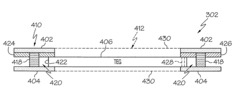
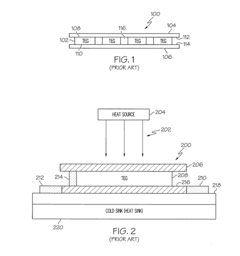
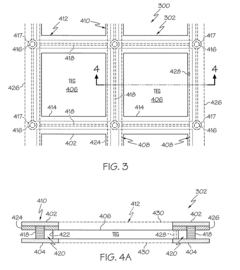
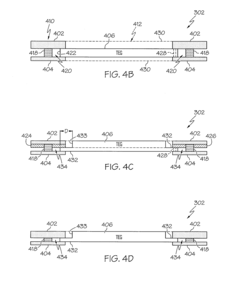
- A thermoelectric generator assembly with a frame that includes a first and second frame member to retain TEG devices, a spacer for thermal expansion relief, and a power bus for electrical energy transmission, allowing for direct contact with heat sources and sinks without air gaps, and featuring a ledge on the TEG device for improved thermal contact and reduced thermal resistance.
Space Qualification Standards and Reliability Requirements
Thermoelectric Generator (TEG) modules deployed in aerospace applications must adhere to stringent space qualification standards and reliability requirements to ensure operational integrity in the extreme conditions of space. NASA, ESA, and JAXA have established comprehensive qualification protocols specifically for power generation systems, including TEGs. These standards encompass radiation hardness testing, thermal cycling resilience, vacuum compatibility, and mechanical vibration tolerance.
The MIL-STD-1540 series provides the foundation for environmental test requirements for space systems, with specific provisions for power generation components. For TEGs, this includes testing under simulated space radiation environments to verify performance degradation rates over the mission lifetime. The European Cooperation for Space Standardization (ECSS) complements these with ECSS-Q-ST-70 standards focusing on materials, mechanical parts, and processes for space applications.
Reliability requirements for aerospace TEG modules typically mandate a minimum operational lifetime of 15+ years with less than 5% performance degradation. This necessitates extensive accelerated life testing protocols, including high-temperature soak tests and thermal cycling between extreme temperatures (-180°C to +150°C) for thousands of cycles. The JEDEC JESD22-A104 standard, though originally developed for semiconductor qualification, has been adapted for TEG reliability assessment.
Qualification procedures also address the unique challenges of thermoelectric materials in space environments. These include sublimation testing in high vacuum conditions (10^-7 Torr or better), atomic oxygen exposure assessment for low Earth orbit applications, and charged particle impact resistance verification. The NASA-STD-5001 outlines structural design requirements that TEG modules must satisfy, particularly regarding launch vibration profiles and shock resistance.
Manufacturing process control represents another critical aspect of space qualification. The SAE AS9100 quality management system, specifically tailored for aerospace applications, governs the production of flight-qualified TEG modules. This includes detailed documentation requirements, traceability of materials, and statistical process control methodologies to ensure consistency between production batches.
Failure Modes and Effects Analysis (FMEA) is mandatory for all TEG space applications, with particular attention to thermal interface degradation, electrical connection reliability, and hermetic sealing integrity. The qualification process typically culminates in Technology Readiness Level (TRL) assessment, with most space missions requiring components to achieve TRL-6 (system/subsystem model or prototype demonstration in a relevant environment) or higher before flight approval.
The MIL-STD-1540 series provides the foundation for environmental test requirements for space systems, with specific provisions for power generation components. For TEGs, this includes testing under simulated space radiation environments to verify performance degradation rates over the mission lifetime. The European Cooperation for Space Standardization (ECSS) complements these with ECSS-Q-ST-70 standards focusing on materials, mechanical parts, and processes for space applications.
Reliability requirements for aerospace TEG modules typically mandate a minimum operational lifetime of 15+ years with less than 5% performance degradation. This necessitates extensive accelerated life testing protocols, including high-temperature soak tests and thermal cycling between extreme temperatures (-180°C to +150°C) for thousands of cycles. The JEDEC JESD22-A104 standard, though originally developed for semiconductor qualification, has been adapted for TEG reliability assessment.
Qualification procedures also address the unique challenges of thermoelectric materials in space environments. These include sublimation testing in high vacuum conditions (10^-7 Torr or better), atomic oxygen exposure assessment for low Earth orbit applications, and charged particle impact resistance verification. The NASA-STD-5001 outlines structural design requirements that TEG modules must satisfy, particularly regarding launch vibration profiles and shock resistance.
Manufacturing process control represents another critical aspect of space qualification. The SAE AS9100 quality management system, specifically tailored for aerospace applications, governs the production of flight-qualified TEG modules. This includes detailed documentation requirements, traceability of materials, and statistical process control methodologies to ensure consistency between production batches.
Failure Modes and Effects Analysis (FMEA) is mandatory for all TEG space applications, with particular attention to thermal interface degradation, electrical connection reliability, and hermetic sealing integrity. The qualification process typically culminates in Technology Readiness Level (TRL) assessment, with most space missions requiring components to achieve TRL-6 (system/subsystem model or prototype demonstration in a relevant environment) or higher before flight approval.
Environmental Impact and Sustainability of TEG Materials
The environmental impact of Thermoelectric Generator (TEG) materials in aerospace applications represents a critical consideration as the industry moves toward more sustainable practices. Traditional TEG modules often incorporate materials with significant environmental concerns, particularly heavy metals like lead, bismuth, and tellurium. These elements present potential ecological hazards during extraction, manufacturing, and end-of-life disposal. The mining processes for these rare elements frequently result in habitat destruction, soil contamination, and water pollution, creating environmental liabilities that extend far beyond the aerospace sector.
Recent advancements in TEG material science have focused on developing alternatives with reduced environmental footprints. Skutterudite-based materials and half-Heusler alloys show promising thermoelectric properties while utilizing more abundant and less toxic elements. These newer materials demonstrate comparable or superior performance metrics while significantly reducing dependence on environmentally problematic substances. Additionally, research into organic and polymer-based thermoelectric materials represents a potentially revolutionary approach that could eliminate heavy metal usage entirely.
The aerospace industry's unique operating conditions present both challenges and opportunities for sustainable TEG implementation. The extreme temperature differentials experienced in aerospace environments actually enhance TEG efficiency, potentially allowing for smaller material quantities to achieve desired power outputs. This efficiency advantage translates to reduced material consumption and consequently lower environmental impact per unit of energy generated.
Life cycle assessment (LCA) studies of TEG modules in aerospace applications reveal that the environmental impact is heavily concentrated in the material extraction and manufacturing phases. The operational phase demonstrates minimal environmental burden, as TEGs generate electricity from otherwise wasted heat without additional fuel consumption. This characteristic positions TEGs as inherently sustainable energy recovery systems once deployed, despite initial production impacts.
Recycling and circular economy approaches are increasingly important considerations for aerospace TEG sustainability. Current recovery rates for critical thermoelectric materials remain suboptimal, with less than 1% of tellurium and under 5% of bismuth being effectively recaptured from end-of-life products. Developing specialized recycling processes for aerospace TEG modules could significantly improve material circularity and reduce virgin material demand. Several research initiatives are exploring hydrometallurgical and pyrometallurgical techniques specifically optimized for thermoelectric material recovery from complex aerospace components.
Regulatory frameworks governing hazardous materials in aerospace applications continue to evolve, with increasing restrictions on substances of concern. The European Union's Restriction of Hazardous Substances (RoHS) directive and similar global regulations are driving manufacturers toward more environmentally benign TEG formulations. This regulatory pressure, combined with corporate sustainability commitments, is accelerating the transition to greener thermoelectric technologies throughout the aerospace supply chain.
Recent advancements in TEG material science have focused on developing alternatives with reduced environmental footprints. Skutterudite-based materials and half-Heusler alloys show promising thermoelectric properties while utilizing more abundant and less toxic elements. These newer materials demonstrate comparable or superior performance metrics while significantly reducing dependence on environmentally problematic substances. Additionally, research into organic and polymer-based thermoelectric materials represents a potentially revolutionary approach that could eliminate heavy metal usage entirely.
The aerospace industry's unique operating conditions present both challenges and opportunities for sustainable TEG implementation. The extreme temperature differentials experienced in aerospace environments actually enhance TEG efficiency, potentially allowing for smaller material quantities to achieve desired power outputs. This efficiency advantage translates to reduced material consumption and consequently lower environmental impact per unit of energy generated.
Life cycle assessment (LCA) studies of TEG modules in aerospace applications reveal that the environmental impact is heavily concentrated in the material extraction and manufacturing phases. The operational phase demonstrates minimal environmental burden, as TEGs generate electricity from otherwise wasted heat without additional fuel consumption. This characteristic positions TEGs as inherently sustainable energy recovery systems once deployed, despite initial production impacts.
Recycling and circular economy approaches are increasingly important considerations for aerospace TEG sustainability. Current recovery rates for critical thermoelectric materials remain suboptimal, with less than 1% of tellurium and under 5% of bismuth being effectively recaptured from end-of-life products. Developing specialized recycling processes for aerospace TEG modules could significantly improve material circularity and reduce virgin material demand. Several research initiatives are exploring hydrometallurgical and pyrometallurgical techniques specifically optimized for thermoelectric material recovery from complex aerospace components.
Regulatory frameworks governing hazardous materials in aerospace applications continue to evolve, with increasing restrictions on substances of concern. The European Union's Restriction of Hazardous Substances (RoHS) directive and similar global regulations are driving manufacturers toward more environmentally benign TEG formulations. This regulatory pressure, combined with corporate sustainability commitments, is accelerating the transition to greener thermoelectric technologies throughout the aerospace supply chain.
Unlock deeper insights with Patsnap Eureka Quick Research — get a full tech report to explore trends and direct your research. Try now!
Generate Your Research Report Instantly with AI Agent
Supercharge your innovation with Patsnap Eureka AI Agent Platform!