

Thrust Bearing Component Analysis: Achieve High Load Capacity
MAR 16, 20269 MIN READ
Generate Your Research Report Instantly with AI Agent
PatSnap Eureka helps you evaluate technical feasibility & market potential.
Thrust Bearing Technology Background and Load Capacity Goals
Thrust bearings represent a critical mechanical component designed to support axial loads in rotating machinery, with their development tracing back to the early industrial revolution when steam engines and heavy machinery demanded reliable load-bearing solutions. The fundamental principle involves distributing concentrated axial forces across a larger surface area through carefully engineered contact interfaces, typically utilizing rolling elements or hydrodynamic fluid films to minimize friction while maximizing load capacity.
The evolution of thrust bearing technology has been driven by increasingly demanding applications across aerospace, marine propulsion, heavy industrial machinery, and precision manufacturing equipment. Modern gas turbines, for instance, require thrust bearings capable of handling loads exceeding several hundred thousand pounds while operating at temperatures above 200°C and rotational speeds reaching 10,000 RPM or higher.
Contemporary load capacity requirements have escalated dramatically due to the trend toward more compact, high-performance machinery designs. Wind turbine generators now demand thrust bearings supporting loads up to 2,000 kN, while maintaining operational reliability for 20-year service lives. Similarly, marine propulsion systems require bearings capable of handling massive propeller thrust forces while operating in corrosive saltwater environments.
The primary technical challenge lies in achieving optimal load distribution while managing heat generation, material fatigue, and lubrication effectiveness. Advanced bearing designs must balance competing factors including contact stress concentration, surface roughness effects, material selection, and geometric optimization to maximize load capacity without compromising operational stability.
Current industry goals focus on developing thrust bearings with load capacities 30-50% higher than existing solutions while reducing overall system weight and maintenance requirements. This involves integrating advanced materials such as ceramic composites, implementing sophisticated surface treatments, and optimizing bearing geometry through computational fluid dynamics and finite element analysis.
The technological trajectory emphasizes achieving load capacities exceeding 5,000 N/cm² contact pressure while maintaining acceptable wear rates and operational temperatures below critical material limits, representing a significant advancement over traditional bearing performance parameters.
The evolution of thrust bearing technology has been driven by increasingly demanding applications across aerospace, marine propulsion, heavy industrial machinery, and precision manufacturing equipment. Modern gas turbines, for instance, require thrust bearings capable of handling loads exceeding several hundred thousand pounds while operating at temperatures above 200°C and rotational speeds reaching 10,000 RPM or higher.
Contemporary load capacity requirements have escalated dramatically due to the trend toward more compact, high-performance machinery designs. Wind turbine generators now demand thrust bearings supporting loads up to 2,000 kN, while maintaining operational reliability for 20-year service lives. Similarly, marine propulsion systems require bearings capable of handling massive propeller thrust forces while operating in corrosive saltwater environments.
The primary technical challenge lies in achieving optimal load distribution while managing heat generation, material fatigue, and lubrication effectiveness. Advanced bearing designs must balance competing factors including contact stress concentration, surface roughness effects, material selection, and geometric optimization to maximize load capacity without compromising operational stability.
Current industry goals focus on developing thrust bearings with load capacities 30-50% higher than existing solutions while reducing overall system weight and maintenance requirements. This involves integrating advanced materials such as ceramic composites, implementing sophisticated surface treatments, and optimizing bearing geometry through computational fluid dynamics and finite element analysis.
The technological trajectory emphasizes achieving load capacities exceeding 5,000 N/cm² contact pressure while maintaining acceptable wear rates and operational temperatures below critical material limits, representing a significant advancement over traditional bearing performance parameters.
Market Demand Analysis for High-Load Thrust Bearing Applications
The global thrust bearing market demonstrates substantial growth momentum driven by expanding industrial applications requiring high load-bearing capabilities. Heavy machinery sectors including mining equipment, steel production facilities, and large-scale manufacturing operations represent the primary demand drivers for high-load thrust bearings. These applications typically involve extreme operational conditions where conventional bearing solutions prove inadequate, creating a specialized market segment focused on enhanced load capacity performance.
Wind energy generation has emerged as a particularly significant demand catalyst, with modern wind turbines requiring thrust bearings capable of handling massive axial loads from increasingly larger rotor assemblies. The trend toward offshore wind installations further intensifies load requirements due to harsh marine environments and larger turbine designs. Similarly, the marine propulsion industry continues to demand robust thrust bearing solutions for large vessels, where propeller shaft loads can reach extraordinary levels.
Industrial automation and robotics sectors contribute to market expansion through requirements for precision thrust bearings that maintain high load capacity while ensuring accurate positioning. Manufacturing equipment such as vertical machining centers, heavy-duty presses, and large-scale 3D printing systems rely on thrust bearings that can simultaneously handle significant axial forces and maintain operational precision.
The aerospace and defense industries present specialized demand patterns for high-load thrust bearings, particularly in aircraft engine applications and heavy-lift helicopter systems. These applications require bearings that can withstand extreme loads while meeting stringent reliability and weight constraints. Space launch systems represent an emerging high-value segment with exceptionally demanding load capacity requirements.
Market demand patterns indicate a clear shift toward customized solutions rather than standard bearing products. End users increasingly seek thrust bearings engineered for specific load profiles, operating temperatures, and environmental conditions. This trend drives demand for advanced materials, specialized coatings, and innovative bearing geometries that can achieve superior load distribution and extended operational life.
Regional demand concentration shows strong growth in Asia-Pacific markets, driven by expanding manufacturing capabilities and infrastructure development projects. European markets maintain steady demand through renewable energy initiatives and advanced manufacturing sectors, while North American demand focuses on aerospace applications and industrial modernization programs.
Wind energy generation has emerged as a particularly significant demand catalyst, with modern wind turbines requiring thrust bearings capable of handling massive axial loads from increasingly larger rotor assemblies. The trend toward offshore wind installations further intensifies load requirements due to harsh marine environments and larger turbine designs. Similarly, the marine propulsion industry continues to demand robust thrust bearing solutions for large vessels, where propeller shaft loads can reach extraordinary levels.
Industrial automation and robotics sectors contribute to market expansion through requirements for precision thrust bearings that maintain high load capacity while ensuring accurate positioning. Manufacturing equipment such as vertical machining centers, heavy-duty presses, and large-scale 3D printing systems rely on thrust bearings that can simultaneously handle significant axial forces and maintain operational precision.
The aerospace and defense industries present specialized demand patterns for high-load thrust bearings, particularly in aircraft engine applications and heavy-lift helicopter systems. These applications require bearings that can withstand extreme loads while meeting stringent reliability and weight constraints. Space launch systems represent an emerging high-value segment with exceptionally demanding load capacity requirements.
Market demand patterns indicate a clear shift toward customized solutions rather than standard bearing products. End users increasingly seek thrust bearings engineered for specific load profiles, operating temperatures, and environmental conditions. This trend drives demand for advanced materials, specialized coatings, and innovative bearing geometries that can achieve superior load distribution and extended operational life.
Regional demand concentration shows strong growth in Asia-Pacific markets, driven by expanding manufacturing capabilities and infrastructure development projects. European markets maintain steady demand through renewable energy initiatives and advanced manufacturing sectors, while North American demand focuses on aerospace applications and industrial modernization programs.
Current Status and Challenges in Thrust Bearing Load Capacity
Thrust bearings currently face significant performance limitations when operating under high load conditions, with conventional designs struggling to maintain adequate load capacity while ensuring operational reliability. The primary challenge stems from the fundamental trade-off between load-carrying capability and bearing longevity, where increased loads often result in accelerated wear, elevated operating temperatures, and reduced service life.
Material limitations represent a critical bottleneck in achieving higher load capacities. Traditional bearing materials, including hardened steels and bronze alloys, exhibit insufficient strength-to-weight ratios and thermal conductivity properties when subjected to extreme loading conditions. The contact stress concentrations at bearing surfaces frequently exceed material yield strengths, leading to plastic deformation, surface fatigue, and eventual bearing failure.
Lubrication challenges constitute another major obstacle in high-load thrust bearing applications. Conventional lubricants experience viscosity breakdown and thermal degradation under extreme pressure conditions, resulting in inadequate film thickness and increased metal-to-metal contact. The hydrodynamic lubrication regime becomes difficult to maintain, particularly during startup and low-speed operations where boundary lubrication conditions prevail.
Thermal management issues significantly impact bearing performance under high loads. Excessive heat generation from friction and inadequate heat dissipation mechanisms lead to thermal expansion, reduced clearances, and potential seizure conditions. Current cooling strategies often prove insufficient for managing the thermal loads encountered in high-capacity applications, particularly in compact bearing designs where space constraints limit cooling system implementation.
Manufacturing precision requirements present substantial technical challenges. Achieving the necessary surface finish quality, dimensional accuracy, and geometric tolerances for high-load applications demands advanced manufacturing processes and quality control systems. Surface irregularities and manufacturing variations become critical factors that directly influence load distribution and bearing performance.
The integration of advanced materials and surface treatments remains technically complex and economically challenging. While ceramic composites, advanced coatings, and engineered surface textures show promise for enhancing load capacity, their implementation requires sophisticated processing techniques and comprehensive validation testing to ensure reliability in demanding applications.
Current design methodologies often rely on conservative safety factors that limit the full utilization of bearing load capacity potential. The lack of comprehensive predictive models that accurately account for complex loading scenarios, dynamic effects, and multi-physics interactions constrains the development of optimized bearing solutions for high-load applications.
Material limitations represent a critical bottleneck in achieving higher load capacities. Traditional bearing materials, including hardened steels and bronze alloys, exhibit insufficient strength-to-weight ratios and thermal conductivity properties when subjected to extreme loading conditions. The contact stress concentrations at bearing surfaces frequently exceed material yield strengths, leading to plastic deformation, surface fatigue, and eventual bearing failure.
Lubrication challenges constitute another major obstacle in high-load thrust bearing applications. Conventional lubricants experience viscosity breakdown and thermal degradation under extreme pressure conditions, resulting in inadequate film thickness and increased metal-to-metal contact. The hydrodynamic lubrication regime becomes difficult to maintain, particularly during startup and low-speed operations where boundary lubrication conditions prevail.
Thermal management issues significantly impact bearing performance under high loads. Excessive heat generation from friction and inadequate heat dissipation mechanisms lead to thermal expansion, reduced clearances, and potential seizure conditions. Current cooling strategies often prove insufficient for managing the thermal loads encountered in high-capacity applications, particularly in compact bearing designs where space constraints limit cooling system implementation.
Manufacturing precision requirements present substantial technical challenges. Achieving the necessary surface finish quality, dimensional accuracy, and geometric tolerances for high-load applications demands advanced manufacturing processes and quality control systems. Surface irregularities and manufacturing variations become critical factors that directly influence load distribution and bearing performance.
The integration of advanced materials and surface treatments remains technically complex and economically challenging. While ceramic composites, advanced coatings, and engineered surface textures show promise for enhancing load capacity, their implementation requires sophisticated processing techniques and comprehensive validation testing to ensure reliability in demanding applications.
Current design methodologies often rely on conservative safety factors that limit the full utilization of bearing load capacity potential. The lack of comprehensive predictive models that accurately account for complex loading scenarios, dynamic effects, and multi-physics interactions constrains the development of optimized bearing solutions for high-load applications.
Current Technical Solutions for High Load Capacity Thrust Bearings
01 Hydrostatic thrust bearing design
Hydrostatic thrust bearings utilize pressurized fluid to create a load-bearing film between surfaces, significantly increasing load capacity. The design incorporates fluid supply systems, pressure pockets, and optimized geometries to distribute loads evenly. This approach eliminates direct contact between bearing surfaces, reducing wear and enabling higher load capacities compared to conventional designs.- Hydrostatic thrust bearing design: Hydrostatic thrust bearings utilize pressurized fluid films to support axial loads and increase load capacity. These bearings feature specially designed pockets or recesses that distribute pressurized lubricant across the bearing surface, creating a fluid film that separates the bearing surfaces. The pressurized fluid system allows for higher load capacity compared to conventional thrust bearings by maintaining optimal film thickness and pressure distribution. Design parameters such as pocket geometry, supply pressure, and restrictor configuration are optimized to maximize load-carrying capacity while minimizing friction and wear.
- Tilting pad thrust bearing configuration: Tilting pad thrust bearings employ multiple pivoting pads that can adjust their orientation to accommodate misalignment and optimize load distribution. Each pad is supported on a pivot point that allows it to tilt and conform to the collar surface, creating a convergent wedge-shaped oil film. This self-aligning capability enhances load capacity by ensuring uniform pressure distribution across all pads. The design includes features such as optimized pad geometry, pivot location, and surface treatments to maximize the hydrodynamic pressure generation and overall load-carrying capacity of the bearing assembly.
- Tapered land thrust bearing surface geometry: Thrust bearings with tapered land surface geometries enhance load capacity through optimized hydrodynamic pressure generation. The bearing surfaces incorporate precisely engineered tapers, steps, or grooves that create convergent-divergent flow patterns in the lubricant film. These geometric features promote the development of higher hydrodynamic pressures compared to flat surface designs. The taper angles, land widths, and groove configurations are calculated to maximize the pressure profile and load-carrying capacity for specific operating conditions including rotational speed and lubricant properties.
- Advanced materials and coatings for thrust bearings: The use of advanced materials and surface coatings significantly improves thrust bearing load capacity by enhancing wear resistance and reducing friction. High-performance materials such as specialized alloys, ceramics, and composite materials provide superior mechanical properties including higher hardness and better thermal stability. Surface treatments and coatings create low-friction interfaces that can withstand higher contact pressures and loads. These material innovations allow for thinner lubricant films and higher unit loads while maintaining adequate bearing life and reliability under demanding operating conditions.
- Thrust bearing with enhanced cooling and lubrication systems: Integrated cooling and lubrication systems improve thrust bearing load capacity by managing thermal effects and maintaining optimal lubricant properties. These systems incorporate features such as dedicated cooling channels, optimized oil supply grooves, and enhanced drainage paths that remove heat generated by friction. Effective thermal management prevents lubricant degradation and maintains viscosity within the optimal range for load support. The designs include provisions for controlled lubricant flow rates, temperature monitoring, and circulation patterns that ensure consistent film thickness and pressure distribution across the bearing surface even under high load conditions.
02 Tilting pad thrust bearing configuration
Tilting pad thrust bearings feature multiple pivoting pads that can adjust their orientation to accommodate load variations and misalignment. This self-aligning capability allows for optimal load distribution across bearing surfaces, enhancing load capacity and operational stability. The design improves hydrodynamic film formation and reduces edge loading effects that can limit bearing performance.Expand Specific Solutions03 Advanced bearing materials and coatings
The use of specialized materials and surface coatings enhances thrust bearing load capacity by improving wear resistance, reducing friction, and increasing surface hardness. These materials can withstand higher contact pressures and temperatures while maintaining dimensional stability. Surface treatments and composite materials provide superior performance characteristics compared to traditional bearing materials.Expand Specific Solutions04 Optimized bearing geometry and surface profiles
Geometric optimization of thrust bearing surfaces, including pocket depths, land widths, and surface profiles, directly impacts load capacity. Advanced designs incorporate tapered surfaces, stepped configurations, or textured patterns to enhance fluid film formation and pressure distribution. These geometric modifications maximize the load-bearing area while maintaining adequate lubrication film thickness.Expand Specific Solutions05 Integrated cooling and lubrication systems
Enhanced cooling and lubrication systems improve thrust bearing load capacity by managing heat generation and maintaining optimal lubricant properties under high loads. These systems incorporate circulation channels, cooling passages, and temperature monitoring to prevent thermal degradation. Effective thermal management allows bearings to operate at higher loads without compromising reliability or service life.Expand Specific Solutions
Major Players in High-Performance Thrust Bearing Industry
The thrust bearing component analysis market for high load capacity applications is experiencing robust growth, driven by increasing demands from aerospace, automotive, and industrial machinery sectors. The industry is in a mature development stage with established market leaders like NTN Corp., NSK Ltd., and Oiles Corp. dominating the bearing manufacturing landscape. Technology maturity varies significantly across segments, with companies like Rolls-Royce Plc and Mitsubishi Heavy Industries leading in advanced aerospace applications, while Toyota Motor Corp. and DENSO Corp. drive automotive innovations. Research institutions including Tsinghua University and Shanghai Jiao Tong University contribute to fundamental research breakthroughs. The competitive landscape shows strong consolidation among Japanese manufacturers (NTN, NSK, Hitachi), while emerging players from China and specialized engineering firms like IHI Corp. and Danfoss A/S focus on niche applications requiring exceptional load-bearing capabilities and precision engineering solutions.
NTN Corp. (Osaka)
Technical Solution: NTN develops advanced thrust bearing solutions utilizing ceramic ball technology and optimized raceway geometry to achieve superior load capacity. Their thrust bearings incorporate precision-engineered contact angles and surface treatments that distribute loads more effectively across bearing surfaces. The company employs finite element analysis to optimize bearing internal geometry, resulting in load capacity improvements of up to 30% compared to conventional designs. Their hybrid ceramic-steel bearing configurations reduce friction while maintaining structural integrity under extreme axial loads. NTN's proprietary lubrication systems and cage designs further enhance load distribution and operational reliability in high-thrust applications.
Strengths: Proven ceramic hybrid technology, extensive R&D capabilities, strong market presence in industrial applications. Weaknesses: Higher manufacturing costs, limited customization for specialized applications.
NSK Ltd.
Technical Solution: NSK focuses on thrust bearing load capacity enhancement through advanced metallurgy and precision manufacturing techniques. Their approach includes developing high-strength bearing steels with improved fatigue resistance and implementing micro-surface texturing to optimize contact pressure distribution. NSK's thrust bearings feature innovative cage designs that maintain proper ball spacing under heavy loads, preventing stress concentration. The company utilizes advanced heat treatment processes and surface hardening techniques to achieve Rockwell hardness levels exceeding HRC 62, significantly improving load-bearing capacity. Their computer-aided design optimization ensures optimal raceway curvature for maximum contact area and load distribution efficiency.
Strengths: Superior metallurgical expertise, precision manufacturing capabilities, comprehensive testing facilities. Weaknesses: Conservative design approach, slower adoption of emerging materials.
Key Innovations in Thrust Bearing Component Design and Materials
High load capacity foil thrust bearings
PatentInactiveUS20040066991A1
Innovation
- A compliant foil thrust bearing design featuring a thrust bearing plate and a spring plate with decoupled segments defined by lines of weakness, such as slits, to enhance compliancy and maintain flatness under varying loads and environments.


Thrust bearing structure and supercharger equipped with said thrust bearing structure
PatentWO2012147542A1
Innovation
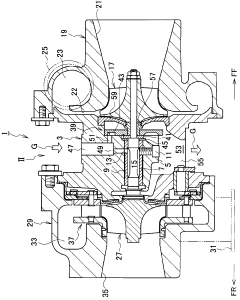
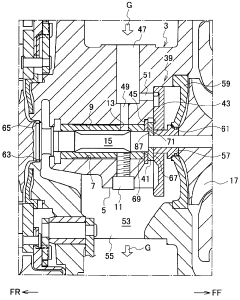
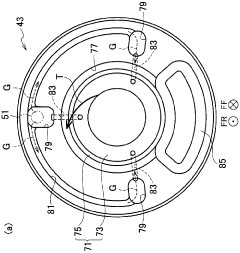
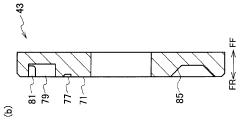
- A thrust bearing structure utilizing a novel configuration with a thrust collar and thrust bearing, where one of the pads has a tapered portion and a land portion, and the lubricating oil's trajectory is determined by centrifugal force, enhancing the wedge effect to support axial thrust loads effectively.
Material Science Advances in Thrust Bearing Applications
The evolution of materials science has fundamentally transformed thrust bearing applications, enabling unprecedented load capacity achievements through innovative material compositions and processing techniques. Advanced ceramic materials, particularly silicon nitride and silicon carbide, have emerged as game-changing solutions for high-load thrust bearing applications. These materials exhibit exceptional hardness, superior wear resistance, and remarkable thermal stability compared to traditional steel bearings, allowing them to maintain structural integrity under extreme loading conditions.
Hybrid bearing configurations represent a significant breakthrough in material science applications, combining ceramic rolling elements with steel races to optimize performance characteristics. This approach leverages the low density and high stiffness of ceramics while maintaining the toughness and manufacturability of steel components. The reduced centrifugal forces from lighter ceramic elements enable higher operational speeds while supporting increased axial loads.
Surface engineering technologies have revolutionized thrust bearing performance through advanced coating systems and surface treatments. Diamond-like carbon coatings, applied through physical vapor deposition processes, provide ultra-low friction coefficients and exceptional wear resistance. These coatings can reduce friction by up to 50% while significantly extending bearing life under high-load conditions. Additionally, ion implantation techniques modify surface properties at the atomic level, creating hardened layers that resist deformation and wear.
Powder metallurgy advancements have enabled the development of specialized bearing steels with tailored microstructures optimized for thrust bearing applications. Through controlled sintering processes and alloying additions, manufacturers can achieve uniform carbide distribution and refined grain structures that enhance load-carrying capacity. These materials demonstrate superior fatigue resistance and dimensional stability under cyclic loading conditions.
Nanostructured materials and nanocomposite lubricants represent the cutting edge of thrust bearing material science. Carbon nanotube-reinforced polymers and graphene-enhanced metallic matrices offer exceptional strength-to-weight ratios and thermal conductivity properties. These materials enable thrust bearings to operate at higher loads while maintaining lower operating temperatures, directly contributing to enhanced load capacity and extended service life in demanding industrial applications.
Hybrid bearing configurations represent a significant breakthrough in material science applications, combining ceramic rolling elements with steel races to optimize performance characteristics. This approach leverages the low density and high stiffness of ceramics while maintaining the toughness and manufacturability of steel components. The reduced centrifugal forces from lighter ceramic elements enable higher operational speeds while supporting increased axial loads.
Surface engineering technologies have revolutionized thrust bearing performance through advanced coating systems and surface treatments. Diamond-like carbon coatings, applied through physical vapor deposition processes, provide ultra-low friction coefficients and exceptional wear resistance. These coatings can reduce friction by up to 50% while significantly extending bearing life under high-load conditions. Additionally, ion implantation techniques modify surface properties at the atomic level, creating hardened layers that resist deformation and wear.
Powder metallurgy advancements have enabled the development of specialized bearing steels with tailored microstructures optimized for thrust bearing applications. Through controlled sintering processes and alloying additions, manufacturers can achieve uniform carbide distribution and refined grain structures that enhance load-carrying capacity. These materials demonstrate superior fatigue resistance and dimensional stability under cyclic loading conditions.
Nanostructured materials and nanocomposite lubricants represent the cutting edge of thrust bearing material science. Carbon nanotube-reinforced polymers and graphene-enhanced metallic matrices offer exceptional strength-to-weight ratios and thermal conductivity properties. These materials enable thrust bearings to operate at higher loads while maintaining lower operating temperatures, directly contributing to enhanced load capacity and extended service life in demanding industrial applications.
Manufacturing Process Optimization for Load Capacity Enhancement
Manufacturing process optimization represents a critical pathway for enhancing thrust bearing load capacity through systematic improvements in production methodologies, material processing techniques, and quality control measures. The optimization approach focuses on refining manufacturing parameters to achieve superior component performance while maintaining cost-effectiveness and production scalability.
Surface finishing processes constitute a fundamental aspect of load capacity enhancement, where advanced machining techniques such as precision grinding, superfinishing, and controlled honing are employed to achieve optimal surface roughness and geometric accuracy. These processes directly influence contact stress distribution and lubrication film formation, thereby improving load-bearing capabilities. Implementation of computer numerical control systems enables precise control over cutting parameters, feed rates, and surface finish quality.
Heat treatment optimization plays a pivotal role in developing enhanced material properties for high-load applications. Advanced thermal processing techniques, including controlled atmosphere hardening, case hardening, and stress relieving procedures, are tailored to achieve optimal hardness gradients and residual stress patterns. These treatments significantly improve fatigue resistance and contact stress tolerance, enabling bearings to withstand higher operational loads.
Quality control integration throughout the manufacturing process ensures consistent achievement of enhanced load capacity specifications. Statistical process control methods, combined with advanced metrology systems, monitor critical parameters such as dimensional accuracy, surface integrity, and material properties. Real-time feedback mechanisms enable immediate process adjustments to maintain optimal manufacturing conditions.
Advanced manufacturing technologies, including additive manufacturing for specialized components and precision forging techniques, offer new possibilities for creating optimized bearing geometries that traditional methods cannot achieve. These technologies enable the production of components with tailored material distributions and enhanced structural characteristics specifically designed for high-load applications.
Process parameter optimization through design of experiments methodologies systematically identifies optimal combinations of manufacturing variables to maximize load capacity while minimizing production costs and cycle times.
Surface finishing processes constitute a fundamental aspect of load capacity enhancement, where advanced machining techniques such as precision grinding, superfinishing, and controlled honing are employed to achieve optimal surface roughness and geometric accuracy. These processes directly influence contact stress distribution and lubrication film formation, thereby improving load-bearing capabilities. Implementation of computer numerical control systems enables precise control over cutting parameters, feed rates, and surface finish quality.
Heat treatment optimization plays a pivotal role in developing enhanced material properties for high-load applications. Advanced thermal processing techniques, including controlled atmosphere hardening, case hardening, and stress relieving procedures, are tailored to achieve optimal hardness gradients and residual stress patterns. These treatments significantly improve fatigue resistance and contact stress tolerance, enabling bearings to withstand higher operational loads.
Quality control integration throughout the manufacturing process ensures consistent achievement of enhanced load capacity specifications. Statistical process control methods, combined with advanced metrology systems, monitor critical parameters such as dimensional accuracy, surface integrity, and material properties. Real-time feedback mechanisms enable immediate process adjustments to maintain optimal manufacturing conditions.
Advanced manufacturing technologies, including additive manufacturing for specialized components and precision forging techniques, offer new possibilities for creating optimized bearing geometries that traditional methods cannot achieve. These technologies enable the production of components with tailored material distributions and enhanced structural characteristics specifically designed for high-load applications.
Process parameter optimization through design of experiments methodologies systematically identifies optimal combinations of manufacturing variables to maximize load capacity while minimizing production costs and cycle times.
Unlock deeper insights with PatSnap Eureka Quick Research — get a full tech report to explore trends and direct your research. Try now!
Generate Your Research Report Instantly with AI Agent
Supercharge your innovation with PatSnap Eureka AI Agent Platform!