

Understanding Polarization Effects in Waveguide Gratings
APR 14, 20269 MIN READ
Generate Your Research Report Instantly with AI Agent
Patsnap Eureka helps you evaluate technical feasibility & market potential.
Waveguide Grating Polarization Background and Objectives
Waveguide gratings represent a fundamental class of photonic devices that have evolved significantly since their initial development in the 1970s. These structures combine the light-guiding properties of optical waveguides with the wavelength-selective characteristics of diffraction gratings, creating versatile components for optical signal processing. The historical progression began with simple surface-relief gratings and has advanced to sophisticated distributed feedback structures, fiber Bragg gratings, and integrated photonic circuits.
The evolution of waveguide grating technology has been driven by the increasing demand for precise optical control in telecommunications, sensing applications, and photonic integrated circuits. Early implementations focused primarily on achieving basic wavelength selectivity, but modern applications require sophisticated manipulation of light's polarization properties. This shift reflects the growing recognition that polarization control is essential for optimizing device performance and enabling advanced functionalities.
Current technological trends indicate a strong movement toward polarization-sensitive and polarization-independent designs, depending on specific application requirements. The development of polarization beam splitters, polarization rotators, and polarization-maintaining components has become increasingly critical as optical systems become more complex and performance-demanding.
The primary objective of understanding polarization effects in waveguide gratings centers on achieving predictable and controllable polarization behavior across different operational conditions. This encompasses developing comprehensive theoretical models that accurately describe how transverse electric and transverse magnetic modes interact with grating structures under various geometric configurations and material compositions.
A key technical goal involves establishing design methodologies that enable engineers to tailor polarization responses for specific applications. This includes creating polarization-independent devices for applications requiring stable performance regardless of input polarization states, as well as developing highly polarization-sensitive components for applications such as polarization division multiplexing and optical sensing.
The advancement of computational modeling capabilities represents another crucial objective, focusing on developing simulation tools that can accurately predict polarization-dependent losses, coupling efficiencies, and spectral responses. These tools must account for fabrication tolerances and environmental variations to ensure reliable device performance in practical implementations.
Furthermore, the integration of polarization control with other optical functionalities, such as wavelength filtering and beam steering, represents a significant technological target. This multi-functional approach aims to reduce system complexity while enhancing overall performance, particularly in space-constrained applications like photonic integrated circuits and compact optical systems.
The evolution of waveguide grating technology has been driven by the increasing demand for precise optical control in telecommunications, sensing applications, and photonic integrated circuits. Early implementations focused primarily on achieving basic wavelength selectivity, but modern applications require sophisticated manipulation of light's polarization properties. This shift reflects the growing recognition that polarization control is essential for optimizing device performance and enabling advanced functionalities.
Current technological trends indicate a strong movement toward polarization-sensitive and polarization-independent designs, depending on specific application requirements. The development of polarization beam splitters, polarization rotators, and polarization-maintaining components has become increasingly critical as optical systems become more complex and performance-demanding.
The primary objective of understanding polarization effects in waveguide gratings centers on achieving predictable and controllable polarization behavior across different operational conditions. This encompasses developing comprehensive theoretical models that accurately describe how transverse electric and transverse magnetic modes interact with grating structures under various geometric configurations and material compositions.
A key technical goal involves establishing design methodologies that enable engineers to tailor polarization responses for specific applications. This includes creating polarization-independent devices for applications requiring stable performance regardless of input polarization states, as well as developing highly polarization-sensitive components for applications such as polarization division multiplexing and optical sensing.
The advancement of computational modeling capabilities represents another crucial objective, focusing on developing simulation tools that can accurately predict polarization-dependent losses, coupling efficiencies, and spectral responses. These tools must account for fabrication tolerances and environmental variations to ensure reliable device performance in practical implementations.
Furthermore, the integration of polarization control with other optical functionalities, such as wavelength filtering and beam steering, represents a significant technological target. This multi-functional approach aims to reduce system complexity while enhancing overall performance, particularly in space-constrained applications like photonic integrated circuits and compact optical systems.
Market Demand for Polarization-Controlled Optical Devices
The global optical communications market continues to experience robust growth, driven by increasing bandwidth demands from data centers, 5G networks, and emerging applications such as autonomous vehicles and IoT devices. Within this expanding ecosystem, polarization-controlled optical devices represent a critical segment that addresses fundamental challenges in signal integrity and system performance. The demand for these specialized components stems from the inherent polarization sensitivity of optical systems and the need for precise control over light propagation characteristics.
Telecommunications infrastructure represents the largest market segment for polarization-controlled devices, where waveguide gratings play essential roles in wavelength division multiplexing systems, optical add-drop multiplexers, and polarization beam splitters. Service providers are increasingly deploying dense wavelength division multiplexing networks to maximize fiber capacity, creating substantial demand for components that can manage polarization effects while maintaining signal quality across multiple channels.
Data center interconnects constitute another rapidly growing application area, where polarization-dependent loss and polarization mode dispersion can significantly impact high-speed optical links. The transition to higher data rates, particularly 400G and 800G Ethernet standards, has intensified requirements for polarization control components that can maintain signal integrity over extended transmission distances. Cloud service providers are driving demand for cost-effective solutions that combine polarization management with other optical functions.
The sensing and measurement instrumentation market presents emerging opportunities for polarization-controlled waveguide gratings. Applications in fiber-optic sensing systems, particularly for structural health monitoring, oil and gas exploration, and aerospace applications, require precise polarization control to achieve accurate measurements. These specialized applications often command premium pricing due to their stringent performance requirements and lower volume production.
Consumer electronics and automotive sectors are beginning to adopt polarization-controlled optical devices for LiDAR systems, augmented reality displays, and advanced driver assistance systems. While currently representing smaller market volumes, these applications are projected to experience significant growth as autonomous vehicle technologies mature and AR/VR devices achieve mainstream adoption.
Regional demand patterns show strong growth in Asia-Pacific markets, particularly driven by telecommunications infrastructure expansion and data center construction. North American and European markets demonstrate steady demand focused on technology upgrades and next-generation network deployments. The increasing emphasis on energy efficiency and reduced power consumption in optical systems is creating additional market drivers for advanced polarization control solutions that can minimize insertion losses while maintaining performance specifications.
Telecommunications infrastructure represents the largest market segment for polarization-controlled devices, where waveguide gratings play essential roles in wavelength division multiplexing systems, optical add-drop multiplexers, and polarization beam splitters. Service providers are increasingly deploying dense wavelength division multiplexing networks to maximize fiber capacity, creating substantial demand for components that can manage polarization effects while maintaining signal quality across multiple channels.
Data center interconnects constitute another rapidly growing application area, where polarization-dependent loss and polarization mode dispersion can significantly impact high-speed optical links. The transition to higher data rates, particularly 400G and 800G Ethernet standards, has intensified requirements for polarization control components that can maintain signal integrity over extended transmission distances. Cloud service providers are driving demand for cost-effective solutions that combine polarization management with other optical functions.
The sensing and measurement instrumentation market presents emerging opportunities for polarization-controlled waveguide gratings. Applications in fiber-optic sensing systems, particularly for structural health monitoring, oil and gas exploration, and aerospace applications, require precise polarization control to achieve accurate measurements. These specialized applications often command premium pricing due to their stringent performance requirements and lower volume production.
Consumer electronics and automotive sectors are beginning to adopt polarization-controlled optical devices for LiDAR systems, augmented reality displays, and advanced driver assistance systems. While currently representing smaller market volumes, these applications are projected to experience significant growth as autonomous vehicle technologies mature and AR/VR devices achieve mainstream adoption.
Regional demand patterns show strong growth in Asia-Pacific markets, particularly driven by telecommunications infrastructure expansion and data center construction. North American and European markets demonstrate steady demand focused on technology upgrades and next-generation network deployments. The increasing emphasis on energy efficiency and reduced power consumption in optical systems is creating additional market drivers for advanced polarization control solutions that can minimize insertion losses while maintaining performance specifications.
Current Polarization Challenges in Waveguide Gratings
Waveguide gratings face significant polarization-related challenges that fundamentally limit their performance in modern photonic applications. The primary issue stems from the inherent birefringence of waveguide structures, which causes different polarization states to experience varying effective refractive indices. This phenomenon leads to polarization-dependent wavelength shifts, where transverse electric (TE) and transverse magnetic (TM) modes exhibit distinct Bragg resonance conditions, resulting in spectral splitting and reduced device efficiency.
Modal birefringence represents one of the most critical constraints in waveguide grating design. The asymmetric cross-sectional geometry of typical silicon-on-insulator waveguides creates substantial differences between TE and TM mode propagation constants. This birefringence can reach values exceeding 0.1 in high-contrast platforms, causing polarization-dependent losses and limiting the operational bandwidth of grating-based devices.
Coupling efficiency variations between polarization states pose another significant challenge. The overlap integrals between guided modes and radiation modes differ substantially for TE and TM polarizations due to their distinct field distributions. This disparity results in unequal coupling strengths, leading to polarization-dependent insertion losses that can exceed 3 dB in conventional grating couplers, severely impacting system performance.
Fabrication-induced polarization sensitivity further complicates waveguide grating implementation. Process variations in etching depth, sidewall roughness, and dimensional control introduce additional birefringence that varies across the wafer. These manufacturing tolerances create unpredictable polarization responses, making it difficult to achieve consistent device performance in large-scale production environments.
Temperature-dependent polarization drift represents an emerging concern as photonic systems operate across wider environmental ranges. The thermo-optic coefficients differ between polarization modes, causing temperature-induced spectral shifts that vary with polarization state. This thermal sensitivity can lead to system instability and requires complex compensation mechanisms.
Cross-polarization coupling in grating structures introduces unwanted polarization conversion that degrades signal quality. Structural asymmetries and fabrication imperfections can cause energy transfer between orthogonal polarization states, resulting in polarization-dependent crosstalk and reduced extinction ratios in polarization-sensitive applications.
Modal birefringence represents one of the most critical constraints in waveguide grating design. The asymmetric cross-sectional geometry of typical silicon-on-insulator waveguides creates substantial differences between TE and TM mode propagation constants. This birefringence can reach values exceeding 0.1 in high-contrast platforms, causing polarization-dependent losses and limiting the operational bandwidth of grating-based devices.
Coupling efficiency variations between polarization states pose another significant challenge. The overlap integrals between guided modes and radiation modes differ substantially for TE and TM polarizations due to their distinct field distributions. This disparity results in unequal coupling strengths, leading to polarization-dependent insertion losses that can exceed 3 dB in conventional grating couplers, severely impacting system performance.
Fabrication-induced polarization sensitivity further complicates waveguide grating implementation. Process variations in etching depth, sidewall roughness, and dimensional control introduce additional birefringence that varies across the wafer. These manufacturing tolerances create unpredictable polarization responses, making it difficult to achieve consistent device performance in large-scale production environments.
Temperature-dependent polarization drift represents an emerging concern as photonic systems operate across wider environmental ranges. The thermo-optic coefficients differ between polarization modes, causing temperature-induced spectral shifts that vary with polarization state. This thermal sensitivity can lead to system instability and requires complex compensation mechanisms.
Cross-polarization coupling in grating structures introduces unwanted polarization conversion that degrades signal quality. Structural asymmetries and fabrication imperfections can cause energy transfer between orthogonal polarization states, resulting in polarization-dependent crosstalk and reduced extinction ratios in polarization-sensitive applications.
Existing Polarization Control Solutions in Gratings
01 Polarization-dependent diffraction efficiency in waveguide gratings
Waveguide gratings exhibit different diffraction efficiencies for different polarization states of incident light. This polarization dependence can be utilized or compensated in optical systems. The grating structure parameters such as depth, period, and duty cycle can be optimized to achieve desired polarization-selective behavior. This effect is particularly important in applications requiring polarization control or separation.- Polarization-dependent diffraction efficiency in waveguide gratings: Waveguide gratings exhibit different diffraction efficiencies for different polarization states of incident light. This polarization dependence arises from the interaction between the electromagnetic field and the grating structure. The grating parameters such as depth, period, and duty cycle can be optimized to control the polarization-dependent response. This effect is particularly important in optical communication systems and display applications where specific polarization states need to be selectively diffracted or transmitted.
- Polarization beam splitting using waveguide gratings: Waveguide gratings can be designed to function as polarization beam splitters, separating orthogonal polarization components into different diffraction orders or propagation directions. This is achieved by engineering the grating geometry and refractive index profile to create polarization-selective coupling conditions. Such devices are useful in optical systems requiring polarization management, including interferometers, sensors, and augmented reality displays.
- Compensation and reduction of polarization effects in waveguide gratings: Various techniques have been developed to minimize unwanted polarization effects in waveguide gratings. These include the use of specific grating geometries, multi-layer structures, or compensation elements that balance the polarization-dependent responses. By reducing polarization sensitivity, these approaches enable more uniform performance across different polarization states, which is critical for applications requiring polarization-independent operation such as wavelength division multiplexing systems and broadband optical devices.
- Polarization conversion and manipulation in waveguide gratings: Waveguide gratings can be configured to convert between different polarization states or rotate the polarization orientation of propagating light. This functionality is achieved through careful design of the grating structure and waveguide geometry to create specific phase relationships between polarization components. Applications include polarization controllers, optical isolators, and devices for quantum optics where precise polarization manipulation is required.
- Polarization-selective coupling in waveguide grating couplers: Waveguide grating couplers can be designed to preferentially couple light of specific polarization states between free space and guided modes. This polarization selectivity is determined by the grating structure, waveguide properties, and coupling geometry. Such couplers are essential in integrated photonic circuits, fiber-to-chip coupling interfaces, and optical sensing systems where controlled polarization coupling is necessary for optimal system performance.
02 Polarization beam splitting using waveguide gratings
Waveguide gratings can be designed to function as polarization beam splitters by exploiting the differential response to orthogonal polarization states. The grating structure can be engineered to direct different polarization components into separate diffraction orders or propagation directions. This enables compact polarization management in integrated optical devices and systems without requiring additional polarizing elements.Expand Specific Solutions03 Compensation of polarization effects in waveguide grating couplers
Various techniques can be employed to reduce unwanted polarization sensitivity in waveguide grating couplers. These include the use of specific grating geometries, multi-layer structures, or blazed grating profiles that equalize the coupling efficiency for different polarization states. Compensation methods enable polarization-independent operation in applications where uniform response across polarizations is required.Expand Specific Solutions04 Polarization conversion using waveguide grating structures
Waveguide gratings can be configured to convert between different polarization states through carefully designed periodic structures. The grating parameters and waveguide geometry can be tailored to achieve efficient polarization rotation or conversion between linear and circular polarization states. This functionality is valuable in optical communication systems and polarization-sensitive detection applications.Expand Specific Solutions05 Polarization-selective waveguide grating filters
Waveguide gratings can be designed as wavelength-selective filters with polarization-dependent characteristics. By controlling the grating structure and waveguide properties, specific wavelength bands can be filtered differently for orthogonal polarization states. This enables simultaneous wavelength and polarization filtering in compact integrated optical devices for applications in spectroscopy and optical communications.Expand Specific Solutions
Key Players in Waveguide Grating Industry
The waveguide grating polarization effects field represents a mature technology sector experiencing steady growth across telecommunications, display, and photonics applications. The industry demonstrates significant market expansion driven by increasing demand for optical communication systems, augmented reality devices, and advanced display technologies. The competitive landscape features a diverse ecosystem spanning established semiconductor manufacturers like Taiwan Semiconductor Manufacturing Co. and Sumitomo Electric Industries, specialized optics companies including MOXTEK and DigiLens, technology giants such as Google and Huawei Technologies, and leading research institutions like MIT and Zhejiang University. Technology maturity varies significantly across applications, with telecommunications-focused solutions reaching commercial deployment while emerging AR/VR applications remain in advanced development phases. The presence of both multinational corporations and specialized startups indicates a dynamic market with opportunities for innovation and differentiation in polarization control technologies.
Google LLC
Technical Solution: Google has developed advanced computational methods for analyzing polarization-dependent loss (PDL) and polarization mode dispersion (PMD) in waveguide gratings. Their approach utilizes machine learning algorithms to predict polarization behavior in silicon photonic waveguides, incorporating finite-difference time-domain (FDTD) simulations to model the interaction between TE and TM modes in grating structures. The company has implemented polarization diversity schemes in their optical interconnects, using polarization beam splitters integrated with waveguide gratings to achieve polarization-independent operation. Their research focuses on minimizing polarization crosstalk through optimized grating geometries and advanced fabrication techniques on silicon-on-insulator platforms.
Strengths: Strong computational resources and AI capabilities for complex polarization modeling, extensive experience in silicon photonics integration. Weaknesses: Limited focus on specialized optical components, primarily oriented toward data center applications rather than broader photonic systems.
Massachusetts Institute of Technology
Technical Solution: MIT has pioneered fundamental research in understanding polarization effects in waveguide gratings through comprehensive theoretical modeling and experimental validation. Their work includes development of coupled-mode theory extensions for polarization-dependent grating behavior, incorporating both linear and nonlinear polarization effects. The institute has created novel polarization-sensitive photonic crystal waveguide gratings with engineered anisotropy, utilizing advanced nanofabrication techniques to control polarization states at the nanoscale. MIT's research encompasses polarization-dependent wavelength filtering using chirped waveguide gratings and development of polarization-entangled photon sources based on nonlinear waveguide grating structures. Their theoretical framework includes comprehensive analysis of polarization rotation mechanisms in periodic waveguide structures and development of design methodologies for polarization-independent grating devices.
Strengths: Leading fundamental research capabilities, strong theoretical foundation, access to advanced nanofabrication facilities, excellent collaboration with industry partners. Weaknesses: Academic focus may limit commercial scalability, longer development timelines compared to industry, limited manufacturing capabilities for large-scale production.
Core Innovations in Polarization-Dependent Grating Design
Waveguide with polarization volume hologram grating
PatentWO2023114113A1
Innovation
- An optical waveguide with a polarization volume hologram (PVH) grating is used, comprising a substrate with opposing outer surfaces and a PVH disposed in or upon the substrate, configured to transmit light of one polarization while diffracting light of orthogonal polarization, enhancing image quality and reducing leakage through a graded-birefringence stack and anti-reflection coatings.


Polarization splitting grating couplers
PatentInactiveUS20060008207A1
Innovation
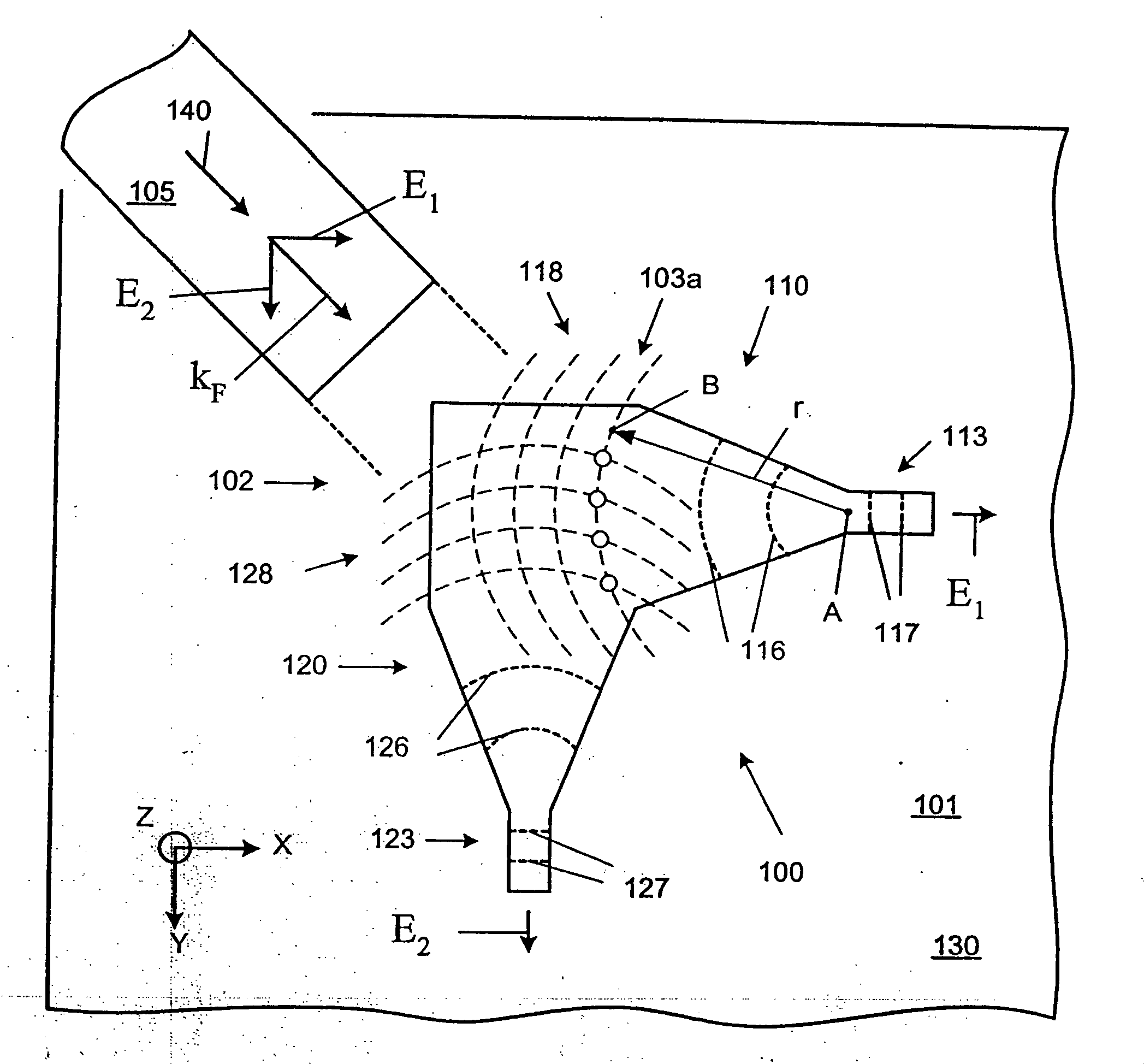
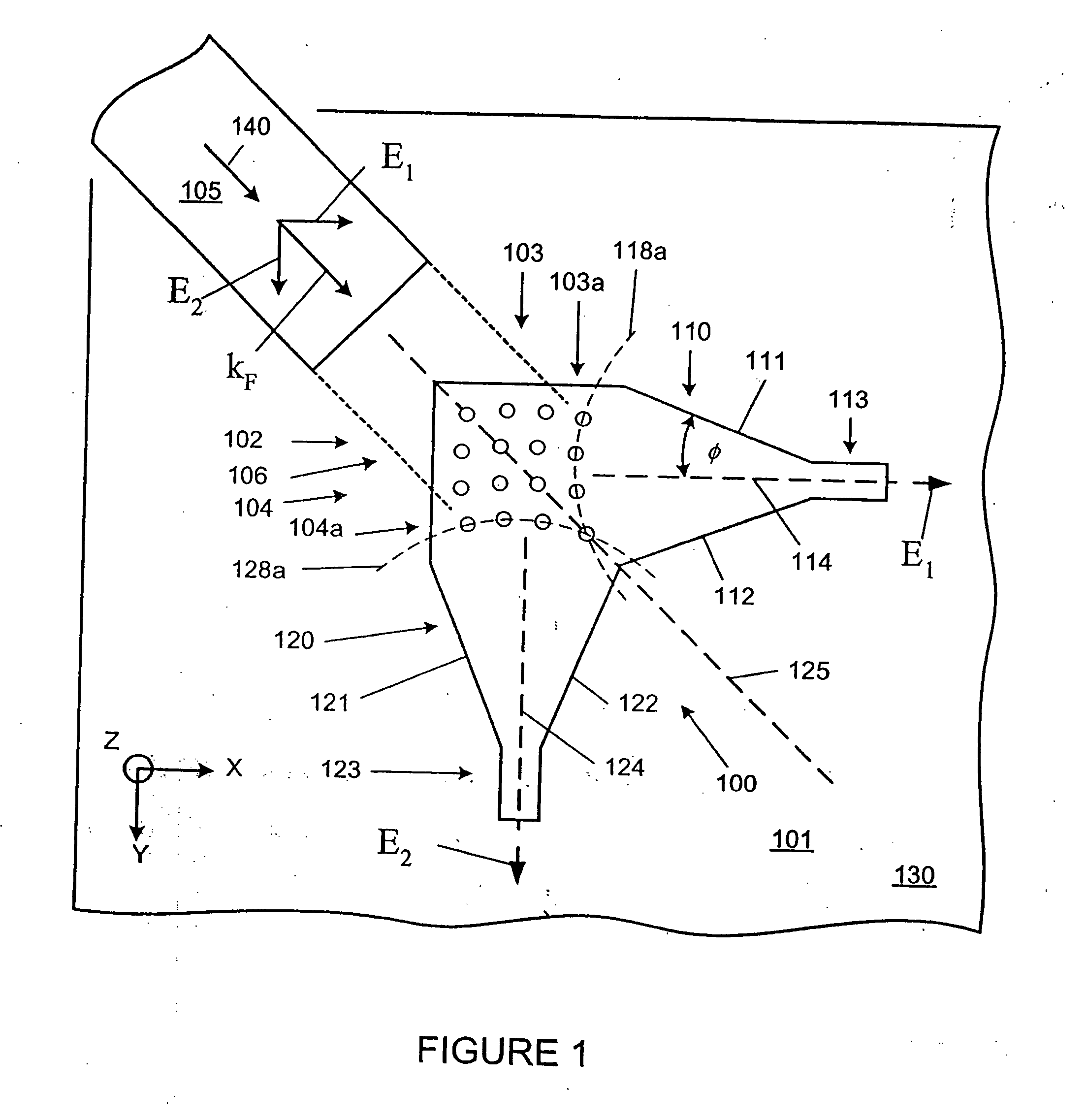
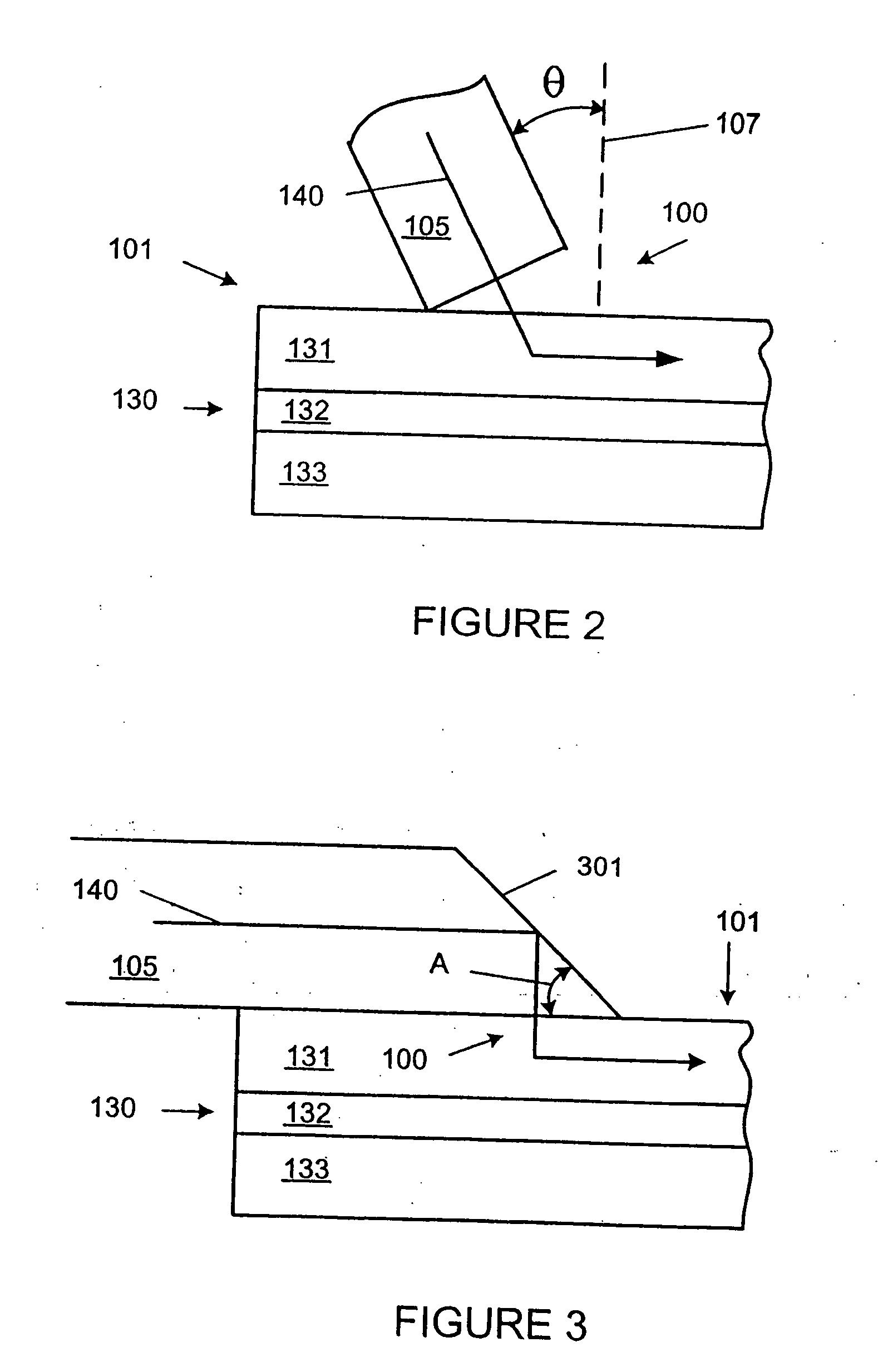
- A polarization splitting grating coupler (PSGC) is designed to separate optical signals into two orthogonal polarizations and direct them to separate waveguides on an integrated circuit, allowing for effective processing and connection, while also operating in reverse to couple signals from the integrated circuit to an optical fiber.

Fabrication Standards for Polarization-Sensitive Devices
The fabrication of polarization-sensitive waveguide grating devices requires adherence to stringent manufacturing standards that directly impact device performance and reliability. These standards encompass dimensional tolerances, material specifications, and process control parameters that are critical for achieving predictable polarization behavior.
Dimensional accuracy represents the most fundamental fabrication requirement for polarization-sensitive devices. Grating period variations must be maintained within ±5 nanometers across the entire device area to ensure consistent polarization splitting ratios. Ridge width tolerances typically require sub-10 nanometer precision, as even minor deviations can introduce unwanted polarization coupling. Sidewall angle control becomes particularly critical, with specifications demanding verticality within ±2 degrees to minimize polarization-dependent loss variations.
Surface roughness standards for polarization-sensitive gratings are more stringent than conventional photonic devices. Root mean square roughness values must remain below 1 nanometer on all optical surfaces to prevent polarization scrambling effects. This requirement extends to both top surfaces and etched sidewalls, necessitating advanced plasma etching techniques with carefully optimized chemistry and power parameters.
Material quality specifications focus on birefringence control and stress management. Silicon-on-insulator substrates must exhibit crystallographic orientation accuracy within 0.1 degrees to ensure predictable stress-induced birefringence. Buried oxide layer thickness uniformity requires control within ±2 nanometers across wafer areas to maintain consistent modal birefringence properties.
Process repeatability standards mandate statistical process control with capability indices exceeding 1.33 for critical dimensions. Temperature control during fabrication steps must maintain stability within ±0.5°C, particularly during thermal oxidation and annealing processes that affect material stress states. Plasma etching parameters require real-time monitoring with feedback control systems to ensure consistent etch profiles across production runs.
Quality assurance protocols incorporate specialized metrology techniques including polarization-resolved optical measurements and stress characterization using photoelastic analysis. These standards collectively ensure that fabricated devices meet the demanding performance requirements for polarization-sensitive applications while maintaining manufacturing scalability and cost-effectiveness.
Dimensional accuracy represents the most fundamental fabrication requirement for polarization-sensitive devices. Grating period variations must be maintained within ±5 nanometers across the entire device area to ensure consistent polarization splitting ratios. Ridge width tolerances typically require sub-10 nanometer precision, as even minor deviations can introduce unwanted polarization coupling. Sidewall angle control becomes particularly critical, with specifications demanding verticality within ±2 degrees to minimize polarization-dependent loss variations.
Surface roughness standards for polarization-sensitive gratings are more stringent than conventional photonic devices. Root mean square roughness values must remain below 1 nanometer on all optical surfaces to prevent polarization scrambling effects. This requirement extends to both top surfaces and etched sidewalls, necessitating advanced plasma etching techniques with carefully optimized chemistry and power parameters.
Material quality specifications focus on birefringence control and stress management. Silicon-on-insulator substrates must exhibit crystallographic orientation accuracy within 0.1 degrees to ensure predictable stress-induced birefringence. Buried oxide layer thickness uniformity requires control within ±2 nanometers across wafer areas to maintain consistent modal birefringence properties.
Process repeatability standards mandate statistical process control with capability indices exceeding 1.33 for critical dimensions. Temperature control during fabrication steps must maintain stability within ±0.5°C, particularly during thermal oxidation and annealing processes that affect material stress states. Plasma etching parameters require real-time monitoring with feedback control systems to ensure consistent etch profiles across production runs.
Quality assurance protocols incorporate specialized metrology techniques including polarization-resolved optical measurements and stress characterization using photoelastic analysis. These standards collectively ensure that fabricated devices meet the demanding performance requirements for polarization-sensitive applications while maintaining manufacturing scalability and cost-effectiveness.
Integration Challenges in Photonic Circuit Applications
The integration of waveguide gratings into photonic circuits presents significant challenges that directly impact the practical implementation of polarization-sensitive devices. One of the primary obstacles lies in the dimensional precision required during fabrication processes. Waveguide gratings demand nanometer-scale accuracy in grating period, duty cycle, and sidewall verticality to maintain consistent polarization behavior across the entire photonic circuit. Even minor variations in these parameters can lead to substantial polarization-dependent losses and unwanted coupling between TE and TM modes.
Thermal management emerges as another critical integration challenge, particularly in dense photonic circuits where multiple components generate heat. Temperature fluctuations cause refractive index variations that affect the effective indices of different polarization modes differently, leading to wavelength drift and polarization instability. This thermal sensitivity becomes more pronounced when waveguide gratings are integrated alongside active components such as modulators and photodetectors.
The complexity of routing and interconnecting polarization-sensitive waveguide gratings within photonic circuits poses additional difficulties. Traditional bend structures and Y-junctions can introduce polarization-dependent losses and crosstalk, compromising the performance of grating-based devices. Maintaining polarization purity throughout the circuit requires careful design of transition regions and the implementation of specialized polarization-maintaining waveguide structures.
Material compatibility issues further complicate integration efforts. Different materials used for various photonic components may exhibit distinct thermal expansion coefficients and stress characteristics, leading to mechanical strain that affects polarization properties. Silicon-on-insulator platforms, while widely adopted, present limitations in terms of birefringence control and polarization handling compared to specialized materials like lithium niobate or indium phosphide.
Packaging and fiber coupling represent final integration hurdles, as maintaining polarization alignment between on-chip gratings and external optical systems requires sophisticated alignment mechanisms and polarization-maintaining fiber connections, significantly increasing system complexity and cost.
Thermal management emerges as another critical integration challenge, particularly in dense photonic circuits where multiple components generate heat. Temperature fluctuations cause refractive index variations that affect the effective indices of different polarization modes differently, leading to wavelength drift and polarization instability. This thermal sensitivity becomes more pronounced when waveguide gratings are integrated alongside active components such as modulators and photodetectors.
The complexity of routing and interconnecting polarization-sensitive waveguide gratings within photonic circuits poses additional difficulties. Traditional bend structures and Y-junctions can introduce polarization-dependent losses and crosstalk, compromising the performance of grating-based devices. Maintaining polarization purity throughout the circuit requires careful design of transition regions and the implementation of specialized polarization-maintaining waveguide structures.
Material compatibility issues further complicate integration efforts. Different materials used for various photonic components may exhibit distinct thermal expansion coefficients and stress characteristics, leading to mechanical strain that affects polarization properties. Silicon-on-insulator platforms, while widely adopted, present limitations in terms of birefringence control and polarization handling compared to specialized materials like lithium niobate or indium phosphide.
Packaging and fiber coupling represent final integration hurdles, as maintaining polarization alignment between on-chip gratings and external optical systems requires sophisticated alignment mechanisms and polarization-maintaining fiber connections, significantly increasing system complexity and cost.
Unlock deeper insights with Patsnap Eureka Quick Research — get a full tech report to explore trends and direct your research. Try now!
Generate Your Research Report Instantly with AI Agent
Supercharge your innovation with Patsnap Eureka AI Agent Platform!