

Utilizing sodium silicate in environmental remediation
AUG 21, 20259 MIN READ
Generate Your Research Report Instantly with AI Agent
PatSnap Eureka helps you evaluate technical feasibility & market potential.
Sodium Silicate Remediation Background and Objectives
Sodium silicate, also known as water glass or liquid glass, has emerged as a versatile and environmentally friendly solution for various remediation applications. The use of sodium silicate in environmental remediation has gained significant attention in recent years due to its unique properties and potential to address a wide range of contamination issues.
The history of sodium silicate dates back to the 19th century when it was first produced on an industrial scale. However, its application in environmental remediation is a more recent development, driven by the growing need for sustainable and cost-effective solutions to address environmental pollution. The increasing focus on environmental protection and the stringent regulations imposed by governments worldwide have further accelerated the adoption of sodium silicate-based remediation techniques.
In the context of environmental remediation, sodium silicate has demonstrated remarkable efficacy in treating various types of contamination, including heavy metals, organic pollutants, and radioactive materials. Its ability to form stable and insoluble compounds with contaminants makes it particularly useful in soil and groundwater remediation projects. Additionally, sodium silicate's non-toxic nature and biodegradability contribute to its appeal as an environmentally friendly remediation agent.
The primary objective of utilizing sodium silicate in environmental remediation is to immobilize and stabilize contaminants, preventing their migration and reducing their bioavailability. This approach aims to minimize the environmental and health risks associated with polluted sites, ultimately facilitating the restoration of contaminated areas to their natural state or enabling their safe reuse for various purposes.
Another key objective is to develop cost-effective and scalable remediation solutions that can be applied to a wide range of contamination scenarios. Sodium silicate's versatility and relatively low cost make it an attractive option for large-scale remediation projects, particularly in developing countries where resources for environmental cleanup may be limited.
Furthermore, the use of sodium silicate in environmental remediation aligns with the principles of green chemistry and sustainable development. By employing a naturally occurring and abundant material, this approach reduces the reliance on synthetic chemicals and minimizes the environmental footprint of remediation activities. This aspect is particularly important as global efforts to combat climate change and promote sustainable practices continue to gain momentum.
As research in this field progresses, the objectives of sodium silicate remediation are expanding to include the development of novel application methods, optimization of treatment processes, and exploration of synergistic effects with other remediation techniques. These advancements aim to enhance the efficiency and effectiveness of sodium silicate-based remediation, ultimately contributing to the broader goal of environmental protection and restoration.
The history of sodium silicate dates back to the 19th century when it was first produced on an industrial scale. However, its application in environmental remediation is a more recent development, driven by the growing need for sustainable and cost-effective solutions to address environmental pollution. The increasing focus on environmental protection and the stringent regulations imposed by governments worldwide have further accelerated the adoption of sodium silicate-based remediation techniques.
In the context of environmental remediation, sodium silicate has demonstrated remarkable efficacy in treating various types of contamination, including heavy metals, organic pollutants, and radioactive materials. Its ability to form stable and insoluble compounds with contaminants makes it particularly useful in soil and groundwater remediation projects. Additionally, sodium silicate's non-toxic nature and biodegradability contribute to its appeal as an environmentally friendly remediation agent.
The primary objective of utilizing sodium silicate in environmental remediation is to immobilize and stabilize contaminants, preventing their migration and reducing their bioavailability. This approach aims to minimize the environmental and health risks associated with polluted sites, ultimately facilitating the restoration of contaminated areas to their natural state or enabling their safe reuse for various purposes.
Another key objective is to develop cost-effective and scalable remediation solutions that can be applied to a wide range of contamination scenarios. Sodium silicate's versatility and relatively low cost make it an attractive option for large-scale remediation projects, particularly in developing countries where resources for environmental cleanup may be limited.
Furthermore, the use of sodium silicate in environmental remediation aligns with the principles of green chemistry and sustainable development. By employing a naturally occurring and abundant material, this approach reduces the reliance on synthetic chemicals and minimizes the environmental footprint of remediation activities. This aspect is particularly important as global efforts to combat climate change and promote sustainable practices continue to gain momentum.
As research in this field progresses, the objectives of sodium silicate remediation are expanding to include the development of novel application methods, optimization of treatment processes, and exploration of synergistic effects with other remediation techniques. These advancements aim to enhance the efficiency and effectiveness of sodium silicate-based remediation, ultimately contributing to the broader goal of environmental protection and restoration.
Environmental Remediation Market Analysis
The environmental remediation market has been experiencing significant growth in recent years, driven by increasing awareness of environmental issues, stricter regulations, and the need to address legacy contamination. The global market for environmental remediation was valued at approximately $85 billion in 2020 and is projected to reach $128 billion by 2025, growing at a CAGR of 8.5% during the forecast period.
Soil remediation represents the largest segment of the market, accounting for over 40% of the total revenue. This is primarily due to the widespread contamination of soil from industrial activities, agricultural practices, and improper waste disposal. Water remediation follows closely, driven by the growing concerns over water scarcity and the need to treat contaminated groundwater and surface water sources.
The market is geographically diverse, with North America holding the largest share, followed by Europe and Asia-Pacific. The United States, in particular, has a mature environmental remediation market due to its long history of industrial activities and stringent environmental regulations. However, emerging economies in Asia-Pacific and Latin America are expected to witness the highest growth rates in the coming years, fueled by rapid industrialization and increasing environmental awareness.
Key drivers of the environmental remediation market include government initiatives and regulations, growing public awareness of environmental issues, and technological advancements in remediation techniques. The implementation of stringent environmental laws and regulations, such as the Comprehensive Environmental Response, Compensation, and Liability Act (CERCLA) in the United States, has been a significant factor in driving market growth.
The market is characterized by the presence of both large multinational corporations and small to medium-sized specialized firms. Major players in the industry include AECOM, Clean Harbors, Inc., Golder Associates, and DEME Group. These companies offer a wide range of remediation services, including site assessment, treatment technologies, and long-term monitoring.
In recent years, there has been a growing trend towards the adoption of sustainable and cost-effective remediation technologies. This has led to increased interest in in-situ remediation methods, which treat contaminants on-site without excavation or removal of soil or groundwater. Bioremediation and phytoremediation have gained popularity as environmentally friendly alternatives to traditional chemical treatments.
The utilization of sodium silicate in environmental remediation represents a promising area within this market. Sodium silicate has shown potential in various remediation applications, including soil stabilization, heavy metal immobilization, and groundwater treatment. Its versatility and relatively low cost make it an attractive option for addressing a wide range of environmental contaminants.
Soil remediation represents the largest segment of the market, accounting for over 40% of the total revenue. This is primarily due to the widespread contamination of soil from industrial activities, agricultural practices, and improper waste disposal. Water remediation follows closely, driven by the growing concerns over water scarcity and the need to treat contaminated groundwater and surface water sources.
The market is geographically diverse, with North America holding the largest share, followed by Europe and Asia-Pacific. The United States, in particular, has a mature environmental remediation market due to its long history of industrial activities and stringent environmental regulations. However, emerging economies in Asia-Pacific and Latin America are expected to witness the highest growth rates in the coming years, fueled by rapid industrialization and increasing environmental awareness.
Key drivers of the environmental remediation market include government initiatives and regulations, growing public awareness of environmental issues, and technological advancements in remediation techniques. The implementation of stringent environmental laws and regulations, such as the Comprehensive Environmental Response, Compensation, and Liability Act (CERCLA) in the United States, has been a significant factor in driving market growth.
The market is characterized by the presence of both large multinational corporations and small to medium-sized specialized firms. Major players in the industry include AECOM, Clean Harbors, Inc., Golder Associates, and DEME Group. These companies offer a wide range of remediation services, including site assessment, treatment technologies, and long-term monitoring.
In recent years, there has been a growing trend towards the adoption of sustainable and cost-effective remediation technologies. This has led to increased interest in in-situ remediation methods, which treat contaminants on-site without excavation or removal of soil or groundwater. Bioremediation and phytoremediation have gained popularity as environmentally friendly alternatives to traditional chemical treatments.
The utilization of sodium silicate in environmental remediation represents a promising area within this market. Sodium silicate has shown potential in various remediation applications, including soil stabilization, heavy metal immobilization, and groundwater treatment. Its versatility and relatively low cost make it an attractive option for addressing a wide range of environmental contaminants.
Current Challenges in Sodium Silicate Remediation
Despite the promising potential of sodium silicate in environmental remediation, several challenges persist in its widespread application. One of the primary concerns is the long-term stability of the treated soil or groundwater. While sodium silicate can effectively immobilize contaminants in the short term, there are uncertainties regarding its ability to maintain this containment over extended periods, especially under varying environmental conditions.
The high alkalinity of sodium silicate solutions poses another significant challenge. When applied in high concentrations, it can dramatically increase the pH of the treated area, potentially causing adverse effects on local ecosystems and microbial communities. This pH alteration may lead to unintended consequences in the soil or water chemistry, affecting the bioavailability of nutrients and the behavior of other chemical compounds present in the environment.
Another hurdle in sodium silicate remediation is the potential for secondary contamination. The introduction of excess sodium into the environment can lead to soil sodicity, which negatively impacts soil structure and plant growth. This is particularly problematic in areas with already high sodium content or in sensitive ecosystems where even small changes in soil composition can have far-reaching effects.
The application method and dosage of sodium silicate present additional challenges. Achieving uniform distribution and penetration in heterogeneous soil matrices or complex groundwater systems is often difficult. Overuse can lead to soil cementation, reducing permeability and potentially creating new environmental issues, while underuse may result in ineffective treatment.
Cost-effectiveness remains a concern, especially for large-scale remediation projects. While sodium silicate is relatively inexpensive, the quantities required for effective treatment can be substantial, driving up overall project costs. Additionally, the need for specialized equipment and skilled personnel for application adds to the financial burden.
Regulatory compliance and acceptance pose further challenges. The use of sodium silicate in environmental remediation is not universally approved, and regulations vary significantly across different regions and countries. This lack of standardization complicates its adoption and implementation in global remediation efforts.
Lastly, there is a need for more comprehensive long-term studies on the environmental impact of sodium silicate remediation. While short-term efficacy has been demonstrated in many cases, the long-term effects on soil and water ecosystems, as well as potential interactions with other remediation techniques or environmental factors, are not fully understood. This knowledge gap hinders the widespread acceptance and application of sodium silicate as a preferred remediation solution in various environmental contexts.
The high alkalinity of sodium silicate solutions poses another significant challenge. When applied in high concentrations, it can dramatically increase the pH of the treated area, potentially causing adverse effects on local ecosystems and microbial communities. This pH alteration may lead to unintended consequences in the soil or water chemistry, affecting the bioavailability of nutrients and the behavior of other chemical compounds present in the environment.
Another hurdle in sodium silicate remediation is the potential for secondary contamination. The introduction of excess sodium into the environment can lead to soil sodicity, which negatively impacts soil structure and plant growth. This is particularly problematic in areas with already high sodium content or in sensitive ecosystems where even small changes in soil composition can have far-reaching effects.
The application method and dosage of sodium silicate present additional challenges. Achieving uniform distribution and penetration in heterogeneous soil matrices or complex groundwater systems is often difficult. Overuse can lead to soil cementation, reducing permeability and potentially creating new environmental issues, while underuse may result in ineffective treatment.
Cost-effectiveness remains a concern, especially for large-scale remediation projects. While sodium silicate is relatively inexpensive, the quantities required for effective treatment can be substantial, driving up overall project costs. Additionally, the need for specialized equipment and skilled personnel for application adds to the financial burden.
Regulatory compliance and acceptance pose further challenges. The use of sodium silicate in environmental remediation is not universally approved, and regulations vary significantly across different regions and countries. This lack of standardization complicates its adoption and implementation in global remediation efforts.
Lastly, there is a need for more comprehensive long-term studies on the environmental impact of sodium silicate remediation. While short-term efficacy has been demonstrated in many cases, the long-term effects on soil and water ecosystems, as well as potential interactions with other remediation techniques or environmental factors, are not fully understood. This knowledge gap hinders the widespread acceptance and application of sodium silicate as a preferred remediation solution in various environmental contexts.
Existing Sodium Silicate Remediation Techniques
01 Use in detergent compositions
Sodium silicate is commonly used in detergent compositions as a builder and alkalinity source. It helps to soften water, remove dirt and stains, and protect washing machines from corrosion. The inclusion of sodium silicate in detergent formulations can improve cleaning performance and stability of the product.- Use in detergent compositions: Sodium silicate is commonly used in detergent compositions due to its alkaline properties and ability to soften water. It acts as a builder, helping to remove dirt and stains while protecting washing machines from corrosion. The inclusion of sodium silicate in detergent formulations can enhance cleaning performance and improve the overall effectiveness of the product.
- Application in cement and concrete: Sodium silicate finds extensive use in the construction industry, particularly in cement and concrete applications. It can be used as an admixture to improve the strength and durability of concrete, as well as to reduce permeability. In cement production, sodium silicate can act as a binder and accelerator, enhancing the setting and hardening processes.
- Role in water treatment: Sodium silicate is utilized in water treatment processes for various purposes. It can act as a coagulant aid, helping to remove suspended particles and impurities from water. Additionally, it can be used to control corrosion in water distribution systems by forming a protective film on metal surfaces. The application of sodium silicate in water treatment contributes to improved water quality and infrastructure protection.
- Use in fire-resistant materials: Sodium silicate is employed in the production of fire-resistant materials due to its ability to form a protective barrier when exposed to high temperatures. It can be used in the manufacture of fire-resistant coatings, boards, and other construction materials. The incorporation of sodium silicate in these products enhances their fire-retardant properties and contributes to improved safety in buildings and structures.
- Application in catalysis and adsorbents: Sodium silicate serves as a precursor in the synthesis of various catalysts and adsorbent materials. It can be used to produce zeolites, silica gels, and other porous materials with high surface areas. These materials find applications in catalytic processes, gas separation, and purification. The use of sodium silicate in this field contributes to the development of efficient and selective catalysts and adsorbents for industrial processes.
02 Application in cement and concrete
Sodium silicate is utilized in the production of cement and concrete materials. It acts as a binder, sealant, and hardening agent, improving the strength and durability of concrete structures. The addition of sodium silicate can also enhance the fire resistance and chemical resistance of cement-based products.Expand Specific Solutions03 Use in water treatment
Sodium silicate is employed in water treatment processes for various purposes. It can be used as a coagulant aid in water purification, helping to remove suspended particles and impurities. Additionally, it can be used to control corrosion in water distribution systems and industrial cooling systems.Expand Specific Solutions04 Application in refractory materials
Sodium silicate is used in the production of refractory materials due to its high-temperature resistance properties. It serves as a binder in the manufacture of refractory bricks, coatings, and other heat-resistant products. The incorporation of sodium silicate can improve the thermal stability and mechanical strength of refractory materials.Expand Specific Solutions05 Use in paper and pulp industry
Sodium silicate finds applications in the paper and pulp industry. It is used as a sizing agent to improve the water resistance of paper products. Additionally, it can be employed in the de-inking process of recycled paper, helping to remove ink particles from the pulp. The use of sodium silicate in paper production can enhance the quality and properties of the final product.Expand Specific Solutions
Key Players in Environmental Remediation Industry
The environmental remediation market utilizing sodium silicate is in a growth phase, driven by increasing environmental concerns and regulatory pressures. The global market size for environmental remediation is projected to reach significant figures in the coming years, with sodium silicate applications showing promise. Technologically, the field is advancing, with companies like Tronox LLC, Evonik Wellink Silica Nanping Co. Ltd., and Rhodia Operations SASU leading in chemical production. Research institutions such as Central South University and Zhejiang University are contributing to technological advancements. Major players like China Petroleum & Chemical Corp. and Tetra Tech, Inc. are investing in environmental solutions, indicating a maturing market with diverse applications across industries.
Tronox LLC
Technical Solution: Tronox LLC has developed an innovative approach to environmental remediation using sodium silicate. Their method involves injecting a sodium silicate solution into contaminated soil or groundwater, which reacts with contaminants to form stable, insoluble compounds. This process, known as in-situ chemical fixation, effectively immobilizes heavy metals and other pollutants[1]. The company has optimized the formulation of sodium silicate solutions for different soil types and contaminant profiles, ensuring maximum effectiveness across various environmental conditions[3]. Tronox's technology also incorporates a proprietary delivery system that ensures even distribution of the sodium silicate throughout the contaminated area, maximizing treatment efficacy[5].
Strengths: Highly effective for immobilizing a wide range of contaminants, customizable for different soil types, and minimal disturbance to the treated area. Weaknesses: May require long-term monitoring, and effectiveness can be influenced by soil pH and organic content.
Evonik Wellink Silica Nanping Co. Ltd.
Technical Solution: Evonik Wellink Silica Nanping Co. Ltd. has pioneered the use of nano-structured sodium silicate for environmental remediation. Their approach involves synthesizing highly reactive sodium silicate nanoparticles with a large surface area, which enhances their adsorption capacity for contaminants[2]. These nanoparticles are then dispersed in an aqueous solution and applied to contaminated sites. The company has developed a proprietary process to control the size and morphology of the nanoparticles, optimizing their performance for specific pollutants[4]. Additionally, Evonik has integrated this technology with a smart delivery system that allows for precise application and real-time monitoring of the remediation process[6].
Strengths: High reactivity and adsorption capacity, versatile application for various contaminants, and potential for lower material usage. Weaknesses: Higher production costs compared to conventional sodium silicate, and potential environmental concerns regarding nanoparticle use.
Innovative Sodium Silicate Applications in Remediation
Silicate modified manganese-based material and preparation method and application thereof
PatentPendingUS20240351005A1
Innovation
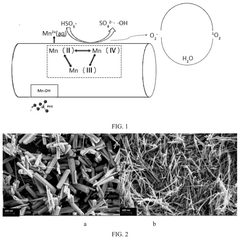
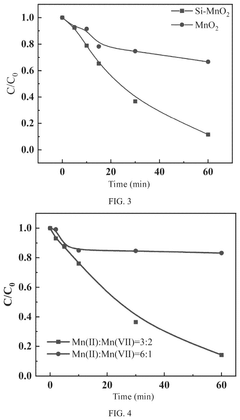
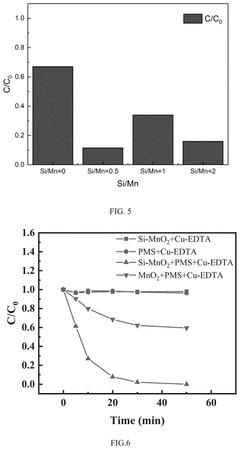
- A silicate modified manganese-based material with a nanoscale needle-like structure is prepared through an oxidation-reduction reaction and hydrothermal process, adjusting the molar ratio of high valence and low valence manganese sources, enhancing catalytic performance and adsorption capacity.
Method for treating process waste waters highly charged with ammonium in waste water systems
PatentWO1999023039A2
Innovation
- The use of a silicate carrier substance with a specific surface area greater than 20 m^2/g, such as natural clay minerals or carbon-containing materials, which maintains suspension and supports nitrifying microorganisms, preventing the release of polyvalent cations and enabling effective treatment of high ammonium concentrations.
Regulatory Framework for Environmental Remediation
The regulatory framework for environmental remediation using sodium silicate is a complex and evolving landscape that varies across jurisdictions. In the United States, the Environmental Protection Agency (EPA) plays a central role in establishing and enforcing regulations related to environmental cleanup. The Comprehensive Environmental Response, Compensation, and Liability Act (CERCLA), also known as Superfund, provides a federal framework for addressing contaminated sites. Under CERCLA, the use of sodium silicate in remediation efforts must comply with specific guidelines to ensure effectiveness and safety.
At the state level, environmental protection agencies often have additional regulations and permitting requirements for remediation projects. These may include specific protocols for site assessment, treatment design, and post-remediation monitoring when using sodium silicate. Many states have adopted risk-based corrective action (RBCA) approaches, which allow for site-specific remediation goals based on potential risks to human health and the environment.
Internationally, the regulatory landscape is diverse, with each country having its own set of laws and agencies overseeing environmental remediation. The European Union, for instance, has established the Environmental Liability Directive, which sets a common framework for preventing and remedying environmental damage. Countries like Canada and Australia have similar federal-level regulations, with provincial or state authorities often having additional requirements.
The use of sodium silicate in environmental remediation must also adhere to broader chemical safety regulations. In the EU, the Registration, Evaluation, Authorisation and Restriction of Chemicals (REACH) regulation governs the use of chemical substances, including those used in remediation. Similar regulations exist in other countries, such as the Toxic Substances Control Act (TSCA) in the United States.
Regulatory bodies often require extensive documentation and approval processes before implementing sodium silicate-based remediation techniques. This typically includes detailed site characterization, treatment plans, and environmental impact assessments. Post-treatment monitoring is usually mandated to ensure the effectiveness of the remediation and to detect any potential long-term effects on the environment.
As environmental concerns continue to grow, regulations are becoming increasingly stringent. There is a trend towards favoring green remediation techniques, which may influence the regulatory approach to sodium silicate use. Regulatory frameworks are also adapting to incorporate emerging contaminants and new remediation technologies, potentially affecting how sodium silicate applications are evaluated and approved.
At the state level, environmental protection agencies often have additional regulations and permitting requirements for remediation projects. These may include specific protocols for site assessment, treatment design, and post-remediation monitoring when using sodium silicate. Many states have adopted risk-based corrective action (RBCA) approaches, which allow for site-specific remediation goals based on potential risks to human health and the environment.
Internationally, the regulatory landscape is diverse, with each country having its own set of laws and agencies overseeing environmental remediation. The European Union, for instance, has established the Environmental Liability Directive, which sets a common framework for preventing and remedying environmental damage. Countries like Canada and Australia have similar federal-level regulations, with provincial or state authorities often having additional requirements.
The use of sodium silicate in environmental remediation must also adhere to broader chemical safety regulations. In the EU, the Registration, Evaluation, Authorisation and Restriction of Chemicals (REACH) regulation governs the use of chemical substances, including those used in remediation. Similar regulations exist in other countries, such as the Toxic Substances Control Act (TSCA) in the United States.
Regulatory bodies often require extensive documentation and approval processes before implementing sodium silicate-based remediation techniques. This typically includes detailed site characterization, treatment plans, and environmental impact assessments. Post-treatment monitoring is usually mandated to ensure the effectiveness of the remediation and to detect any potential long-term effects on the environment.
As environmental concerns continue to grow, regulations are becoming increasingly stringent. There is a trend towards favoring green remediation techniques, which may influence the regulatory approach to sodium silicate use. Regulatory frameworks are also adapting to incorporate emerging contaminants and new remediation technologies, potentially affecting how sodium silicate applications are evaluated and approved.
Sustainability Impact of Sodium Silicate Remediation
The utilization of sodium silicate in environmental remediation has significant sustainability implications. This approach offers a range of positive environmental impacts, contributing to the overall sustainability of remediation efforts. Sodium silicate-based remediation techniques have shown promise in addressing various environmental challenges, particularly in soil and groundwater treatment.
One of the key sustainability benefits of sodium silicate remediation is its potential to reduce the need for more invasive and resource-intensive remediation methods. Traditional approaches often involve extensive excavation or pumping, which can be disruptive to ecosystems and energy-intensive. In contrast, sodium silicate can be applied in situ, minimizing disturbance to the surrounding environment and reducing the carbon footprint associated with remediation activities.
Furthermore, sodium silicate remediation has demonstrated effectiveness in immobilizing a wide range of contaminants, including heavy metals and organic pollutants. By stabilizing these harmful substances, it prevents their migration into water sources and food chains, thus protecting both environmental and human health in the long term. This ability to create a lasting barrier against contaminant spread contributes to the overall sustainability of the remediation process.
The production of sodium silicate itself is relatively environmentally friendly compared to some other remediation chemicals. It is derived from abundant natural materials and can be manufactured using renewable energy sources, further enhancing its sustainability profile. Additionally, the longevity of sodium silicate treatments means fewer repeat applications are necessary, reducing the overall resource consumption and environmental impact over time.
However, it is important to consider potential drawbacks in terms of sustainability. The alkaline nature of sodium silicate solutions may temporarily alter soil pH, which could affect local ecosystems. Careful application and monitoring are essential to mitigate any adverse effects on soil biology and plant life. Additionally, while sodium silicate is generally considered non-toxic, the long-term ecological impacts of its widespread use in environmental remediation are still being studied.
In conclusion, the sustainability impact of sodium silicate remediation is largely positive, offering an effective, less disruptive alternative to traditional remediation methods. Its ability to immobilize contaminants, coupled with its relatively eco-friendly production and application processes, positions it as a promising tool in sustainable environmental management. Ongoing research and careful implementation will be crucial in maximizing its benefits while minimizing any potential negative impacts on ecosystems.
One of the key sustainability benefits of sodium silicate remediation is its potential to reduce the need for more invasive and resource-intensive remediation methods. Traditional approaches often involve extensive excavation or pumping, which can be disruptive to ecosystems and energy-intensive. In contrast, sodium silicate can be applied in situ, minimizing disturbance to the surrounding environment and reducing the carbon footprint associated with remediation activities.
Furthermore, sodium silicate remediation has demonstrated effectiveness in immobilizing a wide range of contaminants, including heavy metals and organic pollutants. By stabilizing these harmful substances, it prevents their migration into water sources and food chains, thus protecting both environmental and human health in the long term. This ability to create a lasting barrier against contaminant spread contributes to the overall sustainability of the remediation process.
The production of sodium silicate itself is relatively environmentally friendly compared to some other remediation chemicals. It is derived from abundant natural materials and can be manufactured using renewable energy sources, further enhancing its sustainability profile. Additionally, the longevity of sodium silicate treatments means fewer repeat applications are necessary, reducing the overall resource consumption and environmental impact over time.
However, it is important to consider potential drawbacks in terms of sustainability. The alkaline nature of sodium silicate solutions may temporarily alter soil pH, which could affect local ecosystems. Careful application and monitoring are essential to mitigate any adverse effects on soil biology and plant life. Additionally, while sodium silicate is generally considered non-toxic, the long-term ecological impacts of its widespread use in environmental remediation are still being studied.
In conclusion, the sustainability impact of sodium silicate remediation is largely positive, offering an effective, less disruptive alternative to traditional remediation methods. Its ability to immobilize contaminants, coupled with its relatively eco-friendly production and application processes, positions it as a promising tool in sustainable environmental management. Ongoing research and careful implementation will be crucial in maximizing its benefits while minimizing any potential negative impacts on ecosystems.
Unlock deeper insights with PatSnap Eureka Quick Research — get a full tech report to explore trends and direct your research. Try now!
Generate Your Research Report Instantly with AI Agent
Supercharge your innovation with PatSnap Eureka AI Agent Platform!