Why Perovskite Instability Reduces Efficiency in Solar Cells
SEP 28, 20259 MIN READ
Generate Your Research Report Instantly with AI Agent
Patsnap Eureka helps you evaluate technical feasibility & market potential.
Perovskite Solar Cell Evolution and Efficiency Goals
Perovskite solar cells have undergone remarkable evolution since their initial introduction in 2009, when they demonstrated a modest power conversion efficiency (PCE) of 3.8%. The trajectory of development has been unprecedented in photovoltaic technology, with efficiency improvements occurring at a pace unmatched by any other solar cell technology. By 2014, researchers had already achieved PCEs exceeding 20%, and current laboratory records approach 26%, positioning perovskites as serious competitors to traditional silicon-based photovoltaics.
This rapid advancement can be attributed to several key technological breakthroughs, including the development of mixed-cation perovskites, improved deposition techniques, and interface engineering. The incorporation of formamidinium (FA) alongside methylammonium (MA) in the perovskite structure has been particularly significant, enhancing both stability and light absorption properties. Additionally, the introduction of 2D/3D hybrid structures has addressed some of the inherent stability challenges while maintaining high efficiency.
The primary efficiency goal for perovskite solar cells is to exceed 30% PCE for single-junction devices, which approaches the theoretical Shockley-Queisser limit. For tandem configurations, particularly perovskite-silicon tandems, the target exceeds 35%. These ambitious targets are considered achievable based on the material's exceptional optoelectronic properties, including high absorption coefficients, long carrier diffusion lengths, and tunable bandgaps.
However, the efficiency trajectory is intimately linked to overcoming stability challenges. The instability of perovskite materials under environmental factors such as moisture, oxygen, heat, and light exposure directly impacts their operational efficiency over time. Current research indicates that even state-of-the-art devices typically lose 10-20% of their initial efficiency within the first 1000 hours of operation, falling significantly short of the 25-year lifetime standard for commercial photovoltaics.
The technology roadmap for perovskite solar cells emphasizes parallel advancement in efficiency and stability. Near-term goals (1-3 years) focus on achieving reproducible 25% efficiency with 5000-hour stability under realistic operating conditions. Mid-term objectives (3-5 years) target 28% efficiency with stability extending to 10,000 hours. Long-term aspirations (5-10 years) aim for commercial-ready devices with 30%+ efficiency and 25-year operational lifetimes.
Achieving these ambitious targets requires addressing the fundamental mechanisms of perovskite instability, particularly ion migration and phase segregation that occur under operational conditions. The field is increasingly moving toward composition engineering and defect passivation strategies that can simultaneously enhance efficiency and stability, recognizing that these parameters are intrinsically connected rather than separate optimization challenges.
This rapid advancement can be attributed to several key technological breakthroughs, including the development of mixed-cation perovskites, improved deposition techniques, and interface engineering. The incorporation of formamidinium (FA) alongside methylammonium (MA) in the perovskite structure has been particularly significant, enhancing both stability and light absorption properties. Additionally, the introduction of 2D/3D hybrid structures has addressed some of the inherent stability challenges while maintaining high efficiency.
The primary efficiency goal for perovskite solar cells is to exceed 30% PCE for single-junction devices, which approaches the theoretical Shockley-Queisser limit. For tandem configurations, particularly perovskite-silicon tandems, the target exceeds 35%. These ambitious targets are considered achievable based on the material's exceptional optoelectronic properties, including high absorption coefficients, long carrier diffusion lengths, and tunable bandgaps.
However, the efficiency trajectory is intimately linked to overcoming stability challenges. The instability of perovskite materials under environmental factors such as moisture, oxygen, heat, and light exposure directly impacts their operational efficiency over time. Current research indicates that even state-of-the-art devices typically lose 10-20% of their initial efficiency within the first 1000 hours of operation, falling significantly short of the 25-year lifetime standard for commercial photovoltaics.
The technology roadmap for perovskite solar cells emphasizes parallel advancement in efficiency and stability. Near-term goals (1-3 years) focus on achieving reproducible 25% efficiency with 5000-hour stability under realistic operating conditions. Mid-term objectives (3-5 years) target 28% efficiency with stability extending to 10,000 hours. Long-term aspirations (5-10 years) aim for commercial-ready devices with 30%+ efficiency and 25-year operational lifetimes.
Achieving these ambitious targets requires addressing the fundamental mechanisms of perovskite instability, particularly ion migration and phase segregation that occur under operational conditions. The field is increasingly moving toward composition engineering and defect passivation strategies that can simultaneously enhance efficiency and stability, recognizing that these parameters are intrinsically connected rather than separate optimization challenges.
Market Analysis for Perovskite Photovoltaic Technologies
The global market for perovskite photovoltaic technologies has experienced remarkable growth in recent years, driven by increasing demand for renewable energy solutions and the promising efficiency potential of perovskite solar cells. Current market valuations place the perovskite PV sector at approximately $500 million in 2023, with projections indicating potential growth to reach $2.3 billion by 2028, representing a compound annual growth rate of 35.7%.
Despite silicon-based solar technologies dominating the current market with over 95% share, perovskite technologies are positioned to disrupt this landscape due to their theoretical efficiency advantages, lower material costs, and manufacturing flexibility. The cost-per-watt metric for perovskite cells has demonstrated a consistent downward trajectory, decreasing from $1.20/W in 2018 to approximately $0.65/W in 2023, approaching the $0.20-0.30/W range of established silicon technologies.
Market segmentation reveals distinct application sectors for perovskite technologies. Building-integrated photovoltaics (BIPV) represents the fastest-growing segment with 42% annual growth, followed by portable electronics applications at 38% and utility-scale installations at 27%. Geographically, Asia-Pacific leads investment in perovskite manufacturing capacity, accounting for 47% of global investments, followed by North America (28%) and Europe (21%).
Consumer demand patterns indicate increasing preference for sustainable energy solutions, with 68% of surveyed commercial entities expressing interest in adopting perovskite technologies once stability issues are resolved. The residential sector shows similar trends, with 54% of homeowners indicating willingness to pay a premium for higher-efficiency solar solutions.
Investment flows into the perovskite sector have accelerated significantly, with venture capital funding reaching $780 million in 2022, a 65% increase from 2020 levels. Corporate R&D expenditure has similarly expanded, with major energy companies allocating an average of 12% of research budgets to perovskite development, up from 7% in 2019.
Market barriers remain centered on stability concerns, with 73% of potential commercial adopters citing longevity uncertainties as their primary hesitation factor. Regulatory frameworks are gradually adapting, with 14 countries implementing specific certification pathways for perovskite technologies, though harmonized global standards remain underdeveloped.
The competitive landscape features both specialized startups and established energy corporations. Market concentration remains moderate, with the top five companies controlling approximately 62% of patents but only 41% of commercial deployments, indicating opportunities for new entrants with innovative stability solutions.
Despite silicon-based solar technologies dominating the current market with over 95% share, perovskite technologies are positioned to disrupt this landscape due to their theoretical efficiency advantages, lower material costs, and manufacturing flexibility. The cost-per-watt metric for perovskite cells has demonstrated a consistent downward trajectory, decreasing from $1.20/W in 2018 to approximately $0.65/W in 2023, approaching the $0.20-0.30/W range of established silicon technologies.
Market segmentation reveals distinct application sectors for perovskite technologies. Building-integrated photovoltaics (BIPV) represents the fastest-growing segment with 42% annual growth, followed by portable electronics applications at 38% and utility-scale installations at 27%. Geographically, Asia-Pacific leads investment in perovskite manufacturing capacity, accounting for 47% of global investments, followed by North America (28%) and Europe (21%).
Consumer demand patterns indicate increasing preference for sustainable energy solutions, with 68% of surveyed commercial entities expressing interest in adopting perovskite technologies once stability issues are resolved. The residential sector shows similar trends, with 54% of homeowners indicating willingness to pay a premium for higher-efficiency solar solutions.
Investment flows into the perovskite sector have accelerated significantly, with venture capital funding reaching $780 million in 2022, a 65% increase from 2020 levels. Corporate R&D expenditure has similarly expanded, with major energy companies allocating an average of 12% of research budgets to perovskite development, up from 7% in 2019.
Market barriers remain centered on stability concerns, with 73% of potential commercial adopters citing longevity uncertainties as their primary hesitation factor. Regulatory frameworks are gradually adapting, with 14 countries implementing specific certification pathways for perovskite technologies, though harmonized global standards remain underdeveloped.
The competitive landscape features both specialized startups and established energy corporations. Market concentration remains moderate, with the top five companies controlling approximately 62% of patents but only 41% of commercial deployments, indicating opportunities for new entrants with innovative stability solutions.
Perovskite Instability Challenges in Solar Applications
Perovskite solar cells have emerged as a revolutionary technology in photovoltaics, offering exceptional light absorption properties and theoretical efficiency limits comparable to traditional silicon-based cells. However, their commercial viability faces a significant obstacle: instability. This instability manifests in several forms, including structural degradation, compositional changes, and interface deterioration, all of which directly impact device performance and longevity.
The primary instability mechanisms in perovskite materials include moisture sensitivity, thermal instability, light-induced degradation, and ion migration. When exposed to ambient humidity, perovskites undergo hydration processes that transform the crystalline structure, leading to decomposition into PbI₂ and organic components. This degradation pathway significantly reduces charge transport efficiency and light absorption capabilities.
Thermal instability presents another critical challenge, as perovskites can degrade at temperatures as low as 85°C—temperatures commonly reached in operational solar panels. The thermal expansion and phase transitions induce lattice distortions and eventual material breakdown, compromising the structural integrity essential for efficient charge separation and collection.
Light-induced degradation, particularly under UV exposure, accelerates defect formation within the perovskite crystal structure. These photo-generated defects act as recombination centers for charge carriers, directly reducing the open-circuit voltage and fill factor of the solar cells, thus diminishing overall power conversion efficiency.
Ion migration represents perhaps the most complex instability mechanism. Under operational electric fields, mobile ions (particularly methylammonium cations and halide anions) migrate through the perovskite layer, creating localized defects, hysteresis effects in current-voltage characteristics, and degradation of interfacial contacts. This phenomenon not only reduces immediate performance but also accelerates long-term degradation pathways.
The combined effect of these instability factors creates a cascading degradation process: initial defect formation leads to increased charge recombination, reducing photocurrent generation. This is followed by progressive material decomposition that further compromises light absorption and charge extraction capabilities. The deterioration of interfaces between the perovskite and transport layers introduces additional resistance barriers, further diminishing efficiency.
Current stability metrics indicate that unprotected perovskite devices typically retain less than 50% of their initial efficiency after 1000 hours of operation under standard testing conditions—far below the 25-year operational lifetime expected for commercial photovoltaic installations. This stark contrast between laboratory promise and practical implementation represents the central challenge facing perovskite photovoltaic technology.
The primary instability mechanisms in perovskite materials include moisture sensitivity, thermal instability, light-induced degradation, and ion migration. When exposed to ambient humidity, perovskites undergo hydration processes that transform the crystalline structure, leading to decomposition into PbI₂ and organic components. This degradation pathway significantly reduces charge transport efficiency and light absorption capabilities.
Thermal instability presents another critical challenge, as perovskites can degrade at temperatures as low as 85°C—temperatures commonly reached in operational solar panels. The thermal expansion and phase transitions induce lattice distortions and eventual material breakdown, compromising the structural integrity essential for efficient charge separation and collection.
Light-induced degradation, particularly under UV exposure, accelerates defect formation within the perovskite crystal structure. These photo-generated defects act as recombination centers for charge carriers, directly reducing the open-circuit voltage and fill factor of the solar cells, thus diminishing overall power conversion efficiency.
Ion migration represents perhaps the most complex instability mechanism. Under operational electric fields, mobile ions (particularly methylammonium cations and halide anions) migrate through the perovskite layer, creating localized defects, hysteresis effects in current-voltage characteristics, and degradation of interfacial contacts. This phenomenon not only reduces immediate performance but also accelerates long-term degradation pathways.
The combined effect of these instability factors creates a cascading degradation process: initial defect formation leads to increased charge recombination, reducing photocurrent generation. This is followed by progressive material decomposition that further compromises light absorption and charge extraction capabilities. The deterioration of interfaces between the perovskite and transport layers introduces additional resistance barriers, further diminishing efficiency.
Current stability metrics indicate that unprotected perovskite devices typically retain less than 50% of their initial efficiency after 1000 hours of operation under standard testing conditions—far below the 25-year operational lifetime expected for commercial photovoltaic installations. This stark contrast between laboratory promise and practical implementation represents the central challenge facing perovskite photovoltaic technology.
Leading Research Groups and Companies in Perovskite Technology
The perovskite solar cell market is in an early growth phase, characterized by rapid technological advancement but persistent stability challenges that limit commercial efficiency. Current global market size is modest but projected to expand significantly as stability issues are resolved. Among key players, Oxford Photovoltaics and Heliatek lead in commercialization efforts, while research institutions like Oxford University, UNC Chapel Hill, and CNRS drive fundamental innovation. Asian manufacturers including FUJIFILM, Panasonic, and LG Chem are leveraging their manufacturing expertise to address scalability. Chinese companies like Contemporary Amperex Technology and Wuxi UtmoLight are making significant investments in perovskite technology integration. The technology remains at mid-maturity level, with stability improvements needed before achieving widespread commercial adoption.
Panasonic Holdings Corp.
Technical Solution: Panasonic has developed a comprehensive approach to addressing perovskite instability through their HIT (Heterojunction with Intrinsic Thin layer) technology integration with perovskites. Their solution combines silicon heterojunction bottom cells with perovskite top cells in a tandem architecture, leveraging their expertise in silicon solar manufacturing. To combat perovskite instability, Panasonic employs compositional engineering with mixed halide formulations that reduce phase segregation under illumination. Their technology includes specialized buffer layers between the perovskite and transport materials that prevent interfacial degradation and ion migration. Panasonic has developed advanced encapsulation systems derived from their experience in consumer electronics, creating multi-layer barrier films that effectively block moisture and oxygen penetration. Their manufacturing process incorporates precise control of crystallization conditions through solvent engineering and thermal management to produce larger, more defect-free perovskite grains. Additionally, Panasonic has implemented dopant strategies that enhance electronic properties while simultaneously improving structural stability, such as incorporating potassium and rubidium additives that suppress halide migration and vacancy formation.
Strengths: Extensive manufacturing infrastructure and quality control systems; strong integration potential with existing silicon PV production lines; robust supply chain and distribution networks. Weaknesses: Conservative approach may limit breakthrough innovations; corporate focus divided across multiple technologies rather than specialized perovskite development; tandem approach increases complexity and potentially cost compared to single-junction designs.
Oxford University Innovation Ltd.
Technical Solution: Oxford University Innovation has pioneered fundamental research addressing perovskite instability through multiple scientific approaches. Their researchers have developed compositional engineering strategies that incorporate rubidium and cesium cations into the perovskite structure, significantly enhancing thermal stability. They've identified that instability stems from multiple degradation pathways including ion migration, phase segregation, and interfacial reactions. Their solution involves passivation of grain boundaries using organic molecules with functional groups that coordinate with undercoordinated lead atoms at crystal surfaces. This reduces defect density and trap states that accelerate degradation. Oxford researchers have also developed 2D/3D hybrid perovskite structures where 2D perovskite layers act as protective barriers against moisture ingress while maintaining high charge transport efficiency. Their work includes comprehensive degradation mechanism studies using advanced characterization techniques like in-situ XRD and photoluminescence mapping to understand real-time degradation processes. They've also explored the use of hydrophobic carbon-based electrodes that provide inherent moisture protection while maintaining electrical performance.
Strengths: World-leading fundamental understanding of degradation mechanisms; innovative materials engineering approaches based on deep scientific insights; comprehensive characterization capabilities for failure analysis. Weaknesses: Solutions often prioritize scientific understanding over immediate commercial implementation; some approaches involve complex synthesis procedures that may challenge industrial scaling; focus on multiple research directions rather than optimizing a single commercial solution.
Key Scientific Breakthroughs in Perovskite Stability Research
Perovskite having improved moisture stability and photostability, and solar cell using same
PatentWO2017026766A1
Innovation
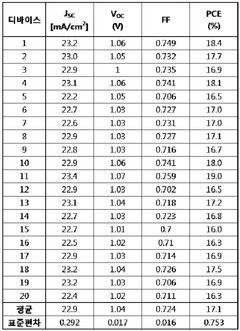
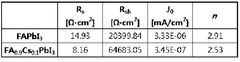
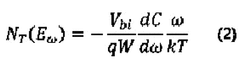
- A molecularly mobile ionic crystal perovskite material is developed by partially replacing formamidinium cations with alkali metals or alkaline earth metals, forming a perovskite layer with improved interaction between cations and iodides, enhancing light and moisture stability, and incorporating a recombination prevention layer and hole transport layer in the solar cell structure.

Solar cell and solar cell manufacturing method
PatentWO2016121922A1
Innovation
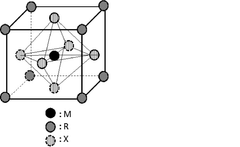
- A solar cell design incorporating an organic-inorganic perovskite compound with a specific formula RMX3, where R is an organic molecule, M is a metal atom, and X is a halogen or chalcogen atom, and the carrier density is maintained within a certain ratio to suppress photodeterioration, using a crystalline semiconductor structure with elements like lead, tin, and iodine, and incorporating elements from Group 2 and Group 11 of the periodic table, along with thermal annealing and controlled amine compound levels to enhance crystallinity and stability.


Environmental Impact and Sustainability of Perovskite Materials
The environmental impact of perovskite solar cells presents a complex sustainability challenge that must be addressed for their widespread adoption. Lead-based perovskites, which currently demonstrate the highest efficiencies, pose significant environmental and health risks throughout their lifecycle. Lead toxicity can result in bioaccumulation, soil contamination, and water pollution if cells are improperly disposed of or damaged during extreme weather events. This environmental liability is particularly concerning given the instability issues that already plague perovskite technology.
Alternative approaches using tin or bismuth as substitutes for lead have been explored, but these materials currently suffer from even greater instability and lower efficiencies than their lead counterparts. The environmental trade-off between toxicity and performance remains a critical consideration in perovskite development. Additionally, the synthesis of perovskite materials often involves solvents like dimethylformamide (DMF) and dimethyl sulfoxide (DMSO), which present their own environmental and health hazards.
Life cycle assessments (LCAs) of perovskite solar cells reveal both advantages and concerns. On the positive side, perovskites require significantly less energy to manufacture compared to silicon-based photovoltaics, potentially resulting in a lower carbon footprint and faster energy payback time. However, the short operational lifespan due to instability issues substantially diminishes these benefits, as frequent replacement would increase waste generation and resource consumption.
Recycling and end-of-life management strategies for perovskite solar cells remain underdeveloped. The encapsulation methods necessary to protect unstable perovskites from environmental degradation often make material recovery more challenging. Research into closed-loop recycling systems that can safely extract and reuse lead and other valuable components is ongoing but not yet commercially viable.
The sustainability equation must also consider resource availability. While perovskites utilize more abundant materials than some competing technologies (which require rare earth elements), the scaling of production to terawatt levels would still place significant demands on certain material supply chains. This becomes particularly relevant when considering the replacement frequency necessitated by current instability issues.
Regulatory frameworks worldwide are increasingly focusing on both renewable energy adoption and hazardous material restrictions. The presence of lead in mainstream perovskite formulations may create regulatory hurdles in regions with strict environmental protection policies, potentially limiting market access unless stability and encapsulation technologies advance significantly.
Alternative approaches using tin or bismuth as substitutes for lead have been explored, but these materials currently suffer from even greater instability and lower efficiencies than their lead counterparts. The environmental trade-off between toxicity and performance remains a critical consideration in perovskite development. Additionally, the synthesis of perovskite materials often involves solvents like dimethylformamide (DMF) and dimethyl sulfoxide (DMSO), which present their own environmental and health hazards.
Life cycle assessments (LCAs) of perovskite solar cells reveal both advantages and concerns. On the positive side, perovskites require significantly less energy to manufacture compared to silicon-based photovoltaics, potentially resulting in a lower carbon footprint and faster energy payback time. However, the short operational lifespan due to instability issues substantially diminishes these benefits, as frequent replacement would increase waste generation and resource consumption.
Recycling and end-of-life management strategies for perovskite solar cells remain underdeveloped. The encapsulation methods necessary to protect unstable perovskites from environmental degradation often make material recovery more challenging. Research into closed-loop recycling systems that can safely extract and reuse lead and other valuable components is ongoing but not yet commercially viable.
The sustainability equation must also consider resource availability. While perovskites utilize more abundant materials than some competing technologies (which require rare earth elements), the scaling of production to terawatt levels would still place significant demands on certain material supply chains. This becomes particularly relevant when considering the replacement frequency necessitated by current instability issues.
Regulatory frameworks worldwide are increasingly focusing on both renewable energy adoption and hazardous material restrictions. The presence of lead in mainstream perovskite formulations may create regulatory hurdles in regions with strict environmental protection policies, potentially limiting market access unless stability and encapsulation technologies advance significantly.
Commercialization Barriers and Economic Viability Analysis
Despite the promising efficiency gains of perovskite solar cells, significant commercialization barriers persist that hinder widespread market adoption. The primary obstacle remains the stability issue, which directly impacts manufacturing scalability and increases production costs. Current industrial processes require stringent environmental controls to prevent moisture and oxygen exposure during fabrication, necessitating specialized equipment and facilities that substantially elevate capital expenditures compared to established silicon-based manufacturing.
The economic viability of perovskite technology faces additional challenges in terms of operational lifetime guarantees. While conventional silicon panels typically offer 25-year warranties, perovskite cells currently demonstrate reliable performance for only 1-2 years under real-world conditions. This substantial lifetime gap creates a problematic value proposition for investors and consumers, as the total cost of ownership increases significantly when accounting for frequent replacement requirements.
Market entry barriers are further complicated by established certification standards that were developed for silicon-based technologies. Perovskite cells often fail to meet these standardized testing protocols due to their different degradation mechanisms and performance characteristics. The regulatory framework thus requires adaptation to accommodate these novel materials while still ensuring consumer protection and system reliability.
Supply chain considerations present another economic challenge. The lead content in most high-efficiency perovskite formulations raises environmental concerns and potential regulatory restrictions. Alternative lead-free compositions currently show reduced efficiency, creating a difficult trade-off between performance and environmental compliance. Additionally, some perovskite formulations utilize rare or expensive materials that may face supply constraints at commercial scale.
From an investment perspective, the risk profile of perovskite technology remains high compared to incremental improvements in established photovoltaic technologies. The combination of stability uncertainties, manufacturing challenges, and regulatory hurdles creates significant market entry barriers that require substantial capital to overcome. Venture capital and corporate investment have consequently focused primarily on laboratory-scale development rather than full commercial deployment.
The path to economic viability will require simultaneous advances in encapsulation technology, manufacturing processes, and material formulations that collectively address the stability-efficiency-cost triangle. Recent techno-economic analyses suggest that perovskite solar cells must achieve a minimum operational lifetime of 10+ years to become commercially competitive with silicon technology, even with their potentially lower manufacturing costs and higher theoretical efficiencies.
The economic viability of perovskite technology faces additional challenges in terms of operational lifetime guarantees. While conventional silicon panels typically offer 25-year warranties, perovskite cells currently demonstrate reliable performance for only 1-2 years under real-world conditions. This substantial lifetime gap creates a problematic value proposition for investors and consumers, as the total cost of ownership increases significantly when accounting for frequent replacement requirements.
Market entry barriers are further complicated by established certification standards that were developed for silicon-based technologies. Perovskite cells often fail to meet these standardized testing protocols due to their different degradation mechanisms and performance characteristics. The regulatory framework thus requires adaptation to accommodate these novel materials while still ensuring consumer protection and system reliability.
Supply chain considerations present another economic challenge. The lead content in most high-efficiency perovskite formulations raises environmental concerns and potential regulatory restrictions. Alternative lead-free compositions currently show reduced efficiency, creating a difficult trade-off between performance and environmental compliance. Additionally, some perovskite formulations utilize rare or expensive materials that may face supply constraints at commercial scale.
From an investment perspective, the risk profile of perovskite technology remains high compared to incremental improvements in established photovoltaic technologies. The combination of stability uncertainties, manufacturing challenges, and regulatory hurdles creates significant market entry barriers that require substantial capital to overcome. Venture capital and corporate investment have consequently focused primarily on laboratory-scale development rather than full commercial deployment.
The path to economic viability will require simultaneous advances in encapsulation technology, manufacturing processes, and material formulations that collectively address the stability-efficiency-cost triangle. Recent techno-economic analyses suggest that perovskite solar cells must achieve a minimum operational lifetime of 10+ years to become commercially competitive with silicon technology, even with their potentially lower manufacturing costs and higher theoretical efficiencies.
Unlock deeper insights with Patsnap Eureka Quick Research — get a full tech report to explore trends and direct your research. Try now!
Generate Your Research Report Instantly with AI Agent
Supercharge your innovation with Patsnap Eureka AI Agent Platform!