Method and device for recycling substrates by thermally cracking wasted printed circuit boards

A technology of thermal cracking and waste printing, applied in the direction of improving process efficiency, etc., can solve problems such as hindering gas discharge, variable gas production, and increasing operating costs, so as to enhance stability, reduce operating risks, and increase recycling. Effect

CN101921915BInactive Publication Date: 2012-05-23巫协森
0 Cites 0 Cited by

Patent Information

Authority / Receiving Office
CN · China
Patent Type
Patents(China)
Current Assignee / Owner
Publication Date
2012-05-23
Estimated Expiration
Not applicable · inactive patent

Smart Images

  • Figure 1
    Figure 1
  • Figure 2
    Figure 2
  • Figure 3
    Figure 3
Patent Text Reader

Abstract

The invention discloses a method and a device for recycling substrates by thermally cracking wasted printed circuit boards. Through the method and the device, combustion is avoided in a thermal cracking process and treatment safety is enhanced mainly by adding the introduction of water (vapor) in a reaction process and creating a completely-sealed low-pressure treatment environment; and by condensing and purifying organic gases to form reusable fuels or industrial chemicals, the treatment cost is reduced, recycling values are increased and a plurality of benefits, such as safe treatment devices and the like, can be created; therefore, the method and the device are of great industrial utilization value.
Need to check novelty before this filing date? Find Prior Art

Description

technical field

[0001] The invention relates to a method and a device for recovering substrates of waste printed circuit boards by pyrolysis. Background technique

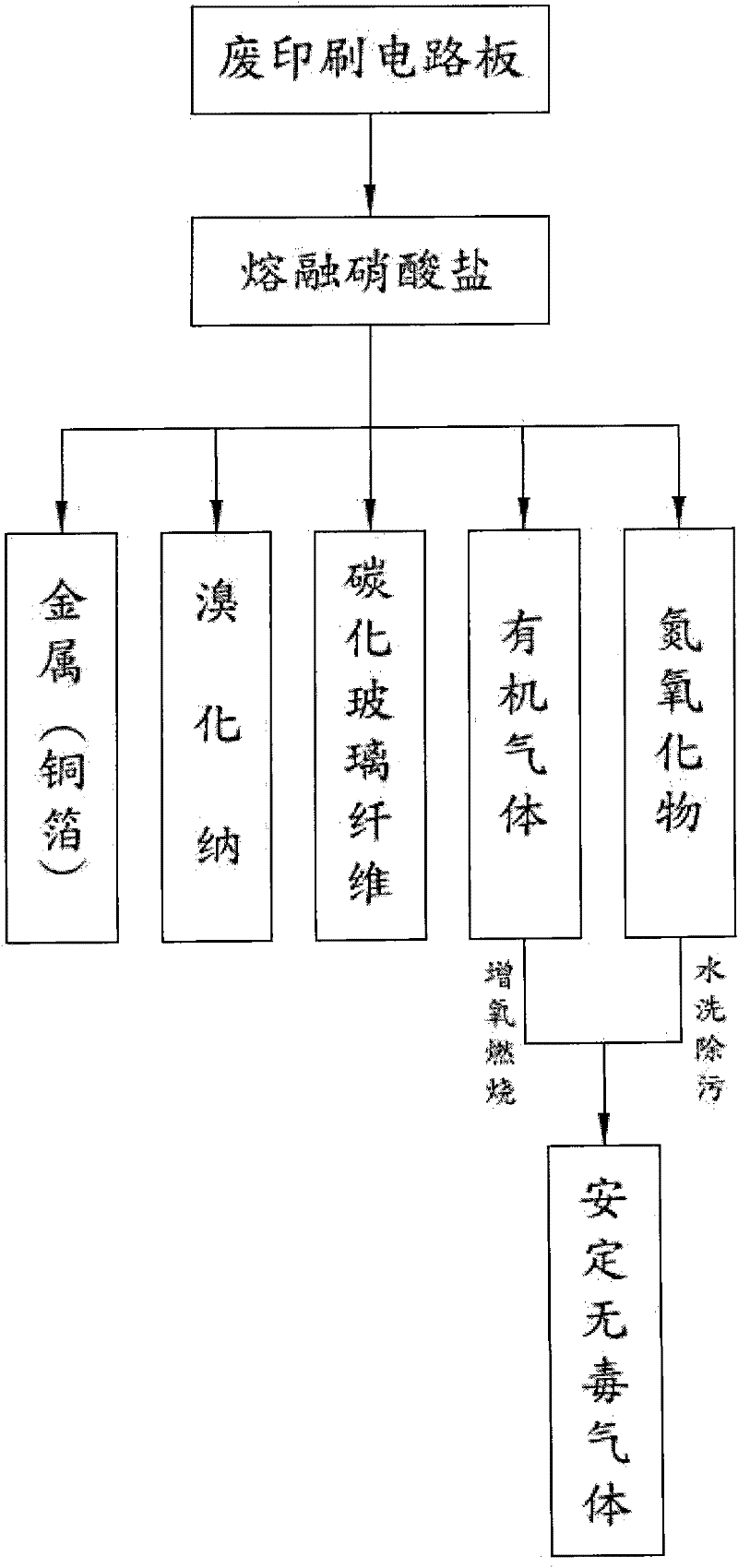
[0002] The inventor of this case filed the invention patent No. 095102342 "Method of Recycling Waste Printed Circuit Boards" in Taiwan on January 20, 2006, and was approved and announced on December 11, 2006 to obtain the patent certificate of invention patent No. I268184. This invention patent has been implemented by the inventor and has achieved good results. Using molten nitrate to pyrolyze the epoxy resin in the circuit board to separate metal and carbonized glass fibers has obvious effects. It is mainly to put waste printed circuit boards into molten nitrate, which can pyrolyze the brominated epoxy resin in the circuit board, and chemically react with it to form a large amount of organic gases and nitrogen oxides, such as figure 1 shown. However, if the concentration of organic gas is high, if there is oxy...

Examples

Embodiment

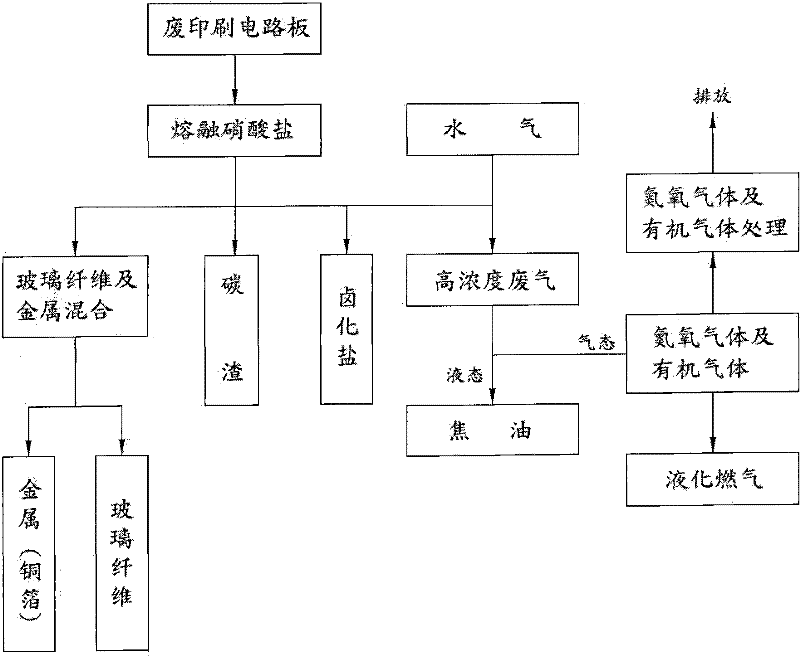
[0042] see figure 2 As shown, it is the thermal cracking recovery flow chart of the method for recycling waste printed circuit boards of the present invention and its device. The waste printed circuit boards are directly put into molten nitrate at 300°C to 550°C, and the waste printed circuit boards are allowed to The thermal cracking reaction of the brominated epoxy resin in the brominated epoxy resin forms a high-concentration waste gas of organic gas, nitrogen and oxygen gas and carbon residue, and for the bromine element in the epoxy resin, the highly active metals of lithium, sodium and potassium in the nitrate can be used to decompose Capture and form stable bromide salts, increase the introduction of water vapor during the reaction process to stabilize the thermal cracking reaction, prevent excessive nitrate reactions (explosive hazards), and use water vapor to heat and expand to form water vapor to maintain the normal operation of the system pressure, and then force t...