
A Thickness Prediction Method for Compressive Fault Zones in Covering Areas
A prediction method and fault zone technology, applied in the field of oil and gas exploration and development, can solve the problem of lack of effective methods for compressive fault zones, and achieve the effect of accurate prediction results
Patent Information
- Authority / Receiving Office
- CN · China
- Patent Type
- Patents(China)
- Current Assignee / Owner
- Publication Date
- 2018-04-27
Smart Images
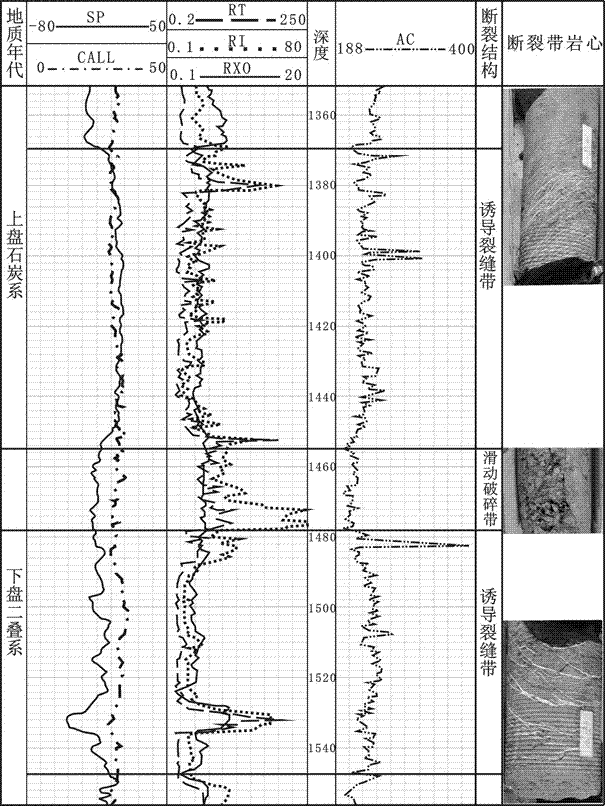
Figure 1 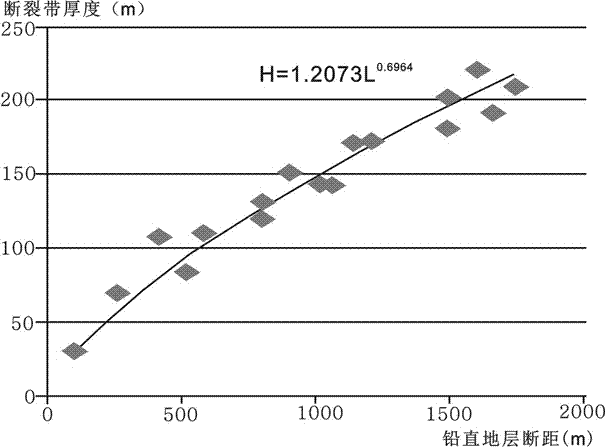
Figure 2 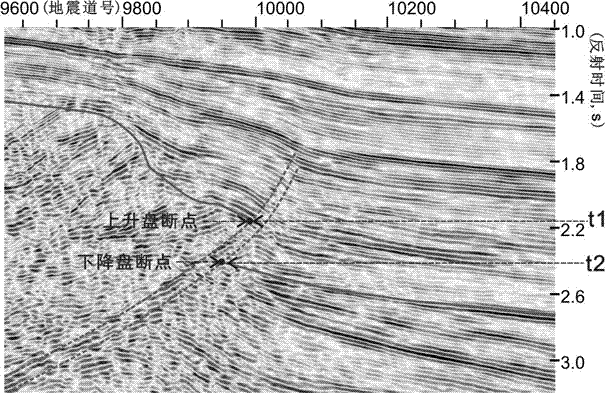
Figure 3
Abstract
Description
Technical field
[0001] The invention belongs to the technical field of petroleum and natural gas exploration and development, and specifically relates to a method for predicting the thickness of a pressure fracture zone in a coverage area. Background technique
[0002] Fracture is a kind of structural deformation phenomenon in which a rock layer breaks under stress and produces obvious relative movement along the fracture surface. The rock layers on both sides of the fracture surface are squeezed and ground during the dislocation process, the rock is broken strongly, and a large number of fractures associated with the fault are generated on both sides of the rock (Song Daofu et al., 2010). Zhang Qinglian et al. (2010) found through field measurements that the density of structural fractures controlled by faults has an exponentially decreasing relationship with the distance from the fault. The closer to the fracture surface, the more the fractures develop. Billi A (2003) et al. d...
Examples
Embodiment Construction
[0029] The specific embodiments of the present invention are described in detail below.
[0030] The method for predicting the thickness of the compressive fracture zone in the coverage area includes the following steps:
[0031] (1) Judge whether the stress environment in the work area is a compressive environment or a tensile environment. If it is a compressive stress environment, go to step (2);
[0032] (2) Interpret the seismic data at the location of the fault zone, identify the fault, and obtain the vertical stratum fault distance L; the method of obtaining the vertical stratum fault distance L is:
[0033] Fit the average seismic reflection velocity in the study area to obtain the comprehensive velocity according to the geological conditions and characteristics of the study area, and establish the time-depth conversion relationship:
[0034] h=a(e bt -1)
[0035] Where: h—depth, m;
[0036] t—Seismic reflection time, ms;
[0037] a, b—constant (reflecting the shape of the speed c...