
An Explosive Diode Based on Laval Nozzle
A Laval nozzle and diode technology, applied in the field of explosive diodes, can solve problems such as property loss, casualties, and difficulty in mining, and achieve the effects of preventing huge losses, reducing transportation safety, and flexible and diverse forms
Patent Information
- Authority / Receiving Office
- CN · China
- Patent Type
- Patents(China)
- Current Assignee / Owner
- Publication Date
- 2017-10-03
Smart Images
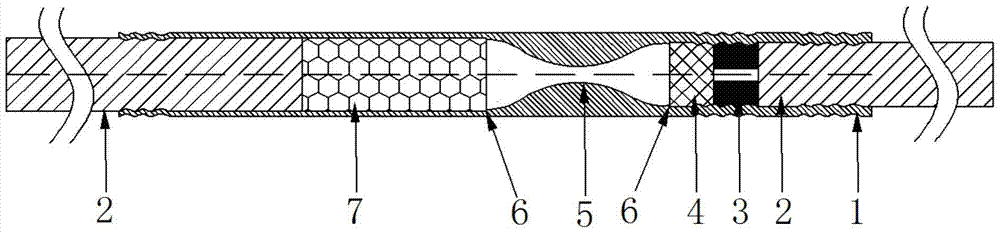
Figure 1 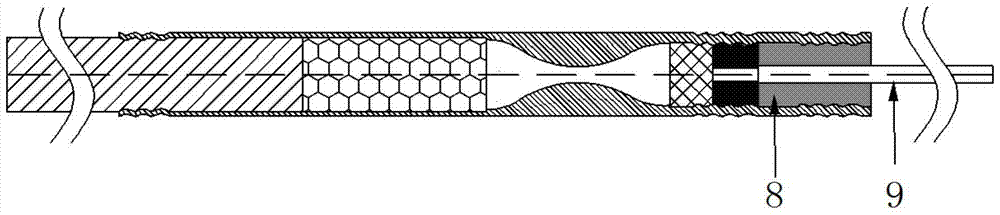
Figure 2 
Figure 3
Abstract
Description
technical field
[0001] The invention belongs to the technical field of blasting equipment, and in particular relates to an explosive diode based on a Laval nozzle. Background technique
[0002] There are many types of resources and minerals in my country, large in quantity, and widely distributed. However, mining is also difficult in many cases and the environment is harsh. Explosives are required for mining. Therefore, my country has a huge demand for blasting equipment, especially the use of detonators. However, due to The unsafe production, transportation and use of some enterprises, coupled with the harsh excavation environment of some projects, have resulted in reduced reliability of detonators and unsafe use. Every year, safety accidents are caused by the premature detonation of detonators. Especially the premature detonation of the detonator will cause the explosion of the whole detonation network, causing heavy casualties and property losses.
[0003] The Laval nozzl...
Examples
Embodiment 1
[0025] figure 1 It is the first structural diagram of the explosive diode of the present invention, and the corresponding working condition is that both the input end and the output end are detonating cords, and the outer diameter is 6.8mm, the inner diameter is 6.0mm, and the copper metal tube shell 1 with a length of 62mm is wherein from the right To the left, the radius of the first circular arc is 5.5mm, the radius of the second circular arc in the middle is 8.8mm, and the third circular arc is 5.1mm. Position the steps at 6 places at the end, and then put in a 4mm lead wire extension body 3, the wire extension body is extruded and fixed on the shell, and the first detonating cord 2 of 9mm is inserted into the input end and squeezed and fixed with a closing machine on the shell. Then the plastic film tube 7 (inside is equipped with bulk film, density is about 0.88g / cm2) of 15mm from the output end 3 ) is placed at the positioning step of the output end, and finally the s...
Embodiment 2
[0027] figure 2 It is the second structure diagram of the explosive diode of the present invention, and the corresponding working condition is that the input end is a detonating tube and the output end is a detonating cord. In the aluminum metal tube shell 1 with an outer diameter of 6.8mm, an inner diameter of 6.0mm, and a length of 62mm, the size is the same as above, first put a 4mm plastic thin tube (with excitation drug inside) with one end open into the positioning step of the input end, and then put it into the 4mm Lead line extension body, the line extension body is squeezed and fixed on the shell, the input end is plugged into a 9mm nonel tube 9 and the nonel tube is tightly wrapped with a rubber plug 8, and the whole is squeezed and fixed on the shell with a closing machine . Then load a 15mm plastic film tube (inside with bulk Taian) from the output end and place it on the positioning step of the output end, and finally install a detonating cord on the output end,...
Embodiment 3
[0029] according to image 3Schematic diagram to make an explosive diode device with a positive and negative symmetrical structure. This structure is completely symmetrical and can be used for forward reliability detonation and reverse reliability explosion resistance experiments at one time. The outer diameter is 6.8mm, the inner diameter is 6.0mm, and the length is 62mm. Load a 15mm plastic film tube (with bulk Taian inside) from the output end and place it on the positioning step of the output end, then insert a detonating cord with a length of 50mm inward from the output end to a depth of 15mm inside the shell, and then Squeeze and fix the detonating cord on the output end on the closing machine, then put the thin plastic tube containing the excitation charge from the input end, the line extension body, and the line extension body is extruded and fixed on the shell, and finally loaded into the detonating The tube and the rubber stopper are squeezed and fixedly connected to...