
Flexible conduit storage organizer
a flexible conduit and storage organizer technology, applied in the field of storage means, can solve the problems of inability to store flexible wares such as long wires, cables, hoses and other conduits, and the use of linear conduits, and achieve the effects of avoiding tangling and snarling of cords
- Summary
- Abstract
- Description
- Claims
- Application Information
AI Technical Summary
Benefits of technology
Problems solved by technology
Method used
Image

Examples
Embodiment Construction
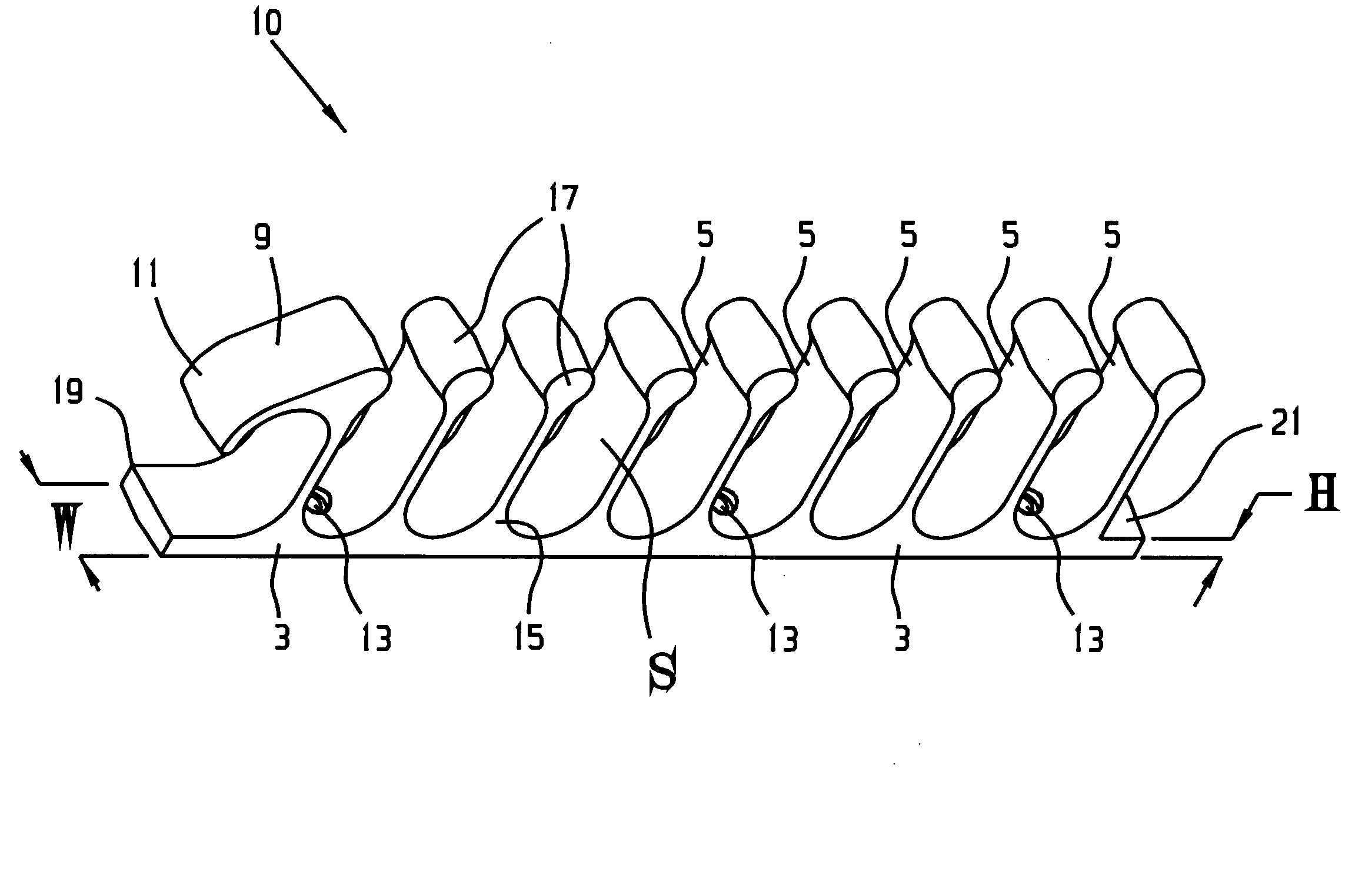
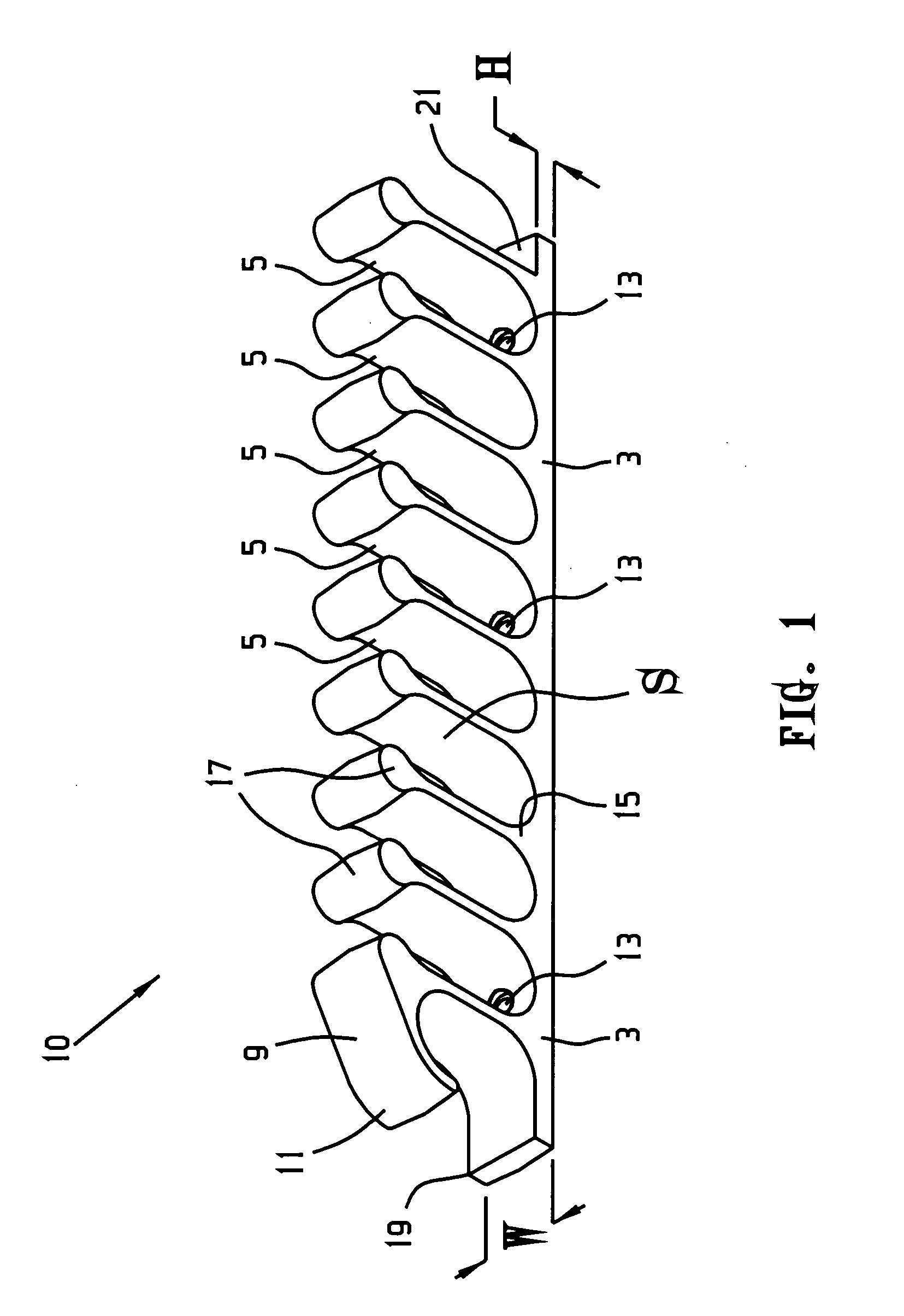
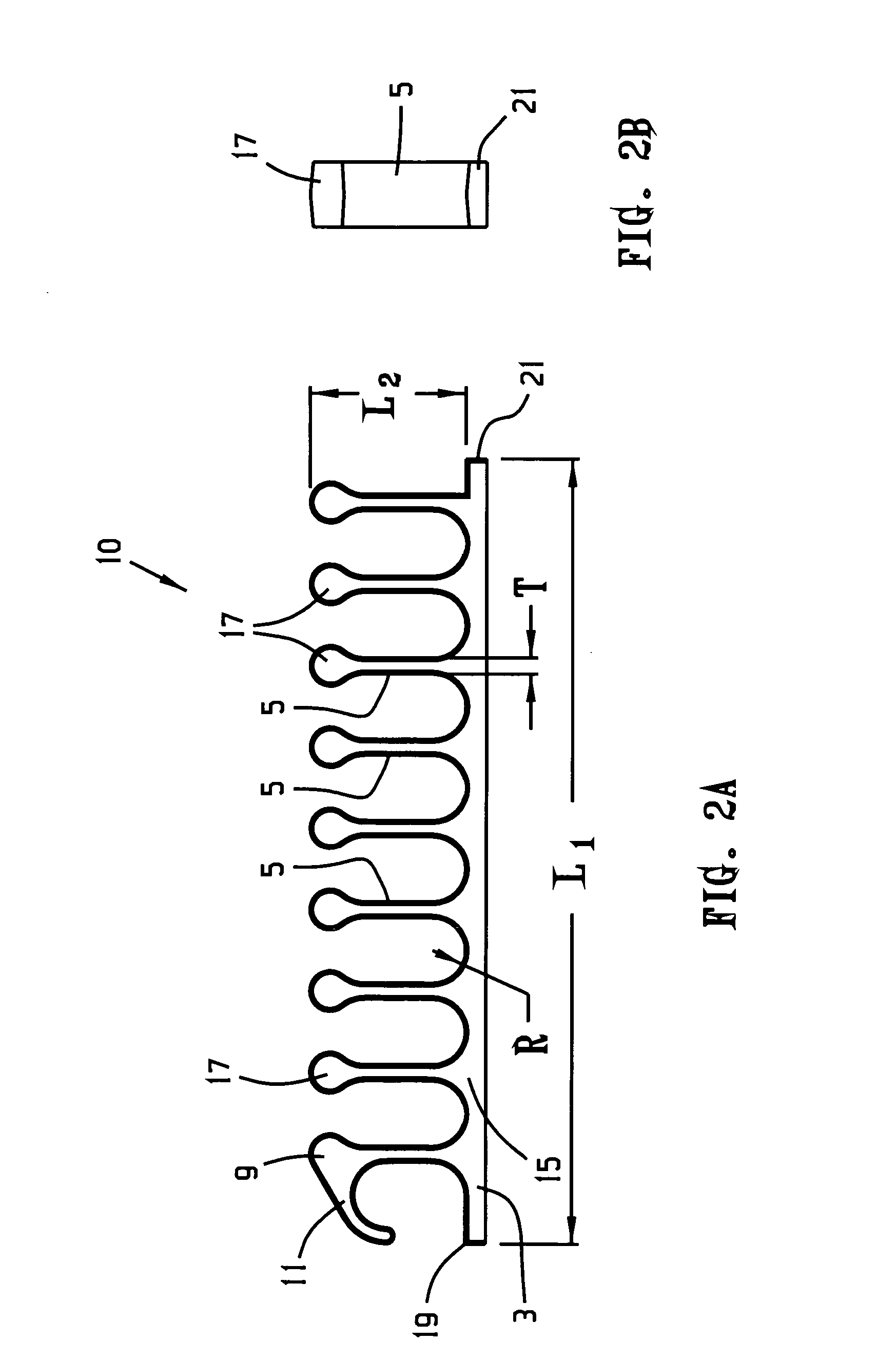
[0010] Referring to the drawings and initially to FIG. 1 there is shown a perspective view of a device according to a preferred form of the invention. In this FIG. 1 there is shown backbone portion 3, which is substantially linear and has an overall longest length dimension L1 (FIG. 2), a width dimension w, a height dimension h, a first end portion 19, and a second end portion 21. There are a plurality of finger portions 5, each having a length dimension L2 (FIG. 2), a width dimension w, a thickness dimension T (FIG. 2), a first end portion 15 and a second end portion 17. The finger portions 5 are disposed along the length dimension L1 of the backbone portion, such that each of the finger portions 5 are attached at their first end portion 15 to the backbone portion 3. The finger portions 5 are preferably oriented such that their length dimensions L2 extend substantially perpendicularly from the backbone portion 3 with respect to the longest length dimension L1 of the backbone portio...
PUM
 Login to View More
 Abstract
Description
Claims
Application Information
 Login to View More