
Method for visual manipulations of all kinds of programming objects
a programming object and object technology, applied in the direction of program control, source code creation/generation, etc., can solve the problems of limited percentage of existing software classes that cannot be visually manipulated the inability to take advantage of visual object manipulation by a state-of-art ide, so as to extend the ability of rapid and visual programming
Patent Information
- Authority / Receiving Office
- US · United States
- Patent Type
- Patents(United States)
- Current Assignee / Owner
- Publication Date
- 2015-01-06
- Estimated Expiration
- Not applicable · inactive patent
Smart Images
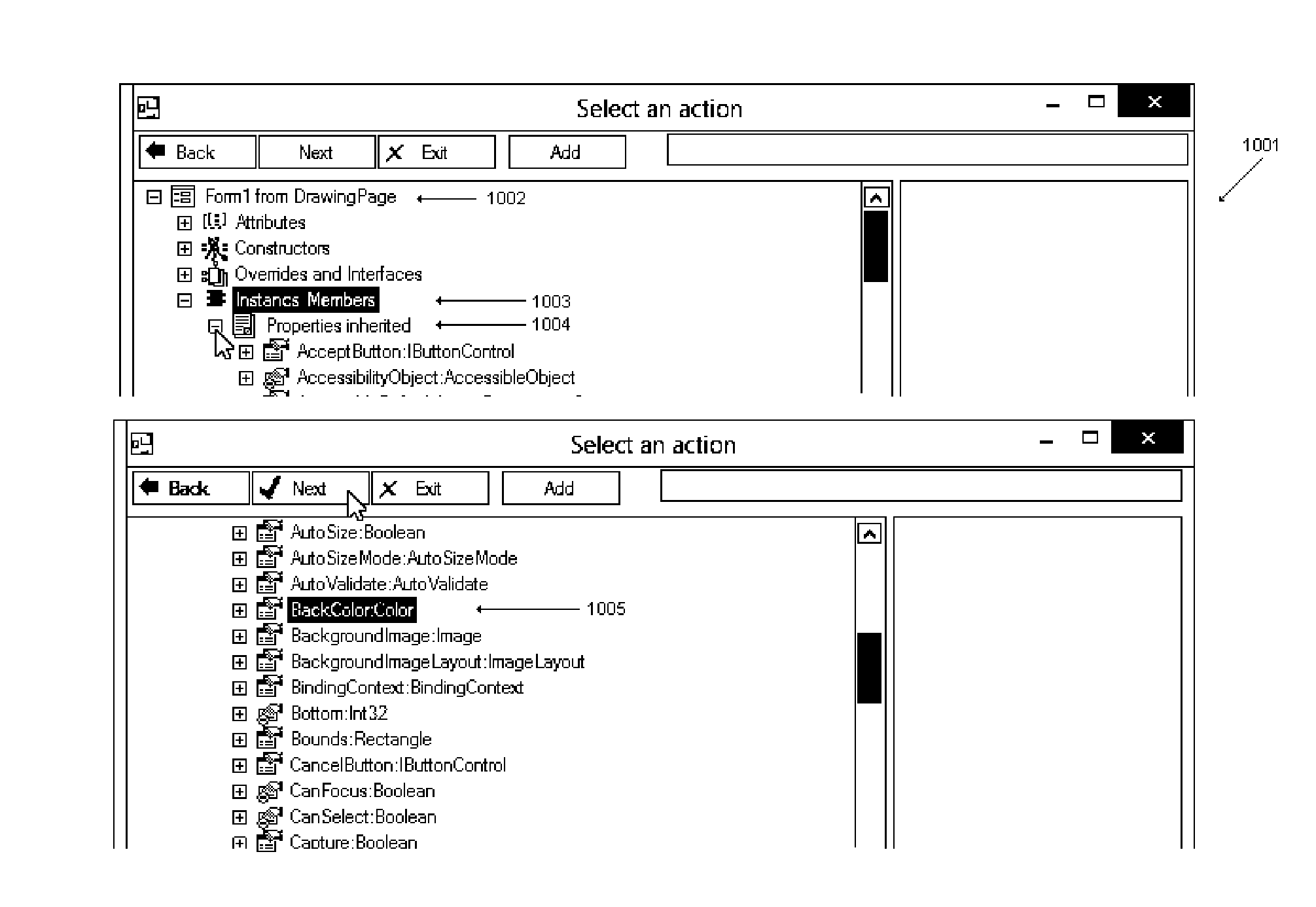
Figure 1 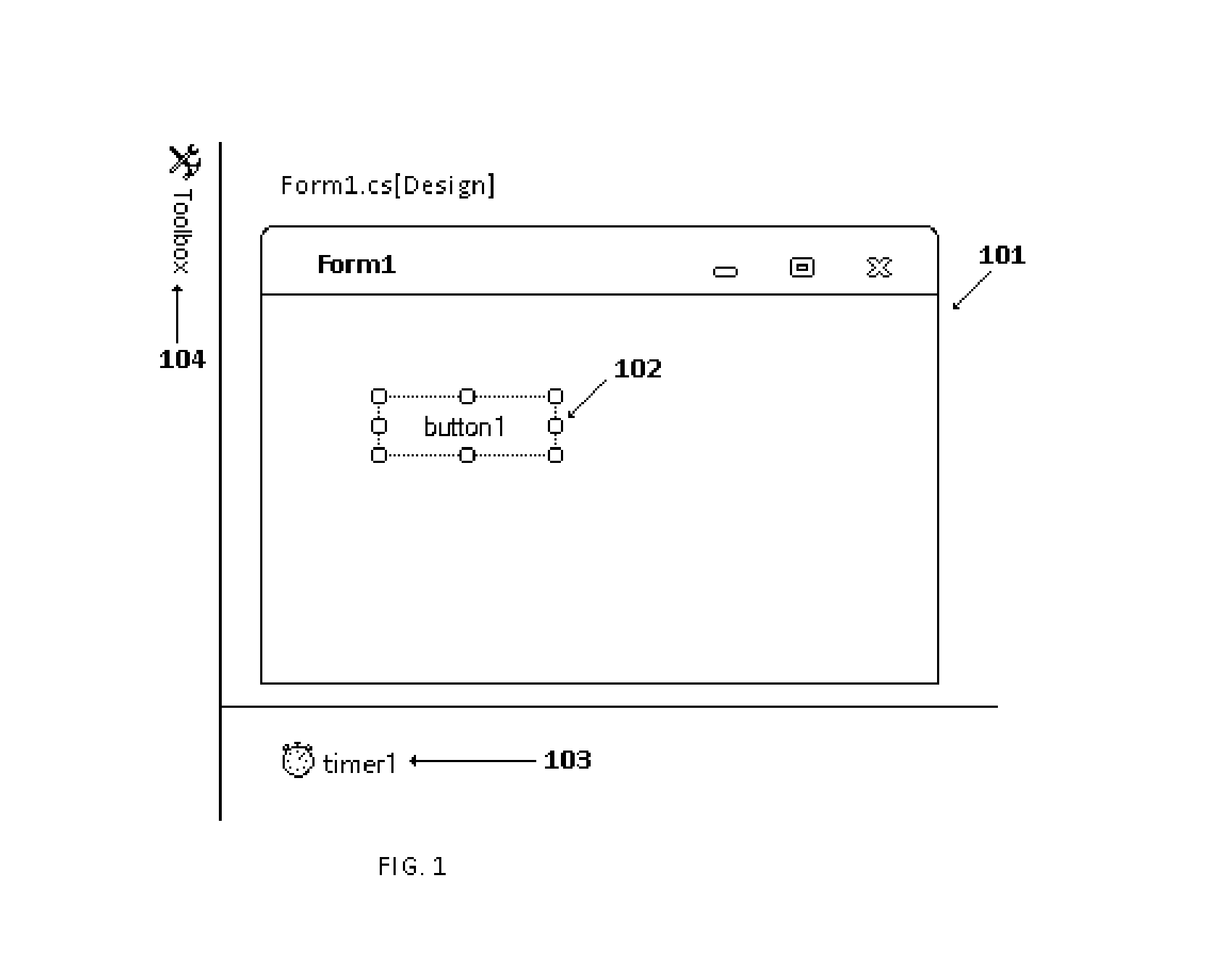
Figure 2 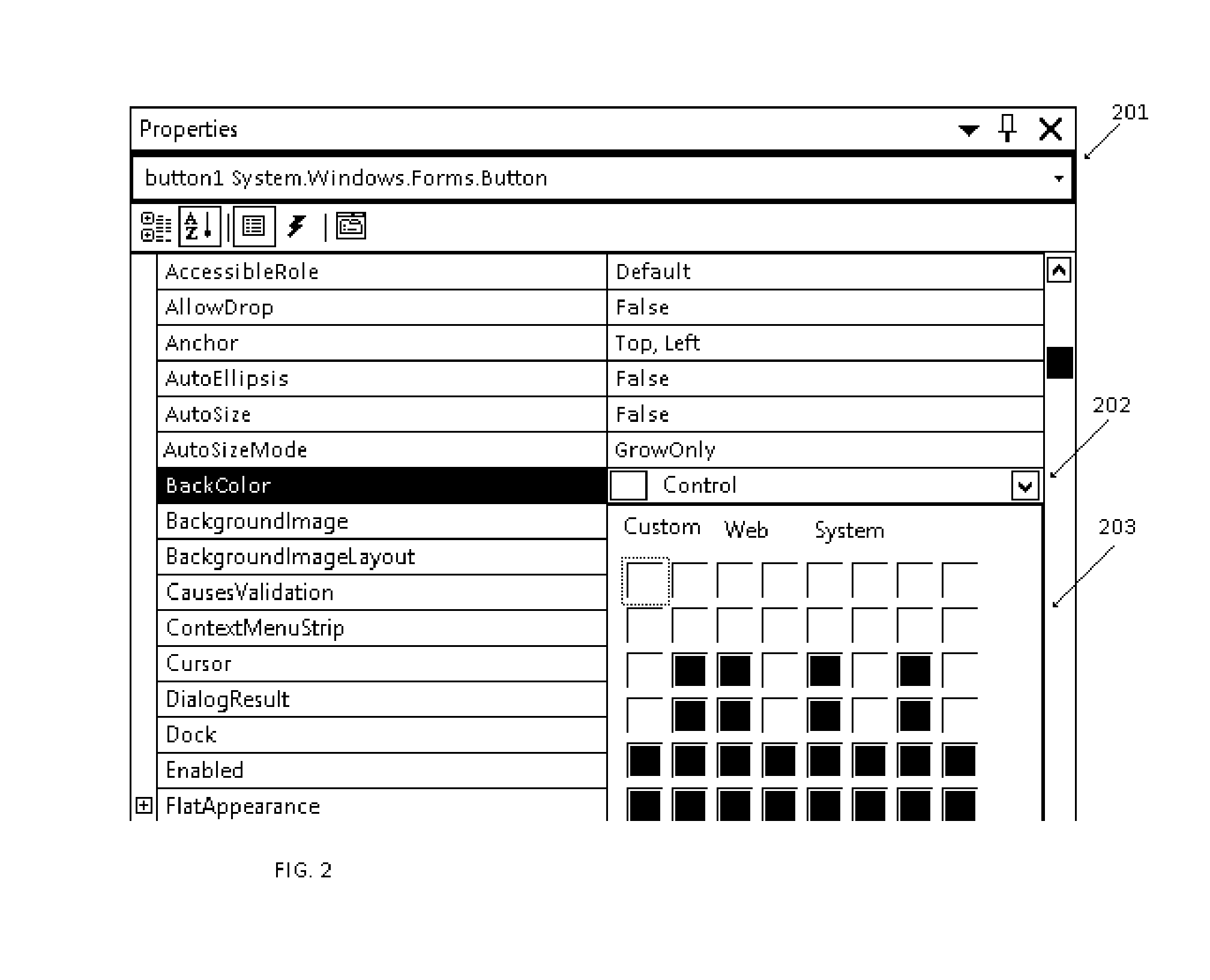
Figure 3
Abstract
Description
TECHNICAL FIELD
[0001] Embodiments of the present invention relate to the field of rapid software development via visual object manipulation. In particular, embodiments of this invention relate to an approach of enabling an Integrated Development Environment (IDE) to be able to visually manipulate any software classes, not just specifically designed classes, as state-of-art IDE's require. Thus it is possible to create a codeless visual programming system which uses existing software libraries as its programming entities.BACKGROUND ART
[0002] State-of-art IDE systems allow developers visually manipulate programming entities, by setting properties visually and by building GUI visually, thus providing rapid software development. FIG. 1 shows a typical MICROSOFT® VISUAL STUDIO® user interface showing a form designer 101, a button 102 on the form, and a timer component 103. The form, the button and the timer are all programming entities. Since the timer component 103 does not have a visual U...
Examples
example 1
Source Code—Public Class TypeMap: Dictionary
[0023]The process in Claim 3 involves a dictionary of types. An embodiment of such a dictionary can be implemented in C# as shown by class TypeMap. The AddType method of TypeMap is supposed to be used by an IDE when adding a “not-visually-manipulate-able” type to a toolbox. The AddType method generates a unique string as the key to the type. The IDE does not add the type to the toolbox because each IDE might have its own restrictions on which types can be added to its toolbox. For example, Visual Studio may only add those types to its toolbox, which implement IComponent interface and have parameter-less constructors. The embodiments of this invention use a special object, XClass, for an IDE to add it to its toolbox, representing any types. The IDE adds XClass to the toolbox and uses the AddType method to get a unique string and display the string for the new toolbox item to uniquely identify each type in the toolbox. The user of the IDE al...
example 2
Source Code—Public Class XClass: IComponent, ICustomTypeDescriptor
[0024]The process in Claim 2 involves a special object, XClass. An embodiment of XClass is implemented in C# to satisfy requirements from Visual Studio to make it visually manipulate-able by Visual Studio: implementing IComponent interface and implementing a parameter-less constructor. The developer visually manipulates “not-visually-manipulate-able” objects through visually manipulating XClass objects. The ObjectType property of the embodiment is the “object-type” referred to in Claim 2. The Constructor property of the embodiment is the constructor referred to in Claim 2. The ConstructorParameterValues property of the embodiment is the values for the constructor parameters referred to in Claim 2. The PropertyValues property of the embodiment is the property values referred to in Claim 2. The TypeParameters property of the embodiment is the type parameters for the ObjectType if the ObjectType is a generic type definit...
example 3
Source Code—Class PropertyDescriptorInfo: PropertyDescriptor
[0029]The process of Claim 6 saves and loads “object-property-values” as a programming process. Parts of “object-property-values” are values for properties of “object type”. The embodiment of XClass uses property PropertyValues, which is a dictionary, to hold values for properties of “object type”; XClass uses class PropertyDescriptorInfo to turn properties of ObjectType into properties of XClass; through PropertyDescriptorInfo the IDE may let developers visually edit the values of properties of “object type”; through PropertyDescriptorInfo the values of properties of “object type” are saved to PropertyValues of XClass.