
A kind of ni-fe-al alloy with linear superelasticity and preparation method thereof
A ni-fe-al, superelastic technology, applied in the field of alloy materials, can solve the problems of difficult precise control of composition, limited alloy research and development, limited cold deformation ability, etc., to achieve easy raw materials, expanded application temperature range, excellent superelasticity Effect
Patent Information
- Authority / Receiving Office
- CN · China
- Patent Type
- Patents(China)
- Current Assignee / Owner
- Publication Date
- 2012-02-08
- Estimated Expiration
- Not applicable · inactive patent
Smart Images
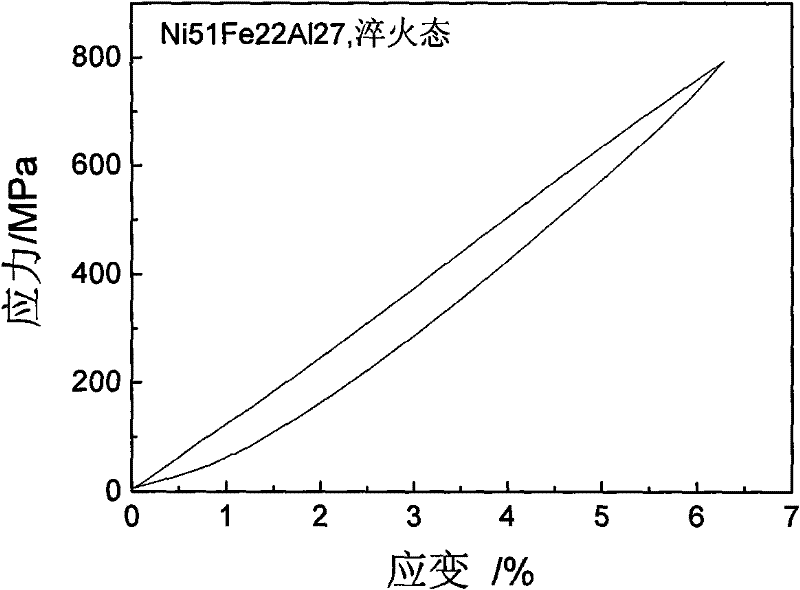
Figure 1 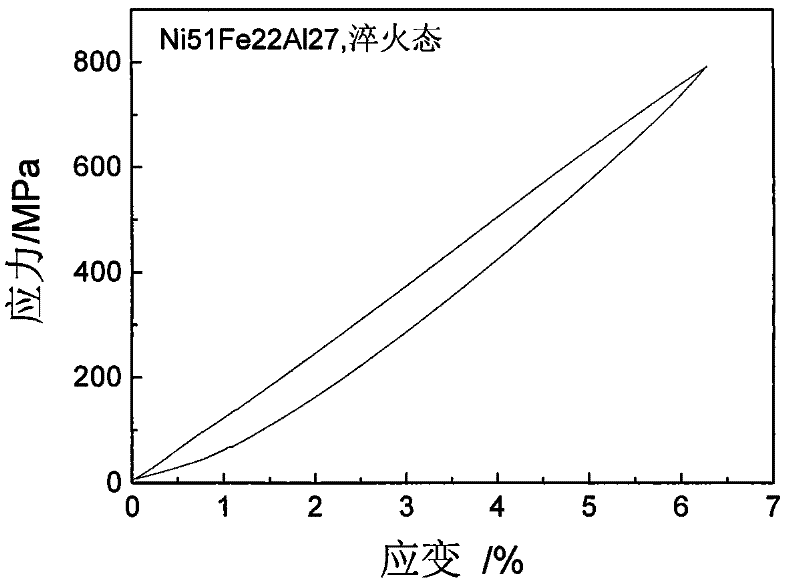
Figure 2
Abstract
Description
technical field
[0001] The invention belongs to the technical field of alloy materials, and relates to an alloy with linear superelasticity and a preparation method thereof, more specifically, to a Ni-Fe-Al alloy with linear superelasticity and a powder metallurgy preparation method thereof. Background technique
[0002] At present, there are many reports on Ti-Ni series, Cu-based, Fe-based and magnetic superelastic alloy systems at home and abroad.
[0003] Ni-Ti alloy has the characteristics of high specific strength, good biocompatibility, excellent damping, non-magnetic, corrosion resistance, wear resistance, etc., and has good superelasticity in the phase transition region. After a certain process, the linear The hyperelastic strain can reach 4%, and the non-linear hyperelastic strain can reach about 8%. But the phase transition temperature of Ti-Ni alloy is low, and the price is expensive, and it is difficult to process and form.
[0004] Cu-based alloys are thermoel...
Examples
Embodiment 1
[0020] Step 1) Weigh the components according to atomic percentage: nickel (Ni) is 56.5%, iron (Fe) is 18.5%, aluminum (Al) is 25%, and these three powders are placed in a mixing tank and mixed evenly.
[0021] Step 2) Pressing the powder into shape with a pressing pressure of 500 MPa.
[0022] Step 3) Vacuum sintering at a sintering temperature of 1280° C., holding time for 2 hours, and cooling with the furnace.
[0023] Step 4) Heating the alloy sintered billet to 1280° C. and keeping it warm for 2 hours, taking it out and immediately performing quenching treatment.
[0024] For the Ni prepared above 56.5 Fe 18.5 al 25 The mechanical properties of the alloy were tested, and it was found that the quenched state of the alloy showed complete linear superelasticity, and the elastic recovery was 4.3%.
Embodiment 2
[0026] Step 1) Weigh the components according to atomic percentage: nickel (Ni) is 56.5%, iron (Fe) is 18.5%, aluminum (Al) is 25%, and these three powders are placed in a mixing tank and mixed evenly.
[0027] Step 2) Pressing the powder into shape with a pressing pressure of 500 MPa.
[0028] Step 3) Vacuum sintering at a sintering temperature of 1280° C., holding time for 2 hours, and cooling with the furnace.
[0029] Step 4) Heating the alloy sintered billet to 1200° C. and keeping it warm for 16 hours, taking it out and immediately performing quenching treatment.
[0030] For the Ni prepared above 56.5 Fe 18.5 al 25 The mechanical properties of the alloy were tested, and it was found that the quenched state of the alloy showed complete linear superelasticity, and the elastic recovery was 4.2%.
Embodiment 3
[0032] Step 1) Weigh the components according to atomic percentage: nickel (Ni) is 56%, iron (Fe) is 19%, aluminum (Al) is 25%, and these three powders are placed in a mixing tank and mixed evenly.
[0033] Step 2) Pressing the powder into shape with a pressing pressure of 500 MPa.
[0034] Step 3) Vacuum sintering at a sintering temperature of 1280° C., holding time for 2 hours, and cooling with the furnace.
[0035] Step 4) Heating the alloy sintered billet to 1280° C. and keeping it warm for 2 hours, taking it out and immediately performing quenching treatment.
[0036] For the Ni prepared above 56 Fe 19 al 25 The mechanical properties of the alloy were tested, and it was found that the quenched state of the alloy showed complete linear superelasticity, and the elastic recovery was 4.2%.