
A method for preparing corrosion-resistant NdFeB permanent magnets
A NdFeB, corrosion-resistant technology, applied in the direction of magnetic objects, magnetic materials, inductors/transformers/magnets, etc., can solve the problems of corrosion resistance decline, loose combination, etc., and achieve the effect of strong corrosion resistance
Patent Information
- Authority / Receiving Office
- CN · China
- Patent Type
- Patents(China)
- Current Assignee / Owner
- Publication Date
- 2016-10-26
- Estimated Expiration
- Not applicable · inactive patent
Smart Images
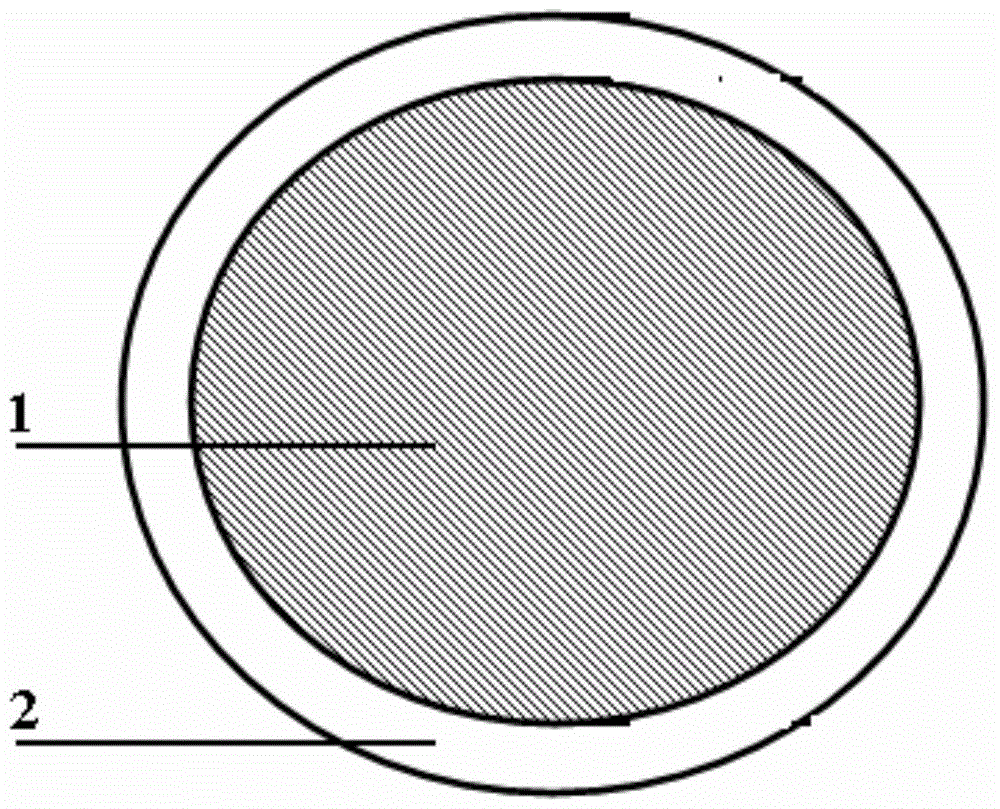
Figure 1
Abstract
Description
technical field
[0001] The invention belongs to the field of rare earth magnetic materials, and specifically relates to a method for preparing a corrosion-resistant NdFeB permanent magnet. Background technique
[0002] NdFeB NdFeB permanent magnets, as the third generation of permanent magnet materials, are currently the best permanent magnet materials due to their high remanence, high coercive force and high energy product. It is widely used in many fields such as aviation, aerospace, microwave communication technology, motors, automobiles, and wind power generation. However, this type of magnet has an obvious defect, that is, poor corrosion resistance (large weight loss of the magnet), which limits the further expansion of the application range of the magnet.
[0003] The main reason for the corrosion of NdFeB permanent magnets is oxidation, that is, chemical corrosion. NdFeB material mainly consists of three phases, the main phase matrix Nd 2 Fe 14 B. B-rich phase and...
Examples
Embodiment 1
[0024] (1) Take 10g of NdFeB powder with a particle size of 50μm, wash it with distilled water, and put it into the mixture with a component concentration of 9g L -1 NaOH, 45g·L -1 Na 2 CO 3 , 65g·L -1 Na 3 PO 4 and 1.5g·L -1 In the degreasing liquid composed of OP-10, degreasing under the action of 40kHZ, 100W ultrasonic. Ensure that the temperature during degreasing is 65°C, the degreasing time is 4min, and the pH value of the solution is 9.
[0025] (2) Filter the degreased powder, wash it with distilled water and place it in 3% HCl and 1g L -1 Pickling in the pickling solution composed of thiourea. Control pickling temperature is 20 ℃. Pickling time is 20s.
[0026] (3) Filter the powder after pickling, wash it with distilled water, and place the concentration of each component at 10g·L -1 of citric acid and 12g·L -1 Activated in the activation solution of ammonium bifluoride. The activation temperature is 20°C. The activation time is 20s.
[0027] (4) After...
Embodiment 2
[0035] (1) Take 10g of NdFeB powder with a particle size of 10μm, wash it with distilled water, and put it into the mixture with a component concentration of 8g L -1 NaOH, 40g·L -1 Na 2 CO 3 , 62g·L -1 Na 3 PO 4 and 1g·L -1 In the degreasing liquid composed of OP-10, degreasing under the action of 40kHZ, 100W ultrasonic. Ensure that the temperature during degreasing is 80°C, the degreasing time is 1min, and the pH value of the solution is 11.
[0036] (2) Filter the degreased powder, wash it with distilled water and place it in 1% HCl and 1g L -1 Pickling in the pickling solution composed of thiourea. Control the pickling temperature to 10°C. Pickling time is 60s.
[0037] (3) Filter the powder after pickling, wash it with distilled water, and place the concentration of each component at 5g·L -1 of citric acid and 10g·L -1 Activated in the activation solution of ammonium bifluoride. The activation temperature is 15°C. The activation time is 60s.
[0038] (4) After...
Embodiment 3
[0046] (1) Take 10g of NdFeB powder with a particle size of 120 μm, wash it with distilled water and put it into NaOH with a component concentration of 10g L-1, Na2CO3 with 60g L-1, Na3PO4 with 80g L-1 and In the degreasing liquid composed of 2g·L-1 OP-10, degreasing under the action of 40kHZ, 100W ultrasonic. Ensure that the temperature during degreasing is 40°C, the degreasing time is 5min, and the pH value of the solution is 8.
[0047] (2) Filter the degreased powder, wash it with distilled water, and pickle it in a pickling solution composed of 5% HCl and 1g·L-1 thiourea. Control pickling temperature is 40 ℃. Pickling time is 10s.
[0048] (3) Filter the pickled powder, wash it with distilled water, and activate it in an activation solution of citric acid with a concentration of 30 g·L-1 and ammonium bifluoride with a concentration of 14 g·L-1. The activation temperature is 40°C. The activation time is 10s.
[0049] (4) After cleaning the activated powder, add a comp...