
Method for Purifying and Rejuvenating Wheat Varieties and Screening Variations
A technology for purifying and rejuvenating varieties, applied in the field of crop breeding, can solve the problems of inter-plant mixing, large field workload, unsatisfactory effect, etc., and achieve the effect of simple operation and easy selection of the best among the best.
Patent Information
- Authority / Receiving Office
- CN · China
- Patent Type
- Patents(China)
- Current Assignee / Owner
- Publication Date
- 2019-02-22
Smart Images
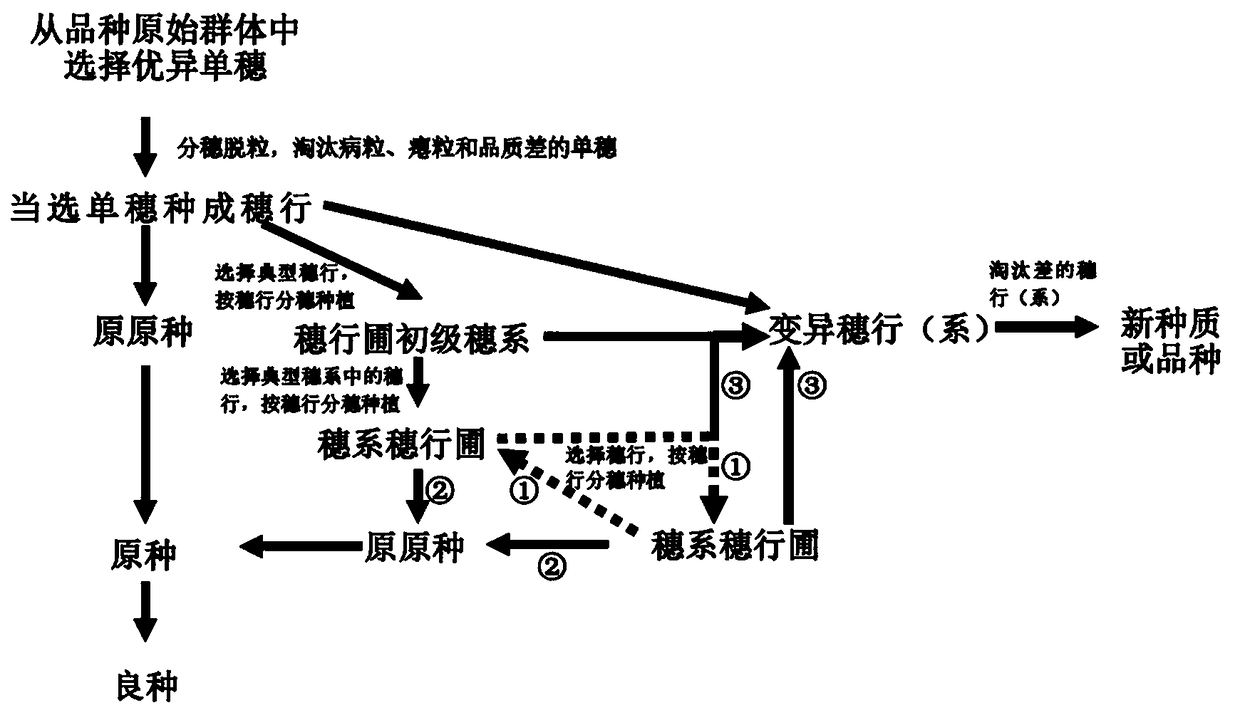
Figure 1
Abstract
Description
technical field
[0001] The invention relates to a method for purifying and rejuvenating wheat and screening beneficial variations, belonging to the field of crop breeding. Background technique
[0002] Wheat is the second largest food crop in the world. my country is the largest producer and consumer of wheat in the world. As a ration consumption, it ranks second among the three major staple foods (rice, wheat, and corn). It is my country's main commodity grain and strategic reserve grain. In the past five years, the sown area of wheat in China has been basically stable at 360-370 million mu, the total output has remained at about 120 million tons, and the yield per mu has reached more than 300 kg. In the past 50 years, the total wheat yield and yield per unit area have both increased by more than 5 times, and the improvement of wheat varieties has played a significant role in increasing the yield per unit area of wheat.
[0003] Wheat is a self-pollinating crop. There ...
Examples
Embodiment 1
[0022] The original seed production of embodiment 1 Ningmai No. 13
[0023] Ningmai 13 is a wheat variety bred by Jiangsu Academy of Agricultural Sciences (Qian Cunming et al., Breeding and Application of New High-quality and High-yield Wheat Variety Ningmai 13, Jiangsu Agricultural Science, 2006, 5: 36-37), and it is currently the most important wheat variety in Huainan, Jiangsu Province. It is one of the main varieties popularized in the wheat area and the middle and lower reaches of the Yangtze River.
[0024] the first year:
[0025] 18,000 typical single ears were selected from the original population of Ningmai 13, the single ears with more than 2 degenerated spikelets were removed, and the single ears with unfulfilled grains and diseased grains were eliminated after threshing, and 12,800 single-eared species were selected as ear nurseries . The ear row nursery is planted in each test field that is 75 meters long and 50 meters wide. The ear row is 1.6 meters long and t...