
A cold isostatic pressing cylinder material forming die
A technology of forming molds and cold isostatic pressing, which is applied in the production of static-pressed graphite products, can solve the problems of waste of core materials, and achieve the effects of reducing waste, moderate wall thickness, and high demoulding efficiency
Patent Information
- Authority / Receiving Office
- CN · China
- Patent Type
- Patents(China)
- Current Assignee / Owner
- Publication Date
- 2022-06-21
Smart Images
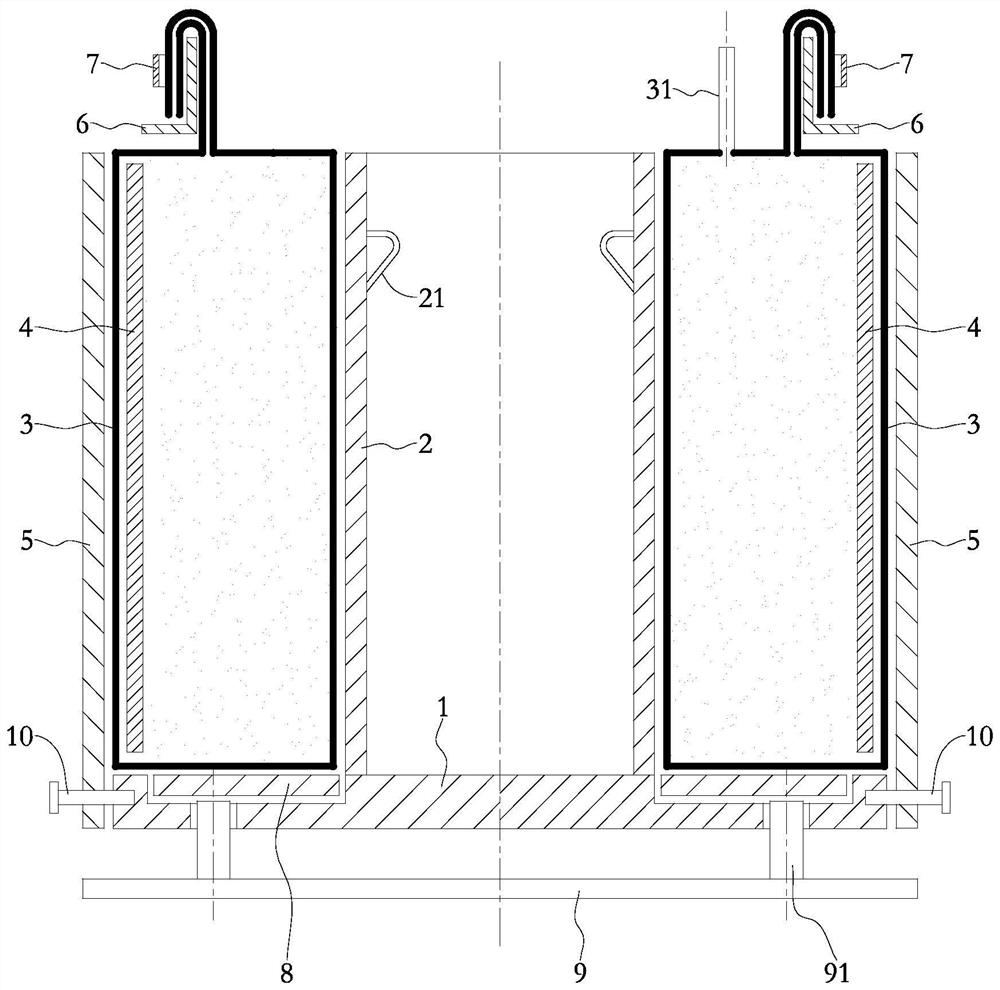
Figure 1
Abstract
Description
technical field
[0001] The invention relates to the technical field of isostatic pressing graphite product production, in particular to a cold isostatic pressing cylinder material forming die. Background technique
[0002] The heaters and thermal insulation cylinders used in the photovoltaic industry are made of solid isostatic graphite round products. Since the heater and thermal insulation cylinder only need the outer ring material, the core material is wasted. Therefore, the photovoltaic heater, The demand for isostatic graphite in the insulation cylinder has changed from solid round material to hollow cylinder material.
[0003] At present, the barrel forming dies are divided into two types: with pressure core and without pressure core. The mold with pressure core can only produce cylindrical products with a smaller inner diameter, which has no great advantage compared with solid products; the mold without pressure core, due to the large shrinkage of the powder during t...
Examples
Embodiment Construction
[0027] In the following, only certain exemplary embodiments are briefly described. As those skilled in the art would realize, the described embodiments may be modified in various different ways, all without departing from the spirit or scope of the present invention. Accordingly, the drawings and description are to be regarded as illustrative in nature and not restrictive.
[0028] In the description of the present invention, it should be understood that the terms "center", "upper", "lower", "front", "rear", "left", "right", "vertical", "horizontal", The orientation or positional relationship indicated by "top", "bottom", "inner", "outer", etc. is based on the orientation or positional relationship shown in the drawings, and is only for the convenience of describing the present invention and simplifying the description, rather than indicating or implying The device or element referred to must have a particular orientation, be constructed and operate in a particular orientatio...